
From legal requirements to maintenance advice, our blog helps you know in depth about bike fitness certificates, cost, renewal and download to keep your rides legal and safe.
To keep your motorcycle legal and safe, you need more than just insurance and registration. You also have to keep your bike’s fitness certificate up to date. This guide explains what a bike fitness certificate is, why it matters, how to get or renew one, and the latest on automated testing in India. Whether you ride every day or just on weekends, knowing these details will help you stay safe and follow the law.
Key Takeaways
- A valid bike fitness certificate is mandatory in India for motorcycles older than 15 years. It must be renewed periodically to ensure legal compliance and roadworthiness.
- Fitness certificates are issued after thorough inspections at RTOs or Automated Testing Stations, covering brakes, lights, emissions, and other safety checks.
- Both petrol and high-speed electric two-wheelers require fitness certificates; low-speed e-bikes may be exempt, but it’s important to check your state regulations.
- Not having a valid fitness certificate can lead to substantial fines, penalties, or even the impounding of your motorcycle.
- Staying organised with documentation, timely renewals, and regular bike maintenance helps ensure a smooth certification process and safer rides.
What Is A Motorcycle Fitness Certificate?
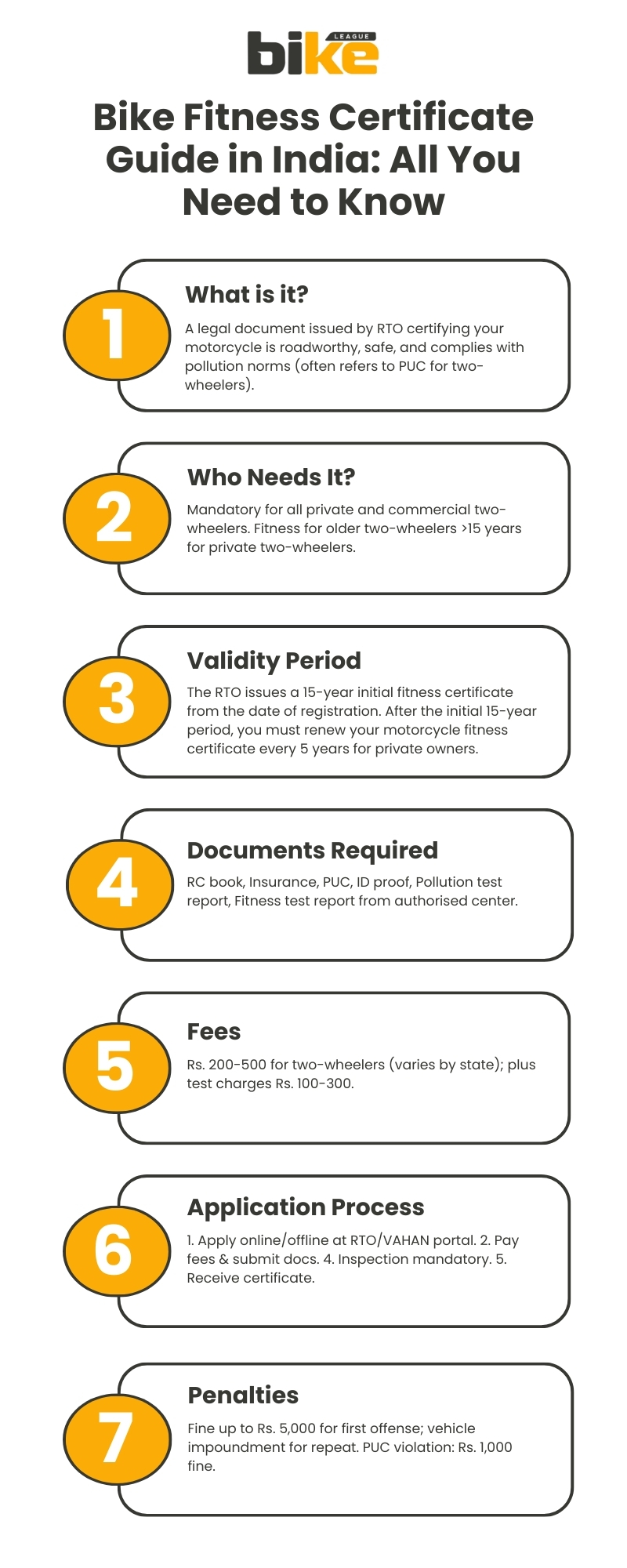
The Regional Transport Office (RTO) or its equivalent authority in a specific region issues a Vehicle Fitness Certificate. This vital document certifies that your vehicle complies with the RTO-mandated safety and emission standards. The certificate confirms that essential components, such as brakes, lights, and steering, are in proper condition and that your vehicle meets roadworthiness and compliance requirements.
Importance Of A Bike Fitness Certificate In India
1. Ensures Safety And Reduces Emissions
A valid FC ensures the motorcycle is safe to operate, reducing the risk of accidents caused by mechanical failures. Regular inspections help identify and address emission issues, contributing to cleaner air.
2. Legal Compliance
Driving a motorcycle without a valid FC is a punishable offence in India, with fines varying by state. Ensuring your vehicle has a valid FC helps you comply with traffic laws and avoid penalties.
3. Cost Savings
Regular FC checks can save money on repairs by detecting potential problems early and preventing expensive repairs later.
4. Environmental Benefits
Maintaining optimal emission levels through regular bike fitness certificate renewals helps reduce vehicular pollution and creates a healthier environment.
Issuance Authority For Bike Fitness Certificates In India
1. Role Of The Regional Transport Office (rto)
The Regional Transport Office (RTO) serves as the primary authority that issues motorcycle fitness certificates in India. The RTO, or its equivalent authority in a specific region, inspects your motorcycle and issues the fitness certificate. Through this process, the RTO ensures that your vehicle meets the required safety and emission standards.
2. Central Government Regulations
The Ministry of Road Transport and Highways (MoRTH) sets the overarching regulations and guidelines for vehicle fitness certification. These regulations form part of the Central Motor Vehicle Rules, 1989, which the government has amended over time to incorporate new standards and procedures. The central government now requires that all vehicle owners, including motorcycle owners, obtain fitness certificates from registered Automated Testing Stations (ATS) from specific dates onward.
3. State Government Involvement
While the central government provides the regulatory framework, state-level RTOs actually issue fitness certificates and conduct inspections. When you apply for a fitness certificate online through the Parivahan Sewa website operated by the Ministry of Road Transport and Highways, you must select your state and the relevant RTO. This collaborative approach allows the central government to set the rules while state governments implement them through their respective RTOs.
4. Automated Testing Stations (ats)
In 2024, all motorcycle and vehicle owners must obtain fitness certificates from Automated Testing Stations (ATS). These stations use mechanical equipment to automate the tests that assess your vehicle’s fitness. The central government has allowed state governments, companies, and associations to open ATS to test the fitness of both personal and transport vehicles.
What’s It Really Like At An Ats Bike Inspection? (and How Is It Different From The Old Rto Checks?)
If you’re going for your bike’s fitness check at an Automated Testing Station (ATS), here’s what you can expect, explained simply.
Unlike the old RTO inspections, where someone would look over your bike and maybe take it for a short ride, ATS uses machines and sensors. Your bike will go through computerised roller benches and automated equipment that test your brakes, speedometer, and emissions in just a few minutes.
The whole process usually takes just 10 to 20 minutes. The main advantage is that it relies on clear measurements instead of personal judgment. This means the standards are stricter, but the results are fairer. ATS has been required for commercial vehicles since October 2024 and is now being introduced for older private bikes in many states.
1. What To Expect During Ats Inspection
- Book your slot online on the Parivahan or AFMS portal.
- Show up with your bike, registration certificate (RC), insurance, PUC, and make sure it’s empty—no luggage or extra load.
2. The Main Automated Tests
- Roller brake test: Your front and rear wheels go on rollers, you apply the brakes, and the machine checks how well they work. The numbers have to meet official AIS-128 standards (front brake >40%, both together >60%).
- Speedometer check: The rollers simulate speed to see if your speedo is accurate (so, no tampering!).
- Emissions: An analyser checks your exhaust gases to make sure you meet the current BS4/BS6 norms.
- Visual and function check: They’ll check your lights, indicators, horn, steering play, tyre tread (over 1mm, no visible damage), reflectors, high-security number plate (HSRP), and that your chain is tight.
The station gives you a digital report right away. If you pass, the system updates your fitness certificate in Vahan. If you do not pass, the station gives you a list of what you need to fix before a retest.
There are a few things to note for two-wheelers. The ATS lanes are narrower than car lanes, you don’t need heavy under-run bars, and if you have an electric bike, they will check your state-of-charge (SOC) indicator.
3. Ats Vs Rto Inspection
| Aspect | ATS (Automated) | RTO (Manual) |
|---|---|---|
| Method | Sensors/rollers/computer—no subjectivity | Inspector’s visual + basic tools + test drive |
| Time | 10–20 mins | 20–40 mins |
| Cost (2W) | ₹200–400 (vehicles | ₹100–500, varies by state |
| Reliability | Encrypted data to MoRTH; tamper-proof | Prone to negotiation/delays |
| Availability | Private centres (growing network) | Local RTO only |
4. Tips To Make Sure The Ats Inspection Is A Success
- One week before: Service your brakes (make sure pads or shoes have at least 50% life), clean the carburettor/fuel system/exhaust, put in a fresh spark plug and air filter, and get your PUC sorted.
- 1–2 days before: Check tyre tread (over 1.6mm at the rear, over 1mm at the front), set tyre pressure right, make sure all lights and horn work, aim your headlamp straight, and check your steering for play (more than 30° will fail you).
- On the day: Arrive with a clean, leak-free bike, lube and tighten your chain (20–40mm slack is ideal), make sure mirrors and reflectors are intact, HSRP is fitted. There are no loose wires or illegal mods. Take a quick test ride to listen for any odd noises or vibrations.
Pro tip: If possible, practice braking on rollers for a smooth, full-force stop. Just avoid over-inflating your tyres, as this can affect the brake readings.
What Is The Validity Of A Bike Fitness Certificate?
1. Initial Validity
The RTO issues a 15-year initial fitness certificate from the date of registration for new motorcycles. This period ensures your vehicle stays in good condition and meets safety and emission standards.
2. Renewal After 15 Years
After the initial 15-year period, you must renew your motorcycle fitness certificate every 5 years. During renewal, the Regional Transport Office (RTO) thoroughly inspects your bike to ensure it continues to comply with safety and emission standards. Renewing the certificate is necessary because older vehicles are more likely to experience mechanical failures and increased emissions.
What About The Fitness Certificate For Electric Two-wheelers In India?
If you own an electric scooter or bike in India, you might wonder whether the rules are any different from those for petrol motorcycles. The short answer: most of the rules are the same, but there are a few unique points for electric vehicles (EVs) to keep in mind.
For high-speed electric two-wheelers (anything that goes over 25 km/h or has more than 250W power), you’ll need a Fitness Certificate (FC) after 15 years from the date of registration—just like with regular bikes. You’ll go through the same process at an Automated Testing Station (ATS). Low-speed e-bikes (the ones that max out at 25 km/h and 250W) are usually treated like bicycles and may not need an FC or even registration, but always check your state’s specific rules to be sure.
1. How The Fitness Certificate Process Works For Electric Two-wheelers
- Only registered, high-speed electric scooters and bikes (such as Ather, Ola, and Bajaj Chetak) need to have the FC renewed every 5 years after the initial 15-year period.
- Your first FC is valid for 15 years from the date of registration. After that, renew it every 5 years if it’s for personal use.
- ATS won’t check EV emissions (since there’s no exhaust). Instead, the inspection focuses on brakes, lights, tyres, steering, the battery’s safety features (like the State of Charge indicator), and electrical wiring.
- The steps are the same as for petrol bikes: apply online via Parivahan, get your inspection at ATS or RTO, and download your certificate from DigiLocker. Expect fees between ₹100 and ₹ 500, depending on your state.
2. Ats Inspection For Your Electric Two-wheeler
- The brakes are tested on rollers, including any regenerative or hydraulic systems your EV might have.
- The speedometer is checked for accuracy.
- Inspectors look at all the usual safety items: lights, horn, tyre condition, steering play, and also check the battery mounts and insulation for safety and make sure there are no leaks or exposed wires. There’s no need for an exhaust gas test.
3. Electric Vs Petrol Two-wheeler Fitness Certificate Comparison
| Aspect | Electric 2W | Petrol 2W |
|---|---|---|
| Trigger | After 15 yrs (high-speed only). | After 15 yrs. |
| ATS Tests | Brakes, speedo, lights, tyres, battery visuals—no emissions. | Brakes, emissions (CO/HC), lights, etc. |
| Validity | 5 yrs private. | 5 yrs private. |
| Exemptions | Low-speed ( | None. |
4. Tips To Make Sure Your Ev Test Is A Success
- Check your battery’s State of Charge (SOC) gauge and ensure there are no loose or exposed wires. The battery pack should be securely mounted, and the Battery Management System (BMS) must be working.
- Brakes need to work smoothly—both the regenerative and regular friction brakes will be checked.
- Tyres and lights must meet the same standards as petrol bikes, and don’t forget to make sure your High Security Registration Plate (HSRP) and reflectors are in place.
- If your EV got a FAME subsidy, make sure your documents are up to date at renewal time.
By taking care of these basics, you can glide through your FC renewal for your electric two-wheeler with minimal hassle.
Application Process For Bike Fitness Certificate
1. Offline Process
- Visit the RTO: Fill out the application form (Form 20) available at the RTO.
- Submit Documents: Provide necessary documents such as the original registration certificate, valid pollution under control certificate, vehicle insurance certificate, payment receipt for road tax, photo identity proof, address proof, and previous FC if applicable.
- Pay Fees: The FC fee varies depending on the state and vehicle engine capacity, typically ranging from ₹100 to ₹500.
- Vehicle Inspection: Get your vehicle inspected by the RTO on the allotted date.
2. Online Process
- Visit Parivahan Sewa Website: Go to the Ministry of Road Transport and Highways’ Parivahan Sewa website.
- Select Services: Click the Online Services option and navigate to the Vehicles Related Section.
- Enter Details: Select your state, enter your vehicle’s registration number, and select the RTO.
- Apply for FC: Choose the Apply for Fitness Certificate option and enter your vehicle’s chassis and registered mobile number to receive an OTP.
- Submit Details and Payment: Enter your insurance details, submit the information, and make the payment online.
- Print Application: Take a printout of the payment receipt and application form.
- Submit Documents: Submit the forms and required documents to the RTO.
- Vehicle Inspection: Get your vehicle inspected by the RTO on the allotted date.
Process For Bike Fitness Certifcate Renewal
1. Inspection
When you renew your bike fitness certificate, the RTO comprehensively inspects your vehicle. The inspection covers essential components such as brakes, lights, and steering to ensure your bike remains roadworthy.
2. Online Application
Vehicle owners can apply for their bike fitness certificate renewal online through the Parivahan Sewa website. The application process can be initiated 30 days before the current certificate expires.
3. Fees
The cost of renewing a bike fitness certificate varies by state in India and by the vehicle’s engine capacity. Typically, motorcycle prices range from ₹100 to ₹500.
How Long Does The Bike Fitness Certificate Process Really Take?
If you’re wondering how longit takes to get your bike’s fitness certificate, here’s what you need to know. In most cases, the entire process, from applying online to downloading your certificate, takes about 3 to 15 working days. The exact time depends on how busy your local RTO is, howsoon you get an inspection slot, and whether your bike passes the inspection the first time or needs repairs and another check.
The online steps, such as applying, paying, and booking a slot, are usually quick and can often be completed instantly or on the same day. The main wait is for your inspection slot, which can take 2 to 10 days, especially in busy cities.
1. Typical Timeline Breakdown
| Stage | Duration | Notes |
|---|---|---|
| Online application + payment (Parivahan) | Instant to 1 day | Enter details, OTP verification, print receipt; available 24/7. |
| Inspection slot booking | 1–7 days wait | Slots assigned by RTO/ATS availability; some states allow immediate if low load. |
| Actual inspection at RTO/ATS | 20–40 minutes | On the allotted date; covers brakes, lights, emissions, etc. |
| FC issuance (if pass) | 1–3 working days | Updated in Vahan; download from Parivahan/DigiLocker. |
| Re-inspection (if fail) | +3–10 days | Book new slot after repairs, pay extra fee (₹100–200); same process |
2. What Affects The Speed?
- RTO workload:If you live in a big city like Delhi or Mumbai, you may have to wait longer, usually 7 to 15 days. In smaller towns, it’s much faster, sometimes just 3 to 5 days.
- ATS vs manual RTO: Automated Testing Stations (ATS), now required in some states, can complete inspections more quickly, but their slots can fill up fast.
- Peak periods: Try not to apply at the end of the month or during tax season, as these are the busiest times and have the longest queues.
- Digital delivery: After your certificate is approved, you don’t have to wait for it in the mail. You can download it right away from the app or website.
How To Download Bike Fitness Certificate Via Digilocker
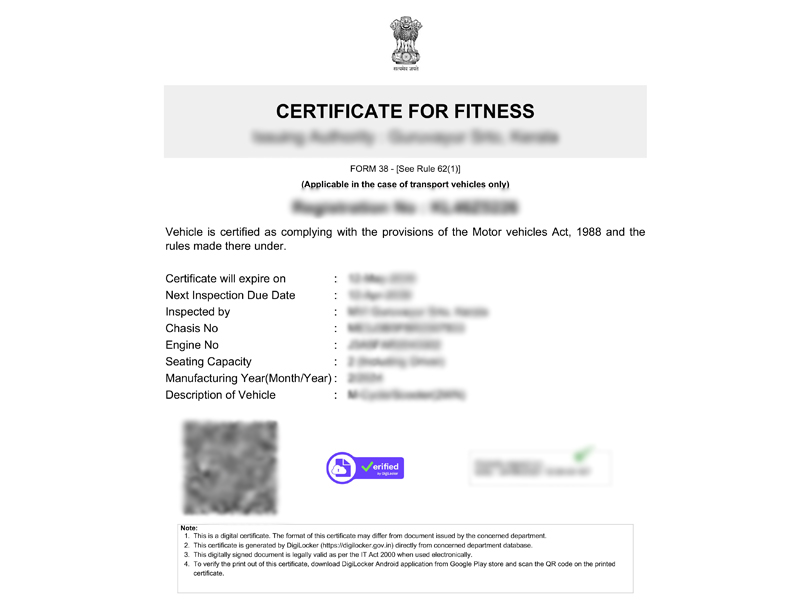
- Register on DigiLocker: Download the DigiLocker app from the Google Play Store or Apple App Store and register using your mobile number.
- Link Aadhaar: Link your Aadhaar number to your DigiLocker account for verification purposes.
- Access the Fitness Certificate:
- Navigate to the ‘Issued Documents’ section.
- Search for the Fitness Certificate using your vehicle registration number.
- Download the bike fitness certificate to your DigiLocker account.
How To Download Bike Fitness Certificate Via Mparivahan
- Download and Register: Install the mParivahan app from the Google Play Store or Apple App Store and register using your mobile number.
- Access Vehicle Details:
- Enter your vehicle registration number to fetch details from the National Register e-Services.
- Navigate to the ‘Fitness Certificate’ section.
- Download the Certificate: Follow the prompts to download the digital copy of your Fitness Certificate.
Required Documents For Bike Fitness Certificate
- Application Form (Form 20): The primary application form for FC.
- Pollution Under Control Certificate: Proof that the vehicle meets emission standards.
- Insurance Certificate: Valid insurance policy for the vehicle.
- Address Proof: Proof of the registered owner’s address.
- PAN Card or Form 60 & Form 61: For financial verification.
- Chassis & Engine Pencil Print: For vehicle identification.
- Signature Identification of Owner: This is for verification purposes.
Penalties For Not Having A Valid Bike Fitness Certificate In India
Driving a motorcycle without a valid Fitness certificate can result in fines ranging from Rs. 2,000 to Rs. 5,000 for the first offence and Rs. 5,000 to Rs. 10,000 for repeat offences. In severe cases, imprisonment may also be imposed.
Why Do Fitness Certificate Applications For Bikes In India Get Rejected, And How Can You Avoid It?
Getting your bike’s Fitness Certificate (FC) approved can be frustrating, especially if your application is initially rejected for unclear reasons. The most common reasons for rejection are mistakes in your paperwork, missing or expired documents like insurance or PUC, or your bike not passing inspection. Even small errors, such as a typo in your registration number or using the wrong mobile number for OTP, can delay your approval.
1. Most Common Frequent Rejection Reasons
- Incorrect vehicle details: Typos in your RC or chassis number, a mismatch in the owner’s name, picking the wrong RTO, or using a mobile number that isn’t linked to OTP can all trigger a rejection.
- Insurance/PUC issues: If your insurance or Pollution Under Control (PUC) certificate has expired, or the details don’t match your bike, your application won’t move forward.
- Unpaid dues or pending issues: Outstanding taxes, unpaid fees, or enforcement blocks must be cleared before your application can be processed.
- Failed vehicle inspection: Problems with brakes, lights, tyres, or visible modifications—or simply not meeting emissions standards—can all cause your bike to fail the test and need a re-inspection.
2. What Should You Do If Your Application Is Rejected?
Here’s how to fix each issue:
- Double-check your details: Carefully compare what you enter online with your RC. Make sure your registration and chassis numbers are correct and that the mobile number you use is ready to receive OTPs.
- Update your insurance and PUC: Renew your insurance policy and get a fresh PUC, making sure both documents have the right registration number.
- Clear pending payments or blocks: Take care of any unpaid road taxes, fees, or enforcement holds before you try to pay again.
- Prepare for inspection:Prepare for inspection: If your bike fails the inspection, get the needed repairs done, such as fixing brakes, lights, tyre pressure, horn, and more. It’s a good idea to get a quick checkup at a trusted workshop before you return for a retest.
3. How To Avoid Rejection When Applying Online?
Here’s a simplified version of the Parivahan process:
Enter your vehicle number → Select “Fitness Certificate” → Enter chassis number and mobile → Generate/enter OTP → Click “Show Details” → Fill out the application (including updated insurance details) → Pay the fee → Print your application letter/receipt.
A little extra care with details and prep goes a long way to ensuring your FC application gets approved without hassle.
What Should You Do If Your Bike Fails The Fitness Test?
Don’t worry if your bike doesn’t pass the fitness test the first time. This is common and doesn’t mean your application is over. The RTO or Automated Testing Station (ATS) will note what needs fixing, and you’ll have a chance to make repairs and try again. Sometimes, there is a small retest fee, depending on your state’s rules.
1. What Exactly Happens When A Bike Fails The Fitness Test?
- The inspector will mark your bike as “unfit” and clearly tell you or write down the reasons. It could be the brakes, lights, tyres, emissions, or something structural.
- Your fitness certificate application is put on hold until you fix those problems. No new certificate is issued on the Vahan or Parivahan portal until you’ve made the repairs.
- In many states, you’ll need to pay a re‑inspection fee when you bring your bike back for another check.
2. What Are The Steps For Rectification And Re‑inspection?
- Take careful note of what the inspector pointed out. Don’t hesitate to ask for a written report or check the inspection status online. This will list all the reasons for failing, such as “brake efficiency low,” “PUC not produced,” or “tyre worn out.”
- Get the repairs done at a trustworthy workshop or your usual mechanic. This could mean fixing brakes, changing bulbs, swapping out tyres, tuning emissions, fixing leaks, or tightening the steering.
- If emissions were the problem, have a basic service done (air filter, spark plug, engine oil, carburettor/fuel injection cleaning) and get a fresh PUC certificate after the repair.
3. When You’re Ready For A Retest
- Apply for a re-inspection slot either online (Vahan/Parivahan portal) or at the RTO/ATS counter. Some states have a deadline—usually within 7 to 30 days after your first failed test.
- Pay any re-inspection charges online or at the RTO. These are often listed separately from the base test fee.
- Bring your original RC, valid insurance, PUC, tax receipt, and your previous FC application/receipt to the retest.
- The inspector will mainly check the issues that were found last time, plus basic safety and emissions. If everything’s in order, your fitness certificate is approved and updated in the official records, and you can download it from Parivahan, DigiLocker, or mParivahan.
4. What If You Can’t Fix The Problems?
If your bike doesn’t pass, you won’t have a valid fitness certificate, and riding it can lead to heavy fines under Section 56/192 of the Motor Vehicles Act. In serious or repeated cases, you could even face impounding or jail. So, it’s important to get the repairs done and return prepared for your next visit.
Faq About Bike Fitness Certificate In India
1. What Is A Bike Fitness Certificate, And Why Is It Necessary?
A bike fitness certificate is an official document issued by the RTO confirming that your vehicle meets all safety and emission standards. It is legally required for bikes older than 15 years (or as per state rules) to ensure roadworthiness.
2. When Should I Renew My Bike’s Fitness Certificate?
The fitness certificate should be renewed before its expiry, typically every 5 years after the initial 15-year period from the date of registration. Check your certificate for the exact expiry date.
3. What Documents Are Required To Apply For Or Renew A Bike Fitness Certificate?
Standard documents include the Registration Certificate (RC), insurance certificate, pollution under control (PUC) certificate, road tax receipt, identity proof, and address proof.
4. What Are The Steps Involved In Getting A Bike Fitness Certificate?
The basic steps are: gather the required documents, complete the application (online or at the RTO), pay the fees, have your vehicle inspected, and collect the certificate upon approval.
5. What Happens If My Bike Fails The Fitness Inspection?
If your bike does not meet the required standards, you will be given a list of issues to fix. Once the necessary repairs are made, you can present your vehicle for a re-inspection.
6. Can I Apply For A Fitness Certificate Online?
In many states, you can initiate the application and pay fees online via the Parivahan portal. However, the physical inspection of the bike at an RTO or authorised testing station is still mandatory.
7. Are There Penalties For Riding Without A Valid Fitness Certificate?
Yes, riding without a valid fitness certificate can result in fines, penalties, and even the suspension of your registration, as per the Motor Vehicles Act.
8. What Is The Fee Structure For Renewing A Bike Fitness Certificate?
Fees vary by state and vehicle type, but generally include an application fee, inspection fee, and possible extra charges for delays or re-inspections.
9. Is The Fitness Certificate Applicable To All Two-wheelers, Including Scooters And Electric Bikes?
Fitness certificate requirements apply to all motorised two-wheelers, including scooters. Electric bikes with registration plates may also require certification, depending on local laws.
10. Can I Transfer My Bike’s Fitness Certificate If I Move To Another State?
Typically, you need to obtain a new fitness certificate from the RTO in your new state of residence and update your registration records accordingly.
Official Links For Bike Fitness Certificate In India
Other Related Articles From Bikeleague India
- Bike Documents for Travel in India: All you need to know
- Motorcycle service – All things you need to know explained
- Bike Pollution Certificate – All you need to know in India
- Medical Certificate for bike riders in India: Essential Guide
- Bike ownership transfer in India – step by step guide
Conclusion
Knowing your bike’s fitness certificate requirements is important for staying legal and safe on the road in India. If you understand the process, prepare for inspections, and keep your documents up to date, you can avoid penalties and keep your motorcycle in good shape for years. Whether you ride a petrol bike or an electric two-wheeler, regular checks on your fitness certificate will help make your rides smooth and trouble-free.
If you have any questions, email us at bikeleague2017@gmail.com or leave a comment below. We are always happy to help. You can also find us on Bikeleague India’s social media accounts.