

Long story short: Understand the differences between E10, E20 and E85, how to check your motorcycle’s approved fuel blend, and what to consider when comparing mileage and running costs. This guide also explains manufacturer guidance, warranty considerations and the distinction between E20 compatibility and flex-fuel capability.
Key Takeaways
- India’s transition to E20: The Ministry of Petroleum and Natural Gas reported 20% national ethanol blending for November–June of ethanol supply year 2025–26. Riders should not assume that E10 remains the default fuel everywhere or that every station offers separate E0, E10 and E20 options.
- Environmental and Economic Considerations: Ethanol blending can offer emissions benefits, reduce reliance on petroleum and support domestic feedstock producers. Environmental outcomes depend on how the ethanol is produced and how the fuel performs in the vehicle; not every exhaust pollutant necessarily decreases.
- Vehicle Compatibility and Maintenance: Check your motorcycle manufacturer’s guidance on permitted ethanol blends and maintenance. The government states that manufacturers continue to honour warranties for vehicles using specification-compliant E20 petrol. Do not extend this assurance to higher blends such as E85 without explicit manufacturer approval.
- Cost and Efficiency Considerations: The effect of ethanol-blended petrol on motorcycle mileage depends on the fuel blend, engine design and calibration. Do not assume a fixed percentage reduction for every motorcycle. Compare your actual mileage and the price paid per litre to assess any change in running costs.
- Materials and Engine Calibration: Ethanol compatibility involves suitable fuel-system materials and engine calibration. E20 compatibility and flex-fuel capability are different, so check the manufacturer’s approved fuel range for your exact motorcycle.
What Is Ethanol?
Ethanol is a clear, colourless alcohol with the chemical formula C2H5OH. In this article, we focus on its use as a blending component in petrol.
What Is Ethanol-blended Petrol?

Ethanol-blended petrol is petrol mixed with ethanol. Labels such as E10 and E20 identify blends containing 10% and 20% ethanol by volume, respectively. For higher-ethanol fuels, check the applicable fuel specification rather than assuming the label always describes an exact percentage.
- E0: Petrol with no ethanol.
- E10: A blend containing 10% ethanol and 90% petrol by volume.
- E20: A blend containing 20% ethanol and 80% petrol by volume.
“Regular petrol” does not necessarily mean ethanol-free petrol. Check the stated ethanol content—such as E0, E10 or E20—rather than relying on the word “regular”.
What Is The Ethanol Blended Petrol (ebp) Programme?
India’s Ethanol Blended Petrol (EBP) Programme began in January 2003 to promote blending ethanol with petrol. Its objectives include improving energy security, supporting domestic feedstock producers and reducing the environmental impact of fuel use.
Types Of Ethanol-blended Petrol In India
E10, E20 and E85 describe different ethanol-petrol blends. The key consideration for motorcycle owners is the fuel range approved by the manufacturer—not simply whether the motorcycle has fuel injection or is a newer model.
| Comparison | E10 | E20 | E85 |
|---|---|---|---|
| Ethanol content | 10% by volume | 20% by volume | A high-ethanol blend; check the applicable fuel specification for its permitted composition |
| Petrol content | 90% by volume | 80% by volume | The balance after ethanol, according to the applicable specification |
| Motorcycle suitability | Use where permitted by the manufacturer | Check model-specific E20 approval and any updated manufacturer guidance | Use only in a motorcycle explicitly approved for E85 |
| Does fuel injection prove compatibility? | No; check the manufacturer’s permitted blend | No; fuel-system materials and calibration also matter | No; ordinary fuel injection does not establish flex-fuel capability |
| Mileage and running costs | Depend on the motorcycle and the comparison fuel | Depend on engine design, calibration and the comparison fuel | Require evidence for the specific flex-fuel motorcycle; do not apply E20 estimates |
| What to check before refuelling | Manufacturer guidance and dispenser label | Manufacturer guidance and dispenser label | Explicit vehicle approval, fuel specification and local availability |
E20 compatibility does not establish E85 compatibility. Similarly, a flex-fuel model’s approval does not automatically apply to a conventional version carrying a similar model name.
Fuel availability is separate from vehicle compatibility. Do not assume that every petrol station offers E10, E20 and E85 as separately selectable grades.
Ethanol Content And Octane Ratings Of Branded Petrol In India
Premium branding or a higher octane rating does not necessarily mean lower ethanol content. The table below compares the reported ethanol grades and octane ratings of selected petrol products in India.
| Fuel type | Company | Ethanol content | Octane rating (RON) |
|---|---|---|---|
| Regular petrol (E20) | Various retailers | E20 — up to 20% | 95 minimum |
| XP95 | IndianOil | E20 — 20% | 95 |
| XP100 | IndianOil | Ethanol-free | 100 |
| Speed97 | Bharat Petroleum | E20 — 20% | 97 |
| poWer95 | Hindustan Petroleum | E20 — 20% | 95 minimum |
| poWer99 | Hindustan Petroleum | Reported as E20; see note below | 99 |
| poWer100 | Hindustan Petroleum | Ethanol-free | 100 |
| Shell V-Power | Shell India | E20-compliant — up to 20% | 95 minimum |
Information checked on 17 October 2026. These entries describe reported fuel grades, not laboratory measurements of every batch. Check the dispenser label, the supplier’s current specification and your motorcycle manufacturer’s permitted fuel requirements.
For poWer99, current product-specific confirmation of ethanol content from HPCL has not been independently verified for this article. The ethanol-free classification for poWer100 is based on published reporting of a written parliamentary reply, rather than independent verification of the original parliamentary answer.
The minimum 95 RON requirement for regular E20 petrol took effect on 1 April 2026. Shell also states that its petrol and V-Power grades are E20-compliant with a minimum 95 RON from that date.
Sources:
CarDekho: Branded petrol and ethanol blending;
HPCL: poWer95;
HPCL: poWer99;
HPCL: poWer100;
Shell India: Current fuel specifications;
Hindustan Times Auto: E20 and minimum 95 RON requirement;
Mathrubhumi: Premium petrol ethanol content;
News24: Parliamentary-reply reporting.
U.S. Department of Energy: Ethanol blends;
U.S. Department of Energy: Flex-fuel vehicle components;
Suzuki Motorcycle India: Model-specific flex-fuel capability.
1. E5 (5% Ethanol Blend)
E5 contains 5% ethanol and 95% petrol by volume. India’s Ethanol Blended Petrol Programme began with a 5% blend in selected states and Union Territories in January 2003.
This is a historical programme milestone, not confirmation that E5 is currently available as a separate choice at your local petrol station. Check the retailer’s fuel information and your motorcycle manufacturer’s permitted ethanol blend.
Source: Press Information Bureau: EBP Programme launch and initial 5% blending rollout.
2. E10 (10% Ethanol Blend)
E10 contains 10% ethanol and 90% petrol by volume. Check your motorcycle’s manual and any updated manufacturer guidance for its permitted ethanol content.
Do not assume that E10 is available as a separately selectable grade at every petrol station. Confirm the fuel grade with the retailer, particularly if your manufacturer specifies a maximum ethanol content of 10%.
3. E20 (20% Ethanol Blend)
- E20 petrol contains 20% ethanol and 80% petrol by volume.
- India has transitioned towards E20. The Ministry of Petroleum and Natural Gas reported 20% national ethanol blending for November–June of ethanol supply year 2025–26.
- This national blending figure does not establish the exact ethanol content of fuel purchased from an individual dispenser. Check the fuel label and seek clarification from the retailer if needed.
- Check your motorcycle manufacturer’s guidance for the permitted ethanol blend. E20 compatibility does not mean the motorcycle can use higher blends such as E85.
4. Higher Ethanol Blends Such As E85
E85 is a high-ethanol fuel intended for vehicles specifically approved for it. E20 compatibility alone does not establish that a motorcycle can use E85.
In India, Suzuki describes its GIXXER SF 250 Flex Fuel as designed to operate on ethanol blends ranging from E20 to E85. This is a model-specific capability, not approval for every GIXXER variant or every fuel-injected motorcycle.
Vehicle compatibility and fuel availability are separate questions. Do not assume that a petrol station sells E85 simply because flex-fuel motorcycles exist. Confirm the fuel’s specification and local availability with the retailer.
Source: Suzuki Motorcycle India: Flex fuel and the GIXXER SF 250 Flex Fuel.
E20-compatible Vs Flex-fuel Motorcycles
- E20-compatible: The manufacturer approves the motorcycle for petrol containing up to 20% ethanol. This does not establish approval for E85 or other higher blends.
- Flex-fuel: The motorcycle is engineered to operate across a manufacturer-specified range of ethanol-petrol blends. Check the exact range for the model rather than assuming every flex-fuel motorcycle accepts every blend.
- Model and variant matter: Approval for a flex-fuel version does not automatically apply to a conventional version with a similar model name.
Follow the fuel specification stated for your exact motorcycle. A flex-fuel label should not be interpreted as permission to use pure ethanol unless the manufacturer explicitly approves it.
How Is Fuel Ethanol Produced?
Fuel ethanol can be produced from plant-based feedstocks, including sugars, starches and cellulosic material such as agricultural residues. The production process depends on the feedstock used.
Source: U.S. Department of Energy: Ethanol Fuel Basics.
Pros Of Ethanol Blended Petrol
- Potential Emissions Benefits: Ethanol blends can reduce some pollutants, but the outcome depends on the vehicle, engine calibration, fuel blend and operating conditions. Not every pollutant decreases in every motorcycle.
- Renewable Feedstocks: Ethanol can be produced from plant-based feedstocks such as corn and sugarcane. Its environmental benefits depend on how those feedstocks are grown and how the fuel is produced and supplied.
- Energy Independence: Using ethanol reduces reliance on imported oil, helping to improve national energy independence.
- Higher Octane Potential: Ethanol can increase a petrol blend’s octane rating, improving resistance to engine knock. Performance benefits depend on whether the engine is designed and calibrated to take advantage of the fuel; they are not guaranteed for every motorcycle.
- Rural Development: Producing ethanol generates rural jobs and supports local agricultural economies.
Cons Of Ethanol Blended Petrol
- Higher Blends Require Specific Approval: Do not use E85 in a motorcycle approved only for E20. Suitability depends on the manufacturer’s stated fuel range, not simply the motorcycle’s age or whether it has fuel injection.
- Infrastructure expenses: Expanding ethanol use means extra investment in storage, pumps, and distribution systems for E20.
- Moisture and material compatibility: Ethanol attracts moisture. Water contamination and unsuitable fuel-system materials can create problems, making proper fuel storage and manufacturer-approved components important.
- Environmental impact of feedstock production: Growing crops for ethanol can involve water use, fertilisers, pesticides and land-use pressures. The environmental impact depends on the feedstock and farming practices used.
What Is The Impact Of Ethanol-blended Petrol On The Motorcycle Owner In India?
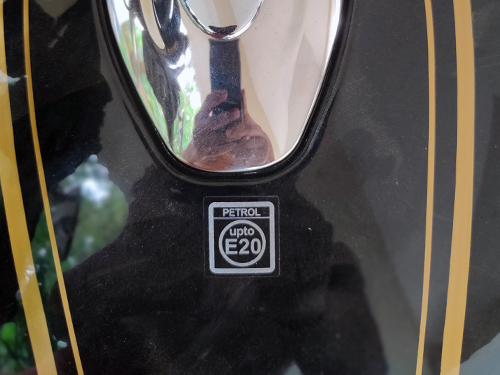
Motorcycle owners in India notice the effects of ethanol-blended petrol in areas like fuel economy, maintenance, performance, costs, and the environment.
1. Fuel Economy And Running Costs
- The effect of ethanol-blended petrol on mileage depends on the fuel blend and the motorcycle’s engine design and calibration. A single percentage should not be applied to every motorcycle.
- Do not assume that E20 is cheaper at the pump or that subsidies compensate riders for any mileage reduction. Calculate running costs using the actual price paid per litre and the mileage your motorcycle delivers.
- Fuel cost per kilometre = price per litre ÷ mileage in kilometres per litre. At an unchanged fuel price, lower mileage means a higher fuel cost per kilometre.
Source: Ministry of Petroleum and Natural Gas: Ethanol Blended Petrol Programme Q&A.
2. Maintenance Considerations
- Follow your motorcycle manufacturer’s maintenance schedule and any model-specific E20 service advisory. E20 use alone is not a reason to shorten service intervals unless the manufacturer recommends it.
- Government clarification notes that some rubber parts and gaskets in certain older vehicles may require earlier replacement when using E20. Such work can be assessed and carried out during routine servicing; it is not a blanket instruction to replace fuel-system parts on every motorcycle.
- If inspection identifies a deteriorated component, use the replacement part specified or approved by the manufacturer. Do not assume that an aftermarket part advertised as “ethanol-resistant” is suitable for your motorcycle.
Source: Ministry of Petroleum and Natural Gas: Response to concerns about E20 petrol.
3. Performance And Ride Experience
Do not expect an automatic improvement in power or throttle response from an ethanol blend. See the engine-effects section below for the distinction between octane rating, engine calibration and demonstrated performance benefits.
4. Environmental And Social Benefits
- Changes in exhaust emissions depend on the motorcycle and fuel blend. A reduction measured for one vehicle under specific test conditions does not establish the same reduction for every motorcycle.
- Ethanol blending supports India’s energy security goals and domestic biofuel production. It can also create opportunities for farmers supplying feedstocks used to make ethanol.
5. Warranty And Manufacturer Guidance
- The Ministry of Petroleum and Natural Gas states that manufacturers continue to honour warranty obligations for vehicles using specification-compliant E20 petrol. Using this fuel does not automatically invalidate a motorcycle’s warranty.
- This assurance does not mean that every repair is covered. The applicable warranty period, coverage and exclusions still matter. Request written clarification from the manufacturer if you have a model-specific concern.
- Do not apply E20 warranty assurances to E85, other higher-ethanol fuels or unapproved modifications. Check the manufacturer’s explicit approval before using a different fuel blend or modifying the motorcycle.
Source: Ministry of Petroleum and Natural Gas clarification on E20 fuel and manufacturer warranties.
How Do Manufacturers Prepare Motorcycles For Ethanol-blended Petrol?
Ethanol compatibility involves both fuel-system materials and engine calibration. These are separate considerations: a motorcycle’s ability to tolerate a blend does not necessarily mean its engine is optimised to deliver the best efficiency on that blend.
- Fuel-system materials: Manufacturers assess components such as hoses, seals, gaskets and other parts that come into contact with fuel for suitability with the approved ethanol blend.
- Engine calibration: Fuel delivery and other engine settings must suit the intended blend. The presence of fuel injection alone does not establish E20 or flex-fuel capability.
- Testing and approval: Compatibility claims should be supported by the manufacturer’s testing and documentation for the specific model and production period.
- Higher-blend capability: Flex-fuel vehicles require an appropriate combination of components and controls for their stated operating range. E20 approval should not be treated as E85 approval.
The 2021 NITI Aayog–Ministry of Petroleum and Natural Gas roadmap distinguished E20 material-compliant, E10-tuned vehicles from E20-tuned vehicles. For owners, the practical lesson is to check the exact manufacturer’s fuel approval rather than infer compatibility from a motorcycle’s age, fuel injection or emissions-standard label.
Sources:
NITI Aayog–MoPNG: Roadmap for Ethanol Blending in India 2020–25;
U.S. Department of Energy: Flex-fuel vehicle components and controls.
What Should Older-motorcycle Owners Check Before Using E20?
Start with the guidance for your exact motorcycle rather than assuming that every older model has the same fuel requirements. Check the owner’s manual and any newer manufacturer clarification covering the model and production period.
- If the manual specifies E10 but newer advice discusses E20, request written clarification from the manufacturer.
- Follow the prescribed maintenance schedule and any model-specific service advisory. Do not assume that E20 use automatically requires additives, tuning or replacement of fuel-system components.
- If a fault develops, have it diagnosed rather than attributing it to ethanol content alone. Keep relevant service records and manufacturer correspondence.
For a more detailed discussion of older-bike ownership questions, read our guide to E20 petrol and older motorcycles in India.
Can Riders Choose Between E0, E10 And E20 Petrol In India?
Riders should not assume that every petrol station offers a choice between ethanol-free petrol (E0), E10 and E20. India’s fuel supply has transitioned towards E20, and the availability of a particular grade must be checked with the fuel retailer.
The Ministry of Petroleum and Natural Gas reported 20% national ethanol blending for November–June of ethanol supply year 2025–26 in its July 2026 FAQ. This national figure is not a measurement of the ethanol content in fuel purchased from an individual dispenser.
The government explains that maintaining separate nationwide supply chains for E0, E10 and E20 would increase distribution, storage and handling complexity. Riders should therefore check local availability rather than expect E10 to be offered as a separate alternative to E20 at every station.
Check the dispenser’s fuel label and seek clarification from the oil marketing company if the ethanol content is unclear. Premium branding or a higher octane number does not, by itself, tell you the fuel’s ethanol content; check the product’s official specification.
E85 and a branded product such as ETHANOL 100 should not be assumed to have the same composition or vehicle requirements. Check the fuel supplier’s official product specification and your motorcycle manufacturer’s approval before using either fuel.
Source: Ministry of Petroleum and Natural Gas: Ethanol Blended Petrol Programme Q&A, July 2026 .
How Does Ethanol-blended Petrol Affect Motorcycle Engines?
The effects depend on the fuel blend and the motorcycle’s design and calibration. The following sections distinguish component durability, power output, throttle response and emissions.
1. Engine Longevity
Distinguish fuel-system material compatibility from engine lifespan. A potential concern about a hose, seal or gasket does not, by itself, establish that E20 will damage the engine or shorten the motorcycle’s working life.
The Ministry of Petroleum and Natural Gas reports no verified widespread engine failures or vehicle breakdowns attributable to ethanol blending. Its clarification also notes that certain older vehicles may require earlier replacement of some rubber parts and gaskets, which can be addressed during routine servicing.
These findings are not a guarantee for every motorcycle. Check manufacturer guidance for your specific model and have any suspected fault diagnosed rather than attributing it to ethanol content alone.
Source: Ministry of Petroleum and Natural Gas: Clarification on E20 and older-vehicle components; Government clarification on reported vehicle failures and ethanol blending.
2. Power Output
Ethanol has a lower energy content per litre than petrol, but this does not translate directly into an equivalent percentage reduction in engine power. Power output and fuel economy are different measurements, and both depend on the engine’s design, calibration and fuel blend.
Electronic fuel injection alone does not establish E20 compatibility or guarantee that the motorcycle can compensate for a higher ethanol blend. Check the manufacturer’s approved fuel range rather than assuming that tuning or carburettor adjustment will make an otherwise unapproved blend suitable.
For a meaningful performance comparison, use documented results for the specific motorcycle and fuel blends being compared.
Source: U.S. Department of Energy: Ethanol, fuel economy and engine optimisation.
3. Throttle Response
Ethanol’s higher octane rating does not, by itself, guarantee sharper throttle response or smoother acceleration. Any performance benefit depends on the engine’s design, calibration and operating conditions.
A noticeable improvement from E10 or E20 should not be assumed. Look for manufacturer information or documented testing of your specific motorcycle rather than treating another model’s results as a guarantee.
4. Emissions Profile
Ethanol blends can change exhaust and evaporative emissions, but there is no single result that applies to every motorcycle. The outcome depends on the fuel blend, engine calibration, emission-control system and operating conditions.
Not every pollutant necessarily decreases. Studies of higher ethanol blends have found reductions in some pollutants alongside increases in others, including acetaldehyde. These findings do not establish the emissions performance of an Indian motorcycle running on E10 or E20; that requires evidence for the relevant vehicle and fuel blend.
Climate benefits require a separate lifecycle assessment covering feedstock production, fuel processing, transport and vehicle use. A lifecycle greenhouse-gas reduction is not the same as an equivalent reduction in tailpipe emissions.
A motorcycle’s BS6 status alone does not identify its permitted ethanol blend or prove that it produces lower emissions on E20 than on E10. Use model-specific manufacturer documentation and applicable test evidence for such claims.
Source: U.S. Department of Energy: Ethanol Vehicle Emissions. This source explains general principles; it does not provide model-specific test results for Indian motorcycles.
India’s Ethanol-blending Timeline: Policy Targets And Reported Progress
India’s ethanol-blending programme has developed through several policy stages. A blending target, a recommended vehicle-rollout date and an achieved national blending percentage describe different milestones and should not be treated as interchangeable.
| Period | Milestone | What it means |
|---|---|---|
| January 2003 | The Ethanol Blended Petrol Programme was launched with 5% ethanol-blended petrol in nine states and four Union Territories. | This was the programme’s initial rollout, not nationwide E10 or E20 availability. |
| 2006 | The Ministry of Petroleum and Natural Gas directed public-sector oil marketing companies to sell 5% ethanol-blended petrol in 20 states and four Union Territories. | The programme’s geographical coverage expanded. |
| 2018–2022 | The National Policy on Biofuels initially set an indicative 20% blending target for 2030. Its 2022 amendment advanced the target to ethanol supply year 2025–26. | These were policy targets, not measurements of fuel sold at individual dispensers. |
| June 2021 | The NITI Aayog–Ministry of Petroleum and Natural Gas roadmap recommended phased E20 introduction from April 2023, with availability by April 2025. | These dates described the roadmap’s proposed fuel rollout. |
| Vehicle milestones recommended in the 2021 roadmap | E20 material-compliant, E10-tuned vehicles from April 2023, followed by E20-tuned vehicles from April 2025. | Material compatibility and engine optimisation were separate recommendations. Check manufacturer guidance for an individual motorcycle. |
| Ethanol supply year 2021–22 | The government reported 10% national ethanol blending. | This was an achieved national blending figure, not confirmation that every station offered E10 as a separate choice. |
| November–June, ethanol supply year 2025–26 | The government reported 20% national ethanol blending for this period. | This was a period-specific national figure, not a full-year result or a measurement of fuel from every dispenser. |
Sources:
PIB: EBP Programme launch and early rollout;
MoPNG/BPCL: Programme history;
Government clarification on the amended blending target;
NITI Aayog–MoPNG: Roadmap for Ethanol Blending in India 2020–25;
PIB: Reported national blending figures.
How Can Riders Check E20 Compatibility And Manufacturer Guidance?
Use this checklist to find model-specific fuel guidance, clarify warranty questions and check the manufacturer’s maintenance recommendations.
1. Check Manufacturer Specifications
Review your motorcycle’s owner manual or official manufacturer website for explicit confirmation of E20 fuel compatibility. Look for statements on ethanol blending tolerance or E20 readiness.
Do not infer E20 compatibility solely from fuel injection, the presence of an ECU or a motorcycle’s emissions-standard label. Look for explicit manufacturer guidance covering your model and production period.
2. Contact An Authorised Service Centre
Ask an authorised service centre for any manufacturer-issued E20 advisory covering your exact motorcycle model and production period.
3. Check For Manufacturer-approved Component Updates
Ask whether the manufacturer specifies any fuel-system component updates for your exact model and production period. Request the relevant service advisory and approved part details if an update is recommended.
Do not treat a component’s appearance or a generic “ethanol-resistant” product description as confirmation of suitability. You do not need to dismantle the fuel system to complete this checklist.
4. Check Warranty Terms And Current Manufacturer Guidance
Review your warranty terms alongside the manufacturer’s latest E20 clarification. Do not assume that an older manual mentioning E10 automatically means E20 use invalidates the warranty. If the guidance is unclear or conflicting, request written confirmation from the manufacturer for your specific motorcycle.
If a claim is rejected and E20 use is cited as the reason, ask for the written technical explanation and the applicable warranty clause.
5. Obtain Model-specific Confirmation
If your owner’s manual does not clearly state the permitted ethanol blend, or if newer manufacturer advice appears to differ from the manual, request written clarification from the motorcycle manufacturer.
Provide your motorcycle’s exact model, variant, manufacturing month and year, and chassis number or VIN through the manufacturer’s official support channel. Ask whether E20 is approved for your specific motorcycle and whether any manufacturer-approved updates are required.
Keep a copy of the response. Do not treat a general fuel-policy announcement or an industry-wide rollout date as confirmation that your individual motorcycle is E20-compatible.
6. Monitor Engine Performance And Behaviour
When trying E20 for the first time, monitor for any unusual engine noises, reduced throttle response, or performance issues. Report any unusual behaviour to the service centre immediately.
7. Check The Dispenser’s Fuel Information
Read the fuel-grade and ethanol information displayed at the dispenser. If the blend is unclear, ask the retailer or contact the oil marketing company before choosing the fuel.
Do not identify ethanol content from premium branding or octane rating alone. Compare the stated fuel specification with the manufacturer’s guidance for your motorcycle.
8. Follow The Prescribed Maintenance Schedule
Follow the manufacturer’s service intervals and any specific E20 advisory for your model. Ask the authorised workshop to assess fuel-system components during scheduled servicing and replace parts when required by their condition or manufacturer instructions.
Do not add extra filter changes, fuel-system cleaning or component replacements solely because you have started using E20, unless the manufacturer recommends them.
9. Stay Updated On Regulations
Follow government notifications regarding fuel quality, ethanol blending levels, and legislative changes affecting fuel use.
10. Keep Records
Keep manufacturer correspondence, service records and fuel purchase receipts for reference when discussing compatibility, servicing or warranty queries.
Frequently Asked Questions About Ethanol-blended Petrol
1. Does Ethanol’s Higher Octane Rating Improve Motorcycle Performance?
Ethanol has a higher octane rating than conventional petrol and can increase a petrol blend’s resistance to engine knock. However, this does not automatically give a motorcycle more power, better mileage or sharper throttle response.
Performance benefits depend on whether the engine is designed and calibrated to use the fuel’s properties. Follow the manufacturer’s specified octane rating and permitted ethanol content rather than assuming that a higher number or a higher ethanol blend is better.
Source: U.S. Department of Energy: How engine design influences the benefits of high-octane fuels.
2. How Does E20 Petrol Affect Motorcycle Mileage And Performance?
E20 can reduce motorcycle mileage, but the effect depends on the engine’s design and calibration. A motorcycle’s compatibility with E20 and its optimisation for E20 are not the same thing.
The 2021 NITI Aayog–Ministry of Petroleum and Natural Gas roadmap estimated a 3–4% fuel-efficiency loss when using E20 in two-wheelers originally designed for ethanol-free petrol (E0) and calibrated for E10. The report separately estimated a 6–7% loss for four-wheelers with the same design and calibration conditions. The four-wheeler figure should not be applied to motorcycles.
These are estimates for specific vehicle categories, not a guaranteed mileage reduction for every motorcycle. Check your manufacturer’s fuel recommendations and do not assume that every E20-compatible motorcycle will deliver the same mileage or performance.
Source: Roadmap for Ethanol Blending in India 2020–25, NITI Aayog and Ministry of Petroleum and Natural Gas.
3. Is E10 Petrol Available Everywhere In India?
Do not assume universal E10 availability. Achieving a national blending target does not establish that every station sells that blend as a separately selectable grade. Check the fuel grade and ethanol information with the retailer.
4. Does E10 Petrol Significantly Reduce Motorcycle Mileage?
There is no single mileage-loss percentage that applies to every motorcycle using E10. The result depends on the motorcycle’s design and calibration, and on the fuel being used for comparison. If you do not know the previous and current fuel blends, a change in measured mileage alone cannot establish an E10-related loss.
5. What Is The Difference Between E10 And E20 Petrol For Motorcycles?
E10 contains 10% ethanol and 90% petrol by volume, while E20 contains 20% ethanol and 80% petrol. For motorcycle owners, the important consideration is whether the manufacturer approves the motorcycle for the blend being used.
Do not assume that E10 is the default fuel everywhere or that every petrol station offers E10 and E20 as separate choices. Check the dispenser label and confirm the fuel grade with the retailer.
6. Does E20 Compatibility Add ₹1,000–₹2,000 To A Motorcycle’s Price?
The ₹1,000–₹2,000 figure was an early industry estimate of the additional cost of making two-wheelers E20-compatible—not a fixed surcharge on every motorcycle. It does not establish the current price difference between models or variants.
For a purchase comparison, use the manufacturer’s current price for the exact model and variant. Do not attribute a price increase entirely to E20 compatibility unless the manufacturer provides a specific cost breakdown.
E20 compatibility and flex-fuel capability are also different. The historical E20 estimate should not be used to predict the price premium of a motorcycle designed for higher ethanol blends.
Source: The Times of India, 12 May 2022: Industry estimates for E20-compatible and flex-fuel vehicle costs.
7. Are All Motorcycles Approved For E20 Petrol?
Do not assume that every motorcycle has the same manufacturer approval for ethanol content. Check the owner’s manual, fuel label and any newer manufacturer clarification for the exact model and production period.
An older manual specifying E10 is a reason to obtain updated guidance, not proof that E20 has damaged or will damage the engine. Government clarification reports no verified widespread engine failures attributable to ethanol blending, while acknowledging that some older vehicles may require earlier replacement of certain rubber parts and gaskets.
8. Is Xp95 Different From E20 Petrol?
XP95 and E20 describe different properties of petrol. XP95 is IndianOil’s 95-octane petrol, while E20 identifies an ethanol blend. As shown in the branded-fuel comparison above, XP95 is reported as E20, so choosing XP95 does not mean choosing ethanol-free petrol.
9. Is E20 Better Than Normal Petrol For Motorcycles?
“Normal petrol” does not identify a particular ethanol content or octane rating. Regular petrol may itself be E20. Compare the stated ethanol blend and octane rating with your motorcycle manufacturer’s requirements rather than treating “normal”, “premium” and “E20” as mutually exclusive categories.
A higher octane rating does not automatically improve mileage or performance. Suitability depends on the motorcycle’s approved fuel requirements, engine design and calibration.
10. Can Ethanol Be Removed From E20 Petrol?
Ethanol can technically be separated from petrol, but attempting this at home is not a safe or reliable way to obtain suitable motorcycle fuel. E20 is petrol blended with ethanol; it is the ethanol component that would need to be removed.
Do not add water to petrol to try to remove ethanol. Water contamination can cause phase separation, creating an ethanol-water layer and a petrol layer with reduced ethanol content. Because ethanol contributes to the blend’s octane rating, removing it can leave petrol with insufficient resistance to engine knock. The remaining fuel should not be treated as equivalent to commercially supplied ethanol-free petrol.
If you need ethanol-free petrol, check the supplier’s current product specification and your motorcycle manufacturer’s fuel requirements rather than modifying fuel yourself. If you suspect water contamination or separated fuel in your motorcycle, contact an authorised workshop instead of trying to recover and reuse it.
Sources:
U.S. EPA: Water phase separation in ethanol-blended petrol;
BP technical bulletin: Phase separation and reduced octane.
Related Motorcycle Fuel And Ownership Guides
- Motorcycle fuel – Types, things to know & take care in India
- Electric motorcycles & scooters in India: Examining the pros & cons
- Motorcycle fuel tank – How to maintain properly
- Electric scooter vs Petrol scooter – Which is best
- Want Your Electric Scooter & Bike to Last Longer? Top 15 Tips
Conclusion
For motorcycle owners, the key distinction is between a fuel blend’s ethanol content and the manufacturer’s approval for that blend. E20 compatibility does not establish flex-fuel capability, and fuel injection alone does not confirm the permitted ethanol range.
Check the guidance for your exact model, follow the prescribed maintenance schedule and compare running costs using your actual fuel price and mileage. The environmental effects include both vehicle emissions and the wider impacts of producing and supplying the fuel.
Have a question about ethanol-blended petrol, or spotted information in this guide that needs updating? Email us at bikeleagueindia@gmail.com. For confirmation of your motorcycle’s fuel compatibility or warranty coverage, contact the manufacturer through its official support channel.