

Long story short: Your motorcycle’s fuel can impact performance and efficiency. Discover how to choose the right motorcycle fuel types from a petrol pump for your bike with this helpful guide. Here, we discuss CNG fuel, petrol octane ratings, and related topics in India.
Picking the right fuel for your motorcycle is important because it affects how your bike performs, how long it lasts, and its environmental impact. Today, Indian riders can choose from petrol, ethanol blends, CNG, and electric power, so it’s helpful to know the benefits and drawbacks of each option.
This guide breaks down the main differences between motorcycle fuels in India, helps you pick what’s best for your bike, and clears up common myths and questions so you can make informed choices at the pump.
Key Takeaways
- Your fuel choice matters for your bike’s health and performance: The fuel you use—whether petrol, ethanol blends, CNG, or electric—affects how your motorcycle runs, how long it lasts, and even its impact on the environment. Always check your owner’s manual for what’s compatible with your bike, especially when it comes to octane rating and ethanol blends.
- Octane rating is important, but only for the right bikes: Most Indian motorcycles work best with 91 RON petrol. High-octane fuels (95+ RON) are really needed only for high-compression or sporty bikes. Using premium fuel in a standard commuter won’t give you more power or better mileage.
- Ethanolblends and electric bikes are the way forwarde: India is moving towars more ethanol-blended petrol like (E10, E20) and electric motorcycles.Ethanol helps cut emissions and supports local farmers, but only use E20 if your bike is certified for it. Electric bikes are great for city rides, though charging infrastructure is still catching up in many places.
- Fuel quality and safety at the pump are a must: Always check the fuel density, make sure the dispenser starts at zero, and double-check quality and quantity if you’re unsure. Avoid distractions, turn off your engine, and never use an open flame or your phone while refuelling.
- Think about the environment and resale value: Ethanol and electric bikes are better for the environment in the long run, with lower emissions and less fossil fuel use. Still, petrol bikes hold their value best right now because they’re familiar and easy to resell, while the second-hand market for electric and CNG bikes is growing but still catching up.
Types Of Motorcycle Fuel In India
| Fuel type | India availability | Main advantages | Main drawbacks | Compatibility / caution | Best for riders who… |
|---|---|---|---|---|---|
| Petrol | Available almost everywhere in India, from cities to remote regions | Strong performance, quick refuelling, wide service network, easy ownership | Higher emissions, petrol price volatility, dependence on fossil fuel | Safe for nearly all motorcycles; always match the recommended octane and ethanol compatibility | Want the simplest, most practical choice for daily use, touring, and rural travel. |
| Ethanol-blended petrol | E10 is common; E20 is expanding in phases across India | Lower fossil-fuel dependence, cleaner burning, supports domestic ethanol production | Possible mileage drop, compatibility issues in older bikes, moisture/corrosion risk if unsuitable | E10 suits most modern bikes; use E20 only if the motorcycle is E20-compliant | Use newer bikes and want a more future-ready petrol option. |
| Electric | Growing mainly in cities and urban commuter markets | Zero tailpipe emissions, low running cost, low maintenance, quiet operation | Charging dependence, range anxiety, battery replacement concerns, weaker rural support | No fuel compatibility issue, but buyers must consider charging access, service support, and battery warranty | Mostly ride in cities and want lower running costs with cleaner mobility. |
| CNG | Limited to selected cities with CNG infrastructure | Lower running cost, reduced emissions, cleaner combustion than petrol | Limited filling stations, reduced performance, conversion complexity, packaging limits | Use only approved kits / legal conversions or factory-built models where available | Commute in CNG-supported cities and want fuel-cost savings over outright performance. |
1. Petrol
Petrol is the classic and most common fuel for motorcycles in India. It comes in different octane levels and is the standard for comparing other fuels’ performance, cost, and convenience.
Pros Of Petrol
- Widespread Availability: You can find petrol almost anywhere in India. Hence, it’s the easiest and most convenient choice for most riders.
- Performance: Petrol engines usually give you strong performance and good fuel efficiency.
Cons Of Petrol
- Environmental Impact: Burning petrol produces CO2 and other pollutants, which isn’t great for the environment.
- Cost: Petrol prices can be high, which means running your bike might cost more over time.
Compatibility
- Almost every bike in India, from basic commuters to powerful sports bikes, is built to run on petrol.
- Always check your owner’s manual for the right octane rating (usually 91 RON) and whether your bike can handle ethanol blends like E10 or E20.
- If you have a very old bike, you might need to make a few small changes if you want to use ethanol-blended petrol.
Infrastructure
- Petrol stations are everywhere—from big cities to remote villages—so you’ll never have trouble finding a place to fill up.
- You’ll find standard petrol and E10 blends almost everywhere. E20 is increasingly appearing in cities and other busy areas.
2. Ethanol (flex-fuel) Fuel
Ethanol-blended petrol (such as E10, E20, and higher) blends renewable ethanol with regular petrol. The Indian government is pushing this fuel to cut emissions and help local farmers.
Pros Of Ethanol
- Environmental Benefits: Ethanol is a biofuel that puts out fewer greenhouse gases than petrol.
- Renewable Resource: Ethanol is made from renewable crops like sugarcane, which India grows a lot of.
- Government Support: The government wants more ethanol in fuel to cut down on oil imports and help Indian agriculture.
Cons Of Ethanol
- Infrastructure: Getting ethanol to every petrol station is still a work in progress, so it’s not as easy to find everywhere yet.
- Engine Compatibility: Not every engine can run on high ethanol blends, but newer bikes are being built with this in mind.
Honda Flex-Fuel Bike: Honda has announced plans to introduce a flex‑fuel motorcycle in India. However, as of 2026, the exact rollout status and engine details are still evolving.
Compatibility
- Most bikes made after 2000 can use E10 petrol without any changes.
- For E20, check your manual or the ARAI list—only newer or E20-certified bikes are sure to run well on it.
- Older bikes or those not meant for ethanol might have problems like rust, rough running, or lower performance with higher blends.
Infrastructure
- E10 is now the normal fuel at most Indian petrol stations since 2022–2023.
- E20 is rolling out in stages. It’s mostly in big cities and some states for now, but the goal is to have it everywhere by 2025–26.
- Higher blends like E85 or flex-fuel are only at a few test stations right now—not common yet.
3. Electric
Electric motorcycles run on batteries and electric motors instead of petrol engines. They’re clean, quiet, and are becoming a more practical choice for city rides and short trips in India.
Pros Of Electric
- Zero Emissions: Electric bikes don’t release any exhaust fumes, so they’re better for the environment.
- Lower Operational Costs: They cost less to run because electricity is cheaper than petrol, and there’s less to fix or maintain.
- Technological Advancements: Many new electric bikes have cool features like smart connectivity, Bluetooth, GPS, and more.
Cons Of Electric
- Range Anxiety: Electric bikes can’t always go as far on a single charge, which can be a worry for longer trips.
- Charging Infrastructure: Charging stations are still being built, so finding a place to charge isn’t always easy everywhere yet.
Compatibility
- Electric bikes don’t need petrol at all. Anyone can ride one as long as they have access to charging and the battery range meets their needs.
- Battery size, charging plugs, and features can be very different from one model to another, so make sure your area has service and spare parts for the brand you pick.
Infrastructure
- Charging stations are growing fast in big cities and on busy routes, but are still hard to find in rural or remote places.
- Most people charge their bikes at home overnight, and public charging is getting better all the time.
4. Cng (compressed Natural Gas)
CNG motorcycles are a newer option in India, mainly in cities with CNG stations. They run on compressed natural gas that’s stored in a special tank on the bike. Some petrol bikes can be fitted with CNG kits, but factory-made CNG bikes are still rare.
Pros Of Cng
- Lower Running Costs: CNG usually costs less than petrol, so you can save money if you ride a lot.
- Reduced Emissions: Burning CNG puts out fewer pollutants and greenhouse gases than petrol or diesel.
- Cleaner Engine: CNG burns cleaner, so there’s less buildup inside your engine, and it might last longer.
Cons Of Cng
- Limited Infrastructure: You’ll mostly find CNG stations in big cities, not in rural areas or on highways.
- Reduced Storage Space: The CNG tank takes up some of your under-seat storage space.
- Lower Performance: CNG bikes may feel a bit slower or less powerful than petrol bikes.
- Conversion Concerns: Not every bike can be fitted with a CNG kit, and doing so might affect your warranty or how reliable your bike is.
Compatibility
- Most CNG bikes in India are regular bikes that get CNG kits fitted later. Always check the rules and the bike maker’s advice before going for a conversion.
- There aren’t many factory-built CNG bikes yet, but a few companies are working on new models.
Infrastructure
- CNG is available only in a few cities, such as Delhi, Mumbai, and Ahmedabad. If you ride elsewhere, it can be tough to refuel.
- If you ride a CNG bike, plan your trips so you don’t run out of fuel.
Maintenance Tips For Cng Motorcycles
- Get your CNG kit fitted and checked by a qualified mechanic.
- Check for leaks or damage in the CNG pipes and tank regularly.
- Stick to the maintenance schedule from the bike maker, and only use approved parts.
- Remember, CNG bikes might need more frequent valve checks and oil changes because they burn fuel differently from petrol bikes.
Different Types Of Petrol Fuel For Two-wheelers In India
In India, the “types” of petrol for motorcycles are defined mainly by octane rating, brand‑specific additives, and ethanol content. Here’s a clear breakdown tailored for Indian riders.
| Petrol type | Octane / blend | What it really is | Best suited for | Main benefit | Important note |
|---|---|---|---|---|---|
| Standard unleaded petrol | 91 RON, usually E10 in many areas | The default petrol used by most Indian motorcycles | Commuter bikes, scooters, most everyday motorcycles | Cheapest and most widely available option | Best choice unless the owner’s manual asks for higher octane or specific ethanol support. |
| Branded additive petrol | 91–94 RON | Regular petrol plus detergents / additives for cleaner combustion | City bikes, older bikes, riders who want cleaner internals | May help keep injectors, carbs, and combustion chambers cleaner | Not a magic performance upgrade; gains are usually small. |
| High-octane premium petrol | 95–100 RON | Higher knock-resistant petrol for high-compression engines | Performance bikes, imported bikes, high-compression engines | Reduces knocking and supports smoother performance in compatible engines | Normal commuter bikes usually do not gain extra power or mileage from this fuel. |
| E20 petrol | 20% ethanol + 80% petrol | Higher ethanol-content petrol being rolled out in India | E20-certified or flex-fuel motorcycles only | Reduces fossil-fuel use and supports cleaner fuel transition | Avoid in non-compliant older bikes due to corrosion, rough running, or fuel-system issues. |
1. Standard Unleaded Petrol (91 Ron)
This is the standard petrol you’ll find in almost every Indian motorcycle. It has an octane rating of 91 RON, which is what most bikes here are designed for.
Who Should Use It
- All commuter bikes (100–180 cc scooters & motorcycles).
- Most 200–350 cc street bikes whose manuals specify “minimum 91 octane”.
Pros
- You can get it almost anywhere, and it’s the most affordable option.
- It gives a good mix of performance and reliability for everyday riding.
Cons
- It doesn’t have extra cleaning additives or special boosters—just the basics.
Stick with this unless your bike’s manual says you need a higher grade or you ride a high-performance machine.
2. Branded “premium” Petrol With Additives (91–94 Ron)
These fuels aren’t higher octane—they’re still 91–94 RON petrol, just with added detergents and cleaning agents.
Examples
- IndianOil Speed / Speed93
- BPCL Speed91 / Speed97
- Shell V‑Power (91 RON)
Octane rating: Still 91–94 RON (similar to normal unleaded).
Key Difference
- They include extra detergents and additives to help keep your engine’s injectors, carburettors, and combustion chambers cleaner.
- This can help your bike run a bit smoother and keep things cleaner inside—but don’t expect a big jump in power or mileage.
Best For
- Slightly older bikes, idling‑heavy city use, or riders who want cleaner‑burning fuel without going to 95+.
3. High‑octane Branded Petrol (95–100 Ron)
Higher-octane fuels are made for high-compression or performance engines—not for every bike.
Examples
- IndianOil XP95 – 95 RON, marketed for high‑performance bikes and sports cars.
- IndianOil XP100 – 100 RON, aimed at race‑oriented and high‑end vehicles.
- HPCL poWer100 – 100 RON petrol.
Octane rating: 95–100 RON (higher resistance to knocking).
Pros
- Reduces engine knocking in high‑compression engines (usually 10.5:1 and above).
- You might notice a bit better throttle response and smoother power delivery if you’re riding hard.
Cons
- It costs quite a bit more per litre.
- If you ride a regular commuter bike that only needs 91 RON, you won’t see any real benefit from using this fuel.
Only go for 95+ RON if your owner’s manual specifically asks for it. Usually, this is for imported sport bikes or high-performance models.
4. Ethanol‑blended Petrol (e10, E20, E85)
Most Indian bikes made after 2020 are designed to run on E10, but whether they can run on E20 depends on the model. Always check your manual or ARAI compatibility labels.
E10 (10% Ethanol)
- What’s inside: 10% ethanol mixed with 90% petrol.
- Where to find it: This has been the standard fuel at nearly every Indian petrol pump since 2022–2023.
Compatibility:
- Most bikes made since 2000 can use E10 without any changes.
- If you have a very old carburetted bike, you might need to adjust the settings or check for wear more often.
E20 (20% Ethanol)
- What’s inside: 20% ethanol blended with 80% petrol.
- Where to find it: E20 is rolling out in cities and is already at many pumps in states like Delhi-NCR, UP, and Maharashtra. The plan is to have it everywhere by 2025–26.
Compatibility:
- You need an E20-compliant or flex-fuel engine to use this fuel safely.
- If your bike isn’t designed for E20, you might notice rough running, stalling, or even signs of rust or corrosion.
E85 / Higher Blends (flex‑fuel)
What’s inside: Up to 85% ethanol mixed with petrol.
Status in India:
- You won’t find this type of fuel at most petrol stations—it’s not widely available for bikes yet.
- It’s mostly just for special flex-fuel vehicles in pilot projects or a few test stations right now.
How To Choose The Right Petrol For Your Bike In India?
Choosing the right petrol for your bike in India is simple if you follow a few key rules: match the octane rating, ethanol blend, and brand to your bike’s engine and commuting pattern.
| Bike type / usage | Recommended petrol | Why it suits | Can you use premium? | E20 suitability | Reader takeaway |
|---|---|---|---|---|---|
| 100–180 cc commuter / scooter | 91 RON standard petrol | These engines are tuned for regular use, efficiency, and low running cost | Yes, but usually unnecessary | Check manufacturer guidance; many newer models are compatible | For most everyday riders, normal 91 RON from a trusted pump is enough. |
| 200–350 cc street / touring bike | Usually 91 RON unless the manual asks for more | Many mid-capacity bikes still run perfectly on standard petrol | Yes, if recommended or if the engine is high-compression | Model-specific; verify manual or OEM statement | Do not assume bigger engine means premium petrol is mandatory. |
| High-compression / performance bike | 95+ RON premium petrol | Higher octane helps control knocking and supports intended ignition timing | Yes, often recommended | Only if specifically approved | Follow the manual strictly; wrong octane can reduce performance and reliability. |
| Older carburetted motorcycle | Standard petrol / E10 only unless upgraded | Older hoses, seals, and carb settings may not tolerate higher ethanol well | Only if the engine actually needs it | Usually not recommended without confirmed compatibility | For old bikes, fuel quality and compatibility matter more than fancy branding. |
1. Start With Your Owner’s Manual
Check What Your Bike’s Manufacturer Recommends:
- If it says “Minimum 91 RON,” regular 91 unleaded (E10 is fine) is all you need.
- If it says “95+ RON recommended,” use XP95, Power95, Speed97, or a similar premium fuel, but only if you want the extra benefit.
Compression Ratio Basics
- Most commuter bikes (with a ratio of 8–10:1) only need 91 RON fuel.
- High-compression sports bikes (10.5:1 and above) can benefit from 95–100 RON.
2. Pick The Right Octane (91 Vs 95+)
91‑ron (standard Petrol):
- This is right for most Indian bikes, including scooters, 100–200 cc commuters, and many 350–400 cc tourers.
- It’s the cheapest and most widely available option. Upgrading doesn’t give you extra benefits unless your bike really needs it.
95–100 Ron (premium / Xp / Power):
- Best for high-compression or imported bikes (like 300–400+ cc sport bikes tuned abroad).
- This fuel helps reduce knocking and may give you slightly smoother power if you ride hard, but don’t expect better mileage.
3.know Youre Ethanol Blends (e10 Vs E20)
- E10 (10% ethanol) Now thew standard at most Indian etrol pumps. It’s safe for most bikes made after 2000, unless your manual says otherwise.
- E20 (20% ethanol): Only use this if your bike is E20-compliant (check your manual, the ARAI list, or an official notice). Avoid E20 in older carburetted bikes unless you’ve upgraded the fuel system and adjusted the carb.
4. Branded Vs “normal” Petrol: Do You Need It?
- Speed91, -Power, XP95, PowWer95, etc.: These are still 91–97 RON petrol with extra detergent or cleaning additives. They’re useful for keeping injectors or carbs clean over time, but not essential if you keep up with regular maintenance.
- When branded petrol helps: It can be helpful for bikes that do a lot of city riding with lots of idling, very old bikes that get premium fuel now and then, or if you just want a cleaner burn without changing octane.
What Is An Octane Rating In Motorcycle Fuel?
An octane rating in motorcycle fuel is a number that indicates how resistant the petrol is to “knocking” or “pinging” when it burns in the engine.
What Octane Rating Actually Means
- It measures how well the fuel can withstand high compression and heat before it ignites on its own (without a spark).
- The higher the octane number (for example, 91 vs 95 vs 100), the more stable the fuel is under pressure and the less likely it is to pre‑ignite or knock in the cylinder.
Why It Matters For Motorcycles
- In a motorcycle engine, the air‑fuel mixture is squeezed (compressed) as the piston moves up; if the fuel is not stable enough for that compression, it can ignite too early, causing knocking.
- Knocking sounds like a metallic tapping or pinging and can lead to reduced power, excess heat, and long‑term engine damage if it occurs often.
How Does Higher Octane Help
- High‑compression engines (like those in sport bikes and performance‑oriented motorcycles) usually need 95+ RON petrol because they squeeze the mixture more tightly.
- Using the correct octane rating smooths combustion, reduces knocking, and lets the engine deliver the power and efficiency it was designed for.
What Lower Octane Can Do
- If you use lower‑octane fuel than what your bike recommends, the mixture may ignite earlier than intended, increasing the risk of knocking, higher engine temperatures, and faster wear.
- But using higher‑octane fuel than needed on a normal commuter bike does not add power or mileage; it mainly costs more.
Practical Takeaway For Indian Bikes
- In India, most bikes are tuned for 91 RON unleaded petrol; that’s your standard fuel.
- If your manual says “minimum 95 RON”, use XP95 / Power97 / similar high‑octane fuel; otherwise, sticking to 91 RON is fine.
How Octane Ratings Affect Performance In Motorcycles?
Octane rating affects motorcycle performance by controlling how well the fuel resists knocking (pinging) under high engine compression, which, in turn, influences power delivery, smoothness, and long‑term reliability.
1. What Does Octane Actually Do Inside The Engine?
Octane measures how resistant petrol is to pre‑igniting when compressed; it does not mean “more energy” or “more power” by itself. If the fuel’s octane is too low for the engine’s compression ratio, the mixture can ignite before the spark plug fires, causing knocking, extra heat, and loss of effective power.
2. How Does This Change Performance?
In High‑compression / Performance Bikes
- These engines (often 10.5:1 and above) need 95+ RON fuel so the mixture doesn’t detonate early.
- Using the correct high‑octane petrol allows the ECU to keep a more aggressive ignition timing, improving throttle response and smoothness without damaging the engine.
In Normal Low‑/medium‑compression Commuter Bikes
- Most Indian bikes are tuned for 91 RON; using 95+ RON doesn’t increase power or mileage because the engine isn’t built to take advantage of that extra stability.
- You mostly just pay extra, with no meaningful performance gain.
3. What Happens If You Use The Wrong Octane?
Too Low Octane On A High‑compression Engine
Increased knocking, rough acceleration, reduced power and fuel efficiency, and risk of long‑term engine wear or damage.
Too High Octane On A Low‑compression Engine
Combustion still works fine; the bike runs smoothly, but does not become faster or more efficient.
4. Practical Takeaway For Indian Riders
- Check your owner’s manual and match the octane (usually 91 RON) to the bike’s design.
- Use 95+ RON only if the manufacturer recommends it (typically sporty or imported high‑compression models).
- In India, standard 91‑RON unleaded petrol is the right default for most motorcycles; higher octane is a safety/refinement tool, not a performance‑booster for normal bikes.
Next, we will discuss engine knocking and the relation between octane rating.
What Is Engine Knocking?
Engine knocking (also called detonation, pinging, or spark knock) is a metallic knocking or tapping sound you sometimes hear from your engine. It happens when the air-fuel mixture burns too early or unevenly in the cylinder, instead of burning smoothly after the spark plug fires.
What’s Really Happening Inside?
- In a healthy engine, the spark plug lights the compressed air-fuel mix, and the flame spreads smoothly, pushing the piston down.
- But during knocking, parts of the mixture explode on their own (because of heat or high pressure), sometimes before the spark or at the same time, creating shock waves inside the cylinder.
Why Does Knocking Matter?
- This uncontrolled burning causes sudden jumps in pressure and heat. You’ll hear it as knocking or pinging, and you might feel the engine running rough or vibrating.
- If ignored, knocking can reduce power, hurt your fuel efficiency, cause more carbon buildup, and, over time, damage key engine parts like pistons, rings, gaskets, and bearings.
What Usually Causes Knocking?
- Using low-octane fuel in a high-compression engine can make the mixture burn too soon.
- Other triggers include engine overheating, bad ignition timing, carbon buildup, or poor-quality fuel.
In short, engine knocking is an uneven, early fuel burning that hurts performance and, if left unchecked, can cause engine damage.
What’s The Link Between Engine Knocking And Octane Rating?
The short answer: higher-octane fuel helps prevent knocking, while lower-octane fuel makes it more likely.
How Does knocking Actually Happen?
- Knocking (also called pinging) happens when the air-fuel mixture in your engine’s cylinder burns too soon—usually because of heat and pressure—rather than waiting for the spark plug to fire. Instead of a smooth burn, the fuel explodes early.
- This causes several pressure waves to crash into each other, making that metallic knocking sound and wasting energy that should be moving your bike forward.
What Does octane Rating Do?
- Octane rating shows how well petrol can resist burning too early under pressure. It doesn’t mean the petrol has more power.
- With a higher octane number, the fuel can handle more pressure and heat before it ignites on its own. This lets the engine run at higher compression and tighter settings without knocking.
How Does This Work In Real Life?
- If you put low-octane fuel in a high-compression engine, the fuel can ignite too early, leading to knocking, less power, and possible long-term engine damage (like to pistons or gaskets).
- If you use the right octane (or a little higher than needed), knocking is much less likely. Your engine runs smoother and can safely use more advanced timing, which boosts efficiency and reliability.
What Is Fuel Density?
Fuel density is simply how much a certain amount of fuel weighs for its size—like how heavy a litre or a cubic meter of petrol is.
In India, petrol density is usually measured in kilograms per cubic meter (kg/m³) at 15°C. The normal range is about 720–775 kg/m³, and most experts say the ideal is between 730 and 770 kg/m³.
Why Fuel Density Matters?
- Quality and purity: If the petrol’s density isn’t in this range, it could be mixed with water or other things, or it might have lost some of its strength. This can hurt how your bike runs and how far it goes on a tank.
- Combustion and mileage: When the density is right, your engine usually gets more power and better mileage. If it’s too low, the fuel might be watered down or of poor quality.
So, when you’re at the petrol pump, a quick look at the fuel density number (ideally 730–770 kg/m³) is an easy way to tell if the fuel is likely clean and right for your bike or car.
What Are The Things To Note While Refilling Motorcycle Fuel At The Petrol Pump In India?
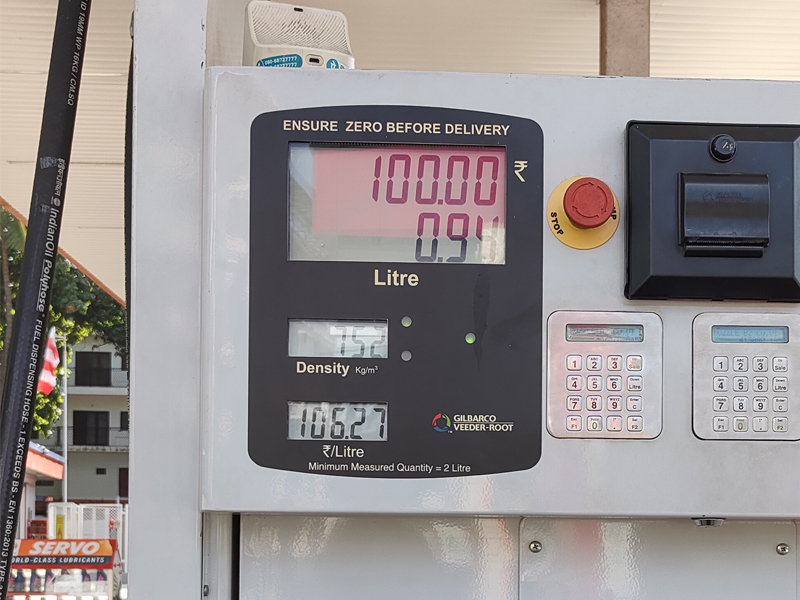
1. Check For Fuel Density
Always check the petrol density—it should be between 730 and 770 kg/m³. If it’s outside this range, the fuel might be mixed with water or other substances and is best avoided.
2. Make Sure The Fuel Dispenser Is Set To Zero
Make sure the meter is set to zero before refuelling. Petrol pumps can be busy and distracting, and sometimes attendants may take advantage by not resetting the meter, a trick called short-fuelling.
3. Check The Quality Of Petrol Using Filter Paper If There Is Doubt
If you ever doubt the quality of the petrol, ask for a filter paper test. Every petrol pump is required by law to provide filter papers, so don’t hesitate to ask if you want to check.
To check for adulteration, place a few drops of petrol on the filter paper. If it leaves stains, the petrol is likely mixed or impure. If not, it’s clean.
4. Check The Quantity Of Petrol If There Is Doubt
Sometimes, fuel dispensing machines are tampered with to give you less petrol than what the meter shows. If you’re unsure about the quantity, ask for a five-litre test measure to check.
Every petrol pump should have a certified 5-litre measure. If the fuel completely fills the test container, you know you’re getting the right amount.
5. Avoid All Distractions And Deviation
When you pull up to a petrol pump, try to avoid distractions and pay close attention to what the attendant is doing and to the fuel meter.
6. Turn Off The Engine
Always turn off your motorcycle’s engine before refuelling. This helps prevent sparks and keeps everyone at the pump safer.
7. Avoid Smoking And Open Flames
Never smoke or use lighters at the petrol pump. Fuel vapours are extremely flammable, and even a small flame can cause danger.
8. Do Not Use Mobile Phones
Don’t use your mobile phone while refuelling. Phones can cause sparks, which could ignite fuel vapours.
9. Avoid Overfilling The Tank
Don’t fill the tank to the brim. Leave a little space for fuel to expand and for vapour to form—this helps your bike run well and prevents spills.
What Is The Future Of Motorcycle Fuel In India?
India’s motorcycle fuel future is headed in three directions: more ethanol-blended petrol, a gradual increase in flex-fuel and ethanol-ready bikes, and steady growth of electric two-wheelers alongside traditional petrol bikes.
Fuel Direction
- Petrol will stay important for a long time, mainly because it’s easy to find across India and gives great range—especially in smaller towns and rural areas.
- But petrol is changing too: India has already shifted from E10 to E20 in many areas, and there’s a push to make E20 the standard nationwide.
- This means most riders won’t stop using petrol overnight, but the amount of ethanol mixed in will keep growing.
Ethanol Growth
- Blending in more ethanol is the biggest short-term change, since it helps India use less imported oil and boosts local ethanol makers.
- Bike makers are also working on more E20-ready models, so we’ll likely see a mix of regular petrol engines and those designed for higher ethanol blends.
- For older bikes, it’s still important to check if they can handle E20 or are limited to E10.
Flex-fuel And Cng
- Flex-fuel motorcycles will likely remain a smaller but valuable option, especially if manufacturers launch more models built for it instead of just offering conversion kits.
- CNG bikes might grow in some cities. Still, limited refuelling spots and technical challenges mean they probably won’t replace petrol bikes everywhere.
- So, instead of one main fuel, the future will likely offer riders a choice—based on what works best for their needs and budget.
Electric Shift
- Electric motorcycles are the biggest long-term challenger to petrol bikes for city rides, since they’re cheaper to run and need less maintenance.
- But petrol still leads on range, quick refuelling, and being available everywhere—which is why EVs are taking off in cities. However, petrol bikes are still the top choice for long trips and rural areas.
- This means India’s bike market will probably stay mixed for years, with EVs growing but petrol bikes remaining mainstream.
What Riders Should Expect
- Riders can expect three big changes soon: more E20 petrol pumps, more bikes made for ethanol blends, and more electric options for daily commuting.
- For now, your best bet is to follow your owner’s manual—especially if your bike is older and might not work well with higher ethanol blends.
- The future isn’t about petrol disappearing, but about it changing—mixing with more ethanol. At the same time, electric bikes are becoming more common.
What Are The Long-term Environmental Benefits Of Switching To Ethanol Or Electric Motorcycles
Switching to ethanol-powered or electric motorcycles in India offers significant long-term environmental benefits. These include reducing emissions, improving air quality, and reducing our dependence on fossil fuels.
Long‑term Benefits Of Ethanol Motorcycles
- Lower CO₂ and pollutant emissions: Ethanol-blended petrol (E10–E20) can cut CO₂ and other emissions by about 20–30% compared with regular petrol. This helps cities meet stricter pollution standards and leads to cleaner air, especially in crowded urban areas.
- Renewable fuel source: Ethanol comes from crops like sugarcane and corn. This means India can depend less on imported oil, strengthen its energy security, and move toward its climate goals.
- Lifecycle-level gains: Using mid-level ethanol blends throughout a bike’s life can reduce the use of fossil fuels and lower air pollution, especially if the engine is designed for them.
Note: Large-scale ethanol farming can put extra pressure on water and soil. Lasting environmental benefits depend on farming more sustainably and using new biofuels that don’t compete with food crops.
Long-term Benefits Of Electric Motorcycles
- Zero tailpipe emissions: Electric bikes do not release any harmful gases while riding. This directly improves air quality in cities and helps reduce health problems caused by air pollution.
- Lower overall carbon footprint: Even though much of India’s electricity comes from coal, electric bikes still use less energy and produce less CO₂ over their life than petrol bikes. As the electricity grid gets cleaner, the benefits of EVs will grow even further.
- Less noise and resource stress: Electric bikes are much quieter, making cities more peaceful and rides more enjoyable. They also reduce the need for petrol, which helps cut down pollution from oil extraction and refining.
Overall Picture For India
- Ethanol-based bikes are a good step for now: They help lower emissions from today’s petrol engines and support Indian farmers and energy needs. However, the benefits depend on how ethanol is produced and used.
- Electric motorcycles are likely the best long-term choice for clean transport, especially as charging stations and battery recycling become more common.
How Fuel Choice Impacts Resale Value, Long-term Reliability, Or The Second-hand Market For Two-wheelers In India?
Here’s a simple look at how your choice of fuel can affect the resale value, long-term reliability, and second-hand market for motorcycles in India:
| Fuel type | Resale value trend | Long-term reliability outlook | Second-hand market demand | Biggest buyer concern | Best summary |
|---|---|---|---|---|---|
| Petrol | Usually strongest | Well proven, easy to service, parts widely available | Highest and most stable | General condition and service history | Still the safest and easiest used-bike choice for most Indian buyers. |
| CNG | Usually lower than petrol | Depends heavily on conversion quality and maintenance | Niche and city-specific | Kit quality, legal approval, and station availability | Useful in the right city, but the resale audience is limited. |
| Ethanol-compatible petrol bike | Similar to petrol if compatibility is clear | Good in compliant bikes; older bikes may raise concerns | Growing but still education-dependent | Whether the model is truly E20-ready | Potentially future-friendly, but buyers will look for proof of compatibility. |
| Electric | Currently weaker than petrol in many cases | Motor is simple, but battery health is critical | Growing, but still relatively small | Battery degradation, replacement cost, service support | Promising segment, but used-bike confidence still depends on battery trust. |
1. Petrol Motorcycles
- Resale Value: Petrol bikes usually fetch the best resale prices because they’re well-known, easy to maintain, and can be refuelled almost anywhere. Most buyers like petrol bikes for their straightforward reliability.
- Long-Term Reliability: Petrol bikes have a solid reputation for lasting a long time and are easy to repair. Spare parts are easy to find, too.
- Second-Hand Market: Petrol bikes make up most of the used-bike market. They’re easy to sell, with steady demand and prices that don’t drop suddenly.
2. Cng Motorcycles
- Resale Value: CNG bikes don’t hold their value as well as petrol bikes. The main reasons are the limited number of CNG stations outside big cities and worries about engine wear over time.
- Long-Term Reliability: Converting a bike to CNG can make things more complicated and sometimes increase maintenance costs or create performance issues. Plus, not all mechanics know how to work on CNG bikes.
- Second-Hand Market: The second-hand market for CNG bikes is small and mostly limited to cities that have good CNG access.
3. Ethanol-blended Fuel Motorcycles (e10, E20, Etc.)
- Resale Value: Ethanol-blend bikes currently sell for prices similar to petrol bikes, but this can change depending on how widespread ethanol fuel is and whether people know the bike is compatible.
- Long-Term Reliability: Ethanol-blended fuels can wear out older engines faster if they’re not designed for it. Newer bikes made for ethanol blends usually do just fine.
- Second-Hand Market: The second-hand market for ethanol-blend bikes is still growing. Some buyers are a bit cautious since they’re not always sure about ethanol fuel availability or possible engine problems.
4. Electric Motorcycles
- Resale Value: Electric bikes don’t resell for as much as petrol bikes right now, mainly because people worry about battery life, expensive replacements, and how quickly technology is changing.
- Long-Term Reliability: The big question for electric bikes is how long the battery lasts and how well it performs. Electric motors are simple and low-maintenance, but batteries are costly to replace, which can put off some buyers.
- Second-Hand Market: More people are starting to look at used electric bikes, but the market is still small. Buyers often worry about battery condition and whether parts and service will be available in the future.
Common Myths And Misconceptions About Motorcycle Fuels In India
1. Premium Petrol Always Gives Better Mileage
Higher-octane or branded fuels only benefit bikes designed for them; most commuter bikes see no real mileage gain.
2. Electric Motorcycles Cannot Handle Indian Road Conditions
Modern EVs are built for Indian roads and weather, with improved water resistance and tougher suspension.
3. Using Cng Will Ruin Your Engine Immediately
Properly installed CNG kits and regular maintenance keep engines reliable, though performance may differ from that of petrol engines.
4. Ethanol Blends Damage All Engines
Most post-2000 bikes are E10-compatible, and newer models are designed for E20. Only very old or non-compliant bikes face real risk.
5. Higher Octane Means More Power For Any Bike
Only high-compression engines benefit from higher octane; standard bikes don’t get extra power or efficiency.
6. All Electric Bikes Have The Same Range
Range varies widely by model, battery size, and riding conditions; some new EVs rival petrol bikes for daily commutes.
7. Refuelling At Any Pump Is Safe If The Price Is Right
Fuel quality, density, and adulteration risks mean caution is needed—always check for certified pumps and correct density.
8. Cng And Electric Bikes Have No Resale Value
While resale markets are newer, demand for clean vehicles and improved battery tech is steadily increasing the second-hand value.
9. Ethanol-blended Fuel Is Always Cheaper.
Ethanol blend prices can fluctuate with agricultural cycles, and higher blends may not always be more economical than standard petrol.
10. Switching To Alternative Fuels Voids All Warranties.
Using manufacturer-approved fuels or kits as per guidelines typically keeps warranties intact; issues arise mainly with unapproved conversions.
Faq About Motorcycle Fuel In India
1. What Is The Best Petrol Type For My Motorcycle?
For most Indian bikes, regular 91 RON unleaded petrol is the way to go. Always check your owner’s manual for any special requirements, especially if your motorcycle is a high-compression model or imported.
2. Can I Use High-octane Fuel In My Commuter Motorcycle?
High-octane fuel (95+ RON) is only helpful if your bike is designed for it. If you use it on a regular commuter bike, it won’t make your ride faster or improve your mileage.
3. Is Ethanol-blended Petrol Safe For My Bike?
E10 (10% ethanol) is safe for most bikes made after 2000. For E20, it depends on your bike’s model—so check your manual or ask your manufacturer for guidance.
4. What Are The Pros And Cons Of Using Cng In Motorcycles?
CNG can help you save money on running costs and reduce emissions. However, CNG stations are limited, performance might drop a bit, and it only works well with certain bikes or properly converted bikes.
5. How Does Fuel Density Affect My Motorcycle?
Getting the right fuel density (730–770 kg/m³) helps keep your bike running smoothly. Petrol that’s too thin or too thick can mean it’s been tampered with or is low quality.
6. What Is Engine Knocking, And How Can I Prevent It?
Engine knocking happens when fuel burns too early in your engine. To prevent it, stick to the recommended octane and avoid poor-quality or dirty fuel.
7. Are Electric Motorcycles A Better Long-term Option?
Electric bikes are clean and cost less to run, but you’ll need to consider that charging stations and range are still catching up across India.
8. Does Using Premium Petrol Improve My Bike’s Mileage?
No, premium petrol with additives might help keep your engine clean, but it won’t give better mileage if your bike is built for normal fuel.
9. What Should I Check When Refuelling At A Petrol Pump?
Check the fuel density, make sure the meter starts at zero, double-check the amount and quality if you’re unsure, stay focused at the pump, and always turn off your engine when refuelling.
10. How Does The Choice Of Fuel Impact My Bike’s Resale Value?
Petrol bikes usually keep their resale value best because they’re widely used and understood. Electric and ethanol-blend bikes are becoming more popular. Still, factors such as battery condition and fuel compatibility can affect their value in the second-hand market.
Other Related Articles From Bikeleague India
- Ethanol blended petrol for Indian bikers – E10, 20 & 85 Fuel
- E20 fuel & older motorcycles in India: What riders must know
- Electric scooter vs Petrol scooter – Which is best
- Two wheeler tyre code – How to read & understand – video
- Bajaj Freedom 125
Conclusion
With so many fuel options and new technology, picking the right motorcycle fuel in India can be confusing. No matter what type of bike you ride—petrol, flex-fuel, CNG, or electric—it’s important to know how your fuel choice affects performance, cost, the environment, and long-term value.
Check your owner’s manual, keep track of which fuels work for your bike, and use only good-quality fuel. As India moves towards cleaner fuels and electric bikes, making informed choices will help you get the most out of your motorcycle now and in the future.
If you have questions about booking a fancy bike number, email us at bikeleague2017@gmail.com or leave a comment below. We’re happy to help. You can also connect with Bikeleague India on our social media accounts.

thanks for info.
Thank you