Overview
Performance And Engine
The performance of the Jawa The Perak has a 334cc liquid-cooled, single-cylinder engine that meets BS6 Phase 2 standards. It delivers 30.2 PS at 7,500 rpm and 30 Nm of torque at 5,500 rpm, giving it strong power for city and highway rides. The engine accelerates smoothly and performs well for daily use and longer trips. Its 6-speed manual gearbox uses a wet clutch for easy shifting, and the slipper clutch helps stop the rear wheel from hopping during hard downshifts.
Single-cylinder, 4-stroke, DOHC with 4 valves per cylinder, 81mm bore x 65mm stroke, 11:1 compression ratio. Liquid cooling via a 900 sq cm radiator keeps temps below 180°C during sustained 110 kmph runs. Wet multiplate clutch with 6-speed constant mesh gearbox (1-down 5-up pattern). Fuel injection via 42mm throttle body ensures crisp response across the 2,000-8,500 RPM range.
In real-world tests, the Perak goes from 0 to 100 kmph in about 11 seconds and can reach a top speed of 142 kmph (with 138 kmph tested on flat highways). It cruises easily at 120 kmph in 6th gear. The single-cylinder engine sounds more classic than the Jawa 42. Engine braking is smooth in traffic, and recent EFI updates have improved cold starts.
Mileage And Fuel Efficiency
The Automotive Research Association of India (ARAI) rates the Jawa Perak’s mileage at 34.05 kmpl. This shows the bike is efficient under standard test conditions, making it a good choice for riders who want both style and practicality.
In everyday riding, the Perak gives between 28 and 35 kmpl, depending on how and where you ride. On highways at 80 kmph, you can get up to 35 kmpl, but city riding may lower it to 28 kmpl. With a 13.2-litre tank, you can travel about 400-450 km on a full tank. For better mileage, clean the air filter regularly and use premium fuel to reduce vibrations. Keep track of your fuel use with the odometer and avoid using 6th gear below 60 kmph. Wet roads during the monsoon can lower efficiency by 10-15%. If you ride about 25,000 km a year, fuel costs are around ₹25,000 at current prices. Adjust the chain every 500 km to keep performance up, and clean the throttle body every 10,000 km for smoother running.
Features And Technology
The Jawa Perak comes equipped with a range of features that enhance its appeal and functionality, making it a compelling choice in the motorcycle market:
- Engine: The Perak is powered by a 334cc liquid-cooled, single-cylinder engine that delivers an output of 30.2 PS at 7,500 rpm and a peak torque of 30 Nm at 5,500 rpm. This engine provides robust performance and suits city commuting and long-distance rides.
- Transmission: It features a 6-speed manual transmission, which enables smooth gear shifts and allows riders to efficiently maximise the engine’s power delivery.
- Breaking system: The motorcycle has disc brakes on both the front and rear, ensuring reliable stopping power. It also offers an Anti-loc Braking System (ABS) for improved ride safety.
- suspension: The front suspension consists of telescopic forks, while the rear features a twin shock absorber setup This combination delivers a comfortable ride by effectively absorbing bumps and providing stability.
- Instrumentation: The Perak features a retro-styled instrument cluster that combines analogue and digital displays, including a speedometer, odometer, and fuel gauge, ensuring essential information is easily accessible to the rider.
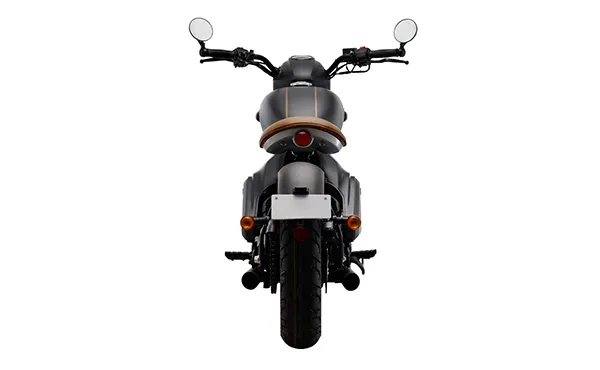
- Lighting: The motorcycle has a full-LED lighting system, including the headlamp, tail lamp, and turn indicators, which enhances visibility and modern appeal.
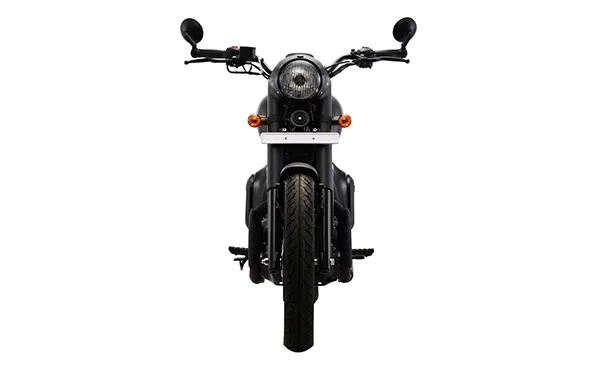
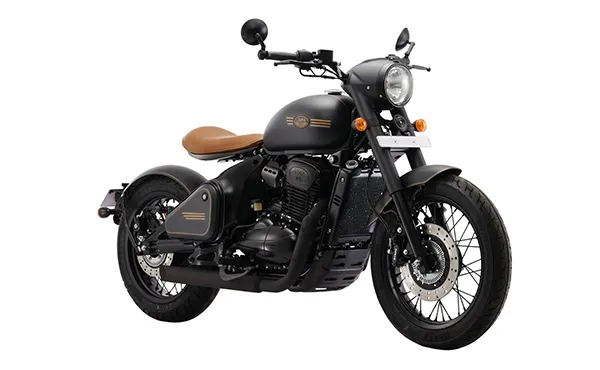
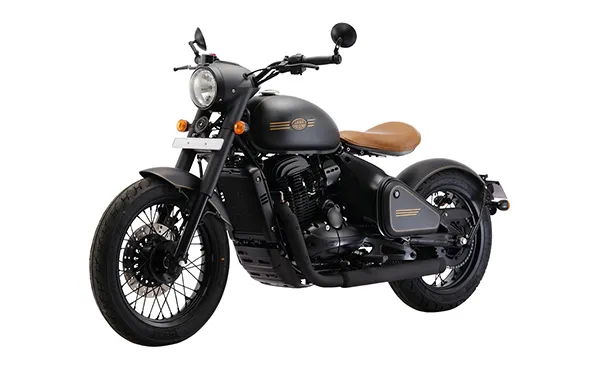
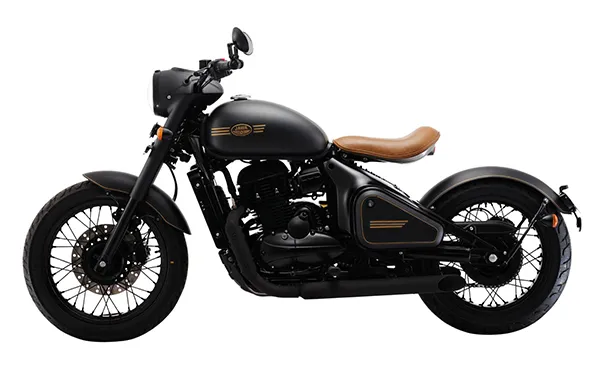
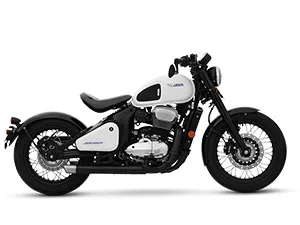
- Design elements: The single-seat configuration, minimalist fenders, and distinctive bobber styling contribute to its aesthetic appeal, making it a unique offering in the market.
- Tyre Configuration: Tubed tyres requiring regular pressure checks (32 psi front, 36 psi rear)
- Emission Compliance: BS6 Phase 2 with catalytic converter and OBD-II readiness
- Service Indicator: Dashboard service reminder activates at 5,000 km intervals
- Roadside Assistance: Included factory roadside assistance program for pan-India coverage.
- Engine Kill Switch: Handlebar-mounted kill switch for instant engine cutoff in emergencies.
- Starting System: Self-start only (electric start, no kick backup).
Build Quality
The Jawa Perak uses a double-cradle frame for stability and durability, which helps with handling and rider confidence, especially in corners and at high speeds. The strong steel frame and high-quality body panels stand up well to daily use and various weather conditions. Chip-resistant paint and chrome accents keep its classic style. Thanks to Jawa’s strict quality checks, most riders have few issues even after 10,000 km.
The Perak weighs 187 kg and feels stable due to its balanced weight distribution. Rust-proofing on the exhaust and undercarriage is helpful for coastal areas, and waxing once a year keeps the matte finish looking fresh. The frame’s welds are strong and handle drops better than some competitors. Powder-coated fasteners help prevent rust, and the seam-welded fuel tank avoids punctures. The 5-year warranty covers manufacturing defects, and most users say the frame stays strong after minor crashes, with only small cosmetic damage.
Handling
The Jawa Perak’s double-cradle frame gives it good stability and handling, making it easy to ride in both city traffic and on highways. The telescopic front suspension and twin rear shocks absorb bumps well, offering a smooth ride that balances comfort and sportiness. At 187 kg and with a 750 mm seat height, it’s easy to control at low speeds and stays stable at higher speeds. Dual-channel ABS helps prevent wheel lock-up on rough roads. With 165 mm ground clearance, it handles speed bumps well, but deep potholes still need caution.
Trail braking is easy to learn, and adjusting the preload can make the ride firmer when carrying a passenger or luggage. The wide rear tyre helps with cornering, even at lean angles up to 110 kmph. The 27-degree rake keeps the bike steady, and the caster angle helps it recover smoothly from small wobbles. It’s smart to true the spoke wheels every 5,000 km to avoid wobbles at high speeds. The Perak is well-suited to long, sweeping highways, where its stable chassis feels better than some sportier bikes can
Comfort
The Jawa Perak has a single, well-cushioned seat designed for comfort. With a seat height of 750 mm, it fits riders who are 5’6″ or taller. The seat shape helps reduce fatigue on long rides. Forward footpegs and wide handlebars create a relaxed riding position that helps prevent back strain. Vibration control is improved in the BS6 models, and the ride stays smooth up to 100 kmph. You can adjust the rear shock to make it firmer for solo rides or when carrying light luggage.
Adding gel seat pads can make long rides more comfortable, and bar-end weights help reduce mirror vibrations. The Perak is suitable for 300 km days if you take breaks every two hours. The space between the footpegs and seat fits riders up to 6’2″, and the knee bend is comfortable for most Indian riders around 5’8″. Wind is not an issue below 90 kmph, and riders using half-helmets report less neck strain than those with full-face helmets. Measuring suspension sag helps you set the right preload
Colour Options And Variants
The Jawa Perak comes in a single color option that adds to its classic look.
- Stealth Matte Black & Matte Grey
The Perak is available in one well-equipped version, which makes choosing and buying simple.
Value For Money And Pricing
The Jawa Perak starts at ₹ 2,19,000 (ex-showroom),offering good value after the GST price cuts. Its 334cc engine offers features such as dual-channel ABS and smooth handling, making it a practical choice for those seeking performance and safety.
Monthly EMIs start at ₹5,800. Each service costs about ₹2,500, which is slightly less than a comparable Royal Enfield. Bundled accessories such as a crash guard and tank pad add about ₹10,000 in value. Over three years, typical running costs for fuel, servicing, and tyres are about ₹45,000. Annual insurance costs about ₹8,500, with lower premiums if no claims are made. Trade-in bonuses up to ₹15,000 are available for owners exchanging a 150cc commuter bike. The Perak retains 80-85% of its value after 36 months or 30,000 km, while the Royal Enfield Classic may offer a slightly higher resale value.
The Perak delivers middleweight power at an entry-premium price, costing ₹20,000 more than the Classic but offering more performance and safety. It is suitable for riders upgrading from 200cc commuter bikes. The aftermarket for custom seats (₹8,000) and exhausts (₹15,000) enhances long-term ownership without greatly affecting resale value. Perak’s main rivals are similarly priced but differ in style and features:
Verdict
The Jawa Perak mixes classic heritage with modern features, making it a good choice for riders who care about style. Its 334cc engine, ABS, and bobber design make both daily rides and tours enjoyable. Even though there are limited options, it offers strong value for the price, especially compared to more expensive custom bikes or less powerful retro models. It’s a great pick for urban riders who want something different from the usual retro bikes.
A test ride is recommended to experience the Perak’s torque. It’s best for solo riders, and there’s growing aftermarket support for touring upgrades and visual changes that keep its custom look. If you service it regularly, the bike is very reliable over the long term, and there are many DIY guides in community forums. It’s an ideal second bike for enthusiasts who want a fun weekend ride without giving up weekday practicality.
Pros
- Striking Design: The Jawa Perak features a classic bobber design that appeals to retro enthusiasts.
- Strong performance:Powered by a 334cc liquid-cooled, single-cylinder engine.
- Comfortable riding position:The motorcycle is designed with a comfortable single-seat configuration that supports long rides without causing fatigue.
- Quality build:Built with high-quality materials and a robust double-cradle frame, the Perak is designed for durability and stability, ensuring a long lifespan.
- Safety features:Equipped with dual-channel ABS and a disc brake system, the Perak offers enhanced safety during rides, especially in emergency braking situations.
- Premium Finish: Users highlight superior pick-up over RE rivals and a premium finish.
- Low ownership costs: Low ownership costs and easy mods boost appeal for customisers.
- Warranty & Resale: Factory warranty transfers cleanly; resale value holds 85% after 2 years/20k km.
- Exhaust Note: Distinct exhaust rumble creates road presence without illegal mods.
Cons
- Limited color options:The Perak is available in a single colour choice, which may not appeal to riders seeking more personalised options.
- Single variant:The motorcycle is offered in a single variant, limiting choices for consumers who prefer different features or specifications.
- Weight:Weighing around 200 kg, the Perak may feel heavy for some riders, mainly during low-speed manoeuvres or for those not used to heavier motorcycles.
- Fuel efficiency:While the performance is commendable, the fuel efficiency may not be as high as some competitors, which could be a consideration for budget-conscious riders.
- Service network:While Jawa has been expanding its service network, it may not be as extensive as some competitors, potentially leading to longer wait times for service or parts.
- Waiting Periods: Up to 90 days in metros
- Spare Parts: Slightly pricier
- Engine Heat: Heat from the single-cylinder felt on the right leg during traffic stops.
- Pillion Delete: Limits family use; no windscreen stock for highways.
Other Related Links From Bikeleague India
List Of All Jawa Motorcycles In India
About Jawa Motorcycles
Jawa is a well-known motorcycle brand that started in Prague, Czechoslovakia (now the Czech Republic) in 1929, founded by František Janeček. In India, Jawa is remembered both as a popular import from the 1960s and 70s and as a retro brand brought back by Classic Legends (part of Mahindra Group) in 2018. Today, Jawa’s Indian models use 293 to 334cc single-cylinder engines that meet BS-VI standards and feature simple, modern classic designs.
History And Growth(1960s)
Jawa first came to India in 1960 and 1961, when Ideal Jawa (India) Ltd, run by the Irani family, started importing and later making Jawa 250 motorcycles in Mysore, Karnataka. These bikes became popular for their toughness, reliability, and unique tank design, building a loyal fan base before the brand changed to Yezdi in the 1970s.
After many years away, Jawa officially returned to India in 2018. Mahindra Group, through its company Classic Legends, got the rights from Jawa Moto (Czech Republic) to make and sell Jawa motorcycles in India and some other Asian countries. The relaunch started with three models: Jawa Standard, Jawa Forty-Two, and Jawa Perak. These were made at Mahindra’s Pithampur plant and designed as modern takes on the classic Jawa 250.
In the first years after the relaunch, Jawa attracted loyal customers by tapping into nostalgia and offering a good riding experience, even though its sales were lower than Royal Enfield’s. Classic Legends later added new models like the Jawa 42 Bobber, Jawa 42 FJ, and Jawa 350, aiming to make Jawa a more performance-focused, premium retro brand.
Key Milestones And Developments
- 1929–1970s: Founding of Jawa in Prague; global expansion; Jawa 250/350 models exported to more than 120 countries, including India.
- 1961: Jawa branded motorcycles begin local production in Mysore, Karnataka, under Ideal Jawa.
- 1971–1973: Transition from “Jawa” to “Yezdi” in India via the same factory and technical lineage.
- 2016: Mahindra strikes a licensing deal with Jawa Moto (Czech Republic) to revive the Jawa brand in India and eastern Asian markets.
- 2018: Three Jawa models—Jawa, Jawa Forty Two, and Jawa Perak—are formally launched; bookings open online, and production starts at Pithampur, Madhya Pradesh.
- 2019–2020: Jawa rolls out its first dealer network and achieves over 50,000 unit sales within the first 12-month commercial window, despite the onset of the pandemic.
- 2022–2024: Introduction and updates on the Jawa 42 Bobber, 42 FJ, and Jawa 350, with the 350 platform becoming the flagship engine across multiple variants.
- 2024–2025: Expansion of online sales via Flipkart and Amazon in 40+ Indian cities, signalling a push towards digital retail and wider accessibility.
Manufacturing Facilities
Today, Jawa motorcycles are made at Mahindra’s factory in Pithampur, Madhya Pradesh. This plant also makes other Mahindra vehicles and two-wheelers. It handles final assembly, engine fitting, sub-assembly, and quality checks for all Jawa bikes sold in India.
The Pithampur plant uses Mahindra’s strong supply chain and technology, which helps Jawa keep its build quality steady as production grows. Classic Legends also plans to increase capacity as Jawa, Yezdi, and BSA expand, with a goal of making 80,000 to 100,000 bikes per year across all brands.
Market Position And Achievements
Jawa presents itself as a premium retro brand in the mid-300cc motorcycle segment in India. It targets riders who want a bike that is more agile, compact, and easier to use in cities than the bigger Royal Enfield models. Jawa’s main prices range from about ₹1.59 lakh to ₹2.2 lakh, depending on the model and location.
Key market positioning points:
- Design and brand value: Jawa keeps many classic design features but adds cleaner and more modern touches than its older bikes.
- Performance and handling: The 293 to 334cc single-cylinder engines use fuel injection and liquid or semi-liquid cooling, giving a smoother and stronger ride than the old side-valve 350s.
- Dealer and service network: Jawa now has over 400 showrooms and more than 140 service centres across India. This gives the brand a solid, but still niche, presence compared to larger mass-market brands.
In terms of achievements, Jawa has:
1. Captured a dedicated retro enthusiast base without relying on mass market volumes.
2. Pioneered some of the earliest online only booking and direct sales models for premium motorcycles in India (via Flipkart/Amazon), reinforcing its digital first approach.
Future Plans
Classic Legends has shared big plans for Jawa, Yezdi, and BSA, aiming to make 80,000 to 100,000 motorcycles per year, driven by demand in India and more exports. For Jawa, the company expects to:
- 1. Add more versions based on the 350 platform, including new body styles and possibly lighter adventure or Scrambler-style models using the same engine.
- 1. 2. Update electronics and rider features, slowly adding ride-by-wire, ride modes, and better suspension to higher-end models.
- 3. Look into selling in international markets like Central America, Southeast Asia, Russia, and parts of Europe, where the Jawa name is still respected.
On the digital and retail side, Jawa–Yezdi is likely to:
- 1. Expand online sales and customization options to more platforms and cities, using the city-wide launches on Amazon and Flipkart as a model.
- 2. Put more effort into after-sales service and building a community through ride clubs, events, and customisation programs to keep Jawa’s strong brand image over time.
Other Related Links From Bikeleague India
- Top 10 Cruising bikes or Cruisers under 5 lakhs
- Jawa 42
- Jawa 350
- Jawa 42 Bobber
- Jawa Perak