
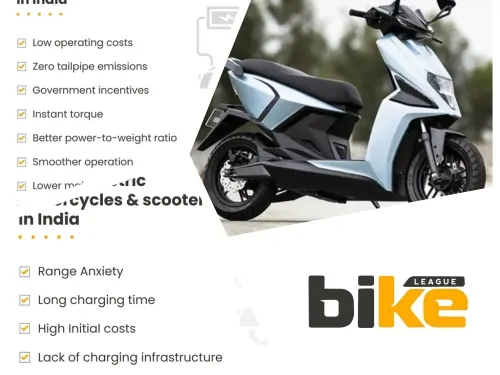
Long story short: Whether an electric motorcycle or scooter is right for you depends on your daily travel distance, charging access, purchase budget, battery warranty, and local service support—not just its advertised range or running cost.
This guide looks at the pros and cons of electric motorcycles and scooters in India, covering running costs, performance, charging, battery ownership, and environmental factors. Use it to see if an electric two-wheeler suits your routine and what to check before buying.
Key Takeaways
- Compare total ownership costs, not just purchase prices. Include energy, servicing, insurance, charger installation, and recurring payments.
- Check reliable charging access and whether the vehicle’s usable range comfortably covers your regular journeys.
- Electric two-wheelers produce no tailpipe emissions, but their environmental footprint also includes manufacturing, electricity generation and end-of-life treatment.
- Compare performance, charging time, and range for the exact model and variant.
- Verify battery warranty coverage, local service support and applicable incentives before paying.
Electric Motorcycles And Scooters In India: Pros And Cons At A Glance
| Factor | Potential advantage | Limitation or trade-off |
|---|---|---|
| Running costs | Lower energy costs, particularly with home charging. | Savings depend on electricity tariffs, consumption, and charging fees. |
| Purchase cost | Eligible incentives may reduce the upfront price. | Initial costs may be higher; include installation and recurring payments. |
| Daily travel and charging | Charging while parked can suit predictable daily journeys. | Usable range, charging time, and compatible charging access can limit flexibility. |
| Performance | Responsive low-speed acceleration and smooth power delivery. | Acceleration, top speed and handling vary by model. |
| Maintenance | No petrol-engine oil changes or spark-plug replacement. | Other components still need servicing; local repair support matters. |
| Emissions and noise | No tailpipe emissions or petrol-engine exhaust noise. | Manufacturing, charging electricity and tyre wear still have environmental impacts. |
| Battery ownership | Warranty coverage may protect against qualifying battery issues. | Check degradation coverage, replacement costs and end-of-life collection. |
Compare the specific electric and petrol models you are interested in. Lower running costs do not always mean lower total ownership costs.
What Are The Pros Of Electric Motorcycles And Scooters In India?
1. Lower Energy Costs
Electric motorcycles and scooters can cost less per kilometre to power than comparable petrol models, particularly when charged at home. Savings depend on your electricity tariff, charging losses, consumption, local petrol price, and the petrol vehicle’s fuel economy.
Compare costs over the same distance:
- Electric energy cost per km = electricity drawn from the socket in kWh × tariff per kWh ÷ distance travelled.
- Petrol fuel cost per km = petrol price per litre ÷ fuel economy in km per litre.
For example, a hypothetical electric scooter using 3 kWh from the socket over 100 km at ₹8 per kWh costs ₹0.24 per km. A petrol scooter returning 50 km per litre at ₹100 per litre costs ₹2 per km.
These are illustrative assumptions, not current prices or verified specifications. Electricity measured at the socket already includes charging losses. Public charging fees may produce a different result.
2. Zero Tailpipe Emissions
Electric motorcycles and scooters do not burn petrol, so they produce no exhaust emissions while riding. Replacing a petrol two-wheeler removes that vehicle’s tailpipe emissions from the streets where it is used.
However, zero tailpipe emissions do not mean zero environmental impact. Electricity generation, manufacturing, and end-of-life processing contribute to the vehicle’s footprint. Tyre and brake wear also remain sources of particulate pollution.
3. Government Incentives For Eligible Vehicles
Government incentives can reduce the upfront cost of eligible electric two-wheelers. Eligibility and benefit amounts depend on the applicable scheme, purchase date, vehicle, and state rules.
- Purchase incentives: Confirm whether the exact model qualifies and whether the quoted price already includes the benefit.
- Registration-certificate fees: Battery-operated vehicles have a central exemption for specified registration-certificate fees. This does not waive every on-road charge.
- State benefits: Road-tax concessions and additional incentives depend on current state rules.
Request an itemised quotation showing the vehicle price, incentive deductions, insurance, applicable tax and other charges. Do not subtract a subsidy again if it is already included.
4. Responsive Acceleration
Electric motors can deliver strong torque from low speeds, giving many electric two-wheelers a responsive feel when pulling away or accelerating through city traffic.
This does not make every electric model faster than a petrol alternative. Compare acceleration under similar conditions, including overtaking response at your usual speeds.
Many electric models also avoid clutch operation and gear changes, simplifying stop-start riding. Petrol scooters already offer similar automatic convenience.
5. Smoother Operation
Electric drivetrains avoid combustion-related engine vibration and can provide smooth power delivery. However, throttle calibration, riding modes and regenerative-braking settings affect the experience.
Battery placement does not automatically produce better handling. Overall weight, chassis, suspension and tyres matter. Test ride the model to assess comfort, balance and ease of manoeuvring.
6. Fewer Routine Powertrain Maintenance Tasks
Electric two-wheelers do not need petrol-engine oil changes, spark-plug replacement or engine air-filter servicing.
They are not maintenance-free. Tyres, brakes, suspension, bearings and other components still need attention. Belt or chain drives require model-specific maintenance.
Check service intervals, replacement items, local workshop availability and warranty conditions. Fewer routine tasks do not guarantee inexpensive repairs.
7. Lower Engine And Exhaust Noise
Electric motorcycles and scooters avoid petrol-engine and exhaust noise, making them quieter in many low-speed riding situations.
They are not silent: motors, drive systems, tyres and wind still produce sound. Pedestrians may not hear an approaching vehicle, so ride cautiously rather than assuming they know you are there.
8. More Efficient Energy Conversion
Electric drivetrains generally convert a greater share of onboard energy into movement than petrol engines, which lose substantial energy as heat.
Models with regenerative braking recover some energy while slowing down, but not all the energy used to accelerate. Charging losses, weight, speed, terrain, and riding style still affect consumption.
9. Reduced Dependence On Petrol
Electric two-wheelers replace petrol purchases with electricity charging for those journeys. Electricity can come from different generation sources rather than a single transport fuel.
This does not mean charging is fossil-fuel-free. Its emissions depend on the electricity mix, while the vehicle’s wider footprint includes manufacturing.
What Are The Cons Of Electric Motorcycles And Scooters In India?
1. Range Limitations And Journey Planning
Range becomes a concern when journeys are unpredictable, charging access is limited, or usable range is close to your daily requirement.
Advertised or certified range is not a guarantee for every journey. Speed, riding mode, load, terrain, weather, tyre pressure, and battery condition affect actual range.
Compare credible range evidence for the exact variant with your complete daily journey, including the return trip and detours. Allow a reserve and verify charging options before longer journeys.
2. Charging Takes Longer Than Petrol Refuelling
Charging usually takes longer than refuelling, which can limit flexibility when you need to continue immediately.
Compare like-for-like charging figures. A 0–80% claim is not a full-charge time, and fast charging requires a compatible vehicle and charger.
Charging while parked may suit predictable travel. Longer journeys may require charging stops, waiting time, and backup plans.
3. Potentially Higher Upfront Costs
An electric model may cost more initially than a comparable petrol vehicle. The difference depends on variants, equipment and applicable incentives.
Check whether the price includes the battery, charger and essential features. Include necessary installation and any rental, subscription, or paid feature plan.
Running-cost savings may recover a price premium, but the break-even period depends on usage and ownership costs.
4. Charging Access And Compatibility Limitations
A nearby charging station is not automatically suitable for your vehicle. Confirm compatibility, access hours, payment requirements, fees, and current availability.
For home charging, check the electrical supply and installation requirements. Apartment residents or tenants may need permission for wiring, parking and billing arrangements.
Assess charging along your actual routes. If public charging is essential, include extra travel, waiting time and fees in your decision.
5. Environmental Impacts Of Battery Production
Battery production involves extraction, processing and manufacturing, with impacts including energy consumption, emissions, water use and local environmental damage.
Materials vary by chemistry. Nickel manganese cobalt batteries use nickel and cobalt, while lithium iron phosphate batteries do not use either in their cathode chemistry. Neither is impact-free.
Battery production alone does not establish which vehicle is environmentally preferable. Compare the full lifecycle.
6. Battery Collection And Recycling Requirements
Waste batteries require appropriate handling, not disposal with household rubbish or uncontrolled dismantling.
India’s Battery Waste Management Rules require consumers to separate waste batteries and hand them to an entity engaged in collection, refurbishment or recycling. Producers also have Extended Producer Responsibility obligations.
Ask about take-back arrangements, charges and registered recycling or refurbishment channels. Do not open or dismantle a traction battery yourself.
7. Emissions From Charging Electricity
Charging-related emissions depend on the electricity supply and the vehicle’s energy consumption. Charging losses increase electricity demand.
Compare this with the petrol vehicle’s complete fuel supply chain and exhaust emissions—not exhaust alone. Manufacturing and lifetime usage also belong in the comparison.
8. Model Availability May Not Match Your Needs
Available electric models may not meet every combination of budget, body style, performance, range and charging needs.
Check comfort, pillion accommodation, storage, load capacity and route suitability. Distinguish vehicles available for delivery from concepts or announced products, and confirm local service support.
9. Battery And Charging Safety Responsibilities
Follow the exact model’s owner’s manual, charging instructions, and warranty conditions. Check for outstanding recalls or service campaigns.
- Use approved charging equipment and a suitable electrical installation.
- Do not use damaged chargers, cables or connectors.
- Do not open the traction battery or modify its management system.
- Seek authorised assessment after flooding, suspected damage or electrical warnings.
Water-resistance ratings and safety features do not remove the need for correct use and maintenance.
Common Myths About Electric Motorcycles And Scooters In India
1. Myth: Electric Two-wheelers Cannot Cover Everyday Travel
Fact: Suitability depends on the model and your complete daily journey. A vehicle suited to commuting may not suit frequent long-distance travel.
2. Myth: Electric Two-wheelers Always Cost More To Own
Fact: Lower running costs may offset a higher purchase price, but the result depends on usage, ownership period, and the models compared.
3. Myth: Charging Is Always Inconvenient
Fact: Reliable home or workplace charging can fit a parked vehicle’s routine. Dependence on public charging may be less convenient.
4. Myth: Electric Two-wheelers Are Inherently Unsafe
Fact: Assess the specific model’s approvals, instructions, recall history, and service support rather than judging safety solely by its power source.
5. Myth: Electric Models Cannot Offer Good Performance
Fact: Many offer responsive acceleration, but capabilities vary. Compare the exact variants under similar conditions.
6. Myth: Battery Warranty Expiry Means Replacement Is Due
Fact: Warranty expiry is not a replacement deadline. A battery may remain usable if it functions safely and its remaining capacity meets your needs.
7. Myth: Electric Two-wheelers Cannot Be Ridden In Rain
Fact: Permitted rain use and water exposure are model-specific. Follow the manufacturer’s limits; rain suitability does not mean flood-proofing.
8. Myth: Electric Two-wheelers Are Only For Young Riders
Fact: Suitability depends on the individual’s needs and the vehicle, not an age-based label.
How Do Upfront Costs Compare Between Electric And Petrol Two-wheelers In India?
There is no universal price difference. Compare vehicles serving similar needs: family scooters with family scooters, commuter motorcycles with commuter motorcycles, and performance models with comparable alternatives.
Obtain itemised quotations for exact variants in the same city and on the same date. Check:
- Vehicle price, battery and charger inclusion.
- Incentives already deducted.
- Insurance, applicable tax and registration-related charges.
- Necessary charging installation.
- Optional warranties, service plans and feature packages.
- Battery rental, subscriptions and other recurring payments.
Keep purchase cost separate from total ownership cost. If the electric model costs more initially, assess whether expected savings recover the difference during your ownership.
Example: Comparing Two Family Scooters
This example uses hypothetical prices and consumption figures, not current quotations or verified model specifications.
Upfront Cost Comparison
| Cost component | Electric scooter | Petrol scooter |
|---|---|---|
| On-road quotation | ₹1,30,000 | ₹1,05,000 |
| Necessary charging installation | ₹5,000 | Not applicable |
| Total initial cost | ₹1,35,000 | ₹1,05,000 |
The electric scooter costs ₹30,000 more initially. Assume both quotations are from the same city and date with comparable insurance. The electric quotation includes the battery, charger, and any applicable subsidy already deducted.
Energy-cost Assumptions
| Input | Electric scooter | Petrol scooter |
|---|---|---|
| Consumption | 3 kWh from the socket per 100 km, including charging losses | 50 km per litre |
| Energy price | ₹8 per kWh | ₹100 per litre |
| Energy cost per km | ₹0.24 | ₹2.00 |
The electric scooter saves ₹1.76 per kilometre in energy costs under these assumptions.
How Monthly Usage Affects Break-even
| Monthly distance | Electricity cost | Petrol cost | Monthly saving | Energy-only break-even |
|---|---|---|---|---|
| 500 km | ₹120 | ₹1,000 | ₹880 | About 34 months |
| 1,000 km | ₹240 | ₹2,000 | ₹1,760 | About 17 months |
The energy-only break-even distance is approximately 17,045 km: ₹30,000 divided by ₹1.76 per km. Higher monthly usage reaches that distance sooner.
This is not a complete total-cost-of-ownership calculation. It excludes servicing, insurance renewals, financing, subscriptions, repairs, and resale value, and assumes unchanged energy prices and consumption.
Replace these inputs with dated quotations and credible consumption figures before making a purchase decision.
How Should The Environmental Impact Of Electric Two-wheelers Be Assessed?
A fair comparison considers the full lifecycle rather than tailpipe emissions alone.
1. Raw Materials And Manufacturing
Assess battery chemistry, pack size, material sourcing, and manufacturing energy. Different batteries do not use identical materials or have identical impacts.
2. Energy Supply And Riding
Include electricity generation and charging losses for the electric vehicle. For the petrol vehicle, include extraction, refining, distribution, and exhaust emissions.
3. Lifetime Use And Battery Condition
State lifetime distance and any battery-replacement assumptions. Do not assume replacement after a fixed number of years without evidence.
4. Collection And Recycling
Recycling can recover materials, but recovery rates vary by material and process. A demonstrated recovery rate does not establish that every discarded battery is collected or recycled.
5. Check The Comparison’s Relevance
- Does it compare similar two-wheelers?
- Is the electricity mix relevant to India, with the year identified?
- Are efficiency, lifetime distance, and replacement assumptions stated?
- Are both energy supply chains included?
- Are greenhouse gases distinguished from mining impacts, water use and local pollution?
- Are collection and recycling assumptions explained?
Do not apply an electric-car emissions percentage to Indian two-wheelers without a relevant study.
Frequently Asked Questions About Electric Motorcycles And Scooters In India
1. Is An Electric Motorcycle Or Scooter Worth Buying?
It can be if its usable range, charging needs, and ownership costs suit your routine. Compare suitable models, battery warranty, and local service support before deciding.
2. Are Electric Two-wheelers Cheaper To Own Than Petrol Models?
They can be, but lower energy costs do not guarantee lower total costs. Include purchase price, charging, servicing, insurance, and recurring payments over your ownership period.
3. How Much Does It Cost Per Kilometre To Run An Electric Scooter?
Multiply electricity drawn from the socket by your tariff, then divide by distance travelled. The hypothetical example above gives ₹0.24 per km; actual costs vary.
4. Can You Charge An Electric Scooter Every Day?
Daily charging is acceptable if permitted by the manufacturer. Follow the model’s instructions and use approved equipment. A full charge is not necessarily needed every day.
5. How Long Can An Electric Two-wheeler And Its Battery Last?
Lifespan depends on usage, maintenance, battery health, and parts availability. Warranty expiry is not an automatic replacement date. Have faults or noticeable range loss assessed professionally.
6. How Much Does A Replacement Battery Cost?
Costs vary by model and battery pack. Request an authorised-service quotation including taxes and labour. Check warranty eligibility, replacement-battery coverage and old-pack collection arrangements.
7. Are Electric Motorcycles And Scooters Maintenance-free?
No. They avoid petrol-engine maintenance, but tyres, brakes, suspension and drive components still need servicing. Follow the manufacturer’s schedule and use authorised support for electrical faults.
8. What Battery And Charging Precautions Should Owners Follow?
Use approved equipment and follow charging and water-exposure instructions. Do not charge damaged batteries or block escape routes. A faulty battery can present a fire risk even when unplugged; if it smokes or burns, leave the area and call the fire service.
Sources And Verification
The cost tables use hypothetical assumptions, not current quotations or BikeLeague road-test results. Prices, incentives, warranties and charging specifications can change.
Before buying, check official documentation for the exact variant, obtain a dated quotation and confirm applicable rules with the relevant authority.
- PM E-DRIVE official scheme portal
- Registration-certificate fee exemption for battery-operated vehicles
- CPCB Battery Waste Management portal
- IEA battery supply-chain sustainability report
- General e-scooter battery-safety guidance
The IEA report provides supply-chain background, not a verified emissions comparison for Indian two-wheelers. UK battery-safety guidance provides general precautions, not Indian legal requirements or fire-rate statistics. State rules and model-specific instructions require separate checks.
Checklist Before Buying An Electric Motorcycle Or Scooter
- Compare usable range with your complete daily journey, allowing a reserve.
- Confirm charging access, installation requirements, and property permissions.
- Verify public-charger compatibility and availability where needed.
- Obtain an itemised quotation covering the battery, charger, incentives and extra charges.
- Compare ownership costs over your expected distance and ownership period.
- Read battery-warranty limits, degradation coverage, exclusions and transfer conditions.
- Confirm authorised servicing, roadside assistance and battery take-back arrangements.
- Check the exact model’s registration, driving licence and insurance requirements.
- Test ride for comfort, throttle response, braking and parking ease.
- Read instructions for charging, rain use and suspected damage.
Other Related Articles From Bikeleague India
- Electric scooter vs petrol scooter: Which is best?
- Diesel bikes in India: Why are they absent on Indian roads?
- How to read two-wheeler tyre codes and sizes
- Motorcycle batteries: Types and maintenance tips
- Simple Energy electric scooters
Conclusion
Pick an electric motorcycle or scooter based on your travel needs, charging options, total ownership cost, battery warranty, and local service support—not just the advertised range or price.
Compare electric and petrol models that fit your needs, get detailed quotes, and take a test ride. If charging or range does not work for your routine, look at other options instead of settling for less than you need.
Have a question about the points covered here? Leave a comment below or email bikeleagueindia@gmail.com.
“`