
Long story short: Find out how Yamaha’s hybrid motorcycle technology, the Smart Motor Generator (SMG), works. Discover its real pros and cons, which bikes in India use it, how it affects fuel efficiency, maintenance tips, and more—all in one place.
Yamaha’s hybrid motorcycle technology is changing how Indian riders view efficiency, performance, and daily use. By combining a petrol engine with smart electric assist, Yamaha offers better city riding, smoother power delivery, and real fuel savings, all without needing to charge the bike.
This article is your complete guide to how Yamaha’s Smart Motor Generator (SMG) system works, its main pros and cons, and what it means for popular bikes in India.
Key Takeaways
- Yamaha’s Smart Motor Generator (SMG) hybrid system gives mild electric help to the petrol engine. This means smoother acceleration, a better city riding experience, and noticeable fuel savings, all without needing to charge the bike.
- hybrid technology works especially well in Indian city traffic. The Stop & Start System (SSS) turns off the engine when you’re stopped and restarts it immediately, reducing fuel waste and making commutes more efficient.
- The hybrid system makes the ride smoother and improves low-speed response, but it doesn’t give a big boost in performance or offer an “EV mode.” The electric motor can’t move the bike on its own, and the power numbers are the same as the standard model.
- Maintaining Yamaha’s hybrid models is just as simple as with regular motorcycles. There are no extra routine service needs. Only hybrid-specific repairs require an authorised service centre, and the hybrid battery is covered by the standard warranty.
- You can find the hybrid system in the Ray ZR 125 Fi Hybrid, Fascino 125 Fi Hybrid (scooters), and FZ-S Fi Hybrid motorcycle in India. This proven, reliable technology makes daily commuting better, but it does cost a bit more and has some limits, like single-channel ABS.
The
What Is Yamaha’s Hybrid Technology?
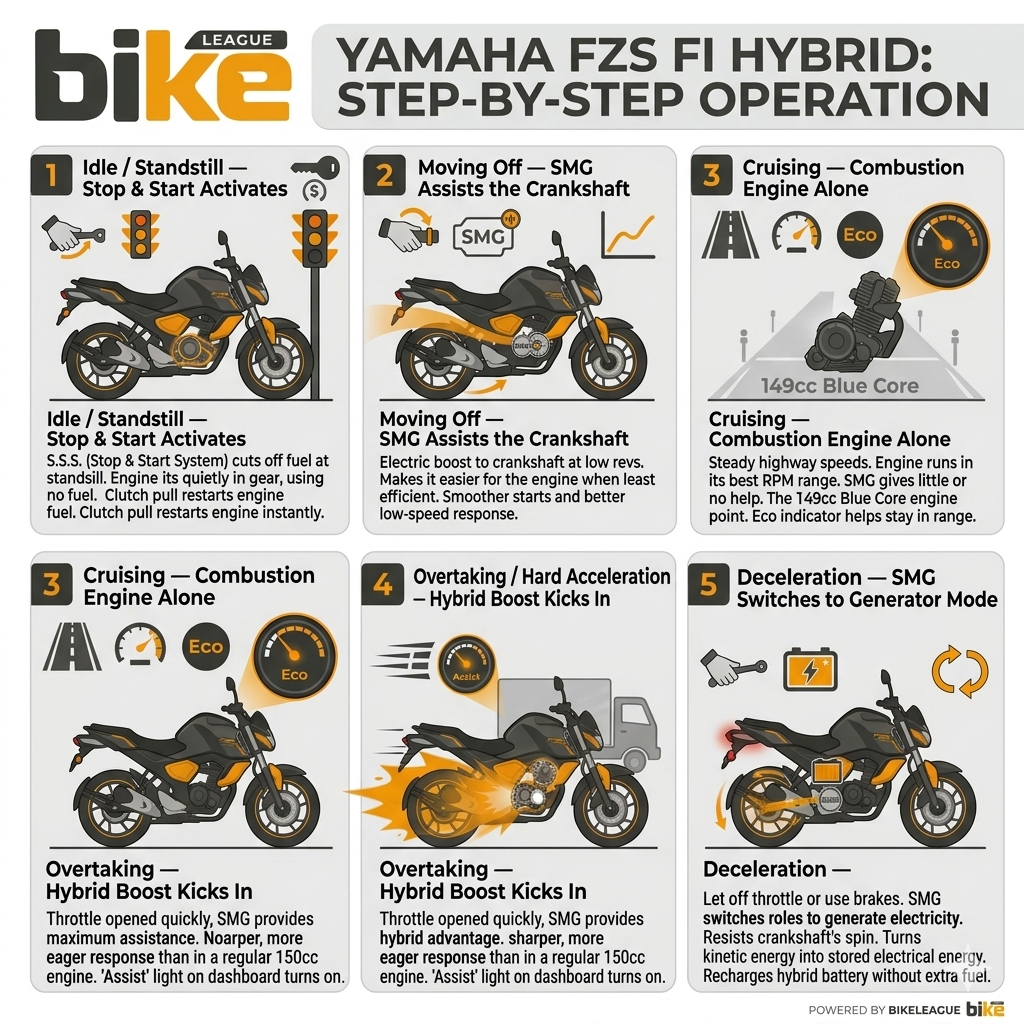
Yamaha’s hybrid system features a mild-hybrid setup centered on the Smart Motor Generator (SMG). This compact electric motor attaches to the engine crankshaft, assists with acceleration, and recharges the battery during deceleration by acting as both a motor and a generator.
A full hybrid runs on electric power alone, while a plug-in hybrid charges from a socket. In contrast, the SMG system always operates alongside the petrol engine and cannot move the bike independently. Instead, it reduces engine strain, smooths power delivery, and enables the stop-start feature.
Key Features Of Yamaha’s Smg Hybrid System
- Hybrid Power Assist (HPA): The SMG gives extra torque at low RPM during acceleration. This makes the motorcycle feel more responsive for overtaking and starting in city traffic, without changing the engine’s actual output.
- Stop & Start System (SSS): The engine automatically shuts off when stationary (at red lights or in traffic jams) and restarts instantly and silently when the rider pulls in the clutch. This is one of the smoothest stop-start implementations in any Indian two-wheeler.
- Silent Engine Start: Since the SMG replaces the usual starter motor, the engine starts without the typical cranking noise. It fires up almost silently, giving the bike a premium feel for its segment.
- Assist & Eco Indicators on TFT Console: The 4.2-inch TFT display shows an “Assist” light whenever the SMG is delivering electric power, and an “Eco” indicator to guide the rider into the most fuel-efficient RPM band.
- Y-Connect App Integration: Via Yamaha’s smartphone app, riders can monitor real-time fuel efficiency, hybrid assist status, trip data, turn-by-turn navigation, call and SMS alerts, and motorcycle diagnostics.
- Segment-First Traction Control: The FZ-S Hybrid adds switchable traction control — a feature previously found only on premium motorcycles — making it significantly safer in slippery or unpredictable conditions.
- No External Charging Required: The hybrid battery recharges itself by capturing energy when you slow down or when the engine is coasting. There is no plug or charging cable. You do not need to worry about range, just like with a regular bike.
How Does Yamaha’s Smg Hybrid Work?
The Foundation: What Is A Smart Motor Generator?
The SMG is an electric motor integrated into the crankshaft, functioning in two ways. When powered, it spins to assist the crankshaft. When the crankshaft spins faster than the SMG, such as during coasting, the SMG resists and generates electricity.
This two-way function keeps the mild-hybrid system simple and efficient. One small part handles both energy recovery and power assist, so Yamaha did not need to make major changes to the 149cc Blue Core engine.
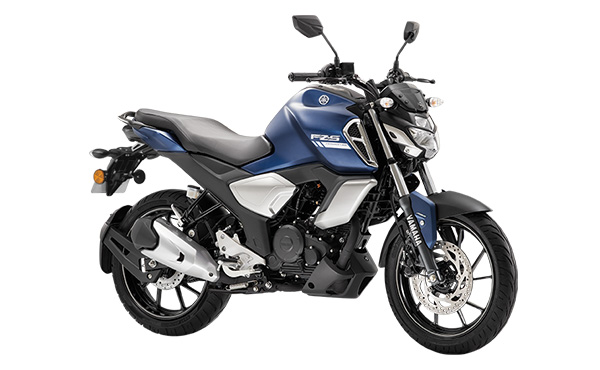
Step-by-step Operation
- Step 1: Idle/StandStill-Stop & Start Activates
- Step 2: Moving Off-SMG Asssists the Crankshaft
- Step 3: Cruising-Combustion Engine Primary
- Step 4: Overtaking & Hybrid Boost-SMG As
- Step 5: Deceleration & Regenerative Braking-SMG Recharges
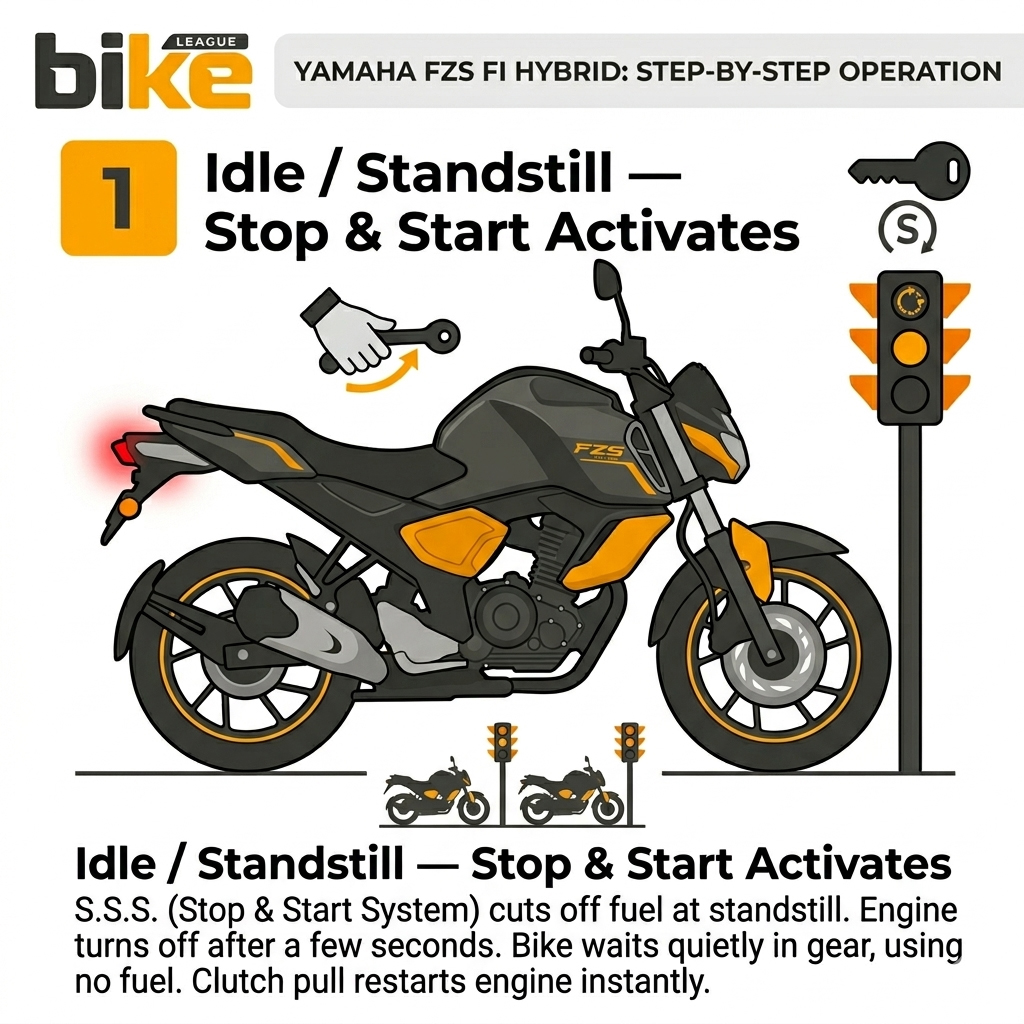
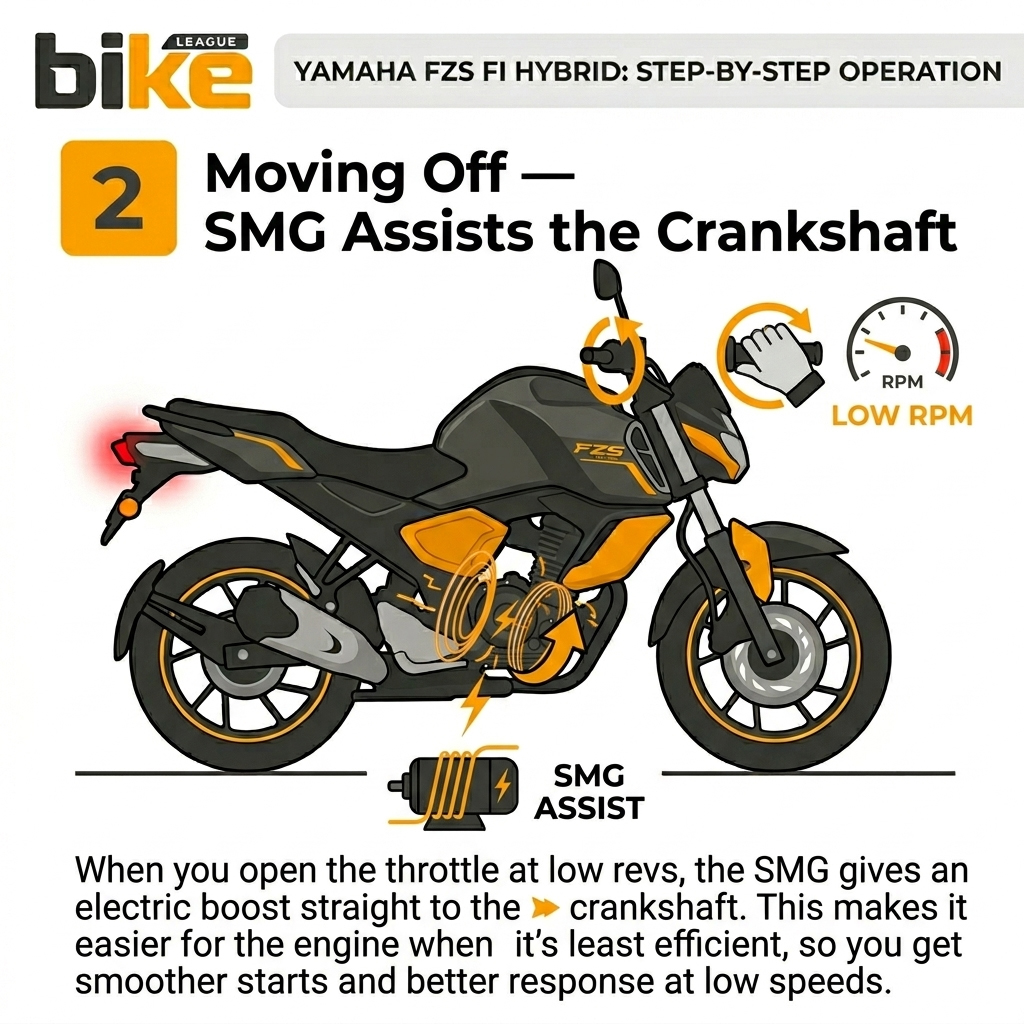
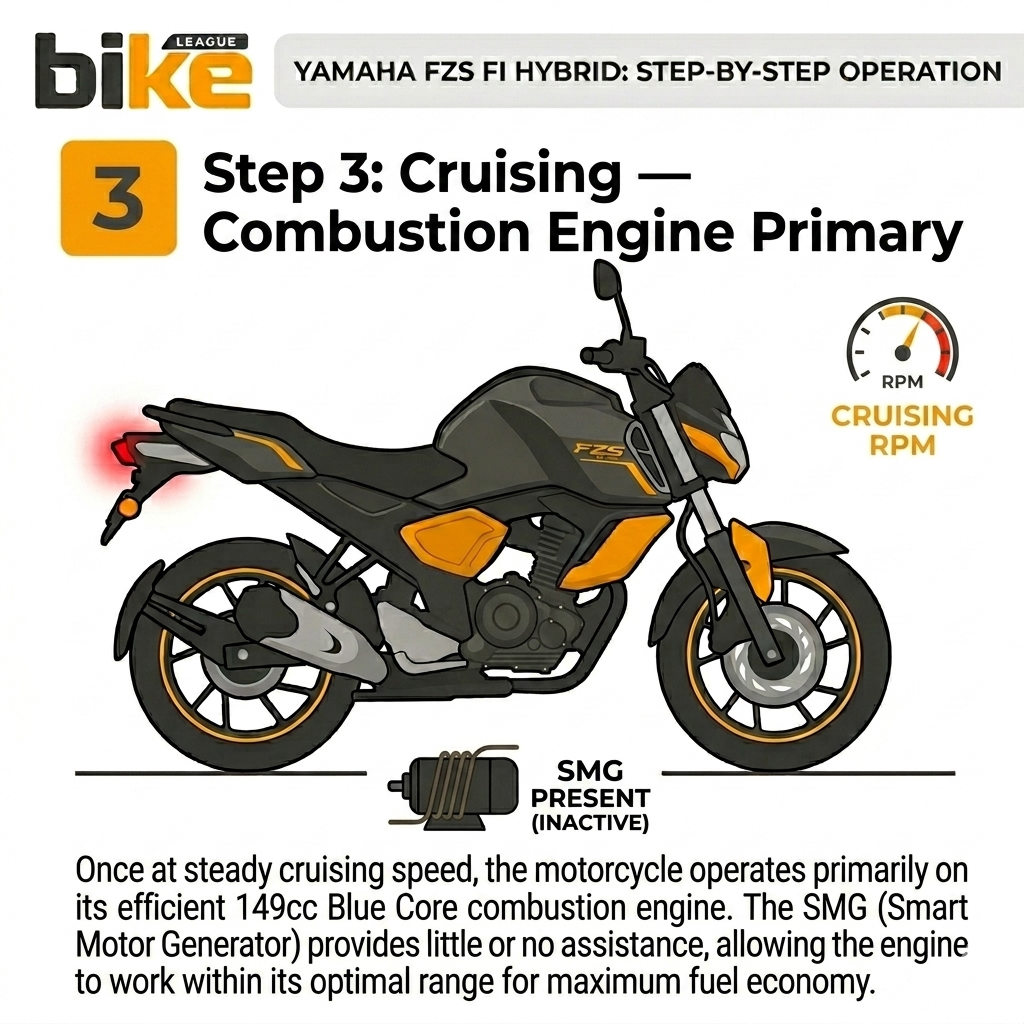
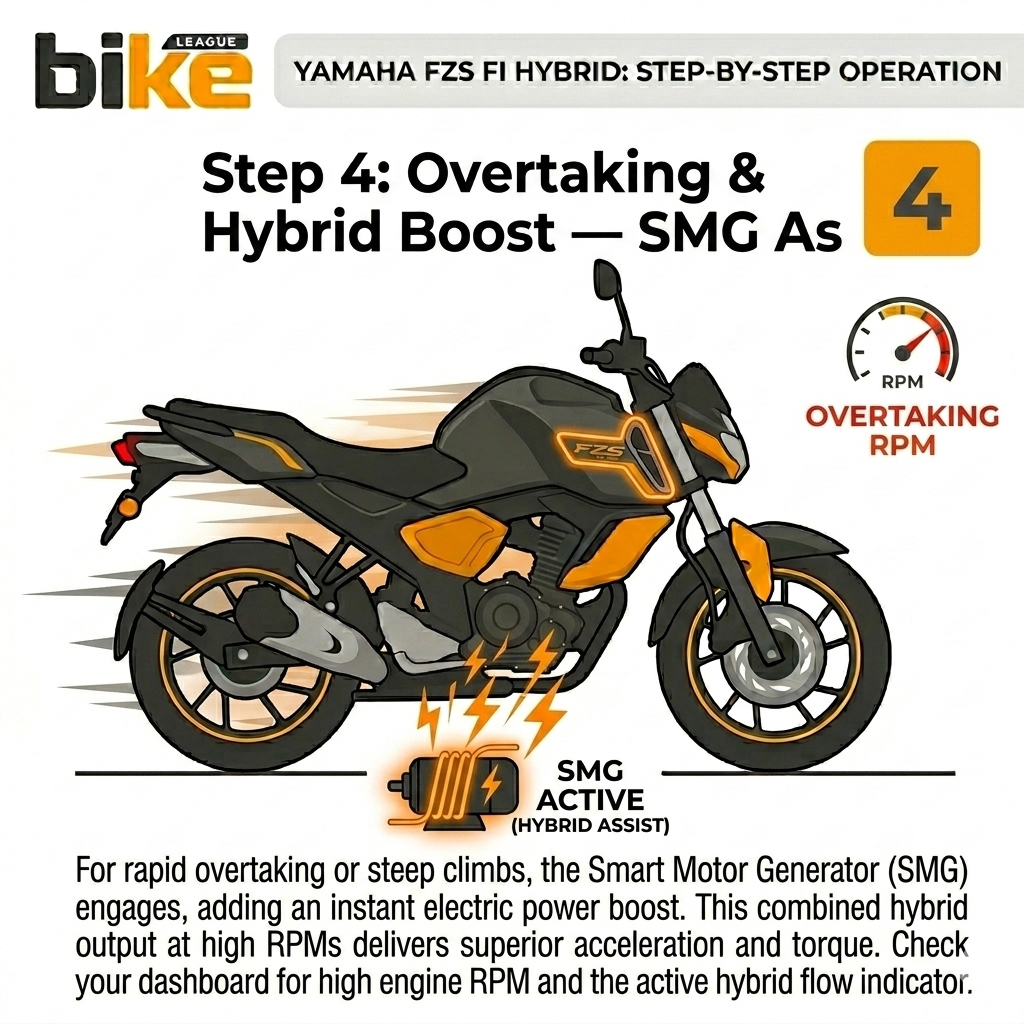
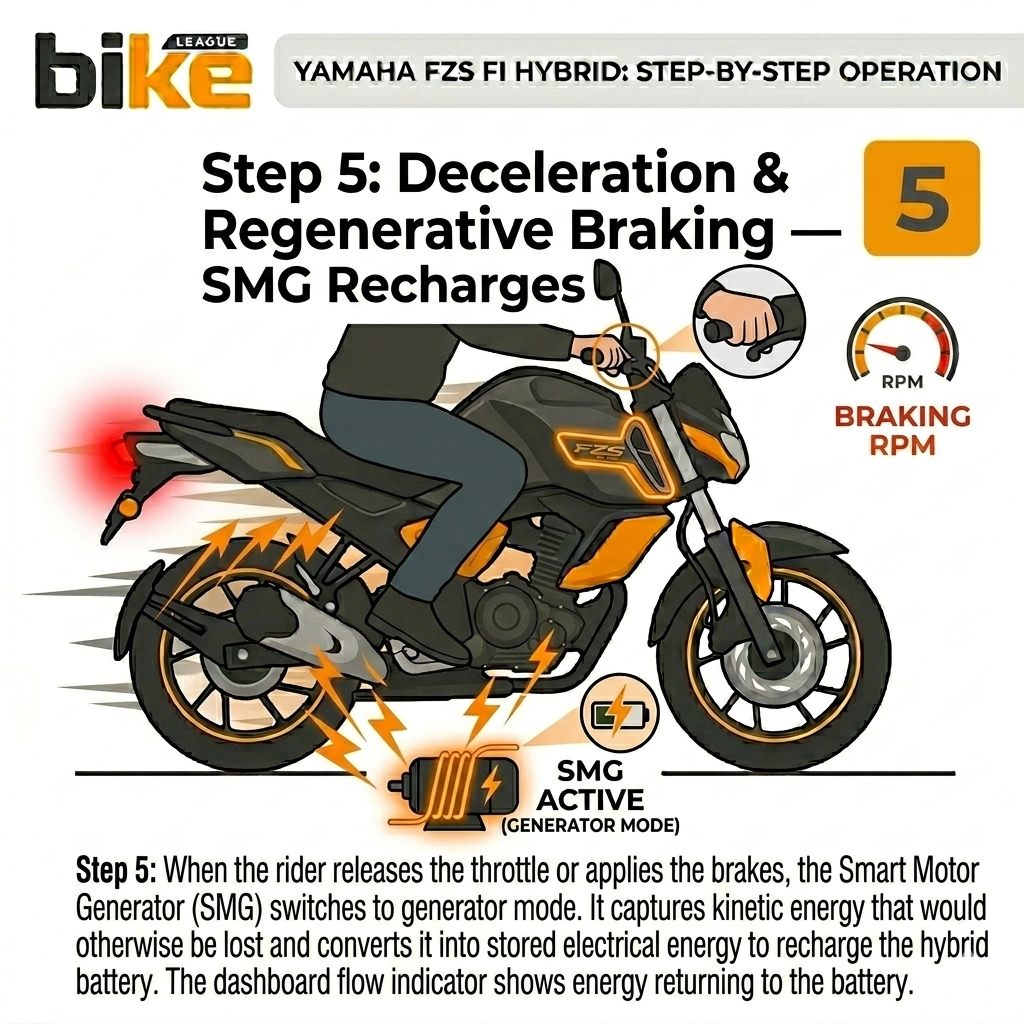
- Step 1 Idle / Standstill — Stop & Start Activates
When the motorcycle stops and the RPM drops to idle, the SSS cuts off fuel and turns off the engine after a few seconds. The bike waits quietly in gear, using no fuel. As soon as you pull the clutch, the SMG restarts the engine almost instantly. - Step 2 Moving Off — SMG Assists the Crankshaft
When you open the throttle at low revs, the SMG gives an electric boost straight to the crankshaft. This makes it easier for the engine when it’s least efficient, so you get smoother starts and better response at low speeds. - Step 3 Cruising — Combustion Engine Alone
At steady highway speeds, the engine runs in its best RPM range, and the SMG gives little or no help. The 149cc Blue Core engine operates at its most efficient point. The Eco indicator helps you stay in this range. - Step 4 Overtaking / Hard Acceleration — Hybrid Boost Kicks In
When you open the throttle quickly, the SMG provides maximum assistance alongside the engine’s power. The “Assist” light on the dashboard turns on. This is when you really notice the hybrid’s advantage—a sharper, more eager response than a regular 150cc engine. - Step 5 Deceleration — SMG Switches to Generator Mode
When you let off the throttle or use the brakes, the SMG switches roles. Instead of helping, it generates electricity by resisting the crankshaft’s spin, turning kinetic energy into stored electrical energy. The hybrid battery recharges without using extra fuel or needing you to do anything.
Which Yamaha Models In India Have Hybrid Technology?
As of May 2026, Yamaha’s SMG hybrid system is available across two segments in India:
| Model | Engine | Segment | Hybrid System |
|---|---|---|---|
| Yamaha Ray ZR 125 Fi Hybrid | 125cc | Scooter | SMG Mild-Hybrid |
| Yamaha Fascino 125 Fi Hybrid | 125cc | Scooter | SMG Mild-Hybrid |
| Yamaha FZ-S Fi Hybrid | 149cc | Commuter Motorcycle | SMG Mild-Hybrid |
| Yamaha FZ-X Hybrid | 149cc | Commuter Motorcycle | SMG Mild-Hybrid |
The FZ-S Fi Hybrid is a landmark model. Yamaha launched India’s first hybrid motorcycle in the 150cc class in March 2025.
Pros Of Yamaha Hybrid Technology (smg)
- Traffic-Ready Stop & Start — Ideal for Indian Cities: In India’s cities, riders often have to stop at signals, junctions, and in heavy traffic. The SSS turns off the engine at every stop, quietly saving fuel without you having to do anything. Users often say it’s one of the smoothest stop-start systems on any Indian two-wheeler.
- Improved Low-End Torque Feel: The SMG helps most where a 150cc single-cylinder engine is weakest: at low RPM. This makes the FZ-S Hybrid feel smoother and easier to ride in the city, even if the performance numbers don’t change much on paper.
- Genuinely Better Fuel Efficiency: Real-world tests returned 51.64 kmpl in city conditions and 48.20 kmpl on the highway — strong numbers for a 150cc streetfighter. Yamaha’s ARAI-certified claim is 60 kmpl. The combination of SMG assist and stop-start technology contributes meaningfully to these figures.
- No Plug Required — Self-Charging System: Unlike plug-in hybrids, the SMG hybrid battery recharges itself through regenerative braking and the engine. You don’t have to change your routine—there’s no charging port, no range planning, and no compromises.
- Silent, Premium Engine Starts: Every time the engine restarts—by key or stop-start—the SMG replaces the usual noisy starter motor. Instead, you get a smooth, quiet crank. This small change makes the bike feel more premium every time you ride.
- Comprehensive Connected Features: The hybrid variant brings the entire Y-Connect ecosystem — TFT display, Bluetooth app, turn-by-turn navigation, call/SMS alerts, hybrid status indicators — features previously reserved for much more expensive motorcycles.
- Segment-First Traction Control: The FZ-S Hybrid is the only 150cc commuter motorcycle in India to offer switchable traction control, adding a meaningful safety advantage that benefits both new and experienced riders.
- Proven Technology from the Scooter Segment: Yamaha’s SMG system is proven technology. The same core system has worked reliably in the RayZR 125 and Fascino 125 hybrid scooters in India for years, so buyers can trust its long-term dependability.
Cons Of Yamaha Hybrid Technology (smg)
- Hybrid Assist Is Difficult to Feel: Many users have said that the SMG’s help is hard to notice while riding. Performance test numbers for the hybrid are nearly identical to those of the standard FZ-S. The system works quietly in the background and doesn’t give a noticeable boost that riders can feel.
- No Meaningful Performance Gains: The FZ-S Hybrid produces the same 12.4 PS and 13.3 Nm as the standard FZ-S. The hybrid system is tuned for efficiency and refinement, not outright performance. Riders looking for a noticeable power increase will not find it here.
- Price Premium Over Standard FZ-S: The FZ-S Hybrid costs quite a bit more than the standard FZ-S. Buyers need to decide if the better efficiency, extra features, and smoother ride are worth the higher price.
- Single-Channel ABS — A Missed Opportunity: At its price point, the FZ-S Hybrid offers only single-channel ABS (front wheel only). Competitors in this segment are increasingly offering dual-channel ABS. Yamaha positions this model as a technology flagship, but omits dual-channel ABS—a notable drawback.
- Fuel Efficiency Split Is Unclear: It’s hard to tell how much of the mileage improvement comes from the SMG assist compared to the stop-start system alone. The stop-start feature likely adds more efficiency in city riding, so it’s unclear how much the hybrid hardware itself contributes.
- Long-Term Battery Durability Uncertain: The FZ-S Hybrid has only been on Indian roads since early 2025. There is limited real-world data on how the SMG’s hybrid battery holds up after 3-5 years of use in India’s heat, humidity, and variable road conditions.
What Are The Performance And Maintenance Aspects Of Yamaha Hybrid Technology (smg)?
Performance
In everyday use, the Yamaha SMG hybrid stands out more for its smoothness and feel than for big performance numbers. The low-RPM assist makes city acceleration smoother and easier. The stop-start system saves fuel at signals. On the highway, the 149cc Blue Core engine runs efficiently on its own, without needing electric help.
Users who tested the bike hard in both city and highway conditions usually got 40-52 kmpl, which is good for a 150cc streetfighter and better than the standard FZ-S in most cases. The ARAI figure of 60 kmpl is only possible in ideal test conditions.
Maintenance
Yamaha set the FZ-S Hybrid to use the same service intervals as the standard FZ-S. The hybrid system does not require a separate maintenance schedule. For regular oil changes, brake service, and normal repairs, any authorised Yamaha dealer can work on the bike.
However, the SMG unit and hybrid battery are special parts. For any hybrid-specific repairs, you need to visit an authorised Yamaha service centre with trained technicians. Yamaha covers the hybrid system under its standard two-year warranty.
Myths And Misconceptions About Yamaha Hybrid Technology
Myth 1 : The Fz-s Hybrid Can Run On Electric Power Alone
Reality: The SMG system is a mild-hybrid. The electric motor cannot propel the motorcycle on its own. It only assists the combustion engine. You cannot switch to an ‘EV mode’ — the engine is always required.
Myth 2 : The Hybrid System Needs To Be Plugged In To Charge
Reality: The SMG battery is entirely self-charging via regenerative deceleration. There is no charging port, no cable, and no charging infrastructure required. It works exactly like a conventional motorcycle from the rider’s perspective.
Myth 3 : The Fz-s Hybrid Is Significantly Faster Than The Standard Fz-s
Reality: On-paper power and torque figures are identical between the hybrid and non-hybrid variants. The performance benefit of the SMG is in smoothness and low-RPM responsiveness, not top-end speed or 0-100 acceleration time.
Myth 4 : The Hybrid System Makes Maintenance Complicated And Expensive
Reality: Yamaha has kept the FZ-S Hybrid on the same service schedule as the standard model. Routine maintenance is unchanged. The SMG simplifies the electrical system by removing the conventional starter motor.
Myth 5 : The Stop & Start System Is Annoying And Inconvenient
Reality: The SSS restarts the engine almost instantly when you pull in the clutch. Users consistently praise it as one of the best-implemented stop-start systems in any Indian two-wheeler — smooth, fast, and unobtrusive. It even restarts when you accidentally stall.
Myth 6 : The Hybrid System Is Unproven And Risky
Reality:Yamaha’s SMG technology has been deployed in the Indian market for several years through the RayZR 125 and Fascino 125 hybrid scooters. The FZ-S Hybrid is an evolution of established technology, not a first-generation experiment.
Myth 7 : Hybrid Motorcycles Are Not Suitable For Long-distance Touring
Reality: Yamaha’s SMG hybrid models are designed to be used just like any conventional motorcycle, including for long rides and highway cruising. The hybrid system operates automatically in the background and does not limit range or require special planning.
Myth 8 : The Hybrid Battery Needs Frequent Replacement
Reality: The SMG hybrid battery is built to last for several years under normal use and is covered by Yamaha’s standard two-year warranty. There is no routine need for battery replacement; it is designed for the life of the motorcycle in typical conditions.
Myth 9 : Hybrid Motorcycles Have Less Power For Overtaking
Reality: The SMG system actually provides a torque boost at low RPM, helping with initial acceleration and overtaking in city traffic. The overall power output remains consistent with non-hybrid models, and the hybrid assist makes the bike feel more responsive at lower speeds.
Myth 10 : Special Riding Skills Are Required To Operate A Hybrid Motorcycle
Reality: No new skills or habits are needed. You operate Yamaha’s hybrid motorcycles exactly like any other geared or automatic two-wheeler. The hybrid functions are seamless and automatic, requiring no rider intervention.
Frequently Asked Questions About Yamaha Hybrid Technology
1. Which Yamaha Models In India Currently Have Hybrid Technology?
As of May 2026, three models carry Yamaha’s SMG hybrid system: the RayZR 125 Fi Hybrid, Fascino 125 Fi Hybrid (scooters), the FZ-S Fi Hybrid and FZ-X.
2. Can I Turn Off The Hybrid System On The Fz-s?
There is no rider-accessible switch to disable the SMG hybrid system. The stop-start feature operates automatically based on riding conditions. There is no ‘hybrid off’ mode — the system is designed to be seamless and unobtrusive.
3. Does The Hybrid System Require Any Change In Riding Technique?
No. You ride the FZ-S Hybrid exactly like any other manual motorcycle — clutch, gearbox, throttle, brakes. The only change is that the engine will shut off at a standstill and restart when you pull the clutch. No special habit or technique is required.
4. What Is The Real-world Mileage Of The Fz-s Fi Hybrid?
Autocar India’s tests returned 51.64 kmpl in city riding and 48.20 kmpl on the highway. Other users observed 40-45 kmpl under mixed hard-riding conditions. ARAI’s official figure is 60 kmpl, achievable under controlled testing conditions.
5. Will Yamaha Bring Hybrid Technology To Bigger Motorcycles?
Yamaha has revealed prototype work on a Series-Parallel Hybrid Electric Vehicle (SPHEV) system — a far more advanced architecture combining a crankshaft-mounted generator with a separate axle-mounted electric drive motor. Yamaha has hinted this could eventually appear in a model powered by the CP3 triple-cylinder engine (MT-09). This is currently prototype-stage technology.
6. Is The Hybrid Battery Covered Under Warranty?
Yes. The SMG system and hybrid battery are covered under Yamaha’s standard two-year manufacturer warranty for new motorcycles in India. All hybrid-related services and repairs must be carried out at authorised Yamaha service centres.
7. How Does The Fz-s Hybrid Handle In Heavy Indian Traffic?
The FZ-S Hybrid’s light 138 kg kerb weight, accessible 790 mm seat height, and smooth low-RPM torque delivery from the SMG make it an excellent urban machine. The stop-start system eliminates fuel waste during idle. The overall package is genuinely well-suited to Indian city commuting conditions.
8. What Happens If The Hybrid Battery Fails?
If the hybrid battery or SMG unit develops a fault, the motorcycle will display a warning on the TFT screen. While the petrol engine will still operate, the hybrid assist and stop-start features may be disabled until the vehicle is repaired at an authorised Yamaha service centre. The hybrid components are covered by a 2-year warranty.
9. Can The Hybrid System Be Retrofitted To Older Yamaha Models?
No, Yamaha’s SMG hybrid system is integrated into the engine and electrical architecture from the factory. It cannot be retrofitted to standard FZ-S or other existing Yamaha motorcycles or scooters.
10. Does The Hybrid System Require Special Maintenance After Heavy Rain Or Water Crossings?
No special maintenance is required. Yamaha’s hybrid motorcycles are designed for normal Indian weather, including monsoon rains. However, as with any motorcycle, avoid submerging the engine or electrical components in deep water, and have the bike checked if it has been exposed to flooding.
Glossary Of Technical Terms Used In This Article
- ABS (Anti-lock Braking System): A safety feature that prevents wheels from locking up during braking, improving control and stability, especially on slippery surfaces. “Single-channel ABS” means only the front wheel is protected.
- ARAI (Automotive Research Association of India): The government-authorised body in India responsible for certifying vehicle fuel efficiency and emissions.
- Blue Core Engine: Yamaha’s proprietary engine technology focused on improving fuel efficiency, power, and environmental performance.
- EV Mode: Refers to “Electric Vehicle Mode,” where a hybrid vehicle can run on electric power alone. Yamaha’s SMG system does not offer EV mode.
- Crankshaft: The rotating shaft inside an engine that converts the up-and-down movement of pistons into rotational force used to drive the motorcycle.
- Eco Indicator: A dashboard light or display icon that guides the rider to operate the bike in the most fuel-efficient RPM range.
- EV Mode: Refers to “Electric Vehicle Mode,” where a hybrid vehicle can run on electric power alone. Yamaha’s SMG system does not offer EV mode.
- FZ-S Fi Hybrid: Yamaha’s 150cc-class hybrid motorcycle that uses the SMG system.
- Hybrid Assist / Hybrid Power Assist (HPA): The feature where the electric motor assists the petrol engine, especially during low-speed acceleration, to improve smoothness and efficiency.
- Hybrid Battery: The rechargeable battery that stores electrical energy for the hybrid system’s electric assist and stop-start functions.
- Kerb Weight: The total weight of a motorcycle with all fluids (fuel, oil, coolant, etc.) but without the rider.
- Kerb Weight: The total weight of a motorcycle with all fluids (fuel, oil, coolant, etc.) but without the rider.
- Mild-Hybrid: A hybrid system where the electric motor assists the petrol engine but cannot drive the vehicle independently. Yamaha’s SMG is a mild-hybrid system.
- PS (Pferdestärke): Metric horsepower, a unit for measuring engine power. 1 PS ≈ 0.986 hp (horsepower).
- Regenerative Braking: A system that recovers kinetic energy during braking or deceleration and converts it into electrical energy to recharge the hybrid battery.
- RPM (Revolutions Per Minute): The number of times the engine’s crankshaft completes a full rotation each minute; used to measure engine speed.
- SMG (Smart Motor Generator): Yamaha’s integrated electric motor/generator unit. It provides electric assist during acceleration and generates electricity to recharge the battery during deceleration.
- SSS (Stop & Start System): Automatically shuts off the engine at stops (like traffic signals) and instantly restarts it to save fuel and reduce emissions.
- TFT Console (Thin Film Transistor Display): A modern, high-resolution colour screen used for the motorcycle’s dashboard, displaying information like speed, fuel level, hybrid status, navigation, etc.
- Torque: The turning force produced by the engine, important for acceleration and pulling power. Measured in Newton-meters (Nm).
- Traction Control: An electronic system that prevents the rear wheel from spinning excessively (especially on slippery roads) to improve safety.
- Y-Connect App: Yamaha’s smartphone application that connects to the motorcycle to provide trip data, navigation, fuel efficiency, call/SMS alerts, and diagnostic information.
Other Related Links From Bikeleague India
- yamaha motorcycles in india
- top 10 scooters with highest mileage in india
- motorcycle engine understanding the different types
- yamaha ray zr 125
- yamaha ray zr street rally Fi
Conclusion
Yamaha’s Smart Motor Generator (SMG) hybrid system is an important step for affordable, practical motorcycles in India. The FZ-S Fi Hybrid may not completely change how you ride, but it brings real benefits: smoother city commutes, quieter starts, better fuel savings, and a noticeable boost in low-end response. These features make daily riding less stressful and more enjoyable, especially in busy city traffic.
However, buyers should consider the hybrid’s mild electric assist, the lack of big performance gains, and the higher price. The missing dual-channel ABS remains a downside for those who prioritise safety and new features.
Looking ahead, Yamaha’s proven hybrid technology in scooters and motorcycles could lead to even better systems. If you want a commuter bike that improves efficiency and adds modern features without changing your habits, the FZ-S Fi Hybrid is a solid choice. As the Indian two-wheeler market grows, Yamaha’s hybrid work suggests more exciting updates are on the way.
If you have questions or feedback, email us at bikeleague2017@gmail.com or leave a comment below. Follow Bikeleague India on social media for more updates and insights.