Long story short: Explore Bajaj partnerships with Kawasaki, KTM, Husqvarna and Triumph, including their history, ownership arrangements, manufacturing roles and relevance to Indian motorcycle buyers.
Bajaj Auto’s international motorcycle relationships take different forms. They include technical collaboration, investment, joint product development, manufacturing, and sales and distribution agreements. Understanding these differences helps explain which brands Bajaj owns or controls, which motorcycles it manufactures, and how each brand operates in India.
This article covers four major Bajaj partnerships in India: Kawasaki, KTM, Husqvarna and Triumph. Kawasaki represents a historical collaboration whose Indian sales and service arrangement ended in 2017. KTM’s relationship with Bajaj has evolved from investment and joint manufacturing to controlling ownership through a corporate holding structure. Husqvarna is connected through the KTM group, while Triumph’s collaboration with Bajaj was established as a non-equity partnership.The article also explores history Of Bajaj’s Relationships, future EV plans, highlighting the potential direction of electric mobility and the evolving strategies of these brands in the two-wheeler industry.
Below, we explain the key milestones in each relationship, distinguish ownership from manufacturing and distribution, and examine what these arrangements mean for motorcycle choice, pricing and after-sales support in India.
Key Takeaways
- Different relationships, different responsibilities: Bajaj’s connections with Kawasaki, KTM, Husqvarna and Triumph involve different combinations of technical collaboration, ownership, product development, manufacturing and distribution. These arrangements should not be treated as identical partnerships.
- Kawasaki is a historical Indian collaboration: Bajaj and Kawasaki ended their Indian sales and service arrangement on 1 April 2017. Kawasaki motorcycles in India are now handled through India Kawasaki Motors and its authorised network, rather than Bajaj’s former Probiking arrangement.
- KTM’s relationship now includes controlling ownership: Bajaj first invested in KTM in 2007. In November 2025, its overseas subsidiary completed the acquisition of the remaining shares in the holding company through which it gained control of the KTM group. This does not mean Bajaj directly owns 100% of KTM.
- Husqvarna is connected through the KTM group: Bajaj manufactures selected Husqvarna motorcycles in India alongside selected KTM models. Manufacturing arrangements must be explained by model and generation, rather than applied to every motorcycle sold by either brand.
- Triumph is a non-equity collaboration: Bajaj and Triumph announced their partnership in 2017 and formalised it in 2020. The collaboration produced the Speed 400 and Scrambler 400 X, launched in 2023. Bajaj also took over Triumph’s Indian sales and marketing operations in April 2023; these responsibilities do not mean Bajaj owns Triumph.
- Buyer benefits depend on the motorcycle and brand: Local manufacturing can support competitive pricing and a wider choice of motorcycles. However, buyers should check each brand’s authorised service network, warranty terms and parts availability separately. A manufacturing partnership does not automatically provide access to ordinary Bajaj service centres.
About Bajaj Auto
Bajaj Auto is an Indian manufacturer of motorcycles, scooters and three-wheelers, and part of the Bajaj Group. Its motorcycle range includes brands such as Pulsar, Dominar, Avenger and Platina.
Alongside its own products, Bajaj Auto works with international motorcycle brands through manufacturing, product-development and distribution arrangements. Its relationship with KTM also includes controlling ownership through a corporate holding structure. These roles differ by brand and should not be confused with ownership of every motorcycle brand associated with Bajaj.
Timeline Of Bajaj’s Major International Motorcycle Relationships
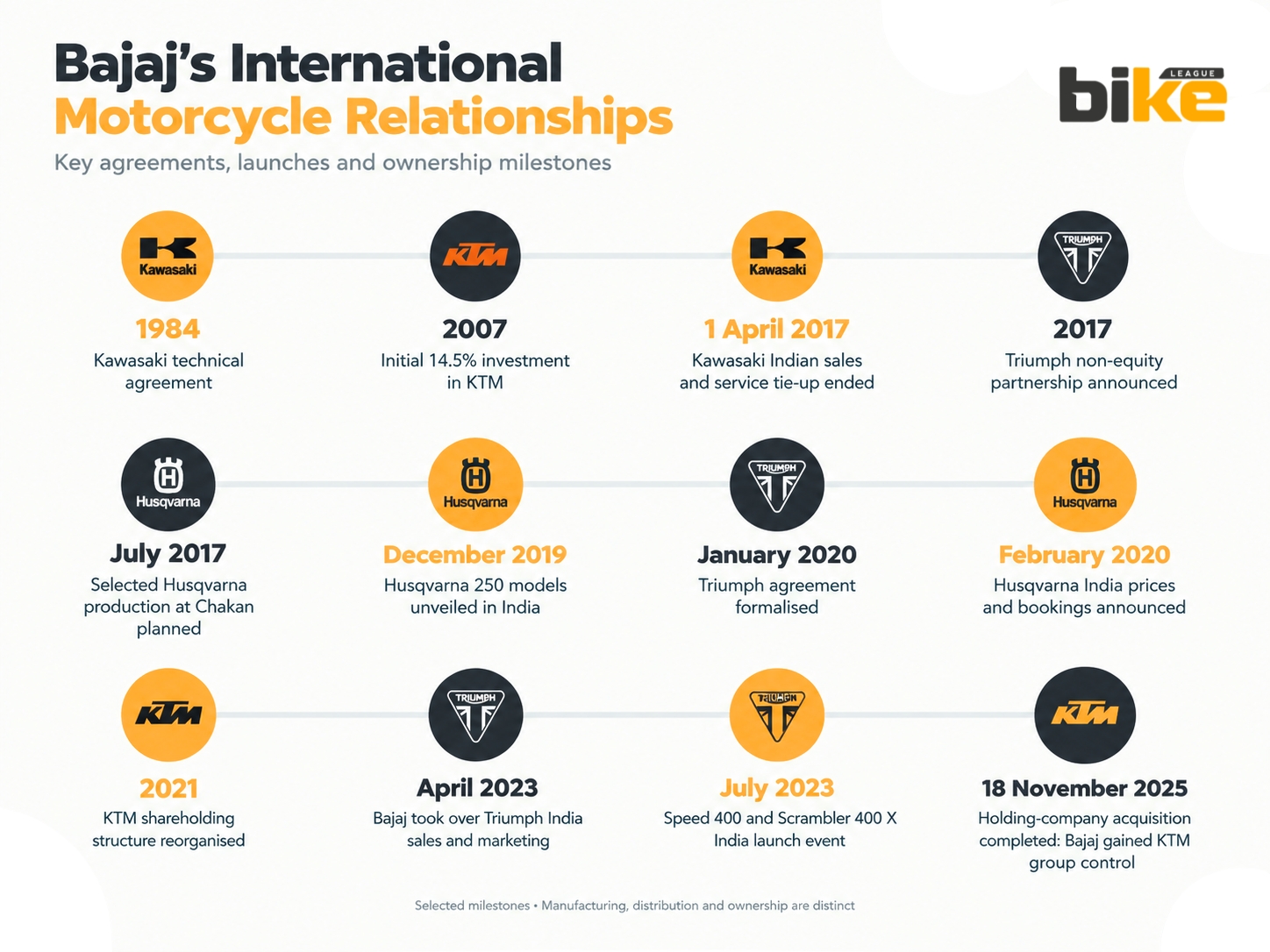
This timeline covers key milestones involving Kawasaki, KTM, Husqvarna and Triumph. Technical agreements, product launches, operational transfers and ownership changes represent different types of developments.
| Date | Brand | Milestone | What changed |
|---|---|---|---|
| 1984 | Kawasaki | Technical collaboration began | Bajaj and Kawasaki entered a technical agreement supporting Bajaj’s expansion into motorcycle manufacturing. |
| 2007 | KTM | Initial investment | Bajaj’s overseas subsidiary acquired a 14.5% stake in KTM Power Sports AG, beginning the investment relationship. |
| 2009 | Kawasaki | Indian sales and service arrangement began | Kawasaki motorcycles were sold and serviced through Bajaj’s Probiking network in India. |
| 2012 | KTM | Indian market entry | KTM entered India with the 200 Duke. Bajaj’s Chakan facility became a manufacturing base for selected KTM motorcycles. |
| 1 April 2017 | Kawasaki | Indian sales and service arrangement ended | Sales and after-sales support moved to India Kawasaki Motors and its own network. This milestone concerns the Indian arrangement. |
| July 2017 | Husqvarna | Manufacturing expansion announced | Bajaj and KTM announced plans for Chakan production of the Vitpilen 401 and Svartpilen 401. This did not represent a transfer of Husqvarna’s entire motorcycle range. |
| 2017 | Triumph | Partnership announced | Bajaj and Triumph announced a non-equity collaboration to develop mid-capacity motorcycles. |
| 2019 | KTM | Electric-platform programme announced | KTM and Bajaj announced a common 48-volt electric two-wheeler platform in the proposed 3–10 kW power range. This was a development announcement, not a production launch or mild-hybrid programme. |
| 6 December 2019 | Husqvarna | Indian unveiling | The Svartpilen 250 and Vitpilen 250 were unveiled at India Bike Week, before their commercial launch. |
| January 2020 | Triumph | Long-term agreement formalised | Bajaj and Triumph formally signed their non-equity collaboration agreement. |
| 25 February 2020 | Husqvarna | Prices announced and bookings opened | Indian prices were announced for the Svartpilen 250 and Vitpilen 250, with deliveries scheduled to begin in March 2020. |
| 2021 | KTM | Shareholding structure changed | Bajaj’s overseas subsidiary exchanged its 46.5% stake in KTM AG for a 49.9% stake in PTW Holding AG. |
| 20 January 2023 | KTM | One-millionth Chakan-produced KTM | A KTM 390 Adventure became the one-millionth KTM motorcycle manufactured at Bajaj’s Chakan plant. |
| 1 April 2023 | Triumph | Indian operations transferred | Bajaj took responsibility for Triumph’s Indian sales and marketing operations. The completed transfer was announced on 10 April 2023. |
| June 2023 | Triumph | First co-developed models unveiled globally | The Speed 400 and Scrambler 400 X were unveiled before their Indian launch event. |
| 5 July 2023 | Triumph | Indian launch event | The Speed 400 and Scrambler 400 X were presented in India. Speed 400 availability was scheduled for July, while the Scrambler 400 X followed later that year. |
| October 2023 | Triumph | Scrambler 400 X market introduction | The Scrambler 400 X received its Indian price announcement and market introduction. |
| May 2025 | Triumph | Scrambler 400 XC announced | The co-developed TR-Series range expanded with the Scrambler 400 XC. |
| May 2025 | KTM | Restructuring support announced | Bajaj announced an €800 million debt-funding package and its intention to take control, subject to approvals. The funding package was separate from the share-acquisition consideration. |
| 18 November 2025 | KTM group | Holding-company acquisition completed | Bajaj’s overseas subsidiary acquired the remaining interest in the intermediate holding company, making it wholly owned and gaining control of the KTM group. This did not mean direct ownership of 100% of KTM. |
Dates refer to the milestones described, not necessarily the start of retail deliveries. Historical manufacturing plans and launch specifications should not be treated as current model information.
History Of Bajaj’s Relationships With Kawasaki, Ktm, Husqvarna And Triumph
The following sections trace Bajaj’s relationships with four international motorcycle brands. Each timeline distinguishes technical agreements, investment, product launches, manufacturing responsibilities and changes in Indian sales and service operations.
Kawasaki’s former Indian sales and service arrangement belongs to the historical part of this overview. KTM, Husqvarna and Triumph require separate explanations because their ownership structures and commercial arrangements differ.
1. Bajaj–kawasaki: Technical Collaboration And The Former Indian Sales Arrangement
Bajaj Auto and Kawasaki began their technical collaboration in 1984. The relationship supported Bajaj’s expansion into motorcycles and contributed to products such as the Kawasaki Bajaj KB100, Caliber and Eliminator.
A separate sales and after-sales arrangement began in 2009. Bajaj’s Probiking network sold and serviced Kawasaki motorcycles in India under this agreement, which differed from the earlier technical collaboration.
Bajaj and Kawasaki mutually agreed to end their Indian sales and service arrangement with effect from 1 April 2017. Kawasaki’s sales and after-sales support, including support for existing customers, moved to India Kawasaki Motors and its own dealer network.
At the time of the separation, Bajaj said it intended to focus its Probiking business on KTM and was converting Probiking outlets into exclusive KTM dealerships. The companies also stated that their cooperation outside India would continue. That announcement should not be interpreted as proof that every overseas arrangement remains unchanged today.
For Indian buyers, Kawasaki should therefore be treated as a historical Bajaj relationship, not as a brand currently sold or serviced through the former Bajaj–Kawasaki arrangement. Buyers should use Kawasaki’s official Indian website to locate authorised dealers and obtain current service information.
2. Bajaj–ktm: Investment, Indian Manufacturing And Controlling Ownership
The Bajaj–KTM relationship began in 2007, when Bajaj Auto International Holdings B.V., Bajaj Auto’s overseas subsidiary, acquired a 14.5% stake in KTM Power Sports AG. The relationship developed into a combination of investment, product development and Indian manufacturing.
KTM entered the Indian motorcycle market in 2012 with the 200 Duke. Its Indian portfolio subsequently expanded into the Duke, RC and Adventure ranges. Bajaj manufactures small-displacement KTM motorcycles at its Chakan plant in Maharashtra for India and export markets. This manufacturing role should not be interpreted as meaning that every KTM motorcycle worldwide is produced by Bajaj.
How Bajaj’s Shareholding Changed
Bajaj’s overseas subsidiary gradually increased its KTM stake to approximately 48%. In 2021, the ownership structure was simplified: it swapped its 46.5% holding in KTM AG for a 49.9% stake in PTW Holding AG, the KTM group’s parent company at the time.
On 18 November 2025, Bajaj’s overseas subsidiary acquired the remaining interest in the intermediate holding company formerly known as Pierer Bajaj AG, bringing its ownership of that company to 100%. The holding company, subsequently named Bajaj Auto International Holdings AG, held approximately 74.94% of Bajaj Mobility AG, the parent company of KTM AG.
Does Bajaj Own Ktm?
Bajaj controls the KTM group through this holding-company structure. However, owning 100% of the intermediate holding company is not the same as directly owning 100% of KTM or its listed parent company.
The simplified ownership chain is: Bajaj Auto → Bajaj Auto International Holdings B.V. → Bajaj Auto International Holdings AG → approximately 74.94% of Bajaj Mobility AG → KTM AG.
What The Relationship Means For Indian Buyers
The relationship has established India as a manufacturing base for small-displacement KTM motorcycles and supported the brand’s expansion across different motorcycle categories. Husqvarna is also connected through the KTM group, with selected motorcycles manufactured by Bajaj in India.
For servicing, warranty support and genuine parts, buyers should consult KTM’s authorised Indian network. Bajaj’s manufacturing and ownership roles should not be confused with permission to use any ordinary Bajaj workshop for KTM warranty work.
- KTM India official website
- Explore KTM motorcycles on Bikeleague India
- Bajaj Auto’s official KTM partnership overview
- Bajaj Auto’s FY2025–26 acquisition and ownership disclosure
3. Bajaj–husqvarna: Manufacturing And Indian Distribution Through The Ktm Relationship
Bajaj’s relationship with Husqvarna Motorcycles developed through its collaboration with KTM. It is therefore better understood as part of the KTM group relationship, rather than as a separate agreement identical to Bajaj’s non-equity collaboration with Triumph.
Plans For Indian Manufacturing
In July 2017, Bajaj and KTM announced plans to expand Husqvarna’s global presence. KTM would initially produce the Vitpilen 401, Svartpilen 401 and Vitpilen 701 in Mattighofen, Austria. The companies planned to move production of the Vitpilen 401 and Svartpilen 401 for global markets to Bajaj’s Chakan factory.
This was a model-specific manufacturing plan. It did not mean that Husqvarna’s entire motorcycle range or all its worldwide production would move from Austria to India.
Indian Unveiling And Commercial Launch
Bajaj unveiled the Husqvarna Svartpilen 250 and Vitpilen 250 at India Bike Week in Goa on 6 December 2019. Both shared their engine platform and several mechanical components with the KTM 250 Duke, while offering distinct styling.
Bajaj announced their Indian prices and opened bookings on 25 February 2020, with deliveries scheduled to begin in March. The motorcycles were initially offered through 100 KTM dealerships across 45 cities.
These dates represent different milestones: December 2019 was the unveiling, February 2020 was the pricing and bookings launch, and March 2020 was the scheduled start of deliveries.
What The Relationship Means For Buyers
The arrangement combines Husqvarna’s design identity with shared KTM-group engineering and Bajaj’s Indian manufacturing capabilities. However, manufacturing locations and shared components should be checked for the specific model and generation rather than assumed to apply to every Husqvarna motorcycle.
The original Indian launch used selected KTM dealerships. Buyers should check Husqvarna’s official Indian website for current model availability, authorised sales outlets and service support rather than relying on the dealership figures announced in 2020.
4. Bajaj–triumph: Non-equity Collaboration, Manufacturing And Indian Operations
Bajaj Auto and Triumph Motorcycles announced their global partnership in 2017 and formally signed a long-term, non-equity agreement in January 2020. The collaboration brought together Triumph’s motorcycle design and engineering expertise with Bajaj’s manufacturing capabilities to develop a range of mid-capacity motorcycles.
Does Bajaj Own Triumph?
No. Bajaj and Triumph established a non-equity collaboration; Bajaj did not acquire Triumph. Bajaj manufactures co-developed motorcycles and manages Triumph’s Indian sales and marketing operations. These responsibilities do not give Bajaj ownership of the Triumph brand.
Transfer Of Indian Sales And Marketing Operations
Effective from 1 April 2023, Triumph transferred its Indian sales and marketing operations to Bajaj Auto. The companies announced the completed transfer on 10 April 2023.
At that time, the arrangement covered Triumph’s existing 15 Indian dealerships. These remained dedicated Triumph outlets operating in line with the brand’s standards. The transfer did not mean that every ordinary Bajaj dealership became a Triumph sales or service centre.
First Motorcycles Developed Under The Partnership
Triumph unveiled the Speed 400 and Scrambler 400 X globally in June 2023. Bajaj and Triumph presented both motorcycles at their Indian launch event on 5 July 2023. Triumph conceived and designed the motorcycles in Hinckley, UK, while Bajaj manufactured them for the Indian market at its Chakan facility in Maharashtra.
The companies scheduled the Speed 400 to reach Indian buyers in July 2023. The Scrambler 400 X followed later that year, with its Indian price announcement and market introduction in October. These product milestones came after the partnership began.
The co-developed range subsequently expanded. Bajaj’s August 2025 anniversary announcement identified the Speed 400, Speed T4, Scrambler 400 X and Scrambler 400 XC as models in the partnership’s TR Series.
What The Partnership Means For Indian Buyers
The collaboration introduced locally manufactured Triumph motorcycles into India’s mid-capacity segment while supporting the expansion of Triumph’s dedicated retail network.
Buyers should check Triumph’s official Indian website for current models, prices, authorised dealerships, service availability and warranty information. Historical dealership-expansion plans and production targets should not be presented as current figures unless supported by a dated update.
- Triumph Motorcycles India official website
- Explore Triumph motorcycles on Bikeleague India
- Official announcement of the transfer of Triumph’s Indian operations
Why Bajaj And International Motorcycle Brands Work Together
These relationships combine different strengths: motorcycle design and engineering, manufacturing capacity, sourcing, distribution and access to new customer segments. However, the responsibilities and commercial objectives vary by brand.
1. Combining Product Development And Manufacturing
The Bajaj–Triumph collaboration provides a clear example. The companies agreed to combine their strengths in design, development technology and cost-competitive manufacturing to create a new range of mid-capacity Triumph motorcycles.
For Bajaj, the arrangement expands its role in developing and manufacturing premium motorcycles. For Triumph, it creates an entry point into higher-volume market segments without requiring the company to establish the entire manufacturing operation independently.
2. Manufacturing At Scale For India And Export Markets
Manufacturing selected motorcycles in India allows the partners to use Bajaj’s production facilities and supply-chain capabilities. The co-developed Triumph range, for example, is manufactured at Chakan for Indian and international markets.
Production scale and cost competitiveness are important commercial objectives, but they should not be presented as a guarantee that every motorcycle will be cheaper, more reliable or less expensive to maintain than its competitors.
3. Expanding Brand Reach And Distribution
Partnerships can help international brands reach customers in additional markets and motorcycle categories. Triumph’s agreement with Bajaj was specifically intended to expand its global reach through a new mid-capacity range.
In India, Bajaj also took responsibility for Triumph’s sales and marketing operations from April 2023. Triumph dealerships formed a dedicated retail channel, rather than becoming interchangeable with ordinary Bajaj motorcycle dealerships.
4. Keeping Brand Identity And Commercial Roles Distinct
A motorcycle manufactured by Bajaj does not automatically become a Bajaj-branded product. The companies sell their co-developed motorcycles under the Triumph brand and divide manufacturing and distribution responsibilities between them.
Ownership is a separate issue. KTM’s relationship with Bajaj includes controlling ownership through a holding-company structure, whereas Triumph’s agreement was established as a non-equity collaboration. The Kawasaki and Husqvarna relationships also need to be understood in their own historical and corporate contexts.
What Do Bajaj’s Partnerships Mean For Indian Motorcycle Buyers?
Bajaj’s international relationships have helped bring selected KTM, Husqvarna and Triumph motorcycles into Indian manufacturing and distribution networks. For buyers, the practical benefits include additional motorcycle choices and access to locally manufactured models from international brands. However, pricing, features and ownership support depend on the specific motorcycle and its authorised network.
1. More Choices Across Motorcycle Categories
These relationships have expanded the options available to Indian riders, including naked motorcycles, fully faired sports bikes, adventure motorcycles and modern classics.
Buyers should compare individual models according to their intended use, riding position, performance, comfort and equipment. A shared manufacturing partner does not mean that motorcycles from different brands deliver the same riding experience.
2. Local Manufacturing Can Support Competitive Pricing
Manufacturing selected motorcycles in India allows the companies to use local production facilities and sourcing capabilities. The Triumph Speed 400 and Scrambler 400 X, for example, were introduced as locally manufactured motorcycles produced at Bajaj’s Chakan facility.
However, local manufacturing does not guarantee that a motorcycle will have the lowest purchase price or running costs in its category. Compare the current on-road price, insurance, scheduled servicing, tyres and replacement parts before deciding which model offers better value.
3. Access To Model-specific Technology And Equipment
Buyers gain access to motorcycles with different combinations of engine technology, braking systems and rider aids. For example, the original Triumph Speed 400 and Scrambler 400 X included liquid-cooled engines, ABS and switchable traction control.
Check the specifications of the exact model, variant and model year. Do not assume that a feature offered on one KTM, Husqvarna or Triumph motorcycle is available on every related model or has been transferred to Bajaj-branded motorcycles.
4. Brand-specific Sales And After-sales Support
Sales and service arrangements differ by brand. KTM India provides service support through its authorised network, while Triumph uses authorised Triumph dealers for warranty repairs and service records.
Bajaj’s role in manufacturing or managing operations does not automatically make every ordinary Bajaj workshop an authorised service centre for these brands. Before buying, confirm the nearest authorised workshop, its distance from your home and whether it supports your chosen model.
5. Clearer Ownership Decisions Through Written Checks
Ask the authorised dealer for the following information before paying a booking amount:
- A written on-road quotation showing the motorcycle price, registration, insurance and optional charges separately.
- The service schedule for the exact model, including time-based and distance-based requirements.
- The applicable warranty period, exclusions and any separate extended-warranty terms.
- Estimated scheduled-service costs and the availability of commonly replaced parts.
- Details of roadside assistance, where offered, including its coverage and renewal charges.
Use the current owner’s handbook, warranty certificate and official brand information to verify these details. Check current ownership terms rather than relying on historical launch offers and partnership announcements.
Ownership Limitations Indian Buyers Should Consider
A manufacturing or distribution partnership does not guarantee convenient servicing, inexpensive replacement parts or identical ownership terms across brands. The following points are checks for prospective buyers, not evidence that the partnerships themselves cause quality or reliability problems.
1. Authorised Service Access Must Be Checked Separately
Do not assume that every Bajaj dealership can provide authorised servicing or warranty repairs for KTM, Husqvarna or Triumph motorcycles. Check the relevant brand’s dealer locator and confirm that the workshop supports your chosen model.
If the nearest authorised workshop is far from your home, consider the travel time and transport arrangements required for scheduled servicing or repairs. Confirm the service location directly, as a sales showroom and its workshop may operate from different addresses.
2. Local Manufacturing Does Not Guarantee Low Ownership Costs
A locally manufactured motorcycle may still have model-specific servicing requirements, consumables and replacement parts. Compare written estimates for scheduled servicing, tyres, brake pads, chains and sprockets rather than assuming that costs will match those of a Bajaj-branded commuter motorcycle.
Before buying, ask the authorised workshop about the availability and estimated ordering times of commonly replaced parts.
3. Warranty Coverage Has Conditions And Exclusions
Warranty protection is subject to the applicable terms, maintenance requirements and exclusions. For example, Triumph requires maintenance in accordance with the owner’s handbook and excludes defects caused by unauthorised parts or accessories under its stated warranty conditions.
Check the warranty documents supplied with the motorcycle, including any separate extended-warranty policy. Do not assume that the warranty covers normal wear, routine servicing, transport expenses or every repair.
4. Shared Platforms Do Not Guarantee Interchangeable Parts
Related motorcycles can differ in their components, electronics, mounting points and calibration. A shared platform or manufacturing facility is not sufficient evidence that a replacement part is compatible.
Before fitting a component from another model, ask the authorised workshop to confirm the correct part number and compatibility. Check any implications for safety and warranty coverage.
5. Check Modifications Before Fitting Them
Customisation should be assessed against the motorcycle’s technical requirements and warranty terms. Ask the authorised dealer about the proposed accessory or modification before installation.
A modification does not necessarily cancel every aspect of a warranty. However, the applicable terms may exclude defects that unauthorised parts, accessories, alterations or faulty installation cause.
Commercial Risks And Responsibilities In Motorcycle Partnerships
Motorcycle partnerships require clear agreements on product development, manufacturing, distribution and after-sales support. The following are potential commercial challenges, not claims that every Bajaj relationship has experienced disputes or operational failures.
1. Aligning Commercial Priorities
Partners need to agree on the motorcycles they will develop, their intended customers, pricing strategies and launch schedules. Their priorities may differ, particularly when one company manages several motorcycle brands or sells competing products of its own.
2. Defining Decision-making And Responsibilities
Agreements need to distinguish who controls design, engineering approval, manufacturing, sourcing, marketing and warranty administration. A manufacturing partner may not own the brand or have authority over every product decision.
This makes it important to explain each relationship separately rather than assuming that ownership, technical collaboration and distribution agreements give Bajaj the same responsibilities.
3. Managing Dependence On A Partner
Where a brand relies on another company for manufacturing or distribution, changes to that arrangement may require adjustments to production, dealer support and parts supply. Similarly, a manufacturer may need to reassess its facilities and investment plans if a partner changes its product strategy.
4. Planning Changes To Sales And Service Arrangements
If a relationship changes or ends, the companies need to explain who will support existing customers. Important responsibilities include warranty claims, service records, replacement parts and communication with dealerships.
For buyers, the useful information is the documented transition plan and the current authorised support network—not speculation about how long a partnership might last.
5. Separating Commercial Risk From Product Quality
Coordination challenges do not, by themselves, prove that motorcycles are unreliable or poorly manufactured. Assess quality, recalls and customer dissatisfaction using model-specific evidence, separately from the commercial relationship.
Engineering And Manufacturing Outcomes Of The Ktm And Husqvarna Relationships
The strongest documented outcomes are joint motorcycle development, shared platforms for selected KTM and Husqvarna models, large-scale manufacturing at Chakan and an announced electric two-wheeler development programme. These should be distinguished from claims that particular features were transferred directly into Bajaj-branded motorcycles.
1. Joint Development Of Small-displacement Motorcycles
Bajaj’s role extends beyond assembling motorcycles. In its January 2023 announcement, the company stated that it co-developed and manufactured motorcycles spanning KTM’s 125cc–390cc range and Husqvarna’s 125cc–401cc range.
These figures describe the range covered by that dated announcement, not a permanent limit on the companies’ current manufacturing activities.
2. Shared Platforms With Model-specific Differences
Selected KTM and Husqvarna motorcycles share engine platforms and mechanical components. For example, the Husqvarna Svartpilen 250 and Vitpilen 250 introduced in India were based on the KTM 250 Duke platform, while retaining their own styling.
Sharing a platform does not make two motorcycles identical. Equipment, geometry, tuning and components should be checked for the particular model and generation. Parts compatibility should not be assumed.
3. The Pulsar Ns200 And Ktm 200 Duke Are Not Identical Engines
The Pulsar NS200 and KTM 200 Duke illustrate why technical differences matter. The NS200 uses a liquid-cooled, four-valve SOHC engine, while the 200 Duke uses a liquid-cooled, four-valve DOHC engine.
SOHC means single overhead camshaft; DOHC means double overhead camshaft. The NS200 therefore does not use a DOHC engine. Their similar displacement is also insufficient evidence that their engines, electronics or replacement parts are identical.
4. Manufacturing Scale At Chakan
On 20 January 2023, the one-millionth KTM motorcycle manufactured at Bajaj’s Chakan plant rolled off the production line. The milestone motorcycle was a KTM 390 Adventure.
This provides a concrete measure of the partnership’s manufacturing scale. It does not, by itself, prove that a specific suspension system, braking component or electronic feature was transferred into a Bajaj-branded motorcycle.
5. An Announced Electric Two-wheeler Programme
In 2019, KTM and Bajaj announced plans to develop a common 48-volt electric two-wheeler platform in the 3–10 kW power range. The announcement envisaged different scooter and moped variants and proposed serial production in India.
Bajaj’s January 2023 partnership update also referred to plans for a common 48-volt electric platform. These statements establish an announced development programme, not proof that every proposed vehicle subsequently entered production.
The announcement concerned an electric two-wheeler platform, not a mild-hybrid system.
6. Features Must Be Verified Model By Model
The presence of a feature on a KTM or Husqvarna model does not establish that the partnership introduced it into Bajaj’s own range.
How Has The Bajaj–triumph Partnership Changed India’s Motorcycle Market?
The clearest effects are the introduction of locally manufactured Triumph motorcycles, expansion of the brand’s Indian retail presence and increased choice in the mid-capacity segment. These outcomes are more useful than predictions that the partnership will automatically transform the entire motorcycle market.
1. A New Entry Point Into The Triumph Range
The Speed 400 and Scrambler 400 X introduced a locally manufactured entry point into Triumph ownership in 2023. Their production at Bajaj’s Chakan facility brought the Triumph brand into consideration for buyers shopping below its larger-capacity motorcycle range.
This widened the choices available to buyers considering a modern classic or scrambler. However, whether either motorcycle represents better value than a competing model depends on current pricing, equipment, riding requirements and ownership costs.
2. Growth In Triumph’s Indian Sales
In March 2026, Bajaj announced that Triumph had crossed the milestone of one lakh motorcycles on Indian roads. Reporting identified the locally developed 400cc range as a major contributor to the brand’s growth.
This is a cumulative milestone, not annual sales or a market-share percentage. It should not be presented as proof that Triumph displaced a particular competitor or became the leader of the mid-capacity segment.
3. Expansion Beyond The Original Dealer Network
Reporting on the March 2026 milestone described a retail footprint of more than 230 stores across more than 200 towns. This provides a dated indication of the brand’s expansion rather than relying on an earlier target of 100 showrooms in 80 cities.
Retail presence does not necessarily mean that every location offers a full workshop or supports every Triumph model. Buyers should confirm the facilities and services available at their nearest authorised outlet.
4. More Options For Buyers Comparing Mid-capacity Motorcycles
The partnership adds Triumph-branded alternatives to the motorcycles Indian buyers may consider in the mid-capacity segment. Comparisons should be made between specific models and current variants rather than treating every motorcycle between 200cc and 750cc as a direct rival.
Useful comparison points include on-road price, riding position, engine characteristics, seat height, equipment, service access and scheduled maintenance costs. Engine capacity and brand reputation alone are not enough to identify the best choice.
5. An Indian Manufacturing Base For International Sales
The collaboration also serves markets outside India. March 2026 reporting stated that the India-manufactured Triumph 400cc range was exported to 18 international markets.
This demonstrates the partnership’s international manufacturing role. It does not establish that every Triumph motorcycle sold worldwide is manufactured by Bajaj.
6. Separate Future Announcements From Speculation
Bajaj’s involvement in electric mobility does not, by itself, establish a confirmed Bajaj–Triumph electric or hybrid motorcycle programme.
Similarly, claims that competitors have changed their prices, products or dealer networks in response to the partnership require specific evidence. Such effects should not be assumed from Triumph’s expansion alone.
Confirmed Developments And Future Plans For Bajaj’s Motorcycle Relationships
Bajaj’s relationships with KTM, Husqvarna and Triumph have different commercial structures and development priorities. They should not be combined into a single product roadmap. Completed launches, ownership changes and announced projects also need to be distinguished from predictions about future motorcycles.
1. Ktm: Financial Restructuring And Controlling Ownership
In May 2025, Bajaj announced an €800 million debt-funding package intended to support KTM’s restructuring, meet creditor obligations and help restart operations. It also announced its intention to take control of the KTM business, subject to regulatory approvals.
The acquisition of the remaining interest in the intermediate holding company was completed on 18 November 2025. This was a completed ownership development, not merely a future ambition.
The €800 million debt-funding package was separate from the consideration paid to acquire the remaining interest in the holding company.
2. Triumph: Expansion Of The Co-developed Motorcycle Range
The Triumph collaboration has already produced additional motorcycles beyond the original Speed 400 and Scrambler 400 X. For example, the Scrambler 400 XC was announced in May 2025 as a further development of the TR-Series platform.
Such launches provide evidence of continuing product development. They do not establish a confirmed launch schedule for every engine capacity or motorcycle category mentioned in earlier partnership announcements.
3. Husqvarna: Model-specific Manufacturing And Development
Husqvarna’s relationship with Bajaj operates through the KTM group. Bajaj’s manufacturing role covers selected models, with production serving Indian and export markets.
4. Electric Mobility: An Announced Programme, Not A Hybrid Roadmap
KTM and Bajaj announced a common 48-volt electric two-wheeler development programme in 2019, covering a proposed power range of 3–10 kW. Bajaj’s January 2023 partnership update also referred to plans for a common electric platform.
These announcements establish a development intention. They do not, by themselves, confirm which proposed vehicles entered production or remain scheduled for launch.
The announcement concerned electric two-wheelers, not mild-hybrid vehicles, and did not establish a Bajaj–Triumph electric motorcycle programme.
5. International Manufacturing And Distribution
Indian manufacturing and international distribution are established parts of these relationships, but their scale must be reported by brand and date. Export destinations, production volumes and dealership counts can change and should not be combined into an undated group-wide target.
6. How To Interpret Future Announcements
- Completed development: A motorcycle launch, operational transfer or ownership transaction that has occurred.
- Announced plan: A project or target publicly identified by the companies but not yet shown to be completed.
- Editorial possibility: A potential direction that has not been confirmed and must be labelled as analysis.
This distinction keeps historical partnership objectives separate from current products and prevents speculative plans from being presented as confirmed developments.
Frequently Asked Questions About Bajaj’s Motorcycle Partnerships
1. Does Bajaj Own Ktm?
Bajaj controls the KTM group through a holding-company structure. On 18 November 2025, its overseas subsidiary acquired the remaining interest in the intermediate holding company formerly called Pierer Bajaj AG, making that company wholly owned. The holding company owns approximately 74.9% of Bajaj Mobility AG, KTM’s parent company. This is not the same as Bajaj directly owning 100% of KTM.
2. When Did Bajaj First Invest In Ktm?
Bajaj’s overseas subsidiary acquired a 14.5% stake in KTM Power Sports AG in 2007. The relationship subsequently expanded into joint product development, Indian manufacturing and controlling ownership.
3. Does Bajaj Own Triumph?
No. Bajaj and Triumph established a non-equity collaboration, announced in 2017 and formalised in January 2020. Manufacturing co-developed Triumph motorcycles and managing Indian sales and marketing operations do not constitute ownership of Triumph.
4. When Did Bajaj Take Over Triumph’s Indian Sales And Marketing?
The transfer took effect on 1 April 2023 and was announced on 10 April 2023. Triumph continued to operate through dedicated Triumph dealerships rather than making every Bajaj outlet a Triumph dealership.
5. Is Kawasaki Still Sold And Serviced Through Bajaj In India?
The Bajaj–Kawasaki Indian sales and service arrangement ended on 1 April 2017. Kawasaki’s Indian sales and after-sales support moved to India Kawasaki Motors and its own network. Buyers should consult Kawasaki’s official Indian website for current authorised outlets.
6. How Is Husqvarna Connected To Bajaj?
Husqvarna’s relationship with Bajaj developed through the KTM group. Bajaj manufactures selected Husqvarna motorcycles in India. This should not be interpreted as meaning that every Husqvarna motorcycle worldwide is manufactured by Bajaj.
7. When Were Husqvarna Motorcycles Introduced In India?
Bajaj unveiled the Svartpilen 250 and Vitpilen 250 at India Bike Week on 6 December 2019. It announced their Indian prices and opened bookings on 25 February 2020, with deliveries scheduled for March. The unveiling and commercial launch marked separate milestones.
8. Does Bajaj Manufacture Every Ktm And Triumph Motorcycle?
No. Manufacturing arrangements apply to selected models and product ranges. Bajaj manufactures small-displacement KTM motorcycles and co-developed Triumph models at Chakan. Check the manufacturing location for the exact motorcycle and model year rather than assuming it from the brand name.
9. Can Any Bajaj Workshop Handle Ktm, Husqvarna Or Triumph Warranty Work?
Do not assume that an ordinary Bajaj workshop is authorised to carry out warranty work for another brand. Use the relevant brand’s official dealer or service locator and confirm that the workshop supports your model. Manufacturing and ownership relationships do not make all service outlets interchangeable.
10. Does The Pulsar Ns200 Use The Same Engine As The Ktm 200 Duke?
The engines should not be described as identical. The Pulsar NS200 uses a liquid-cooled, four-valve SOHC engine, while the KTM 200 Duke uses a liquid-cooled, four-valve DOHC engine. Shared development history or similar displacement does not establish that all components are interchangeable.
11. Have Bajaj And Ktm Announced An Electric Two-wheeler Programme?
Yes. In 2019, they announced plans for a common 48-volt electric two-wheeler platform in the 3–10 kW power range. This was an electric development programme, not a mild-hybrid announcement. A development announcement alone does not confirm that every proposed vehicle entered production.
12. Do These Partnerships Guarantee Lower Prices Or Better Reliability?
No. Buyers should compare current model-specific prices, equipment, maintenance requirements, warranty terms and authorised service access. A partnership or shared manufacturing facility is not sufficient evidence that a motorcycle will be cheaper to own or more reliable than its competitors.
Explore Related Motorcycle Brands On Bikeleague India
Explore the motorcycles covered by these brand relationships, or browse Bikeleague India’s wider motorcycle and scooter brand directory.
- Motorcycle Services: All things you need to know Explained
- Bike ownership transfer in India-Step by step Guide
- Husqvarna Vitpilen 250
- Husqvarna motorcycle
- KTM 890 Adventure R
Conclusion
Bajaj’s relationships with Kawasaki, KTM, Husqvarna and Triumph differ in structure and responsibilities. Kawasaki represents a historical technical collaboration and a former Indian sales and service arrangement. KTM’s relationship includes controlling ownership through a holding-company structure, while Husqvarna is connected through the KTM group. Bajaj and Triumph established a non-equity collaboration covering co-developed motorcycles, manufacturing and Indian sales and marketing responsibilities.
For Indian buyers, the important distinction is between brand ownership, motorcycle manufacturing and authorised after-sales support. A motorcycle manufactured by Bajaj does not automatically carry Bajaj branding, share interchangeable parts with another model or qualify for warranty work at an ordinary Bajaj workshop.
Before choosing a motorcycle, compare its current specifications, on-road price, maintenance requirements, warranty terms and authorised service access. Check these details for the exact model and model year rather than relying on historical partnership announcements or launch offers.
To report a factual correction or suggest an update, email bikeleague2017@gmail.com or leave a comment below. Please identify the relevant section and include a supporting source where available.