
In short: Buying a used motorcycle can help you save money, but a low price does not always mean it is a good deal. Before paying, check the seller and original documents, make sure the engine and chassis numbers match the Registration Certificate (RC), inspect the bike during the day, take a proper test ride, and begin the ownership transfer process right away.
This checklist will guide you on what to look for before buying a used bike or scooter in India. It includes tips on budgeting, checking documents, inspecting the bike, taking a test ride, making safe payments, negotiating the price, and transferring ownership.
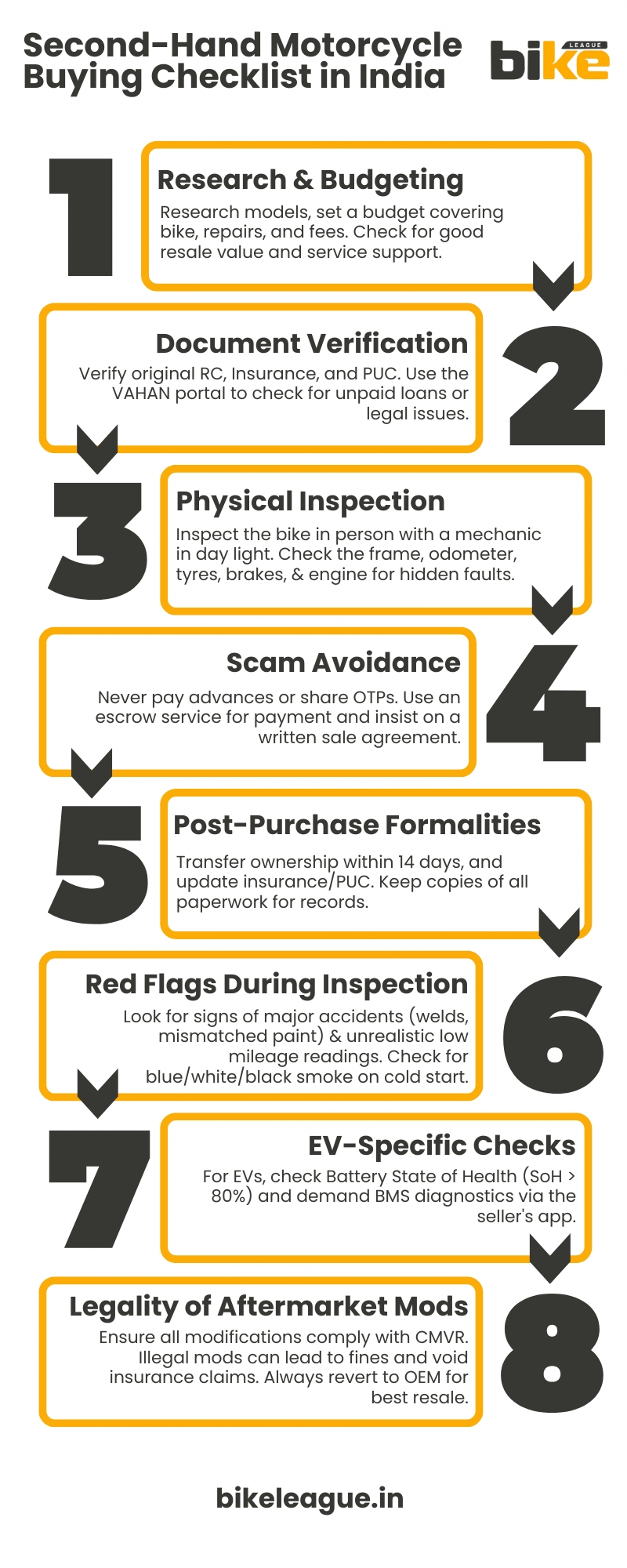
Quick Checklist Before Buying A Used Motorcycle
- Set a total budget that includes the motorcycle price, insurance, ownership transfer, immediate service, and essential repairs.
- Confirm that the seller is the registered owner or has clear authority to sell the motorcycle.
- Inspect the original Registration Certificate (RC) and match the engine and chassis/VIN numbers with the motorcycle.
- Check available registration information, insurance validity, PUC status, pending challans, and hypothecation details.
- Inspect the frame, engine, tyres, brakes, suspension, chain set, battery, and electrical equipment.
- Ask for a cold start and take a proper test ride before discussing the final price.
- Do not send an advance, share OTPs, or scan a QR code to receive money before verifying the bike and seller.
- Use a written sale agreement and keep proof of every payment and document handover.
- Begin RC and insurance transfer promptly after the purchase.
1. Set Your Budget And Choose The Right Used Motorcycle
Think about the kind of riding you will actually do. A used motorcycle might be cheap to buy, but if it is hard to service, costly to repair, or not right for your daily travel, it may not be a good value in the long run.
Pick a model that fits your regular distance, road conditions, whether you carry a passenger, your fuel budget, and how easy it is to find a good mechanic or service center. Usually, a popular bike or scooter with available spare parts and a clear service history is a safer bet than a rare model with a tempting price.
Calculate Your Total Budget, Not Only The Asking Price
Remember, your budget should cover more than just the price of the bike. Plan for the cost of transferring ownership, updating or renewing insurance, an initial service, and any parts that need to be replaced right away.
- Purchase price: The amount paid to the seller for the motorcycle or scooter.
- Ownership-transfer expenses: Applicable RTO fees, documentation, and any professional assistance you choose to use.
- Insurance: Policy transfer, renewal, or a new policy if the existing cover is close to expiry or unsuitable.
- Initial service: A post-purchase check of engine oil, filters, brakes, chain set, tyres, battery and other consumables.
- Immediate repairs: Essential repairs identified during your inspection, such as worn tyres, weak battery, brake pads, chain and sprockets, damaged cables or leaking fork seals.
- Safety gear: A good helmet, gloves, rain protection, or other riding equipment if you do not already own them.
Shortlist Models Before Contacting Sellers
Check out a few listings for the same model in your city or nearby before contacting any seller. Pay attention to the bike’s age, how many kilometres it has done, number of owners, its condition, service history, insurance status, and the asking price. This way, you can spot bikes that are overpriced, unusually cheap, or not described clearly.
- Prefer motorcycles with a clear service history and easy availability of genuine spare parts.
- Check whether the model has a nearby authorised service centre or a competent independent workshop.
- Compare the condition and asking price of multiple similar listings instead of relying on one advertised price.
- Be cautious if a seller is offering a motorcycle far below comparable local listings and is asking for an advance payment.
- For an older motorcycle, budget for preventive maintenance even if the seller says that no work is required.
Use Registration Details As An Early Screening Check
Before you go to see a motorcycle, ask the seller for the registration number, model year, kilometres done, number of owners, and if the RC shows any loan (hypothecation). Use official vehicle information services to check these details if possible. This is just a first step—you still need to see the original RC and check the engine and chassis/VIN numbers in person.
Do not rely on an online search, screenshot, or WhatsApp copy of the RC as proof of ownership. Only move forward if the seller is ready to show you the motorcycle, original documents, and their ID in person.
2. Choose Where To Buy: Private Seller, Dealer Or Certified Seller
You can buy a used motorcycle from a private seller, an independent dealer, or a certified used-bike seller. None of these options is always safe or risky. Choose based on your budget, how comfortable you are with inspecting bikes, whether you need help with paperwork, and if you are willing to pay extra for convenience.
| Buying Option | Potential Advantages | Points to Watch | Best Suited For |
|---|---|---|---|
| Private seller | You can speak directly with the owner, inspect the motorcycle’s condition and service history, and negotiate based on the actual bike. | You must independently verify the seller, original documents, hypothecation status, condition, and ownership-transfer process. | Buyers who can inspect carefully or bring an experienced mechanic. |
| Independent used-bike dealer | May offer multiple motorcycles in one place and may assist with documentation or registration-related paperwork. | Ask exactly what is included in the sale price, whether there is any written warranty, who will complete transfer documents, and whether the dealer is authorised to sell the motorcycle. | Buyers who value convenience but will still inspect documents and motorcycle condition independently. |
| Certified used-bike seller or OEM-backed programme | May provide an inspection report, limited warranty or paperwork support depending on the seller and model. | Read the written terms carefully. Check what the inspection covers, what the warranty excludes, whether the price includes transfer support, and whether the report matches the motorcycle you are viewing. | First-time buyers and buyers who prefer documented processes and some post-sale support. |
Practical tip: Look at bikes from different sources, but only decide after you have checked the actual motorcycle, seen the original documents, and compared the total cost of owning it. A higher price does not always mean it is safer, and a private sale is not always a better deal.
How To Assess A Certified Used-bike Programme
A certified used-bike programme may offer an inspection report, limited warranty or paperwork support, but the value depends on the written terms. Before paying, ask for the exact inspection report for the motorcycle you are viewing, confirm what the warranty covers and excludes, check whether RC-transfer support is included, and verify whether any return or cancellation policy applies.
- Ask whether the inspection report belongs to the exact registration number and chassis/VIN you are buying.
- Check whether the warranty covers engine, gearbox, electrical components, or only selected parts.
- Confirm who is responsible for RC transfer, insurance endorsement, and any pending hypothecation clearance.
- Read the cancellation, return, and claim terms before making payment.
- Still inspect the motorcycle and original documents independently.
3. Verify The Seller And Documents
Never trust just a listing, screenshot, or photocopy of the RC. Always meet the seller, check the motorcycle, and look at the original documents before paying a large amount. If the seller will not show the original documents or if the details do not match the bike, it is best to walk away.
Check The Seller Before Checking The Motorcycle
- Ask whether the seller is the registered owner named on the RC.
- If the seller is not the registered owner, ask for a clear and credible explanation, along with documents that establish their authority to sell the motorcycle.
- Compare the seller’s name with the RC and verify their identity in person.
- Do not depend on a WhatsApp-forwarded RC, a screenshot, or a promise that documents will be arranged later.
- Be cautious if the seller pressures you to transfer an advance before showing the motorcycle and original documents.
Documents And Details To Check
| Document or Detail | What to Check | Why It Matters |
|---|---|---|
| Original Registration Certificate (RC) | Check the registration number, make, model, colour, engine number, and chassis/VIN details. Compare them with the motorcycle in front of you. | The RC is the key registration document used for ownership transfer. Differences in vehicle identifiers are a serious warning sign. |
| Engine and chassis/VIN numbers | Physically locate the stamped numbers on the motorcycle. Check that they are clear, untampered, and consistent with the RC. | Altered, damaged, or mismatched identifying numbers can indicate a serious ownership, accident, or legal issue. |
| Insurance policy | Confirm that the policy is valid, review the insurer details, and ask how the ownership endorsement or transfer will be completed after purchase. | You should not assume that a policy in the seller’s name automatically protects you after the sale. |
| PUC certificate | For petrol or diesel two-wheelers, check that the certificate is valid and corresponds to the vehicle’s registration details. | A valid PUC may be required for the ownership-transfer process and for lawful use of the vehicle. |
| Hypothecation or loan status | Check whether the RC reflects hypothecation. If it does, ask for the financier’s NOC and documents needed to clear or terminate hypothecation. | An unresolved loan or hypothecation can prevent a clean ownership transfer and create a dispute after payment. |
| Service and repair history | Review service invoices, service-book entries and repair records. Compare their dates and odometer readings with the motorcycle’s current condition. | A consistent history can help you judge maintenance quality and spot possible odometer inconsistencies. |
| Transfer documents | Confirm the documents required by the relevant RTO. Forms 29 and 30 are commonly used for a normal ownership transfer; additional documents or an NOC may apply in other situations. | Missing or incorrectly completed forms can delay the transfer of the RC into the buyer’s name. |
Use Official Portals For A Basic Cross-check
Before paying, use official government services where available to cross-check the registration information and identify the current ownership-transfer route. Parivahan provides vehicle-related services, including transfer of ownership, while the exact online and RTO process can vary by state and vehicle record.
Visit Parivahan vehicle-related services to check the applicable process. You can also use the VAHAN citizen services portal where the relevant service is available.
Important: An online cross-check is not a substitute for examining the original RC and physically matching the engine and chassis/VIN numbers on the motorcycle.
Documents To Collect At Handover
- Original RC or the relevant RC record/document required for the applicable transfer process.
- Copy of the valid insurance policy and details needed for ownership endorsement
- Valid PUC certificate for a petrol or diesel two-wheeler, where applicable.
- Completed and signed ownership-transfer documents required by the relevant RTO.
- Financier NOC and hypothecation-clearance documents, if the motorcycle was financed.
- Service records, warranty documents, manuals, spare keys, and original accessories included in the sale.
- A signed sale agreement and payment acknowledgement listing the registration number, engine number, chassis/VIN, sale amount, date and time of handover.
For a detailed ownership-transfer process, see our bike ownership transfer guide in India.
4. Inspect The Used Motorcycle Properly
Check the motorcycle during the day, on flat ground, and before the seller starts the engine. If you are unsure about the bike’s condition, bring a mechanic or get an independent inspection. This is especially important for older bikes, premium models, heavily modified bikes, or those with missing service records.
When To Use A Pre-purchase Inspection Service
Consider an independent mechanic or pre-purchase inspection service when buying an older motorcycle, a premium bike, a high-value model, a heavily modified vehicle, or a motorcycle with incomplete service records. An inspection does not guarantee that every future issue will be found, but it can help identify visible mechanical, structural, electrical, and maintenance concerns before payment.
- Choose an inspector who has experience with the type of motorcycle or scooter you are considering.
- Ask what the inspection includes, such as engine condition, frame inspection, electrical checks, brakes, tyres, suspension, and diagnostic scanning where applicable.
- Request a written summary of faults and recommended repairs.
- Use the findings to decide whether to negotiate, request repairs or walk away.
Do not judge a bike just by its shiny paint, accessories, or low odometer reading. Make sure the bike’s wear, service history, age, kilometres, and the seller’s story all match up.
Physical Inspection Checklist
| Area to Inspect | What to Check | Warning Signs |
|---|---|---|
| Frame, chassis and bodywork | Inspect the steering head, frame tubes, swingarm, engine mounts, footrest brackets, fuel tank, panels and fasteners. Look at the motorcycle from the front and rear for alignment. | Cracks, bends, unusual welding, uneven panel gaps, fresh paint over repairs, overspray, deep dents, severe rust or missing fasteners. |
| Engine and exhaust | Ask for a cold start. Listen to the engine at idle and with gentle throttle input. Look for oil leaks around the engine, cylinder head, crankcase, and underside. | Hard starting, persistent smoke, major oil leaks, loud knocking, metallic rattling, unstable idling, or an exhaust that appears heavily modified or damaged. |
| Clutch, gearbox and chain set | Operate the clutch, select gears while stationary where safe, and check the chain, sprockets, and rear-wheel alignment. Confirm that the clutch lever and cable or hydraulic system operate smoothly. | Very stiff controls, clutch slip, rough gear shifts, repeated false neutrals, heavily rusted chain, hooked sprocket teeth or excessive drivetrain noise. |
| Tyres, wheels and bearings | Inspect tread condition, sidewalls, puncture repairs, tyre manufacturing date, rims, spokes where applicable and wheel alignment. | Cracked sidewalls, bulges, exposed cords, severe uneven wear, damaged rims, missing spokes, wheel wobble or unusual play in bearings. |
| Brakes and suspension | Inspect brake discs, pads, hoses, brake-fluid reservoirs, fork tubes, fork seals, rear shock absorbers, and suspension movement. | Spongy brake feel, deep disc grooves, fluid leaks, oil on fork tubes, badly corroded suspension parts, excessive bouncing, or warning lamps that remain illuminated. |
| Electrical equipment | Test the headlamp, tail lamp, brake lamp, indicators, horn, starter, instrument cluster, switches, charging ports where applicable, and warning indicators. | Weak starting, random or exposed wiring, flickering lights, damaged connectors, recurring warning lights, non-functioning switches, or improvised electrical modifications. |
| Odometer and service history | Compare the kilometre reading with service invoices, tyre wear, brake and control wear, seat condition, handlebar grips and footpeg condition. | A very low reading that does not match visible wear, missing records, inconsistent kilometre entries, or a seller who cannot explain significant gaps in service history. |
Check For Accident Damage And Neglect
Minor cosmetic scratches are common on used motorcycles and do not automatically make a bike unsafe. The bigger concern is damage to structural or safety-related parts. Examine the steering head, frame, swingarm, fork tubes, wheel rims, brake components, and engine mounts closely.
- Walk away or obtain a professional inspection if you see cracks, bent structural parts, or suspicious welding on the frame or swingarm.
- Be cautious of fresh paint, uneven paint texture, or overspray on wiring, bolts, hoses, and rubber components.
- Check for signs of prolonged outdoor storage, including corrosion on fasteners, electrical connectors, the chain, brake parts, and exhaust mounts.
- Ask the seller directly about previous accidents, insurance repairs, and major component replacements.
Inspect The Motorcycle Before The Test Ride
Complete the visual and mechanical checks before riding. Take photographs of the registration number, odometer reading, visible condition, and any damage only with the seller’s knowledge and consent. If the seller does not allow a basic inspection, an independent mechanic check, or a reasonable test ride, treat that as a warning sign.
Remember, if the bike needs repairs, use that information to rethink the total cost of owning it, not just to ask for a set discount. Get up-to-date repair quotes before you decide if the motorcycle is still a good buy.
5. Take A Proper Test Ride
A good test ride can show problems you might not notice when the bike is just parked. Always ask the seller before riding, wear a helmet, and pick a safe route where you can check the brakes, steering, gear shifts, and how the bike handles at low speeds.
If the seller refuses a reasonable test ride, insists that the motorcycle must be bought without inspection, or will not allow the engine to be started from cold, treat that as a warning sign.
Before You Start Riding
- Ask the seller not to start the motorcycle before you arrive, so you can observe a cold start where possible.
- Check that the key, handlebar lock, ignition, fuel cap, seat lock and side stand operate correctly.
- Confirm that the instrument cluster powers on and that essential warning lights behave normally during start-up.
- Check the clutch lever, front brake lever, rear brake pedal, throttle, and gear lever before moving.
- Wear an appropriate helmet and do not test ride a motorcycle if you are not licensed, insured, or comfortable riding that type of vehicle.
What To Check During The Test Ride
| Area | What to Test | Possible Warning Signs |
|---|---|---|
| Cold start and idle | Observe how easily the engine starts, whether it idles steadily, and whether warning indicators clear as expected. | Hard starting, repeated stalling, persistent smoke, loud knocking, unstable idle or warning lamps that remain on. |
| Clutch and gearbox | Move off smoothly, shift through all gears, and check downshifts at a safe speed. | Clutch slip, excessive lever effort, difficulty finding gears, false neutrals, harsh shifts, or jumping out of gear. |
| Steering and handling | Ride at low speed, make gentle turns, and briefly check straight-line stability on a safe road. | Handlebar wobble, pulling to one side, stiffness, unstable steering, or unusual vibration. |
| Brakes | Test front and rear brakes separately and together in a safe, open area. | Spongy feel, pulling to one side, strong pulsation, squealing, reduced braking effect, or ABS warning indications. |
| Engine response | Accelerate gently through the lower and middle rev range after the engine is warm. | Hesitation, misfiring, abnormal vibration, loss of power, overheating signs, or unusual mechanical noise. |
| Suspension and ride quality | Ride over normal road imperfections at a controlled speed and notice damping and stability. | Bottoming out, repeated bouncing, clunking, excessive fork dive, or a harsh, unsettled ride. |
After The Test Ride
- Look under the engine and around the fork seals for fresh oil or fluid leaks.
- Check whether the cooling fan operates when relevant and whether there are any overheating warnings.
- Listen again for engine noise after the motorcycle has warmed up.
- Compare your test-ride observations with the seller’s description and service history.
- Write down the faults you found before discussing price so that you can estimate their likely repair cost calmly.
Do not rush. Just riding around a parking lot is not enough for an expensive motorcycle. If the seller will not allow a proper inspection and test ride, it is usually best to walk away.
6. Estimate A Fair Price And Negotiate
A fair price depends on the exact motorcycle, its age, kilometres ridden, overall condition, service history, number of owners, insurance status, tyre and battery condition, location, and local demand. Do not decide only from one online listing or a generic valuation figure.
How To Estimate A Fair Used-bike Price
- Compare several listings for the same model, similar model year, and similar ownership history in your city or nearby area.
- Give more importance to the condition of the specific motorcycle than the seller’s asking price.
- Check whether costly maintenance items are due soon, such as tyres, chain and sprockets, battery, brake parts, suspension work or a major service.
- Consider whether the service history is complete, partly available, or missing.
- Factor in insurance validity, pending transfer work, missing accessories, extra keys, and documents.
- Compare the total cost of buying and repairing the used motorcycle with the on-road price and ownership benefits of a new alternative.
Negotiate Using Evidence
Negotiate after the inspection and test ride, not before. Keep a short written list of faults, missing items, and documents that need attention. Ask the seller to explain each issue, then decide whether you want a price reduction, a repair before handover, or to walk away.
- Use comparable local listings to support your offer, not a fixed “percentage discount” rule.
- Ask for current repair quotations for major issues before finalising your offer.
- Do not assume a low odometer reading makes a motorcycle valuable if its wear, service history or documents tell a different story.
- Do not pay extra merely for cosmetic accessories, stickers or non-standard modifications unless they are useful to you and compliant.
- Be prepared to walk away if the seller will not allow proper verification, the motorcycle has major faults, or the asking price does not reflect its condition.
A good rule: Look at the total cost after repairs, ownership transfer, insurance, and first service—not just the price you pay the seller.
7. Pay Safely And Sign A Sale Agreement
Finish checking the documents, inspecting the bike, and taking a test ride before you pay a large amount. Do not send money just because the seller says someone else is interested or asks for a booking fee.
Safe Payment Practices
- Meet the seller in a safe public location during daytime, preferably with another person present.
- Use a traceable payment method and retain the payment confirmation for every transaction.
- Do not share OTPs, PINs, passwords, or remote access to your phone.
- Do not scan a QR code to receive money. Verify every request carefully in your banking or UPI app.
- Do not make a large advance payment before inspecting the motorcycle, checking original documents, and verifying the seller.
- Record the registration number, engine number, chassis/VIN, odometer reading, and condition of the motorcycle at handover.
- Keep copies of the RC, insurance policy, transfer documents, seller details, sale agreement, and payment proof.
What To Include In A Sale Agreement
A written agreement gives you a clear record of the sale. The format can change, but it should always have the date and signatures from both the buyer and seller.
- Buyer and seller names, addresses, and contact details.
- Motorcycle make, model, registration number, engine number, and chassis/VIN.
- Odometer reading at the time of handover.
- Sale price, payment method, amount paid, and date of payment.
- Date and time when possession of the motorcycle is handed over.
- List of documents, keys, accessories, manuals, and other items handed to the buyer.
- Statement that the seller will cooperate in completing the ownership-transfer process.
- Signatures of both parties and, if used, witnesses.
Important: Having the motorcycle or a sale agreement is not the same as transferring the RC. Make sure you finish the ownership transfer with the RTO or online as soon as you can.
8. Complete Rc Transfer, Insurance Transfer And Post-purchase Tasks
Having the motorcycle, a sale agreement, and payment proof does not mean you own it officially. Start the RC transfer right after buying, and keep copies of all documents and receipts until the records and insurance show you as the new owner.
1. Start The Rc Ownership-transfer Process
The exact process, documents, fees, and online availability can vary by state, RTO, and vehicle record. For a normal sale, Forms 29 and 30 are commonly used for notifying and applying for transfer of ownership. An interstate transaction, active hypothecation, an inherited vehicle, or another special situation may require additional documents or a different procedure.
- Confirm the applicable ownership-transfer process through the relevant RTO or Parivahan vehicle-related service.
- Keep the original RC or the applicable registration document, insurance details, PUC where applicable, identity/address documents, and completed transfer forms ready.
- Ensure that the buyer and seller details, registration number, engine number and chassis/VIN are entered correctly on every document.
- Obtain and retain an application acknowledgement, receipt or reference number after submission.
- Track the application status and follow up if the RC is not updated within the expected period communicated by the relevant authority.
- If the motorcycle was financed, make sure hypothecation clearance is completed as required before assuming that the title is clear.
Check Parivahan vehicle-related servicesor read our step-by-step bike ownership transfer guide in India.
2. Transfer Or Endorse The Insurance Policy
Contact the insurer promptly after buying the motorcycle and request the ownership endorsement or transfer process. Do not assume that the seller’s existing comprehensive/package policy will automatically provide own-damage protection to the buyer without the required endorsement.
- Share the sale details, registration information, previous policy details, and documents requested by the insurer.
- Ask the insurer which documents are required for endorsement and whether a fresh proposal form is needed.
- Obtain written confirmation or an updated policy/certificate showing the buyer as the insured owner.
- Check the policy expiry date and renew or replace the cover if required.
- Remember that the No Claim Bonus belongs to the previous insured person, not to the motorcycle. The insurer may adjust the premium for the remaining policy period.
IRDAI explains that motor insurance can be transferred to the buyer following written intimation to the insurer and the required documentation. The No Claim Bonus belongs to the previous insured person and does not transfer automatically with the vehicle. Confirm the exact endorsement requirements and applicable time limits directly with the insurer.
3. Complete A Baseline Service
Even if the seller says that the motorcycle was recently serviced, arrange a baseline service after purchase. This gives you a known starting point for maintenance and lets a workshop identify faults that were not visible during the inspection or test ride.
- Change engine oil and filters if the maintenance history is unclear.
- Check brakes, brake fluid, tyres, chain and sprockets, battery, suspension, cables and electrical charging system.
- Inspect coolant level and condition where applicable.
- Replace damaged consumables and address safety-related problems before using the motorcycle regularly.
- Store invoices and service records for future maintenance and resale.
4. Update Your Ownership Records
- Keep digital and physical copies of the sale agreement, payment proof, RC-transfer acknowledgement, insurance endorsement and service invoices.
- Save the seller’s contact details until the RC and insurance transfer are fully complete.
- Confirm that you have received all keys, manuals, tool kit, service book and accessories included in the sale.
- Update emergency contacts and any connected app, roadside-assistance, or manufacturer-account details where applicable.
- For an electric two-wheeler, complete ownership transfer of the OEM app account and verify access to charging, connected features, and warranty records.
Final check: Before you start using the motorcycle regularly, make sure its registration, insurance, safety checks, and all required documents are up to date.
When Should You Walk Away From A Used-bike Deal?
Not every fault makes a used motorcycle a bad purchase. Cosmetic scratches, worn consumables, and routine maintenance needs can often be priced in. However, some problems create a high risk of legal, safety, or ownership complications. If you find one or more of the following issues, pause the purchase and obtain independent advice or walk away.
| Red Flag | Why It Matters | What You Should Do |
|---|---|---|
| Engine or chassis/VIN details do not match the RC | A mismatch, altered stamp, or unreadable identifier can indicate a serious ownership, legal, or accident-related issue. | Do not pay. Ask for clarification and independent verification. Walk away if the mismatch cannot be resolved clearly. |
| Seller cannot show the original RC or valid identity details | You may not be dealing with the registered owner or a person authorised to sell the motorcycle. | Do not rely on screenshots, photocopies or promises that documents will be arranged later. |
| Active hypothecation without financier-clearance documents | An unresolved loan can complicate or prevent a clean ownership transfer. | Ask for the financier’s NOC and applicable hypothecation-clearance documents before making a final payment. |
| Cracks, bends or suspicious welding on structural parts | Damage around the frame, steering head, swingarm or major mounting points can affect safety and resale value. | Arrange a professional inspection. Walk away if structural damage cannot be assessed and repaired safely. |
| Seller refuses a cold start, mechanic inspection, or reasonable test ride | A seller may be preventing you from identifying engine, handling, or document problems. | Do not proceed under pressure. Find another motorcycle you can inspect properly. |
| Odometer reading does not match visible wear or service history | Inconsistent kilometre history can make the motorcycle’s condition and value difficult to judge. | Ask for service invoices and obtain a mechanic’s assessment. Do not pay a premium for an unverified low reading. |
| Major engine, gearbox, brake or suspension faults | Serious faults can make a cheap motorcycle expensive and unsafe to use. | Get a current repair estimate. Walk away if the issue is unclear, safety-related, or uneconomical to repair. |
| Unrealistically low price and urgency for an advance payment | Pressure tactics and “too good to be true” pricing are common warning signs in online listings. | Do not send an advance, OTP, PIN, or QR-code payment. Inspect the motorcycle and documents in person first. |
| Extensive non-standard wiring or questionable modifications | Poor modifications can create safety, reliability, insurance, or compliance concerns. | Ask whether original parts are available. Obtain an independent assessment before buying a heavily modified motorcycle. |
| Used EV has no charger, app ownership access, or credible battery information | Battery, charging, and connected-account problems can be costly or difficult to resolve after purchase. | Verify ownership transfer of the app/account, charger condition, warranty status, and battery information before payment. |
Practical rule: It is better to miss out on a listing than end up with ownership problems, an unsafe bike, or big repair costs. If the seller will not answer your questions or let you check things properly, just walk away.
Used Electric Scooter And Motorcycle Checklist
A used electric scooter or motorcycle needs all the usual checks for documents, frame, brakes, tyres, and ownership. You also need to check the battery, charger, app account, and any remaining warranty. Do not buy just because the seller promises a good range or shows a screenshot from an app.
Ev-specific Checks Before Buying
| Area | What to Check | Warning Signs |
|---|---|---|
| Battery condition | Ask for available battery-health or diagnostic information. Check the motorcycle or scooter for warning messages, unusual heat, physical damage, or signs of water exposure. | Battery warning lights, swelling, damaged casing, unexplained range loss, overheating, corrosion, or a seller who cannot explain battery condition. |
| Real-world range | Take a test ride and compare battery percentage, ride behaviour and displayed range with the seller’s claim. Consider traffic, riding mode, rider weight and road conditions. | Range that drops unusually quickly, inconsistent charge display, sudden power reduction or repeated system warnings. |
| Charger and charging port | Inspect the original charger, cable, plug, charging port, and protective caps. If practical and safe, confirm that charging starts correctly. | Missing charger, damaged cable, loose port, burn marks, corrosion, non-standard repair work, or an incompatible charging setup. |
| App and connected account | Ask whether ownership of the manufacturer app, connected features, and account can be transferred. Confirm the process with the manufacturer or authorised dealer where possible. | Seller refuses to remove the vehicle from their account, cannot provide account-transfer information, or says the app is not required without a clear explanation. |
| Warranty and service history | Check remaining warranty and service history directly with the manufacturer or authorised dealer using the vehicle identification details where possible. | No service records, missing software-update history, unclear warranty status or evidence of unauthorised battery or charger modifications. |
| Motor, controller and electrical system | Listen for unusual motor or drivetrain noise, test acceleration and check all lights, display functions, switches and warning indicators. | Jerky acceleration, error codes, unusual noise, frequent power loss, exposed wiring, or signs of water damage. |
Questions To Ask The Seller
- Why are you selling the electric scooter or motorcycle?
- Has the battery, charger, motor controller, or wiring ever been repaired or replaced?
- Can the manufacturer app and connected account be transferred to the new owner?
- What warranty remains, and can it be confirmed by an authorised dealer or the manufacturer?
- Are the original charger, keys, manuals and accessories included?
- Has the vehicle ever shown battery, charging, motor or controller warnings?
- Has the vehicle been involved in an accident, flood exposure, or major insurance repair?
Important: If an electric two-wheeler has no charger, no app/account transfer route, no credible battery information, or persistent warning messages, do not rush into the purchase. Get an EV-capable technician or authorised workshop to inspect it first.
How To Avoid Used-bike Scams
Most used-bike scams happen when buyers rush, do not get all the information, or pay before checking the bike and seller. Take your time, check everything in person, and keep a written record of the deal.
| Common Scam or Risk | Typical Warning Signs | How to Protect Yourself |
|---|---|---|
| Advance-payment scam | A seller asks for a booking amount before you have seen the motorcycle, inspected documents, or met them in person. | Do not send an advance to “hold” a motorcycle. Inspect the vehicle, seller, and original documents before making a substantial payment. |
| Fake or incomplete documents | Only screenshots or photocopies are available, details do not match, or the seller says documents will be arranged after payment. | Inspect original documents, match the RC with the engine and chassis/VIN numbers, and confirm the transfer process before final payment. |
| Seller is not the registered owner | The seller avoids sharing identity details, gives unclear explanations, or asks another person to handle documents and payment. | Confirm who owns the motorcycle and obtain a clear authority trail if the seller is acting for another person. |
| Odometer or service-history manipulation | Very low kilometres that do not match visible wear, missing service records, or inconsistent invoice readings. | Compare the odometer with service invoices, tyre and control wear, and arrange an independent inspection where necessary. |
| Hidden loan or hypothecation | The RC reflects hypothecation, but the seller says the loan is “already closed” without providing clearance documents. | Obtain the financier’s NOC and required hypothecation-clearance documents before treating ownership as clear. |
| UPI, QR-code or OTP fraud | The seller asks for an OTP, PIN, remote-access app installation, or QR-code scan to “receive” a payment. | Never share OTPs or banking credentials. Verify all payment requests in your own banking or UPI app. |
| Fake listing or copied photographs | The price is unusually low, the seller refuses a video call or inspection, and the photographs look generic or inconsistent. | Ask for a current video showing the motorcycle, registration number, and key details. Do not pay until you inspect it in person. |
If You Suspect A Payment Scam
- Stop communicating through unfamiliar payment links, QR codes, or remote-access apps.
- Contact your bank or payment provider immediately if you have transferred money or shared sensitive details.
- Save screenshots of messages, listing details, payment confirmations, phone numbers, and seller profiles.
- Report digital-payment fraud promptly through the official cybercrime reporting channels and follow the instructions of your bank and relevant authorities.
- Do not delete chats, payment records, photographs, or documents that may help establish what happened.
Simple rule: A real seller will let you ask questions, inspect the bike, check documents, and record the payment properly. Do not let anyone rush you into skipping these steps.
Check Modifications Before Buying A Used Motorcycle
Accessories and changes can affect how the motorcycle runs, its reliability, insurance, and resale value. Bikes with useful original accessories are usually fine, but if a motorcycle has many modifications, inspect it extra carefully before buying.
What To Check
- Ask the seller for a complete list of non-standard parts, including exhaust, lights, tyres, wheels, handlebar, suspension, electrical accessories, and performance-related modifications.
- Check whether the original parts are available and included in the sale.
- Inspect wiring carefully. Poorly installed lights, horns, chargers, auxiliary equipment, or phone-mount wiring can create electrical faults.
- Look for changes to structural parts, including frame cuts, welding, altered mounting points, or modifications that affect steering, suspension, or braking.
- Ask for invoices, warranty records and installation details for expensive accessories or replacement parts.
- Check whether the modifications are reflected in the seller’s insurance disclosure or any relevant vehicle records where required.
- Confirm with the insurer, authorised service centre or relevant authority if you are unsure whether a particular change affects insurance or road-use compliance.
When A Modified Motorcycle Needs Extra Caution
- The motorcycle has a very loud, damaged, or non-standard exhaust and the original exhaust is unavailable.
- There is exposed wiring, loose connectors, flickering lights, or battery-drain symptoms.
- The frame, steering, suspension, brakes, or wheels appear altered.
- The engine-control system, intake, exhaust, or fuel system appears modified without proper documentation.
- The seller cannot explain what was changed, who performed the work, or whether the original components are included.
- The insurance policy or service history does not reflect major alterations that could affect a claim or warranty.
Buyer tip: If you want a reliable bike for daily use, a mostly original motorcycle with service records is usually easier to check, maintain, and sell later than one with lots of unclear modifications.
Official Resources For Used-motorcycle Transactions In India
Start with official government websites to check the latest process for ownership transfer, vehicle services, PUC checks, and e-challan details. The steps, documents, and fees can change depending on your state, RTO, and the bike’s record, so always confirm what applies before sending documents or paying.
| Official Resource | Use It For | Link |
|---|---|---|
| Parivahan Sewa | Vehicle-related services, including information on ownership transfer and forms. | Visit Parivahan Sewa |
| VAHAN citizen services | Accessing available vehicle-related online services and checking the relevant state workflow. | Visit VAHAN citizen services |
| Parivahan forms | Finding current vehicle-related forms, including forms commonly used for ownership transfer. | View Parivahan forms |
| PUC portal | Checking PUC-related information for applicable petrol or diesel vehicles. | Visit the PUC portal |
| e-Challan portal | Checking available e-challan information before completing a used-vehicle transaction. | Visit the e-Challan portal |
Important: Official websites can show you the current process, but you still need to check the motorcycle, original RC, seller’s ID, engine number, and chassis/VIN in person.
For a more detailed walkthrough, read our bike ownership transfer guide in India.
What To Do If You Suspect A Used-bike Scam
If you think a listing, seller, document, or payment request is fake, stop the deal right away. Do not send more money, do not share OTPs or bank details, and keep all messages, screenshots, payment records, and listing info.
Immediate Steps
- Stop communicating through suspicious links, QR codes, payment requests, or remote-access apps.
- Contact your bank or payment provider promptly if money has been transferred or if you shared sensitive banking information.
- Save evidence, including chat messages, call details, listing screenshots, seller profile details, payment confirmations, registration details, and photographs of the motorcycle.
- Report online or payment-related fraud through the official National Cyber Crime Reporting Portal or the relevant cybercrime reporting channel.
- Report the suspicious listing to the marketplace or platform where you found it.
- Contact the relevant police or transport authority if you suspect a stolen motorcycle, altered identification numbers, forged documents, or another serious ownership issue.
- Consider obtaining independent legal advice for a significant payment dispute, dealer dispute, or ownership conflict.
Official Cybercrime Resource
Visit the National Cyber Crime Reporting Portalto find current reporting options and guidance for cybercrime complaints in India.
Important: Report problems quickly and keep all evidence. This helps your bank, payment provider, or the authorities look into your case. Remember, results and how long it takes to resolve things depend on the situation and are not guaranteed.
Glossary Of Used-bike Terms
| Term | Meaning |
|---|---|
| RC | Registration Certificate. The vehicle-registration document containing key details such as the registration number, owner details, and vehicle identifiers. |
| RTO | Regional Transport Office. The relevant government authority for vehicle-registration services and ownership-transfer processes. |
| PUC | Pollution Under Control certificate. An emissions-related document required for petrol or diesel vehicles. |
| Hypothecation | A lender’s interest recorded against a vehicle that was financed. It should be properly cleared when required before treating the ownership as free of finance-related obligations. |
| NOC | No Objection Certificate. This can refer to a document from a financier, RTO, or another relevant authority, depending on the transaction. |
| VIN / chassis number | A unique vehicle identifier stamped on the motorcycle. Physically match it with the RC before purchase. |
| OEM | Original Equipment Manufacturer. The vehicle manufacturer or its authorised parts and service network. |
| NCB | No Claim Bonus. An insurance benefit linked to the insured person’s claim history; confirm how it’s treated directly with the insurer when transferring a vehicle. |
| SoH | State of Health. A battery-condition measure used in some electric two-wheeler diagnostics and manufacturer systems. |
| BMS | Battery Management System. The electronic system that monitors and manages an electric vehicle battery. |
Faq About Buying A Second-hand Motorcycle In India
1. What Should I Check First Before Buying A Used Motorcycle?
Start by checking whether the model suits your needs and budget. Then verify the seller, inspect the original RC, physically match the engine and chassis/VIN numbers, check available vehicle-related information, inspect the motorcycle in daylight, and take a proper test ride before discussing final payment.
2. Which Documents Should I Collect From The Seller?
Collect or verify the original RC or applicable registration record, insurance details, PUC certificate where applicable, completed transfer documents required by the relevant RTO, financier-clearance documents if the vehicle was financed, service records, spare keys, and a signed sale agreement with payment proof.
3. How Do I Check Whether A Used Bike Has An Active Loan Or Hypothecation?
Check whether hypothecation is shown on the RC and ask the seller for the financier’s NOC and any documents required to clear the hypothecation. Confirm the applicable ownership-transfer procedure with the relevant RTO or official vehicle-related service before releasing the final payment.
4. Should I Bring A Mechanic To Inspect A Used Motorcycle?
Yes, especially if you are not confident assessing engines, chassis condition, brakes, suspension, electricals, or accident repairs. An experienced mechanic or independent inspection can help you identify faults that may not be obvious during a brief viewing.
5. How Can I Spot Possible Odometer Tampering?
Compare the displayed kilometres with service invoices, repair records, and visible wear on grips, footpegs, controls, tyres, brake parts, and seat. A low odometer reading is not proof of good condition if the physical wear and service history do not match it.
6. Is It Safe To Buy A Used Bike From A Private Seller?
It can be safe if you properly verify the seller, original documents, vehicle identifiers, condition, and the ownership-transfer process. A private sale requires more independent checking because you should not assume that the seller or platform has completed verification on your behalf.
7. What Should A Used-bike Sale Agreement Include?
Include buyer and seller details, motorcycle make and model, registration number, engine number, chassis/VIN, odometer reading, sale price, payment method, handover date and time, documents and accessories handed over, and signatures of both parties. Keep payment proof with the agreement.
8. What Should I Do After Buying A Used Motorcycle?
Begin RC-transfer and insurance-endorsement processes promptly, retain all acknowledgements, complete a baseline service, and store copies of the sale agreement, payment proof, insurance, RC-transfer documents, and workshop invoices.
9. Is A Heavily Modified Used Motorcycle A Good Purchase?
It depends on the quality and type of modifications, but a mostly stock motorcycle with documented servicing is usually easier to inspect, insure, maintain, and resell. Before buying, carefully inspect the wiring, structural changes, exhaust, lighting, wheels, tyres, and any engine-related modifications.
10. What Extra Checks Are Needed For A Used Electric Scooter Or Motorcycle?
Verify the battery condition, original charger, charging port, warning indicators, real-world ride behaviour, warranty status, service history, and transferability of the manufacturer app or connected account. Arrange an EV-capable inspection if any battery or electrical issue is unclear.
11. How Many Kilometres Are Good For A Second-hand Bike?
There is no single ideal kilometre figure for a used motorcycle. Compare the odometer reading with the bike’s age, service invoices, visible wear, and maintenance history. A well-maintained motorcycle with higher kilometres and consistent records can be a better purchase than a low-reading bike with unclear history or signs of neglect.
12. Which Website Is Best For Buying A Second-hand Bike?
There is no single best website for every buyer. Use multiple used-bike marketplaces, dealer listings, and certified programmes where available to compare local prices and options. A listing platform is only a starting point: inspect the actual motorcycle, verify the seller and original RC, match the engine and chassis/VIN numbers, and complete the transaction safely.
13. Where Can I Find Low-mileage Second-hand Bikes In India?
You can compare listings from private sellers, dealers, used-bike marketplaces and certified programmes where available. However, do not choose a motorcycle only because it has a low odometer reading. Verify that the kilometres are consistent with its service records, visible wear, tyre condition, controls, and overall maintenance history before paying a premium.
Related Bikeleague Guides
- Bike Ownership Transfer in India: Step-by-Step Guide
- Bike Pollution Certificate (PUC): Validity and Rules
- Second-Hand Bike Platforms in India: Detailed Guide
- Motorcycle Service: Everything You Need to Know
- Bike Documents for Travel in India: All you need to know
Conclusion
A used motorcycle is a good buy when the price, condition, and paperwork all add up. Do not rush just because a listing is cheap or the seller is in a hurry. Take your time to compare options, check the seller and documents, inspect the bike well, and take a proper test ride.p>
Before you pay, check that the RC matches the bike’s engine and chassis/VIN numbers, any loan (hypothecation) is cleared, and the sale agreement records the deal. Make sure you know how to transfer the RC and update the insurance. After buying, finish the transfer steps quickly and get a basic service done so you know the bike’s true condition.
Best rule: If you have any doubts about the seller, documents, bike condition, or payment, stop and think before going ahead. There will always be another used motorcycle, but fixing ownership problems or hidden faults can be hard and costly.