
Long story short – Get expert insights and tips on motorcycle/bike service from our website. Everything you need to know is explained in one place right here.
Taking care of your motorcycle is important for its safety, reliability, and long-term performance. However, figuring out where and how to get your bike serviced—whether at authorised centres or local garages—can sometimes feel confusing or overwhelming. Furthermore, as you navigate the world of motorcycle maintenance, you may find that each option offers unique advantages and challenges. Consequently, making informed decisions is crucial to your bike’s well-being.
This guide combines expert advice, practical tips, and helpful checklists for motorcycle owners. Moreover, whether you’re a beginner or an experienced rider, you’ll find what you need to make good decisions, avoid common mistakes, and keep your bike running smoothly—all in one place. In addition, throughout this guide, you will discover insights that help you confidently handle every aspect of motorcycle service.
Key Takeaways
- Regular motorcycle maintenance is essential for safety, performance, and extending your bike’s lifespan.
- Understanding the difference between authorised service centres and local garages can help you make informed decisions about where to service your motorcycle.
- Following the manufacturer’s service schedule and using recommended parts and fluids helps prevent major issues and maintain warranty coverage.
- Learning basic DIY maintenance tasks—such as checking tyre pressure, oil levels, and brake pads—can save you money and help you spot problems early.
- Maintaining thorough service records and staying informed about common maintenance pitfalls helps protect your investment and enhance resale value.
Motorcycle/bike Service Tips That You Need To Know
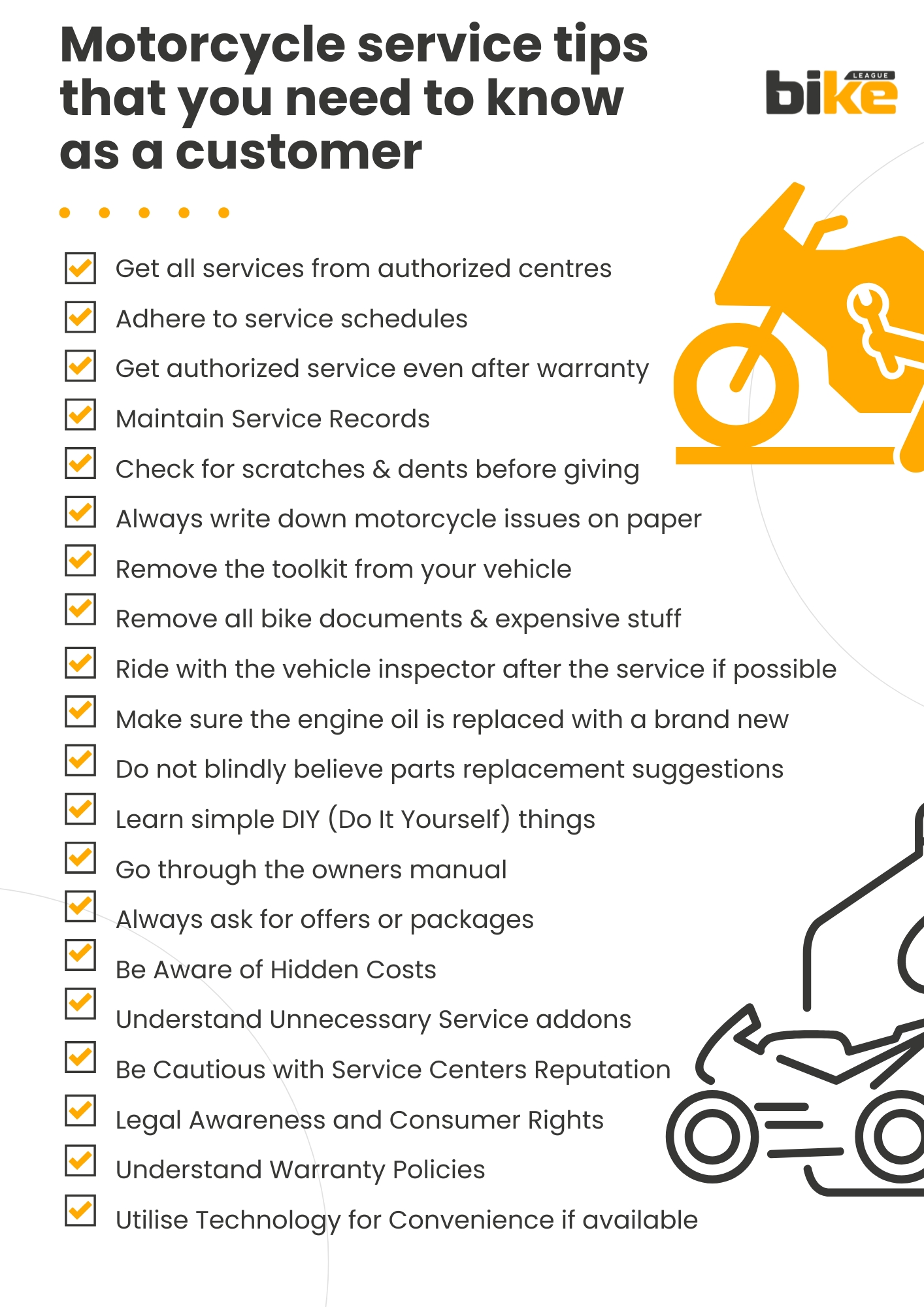
Here are the 20 motorcycle/bike service tips that you need to know in India as a two-wheeler owner.
1. Get All Services From Authorised Centres For The Initial 2-3 Years
Always get mandatory service from authorised stations regularly for 2-3 years without missing the last dates for each free and paid service. Otherwise, you might miss the parts warranty. Talk about the same with the service personnel for clarity.
2. Adhere To Service Schedules
Follow the manufacturer’s service schedule to maintain your motorcycle’s performance and warranty. This includes availing of free services within the stipulated time or kilometre range and continuing with paid services afterwards.
3. After 2-3 Years, Opt For Authorised Services As Long As Possible And Try To Get An Extended Warranty
Keep using authorised service centres for as long as you can, since motorcycle technology and tools are getting more advanced. On the other hand, unauthorised garages may lack the necessary equipment or training. Also, consider getting an extended warranty, which many companies offer for up to 5 years. As a result, you can enjoy greater peace of mind and reduce unexpected repair costs down the line.
4. Maintain Service Records
Keep a detailed record of all services and repairs. Not only is this documentation essential for future reference, but it can also enhance your motorcycle’s resale value. Additionally, well-maintained records make warranty claims and troubleshooting much easier.
5. Check Your Vehicle For Scratches And Dents Before Giving The Motorcycle
Specify it with the vehicle inspector and have him note it on the job card. Many service stations refuse their blunders at the time of delivery if you observe any scratches or dents.
6. Always Write Down Motorcycle Issues On Paper
This is important because it helps you remember all your concerns. Service centres can be busy, and staff may hurry through jobs. Make sure your issues are written on the job card.
7. Remove The Toolkit From Your Vehicle
If you can’t remove it before handing over the bike, count the tools before and after service to avoid theft and mistakes.
8. Remove All Bike Documents And Expensive Stuff From The Motorcycle
The showroom is not responsible for any loss or theft of items left on your bike. Remove seat covers, documents, extra lights, helmets, and other valuables before handing over your motorcycle.
9. Always Ride With The Vehicle Inspector Before And After The Service If Possible
If your bike has issues that only show up while riding, explain them to the inspector during a test ride together. After the service, take another test ride to make sure everything works properly. This helps catch any problems that might have been missed.
10. Make Sure The Engine Oil Is Replaced With A Brand-new One
Check the engine oil at the showroom or at home to make sure it was replaced. This is important because mistakes or dishonesty can happen.
11. Do Not Blindly Believe Parts Replacement Suggestions
Authorised service centres may suggest additional parts to increase your bill. Always check if a replacement is really needed. Refer to your maintenance manual for the recommended timing for parts replacement and repairs.
12. Learn Simple Diy (do It Yourself) Things
Learn some simple DIY tasks and get familiar with your motorcycle’s parts and how they work. Examples include chain lubing, chain cleaning, greasing cables and nuts, and changing engine oil.
13. Go Through The Owner’s Manual
Your owner’s manual is a helpful guide with service schedules and recommendations. Following these guidelines helps you avoid unnecessary services.
14. Always Ask For Offers Or Packages
Showrooms often have service packages. Consider these, but read the details carefully to avoid hidden costs or conditions.
15. Be Aware Of Hidden Costs
Authorised service centres sometimes add hidden costs to the final bill, like extra labour charges for work not done. Always ask for a detailed bill and question any charges you don’t understand.
16. Understand Unnecessary Service Add-ons
Service centres often recommend unnecessary service add-ons to inflate bills. For instance, “engine decarbonising” is not required every 15,000 to 20,000 km, and “engine dressing” is another service that is aggressively recommended but unnecessary. Similarly, unless specific issues exist, “engine flushing” and “fuel injector cleaning” are unnecessary at every scheduled service. Being aware of these unnecessary services can help you avoid paying for them.
17. Be Cautious With Service Centres’ Reputation
Research the service centre’s reputation before handing your motorcycle over. Service centres have sometimes been accused of incompetence and unethical practices, resulting in significant financial losses for customers. Opt for service centres with a proven track record of customer satisfaction.
18. Legal Awareness And Consumer Rights
Understanding your consumer rights can empower you to take action if you feel cheated. In severe malpractice cases, consider filing a complaint with consumer forums or legal authorities. Awareness of your rights can also deter service centres from engaging in unethical practices.
19. Understand Warranty Policies
Ensure you are familiar with your motorcycle’s warranty terms. Warranty claims for parts like tyres and batteries are handled by their respective manufacturers, and all claims must be processed through authorised dealers. Keeping service records is crucial to validating warranty claims.
20. Utilise Technology For Convenience If Available
With advancements like the ‘Smart Workshop’ app, customers can track their vehicle’s service status through a single SMS link, reducing waiting times and enhancing transparency. This allows for better day planning and ensures a smooth service experience.
Tips For Older Bikes Or Out-of-warranty Motorcycles
Once your motorcycle is out of warranty, you don’t have to depend only on authorised service centres. With a good independent mechanic, genuine spare parts, and a basic maintenance routine, you can keep older bikes running reliably while saving a lot on labour and markup costs.
These tips are especially useful for 5+ year-old commuters and classics that have already passed their initial warranty period and now need smart, cost-effective care rather than showroom-style bills.
1. Prioritise Preventive Maintenance Over Cosmetic Work
- Stick to fluid changes: For older engines, change engine oil slightly earlier than the recommended interval (for example, every 3,000–4,000 km on commuters) and never skip brake fluid and coolant changes where applicable.
- Watch rubber and wear items: Inspect tyres, brake pads, cables, chain–sprocket kit and rubber hoses regularly; replacing these on time is cheaper than dealing with breakdowns or accidents later.
- Clean and lube more often: Older chains, linkages and cables benefit from more frequent cleaning and lubrication, especially if you ride in rain, coastal areas or dusty city traffic.
2. Finding A Trusted Independent Mechanic
- Shortlist based on real reviews: Look for neighbourhood garages or doorstep bike services with consistently high Google ratings and detailed rider reviews rather than just low prices.
- Test with a small job first: Start with basic work like an oil change or brake service and see how they communicate, whether they show old parts, and how the bike feels afterwards.
- Insist on transparency: Ask for a written job card and itemised bill. A good independent mechanic will explain which jobs are urgent, which can wait, and will not push unnecessary add-ons just to inflate the bill.
- Stick to one garage once you’re satisfied: Building a long-term relationship means the mechanic knows your bike’s history and can spot problems earlier instead of “experimenting” every visit.
3. Sourcing Quality Spare Parts Without Getting Fake Items
- Prefer OE or reputable brands: For critical components like brake parts, bearings, chains and electricals, choose OEM or reputed aftermarket brands instead of the cheapest local option.
- Use trusted online spare-part platforms: Sites that specialise in genuine motorcycle spares and list brand-specific stores (Hero, Bajaj, TVS, Yamaha, Honda, Royal Enfield, etc.) are safer than random marketplaces because they vet suppliers and clearly show part numbers.
- Match part numbers with the manual: Cross-check the part number on the box with your owner’s manual or manufacturer’s parts catalogue before fitment, especially for items like filters, sprockets and brake pads.
- Keep invoices safely: Store all bills for major parts (battery, tyres, electrical components) so you can claim any brand-specific goodwill warranty later if something fails early.
4. Budgeting Smartly For An Older Motorcycle
- Create an annual maintenance budget: For a typical 150–250 cc commuter that is out of warranty, plan roughly one major service plus 2–3 minor visits per year and set aside money for at least one “big ticket” item like tyres or chain–sprocket kit.
- Separate reliability from “nice-to-have” upgrades: Prioritise brakes, tyres, bearings, cables and fluids before spending on cosmetic accessories or performance mods.
- Use DIY for simple jobs: Chain cleaning/lubing, basic fastener checks, battery terminal cleaning and air-filter inspection are safe DIY tasks that can significantly cut labour costs when done correctly.
With these practices, owners of older or out-of-warranty motorcycles can enjoy reliable daily use and touring without depending entirely on expensive authorised workshops, while still protecting safety and long-term engine health.
What About Motorcycle Service In Remote Areas With Limited Options?
In remote parts of India, where authorised service centres and roadside assistance are limited, it’s better to focus on planning ahead, learning basic self-care, and making smart use of local mechanics. Here’s a practical framework you can use.
1. Accept The Asc (authorised Service Centre) Gap Early
Most of rural India relies on small roadside garages that lack proper training or equipment, so riders must treat the nearest ASC as a “backup hub” rather than a routine stop. In your content, explicitly state that regular light maintenance can be done locally once the bike is out of the first‑year warranty corridor. Still, heavy‑duty work (engine, electronic modules, suspension) should be reserved for a proper shop visited during planned trips to town.
2. Build A “remote‑ready” Basic Toolkit
Advise owners to keep a minimal tool kit (basic spanners, Allen key set, torque‑lite if possible, tyre‑pressure gauge, puncture kit, chain‑lube‑spray, and a good chain‑cleaning brush) and a “service box” at home. This aligns with how many manufacturers now encourage owners to do simple tasks such as oil checks, chain lube, and tyre‑pressure checks themselves.
3. Prioritise What You Can Safely Diy
In remote areas, focus on the handful of high‑impact tasks owners can learn to do themselves:
- Oil level check and periodic oil change using the correct grade.
- Cleaning and lubricating the chain every 500–600 km or after rain.
- Air filter cleaning and tyre‑pressure checks (you can plug in ideal pressures for major Indian brands).
These tasks directly affect mileage, engine life, and safety, and they require only minimal tools and a bit of YouTube practice.
4. Choosing And “training” A Local Mechanic
Where ASCs are far away, owners need to identify a reliable local mechanic rather than hopping from garage to garage. Your content can guide them to:
- Ask other riders in the village/town for references.
- Prefer a mechanic who keeps invoices, uses decent‑quality consumables, and doesn’t overcharge for basic work.
- Pair them with owner‑done basics (e.g., bring the bike with a clean chain, correct oil, and a fresh air filter) so the mechanic can focus on what the rider can’t do safely.
5. Use Rsa As A Contingency, Not A Convenience
Most mainstream RSA in India covers only towing or basic spares up to a certain distance from an authorised workshop, and response in deep rural areas is often slow. For your remote‑rider segment, frame RSA as:
- A “get‑to‑town” plan, not a replacement for local skills.
- Something to activate only for immobilising failures (engine, serious electrical fault, major crash), while everything else should be pre‑planned via a DIY + local mechanic mix.
6. Service Intervals And Record‑keeping
Advise remote owners to:
- Stick to the manufacturer’s schedule, but compress the “harsh‑conditions” track (shorter oil, chain, and air filter intervals if riding frequently on unpaved or dusty roads).
- Keep a simple log (a phone note or a small paper passbook) with the date, km, work done, and parts changed. This helps when you do reach an ASC or a more reputable town garage.
7. When To Skip A “remote Asc Detour” Altogether
Your guidance for remote riders can be:
- For 0–1 year, prioritise ASC‑only service if the bike is still under tight warranty.
- After 2–3 years, use ASCs mainly for major jobs (engine top‑end, clutch, wheel bearing, suspension) whenever you visit a city, and handle routine checks locally. This reduces neglect without forcing impossible trips every 1,500 km.
What Are The Different Challenges, Resources, And Risks Between Urban And Rural Motorcycle Service Experiences In India?
In cities, riders often have many authorised service centres to choose from, quick roadside assistance, and well-trained mechanics. The main challenge is choosing the right place and not trusting bills without checking them.
In rural or remote areas, there are fewer service centres and skilled mechanics, so owners depend more on local garages and do some maintenance themselves. This can lead to poor repairs, delays in getting parts, and breakdowns far from help, so knowing some DIY basics and choosing a good mechanic is even more important.
| Aspect | Urban setting | Rural / remote setting |
|---|---|---|
| Access to ASCs | Multiple authorised service centres (ASCs) within 10–30 km; easy to choose. | Often no ASC nearby; nearest ASC may be 50–150 km away or more. |
| Choice of mechanics | Many garages, plus doorstep‑service apps and chains. | Limited to 1–3 local roadside garages; often just one “default” mechanic. |
| RSA / breakdown support | Faster RSA response; tow and basic spares usually available. | Sparse RSA coverage; help may take hours or never arrive in remote interiors. |
| Tools & diagnostics | ASCs and big independents have proper tools, lift, diagnostics, and air‑guns. | Most local garages use basic hand tools; no proper torque‑wrenches or scanners. |
| Parts availability | Genuine and decent aftermarket parts are easy to source daily. | Long delays for parts; may need to wait days or order from town. |
| Skill level & training | More ASC‑trained and brand‑specific technicians; some specialisation. | Skill varies; few have formal training, often “learned on the job.” |
| Service‑cost pressure | More competition; can compare prices between shops. | Limited competition; owners may pay higher or accept whatever is quoted. |
| Warranty & record‑keeping | Easier to keep digital service history and maintain warranty validity. | Poor record‑keeping; service notes may be in a loose notebook or phone. |
| DIY necessity | Often optional; many riders prefer “wash‑and‑go” at ASC. | Highly recommended: owner must learn basics (oil, chain, tyres, air filter). |
| Biggest risk | Over‑trusting ASCs / doorstep‑service providers without understanding the job. | Getting stuck with an unqualified mechanic, wrong parts, or repeated repairs. |
What Are The Things To Look For When Choosing A New Motorcycle Service Centre In India?
Have the rider ask/observe these before paying or leaving the bike:
1. Certifications & Authorisation
- Is this an authorised service centre (ASC) for their brand, or at least competent with that make/model?
- Do they mention any technician training or brand‑specific certification?
2. Reputation Signals
- Check Google / JustDial / local forums for consistent ratings above ~4.0 and recent positive reviews mentioning specific work (oil, brakes, electrical).
- Ask 2–3 local riders: “Where do you get your ABC‑model serviced?” and cross‑check names.
3. Workspace And Tools
- Are vehicles properly parked, tools in place, and the floor reasonably clean?
- Do they have proper hoists, torque‑wrench‑style tools, tyre‑pressure gauge, and basic diagnostic devices (multimeter, OBD‑like scanners for ECU bikes)?
4. Communication And Transparency
- Does the advisor listen to the issue, note down symptoms, and avoid “vague” diagnoses like “all bikes behave like this”?
- Do they provide a written estimate listing parts, labour, and approximate time before starting work?
5. Parts And Pricing
- Do they clearly state whether they are using genuine/OEM parts or trusted aftermarket parts, and show the old part if it was replaced?
- Are labour charges either flat‑rate items or at least itemised, not “arbitrary” or much higher than ASC benchmarks for similar work?
6. Service History And Warranty
- Do they keep a basic record (date, km, job done, parts used) and stamp/mention it in your service booklet if applicable?
- If the bike is under warranty, do they confirm they won’t void it by performing work the manufacturer considers ineligible?
7. Red Flags To Watch For
Tell readers to be wary if they see:
- No clear nameboard, no written estimate, or insistence on “decide now” without explanation.
- The mechanic is recommending multiple expensive parts (engine, clutch, ECU) for a tiny symptom, with no clear test or demo.
- No explanation of what was done or refusal to show old parts, such as filters, brake pads, or plugs.
- Repeatedly fixing the same issue across multiple visits without a proper root‑cause check.
- Very low prices on complex jobs compared with ASCs, suggesting corner‑cutting or the use of reused / fake parts.
Myths Vs Facts In Motorcycle Service In India
There are many myths and bits of ‘local wisdom’ about motorcycle service in India. These can lead owners to pay extra, skip important checks, or avoid doing simple maintenance themselves. Some riders think authorised service centres can fix everything or feel they must follow every suggestion.
Here’s a clear breakdown of common myths and facts, so you can take care of your bike with confidence, whether you visit a big city centre or a small village garage.
| Myth | Fact |
|---|---|
| “Authorised Service Centres (ASCs) are always competent and honest.” | ASCs can still overcharge, skip checks, or push unnecessary add‑ons; owners should always understand the job list and parts used before approval. |
| “Only ASCs can keep my warranty valid.” | Most manufacturers mainly require you to follow service intervals and maintain records; warranty can still be claimed if you keep proper logs, even if some work is done by trusted independents. |
| “Non‑genuine parts will always ruin my engine.” | Some reputable aftermarket brands are fine; the real risk is low‑quality or fake parts from untrusted shops. Always match part numbers with your manual or catalogue. |
| “If I don’t service at an ASC, my bike will break early.” | If you follow the service schedule with good oil, filters, and competent mechanics—ASC or independent—the bike’s life depends more on usage and care than on brand‑owned billing counters. |
| “Engine decarbonising and fuel‑injector cleaning are needed every 10,000–20,000 km.” | These services are often unnecessary at every service; they should be done only if diagnostics or symptoms actually show carbon build‑up or injector issues. |
| “Remote‑area service centres don’t matter as much because there’s no choice anyway.” | Remote owners face more risk of poor workmanship and parts, so DIY basics and choosing one reliable local mechanic are even more important for safety and longevity. |
Top Motorcycle Service Mistakes To Avoid In India
Even experienced riders make preventable mistakes at service centres, especially in India, where some ASCs and garages mix aggressive sales with genuine technical work. Owners often skip documentation, ignore red flags, or over‑trust mechanics because there’s no easy alternative.
The list below highlights the most common errors and how to avoid them, helping you protect your warranty, wallet, and safety on every bike.
- Not questioning the job list. Blindly handing the bike over without asking what will be done, which parts will be replaced, and at what cost opens the door to unnecessary add‑ons and hidden charges.
- Ignoring service schedules because “ASC quality is poor”. Even if you dislike the ASC, skipping service intervals voids warranty and hurts engine life; balance dislike with discipline.
- Letting the mechanic decide every repair without explanation. If a part replacement is suggested, insist on a simple test or demo, or at least research typical life and service intervals in the manual.
- Forgetting to maintain service records. Manual or digital logs (date, km, job, parts) are critical for warranty, resale, and tracking recurring issues across ASCs and independents.
- Delaying safety‑critical or recall work. Engine, clutch, brakes, suspension, ABS, or recall‑related jobs should not be deferred just to avoid ASC politics or travel distance.
- Keeping valuables and documents on the motorcycle. Showrooms are not responsible for loss or theft; always remove the toolkit, seat covers, helmets, spare light fittings, and documents before handing over the bike.
- Skipping basic DIY even on daily commuters. Simple tasks like oil checks, chain lube, tyre‑pressure checks, and air‑filter inspection keep the bike healthier and reduce dependence on over‑eager mechanics.
- Accepting every service add‑on at ASCs. Avoid “engine decarbonising”, “engine dressing”, “engine flushing”, or frequent fuel‑injector cleaning unless truly justified by symptoms.
- Ignoring local mechanic reputation in remote areas. Relying on whoever is closest without checking feedback or testing small jobs first can lead to repeated repairs, wrong parts, and breakdowns in tough conditions.
- Believing RSA will always reach rural interiors quickly. Treat RSA as a “get‑to‑town” backup, not instant roadside magic; plan for DIY capability and local‑mechanic help in remote zones.
Faq About Motorcycle Service In India
1. Do Manufacturers Often Deny Warranty Claims To Save Costs?
There is a belief that manufacturers frequently deny warranty claims to avoid expenses. While manufacturers may scrutinise claims to ensure they are valid, they are legally obligated to honour warranties if the conditions are met. Owners need to maintain proper service records to support their claims.
2. Are Recalls Always Covered Under Warranty?
A common question is whether recall-related repairs are covered under warranty. Recalls are covered under warranty, and dealers cannot charge for recall work. The National Highway Traffic Safety Administration (NHTSA) mandates this, ensuring that safety-related defects are addressed without cost to the owner.
3. Can Dealers Deny Warranty Claims Due To Lack Of Maintenance?
There is a concern that dealers might deny warranty claims if maintenance records are not provided. While dealers can deny claims if a failure is due to lack of maintenance, the manufacturer has the burden of proving that improper maintenance caused the issue. Keeping detailed records of maintenance, whether done personally or by a dealer, is crucial.
4. Does Using Aftermarket Parts Void The Warranty?
Many riders worry that using aftermarket parts will void their warranty. While some aftermarket components, especially those affecting the engine or software, can void the warranty, this is not always true. It is important to understand the specific terms of the warranty and consult with the dealer before making modifications.
5. Will Diy Repairs Void My Warranty?
DIY repairs can void the warranty if they cause damage or are not performed in accordance with the manufacturer’s guidelines.
6. How Do I Ensure My Warranty Remains Valid After Service?
To keep the warranty valid, it is important to have all services conducted at authorised service centres and maintain proper documentation of these services.
7. What Are The Common Scenarios In Which A Warranty Is Not Applicable?
- Normal ageing, deterioration or rusting of plated parts, paint coats, rubber parts, soft items, glass items, plastic Parts, etc.
- Components like the oil filter, air filter paper element, control cables, brake pads, clutch assembly, drive chain and sprocket kit, steering ball races, electrical equipment, wiring harness, etc., are subjected to normal wear and Tear.
- Failures occurred due to using non-recommended grade lubricants, fuel or improper level.
- Damages from using non-genuine parts, lack of proper maintenance, and incorrect riding habits.
- Damages to engine management system parts (like ECU, throttle body, sensors, etc.) due to tampering affect the motorcycle’s performance.
- Parts damaged due to accidents, collisions, abuse, etc.
- Irregularities not recognised as affecting the quality or function of the motorcycle, such as slight vibration, oil leakage
- Discolouration of the exhaust pipe bend, cat region/silencer/soft or hard shock absorber, etc.
- Warranty is not applicable for discolouring the exhaust pipe and silencer, as this natural process will happen during usage.
- Defects arising from the fitment of unauthorised or additional electrical loads.
- Motorcycle serviced or repaired at unauthorised service centres.
- The motorcycle is used for competitions/racing/stage rallying, etc.
- Electrical components, such as bulbs, fuses, etc., and electronic components, including the ECU, fail due to repair by arc Welding.
- The motorcycle had tampering/drilling/welding marks on any part of the frame.
- Normal maintenance operations include brake adjustment, fuel system cleaning, engine tune-up, and other adjustments.
- Oxidisation of buffed/painted/powder-coated items, etc.
- Any damage from natural disasters, i.e., earthquakes, fires, floods, etc.
The following service tips can help your motorcycle’s engine last longer and perform better. Add these tips to your regular maintenance routine to keep your bike in top shape. From oil changes to tyre pressure checks, these steps help every part of your motorcycle run smoothly.
8. What Specific Documents Should I Keep On Hand When Taking My Motorcycle For Authorised Company Service In India?
These days, most details are stored digitally, and authorised service centres can access your motorcycle’s information quickly. Usually, you don’t need to bring many documents, but it’s best to ask the service centre if they need anything from you.
9. How Often Should I Get My Motorcycle Serviced?
Manufacturers usually recommend servicing your motorcycle every 3,000–5,000 km or every 4–6 months, whichever comes first. However, always check your owner’s manual for the specific service intervals for your model. Regular servicing keeps your bike running smoothly and helps catch issues early.
10. Is It Safe To Wash My Motorcycle At A Roadside Wash Station?
While quick washes are convenient, some roadside wash stations use high-pressure water jets that can force water into electrical parts or bearings, potentially causing damage. It’s safer to wash your motorcycle gently at home or choose a professional service centre that uses motorcycle-appropriate cleaning methods.
Other Related Articles From Bikeleague India
- Bike maintenance at home: Save money & time on services
- Two Wheeler Road Tax in India: A Detailed Explanation
- Motorcycle storage – Long term storage tips & precautions
- Bike engine oil – Everything you need to know explained
- Jawa 42
Conclusion
Looking after your motorcycle is more than a routine job—it’s an investment in your safety, reliability, and riding enjoyment. By following the expert tips and practical advice in this guide, you can avoid common mistakes, make smart choices, and help your bike last longer.
Whether you go to authorised service centres or trusted local mechanics, staying proactive and informed will help you care for your motorcycle. A well-maintained bike runs better, keeps its value, and gives you peace of mind every time you ride.
If you have questions about motorcycle service, you can email us at bikeleague2017@gmail.com or leave a comment below. We’re always happy to help. You can also connect with Bikeleague India on social media.

Your breakdown of minor versus major service intervals is incredibly helpful for keeping tracking clear. Many riders fail to realize that replacing brake fluid on time is just as critical as fresh engine oil for safety. Personally, I noticed a huge difference in my braking response after my last complete flush. Should spark plugs always be replaced during every major service?
Should spark plugs always be replaced during every major service?
Life of spark plug depends upon mainly usage pattern of the motorcycle and several other factors and its health should be checked on every major service.
Check out our dedicated article for the same right here https://www.bikeleague.in/motorcycle-articles/motorcycle-technical-articles/motorcycle-spark-plug-everything-you-need-to-know-explained/
Replacement of the spark plug and its caps should be done only under advice of authorised service technician only if needed.
Regarding brake fluid it must be changed in regular intervals as per owners or service manual whether motorcycle runs or not. Fluids and oil can degrade over time whether the motorcycle is running or not.