
Long story short: Are you aware of the penalties for riding without mirrors in India? Do you know if mirrors are required on two-wheelers, or what the current fines are? If you’re unsure about the rules for bike and scooter mirrors, this article will help.
If you ride a motorcycle or scooter in India, there are important legal rules about safety equipment, including rear-view mirrors. Many riders don’t know that missing or non-compliant mirrors can lead to big fines.
This article explains the latest rules, penalties, and standards for two-wheeler mirrors in India, so you can stay safe and avoid problems.
Key Takeaways
- Rear-view mirrors are legally required for most motorcycles and scooters in India under the Motor Vehicles Act and Central Motor Vehicles Rules.
- Missing or non-compliant mirrors can result in significant fines and penalties. They may even affect insurance claims after an accident.
- Both left and right mirrors are generally mandatory for two-wheelers above 70cc; single mirrors are allowed only on specific low-powered models.
- Only mirrors that meet AIS-001 and AIS-002 standards for size, fitment, and marking are considered legal—even aftermarket mirrors must comply.
- Properly installed mirrors greatly improve safety by providing essential rear visibility and reducing the risk of blind-spot accidents.
What Is The Motor Vehicle Act 1988 Of India?
The Motor Vehicles Act 1988 is a comprehensive legislation enacted by the Parliament of India to regulate all aspects of road transport vehicles in the country. The Act provides the framework for road safety, vehicle registration and licensing, and the management of traffic offences.
What Is Chapter 13, Section 190 Of The Motor Vehicle Act 1988?
The Motor Vehicle Act 1988, Chapter 13, Section 190, forms the cornerstone of the legal provisions regarding vehicle safety equipment, including mirrors. This section addresses vehicles operating in unsafe conditions and provides the fundamental framework for enforcing safety regulations.
The section is particularly significant because it targets individuals who knowingly drive or permit others to drive in conditions that could endanger others. Under this provision, the law prescribes penalties, including potential imprisonment, especially when safety violations result in property damage or injury.
How Are The Motor Vehicle Act 1988 Chapter 13 Section 190 And The Absence Of Mirrors For Motorcycles Interconnected In India?
The Motor Vehicles Act 1988 is a comprehensive legal framework governing road transport in India. Within this Act, Chapter 13 addresses offences and penalties. Section 190 specifically addresses the consequences of operating vehicles in unsafe conditions. This section is particularly relevant when discussing the requirement for motorcycles to have mirrors.
Section 190 mandates that all vehicles, including motorcycles, be roadworthy. This includes having functional mirrors. Riding without mirrors violates this section, and the rider is liable for penalties.
Explanation Of Chapter 13 Section 190 In The Motor Vehicles Act, 1988 – Using The Vehicle Unsafely.
Subsection (1), Any person who drives or causes or allows to be driven in any public place a motor vehicle or trailer while the vehicle or trailer has any defect, which such person knows of or could have discovered by the exercise of ordinary care and which is calculated to render the driving of the vehicle a source of danger to persons and vehicles using such place, shall be punishable with fine which may extend to Rs 250 or, if as a result of such defect, an accident is caused causing bodily injury or damage to property, with imprisonment for a term which may extend to 3 months, or with fine which may extend to one thousand rupees, or with both.
Subsection (2), Any person who drives, causes, or allows a motor vehicle to be driven in any public place and violates the standards prescribed about road safety, noise control, and air pollution shall be punished for the first offence with a fine of Rs 1,000 and for any second or subsequent offence with a fine of Rs 2,000.
Subsection (3), Any person who drives or causes or allows to be driven, in any public place, a motor vehicle which violates the provisions of this Act or the rules made thereunder relating to the carriage of goods which are of dangerous nature to human life shall be punishable for the first offence which may extend to Rs 3,000, or with imprisonment for a term which may extend to 1 year, or with both, and for any second or subsequent offence with fine which may extend to Rs 5,000, or with imprisonment for a term which may extend to 3 years, or with both.
Changes In Section 190 Of The Motor Vehicles Act, 1988 In The Motorcycle Amendment Act 2019
In subsection (1),
- Driving with known defects (including missing mirrors) could result in fines of Rs 1500, increased from Rs 250
- If the defect leads to an accident causing bodily injury or property damage, the penalties increase to:
- Imprisonment for up to 6 months increased from 3 months.
- Fine up to Rs 5,000 increased from Rs 1,000.
- For a subsequent offence, imprisonment for six months or a fine of ten thousand rupees for bodily injury or property damage.
In subsection (2),
- As in The Motor Vehicles Act, 1988, instead of a Rs 1,000 fine, there is imprisonment for 3 months, a fine that may extend to Rs 10,000 or both. He shall be disqualified from holding a license for 3 months.
- As in The Motor Vehicles Act, 1988, instead of a Rs 2,000 fine, there is imprisonment for six months, or with a fine which may extend to Rs 10,000, or with both.
In subsection (3),
- As in The Motor Vehicles Act, 1988, there is a Rs 3,000 fine instead of a Rs 10,000 fine, and he shall be disqualified from holding a license for 3 months.
- As in The Motor Vehicles Act, 1988, instead of a Rs 5,000 fine for a second or subsequent offence, there is a fine of Rs 20,000, and he shall be disqualified from holding a license for 3 years.
What Are The Official Standards For Two-wheeler Mirrors (size, Placement, Isi Marking, Etc.) As Per The Central Motor Vehicles Rules In India?
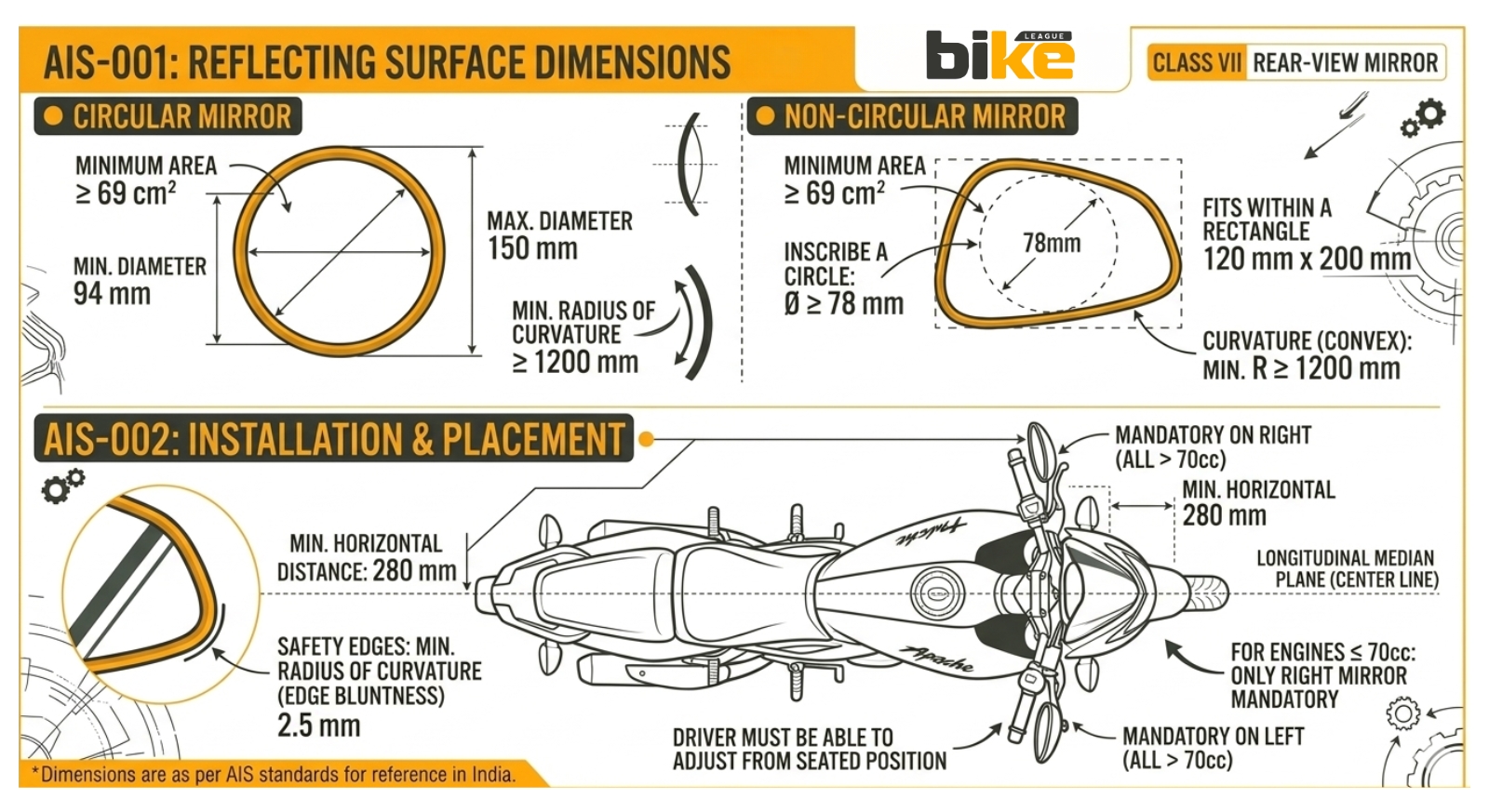
Mirrors on motorcycles and scooters must comply with the installation rules in AIS-002 (Part 2) Rev 1:2011, which remains the current standard. Here’s a simple summary, so you don’t have to go through all the technical documents.
Official Mirror Installation Requirements
From AIS-002 (Part 2) Rev 1:2011 (ARAI, adopted under CMVR for L-category vehicles without full bodywork like motorcycles/scooters).
| Vehicle Type | Minimum Mirrors | Max Design Speed | Right Mirror Distance | Left Mirror Distance |
|---|---|---|---|---|
| L1/L2 (≤70cc scooters/step-thrus) | 1 (right side only) | ≤50 km/h | ≥280 mm horizontal from centerline | N/A |
| L2/L3/L4/L5 (most motorcycles, >70cc scooters) | 2 (left + right) | >50 km/h | ≥280 mm horizontal from centerline | ≥280 mm horizontal from centerline |
Key Rules
- Mirrors must be “Class L” per AIS-001 (Part 2) Rev 1 specs (flat or convex).
- Steady under normal use—no vibration loosening.
- Driver-adjustable from riding position.
- Measured with handlebars straight ahead, mirrors in normal position.
Mirror Technical Specs (ais-001/related)
| Mirror Class | Reflecting Surface Min Dimension | Radius of Curvature (Convex) | Field of View Requirement | Applicable To |
|---|---|---|---|---|
| Class L (Two-wheelers) | Rectangle: 4 cm x u cm (u = 15 × 1000/(1+r) where r ≥1200 mm) |
1200-∞ mm (Flat mirrors allowed) |
Adequate rearward vision per vehicle category | All L1/L2/L3/L4/L5 two-wheelers (scooters, bikes) |
| Exterior (post-70cc bikes) | Inscribable segment ≥7 cm base | ≥1200 mm | Distortion ≤5% | L3/L4/L5 motorcycles >50 km/h design speed |
You don’t need to look for an ISI or BIS mark on your mirrors. Instead, check that your mirrors have AIS type approval. If you’re buying aftermarket mirrors, ask the shop for proof of ARAI homologation. This is what enforcement officers may ask for during checks.
What Do The Data Or Studies Show About Accident Rate Differences Between Riders With And Without Mirrors In Two-wheelers?
A 2022 Indian study found that 93.5% of helmet-wearing riders believe mirrors are essential for safety, and 90% believe riding without mirrors is unsafe (statistically significant, p=0.005). The US NHTSA states that mirrors prevent 18% of lane-change collisions, which are the most common blind-spot incidents for bikes. Without mirrors, riders lose important rearward visibility, which is especially risky during India’s peak crash hours from 6 pm to 10 pm.
| Study/Source | Key Finding | Impact Without Mirrors |
|---|---|---|
| IJSS India Helmet Study (2022) | 93.5% riders: mirrors + helmet safest | 90% consider unsafe (p=0.005) |
| US NHTSA Data (2024) | Proper mirrors prevent 18% lane-change collisions | Higher blind-spot collision risk |
| PubMed Mirror Study (2010) | Poor mirror setup overestimates TTC | Increased rear-end crashes |
| Tamil Nadu Motorcycle Crashes | 37% fatal crashes 6-10 PM low visibility | Worse situational awareness |
Sources:
Which Are The Legal And Illegal Aftermarket Mirrors For Two-wheelers In India?
At the moment, there isn’t a specific type of aftermarket mirror that is always considered legal or illegal in India. What matters is whether the mirror and its installation keep your bike in line with CMVR, AIS-001 (performance/spec), and AIS-002 (installation) rules for size, number, visibility, and marking. In practice, aftermarket mirrors usually fall into two groups: those likely to be legal and those risky or probably illegal.
Types Of Legally Acceptable Aftermarket Mirrors (if Compliant)
These types are usually fine if they provide the right number of mirrors, meet the required size, have proper markings, and actually give you a usable rear view.
1. Oem‑style Replacement Mirrors
- They match the size, shape, and mounting position of the original mirrors. They are often sold as “direct replacements” or RTO‑friendly options.
- It’s best to pick ones that show AIS‑001‑style markings or come from a known brand, rather than generic, unbranded options.
2. Arai‑approved/certified Aftermarket Mirrors
- Look for products that clearly mention AIS‑001 / AIS‑002 or ARAI approval, and have test markings either on the mirror housing or in the paperwork.
- Many RTOs treat these as “replacement parts” rather than illegal modifications, as long as they fit your bike in the same way as the originals.
3. Bar‑end Mirrors That Still Meet Size/position Rules
- Bar‑end mirrors can be legal if you still have the right number of mirrors, enough reflective area, solid mounting, and a clear, undistorted rear view.
- For example, some brands or dealers offer premium bar‑end mirrors as accessories—these are different from tiny, mostly decorative mirrors that aren’t really useful.
4. Convex Mirrors That Meet Ais‑001 Specs
- Larger convex mirrors—at least 6900 mm² in reflective area—that are securely fitted and have the “Objects in mirror are closer than they appear” marking.
- These are considered legal if you install them in the right spot and don’t remove the required second mirror.
Types Of Risky/likely Illegal Aftermarket Mirrors
These mirrors are not banned by name, but they often break the rules by being too small, reducing visibility, or not fitting properly. This means they violate the requirements of AIS-001, AIS-002, or the CMVR.
Mirrors That Are Clearly Non‑compliant
| Mirror type | Why it tends to be illegal |
|---|---|
| Tiny decorative or “racing” mirrors | Way below 6900 mm² reflective area and usually marked down to just “accessories,” not AIS‑001‑compliant spec. |
| Single‑bar‑end mirror fitted instead of the stock mirror (no second mirror) | Violates the requirement for two mirrors on most two‑wheelers above 70 cc. |
| Unbranded, no‑marking glass mirrors | No AIS‑001‑type identification or test marking; police/RTO can treat them as unapproved modifications. |
| Mirrors with no convex warning text when convex | Convex glass lacking “Objects in mirror are closer than they appear” fails the AIS‑001 marking rule. |
| Mirrors that vibrate or fold excessively at speed | While not a separate “type,” mirrors that lose stability are treated as unsafe under CMVR‑style fitness criteria. |
Mirror Setups That Fall Into A Grey Area Legally
- Bar‑end mirrors that are very small or heavily styled: Bar-end mirrors that are very small or mainly chosen for style can be tricky. If they’re too small, lack proper markings, or leave only one mirror after fitting them, many RTOs and police will likely see them as illegal modifications.
- Mirror indicators (indicator‑integrated mirrors): Mirrors with built-in indicators (turn signals) are another grey area. Unless these are officially approved, they change your bike’s original indicator setup, which can make it non-compliant in the eyes of authorities.
- Removing mirrors entirely for “cafe” or “tracker” style: Completely removing mirrors for a “cafe” or “tracker” look is a straightforward rule violation. Riding with only one mirror—or none at all—not only affects safety but also breaks Rule 125 and related regulations. This can lead to fines or even your bike being temporarily impounded.
How To Choose A Legal Two-wheeler Aftermarket Mirror In India?
Here’s a simple guide on how to choose a legal mirror for your two-wheeler in India. It covers what to ask the seller, how to check whether a mirror is compliant, and which markings to look for.
1. What To Ask The Seller
Before buying, ask these questions in this order:
Is This Mirror Ais‑001‑compliant?
Who the mirror is tested/approved by (e.g., ARAI-recognised test lab) and whether the seller can show a type‑approval or test‑report reference.
Do You Have Ais‑001 Or Ais‑002 Marking On The Mirror Or Packaging?
Many compliant units carry a small approval‑type mark or code on the housing, cap, or base plate.
Is This Mirror Meant As An Oem Replacement, Or Is It Just An Accessory?
OEM‑style replacement mirrors are far more likely to be treated as compliant by RTOs than generic “racing” accessories.
Can You Confirm The Reflective Area Is At Least 6900 Mm² (class Vi Size) For Two‑wheelers?
Tiny mirrors rarely meet AIS‑001‑specified reflective‑area rules.
Does The Mirror Come With A Convex Warning Text If It’s A Convex Surface?
Under AIS‑001, convex mirrors must carry “Objects in the mirror are closer than they appear.”
If the seller can’t answer these questions clearly, consider the mirror a high-risk or possibly non-compliant product.
2. How To Physically Verify Compliance
At the shop or online, check these points on the mirror itself:
Look For Markings And Branding
- Legible manufacturer name or trademark.
- Part number or product code.
- Any AIS‑001 / AIS‑002 / ARAI‑type approval‑style marking or “homologated”/“CMVR‑compliant” label.
Reflective Surface
- Glass must be at least roughly 94 mm in diameter (circular) or must allow a 78 mm circle to fit inside the reflective area (non‑circular).
- Surface must be flat or spherically convex, without cloudiness, heavy tint, or visible defects.
Convex‑mirror Text
- If the mirror is convex, verify that the warning line “Objects in mirror are closer than they appear” is printed on the glass or base plate.
Mounting And Stability
- Screw or clamp should feel solid; the mirror should not rotate by itself or vibrate wildly at hand‑shake or cruising speed.
- For two‑wheelers above 70 cc, ensure the setup keeps two mirrors installed, not one removed and one replaced.
3. What Documents Or Proof To Look For
For a “future‑proof” purchase, ask or look for:
Certificate / Test‑report Summary
Some sellers keep a copy of an AIS‑001 test report or type‑approval certificate from ARAI or an MoRTH-recognised lab; AIS‑002 notes that such documents are often kept by the test agency and can be cited with the mirror.
Catalog Or Datasheet
Reputable brands list the mirror under AIS‑001 or AIS‑002 in the product datasheet, along with Class VI or L‑category‑specific classification.
Warranty Or “ais‑certified” Tag
A rear‑view mirror that must be mandatorily AIS‑certified in India has undergone at least a basic approval process by a recognised certification body.
Official Links To Two-wheeler Mirror Standards Documents In India
Below are official links for mirror standards and guidance on where to check them. You can add this section to your aftermarket mirror page for direct access to the source documents.
1. Ais‑001 (part 1) (rev. 2): 2023 – Indirect‑vision Devices (rear‑view Mirrors) Performance
This document covers the complete specifications for mirrors and other indirect-vision devices used on L, M, and N-category vehicles, including Indian two-wheelers.
https://hmr.araiindia.com/storage/ais-details/7_AIS%20001_Part_1_Rev_2_&Corri_1F_3eeec486-eb12-4468-ba72-e42ef749a1c0.pdf
2. Ais‑002 / Ais‑002 (part 1) – Rear‑view Mirror Installation Requirements
It explains how many mirrors are required, how far they should extend outward, and where the reflective area should be positioned relative to the driver’s eyes.
https://hmr.araiindia.com/storage/ais-details/5192015105902AMAIS_002.PDF
3. Arai Ais‑standards Download Page
ARAI provides a public list and download section for all published AIS-001, AIS-002, and AIS-001-Part-2 standards.
https://www.araiindia.com/downloads/ais-downloads
Common Myths And Mistakes About Two‑wheeler Mirrors In India
1. Myth: Mirrors Are Optional; I Can Ride Without Them If I’m Careful.
Reality: Rear‑view mirrors are mandatory for most two‑wheelers on Indian roads, not “optional accessories.”
CMVR and Section 190‑style rules treat missing mirrors as a “known defect” or unsafe condition, which can draw fines and increase liability if the accident is related to rear‑visibility failures.
2. Myth: Only Oem Mirrors Are Legal; All Aftermarket Mirrors Are Illegal.
Reality: Aftermarket mirrors are not automatically illegal; legality depends on whether they keep the bike compliant with AIS‑001 (size/type) and AIS‑002 (fitment) rules, not just OEM vs third-party origin.
OEM‑style replacements, ARAI‑approved mirrors, or bar‑end units that meet size and stability rules are generally fine; it is tiny, unmarked, or unsafe‑fit mirrors that run into trouble.
3. Myth: Rtos And Police Never Check Mirrors; They Only Care About Helmets And Indicators.
Reality: Enforcement varies by city, but RTOs and traffic police can and do fine riders without mirrors.
Cities like Bengaluru and Pune have explicitly announced ₹500–₹1,000‑style fines for two‑wheelers caught without mirrors, and courts have directed strict implementation of rear‑view mirror rules.
4. Myth: If The Law Doesn’t Call It A ‘no‑mirror‑specific’ Crime, Fines Are Not Valid.
Reality: There is no “mirror‑only” offence code, but police levy fines under broader “unsafe vehicle,” “fitment,” or “defect” provisions of the Motor Vehicles Act and CMVR, which absolutely apply to missing or non‑compliant mirrors.
So, even if the ticket is not written as “no mirror,” the absence of a mirror is still the trigger for the challan.
5. Myth: Bar‑end Mirrors Are Always Illegal Or Always Legal.
Reality: Bar‑end mirrors are conditionally legal in India, provided they meet AIS‑001‑style size, marking, and stability requirements and retain the required number of mirrors.
Bar‑end units that are tiny, unbranded, remove the second mirror, or vibrate excessively at speed are the ones that get treated as non‑compliant, not bar‑end mirrors in principle.
6. Myth: Riding With A Single Mirror Is Enough; I Don’t Need Both.
Reality: For most motorcycles and scooters above 70 cc, two mirrors (left and right) are required under AIS‑002‑based rules.
Riding with only one mirror violates the number requirement. It can be treated as a non‑compliant fitment, even if the single mirror is perfectly sized.
7. Myth: Tiny Decorative Mirrors Are ‘good Enough’; They Still Count As Mirrors.
Reality: Tiny racing or decorative mirrors are usually far below the AIS‑001‑specified minimum reflective area (≥ 6900 mm² for many Class VI types), so they fail the basic performance requirement.
From a compliance angle, they are more like “styling doodahs” than proper rear‑view mirrors. They can be treated as illegal or non‑homologated modifications.
8. Myth: If The Bike Comes With Mirrors, I Can Remove Them Later Because The Registration Is Done.
Reality: Registration is based on the original homologated configuration, and removing mirrors or replacing them with heavily non‑compliant units can be treated as a modification that violates CMVR/fitment rules.
Manufacturers and courts have even accepted that removing mirrors can lead to loss of warranty or increased liability in accident cases.
9. Myth: Aftermarket Mirrors Don’t Need Any Approval Or Marking.
Reality: AIS‑001 requires mirrors to carry clear markings (manufacturer, identification code, and AIS‑type references) and, in the case of convex mirrors, the “Objects in mirror are closer than they appear” warning.
Unbranded, no‑marking glass raises the risk that police and RTOs will treat the mirror as an unapproved or illegal modification, even if the fitment looks okay.
10. Myth: I Don’t Need Mirrors Because I Check My Blind Spot By Turning My Head.
Reality: Head‑checking is useful, but rear‑view mirrors are the primary tool for continuous rear‑vision while maintaining control of the bike.
Evidence from Indian and international studies shows that proper mirror use reduces lane‑change and rear‑end‑type crashes; riding without mirrors effectively removes this safety buffer.
Faqs About Motorcycle Mirrors Penalties & Challan In India
1. Are Rear-view Mirrors Mandatory For All Two-wheelers In India?
Yes, rear-view mirrors are legally required for most motorcycles and scooters under the Motor Vehicles Act and Central Motor Vehicles Rules. Two mirrors (left and right) are generally mandatory for vehicles above 70cc.
2. What Is The Fine For Riding Without Mirrors?
Fines range from ₹500 to ₹1,500 or more, depending on the city and whether it is a first or repeat offence. Penalties can also escalate to potential imprisonment if the absence of mirrors contributes to an accident.
3. Can I Use Aftermarket Mirrors On My Bike?
Yes, aftermarket mirrors are legal if they comply with AIS-001 and AIS-002 standards for size, marking, and proper installation. Tiny, unmarked, or unstable mirrors are considered illegal.
4. Are Bar-end Mirrors Legal In India?
Bar-end mirrors are conditionally legal if they meet size, marking, and stability requirements and retain the required number of mirrors for your vehicle type.
5. Is It Legal To Ride With Only One Mirror?
For most two-wheelers above 70cc, two mirrors are required. Riding with only one mirror generally violates the rules, except for specific low-powered models allowed by law.
6. Do Missing Or Illegal Mirrors Affect Insurance Claims Or Accident Liability?
Missing or non-compliant mirrors can influence how insurers and courts assign fault and liability, especially if the absence of mirrors is linked to an accident.
7. Are There Separate Rules For Electric Two-wheelers?
No, electric two-wheelers must comply with the same mirror regulations as petrol-powered vehicles in India.
8. How Can I Check If My Mirrors Are Legal?
Check for AIS-001 or AIS-002 markings, ensure the mirrors provide a clear rear view, and confirm with the seller or manufacturer that they are certified for use on Indian roads.
9. Do Missing Or Illegal Mirrors Affect Insurance Claims Or Accident Liability?
In India, riding with missing or non‑compliant mirrors does not automatically void your insurance. Still, it can definitely influence how insurers and courts treat fault and liability, especially if the accident is clearly linked to poor rear‑view visibility.
10. Is There A Separate Mirror Requirement For Electric Two-wheelers In India?
No — electric two-wheelers do not get a separate mirror exemption just because they are EVs. In India, electric scooters and electric motorcycles fall under the same L-category vehicle framework for mirror approval and installation, so the mirror rules broadly follow the same AIS/CMVR path as petrol two-wheelers.
Other Related Articles From Bikeleague India
- Aftermarket Motorcycle Silencer Rules in India – Explained
- Indian Motor Tariff (IMT) for Two-Wheelers in India
- Bike insurance jargons & addons in India Guide
- Bike modification – The dos and don’ts in India
- Action camera with mount on helmets – Legal or illegal in India
Conclusion
In short, knowing and following the legal rules for two-wheeler mirrors in India helps keep you safe and avoid fines. The latest laws make it clear that you need the right number, type, and proper installation of mirrors on your motorcycle or scooter.
If you follow the tips in this article, your vehicle will stay legal and safe. Following these rules helps you avoid penalties and makes the roads safer for everyone. We’ve explained motorcycle mirror rules in India in detail. If you have more questions, you can email us at bikeleague2017@gmail.com or leave a comment below. We’re happy to help.