
Long story short – Timely servicing of the motorcycle is the vital thing to do as far as improving mileage figures. This comprehensive guide will provide you with the best tips for improving your Two wheeler mileage. These tips help you increase mileage in two-wheelers.
Boosting your motorcycle’s fuel efficiency helps you save money, keep your bike running longer, and reduce its environmental impact. Whether you ride every day or just on weekends, good habits can really make a difference.
This guide covers proven tips, practical maintenance advice, and answers to common questions to help you get the best mileage from your bike.
Key Takeaways
- Regular servicing and timely maintenance are crucial for optimal motorcycle mileage and long-term performance.
- Maintaining correct tyre pressure and using quality fuel directly impact fuel efficiency and safety.
- Riding habits—such as smooth acceleration, avoiding harsh braking, and shifting gears wisely—significantly improve mileage.
- Clean air filters and proper chain maintenance reduce engine strain and help achieve better fuel economy.
- Avoiding common mistakes like overloading, overfilling engine oil, and neglecting warning signs prevents unnecessary fuel loss and mechanical issues.
What are the proven bike/motorcycle mileage tips to save fuel?
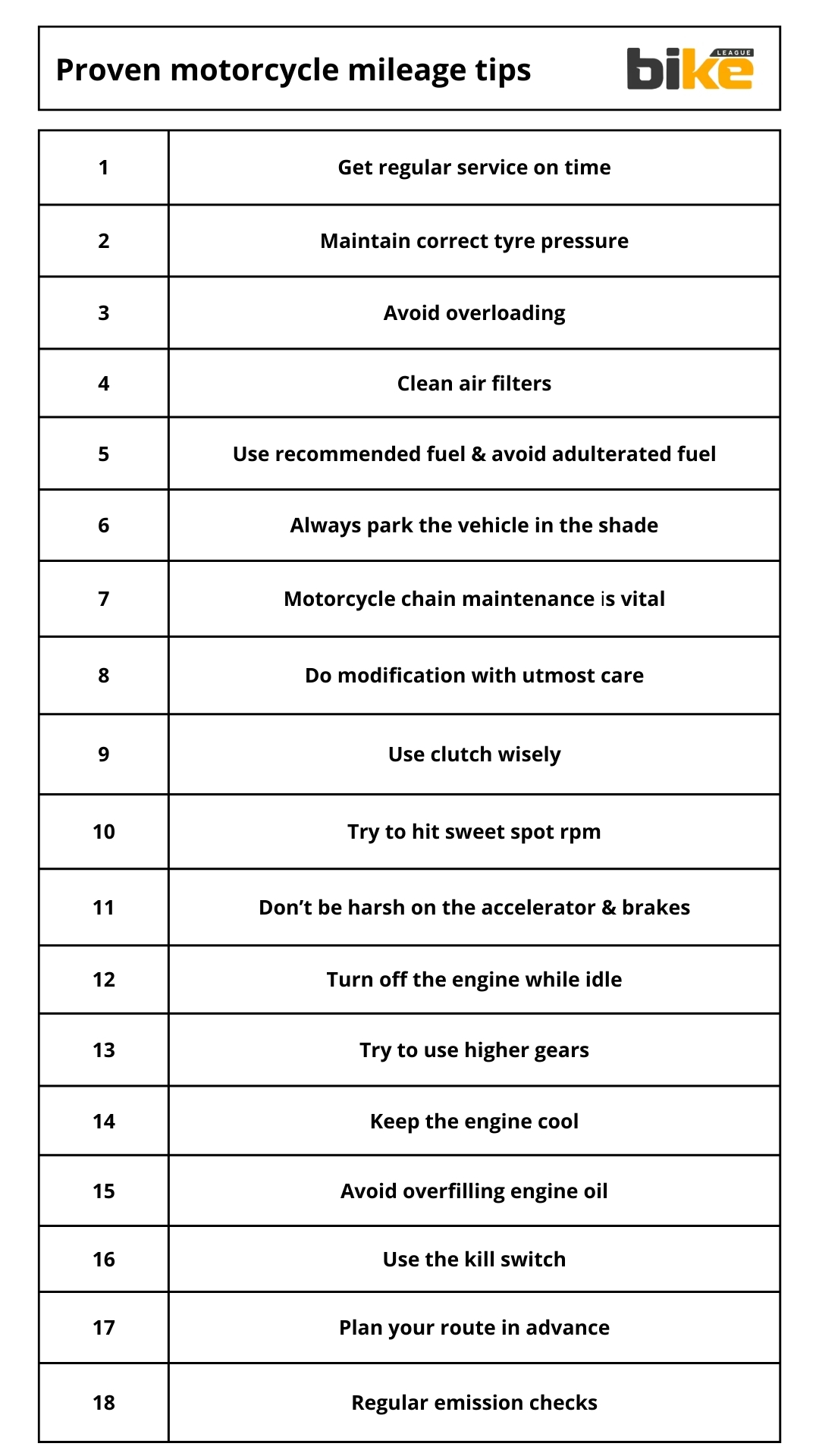
1. Get regular service on time – the crucial fuel economy tip
General service is the most important, as the engine oil and air filter must be changed and cleaned on time. Also, the first 1000 km on the two-wheeler are vital and require utmost care. Always complete all recommended free and paid services and continue servicing at the same intervals even after the warranty period.
2. Maintain correct tyre pressure
Tyre pressure monitoring every month if you are filling nitrogen in tyres. If the air is in place of nitrogen, weekly monitoring is necessary. Nitrogen is the best for tubeless tyres, while air works well for tube tyres. Among tube and tubeless tyres, the latter is the best. Always follow the manufacturer-mentioned tyre pressure figures. Nitrogen is recommended for tyres with a longer life as it does not heat the air inside the tyre. Also, filling tube tyres with nitrogen is irrelevant and offers an added advantage.
3. Avoid Overloading
Minimising the bike’s load can help improve mileage. Overloading the bike increases the engine’s workload, leading to higher fuel consumption.
4. Clean Air Filters
Keeping the air filter clean ensures that the engine receives the right amount of air for combustion, which is essential for fuel efficiency. A clogged air filter can reduce mileage.
5. Use Recommended Fuel and Avoid Adulterated Fuel
Stick to the recommended fuel type for your bike and avoid using adulterated fuel. Adulterated fuel can damage the engine and reduce fuel efficiency.
6. Always park the vehicle in the shade
Leaving your motorcycle in the sun for long periods can cause some fuel to evaporate. While this may not be a major factor, every drop counts. Manufacturers are now working on this by using better materials for fuel tanks.
7. Motorcycle chain maintenance & tension adjustment is vital
Regular lubing and chain slack must be checked in accordance with your area and environmental conditions. Lubing is needed more frequently in dusty, urban environments. Also, the chain slack should be tight enough because it affects power delivery from the engine to the rear wheel.
8. Do modification with utmost care
Custom motorcycle accessories, such as silencers, air filters, and extra-wide tyres, affect mileage. Before modifying, check with the dealer. Try to use manufacturer-approved accessories whenever possible.
9. Use clutch wisely
Do not keep the clutch lever pressed while driving. Try to minimise clutch use as much as possible. Tight clutch settings are far more suitable for the vehicle than a loose clutch. Clutch use is higher in cities than on highways, which directly affects mileage.
10. Try to hit the sweet spot rpm
Every engine has a sweet spot rpm range that maximises fuel efficiency at lower loads. Try to hit that range and ride in it. Most of the best mileage bikes have markings on the tachometer to assist the rider. Fuel efficiency is usually between 40-60km/l in most bikes, but varies when the displacement of the engine changes.
11. Don’t be harsh on the accelerator and brakes
Excessive acceleration and hard braking seriously affect mileage figures. So, calm, disciplined riding is the way to avoid huge holes in your wallet. Also, opt for routes with less traffic, even if they are longer.
12. Turn off the engine while idle
Turn off the engine whenever you can at traffic signals or roadblocks. Even when idling, the engine uses fuel. For example, idling for more than 30 seconds uses more fuel than restarting a modern engine. Studies show that a 150cc bike can waste up to 50–100 ml of fuel per hour of idling. Turning off the engine during long stops can improve your mileage by 5–10% in city traffic.
13. Try to use higher gears
Try to reach and maintain fourth gear or higher, and avoid riding in a higher gear at low speed. The correct gear at the right speed is vital. Avoid high-traffic roads and opt for quieter roads.
14. Keep the engine Cool
Do not cover the engine in the front and sides, as this may restrict the smooth airflow required for air cooling, causing the engine to run at a higher temperature and consume more fuel.
15. Avoid Overfilling Engine Oil
Follow the recommended engine oil replacement schedule in the owner’s manual and avoid overfilling, as excess oil can increase friction and reduce fuel efficiency.
16. Use the Kill Switch
Using the kill switch to shut off the engine during short stops can help save fuel and improve overall fuel economy. The kill switch is designed for quick engine shutdowns, making it faster and more convenient than turning the key, especially in stop-and-go traffic. Frequent use of the kill switch does not harm the engine or electrical system in modern motorcycles.
17. Plan Your route in advance
Strategically planning your route to avoid traffic and poor road conditions can help maintain a steady speed and reduce fuel consumption.
18. Regular Emission Checks
Getting the emission level certified every 3 months can help ensure your bike runs efficiently and doesn’t consume excess fuel due to emissions-related issues.
What are the frequent motorcycle maintenance errors and how to avoid them?
- Overinflating Tyres: Many riders believe that higher tyre pressure improves mileage. However, overinflated tyres reduce the contact area with the road, compromising grip and safety while causing uneven tyre wear. Always maintain tyre pressure as per the manufacturer’s specifications.
- Neglecting Minor Leaks: Small oil or fuel leaks often go unnoticed, but ignoring them can lead to bigger mechanical issues and reduced fuel efficiency. Regularly inspect your bike for signs of leaks and address them promptly.
- Ignoring Warning Lights: Modern motorcycles are equipped with various warning lights for issues like low oil pressure or engine trouble. Ignoring these indicators can cause severe damage and reduce mileage. Pay attention to dashboard lights and consult a mechanic when any warning appears.
- Delaying Oil Changes: Postponing scheduled oil changes leads to increased engine friction, overheating, and poor fuel economy. Stick to the recommended maintenance schedule in your owner’s manual.
- Using Incorrect Engine Oil: Using oil with the wrong viscosity or type can decrease performance and mileage. Always use the grade and type recommended by the manufacturer.
- Overfilling Fuel Tank: Filling the tank to the brim, especially in hot weather, can lead to fuel spillage and evaporation losses. Fill only up to the recommended level.
- Neglecting Air Filter Maintenance: Dirty or clogged air filters restrict airflow to the engine, making combustion less efficient and reducing mileage. Clean or replace air filters regularly.
- Improper Chain Maintenance: A dry, unlubricated, or slack chain increases friction and power loss, resulting in lower fuel efficiency. Regularly clean, lubricate, and adjust your motorcycle chain.
By avoiding these common mistakes, riders can not only improve their motorcycle’s mileage but also ensure safer and more reliable performance.
How do different riding styles specifically affect fuel efficiency in motorcycles in India?
Different riding styles significantly impact motorcycle fuel efficiency in India, influenced by factors unique to the country’s road conditions, traffic patterns, and climate. Let’s explore how specific riding styles affect fuel consumption in the Indian context:
1. Aggressive vs Smooth Riding
Aggressive riding in Indian cities, with quick acceleration and hard braking, reduces fuel efficiency by making the engine work harder and wasting fuel. In contrast, smooth riding with gentle acceleration and steady speed helps save fuel. Frequent stops and starts in traffic make aggressive riding even less efficient. Road features like roundabouts and traffic signals also affect fuel use. Riding smoothly can help you save fuel in the city.
2. Throttle and Gear Management
Proper throttle and gear management is essential for fuel efficiency in India’s varied riding conditions. Avoid using large throttle openings at low revs and small ones at high revs; instead, aim for a mid-throttle opening with the right gear and RPMs. In Indian traffic, where speed changes are frequent, using higher gears at lower RPMs can enhance fuel efficiency by easing the engine’s workload. This approach works best on highways or less congested roads where you can maintain a steady speed.
3. Speed and Aerodynamics
Higher speeds increase air resistance, which requires more fuel to maintain speed. In India, where many roads have speed limits and traffic often moves at moderate speeds, maintaining a consistent speed can significantly improve fuel efficiency. Adopting a streamlined posture and minimising drag by avoiding unnecessary accessories can further enhance fuel economy.
4. Adapting to Road Conditions
India’s road conditions vary greatly, from well-maintained highways to rough, potholed streets. Adapting riding style to these conditions is crucial for fuel efficiency. On roads with surface irregularities, maintaining a steady speed becomes challenging. These irregularities can lead to increased fuel consumption due to frequent acceleration and deceleration. Riders who can anticipate and smoothly navigate these road conditions will achieve better fuel efficiency.
5. Traffic-Aware Riding
A traffic-aware riding style can significantly improve fuel efficiency in India’s often-congested traffic, especially in urban areas. This involves:
- Anticipating traffic flow to minimise unnecessary braking and acceleration
- Avoiding excessive idling in heavy traffic by turning off the engine during prolonged stops
- Choosing routes with less stop-and-go traffic when possible
Studies have shown that real-world riding conditions in India often result in higher fuel consumption than those in standardised test cycles. This highlights the importance of adapting riding style to traffic conditions to improve fuel efficiency.
6. Climate-Conscious Riding
India’s hot climate reduces fuel efficiency due to increased engine cooling requirements. Riders adapt their riding style by avoiding prolonged idling in heat, which can help conserve fuel. During the monsoon season, rainfall can significantly increase travel time and worsen road conditions. In Greater Mumbai, travel time can increase by 8-140% during rain, leading to higher fuel consumption due to slower speeds and more idling.
7. Eco-Driving Techniques
Adopting eco-driving techniques can significantly improve fuel efficiency. These techniques include:
- Maintaining a steady speed
- Avoiding rapid acceleration and braking
- Using engine braking instead of the brakes when slowing down
- Planning ahead to avoid unnecessary stops
How to calculate motorcycle mileage?
There are two main methods for calculating motorcycle mileage:
1. Full-tank-to-full-tank method
This is the most common and accurate method for calculating motorcycle mileage. To use this method, you will need to:
- Fill your motorcycle’s fuel tank to the brim.
- Reset your trip meter to zero.
- Ride your motorcycle for a specified distance, such as 100 kilometres or miles.
- Fill your motorcycle’s fuel tank to the brim again.
- Note the amount of fuel you added to the tank.
- Divide the distance you travelled by the fuel you added to the tank.
For example, suppose you rode your motorcycle for 100 kilometres and added 5 litres of fuel to the tank. In that case, your motorcycle’s mileage is 20 kilometres per litre (km/L) or 50 miles per gallon (MPG).
2. Bottle method
The bottle method is less accurate for calculating motorcycle mileage, but more straightforward. To use this method, you will need to:
- Attach a clear bottle to your motorcycle’s carburettor.
- Fill the bottle with a known amount of fuel, such as 1 litre or 1 quart.
- Set your trip meter to zero.
- Ride your motorcycle until the bottle is empty.
- Note the distance you travelled.
- Divide the distance you travelled by the fuel you used.
For example, suppose you rode your motorcycle for 50 kilometres and used 1 litre of fuel. In that case, your motorcycle’s mileage is 50 kilometres per litre (km/L).
Myths related to fuel efficiency in motorcycles
1. Filling up fuel in the morning or colder environments prevents fuel evaporation
Myth number one and the biggest one. Fuel is continuously pumped from underground storage tanks insulated from gas stations’ temperature fluctuations.
2. Premium fuel makes your non-premium motorcycle run better
Premium fuel is generally less combustible, which benefits powerful performance engines. It will benefit only some vehicles, as all fuel types must meet the same standards.
3. As a motorcycle ages, its fuel economy decreases significantly
What is relevant here is how we maintain and service the bike. Even 5- to 10-year-old motorcycles still have superior mileage figures.
4. It takes more fuel to start a two-wheeler than it does to let it idle.
Not applicable to modern and fuel-injected engines. For other sorts of engines, too, idling draws more fuel.
5. A full tank of fuel, nearly full, prevents fuel evaporation
It’s the biggest joke of recent times.
6. Driving in lower gears improves fuel efficiency
Driving in lower gears can actually decrease fuel efficiency. Lower gears consume more fuel than higher gears, so staying in the highest gear possible is best without lugging the engine.
7. Riding with a pillion passenger always decreases fuel efficiency
The impact of riding with a pillion passenger on fuel efficiency depends on the passenger’s weight and the type of two-wheeler. In some cases, the extra weight may not significantly affect fuel efficiency.
8. Adding fuel additives improves fuel efficiency
Most fuel additives do not improve fuel efficiency. In fact, some additives may damage the engine or void the warranty.
9. Riding in neutral when coasting saves fuel
Riding in neutral when coasting does not save fuel. In fact, it can be dangerous as it takes away your engine braking ability. Staying in gear when coasting helps maintain control and allows the engine to slow you down.
It’s helpful to have a section that lists and explains common mistakes, such as overinflating tyres, missing minor leaks, or ignoring warning lights.
FAQ about motorcycle mileage in India
1. Which motorcycle is best for mileage?
Commuter bikes or low-displacement motorcycles in the 100-125cc range provide the most mileage.
2. What are the most effective tips to improve motorcycle mileage?
Timely servicing, maintaining correct tyre pressure, cleaning air filters, using recommended fuel, avoiding overloading, and riding smoothly are key to better mileage.
3. How often should I service my motorcycle for optimal fuel efficiency?
Follow the manufacturer’s recommended service intervals and never skip scheduled maintenance, even after the warranty period.
4. Does tyre pressure really affect fuel economy?
Yes, under-inflated or over-inflated tyres can reduce efficiency and safety. Always maintain manufacturer-recommended tyre pressure.
5. Is using premium fuel necessary for better mileage?
Only use premium fuel if your motorcycle specifically requires it. Using higher-octane fuel in non-premium bikes does not improve mileage.
6. Does carrying a pillion passenger always decrease mileage?
Not always. The impact depends on passenger weight and bike type. Sometimes, it has a minimal effect.
7. How can I accurately calculate my motorcycle’s mileage?
Use the full-tank-to-full-tank method: fill the tank, reset the trip meter, ride a known distance, refill, and divide the distance by fuel used.
8. Will aggressive riding styles reduce my bike’s mileage?
Yes, rapid acceleration, harsh braking, and erratic throttle use waste fuel. Smooth, steady riding improves mileage.
9. Should I turn off the engine at long traffic lights?
Yes, turning off the engine during long stops saves fuel, especially in congested city traffic.
10. Does overfilling engine oil affect fuel economy?
Yes, overfilling can increase friction and reduce efficiency. Always use the recommended oil quantity and type.
11. What are some common maintenance errors that hurt mileage?
Overinflating tyres, neglecting minor leaks, ignoring warning lights, delaying oil changes, and improper maintenance of the chain or air filter can all negatively impact fuel efficiency.
Other related links from Bikeleague India
- Bike engine oil – Everything you need to know explained
- Bike loan Interest rate – Factors that have an impact in India
- Bike maintenance at home: Save money & time on services
- Best bike tyre brands for your motorcycle in India
- Bike insurance tips in India – Tips to get a lower premium
Conclusion
You can get better mileage from your motorcycle by keeping up with maintenance, riding smart, and using good fuel. Follow these tips and avoid common mistakes to save fuel, spend less, and make your bike last longer. Even small changes in your routine can lead to big savings and a better ride. Ride safely and enjoy the journey!
We hope this article gives you all the tips you need to improve your motorcycle’s mileage in India. If you have questions or need more help, email us at bikeleague2017@gmail.com or leave a comment below. We’re always happy to help. You can also follow Bikeleague India on social media for more updates.