
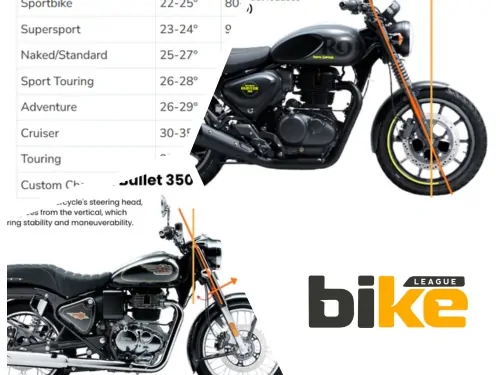
Long story short: Understand motorcycle rake and trail, trail in motorcycles, and steering geometry. See how rake in motorcycles impacts ride stability and cornering.
There’s more to motorcycle handling than just horsepower or speed. The way a bike feels on the road comes down to its steering geometry, especially the rake and trail. These measurements determine whether your ride is stable at high speeds, nimble in corners, or a mix of both. In this article, we’ll break down what rake and trail mean, why they’re important, and how they shape the way your motorcycle handles.
Key Takeaways
- Rake and Trail Define Motorcycle Handling: Rake (the angle of the steering head) and trail (the distance the front tyre contact patch trails behind the steering axis) are fundamental to how a motorcycle feels and responds, affecting both stability and agility.
- Stability vs Agility Trade-Off: More rake and trail give you better stability at high speeds, but make steering slower. Less rake and trail make the bike steer quicker and feel more agile, but you lose some stability. Manufacturers set these values based on what each bike is meant to do.
- Adjustments Are Possible, But Be Careful: You can change rake and trail by adjusting fork height, triple clamp offset, tyre size, and suspension settings. However, making big or uneven changes can make your motorcycle unstable or hard to ride.
- Dynamic and Interconnected: Rake and trail change as you ride. Braking, acceleration, and suspension sag all affect your bike’s real-world geometry. Fork offset and wheelbase also work together with rake and trail to influence handling.
- Common Myths Debunked: Rake and trail are different things, and you don’t need a new frame to change your bike’s geometry. Every motorcycle has a trail, and making careful changes within safe limits can improve handling without risking safety.
What is motorcycle rake?
1. Definition and Measurement
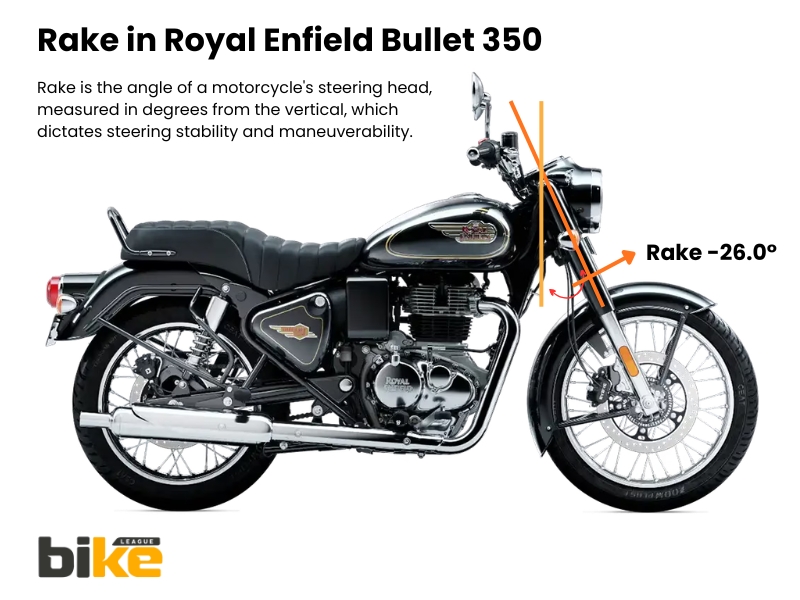
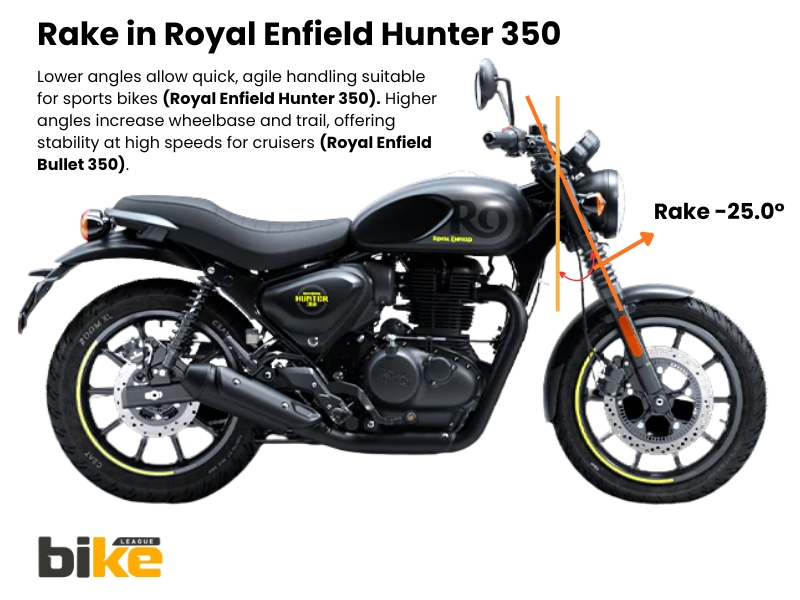
Rake, sometimes called caster or fork angle, is the angle (in degrees) between the steering head (or headstock tube) and a straight vertical line from the ground. Many people think rake is about the fork tubes, but it actually refers to the angle of the steering head in the frame. On most bikes, the fork tubes and steering head are nearly the same, but not always.
To picture rake, imagine drawing a line through the centre of your motorcycle’s steering head down to the ground. Then picture a straight vertical line rising from the front wheel axle. The angle between these two lines is the rake angle.
| Motorcycle Type | Typical Rake Angle |
|---|---|
| Sportbike | 22–25° |
| Standard/Naked | 25–27° |
| Adventure/Touring | 26–29° |
| Cruiser | 30–35° |
| Custom Chopper | 35–45° (can exceed 70°) |
Table 1: Typical rake angles by motorcycle category
2. How is motorcycle rake measured?
To measure rake on your motorcycle, you’ll need a protractor and a level surface:
- Ensure the motorcycle is perfectly upright on level ground.
- If equipped with rear suspension, have someone sit on the bike to simulate riding conditions.
- Place a protractor or angle finder parallel to the steering head axis.
- Measure the angle from vertical (90° minus the reading gives you rake)
Most manufacturers list rake specifications in their technical documents, so you usually don’t need to measure it yourself if your motorcycle is stock.
What is motorcycle trail?
1. Definition and Measurement
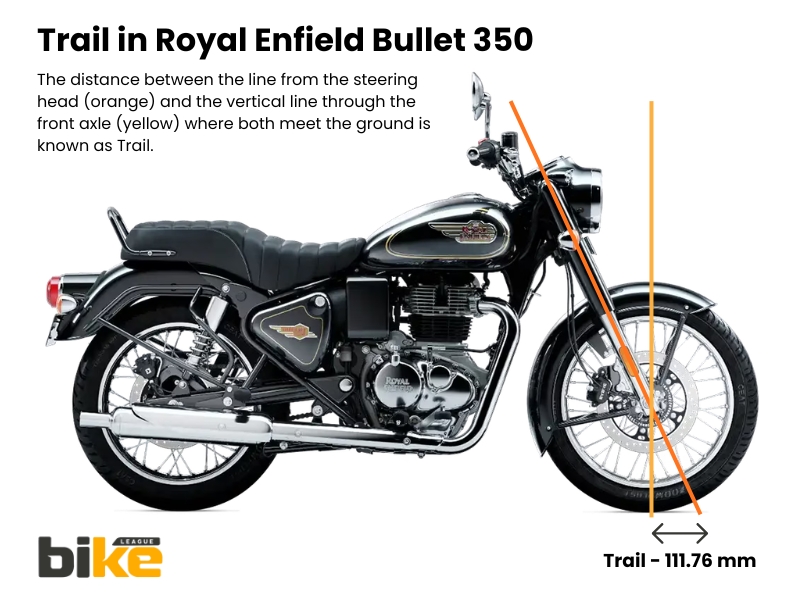
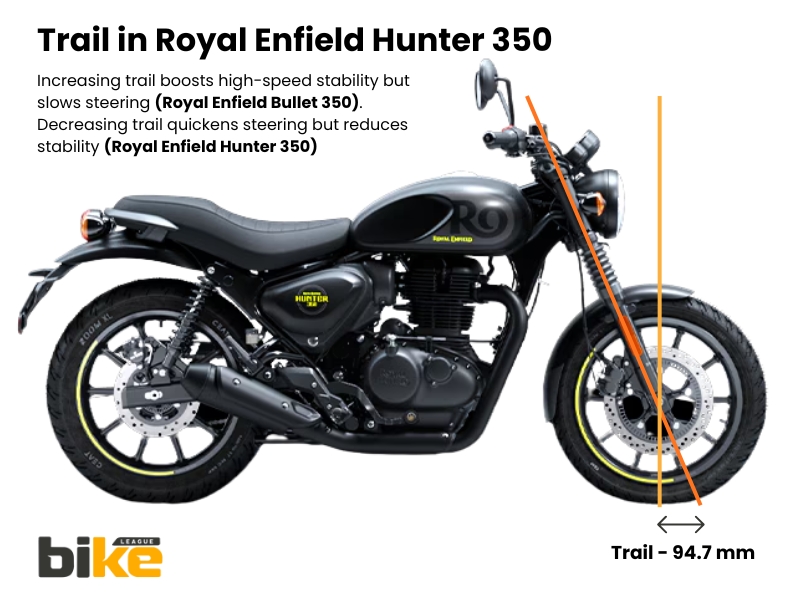
Trail is the horizontal distance between two points on the ground. The first point is where an imaginary line through the steering axis hits the ground. The second is where a vertical line straight down from the front wheel axle touches the ground. In simple terms, trail is how far the tyre’s contact patch trails behind the steering axis.
Unlike rake, which is a visible angle you can measure directly, trail is a calculated distance based on the rake angle, fork offset, and wheel size. Trail is usually measured in millimetres or inches.
| Motorcycle Type | Typical Trail Distance | Examples |
|---|---|---|
| Sportbike | 80-100 mm | Yamaha R15 V4 (88mm), KTM RC 390 (89mm) |
| Standard/Naked | 95-110 mm | KTM Duke 390 (100mm) |
| Adventure/Touring | 100-120 mm | Royal Enfield Bear 650 (116.7mm) |
| Cruiser | 120-160 mm | Royal Enfield Super Meteor 650 (157mm), Harley-Davidson X440 (146mm) |
Table 2: Typical trail measurements by motorcycle category with Indian market examples
2. How is motorcycle trail calculated?
Trail can be calculated using this formula:
Trail=((R×sin?(θ))-d)/(cos?(θ))
Where:
R = front tyre radius
θ = rake angle in degrees
d = triple clamp offset (fork offset)
For practical purposes, you can also physically measure trail:
- Position the motorcycle upright on level ground.
- Hold a tape measure straight down from the front axle to the floor and mark that point.
- Place the tape measure parallel to the steering neck, following the steering axis angle down to the floor.
- Mark this second point
- Measure the horizontal distance between the two marks—this is your trail.
For most street motorcycles, the ideal trail is usually between 2 and 4 inches (50-100 mm).
What is the relationship between motorcycle rake and trail ?
1. How They Work Together
Rake and trail work together to shape how a motorcycle handles. Understanding how they are connected is key to making sense of steering geometry:
- Increasing rake angle increases trail (assuming constant offset)
- Increasing the trail increases the self-centring effect (assuming constant rake)
- Increasing the fork offset decreases the trail.
- Decreasing the fork offset increases the trail.
Rake angle, trail distance, and fork offset all work together to make sure your bike handles safely and predictably.
2. What is Fork Offset?
Fork offset (also called triple clamp offset or triple tree offset) is the distance between the centerline of the steering stem and the centerline of the fork tubes. On sportbikes, fork tubes typically sit further forward from the steering axis, creating a larger offset (30-40mm). On cruisers, forks are closer to the steering axis with minimal offset.
Offset is a way to fine-tune how your bike handles. Manufacturers can adjust the trail without changing the frame’s rake angle. This is why many riders use aftermarket triple clamps with different offsets. They let you change the trail without altering the frame.
How motorcycle rake and trail affect handling?
1. Stability vs Agility: The Core Trade-off
The main idea behind motorcycle steering geometry is that there’s a trade-off between stability and agility:
More Rake + More Trail = Greater Stability, Slower Steering
Motorcycles with larger rake angles and longer trail measurements exhibit:
- Excellent straight-line stability at highway speeds
- Resistance to handlebar deflection from road imperfections
- Self-centring tendency that helps maintain direction
- Heavier, slower steering response
- Larger turning radius
- Greater effort is required for quick direction changes.
Less Rake + Less Trail = Greater Agility, Reduced Stability.
Motorcycles with smaller rake angles and shorter trail exhibit:
- Quick, light steering response
- Excellent manoeuvrability in tight spaces
- Responsive turn-in when cornering
- Reduced stability at high speeds
- Tendency to feel “twitchy” or nervous
- Greater sensitivity to rider input
2. Motorcycle Examples
1. Yamaha R15 V4 (26° rake, 88mm trail)
One of India’s most popular sportbikes demonstrates quick steering thanks to its short trail. The 88mm trail makes it highly manoeuvrable through city traffic and canyon roads. However, riders note it requires more attention at highway speeds above 100 km/h. The 1325mm wheelbase complements the agile geometry for spirited riding.
2. KTM Duke 390 (25° rake, 100mm trail)
The naked street fighter offers balanced geometry that’s perfect for Indian riding conditions. With moderate rake and trail, it handles everything from congested city streets to highway runs confidently. The 1357mm wheelbase provides stability without sacrificing agility, making it ideal for daily commuting and weekend canyon carving.
3. KTM RC 390 (23.5° rake, 84mm trail)
Sharing the same engine as the Duke 390 but with sportier geometry, the RC 390 demonstrates how small changes affect handling. It’s 1.5° less rake and 11mm shorter trail compared to the Duke, making steering noticeably quicker and more track-focused. However, some riders find it slightly nervous during highway cruising.
4. Royal Enfield Bear 650 (26.1° rake, 116.7mm trail)
Royal Enfield’s scrambler showcases adventure-oriented geometry. The longer 116.7mm trail provides excellent stability on mixed terrain and highways, though it requires more effort in tight U-turns. The 1460mm wheelbase further enhances straight-line stability for touring.
5. Royal Enfield Classic 350 (26° rake, 111.76mm trail)
Despite being categorised as a cruiser, the Classic 350 has relatively sporty rake geometry, contributing to its surprisingly nimble handling for a retro-styled motorcycle. This makes it versatile for both city commuting and highway cruising, though the manufacturer doesn’t publicly disclose specific trail measurements.
6. Custom Chopper (40° rake, 180mm+ trail)
Extreme stability at speed, but notoriously difficult to manoeuvre at low speeds or in parking lots. Requires considerable physical effort to turn.
3. The Self-Centering Effect
The trail creates a natural self-centring force when the motorcycle is leaned. Here’s why: when you lean the bike into a turn, the contact patch of the tyre shifts relative to the steering axis. This creates a torque that pushes the front wheel deeper into the turn. More trail amplifies this effect, creating stronger self-centring behaviour that helps maintain straight-line stability but requires more effort to initiate turns.
Typical Rake and Trail Values by Motorcycle Type
| Type | Rake | Trail | Indian Models |
|---|---|---|---|
| Sportbike | 22-25° | 80-100mm | Yamaha R15 V4, KTM RC 390 |
| Supersport | 23-24° | 90-98mm | KTM RC 390 |
| Naked/Standard | 25-27° | 95-110mm | KTM Duke 390 |
| Sport Touring | 26-28° | 100-115mm | Royal Enfield Interceptor 650 |
| Adventure | 26-29° | 100-120mm | Royal Enfield Bear 650 |
| Cruiser | 30-35° | 120-160mm | Royal Enfield Super Meteor 650 |
| Touring | 26-30° | 110-130mm | Royal Enfield Classic 350 |
| Custom Chopper | 35-70° | 150-250mm | Custom builds |
Table 3: Comprehensive rake and trail specifications with popular Indian motorcycles
Manufacturers carefully select these numbers based on each type of motorcycle’s design.
How modifications affect motorcycle rake and trail?
1. Lowering the Front End
Installing shorter fork tubes or sliding fork tubes up through the triple clamps affects steering geometry significantly:
Effects of lowering the front end (increasing fork height in triple clamps):
- Increases rake angle
- Increases trail
- Makes steering heavier and more stable
- Reduces ground clearance
- Changes the weight distribution toward the rear
As a general rule, lowering the front end by one inch is approximately equivalent to increasing rake by one degree.
2. Lowering the Rear End
Lowering the rear suspension has the opposite effect:
Effects of lowering the rear suspension:
- Decreases rake angle
- Decreases trail
- Makes steering quicker and lighter
- Reduces ground clearance
- Shifts weight forward
Many riders lower their motorcycles for comfort or to make it easier to reach the ground. Still, they often do not think about how this changes the bike’s geometry. For balanced handling, if you lower one end, it is best to lower the other by a similar amount to keep the original rake and trail.
3. Tyre Size Changes
Installing different tyre sizes, particularly changing the front tyre diameter, alters effective trail:
- Larger diameter front tyre increases trail (more stability)
- A smaller diameter front tyre decreases trail (quicker steering)
- Wider tyres can affect the shape and feel of the contact patch.
4. Aftermarket Triple Clamps
Changing triple clamps with different offset values is a popular method to fine-tune handling:
- Increased offset reduces trail (quicker steering)
- Decreased offset increases trail (more stability)
- Adjustable triple clamps allow experimentation.
- Common adjustments range from 2 to 5mm of offset.
5. Steering Dampers
Steering dampers don’t change the bike’s geometry. Still, they’re often added if modifications reduce the trail or make the bike less stable. They use hydraulics to slow down quick steering movements, giving extra stability without changing the geometry.
Measuring Your Motorcycle Rake and Trail
1. Tools Needed
- Digital angle finder or protractor
- Tape measure
- Level surface (garage floor or flat pavement)
- Helper (for bikes with rear suspension)
- Chalk or tape for marking the floor
- Motorcycle service manual (for specifications)
2. Step-by-Step Measurement Process
For Rake:
- Position the motorcycle upright on level ground.
- Ensure the front wheel is pointed straight ahead.
- Place the angle finder parallel to the steering head.
- Read angle from vertical (some tools read from horizontal—subtract from 90° to get rake)
- Record measurement in degrees
For Trail:
- Position the motorcycle upright on level ground.
- Have the helper sit on the bike to compress the suspension to the riding position (if applicable)
- Using a tape measure, drop a vertical line from the front axle centre to the ground.
- Mark this point on the floor
- Align the tape measure with the steering axis angle, extending the line to the ground.
- Mark this second point on the floor
- Measure the horizontal distance between marks.
- This distance is your trail measurement.
3. Using Online Calculators
Several online rake and trail calculators simplify the math:
Required inputs:
- Rake angle (degrees)
- Fork offset (mm)
- Front tyre radius (mm)
Outputs:
- Mechanical trail
- Normal trail (perpendicular distance from steering axis to contact patch)
Some popular calculators are the Thompson Choppers Rake & Trail Calculator, the DataMC Calculator, and tools found on motorcycle forums.
Advanced concepts related to rake and trail in motorcycles
1. Normal Trail vs Mechanical Trail
While mechanical trail is the commonly discussed measurement, engineers also consider normal trail:
Normal trail is the perpendicular distance from the steering axis to the front tyre contact patch. This measurement better represents the actual forces involved in steering because it accounts for the true moment arm around the steering axis.
Normal trail is calculated as:
Normal Trail=Trail×cos?(θ)
Where θ is the rake angle.
2. Wheelbase Considerations
Wheelbase (distance between front and rear axles) works alongside rake and trail to determine handling:
- A longer wheelbase increases stability.
- A shorter wheelbase increases manoeuvrability.
- The wheelbase must be balanced with rake and trail for optimal handling.
- Typical sportbike wheelbase: 1400-1450mm
- Typical cruiser wheelbase: 1600-1700mm
3. Dynamic Geometry Changes
Rake and trail values change dynamically during riding:
- Braking compresses the front suspension (decreases rake, decreases trail, quickens steering)
- Acceleration extends the front suspension (increases rake, increases trail, slows steering)
- Cornering loads affect suspension position.
- Suspension sag affects static geometry measurements.
Professional suspension tuners take these dynamic changes into account when setting up race bikes.
Rake and Trail for different motorcycle riding styles
1. Canyon Carving and Sport Riding
Ideal characteristics:
- Rake: 23-26°
- Trail: 90-105mm
- Quick turn-in response
- Neutral mid-corner stability
- Confidence-inspiring feedback
2. Long-Distance Touring
Ideal characteristics:
- Rake: 27-30°
- Trail: 110-130mm
- Excellent high-speed stability
- Reduced rider fatigue from self-centring behaviour
- Predictable, planted feel with luggage and passenger
3. Off-Road and Adventure Riding
Ideal characteristics:
- Rake: 26-29°
- Trail: 105-120mm
- Balance between stability and maneuverability
- Handles varied terrain and conditions
- Tolerates dynamic weight shifts
4. Urban Commuting
Ideal characteristics:
- Rake: 25-27°
- Trail: 95-110mm
- Easy low-speed manoeuvring
- Adequate highway stability
- Light steering effort for traffic navigation
Common myths about rake and trail in motorcycles
Myth 1: “Rake and Trail Are the Same Thing”
Reality: Rake is an angle; trail is a distance. While related, they’re completely different measurements. You can keep the same rake angle but vary the trail values, depending on fork offset and wheel size.
Myth 2: “Fork Angle and Steering Head Angle Are Always Identical”
Reality: On most modern motorcycles, fork tubes run parallel to the steering axis, making these angles identical. However, on custom bikes and some designs, fork tubes can be at a different angle than the steering head, particularly when using raked triple trees.
Myth 3: “More Trail Always Equals Better Stability”
Reality: While increased trail enhances straight-line stability, excessive trail makes the motorcycle difficult to steer. It can create dangerous handling characteristics at low speeds. There’s an optimal range for each motorcycle type.
Myth 4: “You Can’t Change Geometry Without a New Frame”
Reality: Fork height adjustments, triple-clamp changes, tyre size modifications, and suspension adjustments all alter effective rake and trail without frame modifications. Even suspension sag settings affect dynamic geometry during riding.
Myth 5: “Sportbikes Have No Trail”
Reality: All motorcycles have trail—it’s geometrically impossible to have zero trail with a raked steering head. Sportbikes simply have less trail (80-100mm) compared to cruisers (120-160mm).
Myth 6: “Changing Rake or Trail Will Ruin My Bike”
Reality: Within reasonable ranges, geometry adjustments simply change handling characteristics. Problems arise only when modifications create extreme values or unbalanced combinations.
Myth 7: “Fork Rake is the Curve of the Fork Blades”
Reality: Fork rake (or fork offset) refers to the horizontal distance between the steering axis and fork tubes, not the physical curvature of fork blades. Straight fork blades can have a significant offset.
Glossary of Key Terms
- Rake (Caster Angle): The angle, measured in degrees, between the steering head axis and a vertical line drawn through the front wheel. Determines how far the front fork tilts from vertical and affects both stability and steering quickness.
- Trail: The horizontal distance, usually in millimetres, between where the steering axis intersects the ground and where a vertical line from the front axle touches the ground. More trail generally means greater straight-line stability.
- Fork Offset (Triple Clamp Offset): The distance (usually in millimetres) between the centerline of the steering stem and the centerline of the fork tubes. Adjusting the offset changes the trail without altering rake.
- Wheelbase: The distance between the centres of the front and rear axles. Longer wheelbases provide more stability; shorter wheelbases increase agility.
- Steering Axis: The imaginary line running through the centre of the steering head or headstock, about which the front end pivots when turning.
- Contact Patch: The area of the tyre that is in contact with the road surface at any given time. Its position is key to understanding the trail.
- Triple Clamp (Triple Tree): The component that connects the fork tubes to the steering stem, holding the front end together and setting the fork offset.
- Suspension Sag: The amount the motorcycle’s suspension compresses under the weight of the bike and rider. Affects the effective geometry (rake and trail) when riding.
- Mechanical Trail: The straightforward, horizontal distance used to define trail, without factoring in the tyre’s curvature or contact patch location.
- Normal Trail: The perpendicular distance from the steering axis to the contact patch. Provides a more accurate representation of the steering forces.
- Self-Centering Effect: The natural tendency for the front wheel to return to centre after being turned, mainly due to trail. It contributes to straight-line stability.
Frequently Asked Questions about rake and trail in motorcycles
1. What is the difference between rake and trail?
Rake is the angle (in degrees) of the steering head from vertical. At the same time, trail is the horizontal distance (in millimetres) between where the steering axis meets the ground and where a vertical line through the front axle meets the ground. Rake is an angle; trail is a distance. For example, the Yamaha R15 V4 has a 26° rake and 88mm of trail, while the KTM Duke 390 has a 25° rake and 100mm of trail.
2. Can I adjust rake and trail on my stock motorcycle?
Yes, through several methods: adjusting fork height in the triple clamps, changing the triple clamp offset, modifying tyre sizes, or altering suspension settings. However, always stay within safe ranges and consult your service manual.
3. How does lowering my motorcycle affect handling?
Lowering the front increases rake and trail (heavier steering), while lowering the rear decreases rake and trail (quicker steering). For balanced handling, lower both ends proportionally.
4. What happens if I have too much trail?
Excessive trail creates very heavy steering, especially at low speeds, making the motorcycle difficult to manoeuvre in parking lots and tight spaces. The bike will feel extremely stable but cumbersome.
5. What happens if I have too little trail?
Insufficient trail makes the motorcycle feel “twitchy” or unstable, particularly at highway speeds. The steering will be very light, but the bike may wander or feel nervous, especially in crosswinds.
6. Do I need to change anything if I install a larger front tyre?
A larger diameter front tyre increases trail, making steering slightly heavier and more stable. If the change is significant, you may need to adjust other parameters to compensate, or you might prefer the new handling characteristics.
7. Why do cruisers have more rake than sportbikes?
Cruisers are designed for comfortable, stable highway cruising rather than aggressive cornering. The increased rake and trail provide excellent straight-line stability and a relaxed riding experience, which matches their intended purpose. However, modern Indian cruisers like the Royal Enfield Classic 350 feature relatively moderate rake (25°) compared to traditional cruisers, offering a balance between stability and manoeuvrability for diverse Indian road conditions.
8. Can rake and trail explain why my bike feels unstable at high speed?
Possibly. Insufficient trail or improper geometry can cause high-speed instability. However, also check tyre pressure, tyre wear, wheel bearings, suspension condition, and steering head bearings before concluding it’s a geometry issue.
9. How much does suspension sag affect rake and trail?
Suspension sag significantly affects dynamic geometry. Too much sag effectively lowers that end of the bike, altering rake and trail. Proper sag settings (typically 25-35mm front, 25-40mm rear) maintain intended geometry.
10. Should I install a steering damper if I change my rake or trail?
Not necessarily. A steering damper is useful if modifications create instability or the bike exhibits unwanted steering oscillations (tank slappers). If your geometry changes result in stable, predictable handling, a damper isn’t required.
Other related links from Bikeleague India
- Bike chassis – Which is right for your riding style
- Motorcycle Cruise Control – All you need to know
- Kawasaki KLX 230 RS
- Suzuki Hayabusa
- Kawasaki Ninja ZX-4RR
Conclusion
Rake and trail might sound like technical terms, but they are key to what makes each motorcycle unique. When you understand how these measurements affect agility and stability, you can make better choices—whether you’re buying, modifying, or just enjoying your bike.
Manufacturers set each motorcycle’s geometry for a reason. Still, with the right knowledge, you can enjoy, adjust, or even improve your ride. The best handling isn’t just about numbers—it’s about feeling confident and connected on the road. Stay curious, ride safe, and let what you know about rake and trail help you enjoy every ride.
If you have any other questions about rake and trail in motorcycles, email us at bikeleague2017@gmail.com or share your thoughts in the comments section below. We are always happy to help. You can also find us on Bikeleague India’s social media accounts.