Overview
Performance And Motor
The EC-06 uses an advanced IPMSM (Permanent Magnet Synchronous Motor) that delivers 4.5 kW of continuous power and 6.7 kW at its peak, along with 26 Nm of torque for quick acceleration from a standstill. It offers three riding modes: Eco, Standard, and Power, so you can choose between better range or more performance. Power mode is great for quick overtakes in traffic. The motor runs efficiently and smoothly, making it well-suited for city commutes, and regenerative braking helps recover energy as you slow down.
The EC-06 has a single-speed belt-drive automatic transmission, so there are no gears or a clutch. Power goes straight from the motor to the rear wheel, making the ride smooth and quiet. This setup needs less maintenance than traditional petrol scooters. It provides a jerk-free experience, which is helpful in city traffic where you often stop and start.
Yamaha says the EC-06 can reach a top speed of 79 kmph, which matches most city speed limits in India. It can cruise comfortably at 70-75 kmph, even with a passenger on board. Early users say it feels stable at higher speeds, thanks to its 132 kg weight and aerodynamic design, so it can handle short highway trips without any wobble.
Charging Time
The 4 kWh NMC lithium-ion battery charges from 0 to 80% in 8 hours and fully charges in about 10 hours using a regular 230V household socket with a 16A 3-pin plug. You don’t need a special fast charger. The battery is IP67-rated for durability, and Yamaha offers a 3-year or 30,000 km warranty against battery degradation, making it a good fit for home charging.
Range
The EC-06 is certified for a 169 km range under the Indian Driving Cycle, which is based on lab tests at speeds of 45 kmph or less. In real-world use, you can expect 100-140 km per charge, depending on your riding mode, how much weight you carry, and the terrain. Eco mode gives the best range for daily commutes.
Early users say the EC-06 gets 100-130 km per charge in typical Indian conditions. Riding solo in Eco mode in moderate traffic can yield 120-140 km on highways like the Mumbai-Pune route. With two people and frequent stops in the city, the range drops to 80-110 km, and Power mode gives about 70-90 km. Regenerative braking can add 10-15% more range in stop-and-go traffic. Users like that it can handle a 150 km week over three days without worry, and it’s a bit more efficient than the iQube, even without battery swap stations.
Features And Technology
The Yamaha EC-06 is Yamaha’s top electric maxi-scooter in India, combining a stylish look with practical electric features for city riders.
- Digital TFT Instrument Console:The bright colour TFT display shows speed, odometer, trip meter, range, clock, Bluetooth status, riding mode, and call or SMS notifications, making it easy to check important info at a glance.
- Bluetooth Connectivity & App:You can pair the scooter with the Yamaha app for telematics, live tracking, low battery alerts, over-the-air updates, ride analytics, and geo-fencing, making it easy to connect your smartphone.
- Three Riding Modes:Eco, Standard, and Power modes let you choose between better efficiency and more performance. You can also adjust regenerative braking to suit city or highway riding.
- Combined Braking System (CBS):The 200mm front and rear disc brakes with CBS help distribute braking force for safer stops. There’s also a low battery indicator.
- All-LED Lighting: The scooter uses LED headlamps, daytime running lights, taillights, and turn signals for better visibility and a modern look. It also has a pass light function.
- USB Charging Port:There’s a USB-A port on the dashboard, so you can easily charge your devices while commuting.
- Reverse Assist: The reverse gear makes it easier to handle tight U-turns and to park in crowded areas, a rare and practical feature.
- Spacious Underseat Storage:The 24.5L boot fits a full helmet and groceries. There’s also a carry hook and a footrest for the passenger, adding to its versatility.
- Telescopic Front Suspension:The front telescopic forks with hydraulic dampers, along with the rear coil-spring suspension, help absorb potholes. With 145mm ground clearance, it can handle speed bumps easily.
- 14-Inch Alloy Wheels:The scooter has tubeless 14-inch alloy wheels (110/80-14 front, 120/70-14 rear) for better stability and puncture resistance, along with a stylish look.
Build Quality
The EC-06 uses a strong steel tubular frame to safely hold the IP67-rated 4 kWh battery and PMSM motor, protecting them from water, dust, and minor impacts. At 132 kg, it balances being light and sturdy. The 14-inch alloy wheels with tubeless CEAT Gripp XL tyres (110/80-14 front, 120/70-14 rear) add puncture resistance and stability.
The 200 mm front and rear disc brakes with CBS use stainless rotors for reliable stopping. The scooter’s premium plastics, chrome accents, and LED housings show Yamaha’s quality and resist UV fading and monsoon weather, as seen in early durability tests.
Handling
The EC-06 handles well with telescopic hydraulic front forks and coil-spring rear suspension, plus 145 mm ground clearance to absorb potholes and speed bumps common in cities. Its 1354 mm wheelbase and 765 mm width make U-turns and lane changes easy, helped by the low centre of gravity from the battery placement.
CBS distributes braking force effectively for stable stops from 60 kmph, with users praising the planted feel at 70 kmph laden and the utility of reverse mode for tight parking, though some note mild understeer in sharp corners at full speed.
Comfort
The EC-06 is designed for comfort, with an upright riding position and a roomy single-piece seat at 1153 mm. It suits riders from 5’2″ to 6′, offering easy flat-footing and plenty of legroom. Passengers get a sturdy grab rail and foldable footrests, making short rides with two people comfortable.
The suspension is tuned for a smooth ride over bumps without bottoming out. The digital TFT console is easy to read, and vents help reduce heat. Users say they can ride 80-100 km in a day without getting tired. Still, the firm seat may be uncomfortable on longer trips, and the 24.5L underseat storage only fits a half-helmet and a small bag.
Styling
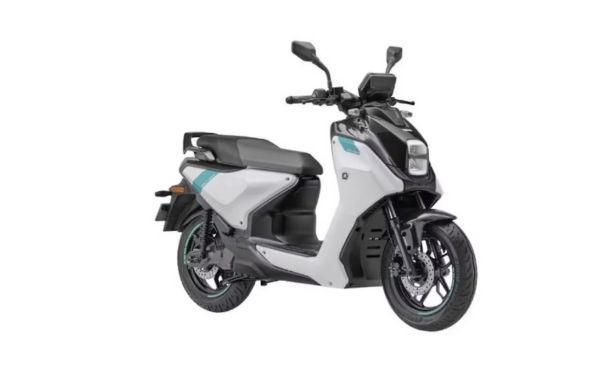
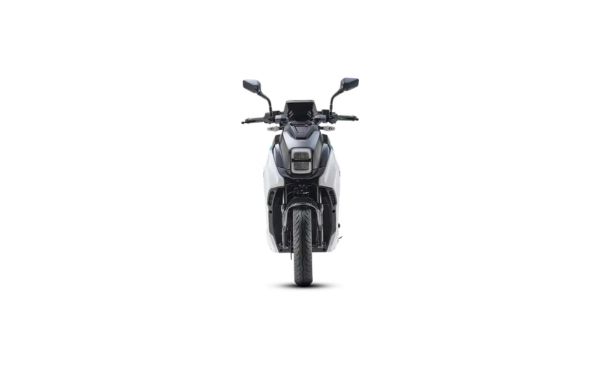
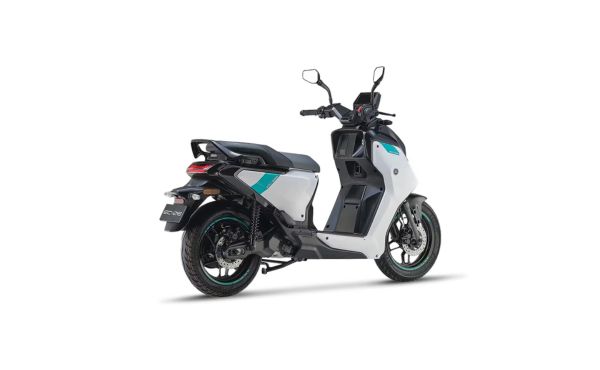
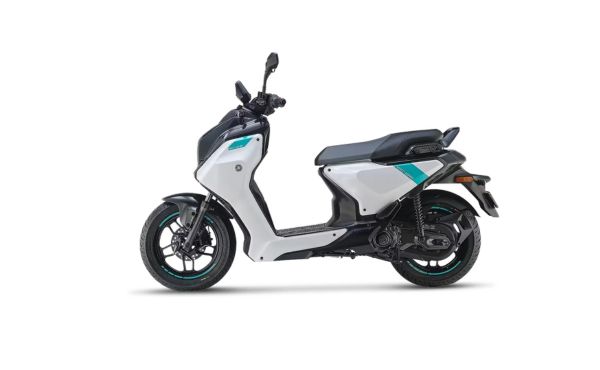
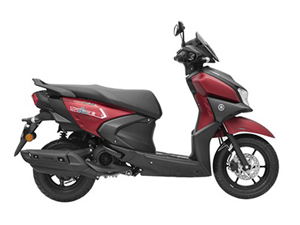
The EC-06 has a unique maxi-scooter look with a long, low stance (1890 mm long, 765 mm wide), sharp body lines, a flat floorboard, and a stepped seat for a sporty feel. The slim, vertically stacked LED headlamp with integrated DRLs gives it a striking front, while the sculpted apron and compact LED taillight add a modern touch.
The 14-inch alloy wheels with CEAT tubeless tyres look muscular, and the high-mounted, exhaust-free design and grab rail add to its premium feel. Features like the keyless fob slot and TFT display show off Japanese minimalism, and it’s praised for its sharp, premium road presence.
Color Options And Variants
Available in a single captivating
- Bluish White
The EC-06 comes in a glossy white colour with bold blue accents on the side panels, wheel spokes, graphics, and trim, creating a dynamic look that stands out under streetlights. This exclusive colour scheme highlights its clean, sophisticated style. The durable clear coat protects against dust, UV rays, and minor scratches, which is useful in Indian conditions. There are no other colour options at launch, keeping the look consistent across Yamaha Blue Square outlets.
The EC-06 is available as a single, fully loaded variant. It includes a 4 kWh NMC battery, a 6.7 kW IPMSM motor, three ride modes, a TFT console, CBS disc brakes, and 24.5L storage, with no stripped-down or higher-trim options.
Value For Money And Pricing
The EC-06 is priced at ₹ 1,67,600 ex-showroom across the country. You get a 169 km IDC range (105-140 km in real use), a durable IP67 battery, a clear TFT screen, app connectivity, and ride modes. It competes with more expensive Ather models but doesn’t need fast charging. Many buyers appreciate the reliable Yamaha experience from over 500 dealers, which startups can’t offer.
Running costs are just ₹0.15 per km, which means you could save around ₹28,000 a year compared to a petrol scooter. Its CBS brakes and regenerative braking make it easy for new riders, while the spacious 24.5L boot handles everyday needs. It may not have all the high-tech features of the Ola. Still, for Tier-2 towns, the EC-06 is a real game-changer—offering practical comfort and reliable performance without any fuss.
Competitor models are
- River Indie
- Ather 450S
- TVS iQube ST2
- Ola S1 Pro
- Bajaj Chetak 3502
- Simple One Gen1
The EC-06 offers excellent build quality, a strong range, and reliable service. It’s a dependable choice for anyone who wants to switch to an electric scooter without worries.
Verdict
To sum up, the Yamaha EC-06 is a fantastic choice for city riders who want a scooter they can really count on. If you value having a reliable service network, a genuine 100–140 km range for your daily trips, and practical features like Bluetooth connectivity and CBS brakes, the EC-06 fits the bill. Its IP67-rated battery (with a 3-year warranty), low running costs, and comfy suspension make it perfect for daily metro commutes. It’s a scooter that gives you peace of mind, especially if you want something built to last.
On the flip side, the EC-06’s higher price, long 10-hour charging time, limited 24.5L storage, and heavier build might not suit everyone—especially if you live in an apartment, are shopping on a tight budget, or are new to scooters. Brands like River Indie and Ather offer more affordable or faster-charging alternatives. If you’re interested, take a test ride at a Yamaha Blue Square dealer to get a real feel for its stable handling and comfort. If Yamaha’s reputation is important to you, the EC-06 is definitely worth a look.
Pros
- Great Real-World Range:: Yamaha claims 169 km per charge, but in daily use, you can expect 100–140 km. If you ride solo in Eco mode, you might get 120 km or more—enough for a typical urban commute. You only need to charge it 2 or 3 times a week, which is less frequent than the River Indie.
- Zippy City Performance:With 26 Nm of torque and three riding modes (Eco, Standard, Power), the EC-06 accelerates quickly and handles overtaking in traffic with ease. Its top speed of 79 km/h is perfect for city ring roads, and the smooth belt drive means less maintenance.
- Reliable After-Sales SupportYamaha’s IP67-rated battery and three-year warranty offer peace of mind for Indian weather conditions. Nationwide dealer service is a big plus over newer brands, and running costs are just ₹0.15 per km—much cheaper than petrol scooters.
- Everyday Comfort and Storage:The 24.5L underseat boot fits a helmet or groceries, and the floorboard adds extra space. The plush seat and suspension are designed for bumpy city roads. Reverse assist makes parking in tight spaces simple.
- Modern Tech and Safety:: The LCD display and app keep you updated, while full LED lighting and CBS brakes make riding safer. The upright riding posture and 145mm ground clearance help with tricky city roads.
- Sturdy Build:The steel frame and alloy wheels are made to last. Tubeless tyres mean fewer punctures and more peace of mind.
Cons
- Expensive Compared to Rivals:The EC-06 costs more than the River Indie and Ather Rizta, with no cheaper variants or government subsidies right now.
- Slow home charging:It takes 10 hours to fully charge at home, and the battery is fixed—no fast charging or swapping options.
- Smaller Storage: The 24.5L boot is decent but smaller than what you get on rivals like the Indie (43L) or Rizta.
- Heavy for Some Riders:: At 132 kg with a wide stance, it can feel bulky for shorter or less experienced riders, especially in traffic.
- Limited Availability: : The EC-06 is only sold in select cities and dealerships, making it harder to find or test ride in Tier-2 towns.
- Basic Display:It comes with a simple LCD, not the fancy TFT or navigation screens you see on the Ather or Ola scooters.
Other Related Links From Bikeleague India
List Of All Yamaha Motorcycles In India
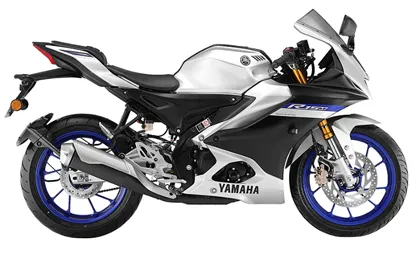
Yzf R15 V 4.0
155cc, 40-45km/l,
18.4PS @ 10,000rpm,
14.2Nm @ 7,500rpm
Price – ₹ 1,74,019 Onwards
Ec-06
Lithium Ion,50-80Km/c,
79 km/h,
26 Nm
Price – ₹ 1,67,600 Onwards
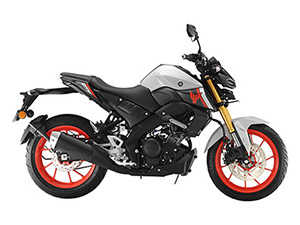
Mt 15
155cc, 30-35km/l,
18.4ps @ 10,000rpm,
14.1Nm @ 7,500rpm
Price – ₹ 1,55,469 Onwards
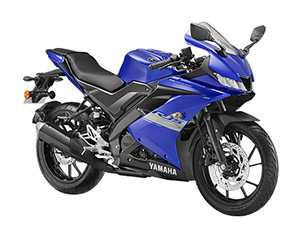
R15 S
155cc, 30-40km/l,
18.6ps @ 10,000rpm,
14.1Nm @ 8,500rpm
Price – ₹ 1,53,892 Onwards
Aerox 155
155cc, 44-49km/l,
15PS @ 8,000rpm,
13.9Nm @ 6,500rpm
Price – ₹ 1,38,075 Onwards
Fzs Fi
149cc, 40-45km/l,
12.4PS @ 7,250rpm,
13.3Nm @ 5,500rpm
Price – ₹ 1,23,963 Onwards
Fzs Fi V4.0 Dlx
149cc, 40-45km/l,
12.4PS @ 7,250rpm,
13.3Nm @ 5,500rpm
Price – ₹ 1,20,304 Onwards
Fz X
149cc, 40-45km/l,
12.4PS @ 7,2500rpm,
13.3Nm @ 5,500rpm
Price – ₹ 1,19,194 Onwards
Fz Rave
149cc, 50-57km/l,
12.4 PS @ 7,250 rpm
13.3 Nm @ 5,500 rpm
Price – ₹ 1,17,218 Onwards
Fz Fi V3
149cc, 45-48km/l,
12.4PS @ 7,250rpm,
13.3Nm @ 5,500rpm
Price – ₹ 1,12,693 Onwards
Ray Zr Street Rally 125 Fi Hybrid
125cc, 65-74km/l,
8.2PS @ 6,500rpm,
10.3Nm @ 5,000rpm
Price – ₹ 85,974 Onwards
Fascino 125
125cc, 55-61km/l,
8.2PS @ 6,500rpm,
10.3Nm @ 5,000rpm
Price – ₹ 74,044 Onwards
Ray Zr 125
125cc, 55-61km/l,
8.2PS @ 6,500rpm,
10.3Nm @ 5,000rpm
Price – ₹ 73,430 Onwards
About Yamaha Motorcycles
In India, Yamaha motorcycles have been part of strategic partnerships, iconic models, and continuous innovation. However, our journey is not just about products, but also about the riders who make our motorcycles come alive. It has been marked by strategic alliances, iconic product launches, and a constant focus on innovation and customer engagement. The Yamaha bike’s cost range is designed to cater to various riders, starting from ₹83,091 for entry-level models and going up to ₹4,65,267 for premium options in India.
Yamaha’s journey in India began in 1985 with the legendary RD350, and it has since evolved into a diverse portfolio of scooters and motorcycles. The company’s future in India is promising, with ambitious plans to expand its market share, introduce high-capacity models, and enhance its manufacturing and dealership network.
By focusing on premium positioning, technological advancements, and targeted marketing campaigns, Yamaha is well-positioned to strengthen its presence in the competitive Indian two-wheeler market. As Yamaha continues to “Rev Your Heart” with its blend of performance, style, and innovation, it remains a significant player in shaping the future of India’s motorcycle industry.
Timeline Of Yamaha Motorcycles In India
1985: Market Entry
Yamaha’s entry into the Indian motorcycle market in 1985 was a significant milestone in the country’s two-wheeler industry. This entry was made possible through a strategic alliance with Escorts Motors Limited, which played a crucial role in establishing Yamaha’s initial foothold in the competitive Indian market. Yamaha’s experience in India serves as a case study in international market entry, highlighting the importance of strategic partnerships, local market adaptation, and long-term commitment to achieving success in emerging markets.
Key Model Launches
- RD350 (1983-2009): Known as the “Road Burner,” the RD350 was one of Yamaha’s first offerings in India. Due to its raw power and aggressive styling, it quickly gained a cult following and set a high bar for performance in its segment.
- RX100 (1985-1996): This lightweight, two-stroke motorcycle became a cultural icon. Its affordability, speed, cost/price, and ease of maintenance made the RX100 model extremely popular among young riders compared to other Yamaha bikes, and it symbolized freedom and rebellion.
1990s: Establishing A Footprint In India
Manufacturing Milestones
- 1999: Yamaha’s Surajpur factory in Uttar Pradesh achieved its first major production milestone, reaching the one-million-unit mark. This achievement underscored the growing demand for Yamaha motorcycles in India.
2000s: Expansion And Diversification Of Yamaha Motorcycles
Manufacturing Expansion
- Yamaha motorcycles in India continued to strengthen its manufacturing capabilities, with the Surajpur and Faridabad plants playing crucial roles in production.
Market Challenges
- Following the Asian financial crisis, Yamaha’s market share declined, holding only 4% of the market. This period highlighted the challenges Yamaha faced in maintaining its position in the competitive Indian market.
2010s: Renewed Focus And Growth
Key Milestones And Launches
- 2012: Yamaha reached the five-million-unit production milestone, a testament to its growing presence in India.
- 2012: Launch of the Ray scooter, marking Yamaha’s entry into the Indian scooter segment.
- 2015: Inauguration of the Chennai plant in Tamil Nadu, representing a significant expansion of Yamaha’s manufacturing capabilities in India.
- 2016: Celebration of one million scooters produced in India, highlighting the success of Yamaha’s diversification into the scooter segment.
- 2019: Yamaha achieved the ten-million-unit production milestone, with the FZS-FI Version 3.0 being the ten-millionth unit.
Strategic Initiatives
- “The Call of the Blue” Campaign: Launched in 2018, this flagship campaign aimed to reinforce Yamaha’s premium positioning in the Indian market, targeting young motorcycle enthusiasts.
- Blue Square Showrooms: Introduce premium dealerships to enhance the brand experience and showcase Yamaha’s exclusive range of products.
Product Portfolio Expansion
- Introduction of the FZ series, which gained popularity for its design and performance.
- The launch of the Fascino scooter significantly contributed to Yamaha’s sales in the scooter segment. It offered a cost-effective option compared to other Yamaha bikes, which ranged from ₹83,091 to ₹97,509 in India.
2020s: Current Status And Future Outlook
Current Market Position
- As of 2023, Yamaha held a 14.8% market share in the Indian two-wheeler market, with sales of 430,000 units. This represents a significant increase from the 3.6% market share and 522,000 units sold in 2021.
Future Plans And Strategies
- Market Share Expansion: Yamaha aims to increase its market share from 3.8% to 10% by 2027, focusing on higher-capacity motorbikes and targeting first-time and young buyers in urban and semi-urban areas.
- Product Development: Plans to introduce new models with higher capacities to cater to the growing demand for performance-oriented products.
- Manufacturing and Exports: Consider setting up a new factory to support growth plans and increase exports to new markets in Europe and Japan.
- Dealership Expansion: Plans to add 255 new Blue Square showrooms to the existing 300 dealerships, enhancing the premium customer experience.
- Technological Advancements: Incorporating features like side stand engine cut-off switches and stop-start systems to enhance safety and fuel efficiency.
Other Related Links From Bikeleague India
- Yamaha vs Honda vs Kawasaki : Comparing Bike Giants
- Two wheeler Sales in India FY 2023-24 | Analysis of Top Brands
- Yamaha Ray ZR Street Rally 125 Fi
- Yamaha Ray ZR 125
- Yamaha FZS V4