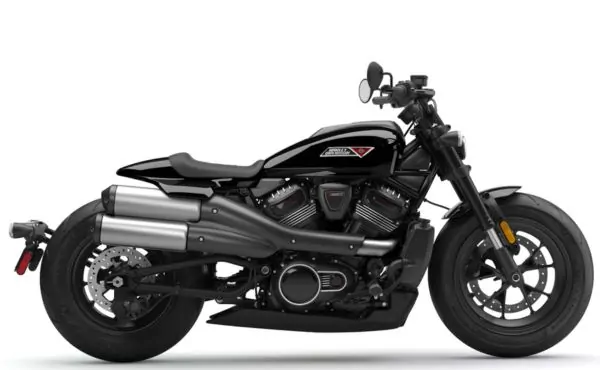
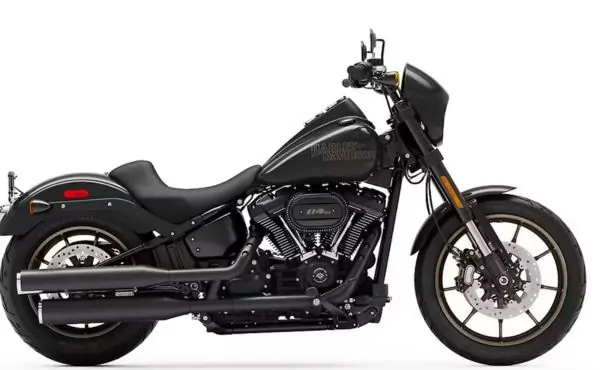
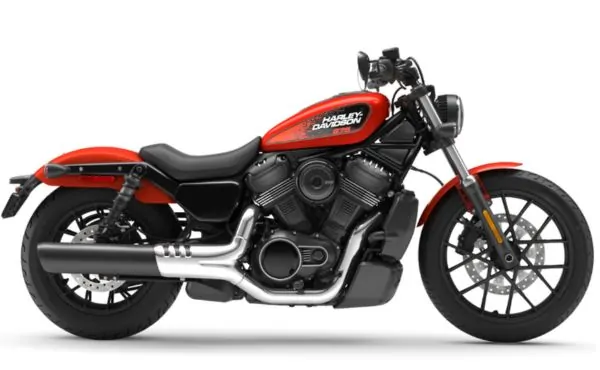
Harley Davidson Fat Boy

Home > Harley Davidson > Harley Davidson Fat Boy

Introduction

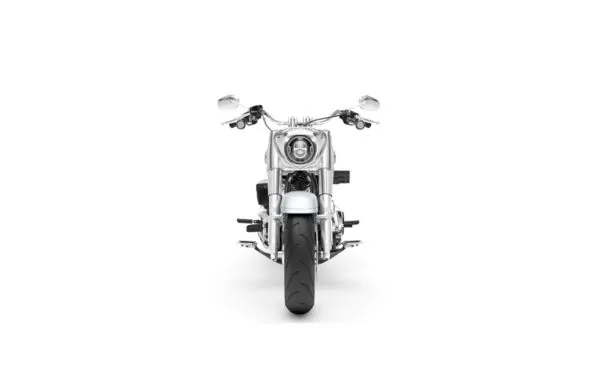
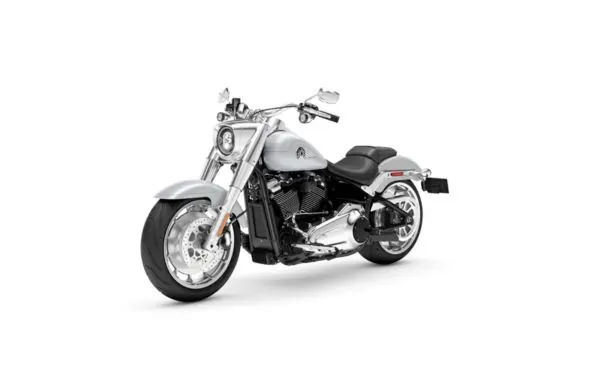
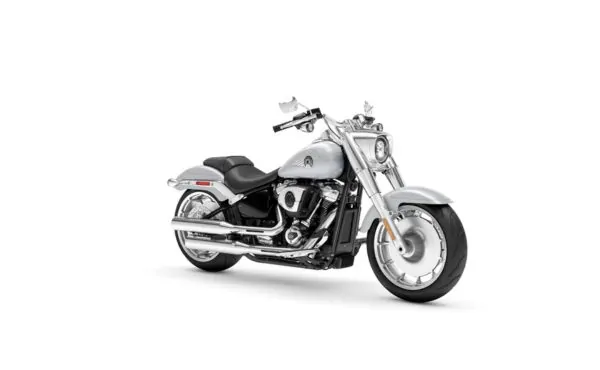
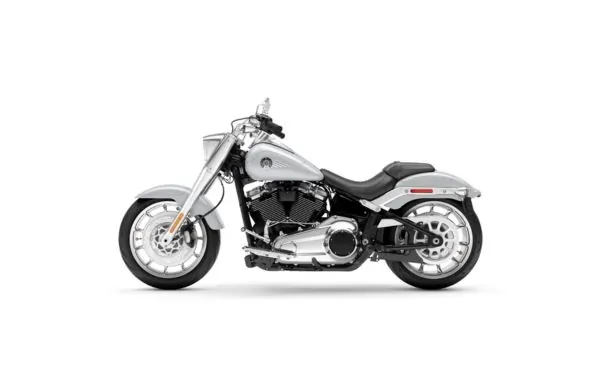
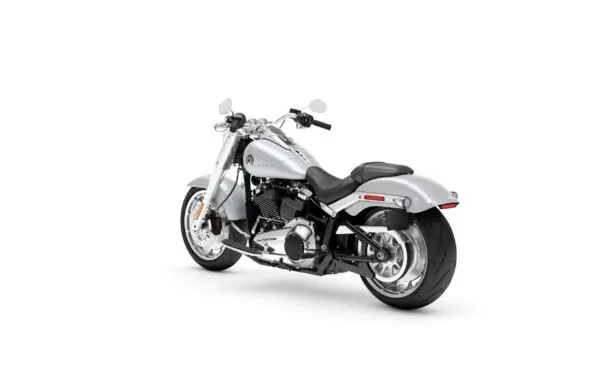
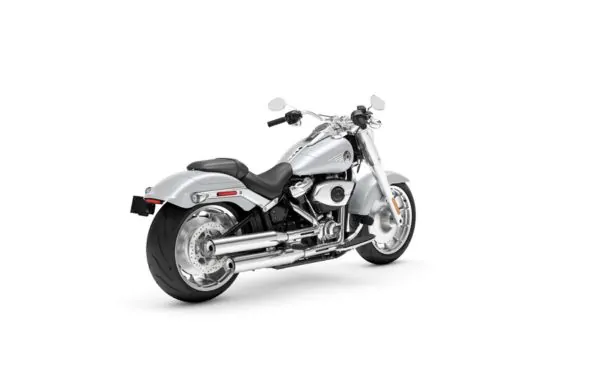
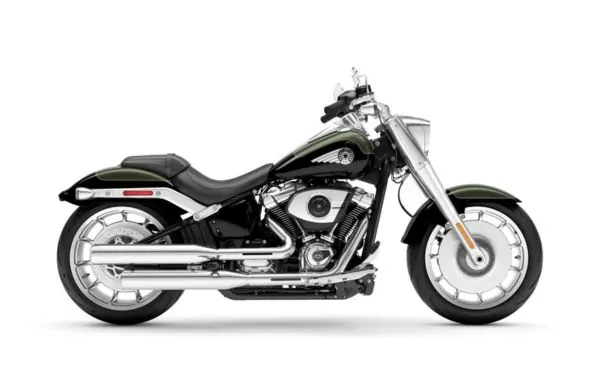
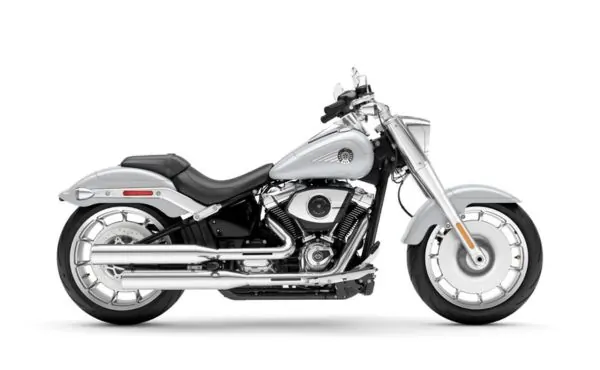
The Harley-Davidson Fat Boy arrives in India as a true cruiser legend, showing off its wide Michelin Scorcher 11 tyres, machined Lakester wheels, and a powerful Milwaukee-Eight 117 V-twin engine that delivers 168 Nm of torque. It’s built to handle everything from busy Mumbai streets to quiet Kerala backroads. This BS6 Phase 2-compliant bike mixes its Hollywood roots—remember its role in Terminator 2—with modern safety features, full LED lighting, and bold colours like Olive Steel Metallic. The Fat Boy is more than just a motorcycle; it’s a statement of power and style in the world’s largest two-wheeler market.

Gallery

Key Specifications

Displacement

1923 cc

Mileage

14-21 km/l

Power

104.43 PS @ 5020 rpm

Torque

168 Nm @ 3000 rpm

Fuel System

ESPFI

Tank Capacity

18.9 litres

Rear Suspension

Hidden Coil over Monoshock

Kerb Weight

315kg

Ratings

  • 100%

    Performance

  • 90%

    Features

  • 90%

    Handling

  • 95%

    Comfort

  • 95%

    Build Quality

  • 100%

    Styling

  • 95%

    Value for Money

  • 95%

    Total

Price

State - DELHI
City - DELHI
Price (Ex-showroom) - 28,03,000

Special Features

1

Milwaukee-eight Engine

2

Dual Exhaust Pipes

3

Strong Low-end Torque

4

Extra-wide Front & Rear Tires

5

Signature Led Lighting

6

Anti-lock Braking

7

Modern Electronics

8

2-into-2 Staggered Exhaust

9

Espfi

10

Usb-c Charging Port

11

Multiple Ride Modes

12

Drag-torque Slip Control

Full Specifications

City 14-16km/l
Highway 18-21km/l
Engine Type Milwaukee-Eight® 117
Displacement 1,923cc
Power 104.43 PS @ 5,020
Torque 168 Nm @ 3,000rpm
Bore x Stroke 103.5mm x 114.3mm
Compression Ratio 10.3:1
Fuel Supply Electronic Sequential Port Fuel Injection
Speedometer Analogue
Tachometer Yes
Tripmeter Yes
Fuel Guage Yes
Low Fuel Indicator Yes
Low Battery Indicator Yes
Low Oil Indicator Yes
Start Type Electric
Kill Switch Yes
Clock Yes
Pass Light Yes
ABS Dual ABS
Stand Alarm Yes
Tyres (F) 160/60R18,70V,BW
Tyres (R) 240/40R18,79V,BW
Brakes (F) 4-piston fixed
Brakes (R) 2-piston floating
Front Suspension Dual-bending valve 49 mm telescopic with aluminum fork triple clamps; dual rate spring; "beer can" covers
Rear Suspension Hidden, coil-over monoshock; 43mm stroke; hydraulic preload adjustment
Wheelbase 1665mm
Ground Clearance 125mm
Length 2365mm
Seat Height 675mm
Kerb Weight 315kg
Fuel Capacity 18.9
Lights All LED headlamp, low and high beam with signature position lighting headlamp; All LED Tail/Stop lamp with signature tail lighting; LED Bullet front and Rear Turn Signals
Gauges 5-inch analog speedometer with digital gear, odometer, fuel level, clock, trip, range and tachometer indication

Harley Davidson Videos

[slide-anything id=”42070″]

Overview

Performance And Engine

The Fat Boy features a Milwaukee-Eight 117 V-twin engine with 1,923 cc displacement, designed for effortless power delivery in Indian conditions. The air/oil-cooled 50-degree V-twin includes a 103.5 mm bore, 114.3 mm stroke, and 10.3:1 compression ratio, ensuring BS6 Phase 2 compliance and a signature rumble.

The Milwaukee-Eight 117 Custom engine produces 104.69 PS at 5,020 rpm and a peak 168 Nm of torque at 3,000 rpm, with more than 90% of its torque available right from idle. This means quick overtakes in traffic are easy. The 4-valve-per-cylinder design with electronic fuel injection delivers strong low-end power and smooth high-rpm performance, producing about 103 hp. Riders get instant throttle response, making it great for both highways and city rides. Vibration dampers help keep long journeys comfortable.

The 6-speed manual gearbox features a chain primary drive (34/46 ratio) and a hydraulic wet multi-plate clutch with slip-and-assist technology for smooth, easy shifting. The gear ratios start wide in first gear and narrow down for relaxed cruising at 100-120 kmph in top gear. This setup manages the bike’s torque well and helps reduce rider fatigue during downshifts on winding roads or long trips.

The Fat Boy reaches a top speed of 177 kmph, which is electronically limited for safety. It can sprint from 0 to 100 kmph in under 5 seconds. Its design and power let it maintain high speeds on expressways, while electronic controls prevent over-revving during long stretches.

Mileage And Fuel Efficiency

ARAI certification lists 18-18.18 kmpl under standard test cycles, paired with an 18.9-19 litre fuel tank for a theoretical range exceeding 340 km. Efficient ESPFI mapping and optimised tuning contribute to this figure, balancing the big-displacement engine’s thirst for fuel.

In real-world use, Indian riders get between 14 and 21 kmpl. City traffic usually yields 14-16 kmpl due to frequent stops. On highways at a steady 80 kmph, mileage improves to 18-21 kmpl, especially with premium fuel after the break-in period. Aggressive riding can lower it to 12-14 kmpl. Monthly fuel costs are about ₹2,778 for 500 km, but this can change depending on the route and load, especially in places like Kerala.

Features And Technology

The Harley-Davidson Fat Boy stands out to Indian riders with its bold cruiser look and powerful Milwaukee-Eight 117 engine. It combines classic design with modern technology for a unique presence.

  1. Milwaukee-Eight 117 Custom engine: 1,923 cc air/oil-cooled V-twin, 103.5 mm bore x 114.3 mm stroke, 10.3:1 compression, ESPFI fuel system, 103 HP at 5,020 rpm, 168 Nm torque at 3,000 rpm;
  2. 6-speed manual transmission: Chain primary drive (34/46 ratio), gear ratios 9.311 (1st) to 2.79 (6th), hydraulic wet multi-plate clutch with slip/assist;
  3. Dimensions and chassis: 2,365 mm length, 965 mm width, 1,650 mm wheelbase, 675 mm unladen seat height, 125 mm ground clearance, 315 kg running weight, 30° rake, 104 mm trail;
  4. Suspension setup: Front dual-bending valve 49 mm telescopic forks with aluminium triple clamps and “beer can” covers; rear hidden free-piston coil-over monoshock, 43 mm stroke, hydraulic preload adjustment;
  5. Braking system: 4-piston fixed front calliper, 2-piston floating rear, silver split 7-spoke floating rotors (300 mm front disc, 292 mm rear), Dual Channel ABS, Cornering ABS (C-ABS);
  6. Wheels and tyres: Machined Lakester cast aluminium wheels, Michelin Scorcher 11 tubeless radials – front 160/60R18 70V, rear 240/40R18 79V for steamroller stance;
  7. Lighting package: All-LED with 178 mm signature headlamp in chrome nacelle, low/high beam, position lights, bullet-style LED tail/stop/turn signals front and rear;
  8. Instrumentation: 127 mm analogue speedometer with digital display for gear, odometer, fuel, ride modes, traction control, ABS, TPMS, clock, trip, range, tachometer;
  9. Safety enhancements: Rider Safety suite including TCS, DSCS, C-TCS, C-DSCS, TPMS; traction control, cornering aids standard;
  10. Ergonomics and controls: Ride-ready hand controls, relaxed cruiser posture, USB charging port, saree guard, stepped pillion seat with footrests and grab rail;
  11. Additional tech: Airflow-optimised touring intake, stiffer cast aluminium frame, oil capacity 4.7 L with filter;

Build Quality

Harley-Davidson uses a strong cast-aluminium frame backbone, reinforced to handle the Fat Boy’s 315-317 kg weight. This frame stands up well to speed breakers, rough roads, and heavy monsoons in Indian cities and backroads. Chrome accents on the nacelle, tank console, and exhaust headers are now more rust-resistant thanks to improved plating. The solid-mounted fork covers and Lakester cast wheels also stay aligned, even after many potholes.

The 4.7 L oil reservoir with cooling channels keeps the engine stable even in temperatures above 40°C. Tight assembly means vibrations are noticeable but not annoying, and riders appreciate the lack of panel gaps or loose fasteners even after 10,000 km. Indian owners praise the paint finishes, such as Olive Steel Metallic or Vivid Black, for resisting fading from the sun and from bird droppings. The saree guard and pillion grab rail are designed for family use. The 2-into-2 staggered exhaust meets BS6 Phase 2 standards. It has heat shields to prevent burns in traffic, showing Harley’s attention to Indian needs.

Handling

Despite its size, the Fat Boy’s 1,650 mm wheelbase, 30° rake, and 104 mm trail give it responsive steering, making it easy to handle in busy cities like Delhi or Bangalore. The wide 240/40R18 rear tyre grips well during sharp turns on winding roads, while the 160/60R18 front tyre gives good feedback for dodging traffic.

At the front, 49 mm telescopic forks with 130 mm travel absorb bumps on highways like NH44. The rear has an 86 mm hidden monoshock with adjustable preload, so riders can set it up for solo or pillion rides. Cornering ABS, traction control, and drag-torque slip control work smoothly on wet roads to prevent skids. The low centre of gravity, due to the engine’s position, makes U-turns in narrow alleys possible, even with the bike’s width. Riders say the Fat Boy stays stable at 140 kmph on expressways, with little shaking even in crosswinds.

Comfort

The 675 mm seat height lets shorter Indian riders put both feet flat on the ground. The 16-inch ape-hanger-style handlebars and forward mid-controls give a relaxed, upright riding position, perfect for long rides like Chennai to Pondicherry. The solo seat uses high-density foam to conform to the rider’s shape and distribute the bike’s weight, helping prevent numbness on long trips.

Pillion comfort gets a boost from the stepped dual seat at 710 mm, rubber-mounted grab rail, and lowered mid-set footpegs that accommodate sarees or casual wear without pinching, making family outings to hill stations viable.

The rubber-mounted Milwaukee-Eight 117 engine keeps the handlebars and foot pegs free from vibration at speeds above 80 kmph. There’s a USB-C charging port under the console for powering phones during GPS-guided rides. In hot weather, the air-cooled heads and touring intake help keep things cool, while winter riders like the heated grips and wind-deflecting headlight cover. The upright wrist position stays comfortable in city traffic. Still, the 965 mm width can be tricky in narrow lanes and takes some getting used to.

Styling

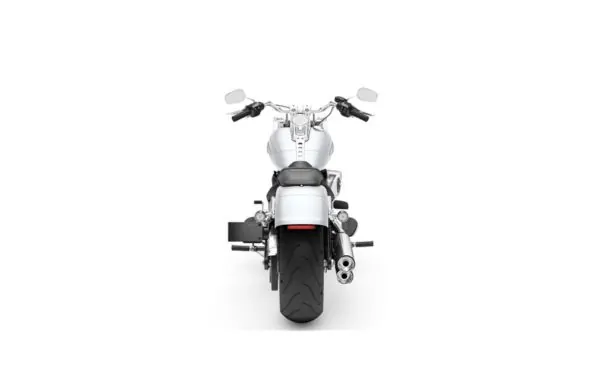
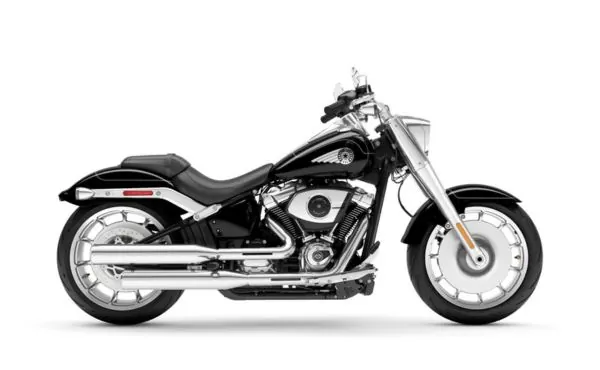
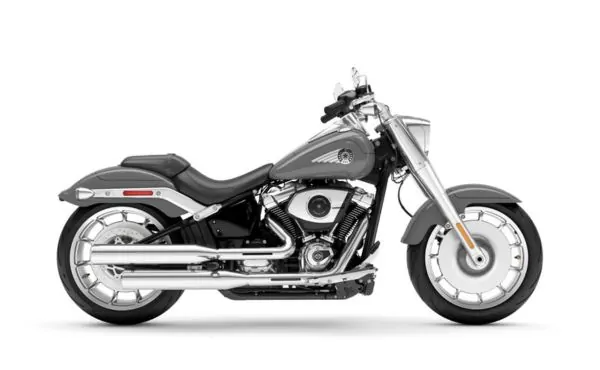
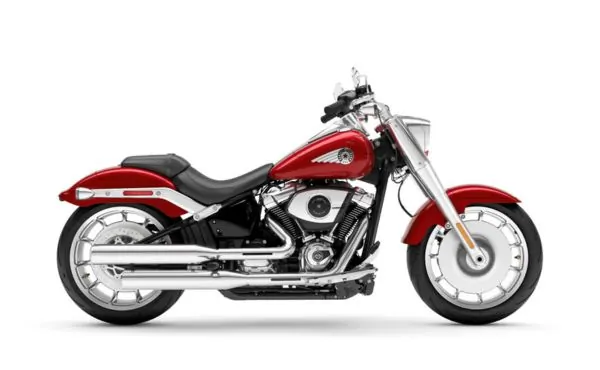
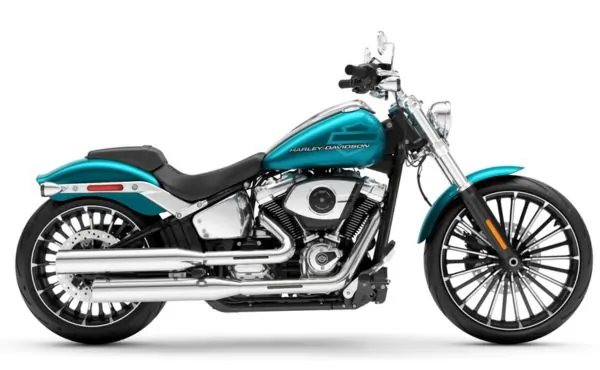
The Fat Boy’s wide 160 mm front and 240 mm rear Michelin tyres on machined Lakester cast-aluminium wheels give it a strong, low-slung look. The sculpted chrome headlight cover holds a bright 178 mm LED Daymaker with signature lighting, and the bullet-style LED turn signals add a mix of retro style and clear visibility.

Bold lines run from the 2-into-2 staggered chrome exhaust to the retro-style tank medallion, with solid fork covers, polished triple clamps, and chrome engine guards adding to its shine. At 2,365 mm long and 965 mm wide, the Fat Boy stands out on Indian streets. The tighter bodywork and satin-chrome details pay tribute to its Hollywood roots while keeping it modern.

Colour Options And Variants

India-exclusive offerings for the Fat Boy include five striking schemes, starting with

  1. Dark Billiard Gray
  2. Vivid Black
  3. White Onyx Pearl
  4. Brilliant Red
  5. Olive Steel Metallic/Vivid Black

Harley-Davidson India launches the Fat Boy in a single variant differentiated by exclusive paint and chrome trim as the only option.

Value For Money And Pricing

Ex-showroom pricing for the Fat Boy starts at ₹ 28,03,000 onwards in Delhi. The Fat Boy justifies its tag with unmatched brand prestige, resale retention (80-85% after 3 years per Indian portals), and low running costs of ₹2-3/km blending 18 kmpl ARAI with premium fuel. Ownership includes a 2-year/unlimited km warranty, extendable to 5 years, 24/7 roadside assistance across 30+ H-D India dealerships, and Stage 1 tuning kits that boost torque by 10-15% without voiding coverage.

Compared to rivals, its Rider Safety suite (C-ABS, TCS, TPMS) adds safety premiums, while LED lighting slashes bulb replacements and the belt-free chain drive cuts maintenance to ₹15,000-20,000 annually. Long-term riders tout 1 lakh+ km durability, cultural status in rider clubs, and customisation ecosystem via H-D parts, outweighing initial outlay for those prioritising legacy over entry-level affordability.

In India’s heavyweight cruiser arena, the Fat Boy squares off against

  1. Indian Springfield Dark Horse
  2. Indian Super Chief Limited
  3. BMW R12
  4. Royal Enfield Super Meteor 650

The Harley-Davidson Fat Boy stands out as a top-tier cruiser in India, known for its strong presence. However, it faces challenges in urban environments.

Verdict

The Harley-Davidson Fat Boy is seen as India’s top cruiser, combining the Milwaukee-Eight 117’s strong torque with classic looks and modern safety features. It’s built for all kinds of roads, from Kerala’s coast to the Himalayas. Its solid build, comfortable ride, and striking appearance make owning it more than just getting from place to place—it creates a real connection for riders who want both authenticity and power.

While its premium price and urban heft pose hurdles for budget-conscious commuters, the Fat Boy rewards dedicated enthusiasts with legendary resale value, effortless customisation, and a V-twin soul that echoes across generations—making it the definitive choice for those ready to claim the road’s throne. Whether blasting highways or dominating traffic, this icon reaffirms Harley’s enduring legacy in the world’s largest two-wheeler market.

Pros

  • Iconic styling and road presence: Massive fat tyres (160/60R18 front, 240/40R18 rear), sculpted chrome nacelle, and solid Lakester wheels create an unbeatable head-turning silhouette on Indian streets;
  • Explosive Milwaukee-Eight 117 performance: 168 Nm torque at 3,000 rpm and 104.69 PS deliver instant roll-on power for effortless highway overtakes and thumping V-twin character;
  • Exceptional highway comfort and stability: Low 675 mm seat height, plush seating, and planted chassis with 1,650 mm wheelbase ensure fatigue-free 400+ km rides on NH44 or monsoons;
  • Advanced Rider Safety Enhancements: Standard C-ABS, TCS, C-DSCS, TPMS, and 3 ride modes (Road, Rain, Sport) boost confidence on wet ghat roads or erratic traffic;
  • Premium build and resale value: Tank-like aluminium frame, rust-resistant chrome, and strong 80-85% depreciation hold make it a smart long-term investment.
  • Highly customisable: Vast H-D India parts ecosystem for exhausts, seats, and Stage 1 kits enhances personalisation without warranty voids;
  • 7Smooth electronics and controls: Ride-ready hand controls, adjustable brake levers, USB-C port, and cruise control elevate touring ease.

Cons

  • Hefty 315-317 kg weight: Challenges low-speed manoeuvres, U-turns in tight Indian city alleys, and solo lifting during parking;
  • Low fuel efficiency: Real-world 14-18 kmpl strains budgets at ₹100/litre, especially with an 18.9 L tank needing frequent urban refills;
  • High upfront pricing: ₹28.03-28.56 lakh ex-showroom demands premium commitment amid insurance hikes;
  • Limited ground clearance (125 mm): Scrapes on speed breakers, potholes, or speed bumps prevalent on Indian secondary roads;
  • Spongy front braking feel: 300 mm front disc requires a firm rear bias to manage inertia, making it less intuitive for beginners.
  • No advanced riding modes variety: Lacks customisable traction or throttle maps beyond basic Road/Rain/Sport, missing flexibility for mixed conditions.
  • Expensive servicing: Annual costs ₹15,000-25,000 at authorised dealers, with specialised tools needed for Milwaukee-Eight maintenance;

Other Related Links From Bikeleague India

List Of All Harley Davidson Bikes

About Harley Davidson Bikes

Harley-Davidson, the well-known American motorcycle brand founded in 1903, entered the Indian market in August 2009 by setting up a subsidiary in Gurgaon, Haryana. The company faced high import duties of over 100% and strict emission standards, so it began by importing fully built bikes priced between ₹6.95 lakh and ₹34.95 lakh, mainly for urban customers. Today, Harley-Davidson is successful in India through local assembly and co-development, combining its classic cruiser style with the country’s expanding premium motorcycle market.

History And Growth

Harley-Davidson opened its first dealership in Hyderabad in July 2010 with the JCBL Group, then expanded to five cities, including Delhi and Mumbai. In its first 10 years, the company sold over 25,000 bikes, helped by events such as Harley Rock Riders and annual H.O.G. rallies in Goa. Growth picked up when Harley started assembling bikes from kits in 2011, beginning with the Sportster, then adding the Dyna in 2012 and Softail in 2013. This made India Harley’s third-largest facility after the US and Brazil. Although Harley stopped direct manufacturing in 2020 because of low demand, Hero MotoCorp brought the brand back through a licensing deal, making the bikes more accessible.

Key Milestones And Developments

  1. 2009: Subsidiary launch amid “mango diplomacy” trade talks, easing entry.
  2. 2011: Bawal, Haryana assembly starts, cutting costs.
  3. 2014: Street 500/750 production for export; zonal rides and H.O.G. growth.
  4. 2020: Operations halt; Hero partnership begins for imports and X440 co-development.
  5. 2023: X440 launch at ₹2.4 lakh, challenging Royal Enfield in mid-size premiums.
  6. 2024-2025: Partnership extends for X440 variants and new models; 8,974 X440 units sold Apr-Dec 2024 (31% YoY growth).

Manufacturing Facilities

Harley-Davidson first assembled bikes in Bawal, Haryana, until the plant closed in 2020. This facility made Street models for export worldwide. After partnering with Hero MotoCorp, production moved to the ‘Garden Factory’ in Neemrana, Rajasthan, which now makes 250 X440 bikes each day and uses eco-friendly features like zero liquid discharge. The factory also produces the Hero Mavrick 440, helping save on import duties and making it easier to export more bikes in the future.

Market Position And Achievements

Harley-Davidson led India’s market for bikes over 1000cc in FY2022, holding a 37% share with 601 units sold. The X440 model helped the Hero-Harley partnership grow its segment by 77%, selling 12,188 bikes from April to December 2024 and gaining a 13% share in the 350-500cc segment. The dealership network grew to 22 full-service locations, with new ones in Kochi and Bengaluru as of March 2026. The X440 is also available at 115 Hero Premia outlets, and there are now 33 H.O.G. chapters. While global sales have dropped, India allows duty-free imports for bikes between 800cc and 1600cc, which helps strengthen the premium market.

Future Plans

Hero and Harley-Davidson have extended their partnership to include new X440 versions, like the X440T, and plan to launch a new co-developed motorcycle by the second quarter of FY26. They aim to grow their network in key enthusiast areas and may use the Neemrana factory for global exports under the ‘Make in India’ initiative. There is also a chance that the Sprint model will return globally in early 2026, which would complement the X440. The focus remains on keeping dealers strong and maintaining premium offerings

User Reviews

0.0
0.0 out of 5 stars (based on 0 reviews)
Excellent0%
Very good0%
Average0%
Poor0%
Terrible0%

There are no reviews yet. Be the first one to write one.

Hiran Narayanan - Founder & CTO, Bikeleague India

Hiran Narayanan

Founder & CTO at Bikeleague India

Hiran Narayanan is the Founder and CTO of Bikeleague India, bringing over 15 years of experience in motorcycle technical writing. He develops detailed analyses, tools, model overviews, and blogs that contribute to bikeleague.in's improving rankings.

Core Expertise
Two-wheeler Technical & Blog Content Writing Petrol Motorcycle Analysis Electric Motorcycle Analysis Petrol Scooter Analysis Electric Scooter Analysis WordPress & SEO