
Long story short: Here’s a quick guide to the key documents you need for bike RC transfer in India. Get everything ready ahead of time to ensure a smooth and easy process.
Transferring a bike’s Registration Certificate (RC) in India might look complicated at first, but it becomes much easier once you know which documents you need and how the process works. Whether you’re buying, selling, or moving your bike to another state, this guide will help you complete the RC transfer without trouble. Use the tips below to organize your paperwork and avoid common mistakes.
Key Takeaways
- Gather All Required Documents: The RC transfer process in India requires the original RC, valid insurance, PUC certificate, sale agreement, ID/address proof for both parties, and specific government forms. Additional documents may be needed in special cases, such as the death of the owner or financed bikes.
- Obtain a No Objection Certificate (NOC) When Necessary: For inter-state transfers or financed bikes, securing an NOC from the RTO (and the financier, if applicable) is essential to confirm there are no legal or financial dues on the bike.
- Choose Online or Offline Transfer—But Check Your State’s Rules: Many states allow most or all of the process to be completed online via the Parivahan portal, but some require an RTO visit for document verification. States like Delhi, Maharashtra, and Telangana offer fully online, “Faceless Services.”
- Meet Deadlines to Avoid Penalties: Apply for transfer within 14 days for intra-state sales, or within the specified window for inter-state moves. Late applications attract a penalty, and legal liability for the vehicle remains with the previous owner until the RC is officially updated.
- Seller Remains Liable Until Transfer Is Complete: Handing over the bike or signing a sale agreement does not shift legal responsibility. Liability officially transfers only after the RTO updates the RC in the buyer’s name.
What Is Bike Ownership?
In India, owning a bike means your name appears on the Registration Certificate (RC) issued by the RTO. This outlines your legal rights and responsibilities regarding the bike.
What Is Bike Ownership Transfer?
Transferring bike ownership is the legal process of updating the RC from the seller’s name to the buyer’s. You need to do this when buying or selling a used bike.
What Documents Are Required For Bike Ownership Transfer?
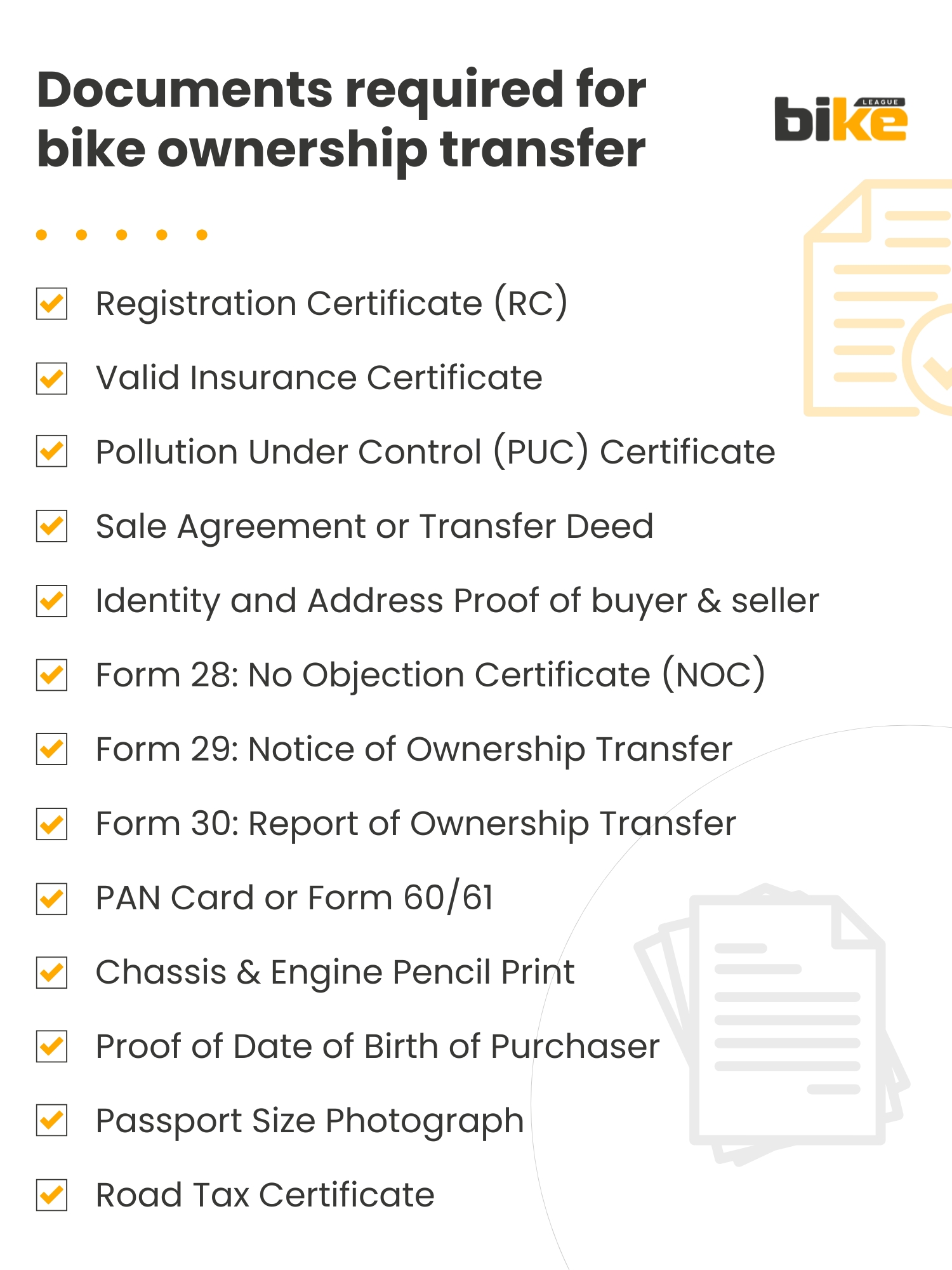
1. Registration Certificate (rc)
The Registration Certificate confirms that the RTO has registered the bike in the seller’s name and that it has no legal issues. Submit this certificate to the Regional Transport Office during the transfer.
2. Valid Insurance Certificate
You must have a valid insurance certificate when transferring ownership. Update it with the new owner’s details to avoid issues.
3. Pollution Under Control (puc) Certificate
The PUC certificate proves the bike meets emission standards. You need this certificate when you buy a used motorcycle.
4. Sale Agreement Or Transfer Deed
A sale agreement or transfer deed outlines the sale terms and confirms that the seller is transferring ownership to the buyer.
5. Identity And Address Proof
Both the buyer and seller must present valid identification and proof of address, such as a driver’s license, Aadhaar card, passport, utility bill, or rental agreement, to verify their identities for the transfer.
6. Forms 28, 29, And 30
- Form 28: NOC needed when moving the bike to another state. The seller submits three copies.
- Form 29: Used to tell the RTO about the sale. The seller submits two copies.
- Form 30: Needed to complete the ownership transfer. Submit two copies to the RTO
7. Additional Documents For Special Cases
- On Death of Owner: On the owner’s death, provide the death certificate, RC, Certificate of Succession, and Form 31 for bike transfer.
- For Financed Vehicles: For financed bikes, get a NOC from the loan provider. Once the loan is closed, you must formally remove the hypothecation entry from the RC using Form 35 (Notice of Termination of Hire-Purchase, Lease, or Hypothecation Agreement). If the loan is still active at the time of transfer, the new hypothecation is instead endorsed on the RC via Form 34, which carries a fee of ₹500 for a motorcycle under Rule 81 of the CMVR.
8. Other Necessary Documents Needed For A Bike Transfer
- PAN Card or Form 60/61: The seller and purchaser must verify financial transactions.
- Chassis & Engine Pencil Print: Authorities often require this for verification purposes.
- Proof of Date of Birth of Purchaser: To ascertain the age of the new owner.
- Passport Size Photograph: Authorities may require a recent photograph of the purchaser.
- Road Tax Certificate: Confirms the previous owner has paid all road taxes.
What Are The Crucial Things To Note During The Transfer Of Bike Ownership In India?
Now that you know the required documents, here are key points to keep in mind during the transfer process.
- No Objection Certificate (NOC): Get an NOC from the RTO and from the bank if the bike is financed, to confirm no dues or legal problems.
- Insurance Transfer: Ensure the bike’s insurance policy is updated with the new owner’s details to avoid penalties.
- Outstanding Dues: Pay any outstanding loans or insurance claims before starting the transfer.
- State-Specific Rules: Check for current RTO rules, as these vary by state and can change.
- Filing Deadline: Apply for the ownership transfer within 14 days of the sale for same-state transfers. If you miss this deadline, you may have to pay a fine, and you will still be legally responsible for the vehicle, including any traffic challans or accidents, until the RC is updated in the buyer’s name.
- Ongoing Liability: A sale agreement or handing over the bike does not transfer legal responsibility. The person listed as the registered owner at the RTO is still responsible for challans, accidents, or any legal issues involving the vehicle until the RC transfer is officially completed. Sellers should keep proof, such as an acknowledgement receipt or application number, to show that the transfer process has started.
What Are The Fees For Bike Ownership Transfer In India?
Fees vary slightly by RTO and state, and are periodically revised centrally, so treat the figures below as a current reference rather than a final quote — always verify the exact amount for your RTO on the official Parivahan Fees & User Charges page before paying.
| Fee Component | Amount (Motorcycle/Scooter) | When It Applies |
|---|---|---|
| Transfer of Ownership Fee (Rule 81, Sl. No. 6) | ₹150 (half of the ₹300 registration fee) | Every ownership transfer |
| Smart Card RC Fee | ₹200 | If the new RC is issued as a smart card (waived if the fresh RC follows cancellation of a hire purchase/lease/hypothecation agreement) |
| Hypothecation Endorsement Fee (Rule 81, Sl. No. 9a) | ₹500 | Registering a loan/hypothecation against the vehicle at the time of transfer |
| Change of Residence Fee (Rule 81, Sl. No. 7) | ₹150 | Updating address on the RC, relevant for inter-state moves |
| Delay Penalty | ₹300 per month (or part thereof) | Late submission of the NOC or transfer application beyond the deadline |
| Road Tax (Inter-state only) | Varies by state and vehicle value | Registering the bike in a new state |
Note: All fees listed above do not include GST. The official fee schedule does not mention a separate charge for the Form 28 NOC. Some RTOs may apply a general application fee (about ₹200), so check the exact amount with your RTO or on the Vahan portal when you apply.
State-specific road tax slabs can differ significantly — use our Bike On-Road Price Calculator to estimate road tax for a specific state before an inter-state transfer.
What Are The Steps For Online Bike Ownership Transfer In India?
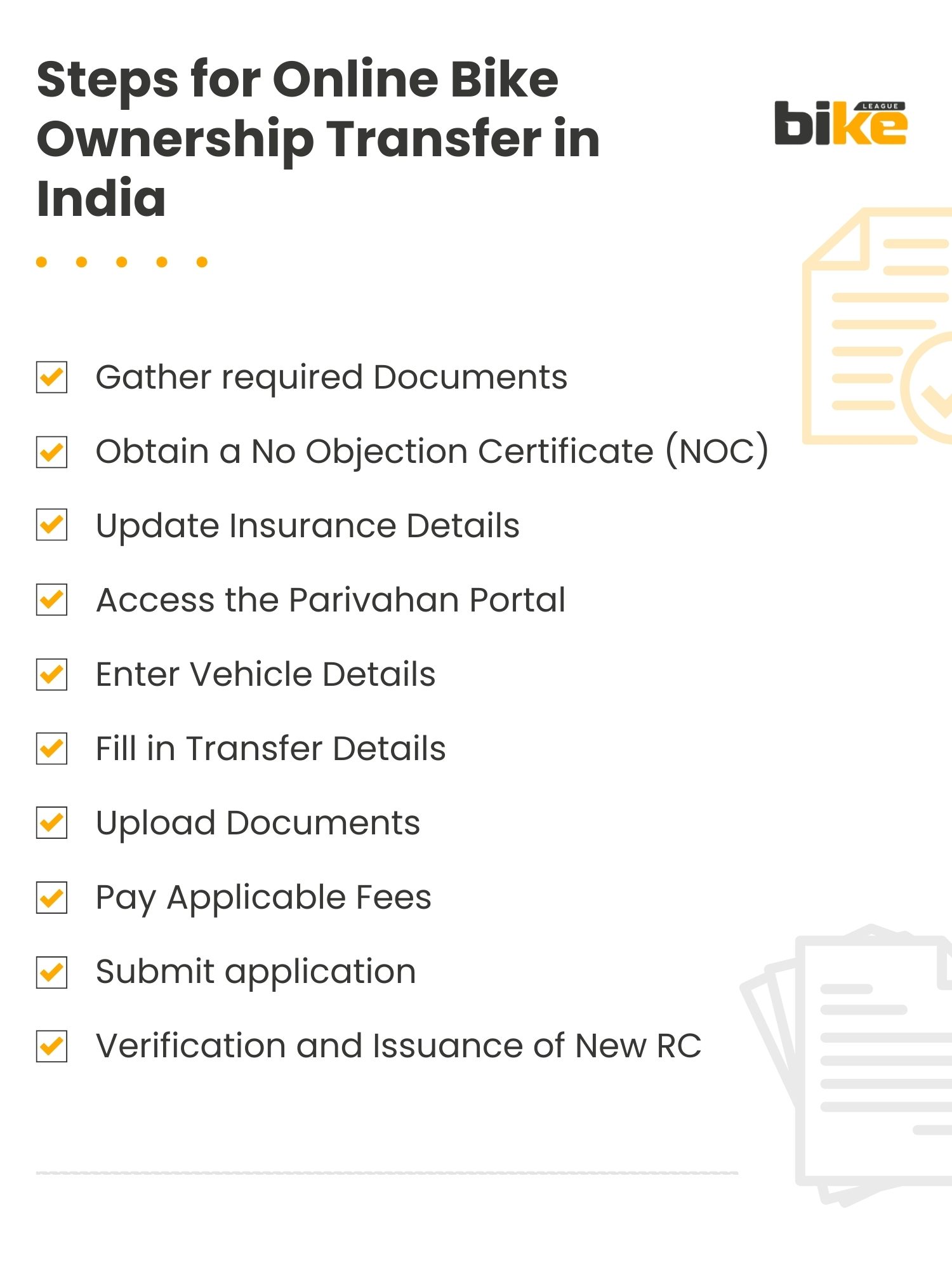
Note: The steps below cover the online application process, but whether you can complete the entire transfer without visiting the RTO depends on your state. States with “Faceless Services”—including Delhi, Maharashtra, and Telangana—allow you to complete the full process online using Aadhaar e-KYC authentication, with the new RC dispatched directly to your address. In most other states, you can complete the application and payment online, but you’ll still need a short RTO visit for document verification or a chassis/engine pencil print. Check your state RTO’s portal to confirm which applies to you.
1. Gather Required Documents
Before you begin, collect the RC, insurance, PUC, ID, and address proof for both the buyer and seller, along with passport photos.
Fill out and sign Forms 29 and 30 to transfer ownership.
2. Obtain A No Objection Certificate (noc)
If the bike comes from another state or has any dues, get a NOC from the RTO. This certificate confirms that you have no legal or financial issues.
3. Update Insurance Details
Add the new owner’s details to the insurance policy to keep coverage valid.
4. Access The Parivahan Portal
Visit the Parivahan portal to initiate the online transfer. This government website supports various vehicle services, including vehicle ownership transfer.
5. Enter Vehicle Details
Log in, enter your bike’s registration and chassis numbers, and choose ‘Transfer of Ownership.’
6. Fill In Transfer Details
Select ‘Transfer of Ownership,’ enter the buyer and seller details, and confirm everything is correct.
7. Upload Documents
Upload clear scanned copies of the RC, insurance, PUC, and ID proof.
8. Pay Applicable Fees
Check the fee and pay online using a credit or debit card or net banking. The amount depends on your RTO and state.
9. Submit application
After you pay, submit your application. After processing your documents, the RTO issues a new RC to the buyer.
10. Verification And Issuance Of New Rc For A Bike Ownership Transfer
The RTO will check your documents and may inspect the bike. After this, they will issue a new RC in the new owner’s name. Usually, this process takes 7 to 30 working days from the time you submit your application, depending on your RTO and whether a physical verification is needed. Some cases may take longer if documents are missing or if the RTO has a backlog. You can track your application status anytime on the Vahan portal using your application number. If your application is delayed much longer than expected without a clear reason, you can raise the issue through your state transport department’s grievance portal or the Central Public Grievances Portal (pgportal.gov.in).
What Are The Steps For Offline Bike Ownership Transfer In India?
1. Gather Required Documents
Bring the RC, insurance, PUC, ID, and address proof for both the buyer and seller, along with the buyer’s passport photos. Also, bring the filled-out Forms 29 and 30.
2. Obtain A No Objection Certificate (noc)
If there’s a loan or the bike comes from another state, get an NOC from the bank or RTO to confirm there are no dues or legal issues.
3. Visit The Regional Transport Office (rto)
Both the buyer and seller should visit the seller’s RTO together. Booking an appointment can help you save time.
4. Submit the Application and Documents
Submit the filled Forms 29 and 30, along with all the required documents, to the RTO. Ensure that everything is complete to facilitate a smooth verification process.
5. Pay The Applicable Fees
Pay the transfer fees at the RTO counter. According to Rule 81 of the Central Motor Vehicles Rules, the basic transfer fee for a motorcycle or scooter is ₹150, with an extra ₹200 if a Smart Card RC is issued. Many RTOs add postal, handling, or state-specific surcharges to this base fee, so the total amount you pay at the counter may be higher than the basic fee. Always check the exact amount for your RTO on the Vahan portal before you visit.
6. Verification And Inspection
The RTO will check your documents and might inspect the bike. This ensures all details are correct and the bike meets legal standards.
7. Obtain The New Registration Certificate (rc)
After the verification and inspection, the RTO will process the ownership transfer. Then, they’ll issue a Registration Certificate in the buyer’s name to finish the process. This generally takes 7 to 30 working days, and the new RC is either dispatched by post or made available for download on the Parivahan portal and mParivahan app, depending on your state.
What Are The Steps For Bike Rc Transfer Between States In India?
1. Obtain A No Objection Certificate (noc) For A Bike Ownership Transfer
The first step in transferring a bike’s RC is to obtain an NOC from the current Regional Transport Office (RTO). This certificate is needed to legally move the bike to another state.
2. Transfer The Bike To The New State
After you get the NOC, you can move the bike to the new state.
3. Register The Bike In The New State
Once the bike arrives in the new state, register it with the local RTO. You’ll need to submit the NOC and other required documents.
4. Pay The Road Tax For A Bike Ownership Transfer
The new state may ask you to pay road tax or a lifetime tax. This step is required to finish the registration.
5. Verification And Issuance Of New Rc
The RTO will check your documents and inspect the bike. After that, they’ll issue a new RC.
6. Refund Of Road Tax
If it applies, you can ask for a refund of the road tax you paid in the previous state. The process is similar to filing income tax returns.
What Are The Crucial Things For A Bike Ownership Transfer Between States In India?
- Eligibility and State Rules: Ensure you meet the eligibility criteria for vehicle registration in the new state, which may include residency or employment requirements.
- Emission Testing: Some states require an emission test for the vehicle during the transfer process.
- NOC from Financiers: An NOC from the bank or financial institution may be required if the bike is financed.
- Timeframe and Penalties: To avoid penalties, complete the transfer within the mandated time frame. Keeping a bike in another state for more than 12 months without re-registering can result in fines and penalties.
How Is Bike Ownership Transfer Different For Electric Two-wheelers?
Electric two-wheelers generally follow the same core RC transfer process outlined above, but a few EV-specific factors are worth checking before you buy or sell a used electric bike or scooter in India.
1. State Subsidy Conditions And Resale Restrictions
Several states have conditions for road tax exemptions, registration waivers, or purchase subsidies for EVs, and some are introducing minimum ownership periods before you can resell. For example, Delhi’s proposed EV Policy 2.0 suggests a resale restriction of up to five years on subsidised electric vehicles to prevent quick resales and help stabilize the used EV market. However, this is still a draft policy, so buyers should confirm its final status before deciding.
Since subsidy terms vary by state and scheme, and central schemes like FAME-II or PM e-DRIVE give incentives to manufacturers instead of buyers, always review your state’s EV policy or the subsidy documents you received when you bought the vehicle. Selling within a restricted period could affect the tax or subsidy benefits linked to your vehicle.
2. Battery Ownership And Lease Agreements
Some EV models, particularly in the low-speed and budget segment, separate the vehicle and battery ownership through a battery-as-a-service or lease model. If your EV’s battery is financed or leased separately from the vehicle, you’ll need a NOC from the battery leasing company in addition to (or instead of) a standard vehicle-loan NOC, and you should clarify this with the seller before the sale agreement is finalised.
3. Insurance Considerations For Used Evs
EV insurance policies typically price the battery separately from the vehicle body, and battery health/warranty status can affect the premium quoted to a new owner. When updating the policy to the buyer’s name as part of the transfer process, confirm whether the existing battery warranty transfers to the new owner, since this varies by manufacturer.
4. Rc And Registration Details Are Otherwise Unchanged
Apart from these differences, EVs use the same Forms 28, 29, and 30, the same RTO transfer fee structure, and the same Vahan portal process as petrol two-wheelers. There is no separate “EV transfer” procedure at the RTO.
What Is The Process To Obtain A No Objection Certificate (noc) From The Rto In India?
The No Objection Certificate (NOC) from the Regional Transport Office (RTO) in India is a mandatory document required primarily for inter-state transfer of a vehicle’s registration or for cases such as selling, gifting, or scrapping a vehicle. It certifies that the vehicle has no outstanding dues or legal objections, allowing smooth transfer or other formalities.
Process To Obtain A No Objection Certificate (noc) From The Rto In India
1. Application Submission
- The vehicle owner must fill out Form 28 (application for NOC) available at the local RTO or online via the Ministry of Road Transport and Highways portal (parivahan.gov.in).
- Submit the completed application in person at the RTO or through authorised agents where applicable.
Documents Required
- Original RC (Registration Certificate) of the vehicle
- Valid insurance certificate
- Valid Pollution Under Control (PUC) certificate
- Proof of address and identity of the applicant (Aadhaar, voter ID, passport)
- Challan receipt, if applicable (to prove no pending traffic violations)
- Copies of the seller’s and buyer’s ID and address (in case of sale)
- Form 28 duly filled and signed
Verification And Clearance
- The RTO verifies the vehicle documents and ensures that there are no outstanding dues, such as road tax, challans, or fines, associated with the vehicle.
- A physical inspection of the vehicle may be conducted if necessary.
Payment Of Fees
Pay the prescribed fee for NOC issuance, which varies by state but generally ranges from ₹50 to ₹500.
Issuance Of Noc
- Once all documents are verified and dues are cleared, the RTO issues the NOC
- The certificate confirms that there are no objections to the vehicle with respect to the transfer or use in another state.
Validity
The NOC is typically valid for a specific period (usually six months), during which you must transfer the vehicle registration to another RTO (inter-state transfer).
Follow-up
Suppose the vehicle is being transferred to another state. In that case, you must submit the NOC to the new state RTO along with an application for new registration.
Some states offer partial or complete online processing, which simplifies the application and reduces the need for physical visits.
Faq Related To Bike Ownership Transfer In India
1. Why Is It Necessary To Transfer Bike Rc When Moving States?
Transferring your bike’s RC is legally required if you plan to live in a new state for more than a year. This ensures your vehicle falls under the new state’s Regional Transport Office (RTO), helping you avoid legal issues and fines.
2. How Do I Register My Bike In The New State?
After obtaining the NOC, you must register your bike in the new state by visiting the local RTO. This involves submitting the required documents, paying the road tax, and undergoing a vehicle inspection. Once you complete these steps, the RTO will issue a new RC.
3. Can I Get A Refund On The Road Tax Paid In The Previous State?
Yes, you can apply for a refund of the road tax paid in the previous state. This is similar to filing for income tax returns and requires submitting the necessary documents to the existing RTO.
4. What Should I Do If My Bike Is Financed?
If your bike is financed, you must obtain an NOC from the bank or financial institution that provided the loan. Submit this NOC, along with other documents, to the RTO.
5. How Do You Cancel A Bike Rc Transfer Application In India?
The process for cancelling a bike RC transfer application may vary by state. Generally, you can visit the Parivahan Sewa website, select your state, choose “Others,” and click “Cancel Application” to initiate the cancellation process.
6. Can We Transfer Rc From One District To Another?
Transferring RC from one district to another within the same state typically follows a procedure similar to transferring between states. This involves submitting necessary forms and documents to the registering authorities within specified timeframes. Contact the local RTO office for detailed information and specific requirements.
7. Can We Transfer The Bike Rc Without Noc In India?
Transferring RC without an NOC is generally not permissible, as the NOC is a crucial document for the transfer process. It’s advisable to obtain the NOC from the current RTO before initiating the transfer to another state.
8. How Long Do I Have To Transfer Bike Ownership After Buying Or Selling It?
For a same-state sale, the buyer must apply for the RC transfer within 14 days of the purchase date. For an inter-state transfer, the timeframe is typically longer but varies by state, so confirm the exact window with your local RTO. Under Rule 81 of the Central Motor Vehicles Rules, delaying the transfer — or delaying submission of the NOC where one is required — attracts a penalty of ₹300 for every month or part of a month of delay, on top of the transfer fee itself. Importantly, the seller also remains the legally registered — and liable — owner until the transfer is officially completed, so there’s a real cost to putting this off beyond the fine.
9. Am I Still Liable If I Sold My Bike But Didn’t Transfer The Rc?
Yes. Under Indian law, the person named on the Registration Certificate is treated as the legal owner of the vehicle, regardless of any private sale agreement, delivery note, or handover of possession. If the buyer commits a traffic violation, gets into an accident, or uses the vehicle in a crime before the RC is officially transferred, liability—including traffic challans and legal notices—falls on the seller, since they remain the RTO’s registered owner on record. A signed sale agreement alone does not transfer this legal responsibility; only the completed Form 29/30 process at the RTO does. This is why sellers should never delay initiating the transfer after handing over a bike, and ideally should keep a copy of the acknowledgment receipt from the RTO or Parivahan portal as proof that the process was initiated.
10. How Long Does It Take To Get The New Rc After Applying For Transfer?
Once you submit documents, pay fees, and complete any required physical verification, the new RC is typically issued within 7 to 30 working days, though this can vary by RTO and state. Delays are more common when documents are incomplete or a physical inspection is pending. You can track your application in real time on the Vahan portal by entering your registration number and application ID under “Know Your Application Status.”
11. Is A Physical Rto Visit Mandatory For Bike Ownership Transfer?
It depends on your state. States that have rolled out “Faceless Services”—currently including Delhi, Maharashtra, and Telangana—allow you to complete the entire transfer online through Aadhaar e-KYC authentication, with the new Smart Card RC dispatched directly to your registered address. In most other states, you can complete the application, upload documents, and pay the fee online, but you’ll still need to visit the RTO in person for document verification or a chassis/engine pencil print before the transfer is finalised. Check your specific state RTO’s portal or the Vahan website to confirm whether faceless processing is available in your area.
12. What Can I Do If My Bike Ownership Transfer Application Is Stuck Or Delayed?
First, track your application on the Vahan portal using your registration number and application ID under “Know Your Application Status” to see whether it’s pending document verification, awaiting RTO approval, or already processed. If there’s no movement for several weeks with no clear reason, you have two escalation options: most state transport departments run their own grievance portals (for example, Telangana’s Citizen Grievance Redressal System or Karnataka’s Transport Department helpline) where you can file a complaint specific to your RTO, or you can file a grievance with the Central Government’s Public Grievances Portal (pgportal.gov.in), which covers complaints against any government department including RTOs. Keep your acknowledgment receipt and application number handy, as you’ll need them for either route.
Sources
- Ministry of Road Transport & Highways – Fees & User Charges (official fee schedule under Rule 81, Central Motor Vehicles Rules, 1989)
- Vahan Citizen Services Portal (online application, document upload, fee payment, and application status tracking)
- Parivahan Sewa (Ministry of Road Transport & Highways portal for RC, DL, and related vehicle services)
- Motor Vehicles Act, 1988, Section 50 (reporting obligations and deadlines for transfer of ownership)
- Central Motor Vehicles Rules, 1989, Rule 81 (fee schedule for registration, transfer of ownership, hypothecation, and related services)
- Public Grievances Portal (CPGRAMS) — Department of Administrative Reforms and Public Grievances, for escalating stalled or unresolved RTO applications
Other Related Articles From Bikeleague India
- Motorcycle RC book in India:Exploring Book vs Digital
- Bike fitness certificate guide – All you need to know
- Must have bike documents for travel in India
- Buying a second-hand bike in India: Smart or risky choice
- KTM RC 390
- KTM RC 200
Conclusion
Transferring bike ownership in India is straightforward when you have the necessary documents and understand the procedures for your situation. Completing the RC transfer on time not only fulfills legal obligations but also protects both buyer and seller from future liabilities. By following the guidelines in this guide and staying up to date on your state’s regulations, you can complete the transfer smoothly and confidently.
If you have any questions, email us at bikeleagueindia@gmail.com or leave a comment below. We’re always happy to help. You can also connect with Bikeleague India on social media.