
Long story short: When comparing Fuel Injection vs Carburetor systems, Fuel injection is superior in performance, efficiency, and emissions, while carburetors have advantages only in maintenance and cost.
Deciding between fuel injection and carburetor systems is important for motorcycle fans, mechanics, and regular riders. Most new bikes use fuel injection because it offers better performance, efficiency, and lower emissions. Still, many people like carburetors for their simple design, lower price, and easy upkeep.
This article explains how both systems work, compares their pros and cons, and shows why new rules have pushed more bikes to use fuel injection. If you want to learn about your bike’s technology or are thinking about an upgrade, this guide will help you pick the right system for your needs.
Key Takeaways
- A carburetor mixes fuel and air to enable combustion inside a motorcycle engine, then delivers this mixture to the engine’s intake.
- In motorcycles, various types of fuel injection systems are employed, primarily electronic fuel injection (EFI), with variations including full port injection and simpler throttle-body/single-point injection.
- Fuel injection beats carburetors in most areas except for maintenance and cost. This change lowers emissions but also raises motorcycle prices.
- Repairs to fuel injection systems typically require expert knowledge and specialised tools.
- Fuel injection has been mandatory on every new motorcycle sold in India since BS6 Phase 1 came into effect in April 2020. Carbureted bikes are no longer manufactured or sold as new — they now exist only in the used-bike market.
First, we’ll look at how carburetors and fuel injection work. Then, we’ll compare what each does well and where they fall short.
What Is A Carburetor?
A motorcycle carburetor is a mechanical part that mixes air and fuel in the right ratio to power the engine. It sits between the air intake and the engine cylinder.
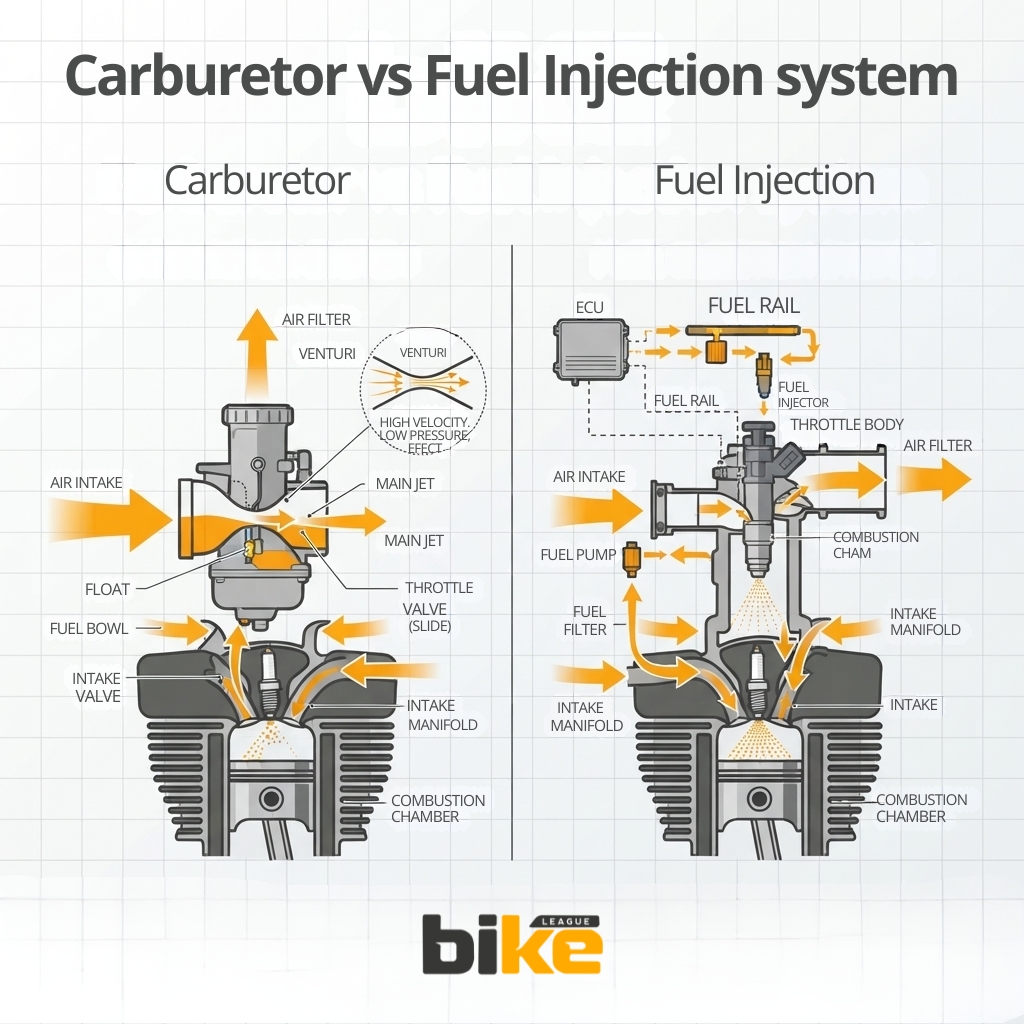
How Does A Carburetor Work?
Here’s a straightforward look at how a motorcycle carburetor works:
- Air Intake: The carburetor draws in air from outside through its intake opening. The amount depends on the throttle position, and during cold starts, the choke can restrict air to help the bike start more easily.
- Venturi Effect: Air passes through a narrow passage (venturi). This causes the air speed to increase and the pressure to drop, creating suction.
- Fuel Metering: The drop in pressure draws fuel up from the float chamber through small jets. The main jet supplies fuel at high speeds, while the pilot jet controls fuel at idle and low throttle.
- Fuel Atomisation: The fast-moving air mixes with fuel, breaking it into tiny droplets for better combustion.
- Throttle Valve Control: Twisting the throttle by the rider opens the throttle valve, letting in more air, which creates more suction and pulls in additional fuel. More fuel and air equals more power.
- Air-Fuel Mixture Formation: The carburetor ensures the right ratio of air to fuel by balancing airflow (via throttle) and fuel flow (via jets and float).
- Combustion Chamber Delivery: The mixed air-fuel is sent into the engine cylinder, where it’s compressed by the piston.
- Ignition and Combustion: The spark plug ignites the compressed mixture, powering the engine to move the motorcycle.
- Exhaust Stroke: Burnt gases are expelled from the cylinder, making room for the next fresh mixture.
- Cycle Continuation: This process repeats continually as long as the bike is running.
Types Of Bike Carburetor
There are five main types of motorcycle carburetors:
| Carburetor Type | Description | Examples |
|---|---|---|
| Constant Velocity (CV) | Uses vacuum to operate a slide, balancing airflow and fuel, providing smooth throttle response and better fuel efficiency. Ideal for commuter bikes. | Hero Splendor, Bajaj Platina, Honda CB Shine, TVS Star City, Hero HF Deluxe |
| Slide / Mechanical Slide | Uses a slide directly controlled by the throttle cable for quick throttle response and moderate fuel efficiency. Suitable for performance and sportier bikes. | Royal Enfield Classic 350 (older carbureted models), Bajaj Pulsar 150 (older models), Yamaha FZ-S V2.0 (older carbureted variants) |
| Butterfly Carburetor | Uses a butterfly valve for airflow control; common in older motorcycles with less smooth throttle response. | Older models of Bajaj Chetak, older scooters like TVS Jupiter carbureted variants |
| Downdraft Carburetor | Positioned above the inlet manifold, allowing the air-fuel mixture to move downward into the engine, suitable for high-performance bikes. | Rare in Indian motorcycles but seen in performance variants of older sport bikes imported or customised. |
| Updraft Carburetor | Air flows upward; found mostly in vintage motorcycles. | Classic and vintage motorcycles like early Royal Enfield Bullet carbureted versions |
- Most modern commuter bikes in India utilise CV carburetors for enhanced efficiency and smoothness.
- Older performance-oriented motorcycles with quicker throttle response use slide carburetors.
- Vintage and classic bikes typically feature updraft or butterfly carburetors.
- Downdraft carburetors are less common but are used in specialised or performance bikes.
- Most new motorcycles now use fuel injection instead of carburetors because of stricter emission standards like BS-6.
Advantages Of Motorcycle Carburetor
- Cost-Effective: carburetors are generally cheaper to purchase and repair. They are ideal for budget-friendly motorcycles and low-capacity engines, making them accessible to a wide range of riders.
- Simplicity and Maintenance: carburetors are simpler mechanical devices, which makes them easier to maintain and repair. They can be serviced by most mechanics and are customisable to meet user demands and surroundings.
- Tolerance to Fuel Quality: carburetors are more tolerant of substandard fuel and can be easily cleaned if contaminated, which can be beneficial in areas with inconsistent fuel quality.
Disadvantages Of Motorcycle Carburetor
- Cold Start Issues: Carbureted motorcycles often struggle with starting in cold weather and at higher altitudes without adjustment, which can be inconvenient for riders in such conditions.
- Fuel Efficiency and Emissions: carburetors have lower fuel efficiency and tend to produce higher emissions due to less efficient combustion, making them less environmentally friendly.
- Performance Limitations: They struggle to deliver reliable power across all load and RPM ranges. They need to be tuned more carefully to pass emissions regulations while maintaining drivability.
- Maintenance Needs: carburetors require periodic adjustments or tuning and are more prone to fuel and air leaks compared to fuel injection systems.
Next, let’s look at how fuel injection works.
What Is Fuel Injection, And How Does Fuel Injection Work?
Motorcycle fuel injection is a modern system that carefully controls how much fuel enters the engine. Unlike carburetors, which mix air and fuel using mechanical parts, fuel injection relies on electronic sensors and an engine control unit (ECU) to deliver the right amount of fuel for top performance.
Here’s an easy step-by-step explanation of how a motorcycle fuel injection system works:
- Fuel pump activates: When you turn the key, the fuel pump sends fuel from the tank under high pressure to the fuel injectors.
- Sensors collect engine data: Various sensors (like those measuring throttle position, engine temperature, and air pressure) feed real-time data to the electronic control unit (ECU).
- ECU calculates requirements: The ECU (motorcycle’s computer) instantly calculates the right amount of fuel needed for the current engine and riding conditions, using a pre-set fuel map.
- Throttle input (rider control): When you twist the throttle, it changes the amount of air entering the engine (via throttle valve or ride-by-wire). The ECU senses this and adjusts fuelling accordingly.
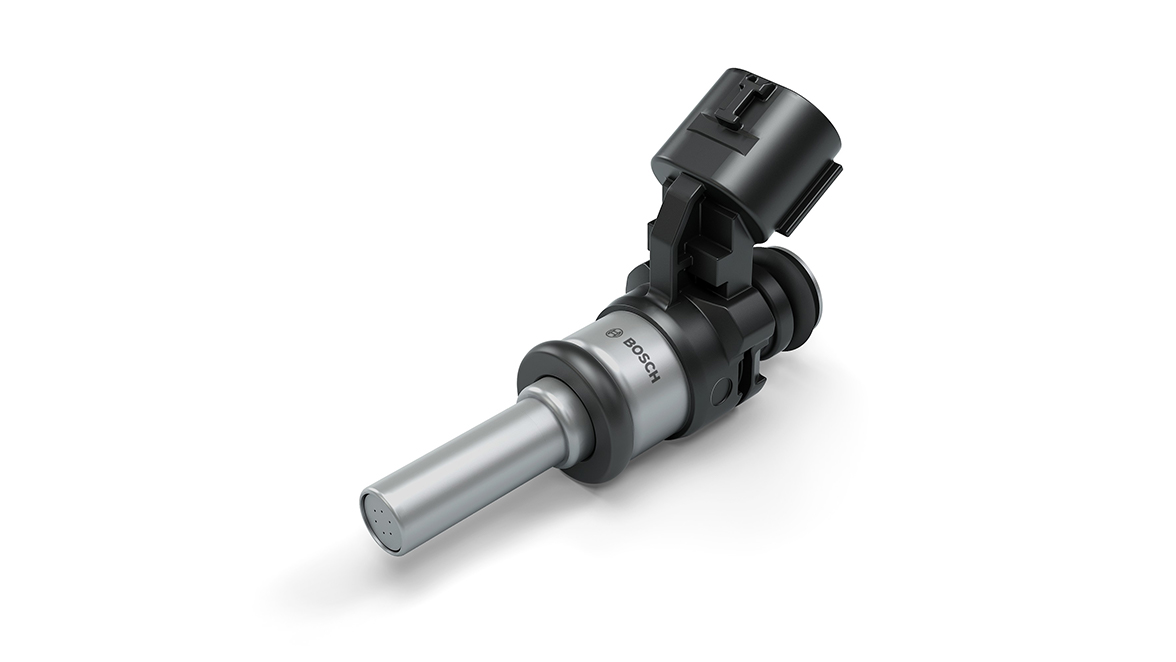
- Injector sprays fuel: The ECU sends a signal to the injector, which opens for a precise time. The injector sprays fuel as a fine mist into the intake manifold or directly into the cylinder (depending on design).
- Air mixes with fuel: The atomised fuel mixes with incoming air to form a uniform air-fuel mixture.
- Mixture enters engine: This mixture is drawn into the cylinder, then compressed by the piston.
- Combustion: The spark plug ignites the mixture, producing the power needed to move the motorcycle.
- Real-time adjustments: The ECU continuously monitors sensors and adjusts injection timing & quantity for precision, efficiency, and emissions control.
Types Of Fuel Injection
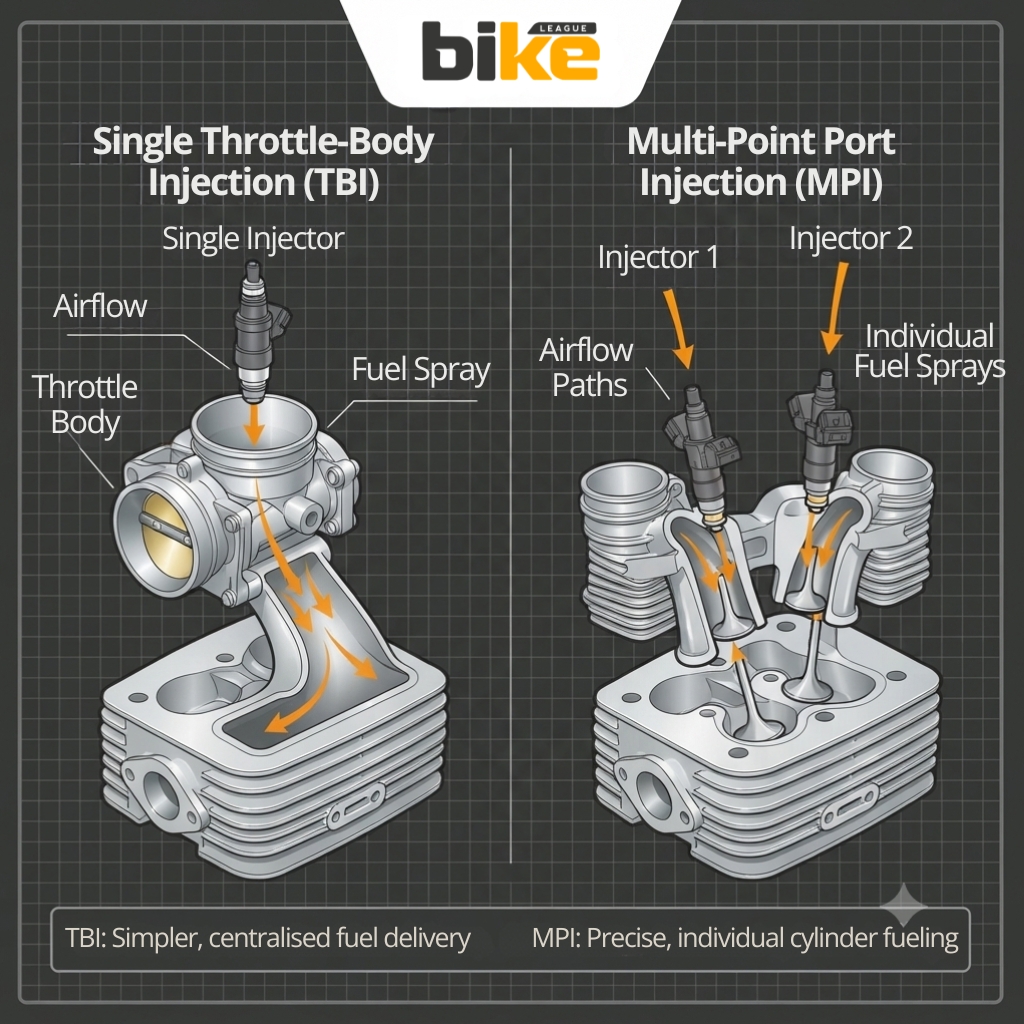
Motorcycles use different types of fuel injection systems. The most common is electronic fuel injection (EFI), which comes in versions like full port injection and simpler throttle-body or single-point injection, depending on the model and brand.
1. Electronic Fuel Injection (efi) – Port Injection
The most common type of fuel injection in Indian motorcycles. Fuel is injected near the intake valve (intake port) for better atomisation and combustion. EFI systems usually consist of sensors and an ECU that precisely controls the fuel flow based on engine conditions.
Examples:
2. Throttle Body Injection (tbi) / Single-point Injection
This is a simpler, single-injector type of EFI that helps budget and entry-level commuter bikes meet BS6 standards at a lower cost. One injector is placed at the throttle body instead of having separate injectors for each intake port. It delivers fuel to the intake manifold, not directly to the cylinder. Because it’s cheaper to use than full multi-point port injection, you’ll find it on India’s most affordable FI motorcycles.
That’s why a 100cc commuter with FI costs about the same as its old carbureted version, while performance FI bikes are more expensive than their carbureted counterparts. Use our on-road price calculator to check the exact price difference for a specific model in your state.
Examples:
Advantages Of Motorcycle Fuel Injection
- Cold Start Performance: Fuel-injected motorcycles excel in cold start conditions, starting easily without the need for manual choking. The system automatically adjusts the air-fuel mixture according to the prevailing conditions.
- Fuel Efficiency and Emissions: Fuel injection systems offer better fuel economy and lower emissions due to precise fuel injection and efficient combustion.
- Engine Performance: Fuel-injected engines generally provide higher power output and are suitable for high-performance applications.
- Reliability and Maintenance: These systems are generally more reliable and require less maintenance over time. They are less prone to issues like engine vibrations and fouled spark plugs.
Disadvantages Of Motorcycle Fuel Injection
- Complexity and Cost: Fuel injection systems are more complex, involving numerous sensors, wiring, and a computer unit, which can fail. They are also more expensive than carburetors.
- Repair and Replacement: Diagnosing and repairing fuel injection systems can be challenging, often requiring specialised services. If damaged, the entire system may need to be replaced.
- Sensitivity to Fuel Quality: Fuel injection systems, particularly newer multi-point electronic systems, are more sensitive to fuel quality, which can affect performance. This includes ethanol-blended fuels like E20 — see our guide to E10, E20 & E85 fuel for Indian bikers for how blending affects both carbureted and fuel-injected motorcycles.
Can You Tune A Fuel-injected Motorcycle? Aftermarket Options Explained
Unlike a carburetor, which riders and mechanics can adjust directly with jets and mixture screws, a fuel injection system is controlled by the ECU’s pre-programmed fuel map. However, this doesn’t mean FI bikes are stuck with factory settings. You just need different tools to make changes.
- Piggyback Fuel Controllers: Devices like a Power Commander sit between the ECU and the injectors, intercepting and modifying the signal to adjust fuel delivery without touching the stock ECU. This is the most common route for riders adding aftermarket exhausts or air filters, since those changes alter airflow enough to need a fuel remap to avoid running too lean.
- Open-Source ECU Flashing: On bikes with well-documented ECUs — the KTM Duke and RC series are a common example in the Indian performance-bike scene — riders and tuners use flashing tools to directly rewrite the stock fuel and ignition maps. This gives finer control than a piggyback device but requires more technical knowledge and carries a higher risk of engine damage if done incorrectly.
- Dealer/Performance Shop Remapping: Many tuning shops offer professional ECU remapping as a service, particularly for riders who want performance gains without doing the flashing themselves.
The main difference with tuning fuel injection, compared to carburetors, is that it costs more and is more complex. Instead of just using a screwdriver, you often need to buy a controller or flashing tool, and mistakes are harder to notice than with a carburetor. Still, you can tune fuel-injected bikes. Many riders with bikes like the KTM Duke 200/390 or RC 200/390 often remap the fuel system when they upgrade exhausts, air filters, or make other changes for better performance.
Common Myths About Fuel Injection And Carburetors
- Myth: Carbureted bikes always get worse mileage than fuel-injected ones. Generally true, but not universally. A well-tuned carburetor on a properly maintained engine can match or occasionally beat a poorly maintained or badly mapped FI system. The real gap shows up over time — carburetors drift out of tune with wear and altitude changes, while FI holds its factory efficiency far longer without rider intervention.
- Myth: Fuel-injected bikes never need servicing. False. FI bikes still need regular oil changes, air filter cleaning, spark plug replacement, and periodic checks on the fuel pump, injector, and sensors. What FI removes is the need for manual carburetor tuning and jet cleaning — it doesn’t eliminate routine maintenance altogether.
- Myth: You can’t tune a fuel-injected bike yourself. Partially false — see the aftermarket tuning section above. FI systems just require different tools than a carburetor, not none at all.
- Myth: Fuel injection systems fail more often than carburetors. False in practice. FI systems are generally more reliable over the life of the bike because they have no float bowls to flood, no jets to clog, and no manual adjustments to drift out of spec. When FI does fail, though, the repair is usually more expensive and requires a mechanic rather than a DIY fix — that’s a real trade-off, just not a reliability one.
- Myth: All modern bikes use the same type of fuel injection. False. As covered above, budget commuters typically use simpler throttle-body/single-point injection, while performance bikes use full multi-point port injection with more sensors and finer control. Not every “fuel-injected” bike has the same level of sophistication under the badge.
Fuel Injection Vs Carburetor Comparison
Now that you know how carburetors and fuel injection work, let’s compare them:
| Parameter | carburetor | Fuel Injection |
|---|---|---|
| Fuel Delivery | Mechanical mixing of air and fuel | Electronic control with sensors and ECU |
| Fuel Efficiency | Lower due to fixed air-fuel ratio | Higher due to precise and adaptable control |
| Engine Performance | Less efficient and less responsive | Better throttle response and optimized power |
| Cold Start | Difficult, requires choke | Easy, no choke needed |
| Maintenance | Simpler, easier to clean and repair | Complex, requires specialized tools |
| Repair Cost | Lower, inexpensive parts | Higher, costly electronic parts |
| Adaptability | Needs manual adjustment for altitude, temp | Automatically adjusts to riding conditions |
| Emissions | Higher pollution | Lower emissions |
| Durability | Good but prone to clogging | Generally durable, sensitive electronics |
| Replacement | Easy, widely available | Difficult, specialized parts |
| Initial Cost | Lower initial cost | Higher initial cost |
| Overall Reliability | Susceptible to dirt causing frequent tuning | More reliable with less frequent tuning |
| Environmental Impact | Higher due to inefficient combustion | Lower due to optimized combustion |
Fuel injection is better than carburetors in most ways, except for maintenance and cost. Since April 2020, all new motorcycles in India must have fuel injection, so every new bike uses it. Carbureted bikes are now only found as used models. This change has reduced emissions but also made bikes more expensive. If you’re buying a new fuel-injected bike on finance, our EMI calculator can help you figure out your monthly payments. Keep in mind that fixing fuel injection systems often requires expert skills and special tools.
What Are The Specific Performance Advantages Of Fuel Injection Over Carburetors In Various Riding Conditions In A Motorcycle?
Fuel injection offers several specific performance advantages over carburetors in various riding conditions in motorcycles:
- Precise Fuel-Air Mixture and Atomisation: Fuel injection systems use sensors and the ECU to measure and deliver the exact amount of fuel needed, optimising combustion efficiency. This results in cleaner, more efficient fuel burning across different conditions compared to carburetors, which rely on mechanical mixing with less precision.
- Adaptability to Riding Conditions: Fuel injection automatically adjusts the air-fuel mixture based on changes in altitude, temperature, and humidity. For example, at higher altitudes where oxygen levels drop, fuel injection compensates to maintain performance without manual tuning, unlike carburetors that need manual adjustments or different jets.
- Sharper and Quicker Throttle Response: The electronic control of fuel injection allows immediate fuel delivery matching throttle input, providing smoother and more responsive acceleration. carburetors have a slower mechanical response and can be less consistent in throttle feedback.
- Cold Start Performance: Fuel injection enables easier and more reliable engine starting in cold conditions without the need for a choke, which is often required for carburetted engines. This smooth, cold start contributes to better overall performance, especially in varying climates.
- Better Fuel Efficiency and Mileage: The accuracy of fuel delivery in fuel injection systems leads to better fuel economy, as fuel is not wasted burning rich or lean mixtures common in carburetors under changing conditions. This advantage is particularly evident in mixed or urban riding conditions, where throttle and load vary frequently.
- Lower Maintenance and Emissions: Fuel injection systems require less regular tuning and maintenance than carburetors, and they produce lower exhaust emissions due to optimised combustion. This makes them more durable and environmentally friendly.
To sum up, fuel injection gives steady engine performance and better fuel efficiency. It adjusts easily to different riding conditions, such as cold starts or changes in altitude and temperature. Carburetors struggle more with these changes because they are mechanical and less adaptable.
How Does The Complexity Of A Fuel Injection System Affect Its Long-term Maintenance Compared To A Carburetor In A Motorcycle?
The complexity of a fuel injection system does affect its long-term maintenance compared to a carburetor in motorcycles in several ways:
- Higher Complexity and Specialised Knowledge Required: Fuel injection systems involve electronic components like sensors, ECU, and injectors, making them more complex than primarily mechanical carburetors. This complexity means that maintenance and tuning require specialised tools and expert knowledge, unlike carburetors, which can be serviced or tuned more easily by riders or general mechanics.
- Less Frequent Routine Maintenance: Fuel injection systems generally need less frequent maintenance because they don’t suffer from issues like clogged jets or float bowl problems common in carburetors. They are more resistant to dirt and contamination, but require periodic checks on sensors and the fuel pump.
- Higher Repair Costs: If a fuel injection system fails, the repair or replacement costs can be significantly higher than carburetor repairs. Every fuel injection system is often unique, making parts and repairs more expensive and time-consuming compared to the simpler carburetor parts.
- Dependence on Electronics: Fuel injection systems are highly reliant on electronic components, so a single sensor or ECU failure could cause multiple performance issues, complicating diagnosis and repair. carburetors, being mechanical, are less susceptible to electronic failures.
- Ease of DIY Maintenance: carburetors are considered easier and more accessible for amateur riders or mechanics to maintain at home due to their mechanical simplicity. Fuel injection maintenance, on the other hand, is often better performed by professionals due to the technical complexity.
- Maintenance Benefits: Despite the complexity, fuel injection systems offer advantages like no need for manual tuning for altitude or temperature, no choke for cold starts, and more consistent fuel delivery, which reduces the need for constant adjustments that carburetors require.
In simple terms, fuel injection systems are more complex and expensive to repair, but they need less maintenance and are usually more reliable. Carburetors are easier and cheaper to fix, and you can often repair them yourself, but they need more frequent tuning and cleaning.
Glossary: Fuel Injection And Carburetor Terms
- Carburetor: A mechanical device that mixes air and fuel using vacuum and jets, without any electronic control.
- ECU (Engine Control Unit): The onboard computer in a fuel-injected motorcycle that calculates and controls fuel delivery based on sensor inputs.
- EFI (Electronic Fuel Injection): A broad term for any fuel injection system controlled electronically by an ECU, as opposed to mechanically.
- Port Injection: A type of EFI where fuel is sprayed near the intake valve (port) for each cylinder, typically used on performance and mid-to-premium motorcycles.
- Throttle Body Injection (TBI) / Single-Point Injection: A simpler, lower-cost form of EFI using one injector at the throttle body instead of one per cylinder port, common on budget commuters.
- Venturi: The narrow passage inside a carburetor where air speeds up and pressure drops, creating the suction that draws in fuel.
- Choke: A carburetor component that restricts air intake during cold starts to enrich the fuel mixture and make starting easier.
- Fuel Map: A pre-programmed table in the ECU that tells the fuel injection system how much fuel to deliver for a given combination of throttle position, RPM, and other sensor readings.
- BS6 (Bharat Stage 6): India’s current vehicle emission standard, mandated by the Ministry of Road Transport and Highways (MoRTH) for all two- and three-wheelers manufactured on or after 1 April 2020, which effectively made fuel injection mandatory for all new petrol motorcycles. A second stage, BS6 Phase II, took effect on 1 April 2023 and added mandatory OBD-II diagnostics on top of the Phase 1 fuel-injection requirement.
- OBD-II (On-Board Diagnostics II): A self-diagnostic system that monitors engine and emissions performance in real time and flags faults via a warning light or connected app. BS6 Phase II made OBD-II mandatory on all fuel-injected two-wheelers in India from April 2023; carbureted bikes, having no ECU, were never subject to this requirement.
- Piggyback Fuel Controller: An aftermarket device (such as a Power Commander) that intercepts and modifies signals between the ECU and injectors, allowing riders to remap fuel delivery without replacing the stock ECU.
Faq Related To Motorcycle Fuel Injection Vs Carburetor
1. How Does A Fuel Injection System Differ From A Carburetor?
Fuel injection systems utilise electronic sensors and an engine control unit (ECU) to deliver fuel directly into the combustion chamber, resulting in a more precise air-fuel mixture compared to the mechanical operation of carburetors.
2. Which Gives More Mileage, Carburetor Or Fuel Injection?
The fuel injection system gives more mileage as fuel delivery to the engine is done based on inputs from the various sensors and factors in the Fi system. Therefore, the right amount of fuel is delivered, resulting in increased mileage.
3. Which Provides More Performance, Fi Or Carburetor?
Fuel injection systems enhance motorcycle performance by providing a precise air-fuel mixture, resulting in higher power output and better fuel management.
4. What Are The Signs Of Failure Of The Carburetor & Fi?
Failure signs include starting issues, poor idling, reduced mileage, the engine not reaching the intended RPM, and increased exhaust smoke.
5. Which One Is Better For Cold Conditions, The Carburetor Or Fi?
Fuel injection systems perform better in extreme weather conditions, providing consistent performance and easier starting in cold weather, unlike carburetors, which can struggle in such situations.
6. Why Has The Fuel Injection System Replaced The Carburetor On Bikes Launched Recently?
Fuel injection has been mandatory on every new motorcycle sold in India since BS6 Phase 1 took effect in April 2020, so this isn’t a “recent” or ongoing change — it’s already fully complete. No manufacturer has legally sold a new carbureted motorcycle in India since then, even in low-displacement segments. If you’re looking at a carbureted bike today, it will be a used or pre-owned model from before 2020; a simple way to check is the presence of a choke lever near the handlebar or fuel tank, which fuel-injected bikes don’t have.
7. Does The Fi Or The Carburetor Last Longer, And Which One Has Less Wear And Tear?
Fuel Injection lasts longer and causes less wear and tear compared to a carburetor.
8. What’s The Difference Between Port Injection And Throttle Body Injection?
Port injection (EFI) uses a separate injector at each cylinder’s intake port, spraying fuel close to the valve for finer atomisation and control — it’s the standard on most performance and mid-to-premium Indian motorcycles.
Throttle body injection (TBI) uses a single injector at the throttle body instead of one per cylinder, delivering fuel to the intake manifold rather than directly at each port. TBI is simpler and cheaper to implement, which is why it’s common on budget and entry-level commuters.
9. Which Type Of Carburetor Is Most Common On Older Indian Commuter Motorcycles?
Most older commuter bikes in India use Constant Velocity (CV) carburetors. A CV carburetor uses vacuum to operate a slide that balances airflow and fuel automatically, giving smoother throttle response and better fuel efficiency than a mechanical slide carburetor — which is why it suits everyday commuting rather than performance riding.
10. Do All Fuel-injected Motorcycles Use The Same Level Of Technology?
No. Budget commuters typically use simpler throttle-body/single-point injection with one injector, while performance bikes use full multi-point port injection with an injector per cylinder, more sensors, and finer fuel control. Two bikes can both be labelled “fuel-injected” while running noticeably different systems underneath.
11. What Is Obd-ii And How Does It Affect Fuel-injected Motorcycles?
OBD-II (On-Board Diagnostics II) is a self-diagnostic system that monitors engine and emissions performance in real time and flags faults through a warning light or connected app. India’s BS6 Phase II norms, effective 1 April 2023, made OBD-II mandatory on all fuel-injected two-wheelers, building on the Phase 1 fuel-injection mandate from 2020. Carbureted bikes, having no ECU, were never subject to this requirement — one more reason FI systems are generally easier to diagnose despite being electronically more complex.
Other Related Articles From Bikeleague India
- Adventure bikes vs Touring bikes which one is the best
- Yamaha vs Honda vs Kawasaki : Comparing Bike Giants
- Fuel Priming Pump Guide: Usage & Care for Indian Bikes
- Motorcycle Cruise Control – All you need to know
- Zontes 350T ADV
Conclusion
The move from carburetors to fuel injection in motorcycles shows the industry’s focus on better efficiency, performance, and caring for the environment. Some riders still like carburetors because they are simple and easy to maintain, but fuel injection offers better mileage, more reliability, and suits today’s riding needs. Keep in mind, all new two-wheelers now use fuel injection.
The best system for you depends on what matters most—easy repairs and low costs, or advanced technology and long-term benefits. As rules and technology change, fuel injection will stay the standard. Still, knowing how both systems work helps you choose what’s best for your bike.
If you have questions, feel free to email us at bikeleagueindia@gmail.com or leave a comment below. We’re always happy to help. You can also reach out to Bikeleague India on social media.