
Long story short: Are you looking to finance your dream bike through a two-wheeler loan? This guide will walk you through obtaining a bike loan and explore in depth the factors that influence bike loan interest rates.
Do you want to own a new motorcycle but feel unsure about how to handle the finances? With so many lenders, loan types, and requirements in India, the process can feel confusing.
This guide is here to make things easier for you. It covers different loan options, how to calculate EMIs, what documents you need, and tips to improve your chances of approval and get the best rates.
Key Takeaways
- Both secured and unsecured bike loans are available, each with different eligibility, interest rates, and collateral requirements.
- Your CIBIL score plays a crucial role in loan approval, interest rates, and overall eligibility—aim for a score above 700 for better terms.
- Lenders typically finance 85–100% of the bike’s on-road price, but making a higher down payment reduces your EMI and total interest paid.
- Always compare offers from banks, NBFCs, and dealers to secure the best interest rate and lowest processing fees.
- Read the loan agreement carefully to understand all charges, prepayment rules, and penalties before signing
What Is A Two-wheeler Or Motorcycle Loan?
A bike loan, also known as a two-wheeler loan, allows individuals to finance the purchase of a motorcycle or scooter. It is a popular financing option for those who want to buy a two-wheeler but may not have the total amount available upfront.
When you take a bike loan, the lender (usually a bank or a financial institution) provides the required funds to purchase the bike. You repay the loan monthly over a specified period, including interest and sometimes other charges. The tenure of a bike loan can range from a few months to several years, depending on the lender’s terms and the borrower’s preferences.
Types Of Motorcycle Loan
| Feature | Secured Motorcycle Loan | Unsecured Motorcycle Loan |
|---|---|---|
| Collateral Requirement | Requires collateral (usually the motorcycle itself). | No collateral required. |
| Basis of Approval | Based on collateral value and repayment ability. | Based on borrower’s creditworthiness and income stability. |
| Interest Rates | Lower bike loan interest rates due to reduced lender risk. | Higher bike loan interest rates due to increased lender risk. |
| Loan Amount | Higher loan amounts available because of added security. | Lower loan amounts due to the absence of collateral. |
| Repayment Tenure | Longer repayment terms, providing flexible EMI options. | Shorter repayment periods compared to secured loans. |
| Fees and Charges | May include additional costs such as processing, appraisal, or origination fees. | Generally, fewer fees, but interest cost is higher. |
| Approval Time | Longer approval process since collateral verification is required. | Faster approval process as there’s no asset evaluation needed. |
| Risk to Borrower | Risk of asset forfeiture if the borrower defaults. | No risk of vehicle repossession, but affects credit score in case of default. |
| Credit Score Impact | Timely repayments can help improve credit score. | Strong credit score required for approval; repayment also affects credit standing. |
| Purchase Flexibility | Generally limited to authorized dealers. | Can be used for private seller purchases as well. |
1. Secured Motorcycle Loan
Secured motorcycle loans require the borrower to pledge an asset, typically the motorcycle itself, as collateral. If the borrower defaults on the loan, the lender has the right to seize the bike to recover the outstanding amount.
Benefits Of Secured Motorcycle Loans
- Lower bike loan Interest Rates: Secured loans generally offer lower bike loan interest rates compared to unsecured loans because the collateral reduces the lender’s risk.
- Higher Loan Amounts: Borrowers can often secure larger loan amounts with a secured loan, as the collateral provides additional security for the lender.
- Improved Credit Score: Successfully repaying a secured loan can help improve the borrower’s credit score.
- Longer Repayment Terms: Secured loans typically come with longer repayment terms, providing more flexibility in managing monthly payments.
Drawbacks Of Secured Motorcycle Loans
- Risk of Asset Forfeiture: If the borrower fails to repay the loan, the lender can seize the collateral, which in this case is the motorcycle.
- Additional Fees: Secured loans may include various fees, such as origination fees, appraisal fees, and other charges, which can add to the overall cost of the loan.
- Higher Processing Time: The process of evaluating and approving a secured loan can take longer due to the need to appraise the collateral.
2. Unsecured Motorcycle Loan
Unsecured motorcycle loans do not require collateral. They are granted based on the borrower’s creditworthiness and ability to repay without the need to pledge any assets.
Benefits Of Unsecured Motorcycle Loans
- Faster Approval: Unsecured loans typically have a quicker approval process since there is no need to appraise collateral.
- No Risk of Repossession: Since no asset is pledged, there is no risk of losing the motorcycle in case of default.
- Flexibility in Purchase: Unsecured loans can be used to purchase motorcycles from private sellers, providing more flexibility in choosing the bike.
Drawbacks Of Unsecured Motorcycle Loans
- Higher bike loan Interest Rates: Unsecured loans generally come with higher bike loan interest rates due to the increased risk for the lender.
- Lower Loan Amounts: The loan amounts for unsecured loans are usually lower compared to secured loans, as there is no collateral to back the loan.
- Credit Score Dependency: Approval for unsecured loans heavily depends on the borrower’s credit score and credit history.
How To Calculate Bike Loan Emi In India?
Before buying a new bike, it’s important to figure out the EMI for your loan. This helps you see if the loan fits your budget, so you can enjoy your bike without money worries. Knowing how to calculate your EMI also helps you pick the right loan.
1. Manual Motorcycle Loan Calculation Using A Formula
The Equated Monthly Installment (EMI) formula calculates EMI for a bike loan in India. The EMI is the fixed monthly amount a borrower must pay to repay the bike loan.
The formula to calculate EMI for a bike loan is as follows:
EMI = [P x R x (1+R)^N] / [(1+R)^N-1]
Where: EMI = Equated Monthly Installment P = Principal amount (bike loan amount) R = Monthly interest rate (annual interest rate divided by 12 and converted to decimal) N = Loan tenure in months
2. Automatic Two-wheeler Loan Calculation With A Bike Emi Calculator
There are many online two-wheeler loan calculators, especially on bank websites, that can give you an estimate.
You can also use our Bikeleague India EMI calculator to work out your bike loan. Just follow the link below.
Bike Loan EMI calculator
Documents Required For A Bike Loan In India
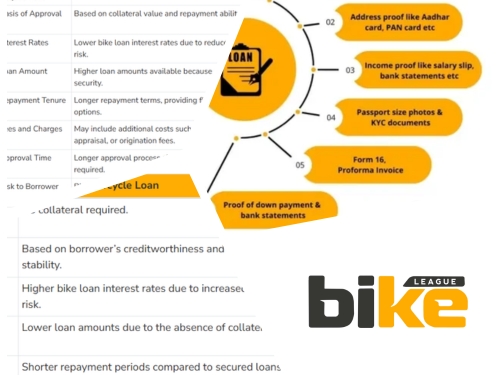
Most lenders in India ask for the same basic documents for a bike loan: KYC proof, income proof, and some simple application forms. The exact list might change a little depending on the bank or NBFC, but the main requirements are similar.
| Category | Salaried Employee | Self-Employed / Business Owner | Notes |
|---|---|---|---|
| Identity Proof | Aadhaar, PAN, Passport, or DL | Same as salaried | Any one valid ID |
| Address Proof | Aadhaar, utility bill, rental agreement | Same; business address may be added | Supporting proof of address |
| Age Proof (if asked) | Aadhaar, Passport, DL, Birth Certificate | Same | Many lenders skip separate “age proof” |
| Income Proof – Regular | Last 3 salary slips + Form 16 | 1–2 years ITR | Used to compute EMI eligibility |
| Income Proof – Bank Trail | 6 months’ bank statements | 6–12 months’ statements | Shows cash flow stability |
| Business Proof (if any) | Employment ID / company letter (optional) | GST certificate, trade license, MSME/Udyam | Higher loan amounts usually need this |
| Application Formalities | Loan form, photos, signature proof | Same | Common across all candidates |
| Vehicle-Side Documents | Dealer invoice, on-road breakup, insurance cover note | Same | Needed once bike is finalised |
Common Documents For Bike Loan
You’ll usually need these types of documents:
- KYC – Identity proof (any one): Aadhaar card, PAN card, passport, driving licence, voter ID, NREGA job card, or NPR letter.
- KYC – Address proof (any one): Aadhaar with address, passport, utility bills (electricity, water, landline, post‑paid mobile), rental agreement, or property‑tax receipt.
- Income proof (as per employment type)
1. Salaried employees:
Last 3 months’ salary slips, Form 16, and 6 months’ bank statements showing salary credits.
2. Self‑employed / business owners:
1–2 years’ ITR, 6–12 months’ bank statements, business registration/GST certificate, and other business‑proof documents. - Application‑related documents
1. Duly filled loan application form.
2. 2–3 recent passport‑size photographs.
3. Signature verification document (cheque leaf, bank‑signed sheet, etc.). - Vehicle‑related documents
1. A proforma invoice or quotation from the dealer with the on‑road price breakup.
2. Vehicle insurance cover note (often required at disbursement).
Things To Check And Know About Motorcycle Loans In India
| Loan Factor | What You Should Check | Why It Matters | Practical Borrower Tip |
|---|---|---|---|
| Eligibility | Age, citizenship, KYC details, address proof, and whether your income type matches the lender’s policy. | If you do not meet the lender’s basic criteria, your application may be rejected even before detailed verification. | Check age limits, minimum income, and accepted job or business categories before applying. |
| Interest Rate | Compare the annual interest rate across banks, NBFCs, dealer tie-ups, and fintech lenders. | Even a small difference in interest rate can significantly change your total repayment over the loan tenure. | Do not rely only on the dealer quote compare at least 2 to 3 lenders before finalising. |
| Down Payment | How much of the bike’s on-road price you can pay upfront. | A higher down payment reduces the loan amount, EMI burden, and total interest outgo. | If possible, target a 20 to 30% down payment instead of choosing zero-down or near-full finance. |
| Loan Tenure | Whether the repayment period is 12, 24, 36 months, or longer in special cases. | A longer tenure lowers monthly EMI but increases total interest paid over time. | Choose the shortest tenure you can comfortably afford without stressing your monthly budget. |
| Processing Fee | Percentage fee, minimum charge, GST, and whether any waiver offer is available. | A low interest rate can still become costly if the lender adds high upfront charges. | Always calculate the total loan cost, not just the advertised EMI or headline rate. |
| Prepayment Rules | Whether part-payment or foreclosure is allowed, and if any lock-in period or fee applies. | Flexible prepayment terms help you close the loan early and reduce total interest. | If you expect bonuses, seasonal income, or business surpluses, choose a lender with easier prepayment rules. |
| Approval and Disbursal Time | The estimated time from application to sanction and then to dealer payment. | Fast approval is useful if you need the bike urgently, but speed should not come at the cost of poor terms. | Ask separately about approval time and actual disbursal time they are not always the same. |
| CIBIL Score | Your latest credit score, repayment history, active loans, and recent hard inquiries. | A stronger score improves approval chances and may help you get lower interest rates. | Try to apply with a score above 700 and avoid multiple loan applications within a short period. |
| Insurance and Hypothecation | Whether comprehensive insurance is mandatory and how the financier’s hypothecation is recorded. | Insurance and hypothecation are part of most bike loans and can affect both paperwork and cost. | Confirm whether the insurance premium is included in the loan or must be paid separately. |
| Default Consequences | Late fees, bounce charges, credit score impact, and recovery process in case of missed EMIs. | Ignoring these terms can create long-term financial stress and damage your future borrowing ability. | Read the default clause carefully and keep a small emergency buffer for at least 3 to 6 EMIs. |
1. Check Eligibility Early
Most banks and NBFCs require:
- Age typically 21–60 years (some extend to 65–70 at the time of sanction).
- Indian nationality, valid ID (Aadhaar/PAN), and address proof.
- Stable income–proof: salary slips/Form‑16 for salaried; ITR, bank statements, Udyam/MSME, or platform‑payout statements for self‑employed, freelancers, and gig workers.
- For retirees, many lenders check if the loan tenure ends before the upper age limit and may prefer a co‑applicant or strong pension proof.
2. Always Compare Interest Rates
- Bike loan interest rates for two‑wheelers in India usually range from around 8–15% per annum, depending on the lender, applicant profile, and bike price.
- NBFCs and fintechs may offer slightly higher rates but more flexible eligibility criteria for self‑employed/freelancers, while banks often offer lower rates but stricter income and documentation requirements.
3. Think About The Loan Amount And Down Payment
- Most lenders finance up to 85–100% of the on‑road price, depending on profile and scheme.
- A higher down payment (20–30%) reduces your loan amount, EMI, and total interest paid.
4. Choose Tenure Wisely
- Typical two‑wheeler loan tenures are 12–36 months.
- A longer tenure lowers EMI but increases the total interest; a shorter tenure keeps costs lower but raises monthly pressure.
5. Factor In Fees And Charges
- Processing fees (often 1–3% of the loan amount), administrative charges, and prepayment/foreclosure penalties vary by lender.
- Some NBFCs and dealer tie‑ups offer waivers or discounts on processing fees or interest as part of launch offers.
6. Understand The Repayment Schedule
- EMIs are usually fixed monthly and debited automatically from your bank account linked to the loan.
- Know the EMI amount, due date, and late‑payment penalty before signing; missing EMIs can trigger bounce charges and CIBIL damage.
7. Prepayment And Foreclosure Rules
- Some lenders allow partial prepayment without penalty; others charge or restrict prepayment in the first 6–12 months.
- Full foreclosure (closing the loan early) may require a closure letter, NOC, and a small fee; check this before finalizing the lender.
8. Prepare Documents Thoroughly
Commonly asked documents:
- KYC: Aadhaar, PAN, address proof (utility bill, rent agreement, etc.).
- Income proof: salary slips/Form‑16 (salaried); ITR + bank statements (self‑employed); bank statements + platform‑payout statements (freelancers/gig workers).
- Other: 6–12 months’ bank statements, cancelled cheque, pro forma invoice for the bike, and passport‑size photos.
9. Expect Realistic Approval And Disbursal Time
- Many NBFCs and fintechs advertise “instant” or same‑day approval, but complete disbursal can take 1–3 working days after document verification and dealer coordination.
- Banks may take 3–5 working days or more, especially if additional verification or branch visits are needed.
10. Maintain A Healthy Credit Score
- A good CIBIL score (700+) significantly improves approval chances and can fetch better interest rates.
- Avoid multiple hard enquiries in a short time; spread out applications and first check eligibility using online calculators or pre‑qualification tools.
11. Insurance And Hypothecation Rules
- Most lenders require comprehensive insurance with the financier added as the hypothecation holder for the entire loan tenure.
- You must renew insurance on time; a lapse can trigger penalties or stricter loan monitoring.
12. Check For Offers And Tie‑ups
- Many dealers run special schemes with specific banks/NBFCs (lower interest rates, waived processing fees, or cashback) that are only visible at the showroom.
- Always ask the dealer + 1–2 other lenders directly so you’re not locked into a higher‑rate option just because of in‑house financing.
13. Know The Consequences Of Default
- Missed EMIs can reduce your CIBIL score, attract late‑payment fees, and lead to repeated recovery calls and SMS.
- Persistent default may result in legal action and recovery of the bike through the court or RTO process, especially if the lender is an NBFC/bank vs a dealer‑only finance plan.
14. Read The Loan Agreement Carefully
- Pay attention to interest compounding, penalty structure, insurance clauses, and prepayment terms embedded in the small print.
- If any clause is unclear, ask for a written explanation or summary before signing.
15. Consider Customer Support And Grievance Redressal
- Choose a lender with clear helpline numbers, app support, and a formal complaint process.
- If a genuine issue (disbursal delay, error, or wrong charges) is not resolved, you can escalate to the RBI Banking Ombudsman or the NBFC grievance channels with proper documentation.
16. If Your Motorcycle Loan Is Rejected
- Ask the lender for the exact reason (low income proof, weak CIBIL, high existing debt, or document mismatch).
- Improve your profile by clearing small dues, increasing down payment, reducing other EMIs, or adding a co‑applicant (spouse/parent), then wait 3–6 months before reapplying.
- If motorcycle‑specific loans keep getting rejected, consider NBFC‑focused two‑wheeler loans or, as a last‑resort alternative, a personal loan for the bike amount, keeping total EMIs under 40–50% of your monthly income.
How Bike Loans Affect Your Cibil Score In India
Your CIBIL score (ranging from 300 to 900) is a key factor that lenders look at when you apply for a bike loan. Generally, a score of 750 or higher helps you secure lower interest rates and smoother approval. Regular EMI payments on your bike loan can help build a positive credit history, but missed or delayed payments may negatively impact your score.
What Is A Cibil Score?
CIBIL generates your credit score based on information it receives each month from banks and financial institutions. A higher score (750-900) can get you interest rates as low as 8-12% and speed up your loan approval. Lower scores (below 650) may result in higher interest rates or loan rejection.
| CIBIL Factor | Weight | Bike Loan Impact | Score Change | Timeline |
|---|---|---|---|---|
| Payment History | 35% | On-time EMIs strengthen | +20-50 pts | (6-12 months) |
| Credit Utilization | 30% | EMI debt ratio spikes initially | -10-30 pts if >30% | Recover via payments |
| Credit Mix/Length | 15% | Adds secured installment loan | +10-20 pts | Long-term diversity |
| New Credit/Inquiries | 10% | Application hard inquiry | -3-5 pts | Gone in 12 months |
| Credit Age | 10% | Extends average account age | +5-15 pts | Gradual over tenure |
Positive Cibil Scenarios
- Make regular EMI payments for 24 to 48 months to mark your loan account as “Standard/Closed.” This improves your credit history and credit mix.
- Upgrading to a premium bike, such as a Royal Enfield, is easier with a strong repayment record.
- After closing your loan, your CIBIL score may increase by 50 to 100 points, making you eligible for better rates on future loans, such as a home loan.
Negative Cibil Scenarios
- If you delay payments by more than 30 days, your account could be marked as “SMA” (Special Mention Account), which may lower your score by 50 to 110 points for up to seven years.
- Settling a loan for less than the full balance can be marked as “Settled,” which might decrease your score by 75 to 175 points and make it harder to get loans in the future.
- Having multiple loans at once can also negatively impact your score.
Cibil Improvement Roadmap
- Check your free CIBIL report annually at cibil.com and quickly dispute any errors.
- Set up EMI autopay a few days early and consider prepaying 20% of your loan principal each year after any lock-in period.
- Limit your loan inquiries (space them at least 45 days apart) and, if helpful, maintain a mix of credit types.
- Aim for six months of on-time payments to target a score of 750 or more, which can open up offers like zero-cost financing from select lenders.
What Is The List Of All Possible Charges That Usually Come With A Motorcycle Loan In India?
Here’s a clean breakdown of motorcycle loan‑related charges with typical ranges. Please note that the values below are not accurate and may vary by bank.
| Charge Type | Typical Range or Structure | When It Applies | What Borrowers Should Watch |
|---|---|---|---|
| Interest Charge | Usually around 8 to 15% per annum for standard bike loans; higher for premium bikes or weaker profiles. | Throughout the entire loan tenure as part of your EMI. | Check whether the quoted rate is fixed, reducing-balance based, and whether the EMI fits your actual budget. |
| Processing Fee | Generally 1 to 5% of the loan amount, sometimes with a minimum fixed cap plus GST. | Usually deducted or collected at sanction or disbursal. | A low EMI offer may still be expensive if the processing fee is high. |
| Documentation or Admin Fee | Flat fee or about 0.5 to 2.25% depending on lender and scheme. | During application processing and verification stage. | Some lenders merge this with processing fees, while others list it separately. |
| Stamp Duty and Statutory Charges | Usually a small fixed amount or state-based slab on the loan agreement. | At the time of executing the loan agreement and related paperwork. | This may vary by state, so do not assume one lender’s charge matches another’s. |
| Part-Payment Charge | Often 1 to 5% of the part-payment amount plus GST, though some lenders allow limited free part-payment. | When you pay a portion of the principal before the scheduled tenure ends. | Check if there is a lock-in period during the first 6 to 12 months. |
| Foreclosure Charge | Generally 0 to 5% of outstanding principal, depending on lender and loan age. | When you close the loan completely before the original tenure ends. | Ask whether foreclosure becomes cheaper after 12 or 24 months. |
| Late Payment or Penal Interest | Often 12 to 18% per annum on overdue amount or a flat monthly penalty. | When an EMI is not paid by the due date. | Late fees can stack with bounce charges and can also affect your CIBIL score. |
| Bounce or Failed Debit Charge | Usually around 400 to 750 per failed cheque, ECS, or auto-debit transaction. | When your repayment instrument fails due to low balance or banking issues. | This is separate from late payment interest, so both charges may apply together. |
| Loan Rescheduling or EMI Revision Fee | Usually a flat amount plus GST if tenure or EMI is restructured. | When you request a change due to hardship or repayment difficulty. | Not all lenders allow easy restructuring on small two-wheeler loans. |
| Statement, NOC, or Closure Document Fee | Small flat charge for physical statements, amortisation schedules, duplicate documents, or certain service requests. | After sanction, during the loan period, or at closure. | Confirm whether the final NOC and closure letter are free or chargeable. |
| Legal, Recovery, or Repossession Charges | Usually charged at actuals and may vary significantly depending on recovery action. | In serious default cases where the lender initiates legal or recovery steps. | These costs can become substantial, so repeated defaults should never be taken lightly. |
1. Interest On The Loan
- Typical range: Around 8–15% per annum for regular two‑wheelers; premium‑bike or high‑risk profiles can go up to 18–20%+.
2. Processing Fee
- Typical range: 1–5% of the loan amount, often with a minimum cap (e.g., ₹1,000–₹5,000).
- Many banks charge 1.5–2.5% of the loan amount + GST.
- Some NBFCs/fintechs offer 0% processing fee on select schemes.
3. Documentation / Handling / Admin Charges
- Typical range: 0.5–2.25% of the loan amount or a flat fee of ₹500–₹1,500, depending on bank/NBFC.
- These are often bundled under “processing” or listed separately as “admin” or “handling fees”.
4. Stamp Duty And Statutory Charges
- Charged by the lender to cover mandatory stamp duty on the loan agreement and related paperwork.
- Usually, a small percentage of the loan amount or a fixed state‑wise slab (commonly ₹100–₹1,000+).
5. Prepayment / Part‑payment Charges
- Part‑payment (partial repayment): Often, 1–5% of the part‑payment amount + GST, or a certain percentage (e.g., 10–25%) is allowed free per year.
- Full foreclosure (closing the loan early): Typically, 0–5% of the outstanding amount, often lower if the loan is running for 12–24 months.
6. Late‑payment / Penal Interest
- Typical structure: 12–18% per annum on the overdue EMI amount, or a flat monthly fee (e.g., ₹300–₹600), whichever is higher.
- Repeated delays can hurt your CIBIL score and prompt stricter recovery measures.
7. Bounce / Failed‑debit Charges
- For cheque bounce or failed auto‑debit, most banks/NBFCs charge ₹400–₹750 per failed transaction.
- These are separate from penal interest on the overdue EMI.
8. Legal / Recovery / Repossession Charges (if Default)
- If the account is seriously overdue, lenders may pass on legal notice, repossession, and enforcement costs to you.
- These are usually “at actuals” and can run into thousands of rupees, depending on the case and region.
9. Rescheduling / Service‑related Fees
- Loan rescheduling (tenure or EMI change): Some lenders charge ₹500–₹1,000 + GST for restructuring due to hardship.
- Statement / amortisation‑schedule charges: A physical statement or detailed schedule may cost ₹50–₹500, depending on the bank.
What To Do If A Bike Loan Application Is Rejected?
If your bike loan application is rejected, focus first on understanding the exact reason, then fix gaps in your eligibility, and only later reapply or switch to an alternative finance option.
| Common Rejection Reason | What It Usually Means | How to Fix It | Best Next Step |
|---|---|---|---|
| Low CIBIL Score | The lender sees a higher repayment risk due to past delays, defaults, settlements, or weak credit behaviour. | Pay overdue amounts, reduce credit card utilisation, dispute incorrect report entries, and build 3 to 6 months of clean repayment history. | Reapply only after your score and report improve, or approach an NBFC with more flexible underwriting. |
| Insufficient Income Proof | Your salary slips, ITR, bank statements, or business proof are not strong enough for the requested EMI. | Submit clearer income documents, updated bank statements, ITRs, or platform payout proof if self-employed or freelance. | Consider a lower loan amount or add a co-applicant with stable income. |
| High Existing EMIs or Debt | Your debt-to-income ratio appears too high for the lender’s comfort. | Close smaller loans, reduce card balances, and avoid taking on new debt before reapplying. | Apply after freeing up monthly cash flow or lowering the requested bike loan amount. |
| Incomplete or Mismatched Documents | Your KYC, address, income details, signatures, or bank records do not match properly. | Correct name spelling, address differences, PAN-Aadhaar mismatch, and document date inconsistencies. | Prepare a clean, updated document set before applying again. |
| Very Low Down Payment | The lender may feel the requested finance amount is too high relative to your profile. | Increase your down payment so the financed amount and EMI become more manageable. | Rework the budget and target a 20 to 30% contribution if possible. |
| Job or Income Instability | Irregular salary credits, recent job change, unstable business cash flow, or inconsistent earnings may worry the lender. | Wait until income stabilises, maintain stronger bank trails, and present supporting documents clearly. | Try again after showing a few months of steady inflow. |
| Too Many Recent Loan Applications | Multiple hard enquiries suggest urgent or risky borrowing behaviour. | Pause fresh applications, compare lenders offline first, and avoid submitting many requests at once. | Wait for some time and then apply only to shortlisted lenders. |
| Lender Policy Mismatch | Your profile may not fit that lender’s internal policy even if your documents are acceptable elsewhere. | Shift to a lender better suited to your employment type, city, bike price, or credit band. | Compare banks, NBFCs, and fintech lenders instead of relying on one rejection. |
| Bike Category or Dealer Issue | The lender may not finance that dealer, model, invoice type, or used-bike structure in the requested format. | Confirm dealer empanelment, invoice format, and whether the lender supports that vehicle category. | Ask the dealer to switch financier or choose another lender. |
1. Find Out Why It Was Rejected
- Ask the lender for a clear written reason (low CIBIL score, insufficient income proof, incomplete documents, high existing debt, etc.).
- If the dealer applied for you, request the loan‑rejection letter/feedback from the financier and check whether it mentions a specific score band, income gap, or document mismatch.
2. Improve Your Eligibility Before Reapplying
Re‑apply only after you’ve addressed the root cause; typically, wait 3–6 months to show improvement.
Fix Your Credit Profile
- Pull your free CIBIL/credit report (via major banks or CIBIL site) and dispute any errors (wrong late payments, extra loans, etc.).
- Pay all outstanding amounts on time, keep credit‑card utilisation below 30%, and avoid multiple hard enquiries within a short period.
Adjust Income And Debt
- Reduce existing EMIs (clear smaller loans, pay credit‑card dues, negotiate settlements) to lower your debt‑to‑income (DTI) ratio.
- If your income is tight, consider including a working co‑applicant (spouse/parent) with stable income and better credit.
Documentation And Loan Structure
- Ensure all KYC, income proofs, and bank statements are updated, error‑free, and match.
- Offer a larger down payment (e.g., 20–30% instead of 10%) to reduce the loan amount and monthly EMI.
3. Best Time And Way To Reapply
- Wait at least 3–6 months, then reapply after you’ve improved your CIBIL, cleared some debts, and possibly added a co‑applicant.
- Compare institutions (banks, NBFCs, and fintechs) and apply to the one that best matches your profile, rather than spamming multiple apps.
4. Alternative Financing Options
If a bike‑specific loan isn’t working, consider:
Nbfc Or Fintech Two‑wheeler Loans
- NBFCs like Shriram and Bajaj Finance often accept lower credit scores or more flexible income proofs than banks, though interest rates may be higher.
- Tenure is usually 12–36 months, with financing up to up to 100% of the on‑road price in some cases.
Personal Loan For A Bike
- If your bike is already invoiced and the dealer can’t change the financier, you can take a personal loan (at a higher rate than a bike loan) to clear the dealer or the earlier rejected financier.
- Ensure the total EMI (including other loans and this personal loan) stays within 40–50% of your monthly income.
Dealer Or Family‑based Options
- Ask the dealer if they can switch the financier (e.g., from a bank to an NBFC) or offer in-house EMI/extended payment terms on the invoice.
- If comfortable, a loan from a family member can be used, with a clear written agreement and repayment plan.
5. Quick Checklist Before Re‑applying
- CIBIL above 680–700 (ideally).
- Existing EMIs plus proposed bike‑loan EMI ≤ ~40–50% of monthly income.
- All documents are correct, latest, and consistent (PAN, Aadhaar, bank statements, salary slips).
- At least one backup institution (an NBFC or a fintech) is identified in advance.
What Are The Top Mistakes To Avoid When Taking A Bike Loan?
| Mistake | What Can Go Wrong | Smarter Approach | Why It Works Better |
|---|---|---|---|
| Not checking your credit score first | You may apply blindly and end up with rejection, stricter terms, or a higher interest rate. | Check your credit profile before applying and clear small dues if needed. | A stronger score improves both approval chances and bargaining power. |
| Accepting the first lender offer | You may pay more in interest, processing fees, or hidden charges than necessary. | Compare at least 2 to 3 lenders, including one bank and one NBFC. | Comparison helps you identify the best total cost, not just the fastest approval. |
| Borrowing more than you can comfortably repay | A high EMI can strain your monthly budget and create stress if income fluctuates. | Keep your bike EMI within a manageable share of take-home income. | This reduces the risk of missed payments and future credit damage. |
| Focusing only on EMI | A lower EMI may hide a longer tenure, higher total interest, or extra fees. | Compare total repayment, processing fee, and foreclosure terms along with EMI. | You see the real cost of the loan instead of just the monthly outflow. |
| Ignoring the loan agreement fine print | You may discover penalties, lock-in rules, or service charges only after signing. | Read the agreement carefully and ask for written clarification if needed. | This prevents surprises later during repayment or foreclosure. |
| Depending only on dealer finance | Showroom-linked finance may be convenient but not always the cheapest option. | Get outside quotes from banks or NBFCs before finalising the dealer loan. | It gives you negotiation leverage and often better pricing. |
| Applying in a rush with poor paperwork | Errors in KYC or income proof can delay approval or lead to rejection. | Spend time preparing accurate and updated documents before submission. | A clean application improves speed and reduces underwriting friction. |
| Choosing zero or very low down payment | The financed amount rises, total interest increases, and EMI pressure becomes higher. | Make a healthier upfront contribution if your budget allows. | You reduce both loan burden and long-term interest cost. |
| Submitting too many applications together | Multiple hard enquiries can temporarily weaken your credit profile. | Shortlist lenders first and apply only where your profile is a strong fit. | It protects your score and makes your application strategy more efficient. |
| Not planning for EMI shocks | Unexpected events like salary delay, job loss, or medical expenses can derail your repayment plan. | Keep a small emergency fund and avoid stretching EMI to the limit. | Financial buffer gives you time to manage short-term setbacks without defaulting. |
1. Not Checking Your Credit Score First.
Many applicants apply without knowing their CIBIL score, which can lead to higher interest rates, stricter terms, or outright rejection.
Fix:Check your credit report, pay off small balances, and improve your score (aim for 700+) before applying.
2. Skipping Proper Lender Comparison
Taking the first offer at the dealer desk often means paying more; rates and fees can vary significantly between banks, NBFCs, and fintechs.
Fix: Compare at least 2–3 loan options (e.g., 1 bank + 1 NBFC + 1 digital lender) on interest, processing fees, and prepayment terms.
3. Borrowing More Than You Can Afford
Accepting the maximum loan amount approved can push EMI uncomfortably close to your income, leaving little for other expenses.
Fix: Keep bike EMI at no more than 30–40% of your monthly take‑home, especially if you already have other EMIs.
4. Ignoring The Total Cost (only Focusing On Emi)
Many buyers look only at the monthly EMI and forget the total interest, processing fees, and other charges over the tenure.
Fix: Use an EMI calculator and add up all fees + interest to see the real cost, not just the monthly number.
5. Not Reading The Loan Agreement Carefully
The “fine print” hides prepayment/foreclosure charges, late‑payment penalties, bounce fees, and documentation costs.
Fix: Before signing, ensure you understand prepayment rules, penalties, and how all charges add up.
6. Over‑relying On Dealer‑only Financing
Some dealers push you into their in‑house financier or a tied‑up NBFC without explaining better options elsewhere.
Fix: Ask the dealer for written quotes from at least one external bank/NBFC and compare with your own online research.
7. Rushing The Application
Festival‑season or “instant‑approval” hype leads people to apply in a hurry, often with incomplete documents or mismatched details.
Fix: Take 1–2 days to gather accurate KYC, income proof, and bank statements, and double‑check spelling and dates.
8. Zero Or Very Low Down Payment
Opting for 100% or near‑100% financing increases total interest costs, increases EMIs, and may attract higher processing fees or stricter scrutiny.
Fix: Aim for a 20–30% down payment if possible to reduce the loan amount and EMI burden.
9. Applying Multiple Times In A Short Period
Sending applications to too many lenders at once can trigger multiple hard inquiries, which may temporarily lower your CIBIL score.
Fix: Do your research first, then apply to 1–2 shortlisted lenders with the best match for your profile.
10. Not Planning For Emi Shocks
Many borrowers don’t budget for job loss, salary cuts, or medical emergencies, which can make EMI payments an immediate source of stress.
Fix: Ensure you have 3–6 months of EMIs in a contingency buffer and consider a shorter tenure if EMI is manageable.
What Are The Strategies For Bargaining Interest Rates, Processing Fees, Or Getting Better Schemes For Motorcycle Loan?
Here’s a practical, India‑focused guide to bargaining interest rates, processing fees, and getting better bike‑loan schemes that you can drop into your article.
| Negotiation Strategy | What You Can Ask For | Why Lenders May Agree | Best Use Case |
|---|---|---|---|
| Use a strong CIBIL score | Lower interest rate, easier approval, or better scheme terms. | A good credit profile signals lower repayment risk to the lender. | Best for applicants with a score above 700 to 750 and stable repayment history. |
| Show stable income and low debt | Rate reduction, smoother approval, or lower documentation pressure. | Strong income proof and manageable EMIs improve your borrower quality. | Useful for salaried employees, professionals, and self-employed applicants with clean bank trails. |
| Compare multiple lender offers | Rate match, fee reduction, or waiver of certain charges. | Competing quotes create pressure to retain your application. | When you already have 1 to 2 written or verbal quotes from other lenders. |
| Offer a higher down payment | Slightly lower rate, easier sanction, or better processing fee treatment. | A lower financed amount reduces the lender’s exposure and risk. | Useful when you can put down 20 to 40% of the bike’s on-road price. |
| Choose a shorter tenure | Lower rate or better total cost structure. | Shorter tenure means quicker recovery of funds and lower long-term risk. | Best when your monthly income can comfortably support a slightly higher EMI. |
| Ask for processing fee waiver | Partial waiver, full waiver, or discounted fee slab. | Processing fees are often more flexible than interest rates in promotional or competitive situations. | Useful during festive campaigns, stock-clearance periods, or relationship-banking offers. |
| Use existing relationship with bank or NBFC | Relationship pricing, faster approval, lower fees, or smoother documentation. | Existing customers are often cheaper to onboard and lower-risk to service. | Works well if you already have salary account, FD, card, or past loan history with the lender. |
| Apply during festive or special offer period | Lower interest, zero processing fee, cashback, or bundled benefits. | Lenders and dealers push volumes during promotional windows. | Ideal around festival season, financial year-end, or showroom campaign periods. |
| Negotiate prepayment and foreclosure terms | Reduced lock-in, lower part-payment fee, or zero foreclosure after a certain period. | This is often easier to relax than the headline interest rate. | Best for borrowers who expect to close the loan early with bonus income or savings. |
| Use a pre-approved offer as leverage | Rate or fee improvement from another lender. | A real competing approval gives credibility to your negotiation. | Helpful when a bank, NBFC, or fintech has already shared a pre-approved or pre-qualified offer. |
1. Build A Strong Negotiation Profile
- Aim for a CIBIL score above 700–750; this is the biggest leverage for lower interest and better terms.
- Show stable income (salary slips, ITR, bank statements) and minimal existing debt so the lender sees you as low‑risk.
2. Compare Multiple Lenders Upfront
- Check 2–3 options: 1 bank, 1 NBFC, and 1 fintech or dealer‑tie‑up, and note their headline rate + processing fee + prepayment charges.
- Use this comparison as leverage: “Bank/NBFC‑X is offering XX% with Y% fee; can you match or beat it?”
3. Negotiate The Interest Rate Directly
You can often negotiate 0.25–1% off the published rate if you have a good profile.
Typical levers:
- A higher down payment (30–40% of the bike’s value) reduces your loan amount and risk, making lenders more willing to cut interest rates.
- A shorter tenure (12–24 months) can justify a slightly lower rate, as overall risk is compressed.
4. Push To Reduce Or Waive Processing Fees
- Typical processing fees range from 1–3% of the loan amount + GST, and some lenders offer reduced or waived fees during festivals, promotions, or for existing customers.
- Tactics:
* Ask outright: “Can you reduce or waive the processing fee because I’m a long‑term customer / because I’m paying 30%+ down payment?”
* Use competing offers: “NBFC‑Y is offering 0% processing fee on this scheme; can you match it?”
5. Time Your Application To Festive Or Promo Seasons
- Banks and NBFCs often run festival/seasonal offers (Diwali, year‑end, new‑year, stock‑clearance) with lower interest, 0% processing fee, or free documentation.
- Check websites or dealer boards for limited‑time bike‑loan schemes before locking in a rate.
6. Leverage Existing Relationships With The Bank/nbfc
- If you already have a savings account, FD, credit card, or prior loan with the lender, highlight this and ask for relationship‑based pricing.
- Many banks offer a 0.25–0.5% discount or a lower processing fee for existing customers.
7. Choose Scheme Features That Indirectly Lower Cost
You can’t always get a lower interest, but you can structure the loan smarter:
- Pick a shorter tenure if EMIs are affordable; you pay less total interest even if the rate stays the same.
- Avoid unnecessary add‑ons (extra insurance riders, gold‑loan‑tying schemes) that increase total cost.
8. Negotiate On Prepayment And Foreclosure Terms
- Ask if they can reduce or waive prepayment charges, especially for the first 6–12 months.
- If one lender offers 0% foreclosure after 12 months and another charges 3–4%, that’s often a bigger saving than fighting for 0.25% on interest.
9. Avoid “dealer‑only” Or In‑house Finance Without Comparison
- In‑house dealers or NBFCs may push higher‑fee or high‑rate schemes because they earn a commission.
- Always:
* Ask for written quotes from external banks/NBFCs, and
* Compare the total cost (interest + fees + tenor) before signing.
10. Use Pre‑approved Or Direct‑bank Offers As Leverage
- If you have a pre‑approved two‑wheeler loan or an existing loan with an NBFC, that offer can be used as a baseline for negotiation elsewhere.
- Example: “I already have a pre‑approved offer at X% with Y% fee from NBFC‑Z; can you beat that?”
Myths & Misconceptions About Motorcycle Loans In India
Myth 1: Bike Loans Are Only For Salaried People With High Incomes
It’s a common belief that only salaried employees with large paychecks can get a two-wheeler loan. In reality, most banks and NBFCs also offer loans to self-employed individuals, small-business owners, and freelancers or gig workers, as long as they have steady income proof, such as ITRs or bank statements. Eligibility is based on factors like age, minimum monthly income, and repayment capacity—not just whether you have a corporate job.
Myth 2: There’s Too Much Paperwork, And The Process Is Painful
Some people still imagine a mountain of forms and endless visits to the bank. Today, most lenders only require basic KYC documents such as PAN, Aadhaar/address proof, income proof, and the bike’s invoice or proforma invoice. Thanks to digital processes, many banks and NBFCs now offer fast approvals and minimal documentation, especially for repeat customers.
Myth 3: Tw-‑wheeler Loan Interest Rates Are Always Very High
It’s true that rates were higher in the past, but now, with competition, many lenders offer rates between 7% and 15% per annum, depending on your credit profile and the type of bike. Premium models or riskier applicants may face higher rates, but for most, EMIs are designed to fit typical Indian budgets over 12–36 months.
Myth 4: A High Credit Score Guarantees Approval
A strong CIBIL score certainly helps, but it doesn’t guarantee a loan. Lenders also consider your income stability, existing EMIs, employment type or business, and the completeness of your documentation. Even with a good score, high debt-to-income ratios or irregular income can lead to stricter terms or rejection.
Myth 5: Zero Down Payment Means The Bike Is Cheaper Or ‘free’ Upfront
Zero-down-payment schemes can seem tempting, but financing 100% of your bike’s cost often means higher total interest, possibly higher rates, and longer tenures. While these schemes look attractive, you typically end up paying more over the life of the loan compared to making a 20–30% down payment.
Myth 6: Dealer’s I-‑house Finance Is Always The Best Deal
Showroom tie-up financiers are convenient, but not always the cheapest or only option. Dealer-‑route loans can include higher rates or stricter fees, because dealers may earn incentives from the financier. It’s smart to compare at least one independent bank or NBFC quote before signing anything.
Myth 7: Womenor/ Certain Groups Can’t Easily Get Tw-‑wheeler Loans
Some people assume that lenders don’t finance certain groups, often based on anecdotal experiences. In fact, most banks and NBFCs focus on age, income, credit score, and residence—not gender or background. Many lenders even have special schemes for women and first-time riders.
Myth 8: Longer Tenure Is Always Better Because Emi Is Low
A lower EMI may look appealing, but a longer tenure increases the total interest paid. Shorter tenures, if affordable, are generally more cost-effective—even if each EMI is a bit higher. Stretching the loan term to the maximum should be a last resort for those with tight cash flows.
Myth 9: Taking Any Loan Automatically Improves My Credit Score
Simply taking a loan doesn’t build your credit. Only regular, on-time EMI payments help your score. Late payments, bounces, or defaults will hurt your credit and make future loans more difficult or expensive.
Myth 10: A Tw-‑wheeler Loan And A Personal Loan Are Basically The Same
Some believe it doesn’t matter whether you choose a bike loan or a personal loan foryoure purchase. In practice, two-wheeler loans are usually secured by the bike and have lower interest rates, while personal loans are unsecured and tend to be costlier. If your goal is to buy a bike, a dedicated tw-‑wheeler loan is usually the more affordable and structured choice.
Faq About Motorcycle Loans In India
1. Who Is Eligible For A Motorcycle Loan In India?
Most banks and NBFCs require applicants to be Indian citizens aged 21–60 (sometimes up to 65–70), with stable income and valid KYC documents.
2. What Documents Are Needed To Apply For A Bike Loan?
Common documents include KYC proofs (Aadhaar, PAN, passport), address proof, income proof (salary slips, ITR, bank statements), photographs, and the vehicle invoice.
3. What Is The Typical Interest Rate For A Two-wheeler Loan?
Interest rates generally range from 8–15% per annum, depending on the lender, applicant profile, and loan scheme.
4. How Much Down Payment Is Required?
Most lenders finance 85–100% of the on-road price. A higher down payment (20–30%) can reduce EMIs and total interest.
5. Can I Prepay Or Foreclose My Bike Loan?
Many lenders allow partial prepayment or foreclosure, though some may impose charges or restrictions, especially in the first 6–12 months.
6. How Does My Cibil Score Affect Bike Loan Approval?
A CIBIL score above 700 improves approval chances and may fetch better interest rates. Lower scores may lead to stricter terms or rejection.
7. What Happens If I Miss An Emi Payment?
Missing EMIs can result in late fees, a reduction in CIBIL score, and, in persistent cases, legal action or vehicle repossession.
8. How Long Does It Take To Get A Two-wheeler Loan Approved And Disbursed?
NBFCs and fintechs may approve loans within a day, while banks typically take 3–5 working days, depending on the level of document verification.
9. Is Insurance Mandatory For A Bike Loan?
Yes, most lenders require comprehensive insurance with the financier as the hypothecation holder for the loan tenure.
10. Is It Better To Take A Dealer-provided Loan Or Approach Banks/nbfcs Directly?
Dealer-tied loans are convenient but may not always offer the best rates. It’s wise to compare offers from banks, NBFCs, and digital lenders before finalizing.
Other Related Articles From Bikeleague India
- Bike Loan EMI calculator
- Unlocking the secrets: Factors that impact bike loan interest rate
- Two Wheeler Road Tax in India: A Detailed Explanation
- Must have bike documents for travel in India
- Motorcycle RC book in India: Exploring Book vs Digital
Conclusion
To sum up, getting a bike loan in India is much easier when you’re prepared. Compare lenders, keep your credit score strong, collect the needed documents, and read all the terms carefully. This way, you can finance your dream bike with less hassle and lower costs.
Be proactive with your research, watch out for common mistakes, and feel free to ask for better terms. With these tips, you’ll be ready to get the best bike loan and enjoy your new ride worry-free.
If you have any questions or need help, email us at bikeleague2017@gmail.com or leave a comment below. We’re always happy to assist you.