
Long story short: Learn how motorcycle sprockets and gear ratios affect acceleration, top speed, mileage, and comfort, plus maintenance tips for Indian roads.
Whether you ride every day, enjoy adventures, or just go out on weekends, it’s important to understand basic motorcycle maintenance and performance. Sprockets and gear ratios play a big role in how your bike handles.
This article is a complete guide to motorcycle sprockets. You’ll learn what they do, how they work, how different setups affect acceleration, fuel economy, and comfort, and get maintenance tips for Indian roads. Whether you’re a beginner or want to improve your bike’s performance, you’ll find helpful information here.
Key Takeaways
- The front and rear sprocket tooth counts directly determine your motorcycle’s gear ratio, influencing acceleration, top speed, and fuel efficiency.
- Higher gear ratios (more rear teeth or fewer front teeth) deliver stronger acceleration but increase engine RPM and fuel use at cruising speeds, while lower ratios provide smoother highway rides and better mileage.
- Routine inspection and maintenance are critical: always replace both sprockets and the chain together, and adjust cleaning/lubrication frequency for India’s diverse riding conditions (dust, rain, heavy loads).
- Even a small sprocket change (±1–2 teeth) can noticeably affect your bike’s performance, maintenance needs, and overall riding comfort.
- Avoid common mistakes such as mismatched chain/sprocket sizes, overtightening, skipping lubrication, or replacing only one part—these can lead to rapid wear, noise, and safety issues.
What Is A Motorcycle Sprocket?
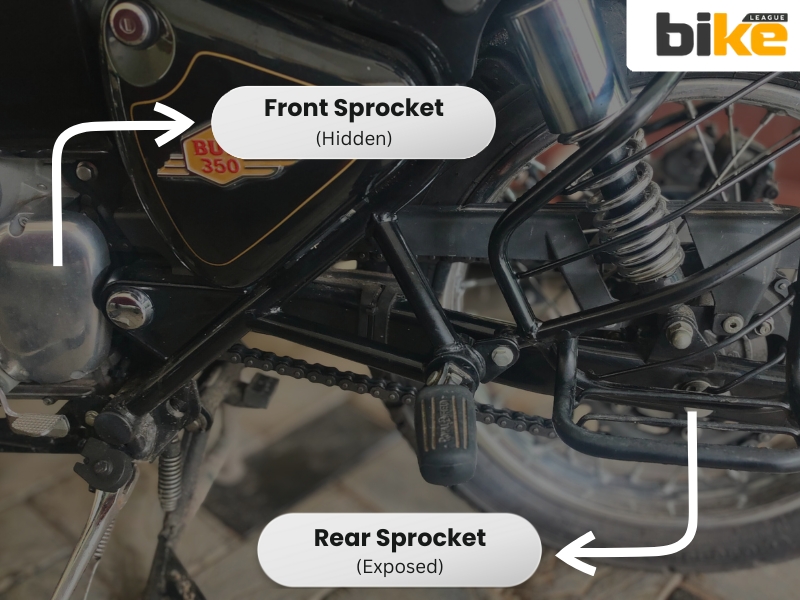
A motorcycle sprocket is a toothed wheel that connects with the drive chain or belt to send engine power to the rear wheel. Most chain-driven motorcycles have two sprockets:
1. Front (drive) Sprocket
The front sprocket is attached to the transmission’s output shaft. When the engine turns this shaft, it spins the front sprocket, which then moves the chain.
2. Rear (driven) Sprocket
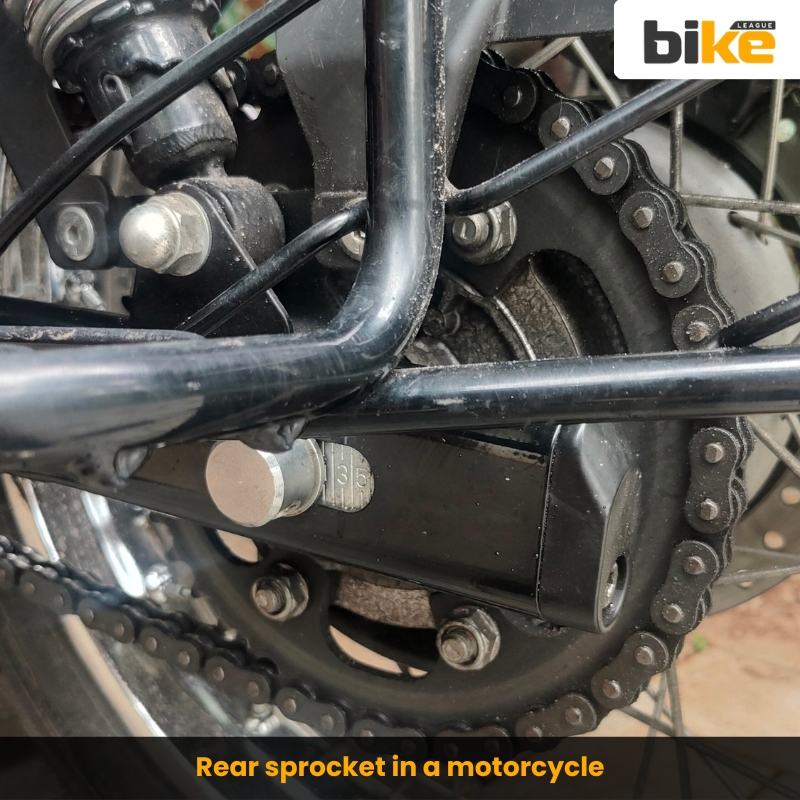
The rear sprocket is fixed to the rear wheel hub. The chain moves between the front and rear sprockets, turning the rear wheel and moving the bike forward.
What Is Motorcycle Gear (final‑drive) Ratio?
Your motorcycle’s final-drive gear ratio shows how many times the engine turns for each rear-wheel revolution. This is set by the sprockets:
Gear Ratio = Front Sprocket Teeth / Rear Sprocket Teeth
1. Numerically Higher Ratio (e.g., 48 ÷ 15 = 3.20 : 1)
With this setup, the engine turns 3.20 times for every wheel revolution. This gives stronger low-end power and faster acceleration, but also means higher RPM and more fuel use at cruising speeds.
2. Numerically Lower Ratio (e.g., 40 ÷ 16 = 2.50 : 1)
Here, the engine turns 2.50 times for each wheel revolution. This lowers RPM at cruising speeds, which improves fuel economy on highways, but reduces quick acceleration and can make the engine struggle at low speeds.
What Is The Difference Between Motorcycle Gear Ratio, Transmission Ratio And Final Drive Ratio?
1. Transmission Ratio
- What it is: The ratio between the speed of the engine’s input shaft and the gearbox’s output shaft for a given gear.
- How it’s expressed: Typically as “Engine : Output” (e.g. 2.40 : 1 in 1st gear).
- Role: Determines how many times the engine must turn to spin the gearbox output. Short ratios (high numbers) give a strong launch; tall ratios (numbers greater than 1) enable overdrive cruising.
2. Final‑drive Ratio
- What it is: The ratio set by the front and rear sprockets (or belt/pulley) that connects the gearbox output to the rear wheel.
- How it’s expressed: “Rear‑teeth ÷ Front‑teeth” (e.g. 45 ÷ 15 = 3.00 : 1).
- Role: Multiplies the gearbox output turns into wheel turns—more rear teeth or fewer front teeth raises the ratio (better acceleration), fewer rear or more front teeth lowers it (taller gearing for top speed).
3. Overall (drive) Gear Ratio
- What it is: The product of the transmission ratio and the final‑drive ratio in a particular gear.
- How it’s expressed: Overall Ratio=(Transmission Ratio in Gear N)×(Final‑Drive Ratio)
- Role: Tells you how many engine revolutions produce one rear‑wheel revolution in that gear, combining gearbox spread and sprocket choice into a single performance characteristic.
How Are Motorcycle Sprocket Teeth & Gear Ratio Interconnected?
The number of teeth on the front and rear sprockets sets the overall gear ratio:
Gear Ratio = Front Sprocket Teeth/ Rear Sprocket Teeth
1. Higher Ratio (more Rear Teeth Or Fewer Front Teeth)
- Pros: Better acceleration, stronger low-end pull
- Cons: Lower top speed, higher engine RPM at cruising speeds
2. Lower Ratio (fewer Rear Teeth Or More Front Teeth)
- Pros: Higher top speed, lower cruising RPM
- Cons: Slower acceleration, reduced engine braking
Common Front & Rear Sprocket Tooth Counts In Some Popular Indian Motorcycles
Here are some examples of stock sprocket setups on popular bikes in India. These can help you understand common gearing choices and ratios:
| Motorcycle Model | Segment | Front Sprocket Teeth | Rear Sprocket Teeth | Gear Ratio |
|---|---|---|---|---|
| Royal Enfield Himalayan | Adventure | 18 | 44 | 2.44:1 |
| Royal Enfield Classic 350 | Cruiser (Heritage) | 17 | 45 | 2.65 : 1 |
| Bajaj Pulsar NS200 | Sport Naked | 15 | 42 | 2.80 : 1 |
| Yamaha R15 V4 | Sportbike | 15 | 42 | 2.80 : 1 |
| Hero Splendor Plus | Commuter | 14 | 40 | 2.86 : 1 |
| Bajaj Pulsar 150 | Sport Commuter | 14 | 41 | 2.93 : 1 |
| TVS Apache RTR 160 | Sport Commuter | 15 | 45 | 3.00 : 1 |
| KTM Duke 200 | Sport Naked | 14 | 42 | 3.00 : 1 |
| Honda CB350 | Cruiser (Retro) | 15 | 46 | 3.07 : 1 |
| Kawasaki Ninja 300 | Sportbike (Entry) | 15 | 47 | 3.13 : 1 |
Adventure bikes (2.44 : 1)
The Royal Enfield Himalayan has the lowest gear ratio (2.44:1), which is great for city riding, rock-crawling, and technical off-road use. This taller gearing lowers chain tension, makes low-speed riding smoother, and helps reduce rider fatigue on rough roads.
Cruiser Bikes (2.65 : 1 → 3.07 : 1)
The Royal Enfield Classic 350 (2.65:1) is designed for relaxed highway cruising at lower RPMs, fitting its retro-cruiser style. The Honda CB350 (3.07:1) has a higher ratio, giving it quicker acceleration but a bit less calm at high speeds, which suits its mini-cruiser feel.
Commuter Bikes (2.80 : 1 → 2.93 : 1)
Popular commuter bikes like the Hero Splendor Plus (2.86:1) and Bajaj Pulsar 150 (2.93:1) offer a balance between city performance and highway comfort. The Bajaj Pulsar NS200 and Yamaha R15 V4, both with a 2.80:1 ratio, are a bit more focused on quick acceleration in city traffic.
Sports Bikes (3.00 : 1 → 3.13 : 1)
The TVS Apache RTR 160 and KTM Duke 200 both use a 3.00:1 ratio, which gives strong low-end power for sporty street riding. The Kawasaki Ninja 300 has a 3.13:1 ratio, offering even faster acceleration and quicker throttle response, which is great for track riding but results in higher RPM at cruising speeds.
How To Choose The Correct Motorcycle Sprocket Setup?
The way you set up your motorcycle’s sprockets changes how the bike behaves and suits different riding styles. Here’s how it varies by type:
- Off‑Roaders & Adventure Riders should lean toward lower numerical ratios (like the Himalayan) for torque and control.
- Cruiser & Touring riders benefit from ratios under ~2.7 : 1 to keep RPMs—and rider fatigue—down on long straights.
- Daily Commuters generally do well around 2.8–2.9 : 1, balancing punch and economy.
- Sporty Street / Track Use thrives at or above 3.0 : 1 for instant throttle response, at the cost of higher engine speed on the highway.
How To Calculate And Compare Gear Ratios For A Motorcycle Using The Sprocket?
1. Calculate Stock Ratio
Divide the rear teeth by the front teeth.
2. Desired Change
For more acceleration, subtract 1–2 teeth from the front or add 2–3 teeth to the rear.
For a higher top speed, add teeth to the front or remove teeth from the rear.
3. Compare Rpm Shifts
After changing sprockets, note your cruising RPM at a given speed—this indicates how much the ratio shifted.
When Should You Replace Sprockets In A Motorcycle?
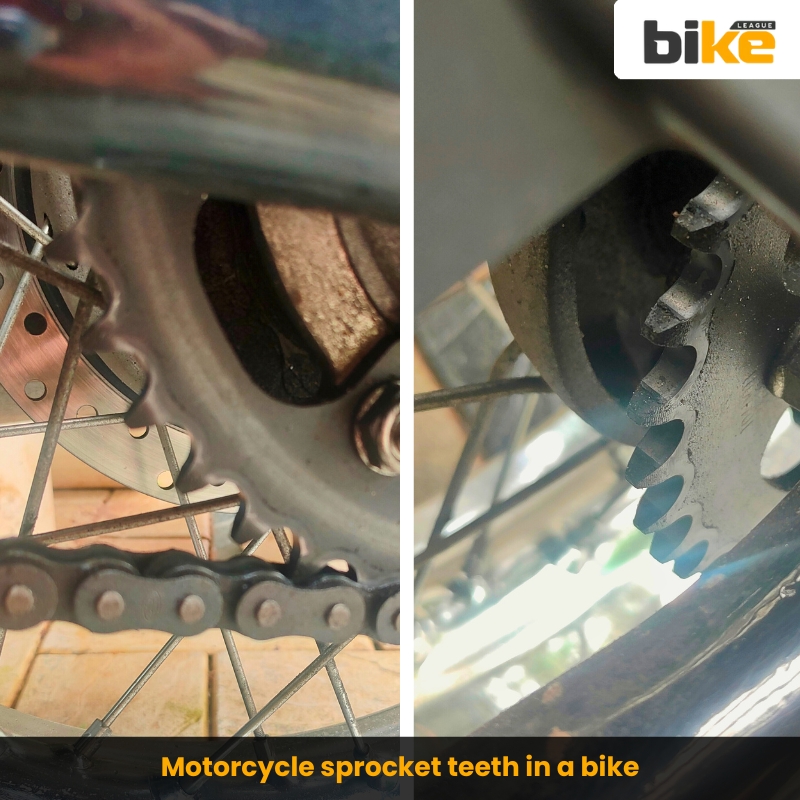
- Hooked (“Shark-Fin”) Teeth: New sprocket teeth are triangular; worn ones become curved or hooked, causing chain slippage under load.
- Uneven or Pointed Teeth: Longer or sharper teeth indicate uneven wear, accelerating chain damage.
- Excessive Chain Slack: If the chain still feels loose after adjusting to the tightest recommended slack, both the chain and sprockets are likely worn.
- Scoring, Pitting, or Rust: Deep grooves or corrosion on teeth can catch the chain, potentially leading to sudden failure.
- Noisy or Rough Engagement: A smooth, quiet sprocket-chain interface is ideal. Grinding or clunking sounds indicate a problem with the tooth profile.
Tip: Replace the chain and both sprockets together to ensure even wear and optimal life.
How Motorcycle Gear‑ratio Changes Affect Fuel Efficiency?
Your bike’s overall gear ratio is found by dividing the number of rear sprocket teeth by the number of front sprocket teeth. Changing this ratio will change your engine’s RPM at any speed:
1. Numerically Higher Ratio (smaller Front Or Larger Rear Sprocket):
- Increases RPM for the same speed
- Stronger acceleration and low‑end pull
- Higher fuel consumption at cruising speeds, since the engine works harder
2. Numerically Lower Ratio (larger Front Or Smaller Rear Sprocket):
- Lowers RPM at cruising speeds
- Potential fuel savings on highways, as the engine runs more relaxed
- But if too low, the engine may lug below its optimal power band, which can increase fuel use and stress components
Tip: A modest change of ±1–2 teeth typically optimises performance without significantly impacting economy; larger adjustments risk moving the engine out of its most efficient RPM range.
How Do Sprocket Changes Affect Everyday Riding, Maintenance Costs, Or Performance On Different Terrains?
Even a small change in sprocket size, like one tooth, can make a big difference in acceleration, comfort, fuel use, and maintenance. In India’s varied riding conditions, these changes also affect how often you need to adjust or replace the chain and sprockets. Here are three examples—a commuter, an adventure-tourer, and a sporty bike—to show how sprocket changes affect ride feel, fuel economy, and maintenance.
1. Commuter Rider On A 125–150 Cc Bike (city & Highway)
Example: Pulsar 125 rider in Bangalore / Tier‑2 city
A Bangalore‑based college student runs a BS6 Pulsar 125 with stock 14/44 (≈3.14:1). He feels the bike lacks low‑end torque and needs to rev hard just to keep up with traffic.
He changes to 13‑tooth front (13/44 ≈3.38:1):
- Acceleration in city traffic improves noticeably; the bike feels more responsive at 1,500–4,000 rpm.
- Top speed in each gear drops by about 4–5 km/h, but he doesn’t care much since he rarely exceeds 80 km/h.
- Highway mileage on the 100‑km route to a nearby town falls by roughly 5–8%, because cruising RPM at 70–80 km/h is higher.
Maintenance Cost Angle
- The front sprocket itself is cheap (a few hundred rupees), but he notices the chain wears faster because the load per tooth is higher.
- He ends up replacing the chain a few thousand kilometres earlier than he would on stock gearing.
2. Adventure / Tourer On A Royal Enfield Or Himalayan
Example: Adventure rider on a Royal Enfield Himalayan (Kerala / Western Ghat roads)
A rider on a Royal Enfield Himalayan (stock ~18/44 → 2.44:1) mostly uses the bike for touring highways and gentle trails. He feels the bike is relaxed at 80–90 km/h but a bit sluggish on steep mountain gradients.
For technical trails in areas like Wayanad or Munnar, switching to a 17/46 setup (≈2.71:1) can help:
- Off‑road, the bike feels more controllable at low speeds; it pulls better out of hairpin turns without dropping below idle.
- On highways, the same RPM now translates to a lower speed, so he has to upshift more often and feels a slight drop in relaxed cruising character.
Maintenance Cost Angle
- On rough, water‑splashed roads, the higher torque demand and more frequent clutch use increase chain and sprocket wear; he starts checking slack every 1,000–1,500 km instead of 3,000 km.
- He replaces the chain + both sprockets together once they show the first signs of “shark‑fin” teeth, avoiding the cost of an emergency breakdown mid‑trip.
3. Performance‑oriented Rider On A 200–300 Cc Sporty Bike
Example: Sporty rider on a Yamaha R15 / KTM Duke 200
A rider on a Yamaha R15 V4 (15/42 → 2.80:1) likes quick roll‑on in city traffic but feels the bike is a bit “rev‑happy” on highways.
He experiments with a 16‑tooth front (16/42 ≈2.63:1) for a slightly taller ratio:
- At 80–90 km/h, engine RPM drops by roughly 800–1,000 rpm, making highway runs more relaxed and reducing fuel consumption on a typical 150‑km inter‑city ride by about 3–5%.
- In city traffic, the bike feels less punchy off the mark, so it may be necessary to slip the clutch more or ride in a lower gear, which can slightly increase clutch wear.
Maintenance Cost Angle
- There are some fuel savings over long rides, but if the gearing goes too tall (for example, 17/42), the engine can lug at around 3,000 rpm, which is noticeable as roughness and slightly higher short‑term fuel use.
- A milder change (such as 16/42) often strikes the best balance between city zip, highway comfort, and overall maintenance costs.
What Are The Common Two-wheeler Sprocket Problems And What Are The Quick Diagnostic Tips?
Even with regular maintenance, sprocket-related issues can develop over time. Here’s a straightforward troubleshooting guide that connects common symptoms to likely causes, along with quick checks you can do before visiting a mechanic.
Problem 1: Chain Skipping Or “jumping” Under Load
Symptoms
- The chain may momentarily hop or slip off the rear sprocket when you accelerate or brake hard.
- You might notice a jerk or thump through the footpegs or seat.
Likely Causes
- Worn sprocket teeth (hooked/shark‑fin or pointed) that no longer grip the chain securely.
- Excessive chain slack or a stretched chain that no longer seats cleanly on the teeth.
- Misaligned rear wheel or sprockets due to improper rear‑axle setup.
Quick Checks
- Place the bike on its centre or regular stand, spin the rear wheel, and watch how the chain sits on the rear sprocket: If the chain lifts away from the sprocket or appears to climb over the teeth, it’s time to replace both the sprockets and the chain.
- Measure chain slack as recommended in your owner’s manual. If it’s more than the specified limit, adjust or replace the chain.
- Check the rear wheel alignment using the swingarm marks or by laying a straight edge across both sprockets.
Action
Replace the chain and both sprockets together. Fitting a new chain on worn sprockets will only shorten its life.
Problem 2: Abnormal Chain Noise
Symptoms
- You hear constant clunking, ticking, buzzing, or rattling from the chain and sprocket area.
- The noise often gets worse at certain speeds or when you accelerate.
Likely Causes
- Worn or rusted chain links and sprocket teeth are causing uneven engagement.
- Insufficient or dried‑out lubrication, especially in hot or dusty conditions.
- Misaligned sprockets or chain, causing the chain to rub against the side plates or sprocket edges.
Quick Checks
- Clean the chain and sprockets thoroughly with a mild degreaser, then look out for:
1. Hooked or pointed teeth.
2. Rust, pitting, or deep grooves on the teeth. - Lubricate the chain properly from the inside while slowly rotating the rear wheel. See if the noise reduces.
- Check that the chain tension is within the specified range and the sprockets are properly aligned.
Action
If the noise persists after cleaning, lubricating, and checking tension, your chain or sprockets are likely worn and need replacing.
Problem 3: Rapid Chain Or Sprocket Wear
Symptoms
- The chain stretches noticeably in a short time.
- A new chain starts to show wear, or the sprocket teeth look hooked (“shark-fin”) sooner than they should.
Likely Causes
- Replace only the chain while reusing badly worn sprockets (they chew the new chain).
- Extreme sprocket modifications (e.g., going from 14/42 to 12/46), which increase stress per tooth.
- Poor maintenance: inadequate cleaning, infrequent lubrication, or riding in very dusty/monsoon‑soaked conditions without proper care.
Quick Checks
- After fitting a new chain, check the sprockets for any visible wear. If they don’t look almost new, plan to replace the whole set.
- Compare your sprocket setup with the stock recommendation, or keep changes mild (just 1–2 teeth at a time).
- Think about how often you clean and lubricate the chain. If you ride in dusty or rainy conditions and don’t wash and lube it regularly, do it more often.
Action
- Always fit a new chain with new sprockets.
- Stick to moderate sprocket changes and keep up with maintenance to make your sprockets last longer.
Problem 4: Excessive Chain Slack Even After Adjustment
Symptoms
- You tighten the chain as much as possible, but it still feels loose, especially when riding.
- The chain visibly sags between the sprockets when the bike is on its stand.
Likely Causes
- A badly stretched chain that has reached the end of its usable life.
- Severely worn sprockets that allow the chain to ride “higher” on the teeth, mimicking extra slack.
Quick Checks
- With the bike on its stand, pull the chain up at the midpoint between the sprockets. If it lifts more than the manual allows, or you see a gap between the chain and sprocket teeth, the set is worn out.
- Turn the rear wheel and check for tight spots or kinks in the chain. These are also signs that it’s time for replacement.
Action
Replace the chain and both sprockets together. Don’t keep riding if your final drive feels slack, as this can lead to sudden failure.
When In Doubt: General “sprocket‑health” Checklist
Every 1,000–2,000 km (or even more often if you ride in dusty or rainy conditions):
- Check the chain’s tension and ensure it’s properly aligned.
- Inspect the sprocket teeth for hooked, pointed, chipped, or uneven wear.
- Look for scoring, rust, or deep grooves on the sprocket’s surface.
- If you spot any of these signs, or notice noise or skipping, plan to replace the full chain-and-sprocket set. This helps you avoid sudden breakdowns and bigger expenses later on.
What Are The Warranty Implications For The Change Of Motorcycle Sprockets In India?
- Consumable Parts: Chains and sprockets are typically considered wear-and-tear items and are not covered by standard warranties in India.
- Aftermarket Parts: Many OEM warranties exclude failures caused by unapproved aftermarket parts. If a claimed failure is linked to such modifications, the warranty claim may be denied.
- Right to Repair Initiative: As of April 2023, India’s Department of Consumer Affairs launched a “Right to Repair” portal. This allows repairs or upgrades at third-party workshops without voiding the vehicle’s warranty, provided the repair did not cause the issue being claimed.
- Consumer Protection Act, 2019: Under Indian law, blanket exclusions for modifications are unfair if they are unrelated to the defect. Manufacturers must prove that a modification, such as a sprocket change, caused the failure to deny coverage.
How Do Indian Riding Conditions Affect Motorcycle Sprocket Wear?
1. Monsoon & Humidity
- Corrosion Risk: Prolonged exposure to water and road salts in coastal regions (e.g., Mumbai, Chennai) can cause pitting of sprocket teeth. Rinse with fresh water and dry immediately.
- Mud Caking: Thick clay‑like mud, common in rural monsoons, builds up between teeth—use low‑pressure sprays first, then degreaser.
2. Dusty & Sandy Terrains
States like Rajasthan and parts of Maharashtra have fine desert dust that infiltrates the chain links. This acts like sandpaper on sprocket teeth—bump up the cleaning frequency to every 200–300 km.
3. Mixed Urban–rural Use
Potholes and speed‑breakers in cities versus gravel farm lanes create shock loads. Those impacts can bend or nick teeth—inspect after off‑road or poor‑road rides.
4. High‑load Conditions
Carrying pillion, luggage or riding two‑up (common on family trips) increases torque on the final drive. More load = more stress on sprocket splines and teeth—inspect and adjust more often.
5. High‑temperature Climates
In very hot regions (e.g., central India summers), chain lubricant can thin out and fling off. Choose a high–temperature–rated chain lube and check tension more frequently as metal expands.
What Are The Best Practices For Maintaining Motorcycle Sprockets In India?
1. Frequent Cleaning & Inspection
- Monsoon & Post‑Ride Washes: After riding in rain or slush, clean sprockets and chain with a mild degreaser and rinse thoroughly. Mud and grit trapped in the teeth accelerate wear.
- Dusty-Road Checkups: In regions with unpaved or dusty roads (e.g., rural India), wipe down sprockets every 300–400 km to remove abrasive dust that turns your chain lube into a grinding paste.
2. Proper Lubrication
- Chain‑First Application: Spray lube on the inside of the chain while back-pedalling the rear wheel, so lubricant works its way into pins and rollers before contacting the sprocket.
- Post‑Clean Lube: Always re‑lube immediately after cleaning, especially during the dry season when dust settles quickly.
3. Correct Chain Tension & Alignment
- OEM Specs: Maintain the recommended slack in your owner’s manual (typically 20–30 mm). In hot, humid conditions (such as those in coastal Kerala), temperature can affect chain tension—check it more frequently.
- Alignment Tools: Use swingarm markers or a simple straight edge to verify that sprockets are in perfect alignment. Misalignment in heavy‑load conditions (e.g., two‑up riding) causes one side of the teeth to wear faster.
4. Replace As A Set
Whenever you notice hooked or uneven teeth, swap both the sprockets and the chain. In India’s mixed‑terrain use—city potholes, highway humps, rural tracks—mismatched wear leads to rapid failure.
5. Quality Components & Torque
Opt for reputable aftermarket brands or OEM replacements with anti‑corrosion coatings (e.g., black oxide). Always torque sprocket nuts/bolts to factory settings; under‑torque can let parts work loose, over‑torque can damage splines.
What Are The Common Mistakes New Riders And Home Mechanics Make With Sprockets And Chains?
Even when riders understand the basics of final‑drive maintenance, a few small errors can quickly turn into costly wear, noise, or even safety‑related issues. Here are the most common sprocket‑ and chain‑related mistakes, especially in the context of Indian riding conditions, and how to avoid them.
1. Mismatching Chain And Sprocket Size (pitch And Width)
Mistake
Fitting a chain of a different pitch or width than the sprockets (e.g., mixing 520‑chain with 530 sprockets, or using an aftermarket rear sprocket that doesn’t match the OEM chain profile). This leads to poor meshing, side‑to‑side slop, and accelerated wear.
What To Do Instead
- Always match chain and sprocket pitch and width (e.g., 428, 520, 530) as specified by the bike’s manual or OEM parts catalogue.
- Double‑check that the rear‑wheel‑mount sprocket is the correct width and tooth profile for the chain; a too‑narrow or too‑wide sprocket will cause chain wander.
2. Over‑tightening The Chain
Mistake
New riders often think “tighter chain = safer”, but an over‑tight chain puts excessive stress on the countershaft bearing, swingarm bushings, and sprocket teeth, reducing component life and making the ride harsh.
What To Do Instead
- Adjust chain tension strictly to the manufacturer’s spec (typically 20–30 mm of upward play on the lower side, depending on bike).
- After tightening, rotate the wheel and re‑check tension; if the slack varies significantly, suspect worn chain or sprockets and inspect for replacement.
3. Skipping Chain Lubrication After Adjustment Or Cleaning
Mistake
Mechanics or DIYers often clean or adjust the chain but forget to re‑lube it, leaving the chain dry. This rapidly increases chain‑and‑sprocket wear, especially in dusty, monsoon, or coastal‑salt‑laden environments.
What To Do Instead
- Apply chain lube to the inside of the chain while slowly rotating the rear wheel to allow the lubricant to penetrate the pins and rollers.
- Always re‑lube after a wash, degrease, or monsoon‑soaked run, and avoid riding more than a few hundred kilometres without lube in dry‑dust conditions.
4. Replacing Only The Chain While Keeping Badly Worn Sprockets
Mistake
Swapping in a new chain while reusing hooked or “shark‑fin” sprockets. The worn teeth eat the new chain in a short distance, throwing off the investment and creating uneven wear patterns.
What To Do Instead
- Inspect teeth for hooking, pointed tops, or uneven wear; if visible, replace both front and rear sprockets with the chain.
- Budget for a set (chain + both sprockets) when the bike is heavily used or when you notice any abnormal noise or chain skipping.
5. Incorrect Sprocket Installation And Torque
Mistake
Mounting the sprocket off-centre, using the wrong washers, or not tightening the sprocket nuts/bolts properly. Loose sprockets can wobble, misalign the chain, or even come off.
What To Do Instead
- Install sprockets with the correct washers, spacers, and keyways; ensure the sprockets run true on the shaft/hub.
- Torque sprocket hardware to the manufacturer’s spec using a torque wrench, not guesswork, and re‑check after the first few rides.
6. Poor Rear‑wheel And Chain Alignment
Mistake
Adjusting chain tension without checking rear‑wheel alignment causes the chain to run at an angle. This creates one-sided dominant wear on the sprocket teeth and can lead to chain climb or skipping.
What To Do Instead
- Use swingarm‑mark alignment or a straight‑edge across both sprockets to ensure they are coplanar.
- Confirm that the chain does not rub against the chain guard or sprocket edges when the wheel is under tension.
7. Confusing “tightest” Chain Section With Overall Tension
Mistake
Setting tension only at the loosest part of the chain, ignoring the tightest section, which can actually be too tight and cause high localised stress.
What To Do Instead
- Rotate the rear wheel fully, find the tightest section, and set slack at that point according to the manual spec.
- If the difference between the tightest and loosest is large, budget for chain‑and‑sprocket replacement, as this indicates uneven wear.
Sprockets & Gear Ratios: Internal Combustion Engines (ice) Vs Electric Motorcycles
When deciding between petrol motorcycles and electric two-wheelers, there’s more to consider than just the fuel. Each type delivers power to the road in its own way, using different gear and sprocket systems. This affects how the bike feels, how much maintenance it needs, and what kind of performance you get. In this guide, we’ll explain the main differences in drivetrains and gear ratios between ICE bikes and EVs, so you can see what’s going on inside and choose what works best for you.
1. Ice Motorcycles (chain‑sprocket System)
- Most petrol bikes rely on a multi-speed gearbox and a final-drive chain and sprocket to send power to the rear wheel.
- Riders shift gears to keep the engine running smoothly and can fine-tune the final-drive ratio (front-to-rear teeth) for either quicker acceleration or more relaxed highway cruising.
- This setup lets you change how the bike feels by swapping sprockets, but it also means there are more parts to keep an eye on, such as the chain, sprockets, and gearbox. As a result, you’ll need to do maintenance more often.
2. Electric Motorcycles & Scooters
- Many Indian EVs use one of two setups:
1. A hub‑mounted motor (no visible chain; power goes directly to the rear wheel), or
2. A single‑speed gear‑reduction box (gear ratio fixed at the factory) with or without a chain on the final drive. - Electric motors deliver maximum torque almost instantly, so most commuter models don’t need multi-speed gearboxes.
- Since the final-drive ratio is usually set at the factory, manufacturers aim to balance acceleration and top speed. Riders rarely need to swap sprockets, which means less wear but also fewer tuning options.
3. How This Affects Acceleration, Mileage, And Tuning
Ice Bikes
- You can adjust the final-drive ratio with sprocket changes, trading off acceleration for smoother cruising and better fuel economy, just as this article explains.
- This flexibility is useful for Indian roads, whether you’re riding through the city and suburbs, going on the highway, or carrying extra weight.
Evs
- With a fixed gear ratio, it’s mostly the factory setup that decides whether your ride feels peppy or relaxed when cruising.
- Instead of sprocket‑based tuning, riders influence performance via:
1. Motor power profile (eco/sport modes),
2. Regenerative braking settings, and
3. Tyre‑size choices, which indirectly change effective gearing.
Because EVs have fewer drivetrain moving parts, they usually require less chain and sprocket maintenance. However, it’s still a good idea to check the hub-motor or gearbox bearings if you plan to take long rides or travel on rough roads.
Faq About Motorcycle Sprockets, Sprocket Teeth And Gear Ratios
1. What Is A Motorcycle Sprocket, And What Does It Do?
A motorcycle sprocket is a toothed wheel that engages the drive chain to transfer engine power to the rear wheel, enabling the motorcycle to move.
2. How Do I Calculate My Motorcycle’s Final-drive Gear Ratio?
Divide the number of rear sprocket teeth by the number of front sprocket teeth. This ratio affects acceleration, top speed, and fuel economy.
3. What Are The Signs That My Sprockets Need To Be Replaced?
Look for hooked or pointed teeth, excessive chain slack, abnormal noise, or visible rust and scoring on the sprocket teeth.
4. How Does Changing The Sprocket Size Affect My Motorcycle’s Performance?
A smaller front or larger rear sprocket increases acceleration but raises cruising RPM and fuel consumption. The opposite setup increases top speed and reduces RPM at cruising speeds.
5. Should I Replace Both Sprockets And The Chain At The Same Time?
Yes. Replacing only one part can lead to rapid wear of the new component. Always replace the chain and both sprockets together.
6. How Often Should I Check And Adjust My Chain And Sprockets?
Inspect every 1,000–2,000 km, or more frequently in dusty, rainy, or rough conditions. Check for tension, alignment, and tooth wear.
7. Can Changing Sprocket Sizes Void My Motorcycle Warranty?
In India, chains and sprockets are considered consumables, but major gearing changes may void warranty claims if a failure is linked to the modification.
8. What Are Common Mistakes When Working With Chains And Sprockets?
Mismatching chain and sprocket sizes, overtightening the chain, skipping lubrication, incorrect installation, and poor alignment are frequent errors.
9. How Do Indian Riding Conditions Affect Sprocket Wear?
Monsoons, humidity, dust, and heavy loads accelerate wear. Frequent cleaning, lubrication, and inspection are essential for long life.
10. What Is The Best Way To Maintain Sprockets For Indian Motorcycles?
Clean and lubricate regularly, keep correct tension and alignment, use quality parts, and replace the set as soon as wear is noticed.
Other Related Links From Bikeleague India
- Motorcycle Chain Maintenance: How to Clean, Adjust & Lubricate
- Two wheeler tyre code – How to read & understand – video
- Bike clutch – Different types explained with pros & cons
- Harley Davidson Low Rider S
- Ola S1 X
Conclusion
Understanding how motorcycle sprockets and gear ratios work helps you get the best performance, safety, and value from your bike, especially in India’s changing riding conditions. With the right sprocket setup and regular maintenance, you can make your bike fit your needs, extend the life of your parts, and avoid issues like quick wear or sudden breakdowns.
Whether you ride to work, travel long distances, or focus on performance, the tips in this article can help you make better choices and enjoy a smoother, safer ride. If you have questions or want to share your experience, feel free to comment or contact us.
This article covered motorcycle sprockets, sprocket teeth, gear ratios, and how they affect your ride, mileage, power, and torque. If you have more questions, email us at bikeleague2017@gmail.com or leave a comment below. We’re always happy to help. You can also connect with Bikeleague India on social media.