

This guide explains motorcycle and scooter crashes in India. It covers national crash statistics, crash causes, ways to protect riders and passengers, and how insurance works after a crash.
Motorcycles and scooters are common transport in both cities and villages in India. Crashes can happen due to speeding, riding while impaired or distracted, road hazards, or mechanical issues. Wearing a helmet helps protect against head injuries if a crash occurs.
Key Takeaways On Motorcycle And Scooter Accidents In India
- Crashes can involve several factors: Speeding, impaired or distracted riding, traffic conflicts, road hazards and mechanical problems can contribute to a crash.
- Helmet use concerns injury protection: Helmets help protect against head injury when a crash occurs. This is distinct from the factors that contribute to the crash itself.
- Road conditions and visibility matter: Rain, fog, poor lighting and damaged surfaces can create additional challenges for two-wheeler users.
- Vehicle maintenance matters: Check tyres, brakes and lights, and follow the manufacturer’s maintenance schedule and tyre-pressure recommendations.
- Statistics need context: The national table distinguishes totals for all road users from figures for two-wheeler users. The Pondicherry study examines a separate, local sample of autopsied two-wheeler fatality cases.
India’s Road-crash Statistics For 2023: National Totals And Two-wheeler Fatalities
This section shares data from the Ministry of Road Transport and Highways report, Road Accidents in India 2023. It is not the most recent annual data.
In 2023, the Ministry recorded 77,539 deaths among two-wheeler users, which was 44.8% of all road-accident deaths in India. The table below shows totals for all road users and for two-wheeler users separately.
| Measure | 2023 Value | Coverage |
|---|---|---|
| Reported road crashes | 4,80,583 | All road users and vehicle categories |
| People killed in road crashes | 1,72,890 | All road users |
| People injured in road crashes | 4,62,825 | All road users |
| Two-wheeler users killed | 77,539 | Two-wheeler users, not motorcyclists alone |
| Two-wheeler share of road-accident deaths | 44.8% | Share of all people killed in road crashes |
The 44.8% figure does not show how many motorcycle or scooter crashes were fatal, or the chance of an individual rider dying.
Source: Ministry of Road Transport and Highways, Road Accidents in India 2023.
Crash-contributing Factors And Injury-severity Factors
Crashes involving motorcycles and scooters can be caused by rider behavior, vehicle problems, road conditions, or weather. The factors listed below are not ranked by how common they are nationwide. The review gives background but does not show exact percentages for each cause in India. Helmet use is discussed separately as a way to reduce injury.
| Factor or Measure | Main Safety Relevance | Explanation |
|---|---|---|
| Speeding | Crash risk and injury severity | Leaves less time to respond to hazards and can make a crash more severe. |
| Alcohol or drug impairment | Crash risk | Can affect judgement, attention and the ability to respond to hazards. |
| Distraction | Crash risk | Diverts attention from traffic and road conditions. |
| Poor roads and reduced visibility | Crash risk | Can create hazards, reduce grip or make hazards harder to detect. |
| Vehicle maintenance | Mechanical-hazard prevention | Helps address problems involving tyres, brakes, lights and other vehicle components. |
| Helmet use | Injury protection | Helps protect against head injury when a crash occurs; it does not explain why a collision happened. |
Speeding
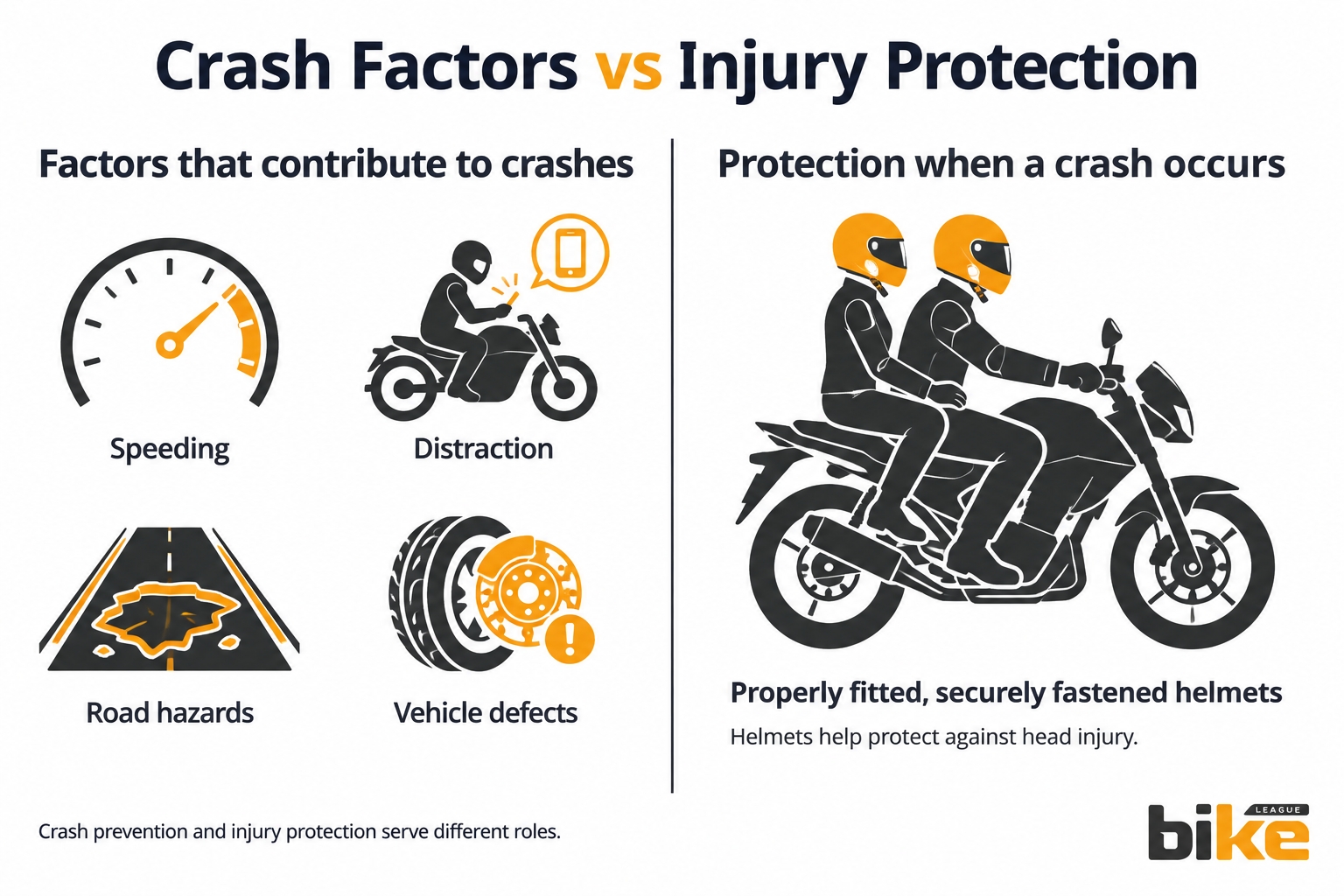
Riding too fast gives you less time to react to traffic or road changes. It can also make crashes worse.
Alcohol And Drug Impairment
Riding after drinking alcohol or using drugs affects your judgment, attention, and ability to react to dangers.
Poor Road Infrastructure
Potholes, poor lighting, missing signs, and bad road surfaces can be dangerous for two-wheeler riders. These problems often combine with speed, low visibility, or traffic, not just act alone.
Vehicle Defects And Inadequate Maintenance
Problems like bad brakes, worn tyres, or broken lights can make riding unsafe. Regular checks and quick repairs help prevent these issues.
Adverse Weather And Reduced Visibility
Rain and fog make it harder to see, and wet or slippery roads reduce tyre grip, raising the risk of skidding. Riders should slow down and avoid sudden moves, even on roads they know well.
Distracted Riding
Using your phone or adjusting navigation while riding takes your attention off the road and slows your reaction to danger. Always stop in a safe spot before using your phone or changing navigation.
Helmet Non-use: An Injury-severity Factor
Helmets protect your head if you crash. Not wearing a helmet does not explain why a crash happened. Both riders and passengers should wear helmets that fit well and fasten the straps securely.
Background reference: A Review on Causes of Accidents in Two Wheelers, IJIREEICE, January 2024. This review discusses human, vehicle, road and environmental factors; it does not establish national percentage shares for the causes listed above.
Motorcycle And Scooter Collision Scenarios
Here are some examples of how motorcycle and scooter crashes can happen. These are just examples, not listed by how often they occur, and some may overlap.
| Scenario | Example | Interpretation Limit |
|---|---|---|
| Junction or turning conflict | A vehicle turns across an approaching rider’s path, turns across a rider travelling alongside it, or emerges from a side road. | The movement alone does not establish responsibility. |
| Rear-end collision | Another vehicle strikes a motorcycle or scooter from behind, or the rider strikes the vehicle ahead. | Following distance, attention and changes in traffic speed need consideration. Sudden braking alone does not establish responsibility. |
| Lane-change conflict | A motorcycle or scooter and another vehicle move into the same road space during a lane change. | The description alone does not establish how the conflict developed or who was responsible. |
| Heavy-vehicle involvement | A motorcycle or scooter collides with a truck or bus. | This can also involve a junction conflict, turning movement, lane change, or rear-end impact. |
Junction And Turning Conflicts
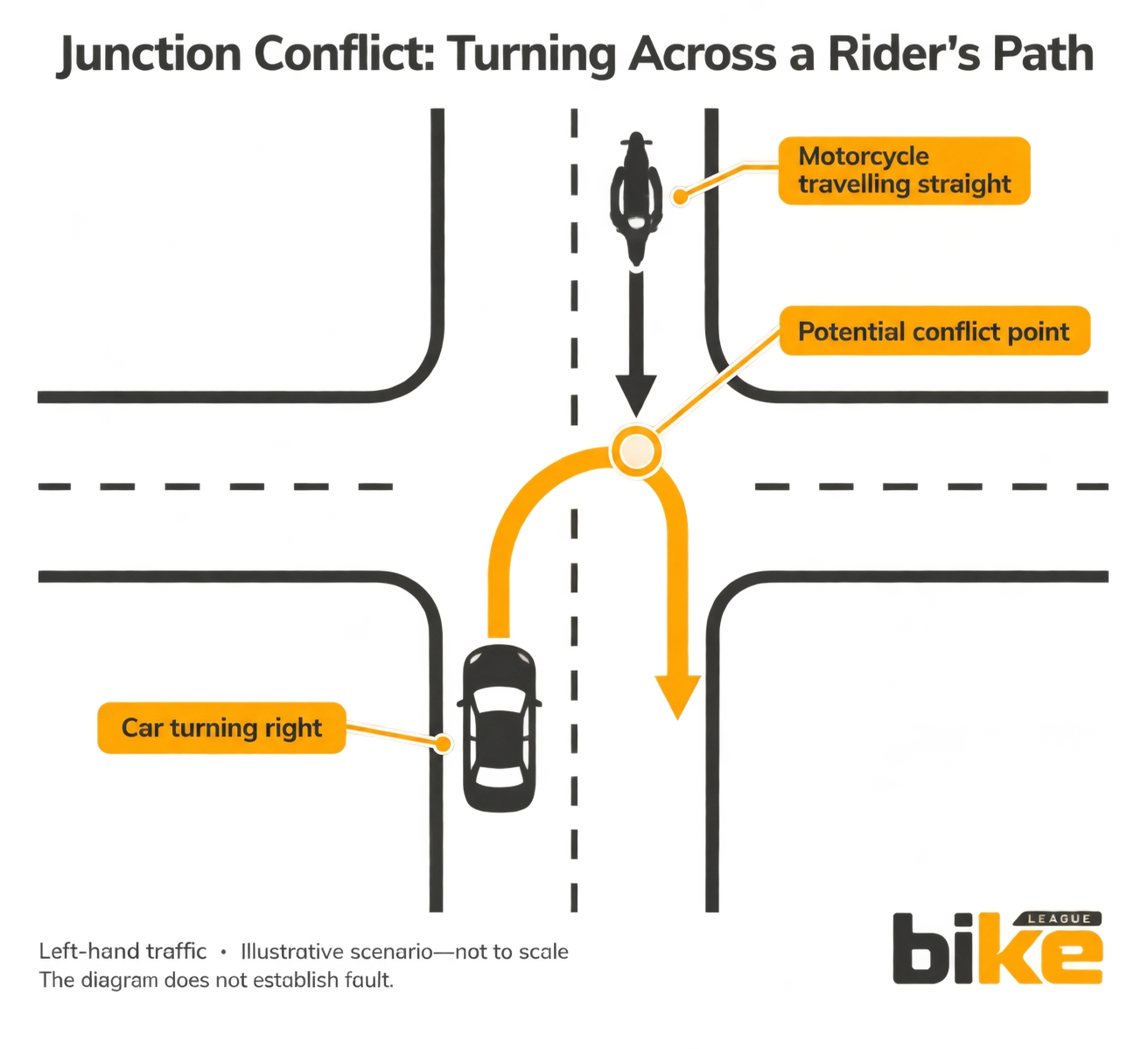
Motorcycles and scooters can get into crashes at junctions, side roads, or U-turns. For example:
- A vehicle turns across the path of an approaching motorcycle or scooter.
- A vehicle turns left across the path of a motorcycle or scooter travelling alongside it.
- A vehicle emerges from a side road or driveway into a rider’s path.
- A vehicle makes a U-turn across a rider’s direction of travel.
Rear-end Collisions
A rear-end crash can happen if another vehicle hits a motorcycle or scooter from behind, or if the rider hits the vehicle in front. This description does not say who is at fault.
Things like how closely you follow, paying attention, and changes in speed matter. Sometimes a rider must brake suddenly to avoid danger, so braking alone does not mean they caused the crash.
Lane Changes And Conflicts Over Road Space
A motorcycle or scooter and another vehicle may move into the same road space when changing lanes. For example, a vehicle may change lanes into the rider’s path, or the rider may move into a space already occupied by another vehicle.
Collisions Involving Heavy Vehicles
A collision between a motorcycle or scooter and a heavy vehicle, such as a truck or bus, may involve a turning movement, a lane change, a rear-end impact or a conflict at a junction.
Local Two-wheeler Fatality Study: Characteristics Of The Autopsied Cases
A study at Pondicherry Institute of Medical Sciences looked at 233 cases of people who died in two-wheeler crashes from 2015 to 2019. These results only describe the people in this hospital sample, not everyone in the area.
The percentages below are based on all 233 cases. Each person may be counted in more than one group, such as age, sex, and whether they were a rider or passenger.
- Male victims: 217 people (93.1%).
- Victims aged 20–29 years: 72 people (30.9%).
- Riders: 191 people (82.0%).
- Pillion passengers: 42 people (18.0%).
The 93.1% male figure is for the whole group, not just those aged 20–29.
These results do not show if crash risk changes by age or sex, or explain what the people did. The study did not have helmet-use data, so it cannot say if victims wore helmets or how effective helmets were in these cases.
Government Organisations And Measures For Two-wheeler Safety In India
Organisations Involved In Road Safety
The organisations listed below each have their own roles in transport rules, highway management, research, and road safety. Their jobs are not the same.
Ministry of Road Transport and Highways (MoRTH)
MoRTH is responsible for formulating and administering policies and legislation relating to road transport and National Highways.
National Highways Authority of India (NHAI)
NHAI is an authority under MoRTH responsible for developing, maintaining and managing the National Highways entrusted to it.
CSIR–Central Road Research Institute (CSIR–CRRI)
CSIR–CRRI is a constituent laboratory of the Council of Scientific and Industrial Research, not a body under MoRTH. Its work includes research on road design, construction and maintenance, traffic and transportation planning, and road traffic safety.
National Road Safety Council (nrsc)
The Government has constituted the National Road Safety Council as an apex body for policy decisions on road safety.
Source: Government statement on design and road-safety standards for National Highways.
State Transport Departments
State transport departments handle transport administration and enforcement under the Motor Vehicles Act, 1988 and related rules. Other state and local groups, like police and road agencies, also help with road safety.
National Road Safety Board
The constitution of the National Road Safety Board and its rules were notified on 3 September 2021. The board advises the Central and State Governments on road safety and traffic management, including vehicle safety standards, road infrastructure, protection of vulnerable road users and road-user education.
Source: Government statement on the National Road Safety Board, 28 July 2022.
Government Road-safety Measures
Legislative Measures
Motor Vehicles (amendment) Act, 2019
The amendment increased penalties for many traffic violations and made other changes to improve road safety and transport rules. Just having stronger penalties does not prove crashes have gone down.
Source: Government statement on causes of road accidents and road-safety provisions.
Automatic Daytime Lighting
Under Rule 105(1)(bb) of the Central Motor Vehicles Rules, two-wheelers manufactured on or after 1 April 2017 must have one or two compliant headlamps that switch on automatically while the engine is running. The rule also permits a compliant daytime running lamp (DRL) arrangement that lights automatically while the engine is running and switches off automatically when the headlamp is switched on.
This rule is about automatic daytime lighting. It does not mean every model’s main headlamp must turn on as soon as you start the engine.
Source: Central Motor Vehicles Rules, 1989, Rule 105(1)(bb).
Abs And Cbs: Requirements Introduced In 2018–2019
The braking requirements introduced for new models from 1 April 2018 and existing models manufactured from 1 April 2019 required eligible L2-category two-wheelers to have either an anti-lock braking system (ABS) or a combined braking system (CBS), with ABS required for models outside the specified lower-powered category.
The ABS-or-CBS category required all three of the following: engine capacity not exceeding 125 cc, maximum continuous rated or net power not exceeding 11 kW, and a power-to-weight ratio not exceeding 0.1 kW/kg. Other models covered by the provision required ABS.
This explains the rules introduced in 2018–2019, not all later changes or current rules for every model. If you are buying or checking a vehicle, look up the latest rules and the vehicle’s approved details.
Helmet Quality Standards
The Helmet for Riders of Two Wheeler Motor Vehicles (Quality Control) Order, 2020, came into force on 1 June 2021. It requires helmets covered by the order to conform to Indian Standard IS 4151:2015, including applicable amendments, and bear the BIS Standard Mark, commonly known as the ISI mark, under a valid Bureau of Indian Standards licence.
BIS gives the certification, and the ISI mark shows a helmet is certified under this scheme. These are not two different certifications.
Source: Helmet for Riders of Two Wheeler Motor Vehicles (Quality Control) Order, 2020.
Road Infrastructure And Accident-prevention Measures
Government road-safety steps include finding dangerous spots, improving roads, doing safety checks, and studying crash data. These actions help all road users, including motorcycle and scooter riders.
Identification And Rectification Of Black Spots
MoRTH identifies accident black spots on National Highways using crash and casualty information. Short-term measures can include improved signs, road markings, delineators, crash barriers and traffic-calming treatments. Longer-term work can include junction improvements, changes to road geometry and underpasses or overpasses, depending on site investigations.
Road Safety Audits
Road safety audits identify hazards during the design, construction, use, and maintenance of National Highways. These steps apply to National Highways, not state highways or city roads, which have their own programs.
Source: MoRTH statement on National Highway black-spot rectification and safety audits.
Crash-data Collection And Analysis
The Integrated Road Accident Database (iRAD) project was developed to support on-site crash-data collection and analysis. The government also administers the electronic Detailed Accident Report (e-DAR) project as a central repository for reporting, managing and analysing road-accident data. These systems help identify hazardous locations and plan safety measures.
Sources: MoRTH statement on the Integrated Road Accident Database; Government statement on road-safety initiatives and e-DAR.
Electronic Monitoring And Enforcement
Government rules allow electronic monitoring and enforcement on certain busy or risky roads and in cities. This does not mean speed cameras are on every road or highway.
Source: Government statement on road-safety initiatives and electronic enforcement.
What Role Does Insurance Play After A Motorcycle Or Scooter Accident?
Motor insurance helps cover certain costs and losses after a crash. What it covers depends on whether your policy has third-party, own-damage, or extra benefits. Insurance does not prevent crashes or injuries.
Third-party Liability Cover
In India, you usually need third-party motor insurance to use your vehicle in public. It covers legal costs if you injure someone or damage their property. It does not pay for damage to your own motorcycle or scooter.
Own-damage Cover
Own-damage insurance can pay for damage to your motorcycle or scooter from accidents or theft, depending on your policy’s rules. Check your policy to see if you have this cover and when it ends.
Policy-specific Benefits And Assistance
Extra benefits depend on your insurer and policy. For example, roadside help may be an add-on for two-wheelers. Check the costs, rules, and limits, as well as what your policy does not cover. Do not assume features like ABS mean you get a discount—always check your insurer’s terms.
Sources: IRDAI consumer guide: Introduction to Insurance; Example of insurer-specific two-wheeler roadside-assistance add-on wording. The add-on document is an example, not a description of benefits available under every policy.
What Do The Cited Studies Show About Government Road-safety Measures?
The two research papers mentioned do not show how much any government program has reduced motorcycle or scooter crashes in India. The January 2024 review talks about safety steps and suggestions, while the Pondicherry study looks at local deaths, not government programs.
Making new rules, putting up cameras, or giving out traffic tickets shows action, but does not prove crashes or injuries have gone down. To judge if a measure works, you need to look at a specific place, compare time periods, and check crash data. Even before-and-after changes need careful review before crediting one action.
Sources: A Review on Causes of Accidents in Two Wheelers, January 2024; An analysis of deaths in two wheeler accidents among autopsied cases: Five year retrospective study, 2021.
Frequently Asked Questions About Motorcycle And Scooter Accidents In India
1. What Factors Contribute To Motorcycle And Scooter Crashes In India?
Crashes can happen because of speeding, riding while impaired or distracted, traffic conflicts, bad roads, low visibility, or mechanical issues. More than one factor can play a role in a single crash. This is not a ranked list for all of India.
2. How Many Two-wheeler Users Died In Road Crashes In India In 2023?
In 2023, the Ministry of Road Transport and Highways recorded 77,539 deaths among two-wheeler users, which was 44.8% of all road-accident deaths in India. This number includes all two-wheelers, not just motorcycles.
Source: Road Accidents in India 2023.
3. Does The 44.8% Figure Show An Individual Rider’s Risk Of Dying?
No. This number shows the share of all road-accident deaths involving two-wheeler users in India in 2023. It does not tell you the chance of an individual rider dying or how many crashes were fatal.
4. How Do Poor Roads And Bad Weather Contribute To Two-wheeler Crashes?
Potholes, bad road surfaces, poor lighting, and missing signs can be dangerous. Rain and fog make it harder to see, and wet roads reduce tyre grip, making skidding more likely. Riders should slow down and avoid sudden moves in these conditions.
5. How Can Other Vehicles Contribute To Motorcycle And Scooter Crashes?
Crashes can happen if another vehicle turns in front of a rider, comes out of a side road, changes lanes into a space already taken, or hits a two-wheeler from behind. Drivers who are distracted may not see riders or changes in traffic. Just describing the crash does not show who is at fault.
6. What Maintenance Checks Can Help Reduce Motorcycle And Scooter Crash Risk?
Check your tyres and their pressure, brakes, and lights regularly. Follow the manufacturer’s maintenance schedule and tyre-pressure advice, and fix any problems quickly. Good maintenance helps prevent mechanical issues but does not replace careful riding or adjusting to road conditions.
7. Do Helmets Prevent Motorcycle Collisions Or Reduce Injuries?
Helmets protect your head in a crash, but they do not stop the crash from happening. Both riders and passengers should wear helmets that fit well, meet Indian standards, and have the straps fastened securely.
8. How Effective Is Abs In Preventing Motorcycle Crashes?
Anti-lock braking systems (ABS) control braking pressure to stop the wheels from locking during hard braking. ABS helps keep the bike stable and lowers the risk of falling, but it does not prevent all crashes or replace safe speed and distance.
A US study of 65 motorcycle models with optional ABS found that ABS was linked to a 22% lower rate of fatal crashes per 10,000 registered vehicle years compared to the same models without ABS. This number is not specific to India or to all motorcycle crashes.
Source: IIHS research: Motorcycle antilock braking systems and fatal crash rates.
9. What Protective Equipment Should Riders Use Besides A Helmet?
Wear protective gloves, jackets and trousers that resist abrasion, and strong shoes that cover your ankles. Bright or reflective clothes help you be seen. Make sure your gear fits well and matches the riding conditions, but remember, no gear can guarantee you won’t get hurt.
Source: NHTSA motorcycle-safety guidance on protective clothing and visibility.
10. What Practical Steps Can Reduce Crash Risk And Serious Injury?
Ride at a safe speed for the conditions, stay sober and alert, keep enough distance from other vehicles, and watch for vehicles turning or changing lanes. Maintain your bike, wear a helmet with the strap fastened, and use protective gear. These steps help reduce different risks, but no single action makes riding completely safe.
Source: NHTSA motorcycle-safety guidance.
Related Motorcycle Safety And Maintenance Guides
- Motorcycle helmet buying guide for Indian riders
- Motorcycle ABS: How it works and common questions
- Motorcycle braking techniques and tips
- Monsoon motorcycle riding tips for Indian roads
- Motorcycle maintenance checks you can do at home
Conclusion
To understand motorcycle and scooter crashes in India, it’s important to separate what causes crashes from what affects how bad injuries are. Rider behavior, traffic, vehicle condition, road quality, and weather all matter, as does protecting both riders and passengers.
The 2023 national table shows crash and casualty numbers for all road users and for two-wheeler deaths, but not for motorcycles alone. The Pondicherry study gives a local view and should not be used to describe all crashes or deaths in India.
Judge government actions by their safety results, not just by what they do or enforce. Insurance provides financial protection under your policy, not crash prevention.
If you have questions or feedback about this article, email bikeleagueindia@gmail.com or leave a comment below.

Thorough analysis of the causes of motorcycle accidents in India! The statistics on speeding and helmet non-compliance are alarming. Distracted riding with smartphones is also a rapidly growing concern in city traffic like Bangalore. One thing worth adding — having adequate two-wheeler insurance with personal accident cover and zero dep is crucial for riders given these risk factors. For bike owners in Bangalore exploring motor insurance options with comprehensive add-ons, this is a helpful resource: https://insurancesupport.online/locations/karnataka/bangalore/motor-insurance
Thank you for sharing this valuable insight. This is helpful for understanding rider safety and the importance of proper insurance coverage.