
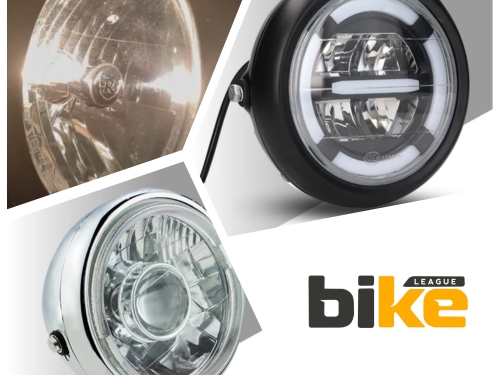
Long story short: Are you seeking information on motorcycle headlights? Look no further! This comprehensive guide has everything you need to make an informed decision.
Picking the right headlight for your motorcycle is important for both safety and style, especially on India’s varied and sometimes tough roads. Whether you’re riding on dark highways, dealing with bad weather, or moving through busy city streets, a good headlight can really improve your ride. With so many choices like halogen, LED, and HID, it can be hard to know which one to pick.
This guide will help Indian riders learn about different types of motorcycle headlights by comparing their features, pros, and cons. Whether you ride every day, love long trips, or just want your bike to look better, you’ll find useful advice, legal info, and tips for Indian roads. Keep reading to find the right headlight for safer and smarter rides.
Key Takeaways
- Selecting the right motorcycle headlight is essential for safety, visibility, and legal compliance on Indian roads.
- LED headlights offer superior brightness, energy efficiency, and longevity compared to traditional halogen bulbs, but may require professional installation and legal consideration.
- Always check the compatibility of aftermarket headlights with your motorcycle model, and verify that they comply with Indian road regulations to avoid fines and insurance issues.
- Regular maintenance, such as cleaning lenses and promptly replacing faulty bulbs, ensures optimal headlight performance and extends their lifespan.
- Stay informed about new headlight technologies and trends to further enhance your riding experience and adapt to changing road conditions.
How does a motorcycle headlight work?
When the engine is running, the motorcycle’s headlight and all other electrical components are powered by the alternator. An alternator is an integral part of every combustion engine vehicle. It converts chemical energy to electrical energy, allowing you to charge and replenish the battery in your motorcycle’s engine and other electrical components.
When the engine is off, the battery runs the headlight and other electrical parts. This power doesn’t last long, and using it too much can harm the battery. Try not to turn on the headlights when the engine is off to avoid damaging the battery.
Different types of motorcycle headlight
1. Halogen headlights
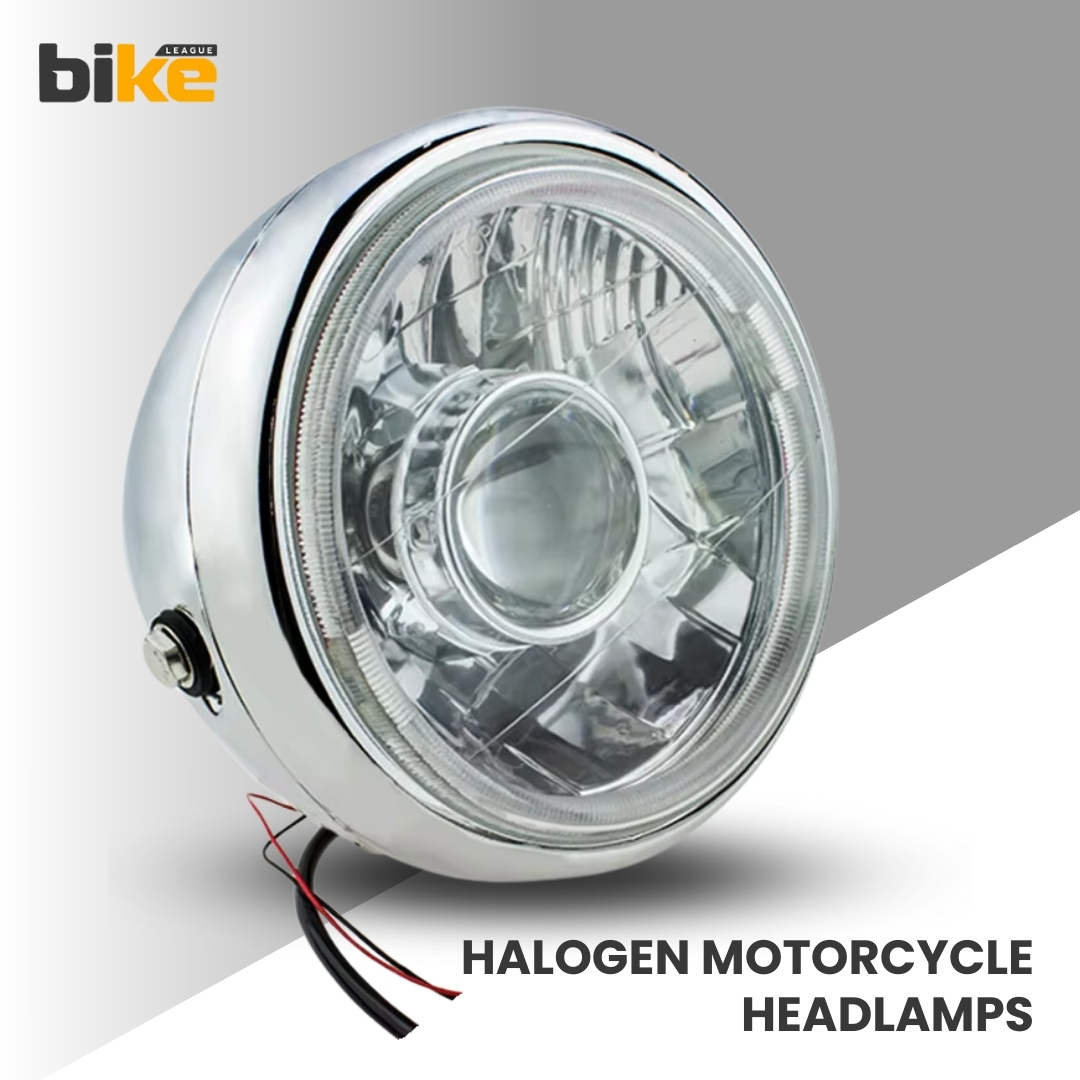
This headlights are the most common type used on motorcycles in India. They come in different varieties, are easy to replace, and are widely available. They give enough light for most needs, but they aren’t the brightest choice.
Some riders choose headlights with bulbs that last longer and offer different colours. A halogen bulb has a tungsten filament and a bit of halogen gas. When electricity passes through, the filament heats up and gives off light.
Pros of Halogen headlights
- Easy to replace
- Readily available in the market
- Cheap
Cons of Halogen headLights
- Do not produce enough light
- Shorter lifespan compared to other lights
2. LED Lights
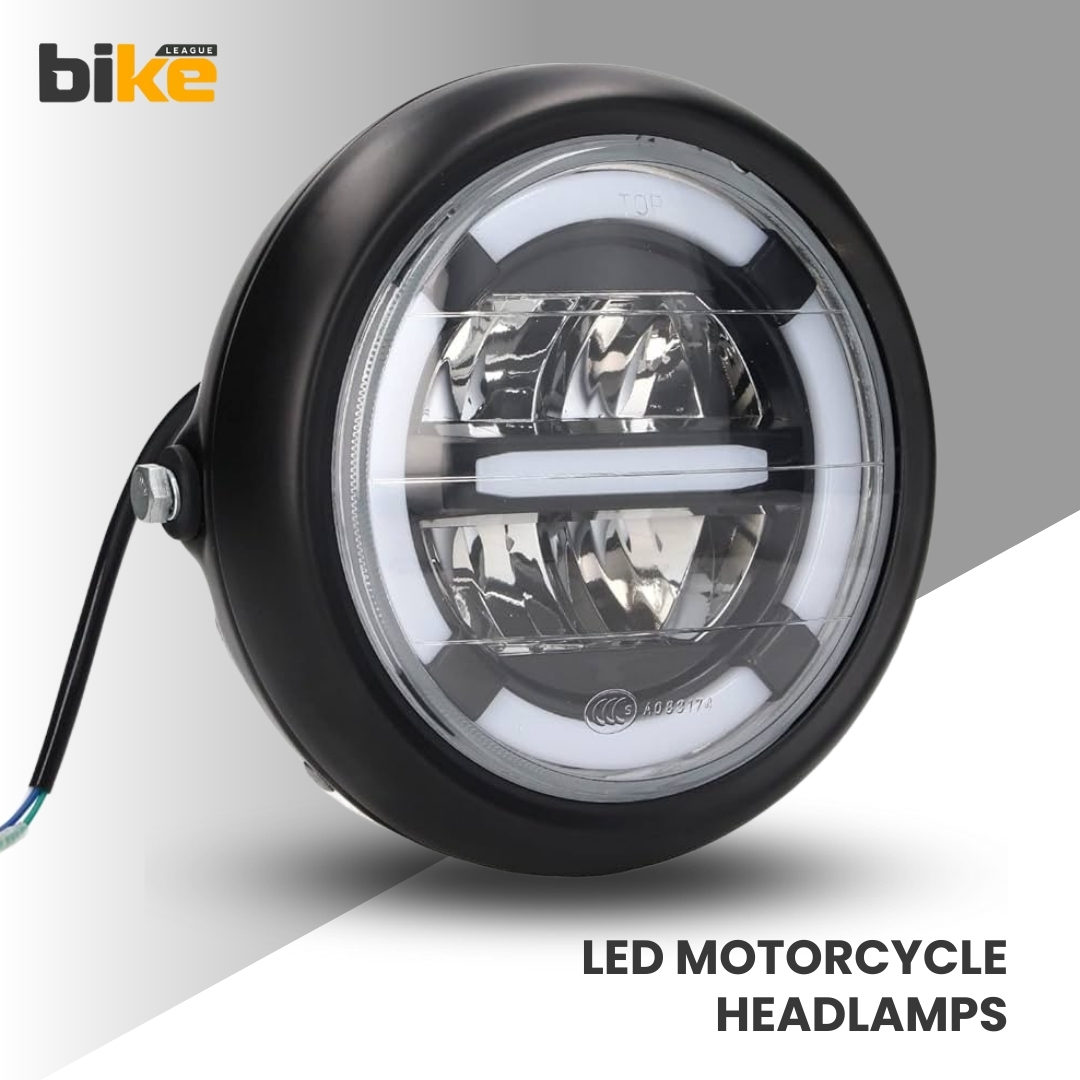
This lights are popular among motorcycle owners because they are bright and long-lasting. Unlike older headlights, you don’t need to replace them often. But keep in mind that very bright LEDs can make it harder for oncoming drivers to see.
A big plus of LED headlights is that you can choose from different brightness levels and light colours to suit your needs. They also last longer than halogen or Xenon HID bulbs and use less power, so they’re more energy efficient.
Pros of LED motorcycle headlight
- Superior brightness and clarity
- Energy-efficient, consuming less power
- Long lifespan and durability
Cons of LED Lights
- Expensive compared to Halogen lights
- LED lights can be very bright, making it harder for oncoming traffic
3. Xenon HID Lights
For those who prefer a longer lifespan and a softer colour temperature, Xenon High-Intensity Discharge (HID) lights are a great option. These lights still provide ample brightness, but the gas inside the bulb creates a more calming tone for better visibility. Additionally, Xenon HID lights have a much longer lifespan than halogen lights.
It’s best to have a professional install these lights to avoid any problems. Like halogen headlights, Xenon (HID) bulbs also use a tungsten filament. However, while halogen bulbs are filled with halogen gas, HID bulbs are filled with Xenon gas. The light emitted by Xenon HID lights has a bluer colour temperature, unlike the warmer hues of standard halogen lights. Instead of heating the gas, the Xenon gas glows when a current is applied, resulting in less heat generated and a longer-lasting bulb.
Pros of Xenon HID Lights
- Very long-lasting
- Bright and comfortable
Cons of Xenon HID Lights
- Expensive
- Need a professional to install the Xenon HID lights
4. Projector Headlights
Projector headlights use a lens to focus the light, making the beam stronger and more direct. Inside, there’s a bulb (usually HID or LED), a reflector, a shutter, and a lens. The shutter helps stop the light from spreading out and blinding other drivers, so you get a clear, even beam with good visibility and less glare.
Projector headlights often use HID or LED bulbs for better brightness and energy savings. You’ll usually see them on premium motorcycles and high-end vehicles because they work well and look modern. They also let you add custom styles like angel eyes or DRL rings to make your bike stand out.
Pros of Projector Headlights
- Focused and intense light beam
- Enhanced visibility
Cons of Projector Headlights
- More complex and potentially more expensive than reflector headlamps
5. Reflector Headlamps
Reflector headlamps have a shiny housing that spreads light from the bulb, which can be tungsten, halogen, or LED. The bulb sits in a reflector that bounces the light forward in a wide, unfocused beam. This simple design makes reflector headlamps cheaper to produce and easier to maintain.
But reflector headlamps don’t have as precise a beam, so they can cause more glare and scattered light. This makes them less effective than projector headlights for lighting up the road. Still, they’re common on commuter bikes and older models because they’re affordable and simple.
Pros of Reflector Headlamps
- Less expensive
- Simple design
Pros of Reflector Headlamps
- Lower brightness and focus compared to projector headlights
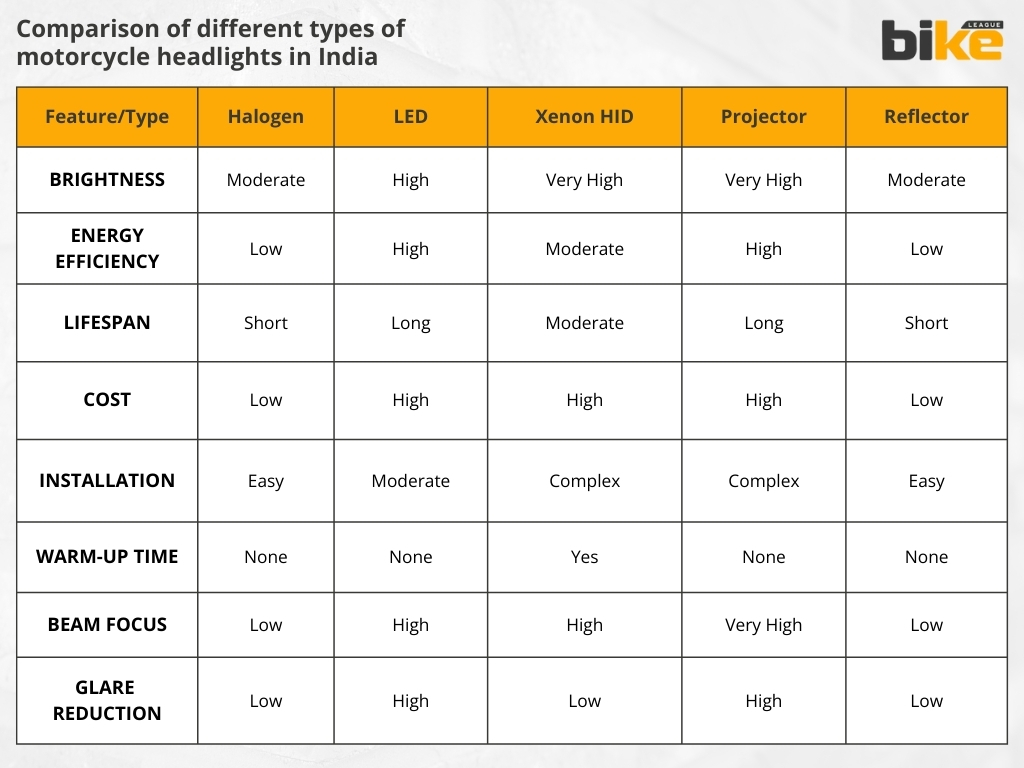
| Type | Technology & Working | Pros | Cons |
|---|---|---|---|
| Halogen | Tungsten filament + halogen gas; current heats filament to glow | Easy to replace; Readily available; Cheap | Low brightness; Short lifespan (500-1000 hrs) |
| LED | Semiconductors emit light via electroluminescence; low heat, instant on | Superior brightness; Energy-efficient; Long lifespan (25k-50k hrs) | Expensive; Can blind oncoming traffic |
| Xenon HID | Xenon gas + arc discharge; ballast ignites glow, blue tint | Very long-lasting; Bright and comfortable light | Expensive; Needs professional installation |
| Projector | Lens focuses bulb light; shutter for cutoff, precise beam | Focused intense beam; Enhanced visibility | Complex and costly; Higher maintenance |
| Reflector | Parabolic reflector bounces bulb light; broad scatter | Less expensive; Simple design | Lower brightness/focus; Prone to glare |
What are the Legal Requirements for Motorcycle Headlights in India?
1. Mandatory AHO (Automatic Headlamp On) Headlights
In India, all motorcycles must have a white headlight visible from 150 meters and a red tail lamp visible from 150 meters. In 2024, new motorcycles must have headlights that switch automatically when the ignition is turned on.
2. Brightness and Colour Regulations
Motorcycle headlights should not be so bright that they dazzle or cause discomfort to other road users. Headlights in colours other than white are not permitted, as they may distract and reduce the bike’s visibility to other road users.
3. Aftermarket Headlights
Aftermarket headlights are allowed as long as they meet the prescribed standards set by the Automotive Research Association of India (ARAI) and are correctly installed.
4. High Beam Usage
It is illegal to use high-beam headlights within city limits or well-lit areas. High beams should only be used in unlit areas outside city limits.
5. Daytime Running Lights
From 2024, motorcycles must have headlights on at all times, including during the day, to increase visibility and reduce the likelihood of accidents.
6. Penalties for Non-Compliance
Non-compliance with bike headlight regulations can lead to penalties, fines, and potential legal action. Ensuring that your bike’s headlights meet the required standards is essential.
| Rule | Details | Penalty |
|---|---|---|
| AHO | Mandatory since 2017 for new bikes | ₹500-1000 |
| Lumens/Watts | ~3000lm / 60W max equiv. | ₹1000+ |
| Colors | White/yellow only | ₹500 |
| Max Lights | 4 total | ₹1500 |
Which are the best motorcycle headlight for specific riding conditions in India?
When choosing the most suitable headlight for a motorcycle in India, owners should consider the following factors:
1. Riding Environment
- Urban areas: In densely populated cities like Delhi, Mumbai, and Bangalore, where traffic is congested and diverse, LED headlights might be the best choice. They offer bright illumination and quick on/off capabilities, which are beneficial in stop-and-go traffic.
- Rural areas: For riders frequently traversing rural roads with varying quality and potential wildlife encounters, a combination of LED low beams for general visibility and HID high beams for long-range illumination could be ideal.
- Highways: For those who often ride on highways, where higher speeds and longer visibility ranges are necessary, HID headlights might be the best option due to their intense brightness and long throw.
2. Weather Conditions
In foggy or rainy conditions, common in many parts of India, headlights with a lower colour temperature (around 3000K) producing a yellowish light are more effective. This is because yellow light has better fog penetration ability than white light.
3. Brightness and Beam Pattern
Consider the headlight’s lumen output. While halogen headlights typically emit between 700 and 1,200 lumens, LED headlights can range from 3,000 to 6,000 lumens.
The beam pattern ensures light is distributed effectively on the road. Look for headlights with a sharp cutoff line to prevent glare to oncoming traffic while providing sufficient illumination.
4. Energy Efficiency
LED headlights are known for their energy efficiency. They consume less power while providing bright illumination, which can be particularly beneficial for long rides or when battery life is a concern.
5. Durability and Longevity
LED headlights generally have a longer lifespan than halogen bulbs, which can benefit riders who cover long distances or ride frequently.
6. Cost Considerations
While LED and HID options might offer better performance, they are typically more expensive than halogen bulbs. When making a decision, consider your budget and how often you ride.
7. Expert Recommendations
Many experienced Indian motorcycle riders recommend aftermarket LED options for cost-effectiveness and performance. Brands like Eagle Lights, Hogworkz LED Halo, and Custom Dynamics are popular choices.
What are the legal regulations regarding bike headlight brightness in India?
Yes, there are specific legal regulations regarding headlight brightness for motorcycles in India:
1. Wattage Limit
The Regional Transport Office (RTO) has set a maximum wattage limit of 7 watts for vehicle headlights. This regulation ensures safety and prevents glare that can blind other drivers.
2. Number of Headlights
A motorcycle can have a maximum of four headlights, including regular headlights and any additional fog or auxiliary lights.
3. Height and Beam Alignment
The height of the headlights should not exceed 1.5 meters from the ground. The light intensity should be controlled to avoid blinding a person at 8 meters.
4. Color Restrictions
Only white or yellowish headlights are permitted. Blue lights are prohibited, as they can confuse other drivers and resemble emergency vehicle lights.
5. High Beam Usage
High beams should only be used on dark, isolated roads with no nearby vehicles. They must be switched off when approaching another car, driving in urban areas, or in heavy traffic.
6. Automatic Headlight On (AHO) Feature
Since April 1, 2017, all new motorcycles and scooters must have an Automatic Headlight On (AHO) feature that keeps the headlights on while the vehicle is running.
7. Daytime Running Lights (DRLs)
DRLs are mandatory for specific vehicles, especially newer models manufactured after April 2019.
It’s important to note that violating these regulations can result in fines ranging from Rs. 500 for first-time offenders to Rs. 1,000 for repeat offenders. Additionally, non-compliant vehicles may not pass the required inspections for registration.
What are the differences in maintenance requirements, replacement costs, or typical lifespan for each motorcycle headlamp type?
1. Halogen Headlights
Halogen bulbs require frequent checks for filament wear and vibration damage, with simple DIY replacement using gloves to avoid oil contamination—typically every 500-1,000 hours or 6-12 months in India. Replacement costs ₹200-500 per bulb (e.g., Hero 12V 25W on IndiaMart), low maintenance but high long-term due to repeats.
2. LED Headlights
LEDs need minimal upkeep: clean lenses quarterly and ensure heat sinks are dust-free to prevent thermal failure, lasting 25,000-50,000 hours (5-10 years daily use). India replacements cost ₹1,000-3,000 (Philips Ultinon), plug-and-play, but verify ARAI for warranty; pro install if integrated.
3. Xenon HID Lights
HID demands ballast inspections yearly for failures and professional installation (₹500-1,000 labour) due to high voltage—lifespan 2,000-3,000 hours (2-3 years). Full kit replacements: ₹2,000-6,000 (Xenon gas bulbs + ballast), with higher maintenance due to gas degradation.
4. Projector Headlights
Projectors (lens-based) require lens polishing/cleaning biannually and bulb swaps matching halogen/LED/HID lifespans; align beams post-replace to avoid glare—DIY possible but tools needed. Costs add ₹2,000+ to the bulb price; durable housing, but lens scratches are common on dusty Indian roads.
5. Reflector Headlamps
Simplest maintenance: wipe reflectors monthly to prevent oxidation; replace bulbs every 500-1,000 hours, like halogens—no special tools. Low cost ₹200-800, but chrome pitting reduces efficiency over 2-3 years; cheapest long-term for commuters.
| Type | Lifespan (India Use) | Maintenance | Replacement Cost (₹) |
|---|---|---|---|
| Halogen | 500-1,000 hrs | Check filament, DIY | 200-500 |
| LED | 25k-50k hrs | Clean heatsink | 1k-3k |
| HID | 2k-3k hrs | Ballast check, pro | 2k-6k |
| Projector | Matches bulb | Lens polish, align | +2k (lens/bulb) |
| Reflector | Matches bulb | Wipe reflector | 200-800 |
How do different headlight types affect your bike’s electrical system—and what does that mean for motorcycle riders?
Here’s how different headlight types—halogen, HID, LED, reflector, and projector—actually affect a motorcycle’s electrical system in real-world riding.
1. Power Consumption
- Halogen headlights: Typically draw 55-65 watts. You’ll notice these are the most demanding and can sometimes cause the lights to dim at idle, especially on older bikes or those with smaller batteries.
- HID headlights: Use around 35 watts. They’re brighter than halogen and slightly easier on your electrical system, but require a ballast (an extra part that can occasionally fail).
- LED headlights: Use just 20-30 watts. These are the most efficient and put the least strain on your battery and alternator.
Reflector and projector housings use the same bulb wattage, but projectors focus the light more effectively—so you get better visibility without adding extra load on your bike’s system.
Because LEDs draw so little, they’re perfect for city bikes or anyone doing lots of stop-and-go riding. Your alternator won’t have to work as hard, and your battery will thank you.
2. Alternator Effects
- If you stick with high-wattage halogen bulbs, you might notice your lights dimming at idle or your regulator/rectifier running hot. Switching to LEDs can reduce this stress and keep your lights bright even in traffic.
- Projector setups focus the beam better, so you see more of the road without needing more power. Reflectors scatter light more, which can lead to wasted energy and less focused illumination.
If you ride a Royal Enfield or similar bike, swapping to LEDs is a popular upgrade for more stable voltage and consistent brightness—even on long rides.
Battery Life Impact
- LEDs not only use less power, but also produce less heat, which is gentler on your battery and wiring. Halogens, on the other hand, can drain smaller 4-7Ah batteries more quickly—especially if you often ride at night or in traffic.
- If you want the most efficient setup, pair a projector with an LED bulb. Reflectors can work with LEDs too, but you might need to adjust the aim to avoid blinding oncoming traffic.
On most touring bikes, upgrading to quality headlights (especially LEDs) won’t cause problems—as long as the installation’s done right.
Upgrade Requirements
- LEDs: Most LED bulbs for Indian bikes (HS1/H4 types) are plug-and-play, so you can swap them in easily at home.
- HIDs: These need ballasts and sometimes extra wiring, so it’s often best to get a professional to fit them.
If you’re switching from a reflector to a projector, you’ll need to change the whole assembly—and sometimes add a relay to protect your wiring. If you’re only changing the bulb, you usually don’t need extra parts.
When in doubt, get a professional installation—especially if your bike has a warranty or uses a CANBUS electrical system. It’ll help you avoid headaches later.
| Type | Power Draw (W, bulb-dependent) | Alternator Load | Battery Impact | Wiring/Relay Needs | Beam Quality |
|---|---|---|---|---|---|
| Reflector | 20-65 | Matches bulb | Matches bulb | Stock for drops; relay for high-power | Wide, scattered |
| Projector | 20-65 | Matches bulb, efficient focus | Matches bulb, optimized | Assembly swap possible; relay optional | Sharp, focused |
| Halogen (any) | 55-65 | High | Higher drain | Stock | Dimmer |
| HID (projector best) | ~35 | Medium | Medium | Ballast/relay | Bright |
| LED (both) | 20-30 | Low | Extended | Plug-and-play | Best in projector |
Motorcycle headlight care tips and tricks to extend the lifespan
Motorcycle headlight care involves regular cleaning, inspections, and protective measures to combat oxidation, moisture, and heat, significantly extending lifespan. Here are some of the tips and tricks
- Regular Cleaning: Wipe lenses weekly with a microfiber cloth and mild soapy water or car shampoo to remove dust, bugs, and grime common on Indian roads.
- Foggy Lens Polish: For oxidised or foggy headlights, apply toothpaste or baking soda paste, rub in circular motions, rinse thoroughly, and follow up with a plastic polish like Meguiar’s PlastX for clarity.
- Avoid Damage During Cleaning: Never use harsh chemicals or dry-wipe lenses to prevent scratches; always tape off surrounding paint areas before polishing.
- Monthly Inspections: Check for condensation (dry with silica packs or professional sealant), loose wiring, corrosion, or dimming; clean and tighten electrical connections as needed.
- Handle Bulbs Properly: Use gloves when touching halogen bulbs to avoid oil contamination; align headlights by testing against a wall 25 feet away (high beam centre at eye level).
- LED-Specific Care: Keep heatsinks on LED units dust-free; polish projector lenses regularly to maintain sharp focus.
- UV Protection: Apply UV sealant after polishing to prevent yellowing from intense sunlight, especially crucial in tropical Indian conditions.
- Electrical Best Practices: Install quality bulbs and relays for upgrades; avoid electrical overloads and park in shade to minimise heat exposure.
- Timely Replacements: Swap halogens every 500 hours, LEDs after 25,000+ hours with proper care—monitor performance proactively.
- Routine Habits: Clean after dusty or monsoon rides, inspect wiring during services, polish quarterly, and reseal yearly.
FAQ about motorcycle headlights in India
1. Which bike headlight is the brightest?
If you want the brightest headlight for your bike, go for LEDs. They light up the road ahead like daytime and make a big difference, especially if you ride a lot at night or in poorly lit areas.
2. Which motorcycle headlight is the most affordable?
On a tight budget? Halogen headlights are your best bet. They’re easy on your wallet, easy to find, and still do a decent job for everyday riding.
3. Which bike headlight is the most expensive?
LED headlights cost more upfront, but they’re an investment—lasting much longer and saving you money in the long run with fewer replacements.
4. Which motorcycle headlight has the longest lifespan?
If you hate changing bulbs, you’ll love LEDs. They can last for years—sometimes even outliving your bike!
5. How to adjust a motorcycle headlight?
You can usually adjust your headlight’s beam with a screw behind the headlight housing. Park your bike about 5 meters from a wall in the dark, turn on the lights, and aim so the beam hits just below eye level. If the light still feels weak, upgrading the bulb is the next step.
6. How to measure motorcycle headlight size?
Grab a measuring tape, stretch it across the widest part of your headlight (rim to rim), and that number is your headlight size. Easy!
7. How to make motorcycle headlights brighter?
Want a brighter headlight? Try upgrading to LEDs or HIDs. It’s a simple swap that makes a huge difference on dark roads.
8. Are motorcycle headlights always on?
Yes—thanks to new rules in India, all new bikes keep their headlights on all the time (AHO feature). You don’t need to worry about switching them off—they’re always ready to keep you visible.
9. Is it illegal to ride a motorcycle without a headlight?
Yes, riding a motorcycle without a working headlight isn’t just risky—it’s illegal in India. Always check your lights before hitting the road.
10. Why do some people put tape on motorcycle headlights?
This is done to prevent broken glass from falling onto them and their fellow riders in the event of an accident.
11. Why does the motorcycle headlight flicker?
If your headlight is flickering, don’t ignore it! The most common causes are:
- Ageing battery
- Failing alternator
- Faulty bulbs or lamps
- Loose connection or fuses
- Bad wiring
- Faulty headlamp switch
12. How to clean motorcycle headlight lens
If your headlight lens looks clear, a simple wash with a good-quality bike cleaner (like 3M) will do the trick. But if it’s cloudy, don’t worry—there are plenty of easy home fixes you can try:
- Toothpaste, Baking soda and a clean piece of cloth
- Soap, sandpaper & polishing compound
- WD-40
- Vinegar and soap
- Aftermarket metal polish
- Shampoo and water
- Glass cleaners & rubbing pads
Other related articles from Bikeleague India
- Motorcycle battery – Different types & tips to extend life
- Automatic Headlamp On in bikes in India: Complete Guide
- Okaya Faast F2F
- Rowwet Eleq
- Rowwet Trono
Conclusion
Choosing or upgrading your motorcycle headlight isn’t just about style. It’s an important choice for your safety and comfort on Indian roads. By knowing the pros and cons of halogen, LED, HID, and other headlights, you can pick the one that fits your riding style, local conditions, and the law.
Always focus on quality, follow the rules, and get professional help if needed. Taking care of your headlights and using them properly will help them last longer and work better, making night rides safer. As new technology comes out, keeping up with the latest headlights can make your rides even better. No matter where you ride, the right headlight will help you see clearly and stay safe. Choose wisely and enjoy safer, brighter journeys.
In this article, we covered all the main types of motorcycle headlights in India and more. If you have questions, feel free to email us at bikeleague2017@gmail.com or leave a comment below. We’re always happy to help. You can also follow Bikeleague India on social media for more updates.