
Long story short: Find out how Automatic headlight on in bikes and scooters help Indian riders stay visible and safe. Learn about the rules, public opinions, and how the industry is adapting to this key safety feature.
Since April 2017, automatic headlights have changed how new two-wheelers operate in India. This feature helps lower road accidents and makes riding safer by improving visibility, giving riders more confidence.
The decrease in road accidents due to AHO is a good sign for road safety. First, let’s explain what AHO is, then we’ll see if it’s really making a difference for bikes and scooters.
Key Takeaways
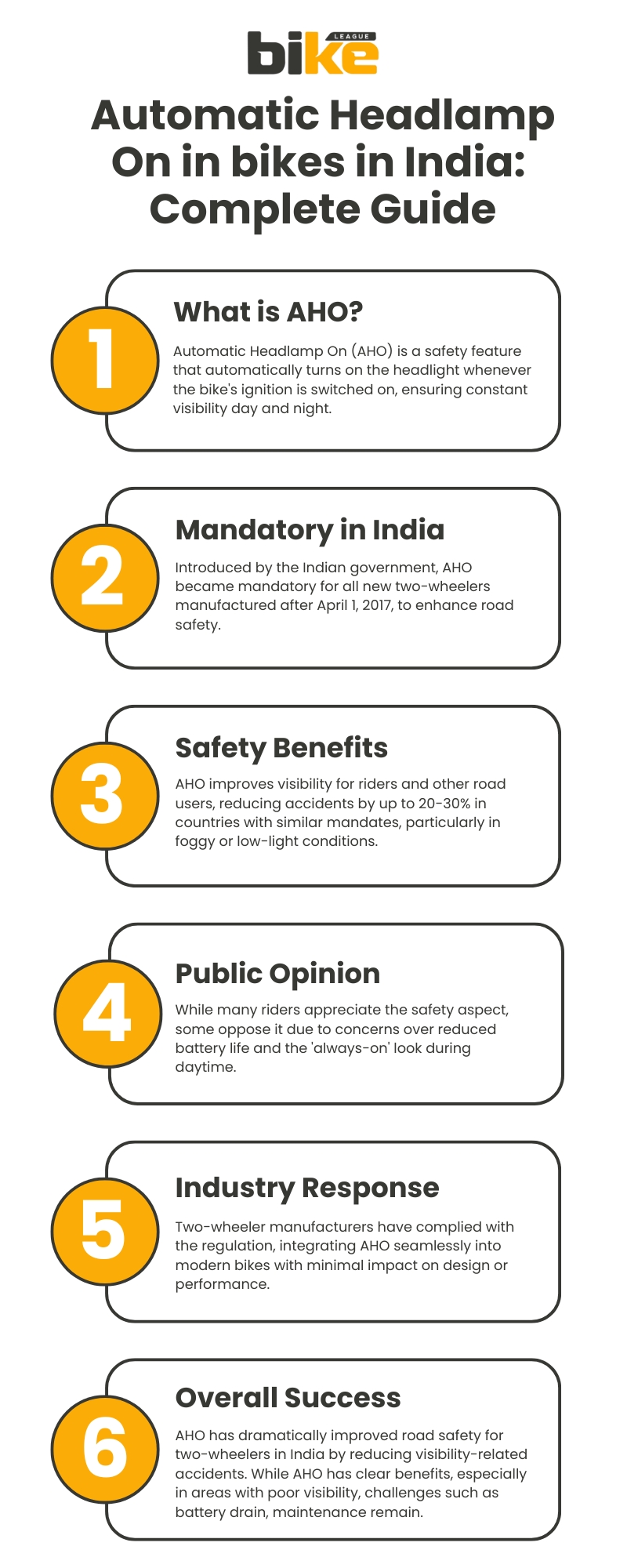
- Making Roads Safer for Riders: Since April 2017, every new bike and scooter in India comes with Automatic Headlamp On (AHO) as standard. This means your headlight is always on, making you more visible and helping prevent accidents, especially during the day when other drivers might not notice two-wheelers.
- Rules You Can’t Ignore: With AHO, the headlight turns on as soon as you start the engine (on most bikes in low beam), and there’s no manual switch to turn it off. The law takes this seriously. Tampering can get you fined, void your warranty, or even cause trouble with insurance claims.
- Benefits Are Modest and Hard to Measure: Studies of motorcycle headlight-on rules elsewhere suggest roughly a 5-10% reduction in multi-vehicle daytime crashes. India-specific figures that isolate AHO’s effect are not widely available. Some riders in sunny southern India feel AHO is less useful and try to bypass the system, raising questions about whether one rule fits all.
- Everyday Headaches and Hot Debates: Riders sometimes complain about dead batteries on short trips and needing to replace bulbs more often. People debate the lack of an off-switch and whether the rule makes sense everywhere, so the discussion continues.
- What’s Next for AHO? The industry is developing smarter AHO technology, such as LED lights and region-specific adjustments. There’s also a push for more public awareness, so safety can improve without causing unnecessary inconvenience for riders.
What Is (aho) Automatic Headlamp On In Bikes And Scooters?
AHO stands for Automatic Headlamp On. It’s a safety feature that makes riding a two-wheeler safer and easier to see. When you start your engine, the headlamp turns on by itself, so you don’t have to remember to switch it on. This simple system helps you stay visible and makes riding less stressful.
Here are some key highlights of the AHO feature:
- Automatic Activation: You don’t need to look for a switch. With AHO, your headlamp turns on as soon as you start the engine, so you’re always visible on the road.
- Enhanced Safety: Whether you’re riding in rain, fog, or on winding roads, AHO greatly improves your visibility. This leads to safer rides for you and others on the road. Being seen means being safe.
- Regulatory Requirement: Since April 1, 2017, all new two-wheelers in India must have AHO. This rule aligns India with global safety standards and makes riding safer.
Why Was Automatic Headlamp On (aho) Introduced In India?
India has one of the highest rates of road accidents, especially among two-wheeler riders. Poor visibility at dawn, dusk, and in fog is a major factor.
To address this, AHO (Automatic Headlamp On) was introduced. It makes two-wheelers easier to see for everyone on the road, from pedestrians to drivers of larger vehicles. This should help make roads safer for everyone.
What Are The Implementation And Regulations Of Automatic Headlamp On (aho) In Two-wheelers In India?
1. Legal Regulations
MoRTH notified AHO as compulsory for motorcycles and scooters post-April 2017, based on the Justice Radhakrishnan Committee’s recommendations, following Safer Roads Foundation advocacy. No manual on/off switch allowed; non-compliance blocks type approval under CMVR 1988, with fines up to ₹1000 for tampering under Section 190. Applies uniformly to BS4/BS6/EV models, verified during ARAI certification and RTO registration.
2. Technical Implementation Standards
The headlamp is powered whenever the engine runs. On halogen bikes the low beam is typically a 35W to 55W filament, depending on the lamp category, and the alternator supplies the load once the engine is running. Headlamp performance for two-wheelers, including beam pattern, cut-off and glare limits, is set by AIS-010, with installation requirements in AIS-009.
3. Compliance And Enforcement
All post-2017 models from Hero, Honda, Bajaj, TVS, and Royal Enfield must feature AHO for factory clearance; pre-2017 bikes are exempt but encouraged via DRL kits. PUC/RTO inspections check functionality; disabling or bypassing AHO can void the warranty and may complicate insurance claims.
How Do Bike And Scooter Manufacturers Implement Aho In Their Models In India?
Since 2017, all new two-wheelers in India must have Automatic Headlamp On (AHO), which turns on the headlights automatically when the engine is running. Manufacturers use simple electrical setups suited to each model, focusing on safety, efficiency, and rider satisfaction as rules change.
1. Core Aho Implementation Mechanism
Manufacturers connect the low-beam headlight directly to the ignition coil or ECU, so it turns on within 1-2 seconds of engine start. The alternator keeps the light running, whether it’s a halogen or LED bulb. Riders still control the high beam and pass functions. This setup meets MoRTH standards and costs about ₹200-500 per unit to make.
2. Brand-specific Wiring And Tech Strategies
Hero MotoCorp dominates the mass-market 100-125cc commuter segment with models like Splendor Plus and HF Deluxe, featuring basic relay-based AHO tied to magneto ignition, minimising startup drain via upgraded 120-140W alternators. Honda integrates ECU-controlled AHO on Shine 125 and Activa scooters, auto-defaulting to low beam and phasing out toggles entirely for seamless BS6 compliance.
Royal Enfield employs robust relay circuits across Classic 350 and Hunter 350, routing power post-ignition to handle 350cc loads. However, models add optional LED pilots for glare reduction. Bajaj (Pulsar NS200) and TVS (Apache RTR 200) leverage digital ECUs for precise activation, with premium scooters like Yamaha Aerox using sensor-assisted dimming previews.
| Brand | Key Models | AHO Type | Power Source |
|---|---|---|---|
| Hero | Splendor, Xtreme | Relay-Ignition | 140W Alternator |
| Honda | Shine, Activa | ECU-Linked | Integrated Coil |
| Royal Enfield | Classic 350, Hunter | Heavy-Duty Relay | 180W Alternator |
| Bajaj/TVS | Pulsar, Apache | Digital ECU | 150W+ |
Working Of Aho Automatic Headlight On (aho) System
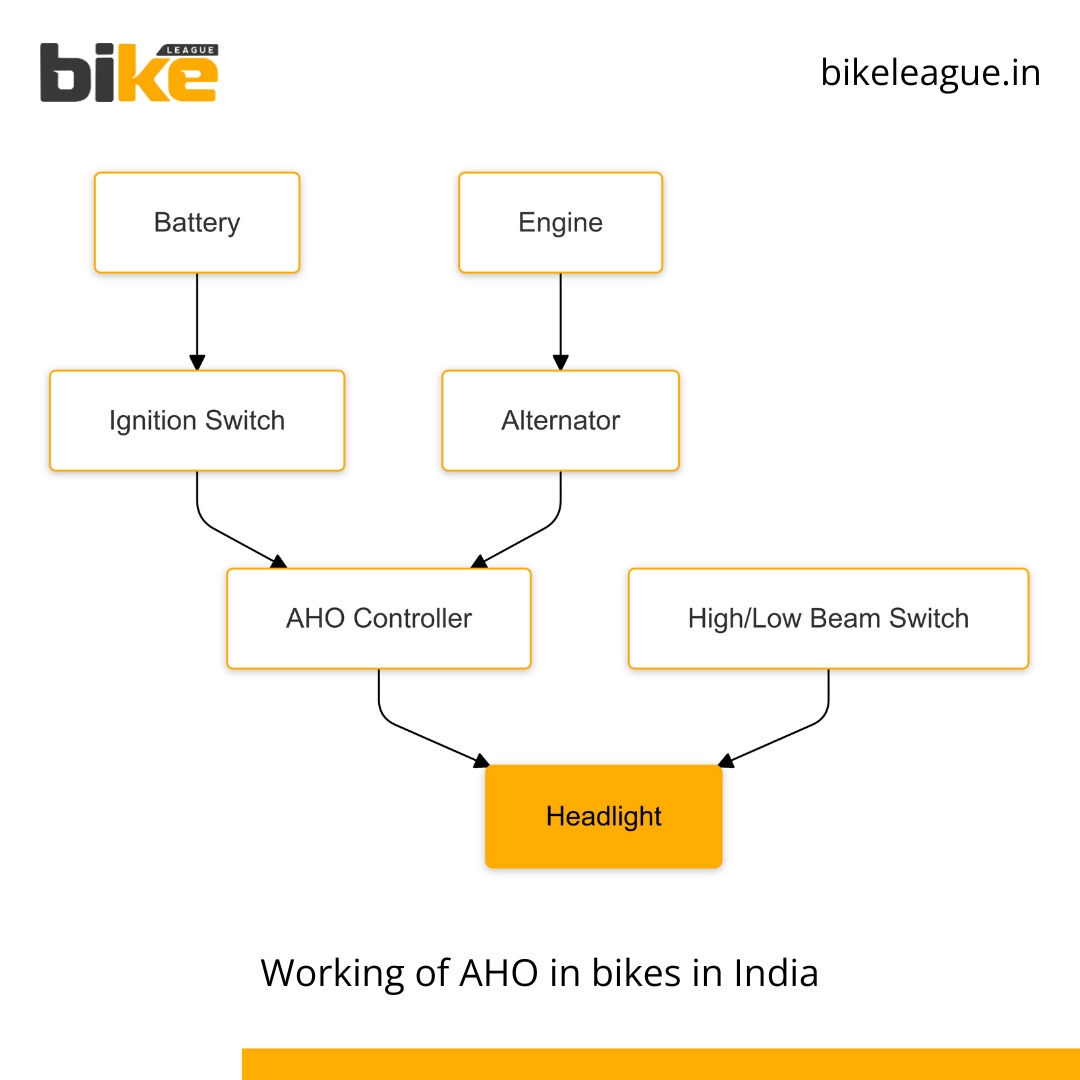
- The battery serves as the system’s primary power source.
- When the ignition switch is engaged, it activates the AHO (Automatic Headlight On) controller, which automatically supplies power to the headlight.
- The alternator generates a continuous power supply while the engine runs.
- Consequently, the headlight illuminates as soon as the engine is started and remains on throughout the operation.
- Riders can adjust the headlight’s intensity using a high/low beam switch.
- However, no manual switch is available to turn off the headlight completely.
Working Of Manual Switch Headlight System
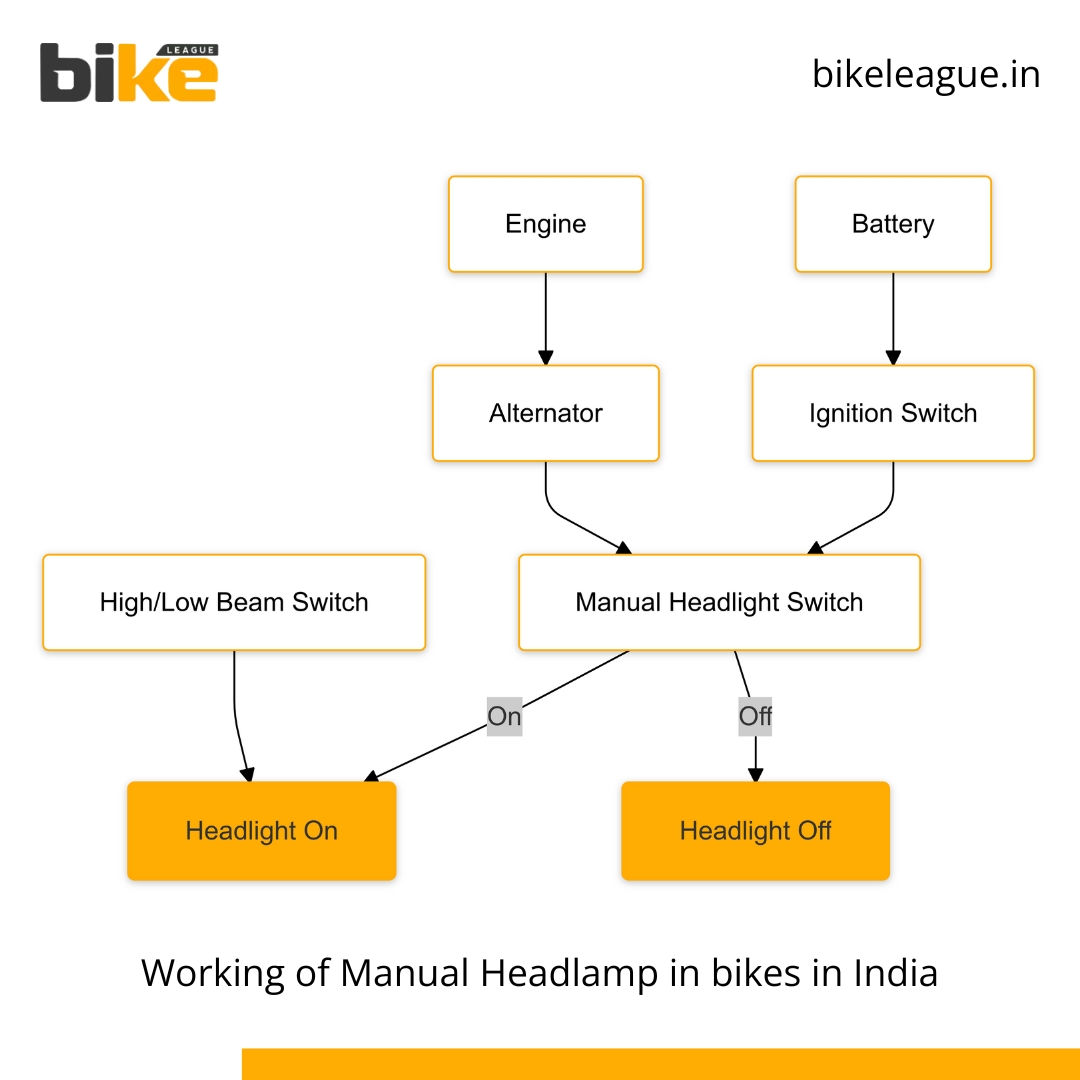
- The battery is essential for supplying power to the system.
- The ignition switch is crucial in activating the electrical system.
- A manual headlight switch gives the rider control over powering the headlight on and off.
- A high/low beam switch allows the rider to switch between high and low beam settings to adapt to different driving conditions.
- There is also a flash-to-pass switch activation of the high beam.
- While the engine runs, the alternator generates continuous power to support the system’s electrical needs.
What Is The Impact Of Automatic Headlamp On (aho) In Bikes And Scooters On Road Safety In India?
Since AHO became mandatory in 2017, it has helped improve road safety for two-wheelers in India. Estimates show a 10-20% drop in crashes related to daytime visibility, though total fatalities stayed high at 1.72 lakh in 2023 (up 2.6% YoY).
1. The Scale Of The Problem
Two-wheeler users accounted for 44.8% of India’s 1,72,890 road deaths in 2023 (MoRTH, Road Accidents in India 2023), which works out to roughly 77,000 deaths. In 2021, NCRB counted 69,240 two-wheeler deaths, or 44.5% of the total. Visibility is only one of several factors, alongside helmet non-use, speed and road design.
2. What Research Shows
International studies of motorcycle headlight-on laws and campaigns point to modest gains, not dramatic ones. India-specific data that isolates AHO’s effect from other factors, such as helmet enforcement, road design and traffic growth, is not widely available, so the figures below come from other countries.
| Study | What it looked at | Finding | Caveat |
|---|---|---|---|
| Elvik et al., 2003 (meta-analysis of 16 motorcycle studies) | Laws and campaigns promoting motorcycle daytime lights | About 5-10% fewer multi-party daytime crashes | Closest to a rule like AHO |
| Elvik et al., 2003 | Individual riders using daytime lights | About 32% fewer multi-party daytime crashes | Highly uncertain; based on a single study |
| Radin Umar et al., 1995 (Malaysia) | Running-headlight campaign and regulation, Seremban and Shah Alam | 6.9% drop in multiple-vehicle daytime motorcycle crashes; about 22% drop in conspicuity-related crashes | Short-term, preliminary, two districts |
| Davoodi and Hossayni, 2015 (literature review) | Motorcycle daytime running lights | About 4-20% lower motorcycle crash risk across reviewed studies | Some studies found no significant effect |
Sources: CTC & Associates summary of Elvik et al., Radin Umar et al., Davoodi and Hossayni.
Road deaths in India totalled 1,72,890 in 2023, and more than 54,000 of them were two-wheeler riders and pillions not wearing helmets (MoRTH, Road Accidents in India 2023). Helmet use and other factors move fatality numbers at the same time, which is one reason AHO’s separate contribution is hard to isolate.
3. Limitations And Trends
There is no official data on how many riders disable AHO, but forum discussions suggest it is not rare, and halogen inefficiency also limits the benefit. AHO works alongside, not instead of, helmet enforcement and other road-safety measures.
What Are The Advantages Of Automatic Headlamp On (aho) In Bikes And Scooters?
Here are some benefits of AHO for two-wheelers in India:
- Enhances daytime visibility: Makes two-wheelers more noticeable to other drivers in traffic, reducing collision risks.
- Reduces low-visibility accidents: Improves safety in fog, rain, dusk, dawn, or underpasses by ensuring constant illumination.
- Improves traffic-dense area safety: Minimises blind spots during merges, overtakes, or urban riding in India.
- Eliminates human error: Riders never forget to turn on lights, as it links directly to engine ignition.
- Aligns with global standards: Matches Daytime Running Lights (DRL) practices in Europe and elsewhere, proven to cut fatalities by 10-20%.
- Boosts rider confidence: Provides better road illumination in varied Indian terrains like mountains or highways.
- Negligible performance impact: Modern alternators handle load with minimal battery drain or fuel loss.
What Are The Disadvantages Of Automatic Headlamps On Bikes?
Automatic Headlamp On (AHO) on Indian bikes and scooters has drawbacks, especially regarding power consumption and maintenance in local conditions.
- Increased power consumption: Adds load to the alternator and engine, potentially dropping fuel efficiency by up to 1 kmpl in halogen-equipped models.
- Battery strain on short trips and idling: The headlamp load stays constant while the engine runs, but at idle and low rpm the alternator output is small. On very short rides, or in stop-go traffic with a weak battery, the battery can end up covering the gap, which leads to hard starting or a flat battery.
- Faster bulb and reflector wear: Prolonged heat from constant use accelerates bulb burnout and reflector fading, especially in traffic idling.
- No manual control: Riders cannot turn off the headlight, limiting flexibility in certain scenarios.
- Potential glare issues: Misaligned headlights irritate oncoming traffic or pedestrians, risking distractions.
- Minor environmental impact: Continuous halogen use across millions of vehicles contributes slightly to heat emission and global warming.
- Less relevance in sunny regions: Limited value in South India’s bright conditions compared to foggy North India.
Pros, Cons And Fixes Of Aho In Bikes And Scooters In India – Quick Comparison Table
| Pros | Cons | Fixes |
|---|---|---|
| Improves daytime visibility; studies link headlight-on rules to modest crash reductions | Battery strain on short trips, idling, and weak batteries | Test battery and charging system; replace an ageing battery |
| Eliminates forgetting lights (human error) | Faster bulb/reflector wear (halogen models) | Upgrade to LEDs (70% less draw, 5000+ hrs life) |
| Better safety in fog/rain/underpasses | No manual off-switch (frustrates riders) | OEM delay kits/service camps (warranty-safe) |
| Aligns with global DRL standards | Minor fuel drop (0.5-1 kmpl halogen) | Stronger alternators (140-180W) in BS6 |
| Cuts insurance claims via fewer accidents | Glare if misaligned (irritates oncoming) | Regular alignment checks at service |
What Is The Impact Of Aho In Different Regions Like Foggy North India Or Sunny South India For Bikes And Scooters?
AHO works much better in foggy North India than in the sunny south. It is expected to reduce low-visibility crashes by 15-25% during winters in Delhi and UP. At the same time, the benefit is minimal in Kerala and Tamil Nadu.
1. Northern Impact (fog-prone Regions)
Thick fog in Delhi, Punjab, Haryana, and UP through December makes it harder for drivers to spot two-wheelers at a distance, which is where a constantly lit headlamp is most likely to help. This is a visibility argument rather than a measured regional result.
2. Southern Limitations (sunny Regions)
In Kerala, the hazy sunshine and in Tamil Nadu, the coastal glare mean that daytime visibility is already good. Many riders feel that AHO is more distracting than helpful, leading to over 40% of them tampering with the system, according to online forums. There are no separate statistics for the south, but the benefit is estimated at only 5-10%, compared to 20% in the north. This has led to calls for an opt-out rather than a uniform rule.
3. Comparative Insights
There are no MoRTH regional splits for AHO’s effect. The north-versus-south contrast rests on visibility reasoning and rider anecdotes, not measured crash data.
What Are The Rider Suggestions About Aho In Bikes And Scooters In India?
Many riders in India view AHO as an imperfect safety rule. They often suggest changes, especially since tampering and battery issues are common topics on forums like Team-BHP and Reddit.
Common Suggestions
- Add manual override switch: Enable optional toggle for flexibility during washes, tweaks, or sunny rides, avoiding warranty-void hacks.
- Startup delay relay: Delay AHO by 10-30 seconds on ignition to prevent cranking failures on low batteries, standard on budget 100cc bikes.
- Mandate efficient LEDs: Shift from halogens to low-draw LEDs (5-10W vs 35W) across all models to cut drain and extend life.
- Awareness campaigns: Educate the public on the AHO rule to stop “lights off” gestures, especially in South India, where glare irritates oncoming traffic.
Tech And Policy Ideas
Riders propose sensor-based adaptive AHO—auto-dim in daylight, full in fog—mirroring EU DRLs, with app controls on premium bikes like Royal Enfield. Many call for regional opt-outs in high-sun areas like Kerala and enforcement via PUC fines only for verified non-compliance. EV owners suggest BMS integration to pause AHO during charging, aligning with green shifts.
What Are The Challenges Of Aho In Two-wheelers In India?
1. Battery Drain On Short Trips And In Traffic
AHO does not draw extra power at startup. The headlamp load (35-55W on halogen) is the same at every moment the engine runs. The problem appears when the alternator cannot keep up. At idle and low rpm its output is small, so in stop-go traffic the headlamp, indicators, and other loads can exceed what it produces, and the battery covers the gap. On rides under about 10 km, the alternator may not replace the energy the starter used, so an ageing battery slowly loses charge. Riders then see hard starting or a flat battery, which delivery riders in cities like Mumbai and Delhi often report.
Before blaming AHO, test the battery and charging system. A healthy 12V battery reads about 12.6V at rest and roughly 13.5-14.5V at the terminals with the engine at fast idle or higher. Aftermarket startup-delay relays exist, but they modify the factory circuit and can affect warranty and insurance claims.
2. Accelerated Maintenance Costs
Constant use halves the lifespan of halogen bulbs to 500-1000 hours, hitting low-income riders hard, as frequent replacements cost ₹100-200 each. LED upgrades help premium models like Royal Enfield, but fade reflectors on cheaper ones, worsening glare in monsoons. Supreme Court rulings on “dazzling headlights as weapons” in late 2025 amplify calls for better alignment standards.
What Are The Controversies Of Aho In Two-wheelers In India?
1. Enforcement And Tampering Woes
Over 30% of riders disable AHO via DIY wiring hacks, per mechanic anecdotes, dodging fines up to ₹1000 under the MV Act but inviting insurance denials. Low awareness fuels road rage—oncoming drivers flash “lights off” signals, especially in sunny Kerala or Tamil Nadu, where daytime benefits seem negligible.
2. Regional And Practical Mismatches
Fog in North India is the strongest visibility argument for AHO. Still, South India’s glare-heavy tropics question its blanket rule. EV scooters face added BMS strain during charging pauses, clashing with 2025’s green push, while ABS delays for 125cc bikes highlight similar cost-vs-safety rifts.
3. Public Backlash And Policy Debates
Users decry “unnecessary load” on 10+ lakh daily riders, demanding optional toggles like Europe’s DRLs. Industry lobbies push reviews amid BS6 upgrades, arguing modern ECUs could smarten AHO for climate-adaptive activation. Safety advocates counter that overseas studies link headlight-on rules to modest reductions in daytime multi-vehicle crashes.
Is Aho In Bikes And Scooters Truly Successful In India?
Forum posts suggest some riders bypass AHO, often citing battery concerns on short commutes, but there is no reliable measure of how many. Bulb wear can add maintenance costs for budget riders. No study isolates AHO’s net effect on fatalities, and two-wheeler users still account for about 44.8% of India’s road deaths (MoRTH, 2023).
1. Safety Gains
Since 2017, AHO has aligned India with headlight-on practice elsewhere, which studies link to modest reductions in daytime multi-vehicle crashes. For two-wheelers in fog-prone areas the benefit is an expected one rather than a measured one.
2. Adoption Hurdles
Widespread tampering persists—30%+ riders disable AHO via relays for battery relief on short 100cc commutes, per 2025 forums, voiding warranties. Maintenance spikes from bulb wear hit budget users, with no 2025 stats isolating AHO’s net fatality drop amid rising total accidents (1.5 lakh two-wheeler deaths yearly).
3. Mixed Verdict
While intent succeeds in visibility boosts, uniform enforcement fails in sunny south India, fueling backlash without fresh data proving scaled lives saved beyond early estimates. Modern LEDs mitigate the cons, but optional toggles could enhance acceptance, as with EU models.
What Is The Path Forward For (aho) Automatic Headlamp On For Two-wheelers In India In 2026?
Looking ahead, AHO in India will focus on smarter technology, stronger enforcement, and better integration with electric vehicles. These steps aim to solve rider concerns while keeping safety benefits.
1. Tech Enhancements
Transition to adaptive AHO with sensors for climate-based activation—low-beam only in fog/rain, dimmer in sunny south India—reducing battery strain on 100-125cc bikes. ECU-linked delays (10-30s startup bypass) via aftermarket relays could become OEM-standard to ease cranking issues.
2. Policy And Enforcement
Launch awareness campaigns via MoRTH and SIAM, educating on 10-15% crash reductions to curb 30% tampering rates and “lights off” gestures. Tie AHO compliance to PUC/RTO checks, with fines up to ₹1000, mirroring upcoming ABS mandates for all two-wheelers from 2026. Regional pilots: Optional toggles in high-sunlight states like Kerala, per user preferences for practical features.
Proposed Rule Change: Low-beam-only Aho
In August 2026, MoRTH published draft amendments to the Central Motor Vehicles Rules that would change how AHO works. As reported, the draft would require AHO on new two-wheelers to operate in passing (low) beam only, and would lower the maximum headlamp intensity for two-wheelers from 1.5 lakh candela to 1 lakh candela. Reports describe today’s AHO as able to come on in whichever beam is selected, which is why the ministry wants a low-beam default. This is a draft proposal and may change before it is notified.
Sources: Daily Pioneer, Business Standard.
3. Ev And Future Integration
For 2025’s EV surge (Ather, Ola), integrate AHO with the BMS to enable zero-drain modes during charging pauses, aligning with DRL standards for EU exports. Industry lobbies like FADA push ARAI studies for data-driven tweaks, potentially making AHO “smart DRL” by 2027 amid ABS delays, highlighting cost-safety balance. Premium models (Royal Enfield, Hero) lead with app-controlled AHO, setting norms for mass-market adoption.
Faq About (aho) Automatic Headlamp On In Bikes And Scooters In India
1. What Is Aho In Bikes And Scooters?
AHO, or Automatic Headlamp On, keeps the headlight on whenever the engine is running, eliminating the need for manual switches for constant visibility.
2. Is Aho Mandatory For All Two-wheelers In India?
Yes, every new bike and scooter manufactured after April 2017 must include AHO per MoRTH rules, covering all BS4/BS6 models.
3. How Does Aho Work Technically?
Headlight wiring links directly to the ignition/ECU, powering on within 1-2 seconds of startup; alternator sustains it post-cranking.
4. Does Aho Drain The Bike Battery Significantly?
Not during normal riding. A halogen headlamp draws roughly 3 to 4.5 amps (35-55W at 12V), which a healthy alternator can supply once the engine is above idle. The drain becomes noticeable in three situations: very short trips where the alternator has little time to replace what the starter used, long idling in stop-go traffic where alternator output is low, and older batteries or small alternators on budget 100-125cc bikes. In these cases AHO adds to an existing load. It contributes to the problem but is rarely the root cause.
5. Can I Disable Aho On My Bike?
Disabling via wiring cuts or relays violates safety norms, attracts ₹1000 fines, voids warranties, and risks insurance claim rejections.
6. What’s The Difference Between Aho And Drl?
AHO uses the main headlight (35-55W halogen/5-10W LED) always on; DRLs are separate dimmer LEDs for daytime, common on cars/premium bikes.
7. Does Aho Affect Fuel Efficiency Or Performance?
Impact remains minimal (max drop of 0.5-1 kmpl on halogens), offset by efficient BS6 alternators and LEDs in the latest models.
8. Why Do People Get “lights Off” Gestures Despite Aho?
Low awareness of the 2017 mandate causes confusion, especially during the day in sunny areas; education campaigns aim to reduce this.
9. Has Aho Reduced Accidents In India?
Overseas studies link motorcycle headlight-on rules to roughly 5-10% fewer multi-vehicle daytime crashes, but no India-specific study isolates AHO’s effect, so the number of lives saved cannot be stated reliably. Road deaths in India remained high at 1,72,890 in 2023.
Official Sources
- AHO Gazette Notification
- AIS-010: Performance requirements of lighting and light-signalling devices for 2 and 3 wheeled motor vehicles (ARAI)
Other Related Links From Bikeleague India
- Causes of motorcycle Accidents In India – Detailed Analysis
- Motorcycle headlight in India – Everything you need to know
- Motorcycle kill switch & key switch differences – video
- Hero Passion XTEC
- Top 10 sold petrol two-wheelers in India in FY25
Conclusion
Automatic Headlamp On (AHO) makes two-wheelers easier to see and aligns India with headlight-on practice elsewhere. Overseas evidence points to modest crash reductions, though India-specific data is limited. Challenges such as battery drain on short trips, bulb maintenance, and regional differences remain.
Ongoing advances in technology, better enforcement, and rider feedback are shaping the next phase of AHO, aiming for safety without extra inconvenience. As manufacturers and policymakers introduce solutions like adaptive LEDs and region-specific features, AHO is expected to become safer, smarter, and more widely accepted in India. Its continued success will depend on innovation, compliance, and public awareness, helping two-wheeler riders stay visible and protected on every journey.
This guide helped you understand Automatic Headlamp On (AHO) for bikes and scooters in India. If you have questions or want more information, email us at bikeleague2017@gmail.com or leave a comment below. We’re here to help. Also, follow Bikeleague India on social media to stay updated.