
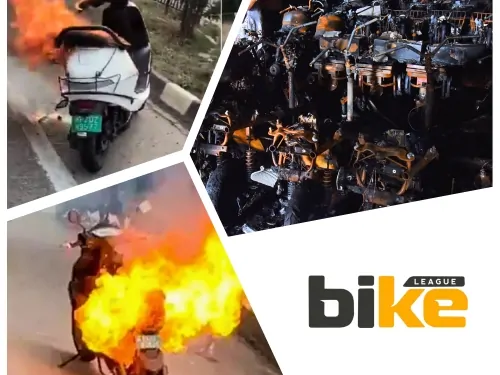
Long story short: Electric bikes and scooters are showing up more often on Indian roads, which is exciting. At the same time, there have also been more fire incidents with these vehicles. As a result, this has made both consumers and regulators more concerned about safety and led to a closer look at the risks.
Electric bikes and scooters have rapidly gained popularity across India, promising eco-friendly transportation and a glimpse into the future of urban mobility. As a consequence, this surge in adoption has been accompanied by a growing number of fire incidents. More importantly, this new trend is thereby raising essential questions about the safety of these vehicles.
As consumers, manufacturers, and regulators grapple with these challenges, understanding the risks—and the steps being taken to mitigate them—has never been more crucial. In light of these concerns, and to clarify, this article explores the causes, risks, prevention measures, and evolving regulations surrounding electric bike and scooter fires in India.
Key Takeaways
- Electric bikes and scooters are becoming more common in India. On the other hand, rising fire incidents have increased safety concerns among consumers and regulators.
- Most fires are caused by battery problems (such as poor-quality batteries or overcharging), technical faults (such as defective chargers or wiring), and manufacturing defects. Notably, these issues often stem from inadequate safety measures or poor quality control. In contrast, vehicles that adhere to strict safety standards experience fewer incidents.
- In response, the government and industry have implemented new safety standards, stricter regulations, and certification requirements to improve EV safety. As a direct result, the industry aims to minimize fire hazards and increase public trust.
- Additionally, following charging guidelines, avoiding unauthorised modifications, using certified parts, and regular maintenance are essential steps to prevent fires. In other words, responsible ownership is key to safety.
- Furthermore, comprehensive insurance policies cover fire-related incidents, and consumers have strong legal protections and the right to seek compensation for manufacturing defects. As such, it is vital for consumers to stay informed about their rights and coverage options.
In summary, these key takeaways highlight the importance of a comprehensive approach to electric vehicle safety in India.
Stats About Fire In Electric Bikes And Scooters In India
To begin with, official data on electric bike and scooter fires in India remains fragmented, with no comprehensive national registry maintained by government authorities. In fact, the lack of centralized data makes it challenging to assess the true scale of the issue.
The Ministry of Road Transport and Highways (MoRTH) does not separately track fire incidents; instead, it records general electric vehicle accidents through its eDAR portal. Nevertheless, the government has acknowledged the fire incidents and provided data that show a broader, troubling trend. As a further point, this highlights the need for more focused data collection.
1. National-level Official Data As A Table
| Year | Accidents | Deaths | Injured | Death Increase (%) | Injury Increase (%) |
|---|---|---|---|---|---|
| 2022 | 4,363 | 1,518 | 5,752 | — | — |
| 2023 | 5,804 | 1,748 | 7,415 | +15.1% | +28.9% |
| 2024 | 7,575 | 1,947 | 9,318 | +11.4% | +25.7% |
| 3-Year Total | 17,742 | 5,213 | 22,485 | +28.2% | +62.0% |
Importantly, Source: Ministry of Heavy Industries, Rajya Sabha Response Unstarred Question No. 3268
2. Key Findings
There has been a 74% increase in total accidents (2022-2024), with deaths rising 28% and injuries climbing 62% over the three years. However, MoRTH’s eDAR portal does not separate fire incidents from general crashes, thus making it impossible to quantify the national prevalence of fire incidents. In summary, comprehensive data is still lacking.
3. Government Acknowledgement Of Fire Incidents
The Ministry of Heavy Industries confirmed in March 2025 that fire-specific data is not centrally compiled by MoRTH, and the government maintains no national registry of fire-related incidents. As a consequence, safety standards were introduced via Automotive Industry Standards (AIS-156, AIS-038) in December 2022, in response to documented fire incidents.
What Are The Causes Of Electric Bike And Scooter Fire In India
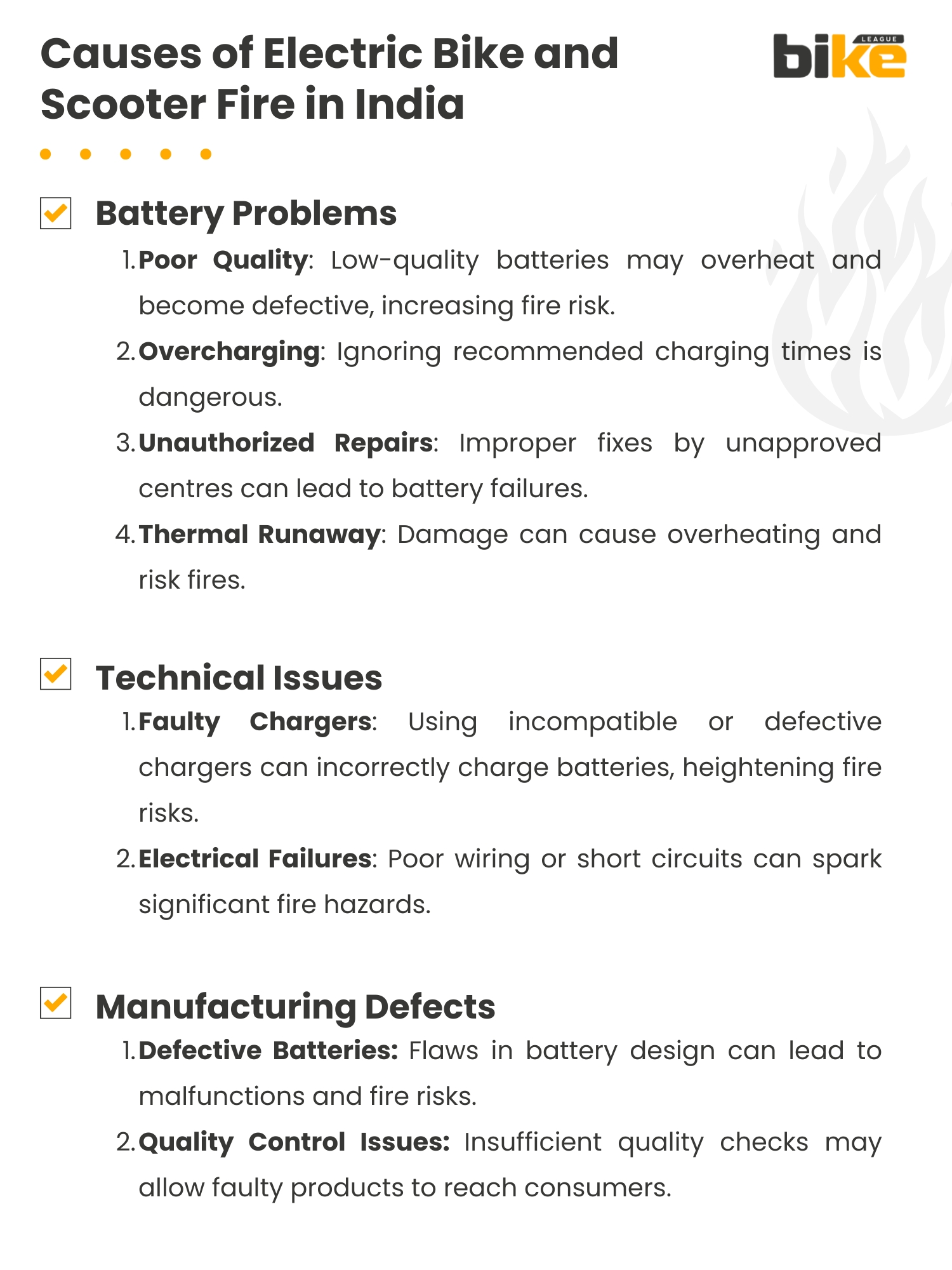
Electric bikes and scooters are more popular than ever, but they also come with safety risks, especially fire hazards. To illustrate, understanding what causes these fires is crucial to staying safe. The main reasons are battery problems, technical issues, and manufacturing defects.
1. Battery Problems
Most electric bike and scooter fires start with their batteries, especially lithium-ion batteries. Specifically, these batteries are powerful but can also be risky:
- Poor Battery Quality: Using low-quality batteries can cause overheating and defects, which may lead to fires.
- Overcharging: Ignoring the recommended charging times is risky. Overcharging can cause batteries to heat up excessively and even ignite.
- Cheap or Unauthorised Repairs: Batteries that are poorly made or fixed by unauthorised service centres are more likely to fail when you need them.
- Thermal Runaway: If a battery is damaged, it can overheat uncontrollably in a process called thermal runaway, which increases the risk of fire.
2. Technical Issues
Moreover, Besides battery issues, problems with the electrical systems in e-bikes and scooters can also cause fires. Additionally, here are some common reasons:
- Faulty Charging Equipment: Using incompatible or defective chargers can lead to improper charging, increasing the chance of battery fires.
- Electrical Failures: Problems like faulty wiring, loose connections, or short circuits can create serious fire risks.
3. Manufacturing Defects
Manufacturing defects can also cause fire hazards. Conversely, high-quality manufacturing can greatly reduce risks. For instance, here are some examples:
- Defective Batteries: Sometimes, a battery’s design has flaws that can lead to malfunctions and, in turn, increase fire risk.
- Inadequate Quality Control: If manufacturers do not check quality carefully, defective products can reach customers and put them at risk.
If riders are aware of these risks, they can take steps to keep their electric bikes and scooters safe and enjoyable. For example, use high-quality parts, follow safe charging habits, and check for technical problems. In conclusion, being careful helps make electric mobility safer for everyone.
What Are The Risks Associated With Electric Bike And Scooter Fire In India?
Electric bikes and scooters make city travel easier and more eco-friendly. However, they also come with some risks, especially if a fire happens. With this in mind, here are some key things to know about fire hazards with these vehicles.
1. Personal Safety At Stake
Injuries And Tragedies
Fires involving e-bikes and scooters can cause serious injuries and even deaths. For example, in London in 2023, there were 143 e-bike fires and 36 e-scooter fires, leading to 3 deaths and about 60 injuries. Thus, these numbers highlight the importance of safety.
Explosive Fire Dynamics
Lithium-ion batteries in e-bikes can be unstable. If a battery enters thermal runaway, it can start a hard-to-control fire. This puts both riders and people nearby at risk, so it’s essential to be careful when using and charging these devices.
2. Property Damage Nightmares
Impact On Homes And Businesses
E-bike and scooter fires can also cause significant property damage. For example, a fire in Brixton, London, started from a faulty e-bike battery and badly damaged a first-floor flat. Clearly, this shows how quickly these vehicles can become dangerous if something goes wrong.
Challenges In Fire Containment
Lithium-ion battery fires can spread quickly and cause severe damage before firefighters arrive. Additionally, the risk is even higher if several devices are charging in the same place. This shows why it’s essential to be careful when charging these batteries.
3. Environmental Implications
Toxic Emissions
Lithium-ion battery fires also harm the environment. When these batteries burn, they release toxic gases and particles that add to air pollution and can be dangerous to people nearby. Therefore, this makes safe handling and storage even more critical.
Waste Management Woes
Properly disposing of damaged or faulty batteries is essential. Otherwise, if these batteries are not recycled properly, they can end up in landfills and leak harmful chemicals into the soil and water. Recycling batteries correctly helps protect the environment.
What Are The Prevention Measures & Safety Guidelines For Electric Bike And Scooter Fire In India?
To address these risks, everyone involved in electric bikes and scooters, including users, manufacturers, and regulators, should prioritise safety. Furthermore, by following and promoting safety guidelines, we can lower the risk of fires and build a safer industry. Specifically, here’s how each group can help keep rides safe.
1. For Users: Your Ride, Your Responsibility
Charge With Care
Always follow the manufacturer’s charging instructions. Furthermore, don’t overcharge, and use only the charger that came with your bike or a certified replacement. On top of that, never leave your bike charging unattended or overnight, as this can cause overheating.
Stay Informed About Batteries
Learn about the risks of lithium-ion batteries. Similarly, store and handle them properly to stay safe.
Safety Gear And Rules Of The Road
Wearing a helmet dramatically reduces the risk of head injuries. Similarly, always follow traffic rules, use bike lanes when you can, and stay alert while riding.
Keep It Well-maintained
Regular maintenance helps your e-bike or e-scooter work properly. Likewise, regularly checking your vehicle can help prevent problems that could cause accidents or fires.
2. For Manufacturers: Innovate With Safety In Mind
First and foremost, Commit to Battery Safety Standards
Make sure the lithium-ion batteries in your products meet or exceed safety standards, such as UL 2271. In particular, test them carefully to prevent thermal runaway and associated fire risks.
Prioritise Quality Control
Moreover, conduct thorough quality checks during manufacturing to identify and fix defects that could affect user safety.
Educate Your Customers
Additionally, provide clear, simple instructions and safety information with your products so users know how to use them safely.
Design For Safety
Likewise, make battery enclosures and electrical systems better to keep your devices safer.
3. For Regulators: Paving The Way For Safer Rides
Enforce Safety Standards
Ensure e-bikes and e-scooters comply with all safety and performance standards, especially regarding batteries. In turn, this helps reduce fire risks.
Launch Public Awareness Campaigns
Educate the public about the risks and safety steps for e-bikes and e-scooters. As a result, informed users can help prevent accidents.
Develop Safe Infrastructure
Create dedicated bike lanes and safe riding areas to reduce conflicts with other vehicles and improve road safety. Consequently, this improves overall safety for all road users.
Establish Incident Reporting Systems
Set up a system to report and study incidents involving e-bikes and e-scooters. Subsequently, this information can help find common problems and improve safety rules.
What Specific Regulatory Measures Are Being Implemented To Improve The Safety Of Electric Bikes And Scooters In India?
India is introducing new rules to improve the safety of electric bikes and scooters. Some key steps include:
1. Automotive Industry Standards (ais)
The Automotive Industry Standards Committee (AISC) has developed specific requirements for electric powertrains in motor vehicles, such as AIS 038 (Rev. 2), which outlines safety standards for electric two-wheelers.
2. Battery Safety Norms
In response to safety concerns, the Ministry of Road Transport and Highways (MoRTH) has introduced regulations focused on battery safety, including standards for battery management systems, thermal propagation from internal cell short circuits, and other safety requirements to prevent fire incidents.
3. Vehicle Certification
The Automotive Research Association of India (ARAI) and other designated agencies are responsible for testing and certifying electric scooters and bikes before they enter the market to ensure compliance with safety standards.
4. Consumer Protection Investigations
Regulatory bodies like the Central Consumer Protection Authority (CCPA) are actively investigating manufacturers regarding service standards and product quality. For instance, Ola Electric faced scrutiny following numerous consumer complaints, prompting an investigation by the Bureau of Indian Standards (BIS).
5. Fame India Scheme
The Faster Adoption and Manufacturing of Hybrid and Electric Vehicles (FAME) scheme incentivises the adoption of electric vehicles while emphasising safety and performance standards. Phase II of the scheme continues to support the development of safe and reliable electric mobility solutions.
How Can Consumers Identify High-quality Batteries And Reliable Manufacturers In India?
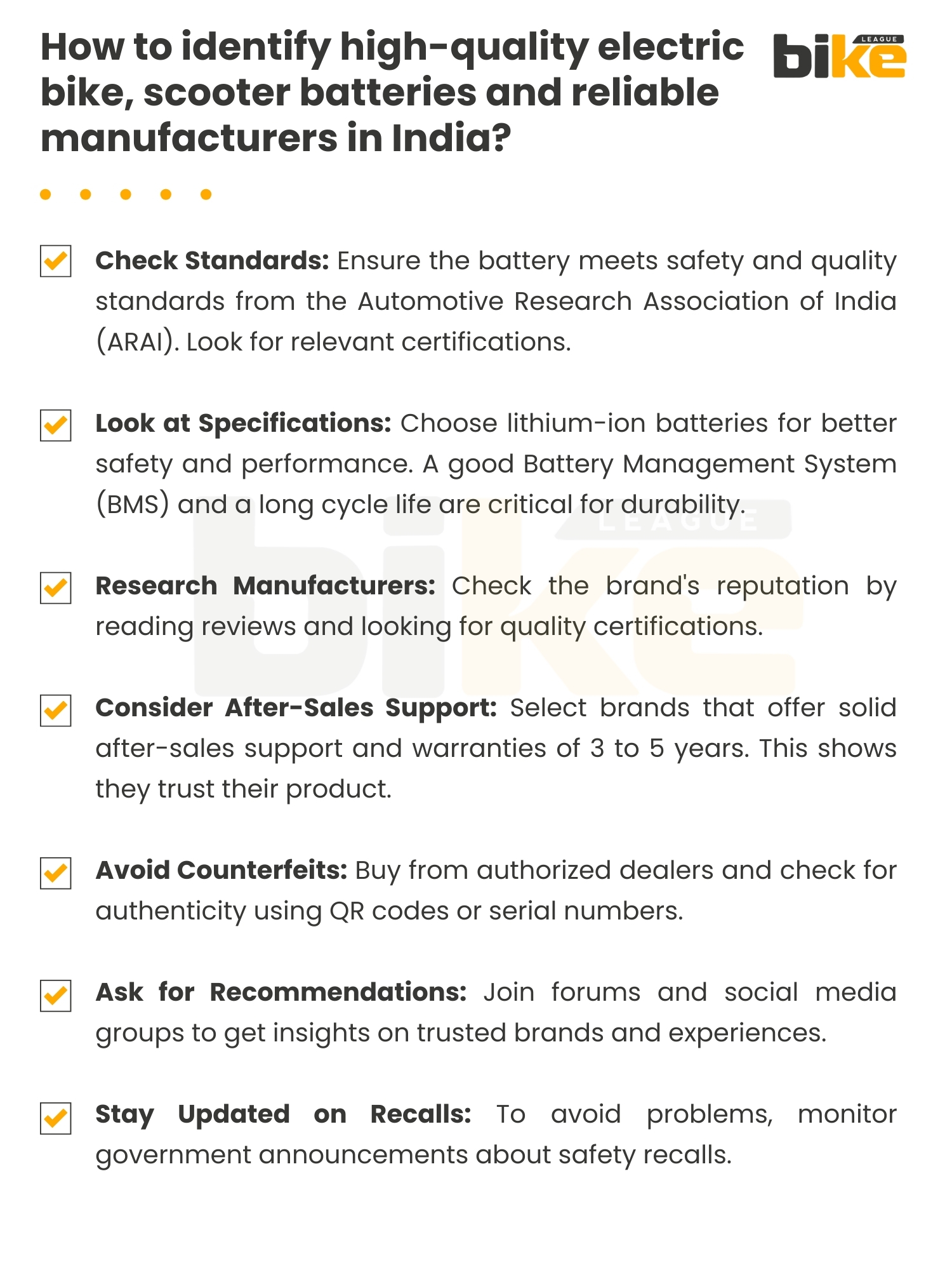
Choosing the correct battery for your electric scooter or bike means knowing what to look for. To help you make an informed decision, here are some simple steps to help you pick a high-quality, reliable battery:
1. Check Compliance With Standards
First, make sure the battery meets key safety and quality standards, such as AIS 156 and AIS 038 Rev. 2. Look for certifications from trusted organisations, such as the Automotive Research Association of India (ARAI) or other well-known testing agencies. These approvals show the battery is safe.
2. Inspect Battery Specifications
Check the details. Choose lithium-ion batteries, as they are safer and more efficient than lead-acid ones. Make sure the battery has a good Battery Management System (BMS) to prevent overcharging, overheating, and short circuits. Also, look at the cycle life; higher numbers mean the battery will last longer.
3. Research Manufacturer Reputation
Learn about the battery brand. Read reviews, check testimonials, and see how well-known the company is. Trusted manufacturers usually hold certifications such as ISO 9001, which demonstrate adherence to high-quality standards.
4. After-sales Support
Choose brands that offer good after-sales support. Look for warranties of 3 to 5 years, as this shows the company trusts its product and will help if problems come up.
5. Avoid Counterfeit Products
Always buy from authorised dealers or directly from the manufacturer to avoid fake products. Check for QR codes, serial numbers, or other unique markings to make sure the battery is genuine. This simple step can prevent many problems.
6. Seek Recommendations
Ask other users for advice. Join forums, social media groups, or local electric scooter and bike communities. These groups can give helpful information on trusted brands and products.
7. Stay Informed About Recalls
Check regularly for updates from the government or manufacturers about recalls or safety issues with certain batteries or vehicles. Staying informed helps you avoid problems.
What Advancements Are Being Made In Battery Technology To Reduce The Risks Of Electric Bike And Scooter Fires & Overheating In India?
The future looks bright for electric scooters and bikes in India, thanks to new battery technology that makes them safer. As more people use electric vehicles, there is a greater focus on reducing risks such as overheating and fires. Here are some significant new developments:
1. Solid-state Batteries: A Game Changer
Solid-state batteries are changing the industry because they use solid electrolytes instead of liquid ones, which significantly lowers the risk of overheating and fires. Companies like Ola Electric are working to add these safer batteries to their scooters soon.
2. Enhanced Thermal Management Systems: Keeping Cool Under Pressure
Controlling battery temperature is essential for safety. New thermal management systems, such as advanced liquid cooling, phase change materials, and improved heat-dissipation designs, help keep batteries safe and working well.
3. Lithium Iron Phosphate (lfp) Batteries: Safety First
LFP batteries are becoming more popular in electric vehicles because they are safer than regular lithium-ion batteries. As a result, they are less likely to overheat or go into thermal runaway. More Indian manufacturers are using this technology to make driving safer.
4. Smart Thermoresponsive Separators: The Future Of Battery Safety
Researchers are developing smart thermoresponsive separators that shut down the battery at high temperatures, helping prevent fires. This new technology could make lithium-ion batteries safer and last longer.
5. Collaboration For Innovation: The Power Of Partnerships
Indian companies are partnering with others to use advanced battery technologies. For example, Amara Raja is working with China’s Gotion to make lithium-ion cells in India, which helps improve safety and performance.
These new technologies show how India’s electric vehicle industry is working to solve safety issues. With these improvements, the future looks bright for electric scooters and bikes.
What Is The Insurance Coverage For Ev Fire Incidents In India?
If you own an electric scooter or bike, it’s natural to worry about what happens if a fire breaks out. The good news is, comprehensive two-wheeler insurance policies in India (as of 2026) do cover fire, explosion, and even self-ignition for electric bikes and scooters. However, it’s essential to know that third-party liability insurance—which is mandatory under the Motor Vehicles Act, 1988—does not cover damage to your own vehicle from a fire. Instead, it’s there to protect you if someone else is hurt or their property is damaged because of an incident involving your scooter or bike.
You can also opt for EV-specific add-ons that provide extra protection against battery fires, electrical surges, and charging-related damage. Plus, to encourage more people to go electric, the IRDAI gives a 15% discount on third-party insurance premiums for EVs. Keep in mind, though, that own-damage premiums are still higher because of the cost of EV batteries.
| Coverage Type | Fire Coverage Details | Exclusions | Recommended Add-ons |
|---|---|---|---|
| Third-Party (Mandatory) | Third-party bodily injury/property damage only | Own vehicle fire/explosion | N/A |
| Comprehensive | Fire, explosion, battery damage in accidents/perils | Wear/tear, improper charging (unless add-on) | Battery protection (₹200-1,000 extra) |
| EV-Specific | Motor controller, charger, zero depreciation | Consequential damage (e.g., floods) without add-on | Roadside assistance, consumables |
If you ever need to make a claim, you’ll usually need to file an FIR (if there’s significant damage), take photos, and get a surveyor inspection within 48 hours. Depending on the situation, your insurer will either cover the repairs or pay you for a total loss based on the vehicle’s Insured Declared Value (IDV).
What If A Fire Is Caused By A Faulty Scooter Or Battery? Here’s Where Manufacturer Liability Comes In:
Manufacturers are strictly held responsible for defective EVs that cause fires under the Consumer Protection Act, 2019 (CPA). You don’t even have to prove negligence. If your scooter or battery was defective and caused a fire, you could be eligible for a full refund, interest, and compensation (and courts have already awarded this in several cases).
The Ministry of Road Transport and Highways (MoRTH) can also order recalls if they find safety defects—this happened with Ola, Okinawa, and Pure EV in 2022, when over 6,000 vehicles were recalled. If a manufacturing defect is found, your insurer might even recover the claim amount from the manufacturer.
Your Rights As A Consumer: What Can You Do?
Under the CPA 2019, you’re officially a “consumer” if you buy an EV. If your bike or scooter has a defect—like a battery fire—you can hold the manufacturer strictly accountable. The Delhi High Court (2023) also clarified that EVs are considered “motor vehicles” under the law, which means they must be insured and registered, just like petrol vehicles.
How Can You Fight For Your Rights If Something Goes Wrong? Here Are Your Options:
- Consumer Dispute Redressal Commissions: You can file for a refund, replacement, or compensation (including medical costs or mental stress). There are no court fees, and you can submit everything online via the E-Daakhil portal. Depending on the claim amount, cases are heard at the District (up to ₹1 crore), State (₹1–10 crore), or National (above ₹10 crore) commissions.
- CPA Remedies: The CPA allows for repair, replacement, refund, and damages, with cases usually resolved in 3–5 months.
- MVA Claims: If a third party is injured or, in tragic cases, dies because of your EV, compensation is handled through the Motor Accident Claims Tribunal.
- Class Actions: If you’re not the only one affected—for example, in a mass recall—you and others can file a collective complaint (class action).
Always keep your RC, invoice, service records, and any evidence of the problem. Government standards (such as AIS 156/038) are in place to ensure battery safety, and companies that don’t follow them can face penalties or recalls. If there’s a proven defect, legal precedents are in your favour—and insurers often support claims against manufacturers.
What Is The Role Of Charging Stations And Fires In Electric Bikes And Scooters In India?
When it comes to charging your electric bike or scooter—whether at home or at a public station—fire safety is a top concern for everyone. Thankfully, India has put in place strict rules to help keep riders and their vehicles safe. Most public charging stations and home installations comply with the Ministry of Power (MoP) guidelines and the Bureau of Indian Standards (BIS) safety standards.
Because of these measures, fires at certified charging sites are pretty rare. Regulations require that only BIS IS 17017-certified chargers be used, along with fire-resistant materials and emergency systems, to reduce the risk of battery fires during charging.
1. Staying Safe At Public Charging Stations
If you’re using a public charging station, look for key safety features: fire extinguishers, smoke detectors, CCTV cameras, surge protection, and staff trained to handle emergencies. By law, these stations must keep chargers in covered and well-ventilated areas, far away from things that can catch fire—and they can’t use halogen materials. These precautions are designed to protect both you and your vehicle.
| Key Requirement | Specification | Purpose |
|---|---|---|
| Equipment | BIS IS 17017 certified (AC/DC), CEA-compliant cabling | Prevents electrical faults, thermal runaway |
| Fire Protection | Extinguishers (CO2/dry powder), heat sensors, emergency cut-offs | Suppresses battery fires |
| Site Design | Encroachment-free parking, rain/lightning protection | Avoids short circuits, overheating |
| Operations | Billing tracking, 24/7 helpline, monthly CCTV storage | Ensures accountability |
Serious fire incidents at public stations are now rare. For instance, in 2022, a major fire at a Delhi metro parking lot destroyed 10 EVs—likely due to a short circuit. But since new rules came into effect, such events have become extremely uncommon, giving riders more peace of mind.
2. Charging Safely At Home
If you prefer to charge your EV at home, there are a few essential things to keep in mind. Regulations say you shouldn’t charge in basements unless it’s the first, well-ventilated level. Always use fire-survival cables and Residual Current Devices (RCDs) for extra protection, and make sure your charging point is above flood level and away from gas lines or exits. Housing societies must set aside 20% of parking spots for EVs, and they cannot stop you from safely installing a charger if you follow the rules.
Smart Safety Habits:
- Only use certified chargers—don’t risk it with cheap, uncertified options.
- Never leave your vehicle charging overnight or without supervision.
- Always charge in well-ventilated, open spaces. Avoid tight or crowded parking arrangements that trap heat.
- Keep the charging setup at least 10 meters away from any flammable materials and ensure it’s out of reach of children.
3. Government Rules That Make Charging Safer
Recent government rules (from 2022 to 2025) require all chargers and batteries to be BIS-certified and have smart systems to manage and monitor battery temperature. Here are some of the latest updates:
- BIS IS 17017: Now mandatory for all charging equipment. This standard ensures chargers are fire-resistant and work with different EV brands..
- 2025 Fire Safety Rules: Require advanced battery management systems and fire-retardant cases for better protection. The market for safe charging solutions is expected to grow by 35% in the near future!.
- NBC Amendments: Stricter rules to limit basement charging, making apartment buildings much safer for everyone.
Remember, following these rules isn’t just about safety—if you comply, you’re also eligible for government subsidies, while breaking them can result in penalties. Most fires happen when people cut corners with uncertified chargers or ignore basic safety steps—not because the charging infrastructure itself is unsafe.
How Aftermarket Modifications And Accessories Affect Fire Chances In Electric Bikes And Scooters In India?
For many riders, the temptation to upgrade or modify their electric bikes and scooters is strong. Suresh, a delivery executive in Pune, recalls swapping his battery for a bigger one at a local shop—hoping for better range. “I thought I was saving money, but a few weeks later, my scooter started overheating while charging. I was lucky nothing worse happened,” he says.
Many electric bike and scooter fires in India are traced back to unauthorised aftermarket modifications, such as battery swaps, custom chargers, or wiring alterations, which void warranties and bypass safety systems. Manufacturers and government warnings emphasise the importance of using OEM parts to avoid thermal runaway and short circuits.
1. Documented Fire Incidents From Modifications: Experiences From The Ground
- Ola S1 Pune Fire (October 2023): The owner, a college student, had unknowingly installed an aftermarket part suggested by a neighbourhood mechanic. One evening, his scooter caught fire while parked outside his hostel. Thankfully, no one was injured, but the incident left him shaken and his vehicle badly damaged.
- Komaki Pune Showroom Fire (July 2022): The showroom manager described the chaos as flames engulfed seven bikes. Later investigation revealed the batteries had been removed and reconnected without the original connectors, likely to save on costs. Overcharging in these tampered units sparked the disaster.
- BattRE Battery Explosion (Vasai, October 2022): A dealer in Vasai shared how a returned battery, recently serviced and refurbished, suddenly exploded while sitting in his workshop. “It was terrifying. I realised how dangerous these faulty or modified batteries could be,” he said.
- General Trends: Investigations by a 2022 expert panel uncovered faulty aftermarket cells or modules in multiple fire cases. The Maharashtra government responded by cracking down on illegal modifications, imposing steep fines—up to ₹1 lakh per dealer. One local dealer admitted, “After seeing a neighbour’s shop fined, I stopped offering non-standard parts. It’s simply not worth the risk.”
Illegal units producing fake batteries exacerbate risks, prompting state transport ministers to demand crackdowns.
2. Risks Of Common Modifications
| Modification | Fire Risk | Why Dangerous |
|---|---|---|
| Battery Swaps (higher capacity) | High: Mismatched BMS, overheating | Disrupts thermal management, voids warranty |
| Custom Chargers | High: No auto-cut, surges | Overvoltage causes cell rupture |
| Wiring/Connector Changes | Medium-High: Short circuits | Poor connections spark/explode |
| Speed/Range Hacks | Medium: Overload stress | Accelerates degradation, thermal runaway |
MoRTH AIS-156 standards (amended 2022/2023) require traceable OEM cells; mods violate them.
3. Guidance To Avoid Risks
- Use OEM Parts Only: Service at authorized centers; retain records.
- Avoid Unofficial Shops: Illegal mods fined ₹1 lakh (Maharashtra precedent); check RTO compliance.
- Warranty Check: Mods void coverage; demand BIS-certified replacements.
- Charging Best Practices: OEM chargers, ventilated areas, no overnight unattended; monitor for heat.
- Buy Verified: Insist on ARAI/BIS certification; report suspicious sellers to RTO/consumer forums.
Government urges pre-emptive recalls and BMS upgrades; consumers can claim under CPA 2019 if OEM defects are proven, but mods weaken cases. Sticking to factory specs significantly reduces the risk of fire.
Comparison Of Urban Vs. Rural Ev Fire Risks And Safety Factors In India
Electric bike and scooter fire risks and safety outcomes vary significantly between urban and rural India due to EV density, access to infrastructure, and awareness gaps. Urban areas report more incidents per capita due to higher adoption, but better response mitigates fatalities; rural areas face higher per-EV risk from poor infrastructure and low awareness.
1. Fire Risks Comparison As A Table
Urban fires often occur at showrooms/charging stations amid dense use; rural risks stem from unregulated home charging and substandard parts. Gujarat 2024 data: 211 EV accidents (76 deaths), mostly urban-linked to battery fires/overheating. National eDAR shows that urban-heavy states (e.g., Kerala: 1,083 accidents; Maharashtra: 426) account for the bulk of the total.
| Factor | Urban | Rural |
|---|---|---|
| Fire Incidents | Higher volume (e.g., Bengaluru showrooms 2024-25) | Lower reported, but higher per EV due to underreporting |
| Primary Causes | Overcharging, mods, traffic accidents | Substandard batteries, extreme heat, no certified charging |
| Fatality Rate | Lower (quick response) | Higher (delayed firefighting) |
| Example | Rajajinagar fires (urban showroom clusters) | Agra older people couple death (home charging, rural) |
2. Certified Charging Infrastructure Access
Urban India leads with ~9,700 public chargers in Tier-1 cities (2025), vs. ~12,000 across Tier-3 and Rural Areas (spread thin). Highways prioritised, but rural grids limit >50kW stations; many rely on swapping. PM E-Drive (2025) targets 72,000 public chargers, with an urban focus.
| Area | Chargers (2025) | Density (per 1,000 EVs) | Coverage |
|---|---|---|---|
| Urban (Tier-1/2) | ~14,300 | 1:135 nationally, denser urban | Malls, highways, metros |
| Rural/Tier-3 | ~12,000 | Sparse; depot/swapping dominant | Limited, grid-constrained |
3. Awareness Levels
Urban users have higher awareness via media/regulations; rural users lag with poor training on charging/mods. Surveys show fire fears curb rural adoption; urban upgrades BMS faster. Gujarat experts note substandard rural batteries spiked early fires.
| Awareness Metric | Urban | Rural |
|---|---|---|
| Safety Training | High (apps, dealers) | Low (word-of-mouth) |
| Certified Parts Use | 70-80% compliance | |
| Reporting | High (eDAR urban bias) | Low underreporting |
Urban advantages: quick fire services, certified infrastructure. Rural challenges: heatwaves exacerbate risks, need localised campaigns. Overall, EV fire rate is low (~0.0012%), but rural gaps amplify per-unit hazards.
What Are The Main Myths Of Electric Bike And Scooter Fires In India?
Many misconceptions swirl around EV fires in bikes and scooters in India, often stoked by dramatic news stories and a lack of clear information. Take Priya, a college student in Mumbai, who hesitated for months before buying her first e-scooter after seeing viral WhatsApp videos of battery fires.
Or Amit, a delivery rider in Pune, who believed that all EV fires are caused by user mistakes—until a manufacturer recall changed his mind. These real worries and stories show why it’s so important to separate fact from fiction. The following section debunks common myths using official sources and investigation findings, helping you make informed, confident choices.
Common Misconceptions As A Table
| Myth | Fact | Source/Evidence |
|---|---|---|
| EVs catch fire more than petrol vehicles | Petrol two-wheelers have higher fire incidence rate in India; EV fires receive disproportionate media attention | MoRTH data shows general vehicle fires more common; EV incidents amplified due to novelty |
| All EV fires happen while charging | ~65% of incidents involve power leakage or electrical issues, but 35% occur during transport, riding, or idle | Karnataka Fire Dept data; Jitendra EV transport fire (20-40 scooters) |
| EV batteries spontaneously combust | No spontaneous combustion; all documented fires have identifiable causes (defective cells, manufacturing faults, improper charging) | MoRTH expert committee findings (2022) |
| EV fires are impossible to extinguish | Lithium-ion fires require specialized techniques but are manageable; standard fire brigade response effective in 90%+ cases | Fire service incident reports |
| EV fire risk has increased over time | No national data to confirm; incidents may appear higher due to increased EV adoption (1.28M units sold 2025) | No baseline comparison data available |
| All EV manufacturers are equally risky | Risk varies significantly by brand; established players (TVS, Bajaj) have lower incident rates than startups | Market share leaders have fewer reported incidents |
| EV fires are a battery-only problem | Multi-factor issue: faulty cells (40%), BMS design (15%), charger incompatibility (10%), assembly quality (25%) | Government investigation breakdown |
| Safety standards solved all EV fire problems | Standards (AIS-156, AIS-038) implemented 3+ years; incidents continue indicating implementation gaps | Ongoing 2024-2025 incidents post-standards |
| EV fires only affect cheap Chinese imports | Imported cells from South Korea (LG) and China are implicated equally; domestic assembly issues are also significant | Expert committee findings |
Frequently Asked Questions About Electric Bike And Scooter Fire In India
1. Can Software Updates Reduce The Risk Of Electric Scooter Fires?
Yes. Software and firmware updates often improve battery management, temperature monitoring, and charging cutoffs. Many recalls in India were resolved through BMS software updates that limited charging speed or adjusted thermal thresholds.
2. Is It Dangerous To Continue Using A Scooter After A Minor Battery Warning?
Yes. Battery or temperature warning lights should never be ignored, even if the scooter still runs normally. These alerts indicate abnormal voltage, heat, or sensor readings. Continuing to ride or charge can worsen internal damage and increase the risk of fire. Stop using the scooter and contact an authorized service center immediately.
3. Can Electric Scooter Batteries Catch Fire Months After An Accident?
Yes. Internal cell damage may not cause immediate failure. Delayed thermal runaway can occur weeks or months later, especially during charging. This is why manufacturers strongly recommend battery inspection after any crash, fall, or severe impact from a pothole.
4. What Role Does The Battery Management System (bms) Play In Fire Prevention?
The BMS is the scooter’s primary safety system. It monitors temperature, voltage, current flow, and cell balance. A well-designed BMS can shut down charging or power delivery if it detects unsafe conditions, preventing overheating and the escalation of fires.
5. Are Electric Scooters Banned In Apartments Due To Fire Risk?
No. There is no nationwide ban on electric scooters in apartments. However, some housing societies impose their own charging rules based on safety concerns. These are precautionary measures, not legal prohibitions. Following safe charging practices usually resolves most concerns.
6. What Should I Do With An Old Or Damaged Ev Battery?
Never dispose of lithium-ion batteries in household waste. Old or damaged batteries should be returned to the manufacturer or authorized recyclers. Improper disposal can lead to fires in landfills or scrap yards and is punishable under Indian e-waste regulations.
7. Do Electric Scooters Need Special Fire Insurance In India?
Standard two-wheeler insurance covers fire damage, including EV battery fires. However, it’s important to confirm that battery replacement costs are included in your policy. Some insurers now offer EV-specific add-ons that provide better coverage for battery packs.
8. How Long Do Electric Scooter Batteries Last Before Becoming Unsafe?
Most lithium-ion scooter batteries are designed to last 3–5 years or 50,000–70,000 km with normal use. As batteries age, their ability to manage heat decreases. Regular software updates, timely servicing, and replacing batteries at the end of their lifecycle help maintain safety.
9. What Should I Do If My Electric Scooter Battery Gets Too Hot Or Smokes?
- Stop riding immediately and move away safely
- Turn off and disconnect the battery if safe
- Call the fire brigade (never use water on Li-ion fires)
- Do not touch or move the battery if it’s on fire
- Inform the manufacturer or authorities for investigation
10. How Can I Prevent Electric Scooter/bike Fires?
Buy AIS-compliant scooters from trusted brands.
- Use only original chargers and avoid overcharging
- Check for damage or swelling after accidents
- Charge in ventilated areas, avoid overnight charging
- Get regular service from authorized centers and follow recalls
- Install fire suppression if parking indoors
Other Related Links From Bikeleague India
- Petrol Bike Fire in India: Causes, Risks, and Prevention
- Motorcycle battery – Different types & tips to extend life
- Bike Pollution Certificate – Key to Legal & Eco-Friendly Riding
- Causes of motorcycle Accidents In India – Detailed Analysis
- Bike Engine Power Converter | Get accurate power units
Conclusion
The increasing adoption of electric bikes and scooters in India marks a significant shift toward sustainable transportation. While fires and safety risks have created concern, ongoing advancements in battery technology, stricter safety standards, and greater consumer awareness are paving the way for safer electric mobility.
By following recommended safety practices and staying informed about regulations and insurance options, riders can enjoy the benefits of electric vehicles with confidence. As the industry continues to evolve, collaboration between users, manufacturers, and regulators will be key to ensuring a safer future for everyone on the road.
We hope this article has helped you understand the causes of electric scooter and bike fires in India. If you have questions or want more information, email us at bikeleague2017@gmail.com or leave a comment below. We are here to help. You can also follow Bikeleague India on social media to stay updated.