

long story short: Time for electric vs petrol scooter cost comparison in India in terms of short-term & long-term running cost, maintenance, pros, cons, future of both and much more in detail with numbers.
Many Indian buyers today are deciding between electric and petrol scooters, each with its own pros and cons. With fuel prices going up, more focus on the environment, and changing government rules, it’s important to know the real costs and what each scooter means for daily use. Here’s a summary of the key points to help you compare electric and petrol scooters in India.
Key Takeaways
- Initial Cost vs. Long-Term Savings: Petrol scooters like the Honda Activa 6G are more affordable upfront, but electric scooters such as the Ather 450X offer significantly lower long-term running and maintenance costs due to cheaper electricity and fewer moving parts.
- Environmental Impact: Electric scooters have a much smaller carbon footprint, producing zero tailpipe emissions and aligning with India’s push for eco-friendly transportation, whereas petrol scooters contribute to air pollution and greenhouse gas emissions.
- Daily Convenience & Infrastructure: Petrol scooters benefit from widespread refuelling stations and quick top-ups, making them ideal for longer, unpredictable journeys. Electric scooters are best for predictable city commutes with overnight home charging, but their convenience depends on access to charging infrastructure.
- Government Incentives and Taxes: Electric scooters Electric scooter are eligible for various government subsidies and lower GST rates, making them more appealing in the long run, while petrol scooters face higher taxes and fewer incentives.
- Resale Value and Depreciation: Petrol scooters generally hold their value better in the second-hand market due to established service networks and buyer trust, while electric scooters tend to depreciate faster, primarily due to battery health concerns and evolving technology.
Comparison Of Running Cost Of Electric Scooter Vs Petrol Scooter In India
Let’s look at two popular scooters: the Honda Activa 6G, a trusted petrol model, and the Ather 450X, a modern electric option. We’ll break down their running costs over 5, 3, and 1 years so you know what to expect.S
1. Ex-showroom Price, Gst & Subsidy
| Model | Ex showroom price Delhi (₹) |
|---|---|
| Honda Activa 6G | ₹ 75,433 |
| Ather 450 X | ₹ 1,50,046 |
Please note that the above-mentioned are Delhi’s ex-showroom prices as of January 2025.
- The Ather 450X has a higher ex-showroom price than the Honda Activa 6G.
- The price difference is mainly due to the cost of the electric motor and battery technology.
- Petrol scooters with engines of 150cc or less are taxed at 18% GST.
- Petrol scooters with engines above 150cc are taxed at 28% GST.
- The ex-showroom price includes GST, covering manufacturing costs and the dealer’s profit margin.
- There are no subsidies for petrol two-wheelers in India.
- Electric scooters have a 5% GST rate, irrespective of battery capacity.
- The EMPS 2024 Subsidy reduces the on-road price of the Ather 450X by Rs 10,000.
- Subsidy for electric two-wheelers: Rs 5,000 per kWh of battery capacity capped at 15% of the vehicle’s factory price.
- Reduced from the previous FAME II scheme that offered Rs 10,000 per kWh.
2. Registration Fees
| Model | Registration Charges (₹) |
|---|---|
| Honda Activa 6G | ₹1000 |
| Ather 450 X | ₹1000 |
Please note registration fees are similar for both petrol and electric scooters and might change across India.
3. Road Tax
| Model | Road Tax (₹) |
|---|---|
| Honda Activa 6G | ₹4,526 |
| Ather 450 X | ₹3,000 |
- Honda Activa 6G: Petrol scooters generally attract a higher road tax of 6% of the ex-showroom price.
- Ather 450X: Electric vehicles benefit from a lower road tax rate of about 2% of the ex-showroom price. In some states, electric scooters are fully exempt from road tax in India.
Please note that road tax varies from state to state for electric and petrol scooters in India. Refer to the Mparivahan website or the official dealer for exact details.
4. Insurance
| Model | Insurance Premium (5-Year) |
|---|---|
| Honda Activa 6G | ₹6,500 |
| Ather 450 X | ₹7,500 |
- Honda Activa 6G: Comprehensive cover (Own Damage + Third Party) for 1 year and third party only for the remaining 4 years; the amount is ₹6,500.
- Ather 450X: Comprehensive cover (Own Damage + Third Party) for 1 year and third party only for the remaining 4 years; the amount is ₹6,500.
Please note that comprehensive insurance varies from the company and premium value changes annually for electric and petrol scooters in India. Refer to the respective insurance company for exact details.
5. On-road Price
| Model | Honda Activa 6G | Ather 450 X |
|---|---|---|
| Ex-showroom Price | ₹ 75,433 | ₹ 1,50,046 |
| Road Tax (1-year) | ₹4,526 | ₹3,000 |
| Registration Fees (₹) | ₹1000 | ₹1000 |
| Insurance Premium (5-Year) | ₹6,500 | ₹7,500 |
| On-road price (after subsidy) | ₹87,459 | ₹1,61,546 |
On-road price includes ex-showroom price plus additional costs required to legally drive the scooter, including road tax, registration fees and 5-year insurance, etc.
6. Battery Replacement
| Model | Honda Activa 6G | Ather 450 X |
|---|---|---|
| Battery Replacement + service charges | ₹3,500 (per 3 year) | ₹55,000 (per 5 year) |
- Honda Activa 6G: Normally has a 3-year warranty for the battery, and it is advisable to replace it after this timeframe.
- Ather 450X: Normally, the battery has a 5-year warranty and is advisable to be replaced after this timeframe.
Please note that battery cost and replacement charges vary from the company for electric and petrol scooters in India. Please contact the respective battery manufacturers for exact prices and replacement costs.
7. Tyre Replacement
| Model | Honda Activa 6G | Ather 450 X | Total |
|---|---|---|---|
| Front | ₹1,500 per tyre every 10,000km | ₹1,500 per tyre every 20,000km | ₹3,000 |
| Rear | ₹1,500 per tyre every 10,000km | ₹2,000 per tyre every 20,000km | ₹3,500 |
- Honda Activa 6G: The total tyre replacement cost is around ₹3,000 for both tyres.
- Ather 450X: The total tyre replacement cost is around ₹3,500 for both tyres.
The rear tyre for the electric scooter is slightly expensive as more battery weight is applied on the rear side and tyre, resulting in more wear.
8. Maintenance Costs
| Model | Honda Activa 6G | Ather 450 X |
|---|---|---|
| Annual Maintenance Cost (₹) | ₹4,000 | ₹2,000 |
- Honda Activa 6G: Petrol scooters require frequent maintenance, like oil changes, air filter cleaning, and spark plug checks.
- Ather 450X: Electric scooters have fewer moving parts and require less maintenance, mainly limited to software updates and checks.
9. Fuel & Electricity Cost
| Model | Honda Activa 6G | Ather 450 X |
|---|---|---|
| Fuel/Electricity Cost (₹ per km) | ₹2.12 per km (47km per litre) | ₹0.232 per km (2.9 kWh per 100 km) |
| Annual Cost (₹) | ₹21,200 | ₹2,320 |
Honda Activa 6g
- Based on 47 km/l mileage and an annual distance of 10,000 km, the fuel cost comes to approximately ₹2.12 per km.
- Calculation: 10,000 km / 47 km per litre = 212 litres of fuel needed for 1 year for travelling 10,000 km.
- Multiply 212 litres x Rs 100 per litre = Rs 21,200.
- Divide the total fuel cost by total kilometres driven: 21200 / 10000 = Rs 2.12 per km.
Ather 450x
- Based on 2.9 kWh per 100 km, the electricity cost comes to approximately ₹0.23 per km.
- Calculation: 10,000 km / 100 km range = 100 kWh needed for 1 year for travelling 10,000 km.
- Multiply 100 kWh x 2.9 kWh battery capacity x Rs 8 per kWh = Rs 2,320.
- Divide the total electric cost by the total kilometres driven: 2320 / 10000 = Rs 0.23 per km.
10. Electric Scooter Vs Petrol Scooter In India – 5-year Total Running Cost Summary (10,000kms Per Year)
The table below presents a detailed 5-year cost comparison between electric and petrol scooters in India. Also, note that these values are approximate and never exact.
| Model | Honda Activa 6G | Ather 450 X |
|---|---|---|
| On-road price (after subsidy) | ₹87,459 | ₹1,61,546 |
| Registration Charges (₹) | ₹1000 | ₹1000 |
| 5 year road tax (₹) | ₹22,630 | ₹15,000 |
| 5 Year insurance (1 OD + 4 TP) | ₹6,500 | ₹7,500 |
| Battery Replacement + service charges | ₹3,500 (per 3 year) | ₹55,000 (per 5 year) |
| Front Tyre Replacement (Every 10,000kms) | ₹7,500 | ₹7,500 |
| Rear Tyre Replacement (Every 20,000kms) | ₹3,000 | ₹4,000 |
| 5 year Maintenance Cost (₹) | ₹20,000 | ₹10,000 |
| 5 year Fuel / Electric Cost (₹) | ₹1,06,000 | ₹11,600 |
| Total 5-Year Cost (₹) | ₹2,57,589 | ₹2,73,146 |
Please note that whether 3 years or 1 year, the customer must take 5 years of mandatory insurance, which includes a comprehensive plan for the first year and the rest of the year’s third-party insurance plan.
11. Electric Scooter Vs Petrol Scooter In India – 3-year Total Running Cost Summary (10,000kms Per Year)
The table below presents a detailed 3-year cost comparison between electric and petrol scooters in India. Also, note that these values are approximate and never exact.
| Model | Honda Activa 6G | Ather 450 X |
|---|---|---|
| On-road price (after subsidy) | ₹87,459 | ₹1,61,546 |
| Registration Charges (₹) | ₹1000 | ₹1000 |
| 3 year road tax (₹) | ₹13,578 | ₹9,000 |
| 3 Year insurance (1 OD + 2 TP) | ₹6,500 | ₹7,500 |
| Battery Replacement + service charges | ₹3,500 (per 3 year) | Nil |
| Front Tyre Replacement (Every 10,000kms) | ₹4,500 | ₹4,500 |
| Rear Tyre Replacement (Every 20,000kms) | ₹1,500 | ₹2,000 |
| 3 year Maintenance Cost (₹) | ₹12,000 | ₹6,000 |
| 3 year Fuel / Electric Cost (₹) | ₹63,600 | ₹6,960 |
| Total 3-Year Cost (₹) | ₹1,93,637 | ₹1,98,506 |
Please note that whether 3 years or 1 year, the customer must take 5 years of mandatory insurance, which includes a comprehensive plan for the first year and the rest of the year’s third-party insurance plan.
12. Electric Scooter Vs Petrol Scooter In India – 1-year Total Running Cost Summary (10,000kms Per Year)
The table below presents a detailed 1-year cost comparison between electric and petrol scooters in India. Also, note that these values are approximate and never exact.
| Model | Honda Activa 6G | Ather 450 X |
|---|---|---|
| On-road price (after subsidy) | ₹87,459 | ₹1,61,546 |
| Registration Charges (₹) | ₹1000 | ₹1000 |
| 1 year road tax (₹) | ₹4,526 | ₹3,000 |
| 5 Year insurance (1 OD + 4 TP) | ₹6,500 | ₹7,500 |
| Battery Replacement + service charges | Nil | Nil |
| Front Tyre Replacement (Every 10,000kms) | ₹1,500 | ₹1,500 |
| Rear Tyre Replacement (Every 20,000kms) | Nil | Nil |
| 1 year Maintenance Cost (₹) | ₹4,000 | ₹2,000 |
| 1 year Fuel / Electric Cost (₹) | ₹21,200 | ₹2,320 |
| Total 1-Year Cost (₹) | ₹1,26,185 | ₹1,78,866 |
Please note that whether 3 years or 1 year, the customer must take 5 years of mandatory insurance, which includes a comprehensive plan for the first year and the rest of the year’s third-party insurance plan.
Electric Scooter Vs Petrol Scooter In India – Which Is Better For You Regarding Running Cost?
- Initial Costs: The Honda Activa 6G stands out as a more affordable option in terms of the ex-showroom price and the on-road cost, providing potential buyers with a sense of financial security.
- Long-Term Costs: Despite the higher initial cost, the Ather 450X is a prudent choice with a significantly lower long-term running cost, thanks to the cheaper fuel/electricity costs, lower maintenance, and the EMPS subsidy.
- Environmental Impact: The Ather 450X offers a greener alternative with fewer emissions. It aligns with the values of environmentally conscious consumers, making it a responsible choice.
Petrol scooters such as the Honda Activa 6G cost less at first, but electric scooters like the Ather 450X save more money over time and support India’s move toward sustainability.
Comparison Of Electric Scooter Vs Petrol Scooter In India
Now, let’s compare electric and petrol scooters in India, highlighting their main pros and cons.
1. Performance, Mileage & Range
Petrol Scooters
- Speed & Power: Petrol scooters typically offer more power with an average 4-6 bhp range, making them suitable for higher speeds and longer trips, especially on highways. The 100cc to 150cc engines provide good acceleration and performance.
- Mileage: Petrol scooters generally have a fuel tank capacity of 5-7 litres, which gives them a range of approximately 200-300 km on a full tank, depending on the model and riding conditions.
Electric Scooters
- Speed & Power: Electric scooters typically offer 2-5 bhp, depending on the motor. While their power is lower than that of petrol scooters, they deliver instant torque, resulting in smoother, quicker acceleration in city traffic. High-performance electric scooters like the Ather 450X or Ola S1 Pro can reach top speeds of around 100-115 km/h.
- Range: The range of electric scooters has significantly improved, with many models offering 80-150 km per charge. With fast-charging technology, most electric scooters now have a charging time of 4-6 hours, although fast-charging options can bring this down to an hour or less.
2. Cost Of Ownership
Petrol Scooters
- Initial Price: Petrol scooters will be available at various prices, from budget models starting at ₹50,000 to premium models crossing ₹1 lakh.
- Fuel Costs: Fuel is the most significant ongoing expense for petrol scooters. With fluctuating petrol prices in India, fuel costs vary, but an average scooter consumes 2-3 litres per 100 km.
- Maintenance: Petrol scooters require regular maintenance, such as oil changes, chain adjustments, brake servicing, and air filter replacements. Depending on the model, annual maintenance costs can range from ₹1,500 to ₹5,000.
Electric Scooters
- Initial Price: Electric scooters tend to be more expensive upfront. Prices for popular models like the Ather 450X, Ola S1 Pro, or Bajaj Chetak range from ₹90,000 to ₹1.5 lakh. However, government incentives and subsidies may lower some buyers’ prices.
- Charging Costs: The cost of electricity is significantly lower than that of petrol. For example, charging an electric scooter may cost around ₹15-₹25 for a full charge, which gives a range of 80-150 km, depending on the model.
- Maintenance: Electric scooters require minimal maintenance since they have fewer moving parts than petrol. There are no oil changes, and brake pads last longer. Maintenance costs are typically lower, averaging ₹500 to ₹2,000 per year.
3. Environmental Impact
Petrol Scooters
- Petrol scooters contribute significantly to air pollution and carbon emissions. With rising concerns about climate change and pollution in India, the environmental footprint of petrol-powered vehicles has become a significant drawback.
- The fuel combustion in petrol scooters releases harmful gases, including CO2, NOx, and particulate matter, which degrade air quality and contribute to global warming.
Electric Scooters
- Eco-Friendly: Electric scooters produce zero tailpipe emissions, making them an environmentally friendly alternative to petrol scooters. They are powered by lithium-ion batteries, and although their manufacturing process has some environmental impact, their overall carbon footprint is much lower than that of petrol vehicles.
- Battery Disposal: One concern with electric scooters is the disposal of lithium-ion batteries. However, recycling programs and improved battery technology are continuously evolving to address this issue.
4. Convenience And Charging Infrastructure
Petrol Scooters
- Refuelling: Petrol scooters enjoy the convenience of an extensive refuelling network across India, with fuel stations available in even the remotest of locations. Refuelling takes just a few minutes, which is one of the key reasons many consumers prefer petrol scooters.
- Maintenance and Repairs: Petrol scooters have an extensive service network, with technicians and spare parts available efficiently, ensuring quick repairs and servicing.
Electric Scooters
- Charging Infrastructure: While the availability of charging stations is improving, electric scooters still face challenges due to the lack of widespread charging infrastructure, especially in smaller cities and rural areas. However, major cities like Delhi, Mumbai, and Bengaluru have seen rapid growth in charging stations, and some electric scooter brands are working on expanding this network.
- Home Charging: One of the main benefits of electric scooters is the ability to charge them at home. With a standard wall charger, you can recharge your scooter overnight, making it incredibly convenient for daily use.
- Range Anxiety: Despite improvements in range, some users may still experience range anxiety, especially on long trips. However, fast-charging solutions are being developed to reduce this issue.
5. Government Support And Incentives
Petrol Scooters
- Petrol scooters are not directly incentivised by the government, though the government does regulate emissions and fuel efficiency standards. Petrol vehicles are subject to higher taxes and fees. With the government’s push for electric mobility, they will likely face additional regulatory hurdles.
Electric Scooters
- The Indian government offers various incentives for electric vehicles (EVs) under the Faster Adoption and Manufacturing of Hybrid and Electric Vehicles (FAME) scheme, which includes subsidies and tax benefits for electric scooter buyers.
- States like Delhi, Maharashtra, and Karnataka offer additional subsidies on EVs, which will make electric scooters a more attractive option for consumers in 2025.
6. Market Trends And Future Outlook
Petrol Scooters
- Petrol scooters maintain the largest market share in India. Still, their dominance is declining as awareness of the impacts of fossil fuels grows and electric mobility expands. They will remain popular in rural areas and among long-distance commuters who need a longer range and quicker refuelling.
Electric Scooters
- Electric scooters will experience rapid growth in 2025 and beyond due to rising demand for eco-friendly transportation and government incentives. Advancements in battery technology, affordable pricing, and better charging infrastructure will help them dominate India’s market in the next 5-10 years.
Electric Scooter Vs Petrol Scooter In India – Which One Is Better For You?
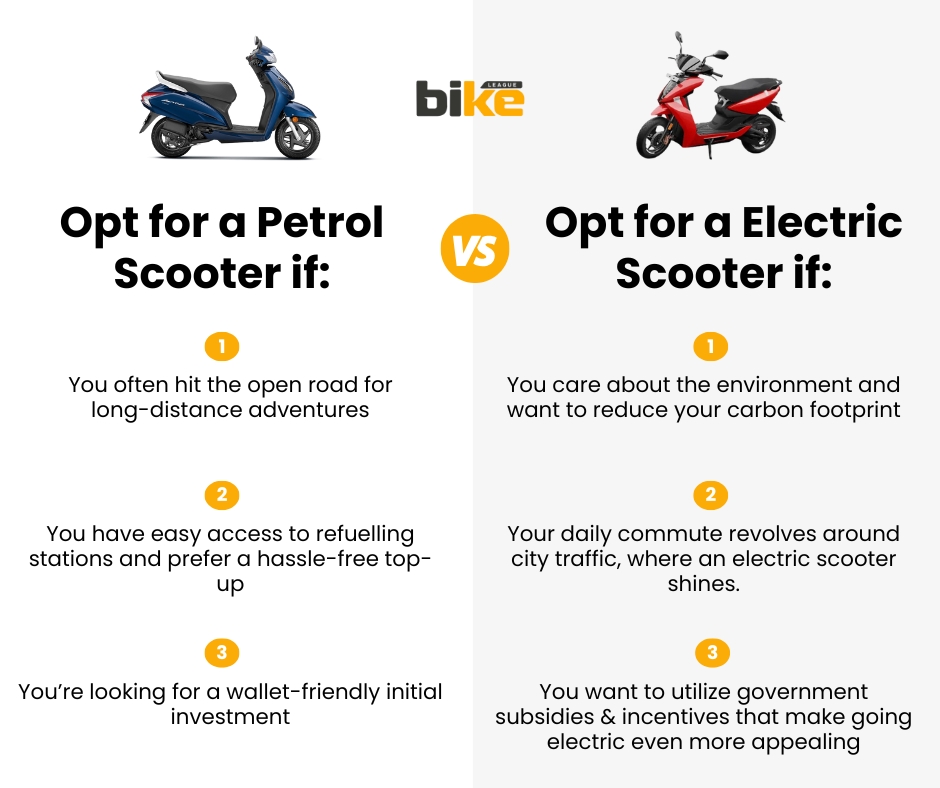
Choosing between a petrol or electric scooter in India depends on your lifestyle, budget, and how you travel each day.
Opt For A Petrol Scooter If:
- You often hit the open road for long-distance adventures.
- You can easily access refuelling stations and prefer a hassle-free top-up.
- You’re looking for a wallet-friendly initial investment.
Choose An Electric Scooter If:
- You care about the environment and want to reduce your carbon footprint.
- Your daily commute revolves around city traffic, where an electric scooter shines.
- You want to take advantage of government subsidies and incentives that make going electric even more appealing.
Electric scooters are great for short daily trips and have much lower running costs, plus they’re better for the environment.
In the end, your choice should match your travel habits, values, and budget. With new improvements in electric scooters, it looks like India’s future is moving toward electric options. Change is coming, so be ready for it.
How Do Resale Value And Depreciation Differ Between Petrol And Electric Scooters In India?
In India, petrol scooters like the Honda Activa or TVS Jupiter generally hold their value better when you resell them than most electric scooters—think more predictable cashback after a few years of riding.
1. Insurance And Tax Depreciation Basics
- On paper, for things like insurance claims, both petrol and electric scooters lose value at the same standard rates set by IRDAI: about 5% in the first six months, 15% by year one, then stepping up to 20-50% over five years.
- For business owners claiming tax deductions, electric scooters can sometimes depreciate faster on your books (up to 40% yearly), but that’s just accounting—not what you actually get when selling on OLX or to a dealer.
2. Real-life Resale Reality
- Petrol scooters from trusted brands have a huge second-hand market, so a well-kept 3-5-year-old Activa might only drop 30-40% from its original price, thanks to steady demand and easy loans for buyers.
- Electric scooters? It’s hit-or-miss: Top ones like TVS iQube or Bajaj Chetak fare okay, but many others tank hard due to battery worries, spotty service, or brands fading away—often losing 40-50% in just three years.
3. Why Evs Depreciate Faster In Practice
- No big difference on insurance sheets yet, but in the real market, batteries are the killer: They make up most of the scooter’s cost, and buyers freak out over replacement bills unless you prove it’s healthy with warranty docs.
- Petrol ones just keep chugging with cheap roadside fixes anywhere in India, so folks happily pay up for an older model without sweating the engine’s future.
4. India’s Market Snapshot
- Petrol still rules sales (over 80% of scooters), even after a 2025 GST cut that made them cheaper upfront by about ₹20k compared to EVs, which lost some subsidies.
- EV sales hit about 1.2 million last year, but trust issues with some brands (like Ola, according to reports) mean their used prices suffer more than petrol rivals’.
5. Quick Advice For Buyers
- Go petrol if you want reliable resale over 4-6 years—Activa or Jupiter won’t let you down much.
- For electric, pick service-strong brands like TVS or Ather, track battery health religiously, and brace for quicker depreciation post-warranty.
Comparison Of Time Taken To Charge Vs Refuel, And How This Impacts Daily Convenience For Different User Types
A key difference between electric and petrol scooters is how long it takes to fill up. Charging an electric scooter at home in India usually takes 2.5 to 6 hours, though fast chargers on premium models can make it quicker. In contrast, refuelling a petrol scooter is almost instant; a quick stop at any pump gets you back on the road in under five minutes.
Time Comparison
- Budget electric scooters (like Komaki X-One) take about 3–5 hours to charge for 60–150 km of range.
- Premium electric scooters (like the TVS iQube) can reach 80% charge in about 4 hours, offering over 200 km of range.
- Petrol scooters just need a few minutes to fill 5–7 litres, giving you a 250–400 km range, and fuel stations are everywhere—even in small towns.
How Does This Affect Daily Life?
- For short city commutes (under 30–50 km each day), electric scooters are super convenient. Plug them in overnight—just like a smartphone—and you’ll wake up ready to ride, with quiet operation and much lower running costs (₹0.25–0.50/km).
- Petrol scooters shine when you need flexibility. There’s no need to plan around charging stations, power cuts, or the weather. Just fuel up and ride, making them ideal for people with unpredictable schedules or longer trips.
Here’s a quick look at which scooter suits different user types in a table
| User Type | Best Fit | Why It Fits Daily Life |
|---|---|---|
| Urban commuter (office/school, <40 km/day, home parking) | Electric | Overnight charge covers it all; saves ₹2,000+/month on fuel, no pump queues. |
| Delivery rider (50–100 km/day, multiple shifts) | Petrol (or fast-charge EV) | Quick refuels beat waiting 3+ hours mid-day; widespread pumps prevent downtime. |
| Family user (errands, kids to school, occasional 100+ km) | Petrol | Instant top-ups for unpredictable plans; no range anxiety on highways or rain. |
| Tech-savvy apartment dweller (metro cities, charger access) | Electric | Home/work charging seamless; app tracking adds convenience over petrol’s basics. |
| Rural/small-town rider (market runs, uneven roads/power) | Petrol | Pumps on every corner, no electricity dependency; simpler for long hauls. |
To sum up, go for an electric scooter if your daily routine is regular and you can charge it overnight. Choose a petrol scooter if you want more flexibility, need to refuel quickly, or often travel long distances.
Other Related Articles From Bikeleague India
Conclusion
In the end, choosing between an electric and a petrol scooter comes down to what matters most to you: upfront cost, long-term savings, environmental impact, or daily convenience. Electric scooters are better for the environment and cheaper to run, while petrol scooters offer more flexibility and better resale value. Think about these points to decide which scooter fits your needs best.
If you have questions, email us at bikeleague2017@gmail.com or leave a comment below. We’re always happy to help. To stay updated and join our community, follow Bikeleague India on social media. Let’s ride safely together!

excellent comparison.and very good information.
Overall operating cost is less for petrol vehicle than electrical scooter.
Thank you for the feedback, sir. This is what fuels us to do more and perform more
hi Hiran narayan
good morning.Excellent write up.
One small doubt ,do we have replce battery on electric bike for 5 years?
After 5 years it still runs ,albeit with reduced range,pls correct me,if I am wrong
There is surely increased risk of complaints and range gets reduced drastically. Its better to get in touch with dealers or manufacturer to get the exact information. Also we think there are reduced rates for old battery exchange which differs among companies. So please do checkout the same