
Long story short – Get all your questions about nitrogen versus air filling in bike tyres, tyre pressure, and pressure loss in India answered here. We break down these topics in straightforward language.
A lot of riders in India ask whether they should use nitrogen or air in their bike tyre. Each option has its own pros and cons, so understanding the facts will help you choose what works best for you.
This article explains the main differences, benefits, common myths, and real-life effects of using nitrogen or air in motorcycle tyres, with a focus on Indian roads.
Key Takeways
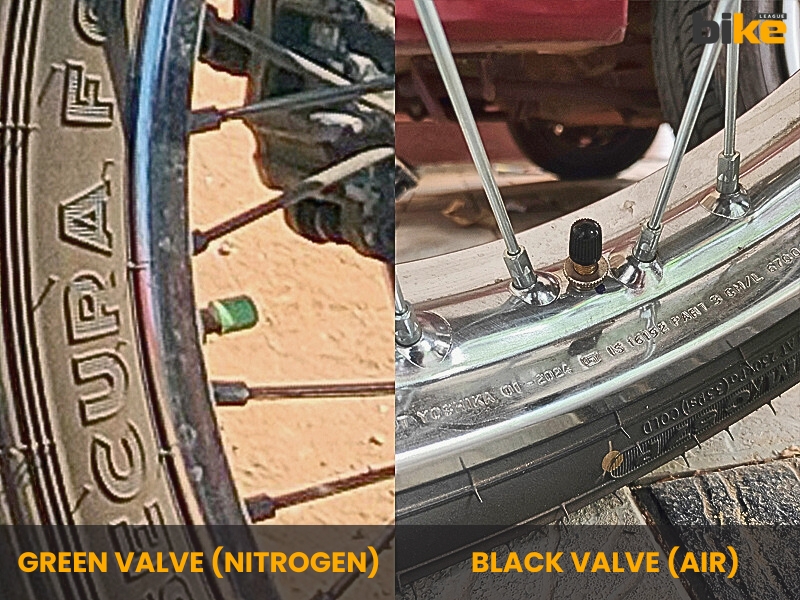
- The valve cap is the primary indicator of whether a motorcycle tyre is filled with nitrogen or air. If it’s green, nitrogen is definitely present. If it’s black, it will mostly be air-filled.
- Nitrogen lacks moisture and contaminants, reducing the risk of corrosion compared to air, which contains water vapour.
- Nitrogen filling stations are less common than air compressors, which can be a limitation during long trips.
- Nitrogen helps maintain stable tyre pressure and temperature, which is beneficial for consistent handling.
- The time gap to check the pressure for air-filled tyres is between 1 and 2 weeks.
- The time gap for checking the pressure of nitrogen-filled tyres is 4-5 weeks.
What Is Nitrogen Filling In A Bike?
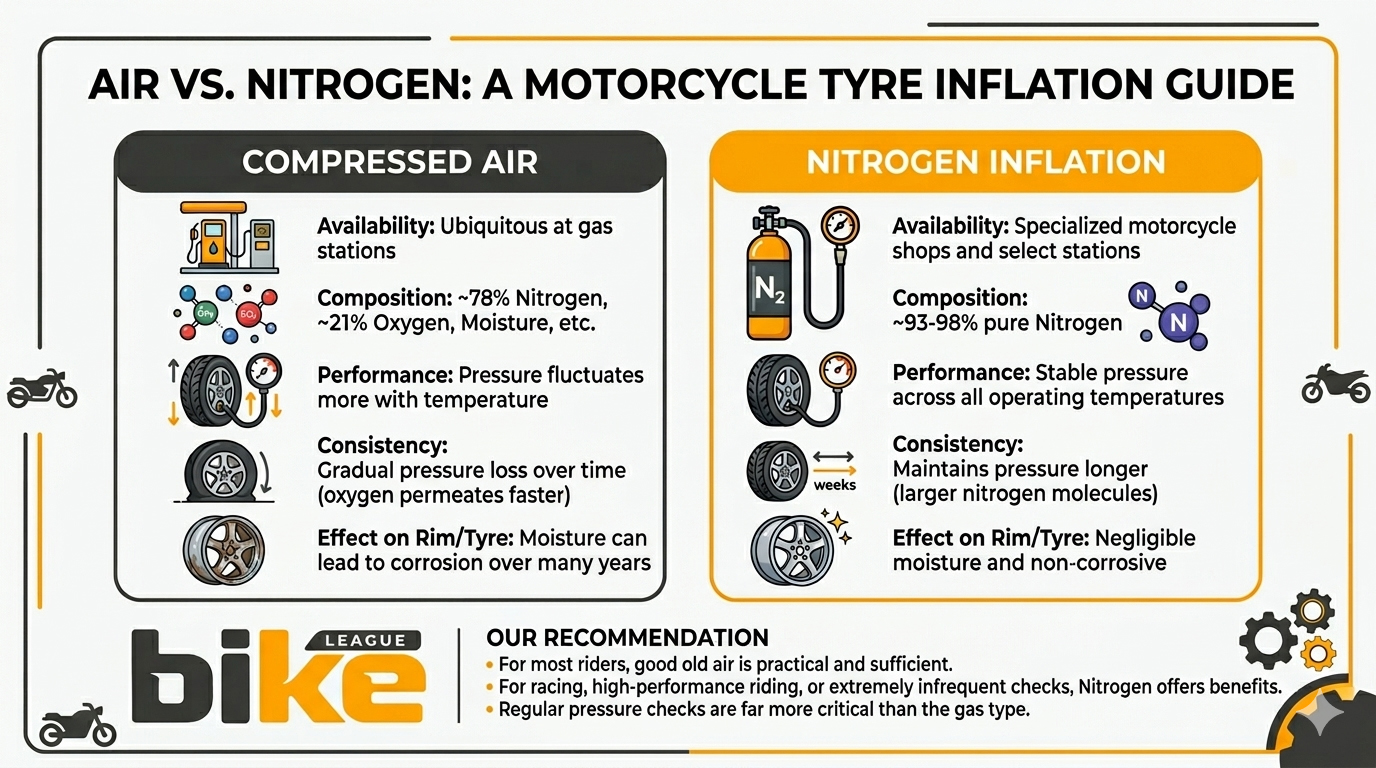
Nitrogen filling means inflating tyres with nitrogen rather than regular air. Regular air contains about 78% nitrogen, 21% oxygen, and 1% other gases. Nitrogen-filled tyres contain approximately 93-95% nitrogen.
What Is Air Filling In A Bike?
Air filling refers to inflating bike tyres with regular air, primarily consisting of nitrogen (about 78%), oxygen (about 21%), and trace gases. Proper inflation is vital for tyre performance, safety, and lifespan.
What Is The Difference Between Nitrogen And Air Filling In Bike Tyres?
1. Molecular Size And Pressure Retention
Nitrogen molecules are larger than oxygen molecules, so tyre pressure drops more slowly with nitrogen. Nitrogen-filled tyres keep pressure longer than air-filled tyres. This can reduce pressure checks and provide a steadier ride.
2. Temperature Stability And Moisture Content
Nitrogen is inert, so it does not react or corrode the inner surface of bike tyres. It also lacks the moisture and corrosive compounds found in air, reducing tyre oxidation.
Nitrogen-filled bike tyres can run cooler, which may help reduce the risk of overheating and tyre failure. This can provide more consistent handling and grip, offering riders added confidence.
3. Cost And Availability
A key drawback of nitrogen is cost. Nitrogen is usually more expensive than air, though some stations provide it free or at a small charge. Nitrogen filling stations can be hard to find in remote areas, leading to greater inconvenience.
4. Performance And Practicality
Nitrogen does help tyres hold pressure longer and reduces moisture, but for most regular riders, the actual performance difference is small. The main point is to know these differences so you can choose what works best for you.
Since regular air already has 78% nitrogen, most daily riders find that the extra cost and hassle of pure nitrogen is not worth it. For everyday use, regular air is easy to get, affordable, and does the job well.
Comparison Of Nitrogen And Normal Air Filling In Motorcycles – Table
| Feature | Nitrogen Air | Normal Air |
|---|---|---|
| Composition | 93-95% pure nitrogen, minimal moisture | 78% nitrogen, 21% oxygen, contains moisture |
| Pressure Retention | Slower pressure loss, more stable | Faster pressure loss, frequent top-ups needed |
| Heat Resistance | Maintains tyre temperature better | More prone to temperature changes |
| Tyre Longevity | Longer life due to no moisture, reduced oxidation | Slightly shorter life, risk of internal oxidation and corrosion |
| Puncture/Leak Risk | Lower (less permeation) | Slightly higher (air molecules smaller, leak faster) |
| Maintenance | Less frequent pressure checks | More frequent checks needed |
| Cost per Top-Up | Higher (Rs. 40–50 per tyre, paid service, fewer outlets) | Low or free (available at almost all petrol stations/repair shops) |
| Availability | Limited, mostly at major service centers or big cities | Very widely available everywhere |
| Best Suited For | Performance bikes, touring, long interval maintenance, alloy wheels | Routine commuting, city riding, users who check pressure regularly |
| Convenience | Less convenient due to limited filling stations | Very convenient, universally available |
What Are The Advantages Of Filling Nitrogen In Tubeless Motorcycle Tyres
- Slower bike tyre pressure loss: Nitrogen molecules are larger than oxygen molecules, causing slower pressure loss. This helps maintain consistent pressure for extended periods. It’s beneficial for drivers who rarely check tyre pressure or face changing temperatures.
- Reduced tyre oxidation:Less oxidation occurs with nitrogen inflation because nitrogen lacks moisture. This prevents internal corrosion and may extend a tyre’s lifespan.
- Improved mileage:Consistent pressure with nitrogen inflation can lead to improved mileage. Properly inflated tyres roll more easily, slightly improving fuel economy.
- Enhanced safety:Consistent pressure from nitrogen can improve handling and traction. This adds to overall vehicle safety.
What Are The Disadvantages Of Filling Nitrogen In Tubeless Motorcycle Tyres?
- Expensive:Nitrogen inflation usually costs more than using regular air in your tyres.
- Availability:Not all gas stations offer nitrogen inflation. If you top up with regular air, the benefits of nitrogen decrease.
- Top-up challenges:Ideally, remove air from the tyre and then refill it with nitrogen.
What Are The Issues With Under-inflated Motorcycle Tyres?
- Decreased Handling and Stability: Soft, underinflated tyres flex more, leading to a vague and unpredictable feel while riding, especially when taking corners. This can significantly heighten the chances of accidents.
- Increased Tyre Wear:Too much flexing causes uneven tread wear, especially on the edges. This shortens tyre lifespan and means more frequent replacements.
- Blowouts:A very underinflated tyre can overheat and blow out. This may cause a sudden loss of pressure and control.
- Higher Fuel Consumption:Underinflated tyres create more rolling resistance. Hence, the engine works harder and fuel efficiency drops.
What Are The Issues With Overinflated Motorcycle Tyres?
- Reduced Traction: An overly firm tyre has less contact with the road surface, reducing grip and traction, especially during braking and cornering. This can be particularly concerning in wet conditions.
- Harsh Ride:Overly firm tyres have less contact with the road, reducing grip and traction, especially when braking or turning. This is particularly dangerous when roads are wet.
- Centre Tread Wear: An overinflated tyre rides stiffly, transmitting more bumps and vibrations. This makes for an uncomfortable journey.
What Are The Long-term Effects Of Regularly Using Nitrogen In Bike Tyres Compared To Air In India?
Here are the long-term effects of regularly using nitrogen in bike tyres compared to air in India:
- Nitrogen maintains tyre pressure longer due to its larger and less permeable molecules, resulting in fewer top-ups and more consistent performance over time.
- Nitrogen’s stable pressure can reduce uneven tyre wear. This often extends tyre life if used consistently.
- Being inert and dry, nitrogen eliminates the risk of internal oxidation and rim corrosion, a crucial factor in India’s humid and monsoon-prone climate.
- Nitrogen-filled tyres lose heat faster, staying cooler on long rides. This lowers the risk of overheating or blowouts on Indian roads.
- Tyres with nitrogen are less prone to sudden punctures and blowouts due to stable pressure, enhancing long-term safety.
- The main disadvantages are higher filling costs and limited availability at service stations in most Indian cities and rural areas.
- Regular air is free and widely available for most daily riders. It is practical for frequent top-ups, though pressure may fluctuate more than with nitrogen.
- For budget-focused and city riders who often check tyre pressure, the long-term difference is minimal. Key takeaway: Nitrogen shows clearer benefits for high-performance tyres or when maintenance is infrequent.
How To Switch Between Air And Nitrogen In Bike Tyres?
You can switch from air to nitrogen, or from nitrogen back to air, at any time. The main rule is simple: to achieve the best nitrogen concentration, the tyre should be deflated as much as possible before refilling; a partial top-up is still safe when a full purge is not practical.
Step-by-step Guide: Air To Nitrogen
- Check the current tyre pressure and inspect the tyre for cuts, nails, slow leaks, or valve damage.
- Remove the valve cap and fully deflate the tyre as much as possible.
- If possible, refill the tyre with nitrogen after deflation, then deflate again and refill once more to reduce leftover air content.
- Set the tyre to the manufacturer-recommended PSI using nitrogen.
- Check the pressure again after a short ride or within a few days to confirm there is no leakage.
Step-by-step Guide: Nitrogen To Air
- Deflate the tyre fully if you want to remove most of the nitrogen content.
- Refill with regular compressed air to the recommended PSI.
- Do not overthink the transition if nitrogen is unavailable on a trip, because topping up with air is safe.
- Continue checking the pressure at normal intervals.
Important Precautions
- Do not fill over a damaged valve or a leaking tyre.
- Do not assume nitrogen removes the need for pressure checks.
- Do not use nitrogen as a substitute for proper puncture repair.
- Do not worry if air is added to a nitrogen tyre during a trip; it is safe, but the nitrogen concentration drops.
- Always confirm the recommended PSI from the owner’s manual or tyre placard.
Switching And Refill Cost Table
| Service | Typical cost | Notes |
|---|---|---|
| Normal air top-up | Free to Rs. 10–20 at many shops | Widely available across India |
| Nitrogen top-up | About Rs. 30–60 per tyre in many outlets | Prices vary by city and brand outlet |
| First nitrogen fill / conversion | Often Rs. 40–60 per tyre, sometimes higher | May be free at select stations, but not everywhere |
| Air to nitrogen conversion | Usually included in first-fill charge | A proper purge-and-refill may take extra time |
Where To Find Reliable Nitrogen Stations
Reliable nitrogen filling is usually available at branded tyre dealerships, select petrol pumps, and service outlets tied to tyre companies or mobility networks. In India, examples include select Jio-bp stations, Apollo Tyres outlets, and other branded tyre service centres, while some local tyre shops also provide the service.
How To Judge A Good Station
- The station should use a proper nitrogen filling setup, not a vague “air and nitrogen mix” claim.
- The technician should be able to fully deflate the tyre before refilling if you want a proper conversion.
- The outlet should let you check pressure with a gauge after filling.
- The outlet should clearly tell you the price before service.
- The station should not pressure you into unnecessary upsells if you only want a simple top-up.
Best Practical Advice For Riders
If nitrogen is unavailable on the road, topping up with air is perfectly fine. The benefit of nitrogen is reduced when the tyre is repeatedly topped up with regular air, but the tyre remains safe as long as the pressure is correct.
What Are The Scientific Studies, Real-world Tests, And India-specific Context For Nitrogen And Air Filling In Two-wheelers?
The original version of this article explains the theory behind nitrogen and air filling well, but many riders also want to know what published studies and real-world data say. The available evidence shows that nitrogen can slow pressure loss, but the practical difference for most daily riders is modest, and it does not remove the need for regular tyre pressure checks.
1. What Scientific Studies Say About Nitrogen Vs Air
One of the most cited studies on this topic is the 2009 NHTSA (National Highway Traffic Safety Administration) study. It found that tyres filled with nitrogen lost pressure at an average rate of 1.39% per month, while tyres filled with air lost pressure at 2.13% per month. In simple terms, nitrogen did retain pressure better, but the improvement was not large enough to skip regular maintenance.
The same NHTSA study also made an important point: nitrogen is not a substitute for regularly checking tyre pressure. This means even nitrogen-filled tyres must still be inspected at proper intervals, especially in Indian riding conditions where heat, potholes, long commutes, and load variation are common.
2. Consumer Reports Real-world Test
A Consumer Reports test comparing nitrogen-filled tyres and air-filled tyres over a period of 12 months found that air-filled tyres lost an average of 3.5 psi, while nitrogen-filled tyres lost 2.2 psi. That is only a 1.3 psi difference over an entire year.
This is the key reason many experts say nitrogen gives only a small real-world advantage for normal commuting. If a rider checks tyre pressure regularly, normal air already delivers nearly the same practical result for day-to-day use.
3. India-specific Riding Conditions That Matter More
For Indian riders, temperature and seasonal weather changes often matter more than the nitrogen-versus-air debate. According to CEAT, during monsoon and changing weather conditions, riders should generally stay close to the motorcycle manufacturer’s recommended pressure, while also understanding that tyre behaviour changes with heat and rain.
CEAT notes that in hot conditions, tyres can swell and pressure may need to be kept slightly lower, while in rainy conditions, tyres can run cooler and contract slightly. The bigger takeaway for Indian riders is simple: correct tyre pressure matters more than gas choice.
4. Bike Tyre Pressure Range In India
TVS Motor notes that, as per industry norms, bikes ranging from commuter models to performance motorcycles generally use tyre pressures between 28 and 49 PSI, although exact values vary by model, load, and whether a pillion is present. Because of this, riders should always treat the owner’s manual or swingarm sticker as the final authority.
5. What Is Proven, What Is Overstated?
| Claim | What evidence suggests |
|---|---|
| Nitrogen keeps pressure longer | Supported. Nitrogen loses pressure more slowly than normal air in published tests. |
| Nitrogen makes tyres maintenance-free | Not supported. Nitrogen-filled tyres still lose pressure and still require regular checks. |
| Nitrogen gives major fuel savings | Overstated. Any mileage benefit is usually small and mainly comes from keeping the correct pressure, not from nitrogen itself. |
| Nitrogen greatly improves ride quality | Overstated for daily riders. Most riders will not notice a dramatic difference in normal commuting. |
| Nitrogen is best for riders who rarely check pressure | Reasonable. A slower rate of pressure loss can help when pressure checks are infrequent. |
6. Practical Verdict For Indian Motorcycle Owners
If you ride daily, check tyre pressure regularly, and want the cheapest and most convenient option, normal air is more than good enough. Since normal air is available almost everywhere in India, it remains the most practical option for commuters and city riders.
Nitrogen can still make sense for riders who do long highway trips, maintain higher-speed touring bikes, use expensive alloy wheels, or simply want slower pressure loss between checks. But even then, it should be seen as a small maintenance advantage rather than a major performance upgrade.
Takeaways
Scientific studies and real-world tests show that nitrogen does slow tyre pressure loss compared with normal air, but the difference is usually small for everyday motorcycle use. For most riders in India, maintaining the correct manufacturer-recommended tyre pressure on time is far more important than choosing nitrogen over air.
Sources And References
-
National Highway Traffic Safety Administration (NHTSA) –
The Effects of Varying the Levels of Nitrogen in the Inflation Gas of Tyres on Laboratory Test Performance -
Consumer Reports –
Should You Use Nitrogen in Your Car Tyres? -
CEAT Tyres –
A Simple Guide to Monsoon Tyre Care for Your Bike -
TVS Motor –
Bike Tyre Pressure: A Quick Guide to Finding the Right PSI for Your Tyres
What Are The Available Scientific Data And Figures On Nitrogen Vs Air Filling?
Below are published figures and real-world reference numbers that help explain the practical difference between nitrogen and normal air in motorcycle and vehicle tyres. These figures show that nitrogen can slow pressure loss, but the real-world gain for most daily riders is usually modest.
1. Nhtsa Pressure-loss Study Data
The 2009 NHTSA study is one of the most commonly cited sources on tyre inflation gas. It found that tyres filled with nitrogen lost pressure more slowly than tyres filled with normal air, but the study also made it clear that nitrogen does not replace routine tyre-pressure maintenance.
| Study metric | Nitrogen-filled tyres | Air-filled tyres |
|---|---|---|
| Average pressure loss rate | 1.39% per month | 2.13% per month |
| Pressure retention | Better than air | Lower than nitrogen |
| Need for regular pressure checks | Still required | Still required |
2. Consumer Reports Real-world Pressure-loss Test
Consumer Reports long-duration comparison found that both tyre types lost pressure over time. The difference between nitrogen and air was measurable, but still small in practical everyday use.
| Test result | Nitrogen-filled tyres | Air-filled tyres |
|---|---|---|
| Initial pressure setting | 30 psi | 30 psi |
| Average pressure loss after 1 year | 2.2 psi | 3.5 psi |
| Difference over 1 year | 1.3 psi less pressure loss | Baseline |
| Practical takeaway | Slight advantage | Still practical with regular checks |
3. India-related Tyre Pressure Figures
For Indian riders, correct tyre pressure matters more than the inflation gas alone. TVS Motor notes that bikes from commuter models to performance motorcycles typically operate in a broad tyre-pressure range depending on the model, load, and category.
| Vehicle / category | Front tyre pressure | Rear tyre pressure |
|---|---|---|
| Industry norm range | 28 to 49 PSI range depending on model | 28 to 49 PSI range depending on model |
| TVS XL 100 | 25 PSI | 35-40 PSI |
| TVS Raider 125 | 25 PSI | 32 PSI |
| TVS Apache RTR 160 | 25 PSI | 32 PSI |
| TVS Apache RR 310 | 32 PSI | 32 PSI |
4. Monsoon And Seasonal Pressure Guidance In India
CEAT notes that weather and seasonal changes affect tyre behaviour in Indian riding conditions. Their guidance highlights that hot and rainy conditions can change how tyres behave, so checking pressure regularly remains more important than choosing nitrogen alone.
| Condition | Reference figure / guidance |
|---|---|
| Hot conditions | Tyres may be kept 2-3 PSI lower than the required level in some conditions because tyres can swell with heat |
| Rainy / cooler conditions | Tyres may run cooler and contract slightly, so pressure must still be checked carefully |
| Monsoon tread depth | At least 2-3 mm tread depth is recommended for grip and safety |
5. Quick Figures Summary
These figures make the main point clear: nitrogen does help with slower pressure loss, but the gain is relatively small for normal day-to-day riding. For most Indian riders, regular pressure checks, correct PSI, and healthy tread depth will have a bigger effect on safety and tyre life than choosing nitrogen over air.
| Figure | Value | Meaning |
|---|---|---|
| NHTSA air-filled pressure loss | 2.13% per month | Air loses pressure faster than nitrogen |
| NHTSA nitrogen-filled pressure loss | 1.39% per month | Nitrogen slows pressure loss |
| Consumer Reports air loss after 1 year | 3.5 psi | Shows gradual pressure drop with normal air |
| Consumer Reports nitrogen loss after 1 year | 2.2 psi | Shows measurable but limited benefit |
| Difference over 1 year | 1.3 psi | Useful, but small for riders who check pressure regularly |
| Typical bike pressure range | 28 to 49 PSI | Exact tyre pressure depends on model and load |
Common Myths About Nitrogen Vs Air Filling In Bike Tyres
Myth 1: Nitrogen Does Not Leak From Tyres As Quickly As Air.
Fact: Both nitrogen and air will leak over time, but nitrogen leaks at a slower rate due to larger molecules.
Myth 2: Nitrogen Is Unaffected By Temperature Changes.
Fact: Nitrogen-filled tyres maintain pressure better in fluctuating temperatures but are not immune to temperature-related changes.
Myth 3: Nitrogen-filled Tyres Are Maintenance-free.
Fact: Regular pressure checks are necessary for nitrogen-filled tyres to identify leaks and ensure safety.
Myth 4: Nitrogen Completely Prevents Tyre And Wheel Corrosion.
Fact: While nitrogen reduces moisture, most air systems already limit water vapour, making corrosion from air not a widespread issue.
Myth 5: Nitrogen Significantly Improves Ride Quality.
Fact: Little evidence supports claims of improved ride quality with nitrogen.
Myth 6: Nitrogen Saves Significant Fuel Costs.
Fact: The fuel savings from using nitrogen are minimal and often not noticeable.
Myth 7: Nitrogen Is A New Technology.
Fact: Nitrogen has been used in various applications, including aviation and racing, for many years.
Myth 8: Nitrogen Is Non-reactive And Completely Safe.
Fact: Nitrogen is inert and stable, making it safe for tyre use.
Myth 9: Nitrogen Is Not Worth The Cost For Average Riders.
Fact: For most riders, the benefits of nitrogen do not outweigh the price, especially when air is free and readily available.
Faq Related To Nitrogen Vs Air Filling In Bike Tyres
1. Is There A Benefit To Adding Nitrogen To Tube Tyres In Motorcycles?
No. Nitrogen is placed inside the tube, so it does not protect the outer tyre from heat or vibration. Tube tyres do not benefit from nitrogen, so air is better for them.
2. Does Regular Air Or Compressed Air Contain Nitrogen?
Yes. Regular air is about 78% nitrogen, 21% oxygen, and 1% other gases. Compressed air is normal air forced into a smaller space, increasing pressure.
3. What Is The Time Gap For Air Pressure Checking In Motorcycles?
The time gap to check the pressure for air-filled tyres is between 1 and 2 weeks.
4. What Is The Time Gap For Nitrogen Pressure Checking In Motorcycles?
The time required to check the pressure of nitrogen-filled tyres is 4-5 weeks.
5. Do Petrol Pumps In India Offer Nitrogen Filling In Motorcycles?
No, in India, petrol pumps primarily offer compressed air for tyre filling, not nitrogen.
6. How Do You Know If A Motorcycle Tyre Is Filled With Nitrogen Or Air?
The valve cap is the primary indicator of whether a motorcycle tyre is filled with nitrogen or air. If it’s green, nitrogen is definitely present. If it’s black, it will mostly be air-filled.
7. How To Check For Motorcycle Tyre Pressure At Home?
There are devices specifically for analogue and digital tyre pressure monitors to check tyre pressure at home. Check out this link for more details.
8. What Is The Recommended Tyre Pressure For Both Front And Rear Tyres In Motorcycles?
Check the owner’s manual for the exact tyre pressures for the front and rear tyres.
9. Should We Increase The Tyre Pressure If There Is A Pillion Passenger On Both Motorcycle Tyres?
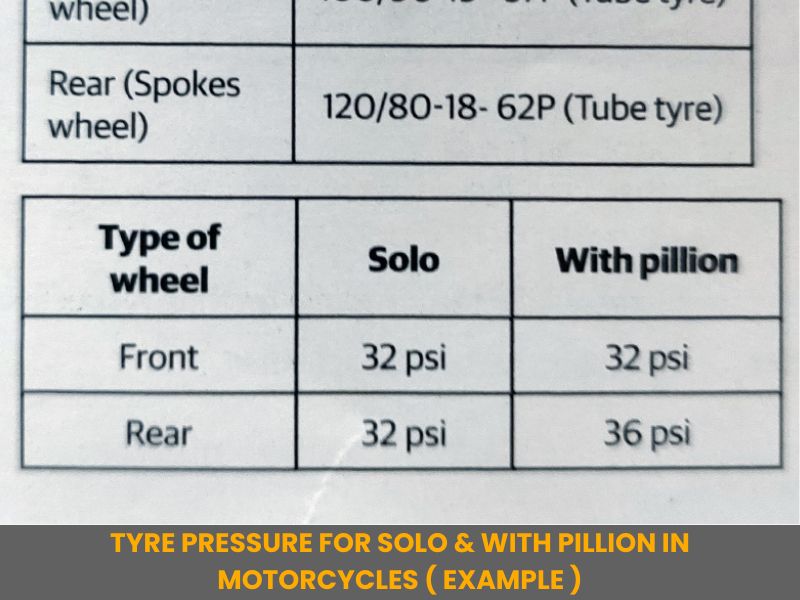
It is usually provided in the owner’s manual, as shown in the picture below. Tyre pressure should be higher on the rear wheel, while on the front wheel, it’s almost the same, especially if a pillion is present. Check the picture given below.
10. Which Is More Expensive, Nitrogen Or Air Filling In Motorcycles?
Nitrogen is definitely the most expensive fuel. Air filling is entirely free at petrol pumps, while in other shops, it costs around Rs 10-20 per bike tyre (approximately); nitrogen filling costs between Rs 30-40 per tyre (approximately).
11. Does Nitrogen Fill Significantly Improve Fuel Efficiency?
Nitrogen inflation usually improves fuel efficiency minimally compared to the benefits of maintaining proper bike tyre pressure with regular air.
12. Why Is Compressed Air Considered Harmful To Tyres?
Compressed air contains oxygen, which can cause oxidation and destroy rubber and other tyre materials, leading to deterioration over time.
13. Can I Mix Air With Nitrogen In My Tyres?
While it’s possible to add air to nitrogen-filled tyres, it reduces the nitrogen concentration. It’s better to maintain correct tyre inflation with air than to use nitrogen to keep tyres under-inflated.
14. Does Nitrogen Improve Fuel Economy And Tyre Life?
Properly inflated tyres, whether with nitrogen or air, can improve fuel economy and extend tyre life. Nitrogen may offer slight advantages in maintaining consistent pressure.
15. Are Nitrogen Filling Stations Widely Available?
Nitrogen filling stations are less common than air compressors, which can be a limitation during long trips.
16. Does Nitrogen Prevent Tyre Corrosion?
Nitrogen lacks moisture and contaminants, reducing the risk of corrosion compared to air, which contains water vapour.
17. Is Nitrogen Suitable For All Types Of Tyres?
Nitrogen is ideal for all tyres and vehicles, providing benefits like consistent pressure and reduced moisture.
18. Does Nitrogen Affect Tyre Temperature Stability?
Nitrogen helps maintain stable tyre pressure and temperature, which benefits consistent handling.
19. What Is The Nitrogen Purity Level In Tyres?
When nitrogen is filled into tyres, the concentration typically ranges from 93% to 95%.
Other Related Articles From Bikeleague India
- Mileage in Two wheelers – Proven & useful tips
- Best bike tyre brands for your motorcycle in India
- Top 10 electric scooters with highest range in India
- Two wheeler tyre code – How to read & understand – Video
- Bike tyre polish in India: Elevate your motorcycle tyre look now
Conclusion
Choosing between nitrogen and air for your motorcycle tyres depends on your riding habits, how often you check your tyres, and your personal preference. Nitrogen offers some benefits, like slower pressure loss and less moisture, but for most daily riders in India, these advantages are minor.
The most important thing for tyre performance, safety, and long life is keeping the correct tyre pressure, no matter which gas you use. If you understand the differences and make informed choices, you’ll enjoy a safer and smoother ride on Indian roads.
We hope this guide has answered your questions and cleared up any myths about nitrogen and air in motorcycle tyres. If you have more questions, you can email us at bikeleague2017@gmail.com or leave a comment below. We’re always happy to help. You can also contact us on Bikeleague India’s social media pages.