
Long story short: This guide explains parts, types, lifespan, and care of motorcycle and scooter spark plugs so you can avoid misfires, save fuel, reduce emissions, and keep your engine running smoothly.
No matter if you ride a motorcycle or a scooter, there’s one small part that makes a big difference in how your engine performs, how reliable it is, and even how much fuel you use: the spark plug. Many people don’t think about it, but the spark plug is key to starting your engine, keeping it running well, and helping you get the most out of every litre of petrol.
With so many types, myths, and options, even experienced riders can get confused about which spark plug to buy, how to look after it, and when it’s time for a change. This guide explains what Indian riders need to know about spark plugs—how they work, the differences between types, useful tips, and how picking the right plug can save you money and avoid problems later.
Key Takeaways
- Spark plugs are critical for performance and efficiency: they play a vital role in starting your motorcycle or scooter, ensuring smooth running, maximising fuel economy, and reducing emissions. Regular inspection and timely replacement are essential for optimal engine health.
- Plug type matters—always match manufacturer specs: There are significant differences between copper, platinum, and iridium spark plugs in terms of lifespan, performance, and cost. Always use the exact type, heat range, thread size, and resistor specification recommended in your owner’s manual to avoid engine damage.
- Symptoms of worn or incorrect spark plugs are easy to spot: Hard starting, rough idling, poor acceleration, increased fuel consumption, and engine misfires can all point to spark plug problems. Addressing these early prevents further damage and costly repairs.
- Proper installation and maintenance save money: Using the correct tools, setting the right gap, and applying the proper torque are crucial. Well-maintained plugs improve mileage, extend engine life, and reduce the risk of roadside breakdowns.
- Counterfeit or mismatched plugs can cause major issues: Fake or “almost identical” plugs can lead to poor performance, fouling, or serious engine damage. Buy only from trusted sources and verify plugs before installation for maximum reliability and safety.
What Is A Spark Plug, And What Does It Actually Do?
A spark plug has a simple but important job in your motorcycle or scooter. It creates a small, controlled electric spark in the engine’s combustion chamber to ignite the air-fuel mixture. The ignition system sends a high-voltage current to the spark plug, which jumps across a tiny gap between the centre and ground electrodes, like a mini lightning bolt.
This spark sets off a quick, controlled explosion (combustion) that moves the piston up and down, happening many times each second to power your bike or scooter. If your spark plug is in good condition, you’ll find it easier to start your engine, enjoy smoother idling, better acceleration, improved fuel economy, and lower emissions.
Parts Of A Motorcycle Spark Plug
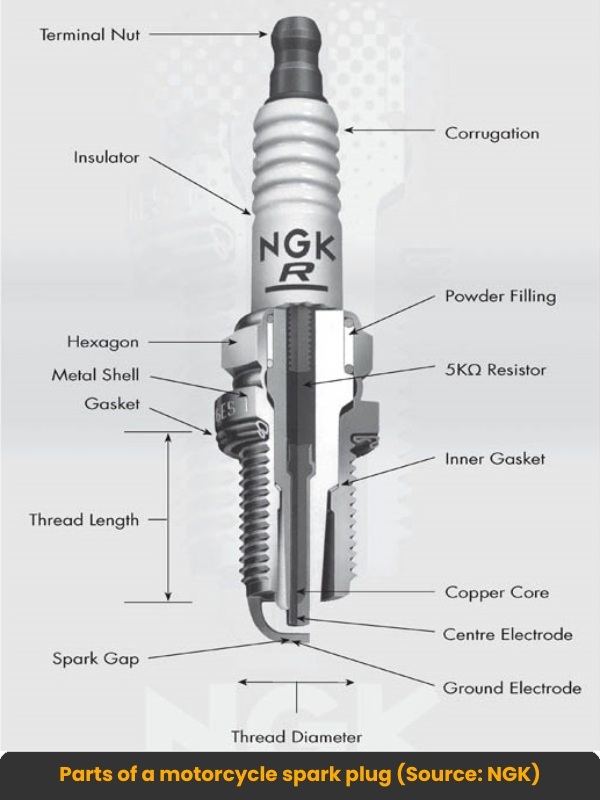
Understanding the main parts of a spark plug helps you pick the right one and look after it properly:
- Terminal Nut: The top part that connects to the ignition coil wire and delivers power.
- Insulator (Ceramic): The white body that prevents electric current from leaking and can handle extreme heat—up to 2500°F.
- Metal Shell: The threaded section that screws into the engine’s cylinder head and helps carry away heat from combustion.
- Centre Electrode: Usually a copper core, sometimes tipped with nickel, platinum, or iridium, which is where the spark is made.
- Ground Electrode: The metal arm at the bottom that the spark jumps to, forming a gap typically between 0.6–1.0 mm for most bikes.
- Gasket: A ring that seals the combustion chamber to prevent leaks.
- Hex: The flat sides near the base, designed for a spanner or socket (usually 14–16mm) to fit during installation or removal.
When the engine is running, the spark jumps from the tip of the centre electrode to the ground electrode, igniting the fuel-air mixture inside the engine.
Types Of Spark Plugs Used In Bikes And Scooters
Most motorcycles and scooters use one of three main types of spark plugs, defined by the material at the tip of the electrode.
| Type | Electrode Material | Lifespan | Price | Best For |
|---|---|---|---|---|
| Copper/Nickel | Copper core + Nickel | 10-20k km | ₹150-300 | Budget commuters |
| Platinum | Platinum tip(s) | 30-50k km | ₹400-700 | Daily riders |
| Iridium | Iridium tip | 50-80k km | ₹600-1200 | Performance/tours |
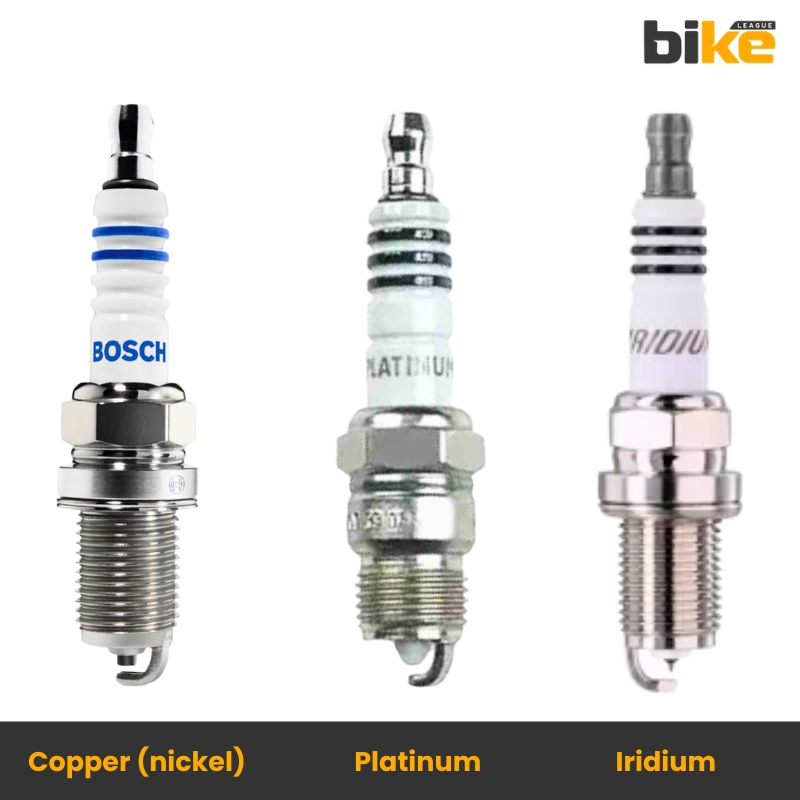
1. Copper (nickel) Spark Plugs
- Construction: Copper core with nickel-alloy outer material on the electrode.
- Pros: Cheap, good conductivity and heat dissipation, widely used and easy to find.
- Cons: Nickel wears faster under heat and pressure, so the life is shorter than platinum or iridium; it needs more frequent replacement.
You’ll often find these plugs in basic commuter bikes and older motorcycles or scooters with carburettors.
2. Platinum Spark Plugs
- Construction: Copper core with a platinum pad on the centre electrode (single) or on both electrodes (double platinum).
- Pros: Higher melting point and harder than nickel, maintains a sharp edge longer, better resistance to wear and high temperatures, longer life than copper.
- Cons: More expensive than copper; usually mid-level in both price and performance.
Platinum plugs are a good choice if you want a balance between lifespan, performance, and price.
3. Iridium Spark Plugs
- Construction: Very fine iridium-tipped centre electrode, sometimes with special ground electrode designs.
- Pros: Stronger and higher melting point than platinum, excellent wear resistance, a very fine tip improves firing efficiency, and the longest lifespan among common types.
- Cons: Highest price; benefits are more noticeable in performance engines or when you want long intervals.
Iridium plugs are often sold as upgrades for commuter bikes and scooters, and they come standard on many high-end or performance models.
What Are The Other Important Spark Plug Characteristics Other Than Metal Type?
It’s not only the metal that matters. Your spark plug also needs to match your engine’s exact requirements:
- Thread diameter and pitch: These must match the cylinder head threads perfectly. The wrong size can damage your engine.
- Reach (thread length): If the plug is too short, some threads in the head are left uncovered. Too long, and the plug can hit the piston or valves.
- Heat range: This rating tells you how quickly the plug can shed heat. Using a plug that’s too “hot” or “cold” can cause problems like fouling or overheating.
- Resistor vs non‑resistor: Most modern bikes use resistor plugs, which help reduce electrical noise that could interfere with your bike’s electronics.
Manufacturers set these details for a reason. Always follow your owner’s manual or a trusted chart, and don’t guess.
Motorcycles Vs Scooters: What Actually Changes In Spark Plugs
Motorcycles and scooters face some different day-to-day demands. For instance, small-capacity commuters and most scooters often run at higher RPMs, deal with stop-and-go traffic, and experience hotter conditions—factors that can accelerate spark plug wear.
Getting to the spark plug is different as well. Scooters may require removing body panels or working around tight engine compartments, while motorcycles generally offer easier access—sometimes just a tank lift or reaching from the side.
Cooling is another key difference. Air-cooled engines, which are common in Indian commuters and scooters, tend to run hotter than liquid-cooled engines. This makes it even more important to choose the correct heat range for your spark plug.
Even with these differences, the main job of a spark plug and the basics of looking after it are the same for both motorcycles and scooters.
Which Are The Best Motorcycle And Scooter Spark Plug Brands In India?
NGK, Bosch, and Denso are widely recognised as the leading spark plug brands for motorcycles and scooters in India. These brands are trusted by riders and manufacturers alike for their consistent performance and reliability. Many popular models from Hero, Honda, TVS, and Bajaj use these brands as original equipment.
If you want longer-lasting plugs, better mileage, and a smoother ride, the iridium options from these companies are a smart choice. For those on a budget, Champion and Spark India also offer decent alternatives, though they might not match the quality of the top brands.
Top Brands At A Glance
- NGK: Known for its advanced iridium technology and used as original equipment in bikes like the Honda Activa, Hero, TVS, and Royal Enfield. NGK plugs resist fouling and help improve fuel efficiency.
- Bosch: Offers durable nickel- and iridium-plated spark plugs that deliver strong pickup and good value for Indian two-wheelers.
- Denso: Well-regarded for its high-performance iridium TT series, which uses fine electrodes for reliable ignition, especially in modern BS6 engines.
What Are The Essential Tools For Motorcycle Spark Plug Jobs?
If you’re new to changing spark plugs, you don’t need to be a professional mechanic or have a special garage. Most riders can change a plug in 15 to 30 minutes with just a few basic tools and some confidence. Here’s what you’ll need:
Essential Toolkit For Indian Riders
| Tool | Why Needed | Recommendation (Amazon/Flipkart) | Price | Usage Tip |
|---|---|---|---|---|
| Spark Plug Socket | Fits hex without slipping | 16mm/21mm magnetic (Force/GoMechanic) | ₹200-400 | Rubber insert grips; extension for tight spots |
| Ratchet Wrench + Extension | Turns socket (3-6″ extension) | 1/4″ drive set (₹500) | ₹300-600 | Flex-head for Pulsar/Activa access |
| Torque Wrench | Precise tightening (12-23 Nm) | Inch-lb 5-25 Nm (₹800) | ₹700-1,200 | Prevents stripped threads—essential! |
| Feeler Gauge/Spark Gap Tool | Checks/measures gap (0.6-1.0mm) | 0.05-1.0mm set (₹150) | ₹100-250 | Slide blade; don’t bend iridium tips |
| Plug Boot Puller Pliers | Removes coil/cap without tear | Plastic jaw pliers (₹200) | ₹150-300 | Twist-pull straight; avoids ₹500 coil damage |
| Carb Cleaner/Anti-Seize | Cleans threads; prevents seizing | WD-40 Specialist (₹250) | ₹200-400 | Light spray; thin anti-seize on threads (no gasket) |
A good starter kit costs about ₹1,800 to ₹4,000. Don’t forget to download a free PDF of your bike’s manual, as it’s your best reference. You can find most basic tools from GoMechanic, Amazon Basics, or local shops (look for Forcebrand sockets).
When To Replace Your Spark Plugs In Your Motorcycle /scooter?
Exact intervals vary by model and plug type, so the first reference is always your owner’s manual. Still, there are common ranges:
| Plug Type | Interval (km) | Brands Using |
|---|---|---|
| Standard Nickel | 10,000-15,000 | Hero, Bajaj stock |
| Platinum | 25,000-40,000 | Honda, Yamaha |
| Iridium | 40,000-60,000+ | Premium upgrades |
- Standard nickel/copper plugs: Roughly 10,000–20,000 km, depending on engine and riding conditions.
- Platinum/iridium plugs: Often in the 30,000–50,000 km range, and some designs may last even longer, again subject to manufacturer limits.
- General motorcycle rule of thumb: Many motorcycle guides quote a lifespan of 13,000–16,000 km (8,000–10,000 miles), but quality and usage can extend or shorten it.
- NGK guidance: One major manufacturer notes that, in general, motorcycle spark plugs are often recommended for replacement around 12,000 km, though this varies by model and conditions.
Taking frequent short trips, riding in stop-and-go traffic, riding in dusty conditions, using low-quality fuel, or riding aggressively can all accelerate spark plug wear.
What Are The Symptoms Of A Bad Or Incorrect Spark Plug?
If something feels off with your bike or scooter, your spark plug might be the reason. Here are a few things to watch out for:
- Trouble starting, especially on cold mornings or after your bike has been parked for a bit.
- The engine idles roughly, shakes, or the RPM needle jumps around at a standstill.
- Hesitation or sputtering when you accelerate, especially if you’re carrying a load or climbing a hill.
- Sluggish throttle response—your bike just doesn’t pick up like it used to.
- You’re at the fuel pump more often, even though your riding style hasn’t changed.
- Occasional backfires or popping sounds from the exhaust are caused by late-burning leftover fuel.
If you see these problems and don’t fix them, they can turn into bigger issues, like a damaged catalytic converter, more build-up on the plug, and higher emissions.
How To “read” Spark Plug Colour In Motorcycles And Scooters?
The colour and deposits on the firing end (insulator tip and electrodes) tell you a lot about engine health and tuning.
| Color/Condition | Meaning | Action Needed |
|---|---|---|
| Light tan/brown | Normal combustion | Good – keep riding |
| Black & sooty | Rich mixture | Check air filter, jets |
| Oily black | Oil burning | Valve seals/rings |
| White/gray | Lean mixture | Carb sync, vacuum leak |
| Melted/cracked | Overheating | Wrong heat range |
Typical Interpretations
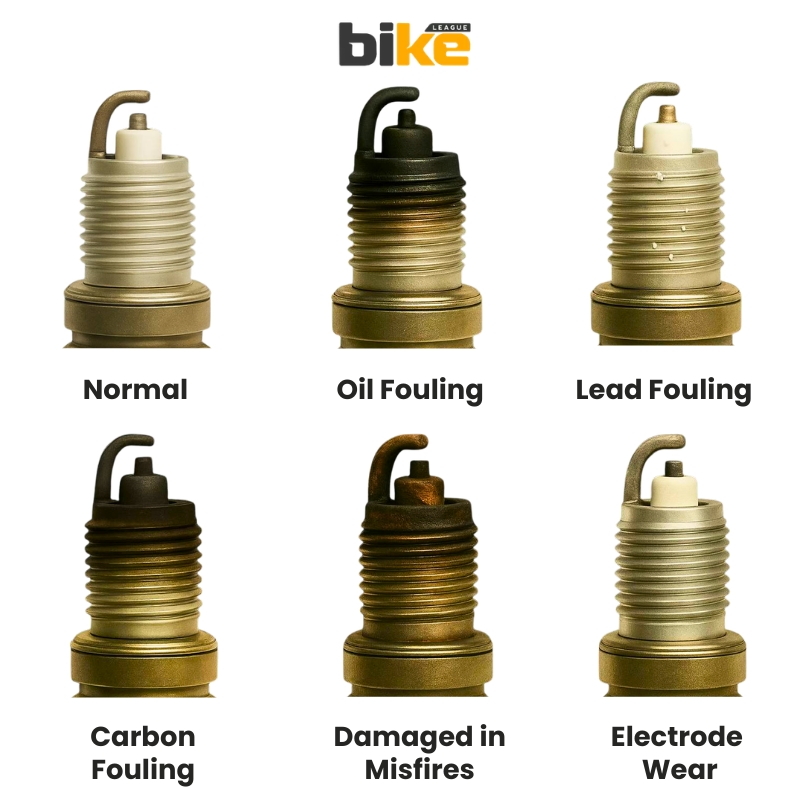
- Light tan / light brown / light grey: Normal. Indicates a correct air‑fuel mixture and a plug heat range that supports efficient combustion.
- Dry, black, sooty deposit: Rich mixture, too much fuel or not enough air; may also indicate a plug that is too cold or lots of low‑speed running.
- Oily or wet black appearance: Possible oil burning from worn rings, valve seals, or other internal issues.
- White or very pale insulator and electrodes: Lean mixture or overheating; can be caused by vacuum leaks, incorrect jetting/mapping, or a plug that is too hot.
- Cracked insulator, melted or eroded electrode, or blistered tip: Severe overheating, pre‑ignition, detonation, or wrong plug specification.
Learning to read spark plugs is a useful DIY skill recommended by both spark plug manufacturers and tuning guides.
How Proper Spark Plug Care Improves Emissions And Saves Money?
Looking after your spark plug by checking it regularly, installing it correctly, and replacing it when needed helps your engine run more efficiently. This leads to less wasted fuel and lower emissions. In India, where petrol is costly and PUC checks are strict, a well-maintained spark plug can save you ₹2,000 to ₹5,000 each year and help you avoid pollution fines.
If your spark plug is worn out or dirty, your engine won’t burn all the fuel properly. Sometimes, up to 30% of the fuel can be wasted as smoke, which reduces your mileage. A new spark plug can ignite the fuel more accurately, making better use of each drop of petrol. That’s why you might see your Hero Splendor’s mileage improve from 55 kmpl to 60 kmpl just by changing to a new plug.
For example, if you ride 10,000 km a year and get 50 km per litre, you’ll use 200 litres of petrol, which costs about ₹20,000. If a new spark plug improves your mileage by just 5%, you’ll save 10 litres (₹1,000) each year, or ₹3,000 over three years. Small changes can make a big difference.
Emissions Reduction Benefits
- When your plug is clean, your engine produces fewer harmful gases, such as HC, CO, and NOx.
- A strong spark means more complete fuel combustion, which can cut these emissions by 20–50%.
- If you have a BS6 bike or scooter with fuel injection, using an iridium plug helps your O2 sensor work correctly—helping you pass pollution checks and avoid fines.
Long-term Money Savings
- Fuel: Better efficiency means saving ₹200–400 per year on petrol.
- Engine life: Fewer misfires mean less coil/CDI wear (₹5k saved).
- Resale/PUC: A well-maintained engine is worth more if you sell it, and you’re less likely to get fined for pollution.
- Iridium plug ROI: An ₹800 iridium plug lasts 50,000 km, while a standard nickel plug might only last 12,000 km—so iridium is actually cheaper per kilometre in the long run.
In India, dusty roads and low-quality fuel can make spark plugs wear out about 20% faster. It’s a good idea to check your plug every 5,000 km—a simple task that costs about ₹50—rather than risk a ₹2,000 repair on the roadside.
Quick Care Tips
- Check the spark plug gap and colour at every service.
- Invest in a torque wrench (about ₹800)—it pays for itself after one or two DIY jobs.
- Always use genuine resistor plugs for fuel-injected bikes and scooters.
How To Choose The Right Spark Plug For Your Bike Or Scooter
Don’t experiment with heat range, thread size, or reach. Always use what’s recommended for your bike or scooter.
Here’s a simple checklist to help you pick the right plug:
- Start with your owner’s manual. It lists the exact plug code, heat range, thread size, and reach your engine needs.
- If you can’t find that exact plug, use the official cross-reference charts from brands like NGK, Denso, or Bosch to match the specs—don’t just go by what looks similar.
- Always match the heat range and plug design. Using the wrong heat range can lead to fouling (if it’s too cold) or overheating (if it’s too hot).
- Make sure you choose resistor or non-resistor plugs as specified by the manufacturer to avoid potential electrical noise issues.
- Decide on the material: Copper plugs are the most affordable but wear out faster, so they’re fine for basic commuters. Platinum plugs cost more but last longer and offer stable performance. Iridium plugs last longest and provide a reliable spark, making them a good choice if you want long intervals or ride a performance bike.
- Buy from reputable brands and trusted dealers. Well-known manufacturers list correct application data and heat ranges, while generic or fake plugs could harm your engine or fail early.
How To Change Your Motorcycle Or Scooter’s Spark Plug (diy)?
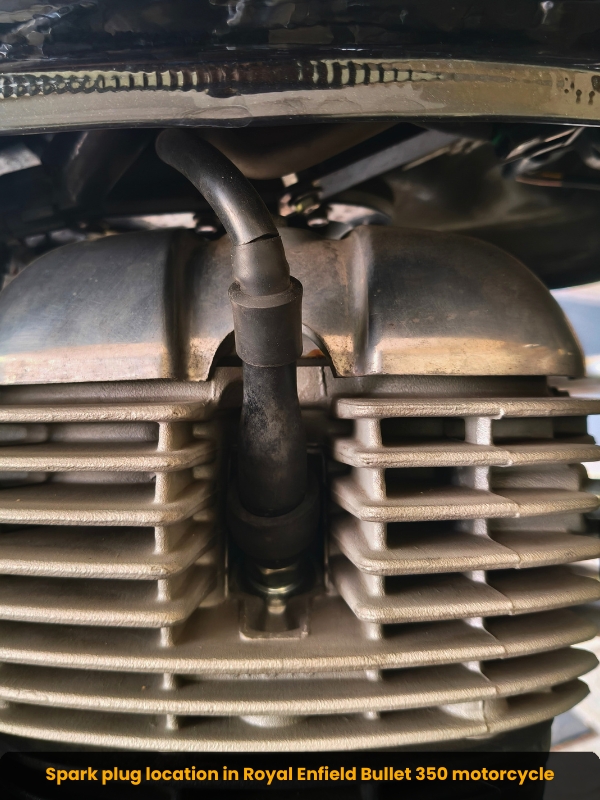
If you have some basic tools and can reach the spark plug easily, changing it is a simple job. Just be sure the engine is completely cool before you begin.
Preparation
- Check your owner’s manual for the right spark plug type, recommended torque, and gap.
- Gather your new plug, plug spanner (socket), an extension, and a feeler gauge (if you’re allowed to adjust the gap—most iridium and platinum plugs shouldn’t be bent).
Removing The Old Plug
- Take off any panels or tank covers that block access.
- Pull the plug cap or ignition coil straight up—don’t yank at an angle, or you might damage the wire.
- Use the plug spanner to gently loosen and remove the spark plug. Try to keep dirt or debris from falling into the hole.
Inspecting The Old Plug
- Look at the colour and any deposits on the tip (tan is good, black, white, oily, or cracked means trouble).
- Check for worn, rounded electrodes, heavy deposits, or a cracked insulator. If you see these, it’s definitely time for a new plug.
Checking And Setting The Gap (if Needed)
- Measure the gap with a feeler gauge. Many plugs need a gap of about 0.6–1.0 mm, but always use your bike’s spec.
- For many platinum and iridium plugs, don’t try to adjust the gap—buy the correct, pre-gapped version instead.
Installing The New Plug
- Start threading the new plug in by hand—this helps prevent cross-threading.
- Tighten using a torque wrench if possible, or follow your manual’s “tighten and then turn” instructions.
- Push the plug cap or coil back on firmly, and put any removed panels or tank parts back in place.
If you’re not sure about tightening the plug, reaching it, or checking its condition, it’s best to ask a trusted mechanic to help.
What Is The Risk Of Using “almost Identical” Spark Plugs From Different Brands Or Engines?
If you’re tempted to use a spark plug that looks similar but isn’t an exact match for your motorcycle or scooter, it’s best to avoid it. This shortcut is common in India, especially when the right OEM part isn’t available, but it can lead to costly problems.
Why Is This Such A Risky Move?
Even if two spark plugs look the same, their specifications—such as heat range, thread length, reach, and resistor type—can be different. Using the wrong one can cause poor performance, fouling, overheating, or even serious engine damage.
Real-world Examples
- Swapping an Activa CR6HSA into a Hero Glamour (with the wrong heat range) results in rapid fouling or overheating.
- Using a Pulsar CR8E in a Yamaha FZ (with the wrong reach) can cause the plug to contact the piston—a costly mistake.
- Fitting a spark plug like the NGK BKR5E in a Splendor (wrong gap and resistor) often results in no spark at all.
The bottom line: Always use the exact spark plug recommended for your vehicle. Don’t choose one just because it looks similar or fits the thread. If you can’t find the right plug, it’s better to wait or go to an authorised service centre. Paying a bit more for the correct plug is much cheaper than risking expensive engine repairs.
Why Proper Spark Plug Torque Matters?
Getting the torque right is not just a technical detail; it’s essential for your engine’s health. Tightening a spark plug to the correct level helps seal the combustion chamber and lets heat move properly from the plug to the cylinder head. If it’s too loose or too tight, you could get leaks, overheating, or even costly engine damage.
Why Is The Right Torque Important?
The spark plug gasket is designed to compress at a specific torque setting—usually 12–23 Nm for motorcycles. This creates a gas-tight seal and proper metal-to-metal contact for heat transfer. Go too loose or too tight, and you upset this balance.
What Can Go Wrong If You Under-tighten?
- The plug may not seat fully, so it can’t shed heat properly. This can make the insulator overheat, leading to early ignition (which damages pistons).
- Combustion gases can leak past the threads, causing rough idling, power loss, and blow-by into the crankcase.
- Vibrations can even break the ground electrode, risking debris inside the cylinder head.
This issue is fairly common on Bajaj and Hero bikes, especially when mechanics use short extension bars. Fixing it typically costs ₹3,000–10,000 (for a new plug-and-play cleanup).
What Can Go Wrong If You Over-tighten?
- Crushing the gasket or seals can create hot spots and cause pre-ignition.
- Over-stretching the metal shell may crack the insulator, leading to misfires as voltage escapes.
- Stripping the threads in the aluminium cylinder head can cause the plug to seize in place (repairs can cost ₹15,000 or more).
- Over-tightened plugs can also be very hard to remove at the next service, sometimes breaking off inside the engine.
Unfortunately, this often happens when mechanics tighten the plug too much because they worry a loose plug might fall out. Pulsar and Activa cylinder heads are especially at risk of damage from over-tightening.
Pro Installation Tips
- Always hand-thread the plug first to avoid cross-threading.
- Use a torque wrench—an ₹800 tool from Amazon can save you big repair costs.
- Clean the threads (never use anti-seize on bikes, as it traps heat).
- Always use a new gasket; don’t reuse an old, crushed one.
1. Can I Clean And Reuse A Spark Plug, Or Should I Always Replace It?
Short answer: If your spark plug has just a bit of dry, black carbon on the tip, you can clean and reuse it once as a quick, budget option. But if the plug is heavily fouled, oily, or looks worn out, it’s safer to replace it—cleaning won’t fix hidden damage and may lead to weak performance.
When to clean: If you see dry soot or carbon from a rich fuel mixture (often caused by a clogged air filter), you can spray carburettor cleaner on the plug, give it a gentle brush (avoid hard abrasives, especially on iridium plugs), re-set the gap, and test it. Don’t overdo brushing, as it can wear down the electrodes.
Risks of reuse: Each time you clean a plug, you risk wearing away the special coatings on the electrodes, which can weaken the spark and cause misfires. If the plug is oily, that usually points to engine problems like worn valve seals—cleaning won’t solve those root issues.
For Indian riders: It’s okay to clean and reuse a basic nickel spark plug (like in a Hero Splendor) if you’re in a pinch. But for more expensive iridium plugs (such as NGK CPR8EAIX in a Pulsar), it’s better to replace them—otherwise, you might end up with a bigger repair bill.
Bottom line: Clean and reuse cheap copper plugs only occasionally. For premium plugs, replacement is the safer bet.
2. What Happens If You Use A Non-resistor Plug In A Modern Scooter?
It’s risky—best to avoid it. Most modern scooters with fuel injection (like the Honda Activa BS6 or the TVS Jupiter) are designed for resistor-spark plugs. Look for an “R” in the code (e.g., CR6HSA). These plugs help prevent electrical noise that can interfere with your scooter’s sensitive electronics.
What can go wrong:
- Electrical noise (RFI/EMI) from a non-resistor plug can confuse the ECU and OBD-II sensors. This might cause warning lights, bad fuel delivery, or even limp mode.
- Voltage spikes can damage the ECU or CDI, leading to repairs that cost ₹5,000–15,000.
- You might notice odd issues, such as radio static, GPS problems, or rough idling, on EFI bikes.
In India, Carburetted BS4 bikes can sometimes use non-resistor plugs without trouble. But BS6 EFI models require resistor types. Only older 2-strokes or racing bikes should use non-resistor plugs.
What Are The Spark Plug Selection Differences For Bs6 Motorcycle And Scooters?
BS6 (Euro 6 equivalent) engines require spark plugs that meet stricter specifications to help meet lower emissions standards and ensure the engine’s sensors function correctly.
- Heat Range: BS6 engines run leaner, which means hotter combustion. Using a plug with the wrong heat range can quickly foul O2 sensors or cause engine knocking.
- Resistor Plugs: All fuel-injected (EFI) BS6 engines need resistor-type plugs (marked with “R” in the code) to avoid electrical noise that can interfere with the ECU.
- Iridium Tips: Finer iridium-tipped plugs are now standard in many BS6 vehicles. They provide a stable, consistent spark—important for the sensitive catalytic converters in these engines (example: Hyundai Creta BS6 uses LZKR6B-10E).
- Low-Sulfur Fuel: BS6 fuel contains much less sulfur (10 ppm), and plugs are designed for it. Older BS4 plugs are not suitable for BS6 vehicles.
In short, always choose plugs that match the updated BS6 specifications for best results and to avoid engine or emission system problems.
What Will Happen If You Fit An ‘upgrade’ Plug, Like An Iridium Plug, On An Old Two-stroke?
It’s usually not a good idea. Classic two-strokes (like pre-2000 Yamaha RX100 or Suzuki Samurai) use oil-mixed fuel, which can quickly foul up the fine tip of an iridium plug. Copper or nickel plugs are simply more robust in these engines.
Here’s why:
- Fouling happens quickly: The thin electrode on the iridium plug gets covered with carbon and oil, causing misfires and making cold starts difficult.
- Weaker spark:The old-style magnetos don’t have enough power to reliably fire a fouled plug.
- It’s a waste of money: An ₹800 iridium plug might last just 1,000–2,000 km in these conditions, while a regular copper plug can go 5,000 km.
If you own a vintage two-stroke, it’s best to use the standard OEM nickel plug (such as BR6HS). Save iridium plugs for modern, clean-burning four-stroke engines with fuel injection.
How Can You Spot A Fake Spark Plug Before Installing It?
Quick checks you can do in just five minutes:
- Scratch test: Lightly scrape a knife on the hex nut. Real spark plugs have solid metal that shines; fakes may have painted surfaces that flake or chip.
- Electrode tip: Genuine iridium plugs have a tiny, smooth wire at the tip. Fakes often use thicker nickel and look rough.
- Insulator: The white ceramic part should look clean and precisely shaped. If it’s yellowish or the size looks off, it’s likely a fake.
- Markings: Check for crisp, laser-etched lot numbers or brand logos. Blurry or smudged markings are a red flag.
- Multimeter check: For resistor plugs, you should get a reading of 3–7kΩ between the terminal and the thread. Fakes often show a wrong value or no reading at all.
- App scan: Use the Niterra India (NGK) or Denso QR code app to verify the plug.
Pro tip: Always buy sealed packs from authorised dealers. Counterfeit plugs can seize or melt during a ride, causing bigger problems.
How To Store Spare Spark Plugs For A Long Time?
Spark plugs can last 5 to 10 years in storage if you keep them safe from moisture, which can cause the metal to rust.
Some simple tips:
- Keep them in their original packaging to block out dust and humidity.
- Store spares in a cool, dry spot. Aim for 15–25°C and less than 50% humidity if possible. Including a silica gel packet helps.
- Use an airtight container, like a gum or plastic box, and label the part number so you don’t mix them up.
- Avoid leaving plugs in damp garages, near chemicals, or in direct sunlight.
- Before installing, always check the tip and gap for any corrosion or damage.
Pro tip: A small gum container in your bike tool kit can hold 2 to 4 spark plugs and a small anti-seize pouch. This is very handy for road trips.
What Are The Practical Tips For Indian Motorcycle And Scooter Owners For Spark Plugs?
- Stick to OEM‑spec heat range and dimensions, then upgrade only the material (e.g., copper to iridium) if you want longer life.
- For city‑only use with frequent idling and short trips, inspect plugs slightly earlier than the maximum interval, as this type of riding promotes carbon buildup.
- Before long highway rides or tours, inspect or replace the plug if it’s already near the end of its service life to avoid roadside trouble.
- Use clean fuel from reliable pumps and keep your air filter clean; both strongly affect plug life and colour.
Common Motorcycle And Scooter Spark Plug Myths And Mistakes In India
1. Local Or Duplicate Plugs Are Just As Good—save ₹300
Fact: Fake plugs often lack key features, such as proper iridium or platinum tips and resistors. This leads to misfires in just a few thousand kilometres and can even cause piston damage in heavy traffic. In 2026, Delhi authorities seized over 10,000 counterfeit NGK plugs. To be safe, use the Niterra app to verify your plug and always buy genuine—it’s cheaper in the long run.
2. Spark Plugs Never Wear Out—change Only If The Bike Won’t Start
Fact: Worn electrodes can silently reduce your mileage by 15–25%. For example, Hero Splendor nickel-plugs can foul after 8,000–12,000 km of city riding. It’s best to inspect your plug at every service (about every 5,000 km). If you see black, sooty deposits, it could be a sign of a rich fuel mixture, often caused by a dusty air filter. Ignoring this can lead to expensive coil or CDI damage.
3. Always Bend The Ground Electrode To Adjust The Gap
Fact: The factory-set gap is almost always correct. Bending the ground electrode, especially on iridium plugs, can crack the tip. Always use a feeler gauge to check the gap—don’t force it. For example, the Pulsar NS200 needs a gap of 0.8–0.9 mm. Unfortunately, some mechanics still set the gap too wide, which weakens the spark in EFI bikes.
4. Iridium Means 20% More Mileage On Any Commuter
Fact: The improvement is modest—usually around 3–7% if your old plug was worn out. There’s no dramatic benefit on stock carburetted engines like the Splendor. Iridium plugs work best on EFI bikes like the Yamaha FZ and on scooters that run at higher RPMs.
5. Wire Brushing Makes Black Spark Plugs Like New
Fact: Using a wire brush can scratch and wear down the electrodes, ruining the gap. Black carbon build-up is usually the result of a rich mixture from a clogged air filter or a stuck choke, and it tends to return quickly. It’s better to use a carburettor cleaner or a fuel additive, and replace the plug if it’s oily.
6. Scooter Plugs Are Interchangeable With Bike Plugs (or Vice Versa)
Fact: Using the wrong plug, such as fitting an Activa plug into a Bajaj Platina, can cause fouling or overheating because the plugs have different heat ranges. Mechanics sometimes swap plugs due to shortages, but this can hurt throttle response and engine health.
7. Copper Plugs Are Better Than Platinum Or Iridium Because Of Conduction
Fact: While copper is a great conductor, these plugs wear out much faster in stop-and-go traffic. Iridium plugs handle heat better and are a smarter choice for daily riders on bikes like the Pulsar or Apache.
Technical Glossary: Spark Plug Terms Explained
Here’s a quick reference for key terms from the spark plug guide. It’s perfect for new riders and mechanics.
| Term | Definition |
|---|---|
| BS6 | Bharat Stage 6 emission norms (India’s strictest petrol standards since 2020). Requires precise plugs for EFI and low emissions. |
| Combustion Chamber | Sealed space in the cylinder head where the air-fuel mix ignites. Plug tip sits here. |
| Cross-Threading | Damaging threads by forcing the plug at the wrong angle. Hand-thread first to prevent. |
| EFI | Electronic Fuel Injection. Modern BS6 bikes/scooters—need resistor plugs. |
| Electrode | Metal tips (centre/ground) where spark jumps. Iridium = finest (0.4mm). |
| Fouling | Deposits (carbon/oil) coating electrodes, blocking spark. Black sooty plug = fouled. |
| Gap | Distance between center & ground electrode (0.6-1.0mm typical). Too wide/narrow = weak spark. |
| Heat Range | Plug’s ability to transfer combustion heat. “Hot” retains heat; “cold” sheds fast. Wrong range = meltdown/fouling. |
| Hex | 6-sided flats (14-16mm) for socket/spanner grip. |
| Iridium | Premium tip material. Fine wire = strong spark, 50-80k km life. |
| OEM | Original Equipment Manufacturer. Bike maker’s specified plug (safest choice). |
| Pre-Ignition | Spark before piston reaches top—causes knocking, piston damage. From hot plug/hotspots. |
| PUC | Pollution Under Control certificate. Clean plugs = pass emissions test. |
| Reach | Thread length protruding into chamber. Wrong reach = piston strike or leak. |
| Resistor Plug | “R” in code (e.g., CR8E). Suppresses electrical noise for EFI/ECU bikes. |
| Thread Pitch | Distance between threads (e.g., M14x1.25). Must match the head exactly. |
Faq About Motorcycle And Scooter Spark Plugs
1. What Is A Spark Plug, And What Does It Do?
A spark plug ignites the air–fuel mixture inside your engine’s combustion chamber by creating a controlled electric spark, powering your motorcycle or scooter.
2. How Often Should I Replace My Spark Plug?
Replacement intervals depend on plug type: standard nickel/copper plugs last 10,000–20,000 km, platinum 25,000–40,000 km, and iridium 40,000–60,000+ km. Always follow your owner’s manual for exact intervals.
3. Can I Clean And Reuse A Spark Plug?
You can clean and reuse a basic nickel plug once if it’s only lightly sooty. Heavily fouled, oily, or worn plugs should be replaced, especially iridium- or platinum-type plugs.
4. What Are The Symptoms Of A Bad Or Incorrect Spark Plug?
Symptoms include hard starting, rough idling, poor acceleration, sluggish throttle response, increased fuel consumption, and occasional backfires.
5. How Do I Choose The Right Spark Plug For My Bike Or Scooter?
Always use the plug recommended in your owner’s manual, matching heat range, thread size, reach, and resistor type. Upgrading material (e.g., copper to iridium) is fine, but do not change key specs.
6. What Happens If I Use A Non-resistor Plug In A Modern Scooter?
Non-resistor plugs can cause electrical noise, leading to ECU or sensor malfunctions, warning lights, and potential damage to electronic components in BS6 fuel-injected scooters.
7. Are All Spark Plugs Interchangeable Between Bikes And Scooters?
No. Even similar-looking plugs may differ in heat range, thread length, or resistor type. Using the wrong one can cause fouling, overheating, or engine damage.
8. How Can I Spot A Fake Spark Plug?
Check for a solid metal hex nut, smooth, fine electrode tips, a clean, precise ceramic insulator, crisp markings, correct resistance, and use barcode/QR verification apps when available.
9. Why Is Proper Torque Important When Installing A Spark Plug?
Correct torque ensures a gas-tight seal and proper heat transfer. Under- or over-tightening can lead to leaks, overheating, misfires, or even cylinder head damage.
10. Can I Use Iridium Plugs In Old Two-stroke Motorcycles?
It’s not recommended. Fine-tipped iridium plugs can foul quickly in oil-mixed fuels typical of old two-strokes. Stick to standard nickel plugs for vintage engines.
Other Related Links From Bikeleague India
- Bike maintenance at home: Save money & time on services
- Bike riding in summer in India – Tips to beat the heat
- Motorcycle Chain Maintenance: How to Clean, Adjust & Lubricate
- Two wheeler tyres – Different types, pros & cons
- Motorcycle disc brake – Everything you need to know
Conclusion
Spark plugs might be small, but they have a big effect on your motorcycle or scooter’s performance, efficiency, and reliability. As this guide shows, knowing which type to use, installing it correctly, and keeping up with maintenance can really improve your daily rides and help you save money over time.
If you follow the manufacturer’s advice, watch for warning signs, and use good-quality spark plugs, you’ll get smoother starts, better mileage, fewer breakdowns, and cleaner emissions. Whether you ride every day or just on weekends, spending a few minutes to check and care for your spark plug is always worth it.
If you have any questions about motorcycle spark plugs, feel free to email us at bikeleague2017@gmail.com or leave a comment below. We are always happy to help you.