
Long story short: This guide helps you find out when your petrol motorcycle or scooter needs a Pollution Under Control (PUC) certificate, what the testing fees and validity periods are, and how to download your certificate. You’ll also learn what happens if you fail a test, what penalties may apply, and how PUC testing is different from Bharat Stage emission standards.
Remember when your petrol motorcycle or scooter first needs a PUC certificate and make sure to renew it before it expires. Passing a PUC test means your vehicle met the emission limits at the time of testing, but it doesn’t cover every environmental rule. Follow your manufacturer’s maintenance advice and fix any issues if your vehicle fails a test before going for a retest.
This guide covers when your two-wheeler needs a PUC certificate, how long it stays valid, what the testing fees are, and how to get tested at an authorised centre. You’ll also find out how to check and download your certificate from the Parivahan portal, what steps to take if you fail a test, and how PUC checks are different from Bharat Stage certification standards.
Key Takeaways
- For petrol motorcycles and scooters, a PUC certificate records that the vehicle passed the applicable in-use emission test. Under Rule 115(7) of the Central Motor Vehicles Rules, 1989, the requirement to carry a valid certificate begins one year after first registration.
- Regular PUC checks help reduce air pollution and contribute to a healthier environment and community.
- To obtain or renew a PUC certificate, take your two-wheeler to an authorised testing centre for a physical emission test. After the certificate is issued and available on the Parivahan portal, you can view and download it online.
- Failing to meet PUC requirements can attract penalties under the applicable law. Keep insurance renewal separate from claim settlement: IRDAI requires a valid PUC certificate at motor insurance renewal, but has clarified that not holding a valid PUC certificate is not, by itself, a valid reason to deny a motor insurance claim.
- Proactive vehicle maintenance and staying up to date on emission norms are crucial for hassle-free PUC certification and responsible ownership.
Sources:
Official Parivahan PUC portal — emission testing instructions; and
Ministry of Road Transport and Highways — explanation of the first-year PUC requirement under Rule 115(7).
Insurance source: IRDAI clarification dated 26 August 2020 — PUC requirements for insurance renewal and motor insurance claims.
What Is The Pollution Under Control (puc) Certificate In India?
A Pollution Under Control (PUC) certificate records that a vehicle passed the applicable in-use emission test at the time of testing. For petrol motorcycles and scooters, an authorised testing centre measures exhaust emissions and compares the readings with the prescribed limits.
Under Rule 115(7) of the Central Motor Vehicles Rules, 1989, the requirement to carry a valid PUC certificate begins after one year from the vehicle’s first registration. This first-year provision is separate from the validity of a certificate issued after an emission test.
Sources:
Ministry of Road Transport and Highways — Central Motor Vehicles Rules, Rule 115; and
MoRTH — explanation of the first-year PUC requirement.
Importance Of Puc Certificate In India
A PUC certificate records that your motorcycle or scooter passed the applicable in-use emission test at the time of testing. It is not a guarantee that emissions will remain within the prescribed limits throughout the certificate’s validity period.
Once the PUC requirement applies to your vehicle, keep the certificate valid and available for inspection. Follow the manufacturer’s maintenance guidance, check the certificate’s expiry date and arrange the next emission test before it expires.
How To Get A Bike Pollution Certificate In India?
1. Visit An Authorised Puc Testing Centre
Take your petrol motorcycle or scooter to an authorised PUC testing centre. Some centres operate at petrol pumps, while others are standalone facilities. You can find listed centres through the official Parivahan PUC Centre List.
During the emission test, the operator inserts a sampling probe connected to an exhaust gas analyser into the bike’s exhaust pipe. The equipment measures carbon monoxide (CO) and hydrocarbons (HC), and the readings are compared with the applicable in-use emission limits.
Follow the operator’s instructions during testing. If the vehicle passes, the centre issues a PUC certificate recording the test results and validity details.
Source: SBI General Insurance — explanation of the two-wheeler PUC testing procedure.
2. Cost Of A Bike Puc Certificate
The fee for a bike PUC test depends on the applicable state or Union Territory fee schedule and the vehicle category. Do not assume that the same price applies throughout India.
For example, Kerala’s Government Order G.O.(Rt)No.353/2022/TRANS lists the following fees for two-wheelers:
- Pre-BS, BS-I, BS-II, BS-III and BS-IV two-wheelers: ₹80.
- BS-VI two-wheelers: ₹100.
These figures are from Kerala’s 2022 notification and should not be treated as nationwide prices. Before testing, check your state transport department’s latest fee notification or confirm the applicable charge with an authorised PUC centre.
3. Physical Testing And Online Certificate Download
To obtain or renew your bike’s PUC certificate, take the vehicle to an authorised emission testing centre. An operator tests the exhaust emissions, and a certificate is issued if the vehicle passes the applicable test.
Once the certificate is issued and its record is available on the Parivahan portal, you can view and download it online. Downloading an existing certificate does not extend its validity. Renewal requires a fresh emission test at an authorised centre.
Official sources:
Parivahan PUC portal — testing instructions and
PUC certificate download service.
What Is The Validity Of A Bike Puc Certificate In India?
Under Rule 115(7) of the Central Motor Vehicles Rules, 1989, the requirement to carry a valid PUC certificate begins after one year from the vehicle’s first registration. This first-year provision is separate from the validity of a certificate issued after an emission test.
The Ministry of Road Transport and Highways’ published explanation states that PUC certificates are generally valid for six months, with twelve-month validity for BS-IV and BS-VI vehicles. However, state-specific orders may distinguish between vehicle categories, so do not assume that every BS-IV motorcycle receives twelve-month validity.
For example, Kerala’s Government Order G.O.(Rt)No.353/2022/TRANS, dated 22 August 2022, specifies the following validity periods for two-wheelers:
- Pre-BS, BS-I, BS-II and BS-III: 6 months.
- BS-IV petrol two-wheelers: 6 months.
- BS-VI two-wheelers: 1 year.
Check the expiry date printed on your certificate and the latest applicable instructions from your state transport department. If the validity shown appears incorrect, ask the issuing centre or transport department to clarify it. Arrange renewal before expiry rather than assuming that a seven-day grace period applies.
Official sources:
Ministry of Road Transport and Highways — explanation of Rule 115(7), published 22 July 2021; and
Kerala Government Order G.O.(Rt)No.353/2022/TRANS, dated 22 August 2022.
What Are The Details Present In A Two-wheeler Puc Certificate?
1. Basic Information
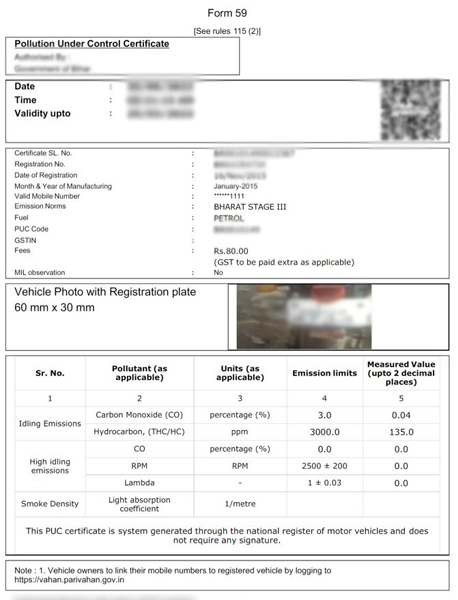
The prescribed PUC certificate format, Form 59, includes identification and vehicle details such as:
- Certificate serial number: Identifies the issued PUC certificate.
- Vehicle registration number: Identifies the vehicle associated with the test record.
- Date of registration: Records the vehicle’s registration date.
- Month and year of manufacture: Records when the vehicle was manufactured.
- Emission norms and fuel: Identifies the vehicle’s recorded emission category and fuel type.
The form also includes a vehicle photograph showing the registration plate. Check that the vehicle details on your certificate are correct.
Source: Parivahan — official Form 59, Pollution Under Control Certificate.
2. Emission Test Results
The certificate also shows the results of your vehicle’s emission test, including:
Emission Levels: The levels of pollutants emitted by the vehicle, such as carbon monoxide (CO), hydrocarbons (HC), etc., are measured and recorded.
Permissible Limits: The certificate shows the applicable emission limits alongside the measured test results. For petrol two-wheelers, these include carbon monoxide (CO) and hydrocarbons (HC). The applicable in-use emission standards are prescribed under Rule 115(2) of the Central Motor Vehicles Rules, 1989.
Source: Ministry of Road Transport and Highways — Central Motor Vehicles Rules, Chapter V, Rule 115.
3. Validity Period
The certificate shows the test date and its validity or expiry date. Check these details to know when your two-wheeler needs its next emission test.
Do not assume that every bike receives the same validity period. Refer to the validity section above for the central government’s published explanation and the Kerala-specific example. For clarification, check the latest applicable state transport department instructions.
If the expiry date appears incorrect for your vehicle category, contact the issuing centre or the relevant transport department. Arrange the next test before the certificate expires.
Source for the Kerala-specific validity distinction: Kerala Government Order G.O.(Rt)No.353/2022/TRANS, dated 22 August 2022.
4. Issuing Authority
A PUC certificate is issued through an emission testing centre authorised by the relevant state or Union Territory authority. The centre must hold the required authorisation to conduct PUC tests; do not assume that every petrol pump, garage or vehicle workshop is authorised.
You can use the official Parivahan PUC Centre List to find a listed testing centre.
Official sources:
Odisha Motor Vehicle Department — testing-centre authorisation and RTO approval; and
Uttarakhand Transport Department — requirements for setting up a pollution checking centre.
What Happens If You Ride Without A Valid Puc Certificate?
Once the PUC requirement applies to your two-wheeler, keep a valid certificate available for inspection. If you receive a challan for a missing or expired PUC certificate, check the legal provision, offence description, and amount recorded on it.
Do not assume that a single first-offence or repeat-offence amount applies throughout India. When checking a quoted penalty, look for both the applicable legal provision and the relevant state or Union Territory notification. Check whether the quoted figure describes a statutory penalty or an amount payable to settle the offence through compounding.
Penalty information must also account for amendments to the law and their commencement dates. The Jan Vishwas (Amendment of Provisions) Act, 2026 amends Section 190(2) of the Motor Vehicles Act, including the provisions concerning air-pollution violations. Older summaries of fines and imprisonment should therefore not be treated as automatically current.
Check the latest applicable official notification or seek clarification from the issuing transport or traffic authority. Do not treat vehicle seizure, imprisonment or licence disqualification as automatic consequences of every missing-PUC case without identifying the applicable legal provision.
Sources:
India Code — Section 190 of the Motor Vehicles Act, 1988; and
Jan Vishwas (Amendment of Provisions) Act, 2026 — amendment to Section 190(2), subject to the applicable commencement notification.
What Is The Bharat Stage (bs) Emission Standard?
The Bharat Stage (BS) emission standards are rules set by the Indian government to control engine emissions, including those from motorcycles and scooters. Each BS stage represents a set of limits for pollutant emissions. Over time, these standards have become stricter, reflecting the government’s commitment to cleaner air and public health.
Bharat Stage Emission Standards For Two-wheelers In India
Bharat Stage standards specify emission requirements for vehicle certification. The tables below focus on motorcycles and scooters rather than passenger cars. They distinguish historical standards from BS-IV and BS-VI requirements and identify relevant vehicle-category qualifications.
Historical Bs-i, Bs-ii And Bs-iii Two-wheeler Limits
The following figures are from the historical two-wheeler tables in ARAI’s September 2021 Indian Emissions Regulations booklet. They are mass-emission limits, not the concentration limits used during a periodic PUC test.
| Emission standard | CO (g/km) | Combined HC + NOx (g/km) |
|---|---|---|
| BS-I (2000) | 2.00 | 2.00 |
| BS-II (2005) | 1.50 | 1.50 |
| BS-III — conventional limits listed in the booklet | 1.00 | 1.00 |
The booklet also lists an alternative WMTC-based BS-III framework separately on printed page 13. Do not combine figures from different test frameworks as though they were interchangeable.
Bs-iv Emission Limits For Petrol Motorcycles And Scooters
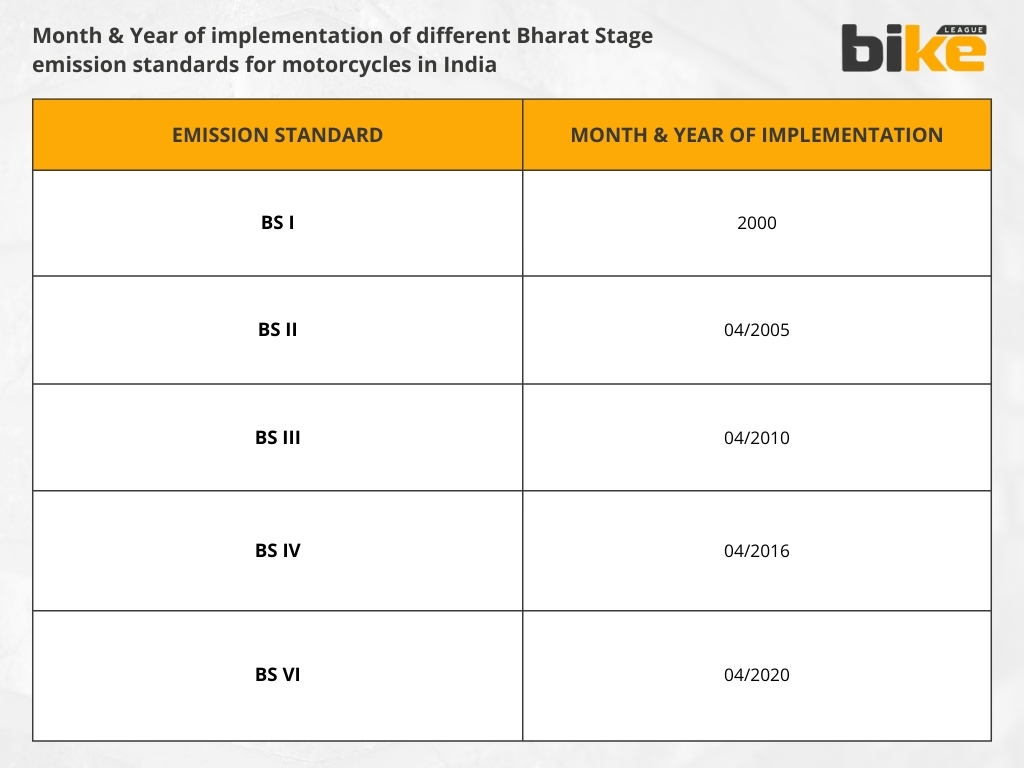
BS-IV mass-emission standards apply to new two-wheeler model types from 1 April 2016 and existing model types from 1 April 2017. The applicable limits depend on the vehicle class and its evaporative-emission compliance option.
The following table shows the petrol two-wheeler limits listed in ARAI’s September 2021 Indian Emissions Regulations booklet. All exhaust mass-emission values are expressed in grams per kilometre (g/km).
| Vehicle class | CO (g/km) | NOx (g/km) | Combined HC + NOx (g/km), with 2 g/test evaporative compliance | Combined HC + NOx (g/km), with 6 g/test evaporative compliance |
|---|---|---|---|---|
| Class 1 and subclass 2-1 | 1.403 | 0.39 | 0.79 | 0.59 |
| Subclass 2-2 | 1.970 | 0.34 | 0.67 | 0.47 |
| Subclasses 3-1 and 3-2 | 1.970 | 0.20 | 0.40 | 0.20 |
The two HC + NOx columns represent alternative evaporative-emission compliance conditions, not two limits that owners can choose between. Evaporative emissions refer to fuel vapour losses and are assessed separately from exhaust emissions.
Vehicle classification depends on engine capacity and maximum vehicle speed. Do not assign a class based only on engine displacement. ARAI provides the detailed class definitions on printed page 11.
The booklet notes that durability requirements are built into the BS-IV mass-emission limits shown above. It also lists separate provisions for the moped category.
Source: ARAI — Indian Emissions Regulations, September 2021, printed pages 10–11: BS-IV two-wheeler limits, implementation dates and vehicle classification.
Bs-vi Emission Limits For Petrol Motorcycles And Scooters
The booklet lists BS-VI two-wheeler standards applicable from 1 April 2020. For the main positive-ignition vehicle classes, including petrol motorcycles and scooters, it specifies the following mass-emission limits.
| Pollutant | Limit (mg/km) | Equivalent limit (g/km) |
|---|---|---|
| Carbon monoxide (CO) | 1,000 | 1.000 |
| Hydrocarbons (HC) | 100 | 0.100 |
| Nitrogen oxides (NOx) | 60 | 0.060 |
| Non-methane hydrocarbons (NMHC) | 68 | 0.068 |
| Particulate matter (PM), subject to the applicability note below | 4.5 | 0.0045 |
For petrol engines, the PM limit shown above applies to gasoline direct-injection engines. It should not be presented as an unqualified PM requirement for every petrol motorcycle or scooter.
The booklet lists separate limits for its spark-ignition moped category. The table above therefore does not cover every two-wheeler category.
BS-VI certification also includes evaporative-emission, durability and on-board diagnostic requirements. These are separate from the exhaust mass-emission limits shown in the table.
Source: ARAI — Indian Emissions Regulations, September 2021, printed page 1 for BS-VI two-wheeler limits and applicability notes, and pages 2–9 for related requirements.
Bharat Stage Certification Limits Are Not Puc Test Limits
Bharat Stage mass-emission limits are expressed in units such as grams per kilometre (g/km) or milligrams per kilometre (mg/km). The booklet’s in-use PUC tables report carbon monoxide (CO) as a percentage by volume and hydrocarbons (HC) in parts per million (ppm).
These measurements are not directly interchangeable. To interpret your bike’s PUC result, compare its readings with the applicable limits shown on the certificate, not with the historical mass-emission table above.
Source: ARAI — Indian Emissions Regulations, September 2021, printed pages 1–9 (BS-VI two-wheelers), 10–12 (BS-IV two-wheelers), 13–16 (BS-III and historical two-wheeler standards), and 85 (in-use PUC limits).
This booklet summarises information available at the time of publication. Refer to the applicable official notifications and subsequent amendments when checking current requirements.
Explanation Of Emission Limits In Bs Emission Standards
- Carbon Monoxide (CO): A colourless, odourless gas that is harmful when inhaled in large amounts. It is produced by incomplete combustion of fuel.
- Hydrocarbons (HC): Organic compounds that contribute to smog formation and harm human health.
- Hydrocarbons + Nitrogen Oxides (HC+NOx): A combination of hydrocarbons and nitrogen oxides contributes to ground-level ozone and smog formation.
- Nitrogen Oxides (NOx): Gases that contribute to the formation of smog and acid rain and can cause respiratory problems.
- Non-methane hydrocarbons (NMHC): Hydrocarbons, excluding methane, significantly contribute to ozone formation.
- Particulate Matter (PM): Tiny particles that can penetrate the respiratory system and cause health issues.
- Respirable Suspended Particulate Matter (RSPM): Small particles can be inhaled and cause respiratory problems.
Is The Puc Test The Same For Every Motorcycle And Scooter?
The general process is similar for petrol motorcycles and scooters: an authorised centre measures exhaust emissions and compares the results with the applicable in-use limits. However, the operator must select the correct vehicle category and test procedure. Applicable limits can depend on factors such as the fuel type, engine type, manufacturing date and emission category.
For example, the in-use emission standards distinguish between certain two-stroke and four-stroke two-wheelers. Do not assume that every motorcycle or scooter is assessed against identical limits.
A periodic PUC test is also different from the laboratory tests used for Bharat Stage vehicle certification. Do not directly compare the CO and HC concentration readings on a PUC certificate with Bharat Stage mass-emission limits expressed in grams per kilometre.
What Steps Can Two-wheeler Owners Take If They Fail The Puc Emission Test?
If your two-wheeler fails the PUC test, ask the authorised testing centre for the rejection slip and an explanation of the recorded reason. The prescribed Form 59-A includes rejection for emission readings that exceed the applicable limits or, where applicable, for the malfunction indicator lamp (MIL) remaining illuminated after the engine starts.
Keep the slip for diagnosis and repair, and confirm the applicable testing or retesting charge with the centre. Do not assume that one fee applies throughout India.
Immediate Consequences Of Failing The Puc Test
If your two-wheeler fails the emission test, the authorised testing centre issues a PUC rejection slip recording the reason for rejection. This slip is not a passing PUC certificate and should not be treated as permission to continue normal riding without meeting the applicable emission requirements.
Keep the rejection slip and show it to a qualified workshop so that the problem can be diagnosed and repaired. After servicing or repair, submit the vehicle for another emission test at an authorised PUC centre.
Do not assume that a failed test automatically grants a grace period or protection from enforcement. Follow instructions from the transport department or enforcement officer, and confirm the permitted arrangements for moving the vehicle for repairs, if necessary.
Official sources:
Ministry of Road Transport and Highways — explanation of PUC rejection slips; and
G.S.R. 410(E), dated 14 June 2021 — Form 59-A, Pollution Under Control Rejection Slip.
Steps To Resolve
- Diagnose and repair: Show the PUC rejection slip and recorded emission readings to a qualified workshop. Ask the technician to identify the cause of the failed test and recommend repairs appropriate to your motorcycle or scooter. Obtain an estimate before approving the work rather than assuming a fixed repair cost or replacing parts without diagnosis.
- Retest: After the necessary repairs, take your two-wheeler to an authorised PUC testing centre for another emission test. Confirm the applicable retest procedure and fee with the centre. If the vehicle passes, check the new certificate’s vehicle details, test results and expiry date. Do not assume that every certificate issued after a retest is valid for six months; validity depends on the applicable vehicle category and rules.
Before the retest: Follow the workshop’s repair advice and the manufacturer’s operating instructions. Ask the authorised PUC operator about the required test preparation, including engine warm-up. Do not assume that leaving the bike idling for 20 minutes is necessary or that warming the engine will fix an underlying emission problem.
Source: ARAI — CMVR test procedures, including the definition of normal thermal conditions.
After repairs, have the vehicle retested at an authorised PUC centre. If it passes, check the issued certificate’s registration details, emission readings and expiry date. Completing repairs alone does not replace a passing test or a valid PUC certificate.
Source: Kerala Government Order G.O.(Rt)No.353/2022/TRANS, dated 22 August 2022 — category-specific PUC validity periods. This is a Kerala-specific example, not a nationwide validity schedule.
How Do Emission Standards Influence Motorcycle And Scooter Technology?
Bharat Stage standards set emission limits and related compliance requirements. They should not be treated as a universal list of components fitted to every motorcycle or scooter. The engineering used to meet those requirements depends on the model and its design.
Fuel Injection And Engine Management
Fuel injection helps control fuel delivery and combustion. Honda explains that replacing a carburettor with fuel injection is not itself a regulatory requirement, but that fuel injection is a more suitable technique for meeting permissible emission limits.
Do not assume that a bike’s BS-IV or BS-VI classification alone identifies every component it uses. Check the manufacturer’s specifications or owner’s manual for the particular model.
Emission Controls And On-board Diagnostics
The ARAI booklet describes requirements beyond exhaust mass-emission limits, including evaporative-emission control, durability and on-board diagnostics. The applicable requirements depend on the vehicle category, fuel and implementation stage.
Emission compliance and fuel economy are related engineering considerations, but a stricter BS classification alone does not establish a particular mileage improvement. Any mileage comparison should identify the models and the manufacturer’s stated test basis.
Sources:
Honda Motorcycle & Scooter India — PGM-FI technology and the role of fuel injection in meeting emission limits; and
ARAI — Indian Emissions Regulations, September 2021, printed pages 1–12 for two-wheeler BS-VI and BS-IV requirements.
What Is The Impact On Fuel And Costs Across Bs Emission Standards?
1. Fuel Quality
The transition from BS-IV to BS-VI improved fuel quality by reducing the permissible sulphur content in petrol and diesel from a maximum of 50 parts per million (ppm) to a maximum of 10 ppm.
These figures describe fuel specifications, not the sulphur content of an engine. Lower-sulphur fuel supports advanced emission-control systems.
Sources:
Government of India — reduction in permissible sulphur content from BS-IV to BS-VI fuel, published 25 July 2022; and
ICCT — gasoline and diesel fuel-quality standards and their relationship to emission-control technology.
2. Purchase Price And Fuel Economy
When comparing BS-IV and BS-VI versions of a motorcycle or scooter, check the specific model, variant, launch price and equipment changes. Do not attribute the entire price difference to emission compliance without a supporting manufacturer statement.
A BS-VI classification alone does not establish a particular mileage improvement. When comparing fuel-economy claims, check which models and variants are being compared and any conditions or qualifications attached to the claim.
For example, Honda’s Activa 125 BS-VI brochure claims 13% higher mileage for the Deluxe variant compared with the Activa 125 BS-IV Deluxe variant. This is a model-and-variant-specific claim, not a general improvement applicable to every BS-VI motorcycle or scooter.
Source: Honda Activa 125 BS-VI brochure, hosted by a Honda dealer — see the mileage-comparison footnote.
Some Common Myths Vs Facts About Puc Certificates For Two-wheelers In India
1. New Bikes Never Need A Puc Certificate
Myth: A motorcycle bought new is permanently exempt from PUC testing.
Fact: Under Rule 115(7) of the Central Motor Vehicles Rules, 1989, the requirement to carry a valid PUC certificate begins after one year from the date of first registration. The first-year provision is not a permanent exemption, nor does it mean that every new bike automatically receives a one-year PUC certificate from the dealer.
Arrange an emission test at an authorised PUC centre before the first registration anniversary so that you have a valid certificate when the requirement begins.
Source: Ministry of Road Transport and Highways — explanation of the PUC requirement under Rule 115(7).
2. Puc Is Required Only In Delhi And Other Major Cities
Myth: Petrol motorcycles and scooters need a PUC certificate only in Delhi, Mumbai or other major cities.
Fact: The PUC requirement under the Central Motor Vehicles Rules is not limited to major cities. For petrol motorcycles and scooters, you must carry a valid certificate after one year from first registration; living in a smaller town does not exempt you.
See the validity section above for the first-year provision and certificate-validity guidance. Pure battery-electric two-wheelers are discussed separately in Myth 7.
3. Two‑wheelers Are Exempt; Puc Is Mainly For Cars
Myth: PUC rules target cars and commercial vehicles, not bikes and scooters.
Fact: The PUC requirement explicitly covers two‑wheelers; emission limits are separately specified for 2‑ and 3‑wheelers based on stroke type and manufacturing year.
4. I Need A Valid Puc Certificate Only When Renewing Insurance
Myth: Showing a valid PUC certificate at insurance renewal means I do not need to keep it valid afterwards.
Fact: Once the PUC requirement applies to your petrol motorcycle or scooter, keep the certificate valid and available for inspection while riding. Showing it to an insurer does not extend its expiry date or replace the requirement to renew it through a fresh emission test.
Check the expiry date on your PUC certificate separately from your insurance renewal date. See FAQ 6 for guidance on carrying paper or officially verifiable electronic proof.
5. Passing A Puc Test Always Gives My Bike One Year Of Validity
Myth: Every motorcycle or scooter that passes a PUC test receives a certificate valid for one year.
Fact: Do not assume that every passing certificate has the same validity. Check the expiry date printed on your certificate and the applicable transport department instructions.
For example, Kerala’s Government Order G.O.(Rt)No.353/2022/TRANS, dated 22 August 2022, specifies six-month validity for BS-IV petrol two-wheelers and one-year validity for BS-VI two-wheelers. These are provisions from a dated Kerala order, not a universal nationwide schedule.
6. Bs6 Bikes Do Not Need A Puc Certificate
Myth: A BS6 motorcycle or scooter is exempt from periodic PUC testing because it already meets stricter emission standards.
Fact: BS6 certification does not exempt a petrol motorcycle or scooter from the applicable PUC requirement. Under Rule 115(7) of the Central Motor Vehicles Rules, 1989, the requirement to carry a valid PUC certificate begins after one year after first registration.
Keep the certificate valid, check its expiry date and follow the applicable transport department instructions for renewal.
Source: Ministry of Road Transport and Highways — explanation of the PUC requirement under Rule 115(7).
7. A Pure Electric Scooter Needs The Same Puc Test As A Petrol Scooter
Myth: A pure battery-electric motorcycle or scooter must undergo the same tailpipe PUC test as a petrol two-wheeler.
Fact: A pure battery-electric two-wheeler does not have an internal-combustion engine or exhaust tailpipe and does not require a tailpipe PUC certificate. Do not confuse it with a hybrid vehicle that also has an internal-combustion engine.
The PUC exemption does not mean that the owner can ignore other applicable vehicle-document requirements. Keep the discussion of PUC separate from registration, insurance and driving-licence requirements.
Source: Dainik Jagran — explanation of PUC requirements for electric vehicles, published 10 April 2026.
8. The Penalty For Riding Without A Valid Puc Is Always Minor
Myth: A missing or expired PUC certificate attracts only a small, fixed penalty everywhere in India.
Fact: Do not rely on an assumed nationwide amount. Check the applicable legal provision and the relevant state or Union Territory notification. An older first-offence or repeat-offence figure may not reflect the law currently in force.
If you receive a challan, check its offence description, legal provision and recorded amount. Seek clarification from the issuing authority if any details appear incorrect.
For the distinction between statutory penalties, state-specific amounts and amendments requiring commencement verification, see the penalties section above.
Sources:
India Code — Section 190 of the Motor Vehicles Act, 1988; and
Jan Vishwas (Amendment of Provisions) Act, 2026 — consult alongside the applicable commencement notification.
9. Puc Testing Can Wait Until My Bike Becomes Old
Myth: A petrol motorcycle or scooter does not need periodic PUC testing until it is several years old.
Fact: Under Rule 115(7) of the Central Motor Vehicles Rules, 1989, the requirement to carry a valid PUC certificate begins after one year from first registration. For petrol motorcycles and scooters, the bike’s relatively young age does not extend that first-year provision.
Check your certificate’s expiry date and arrange renewal before it expires. See the validity section above for the distinction between the first-year provision and the validity of an issued certificate.
10. A Missing Puc Certificate Can Never Affect Refuelling
Myth: A missing or expired PUC certificate can never affect your ability to buy fuel.
Fact: Local measures may restrict fuel supply to vehicles without a valid PUC certificate. Do not assume that the same restrictions, effective dates or exceptions apply throughout India.
For example, The Indian Express reported on 20 October 2026 that Delhi’s announced winter action plan included a “No PUC, No Fuel” measure scheduled to begin on 1 November at 500 petrol pumps equipped with automatic number plate recognition systems.
This describes a reported announcement, not a verified account of every applicable enforcement direction. Before relying on a specific implementation date or exemption, check the latest official notification from the transport department or air-quality authority for the relevant location.
Source: The Indian Express — Delhi winter action plan announcement, published 20 October 2026.
11. Paying The Testing Fee Guarantees A Puc Pass
Myth: Paying the fee at a PUC centre is enough to obtain a passing certificate, regardless of the vehicle’s emissions.
Fact: Paying the testing fee does not mean that the vehicle automatically passes. The authorised centre tests the vehicle and compares its recorded readings with the applicable emission limits.
Check that the issued certificate records your vehicle’s correct registration details, measured emission readings, applicable limits and expiry date.
Source: Ministry of Road Transport and Highways — Central Motor Vehicles Rules, Chapter V, Rule 115.
12. Every Bike Puc Test Has The Same Price And Completion Time
Myth: A bike PUC test costs the same everywhere and is always completed within a fixed number of minutes.
Fact: Check the applicable state or Union Territory fee schedule and your vehicle category. Confirm the charge and expected waiting time with an authorised centre before visiting.
For example, Kerala’s Government Order G.O.(Rt)No.353/2022/TRANS, dated 22 August 2022, lists ₹80 for pre-BS, BS-I, BS-II, BS-III and BS-IV two-wheelers, and ₹100 for BS-VI two-wheelers. These are figures from that Kerala notification, not a nationwide tariff.
Source: Kerala Government Order G.O.(Rt)No.353/2022/TRANS — category-specific PUC fees.
13. Only A Paper Puc Certificate Can Be Accepted
Myth: A valid PUC certificate must always be produced as an original paper slip.
Fact: The electronic-document framework under the Central Motor Vehicles Rules includes the pollution certificate. MoRTH’s guidance recognises officially available transport records presented through DigiLocker or mParivahan.
Do not assume that an expiry-reminder SMS, a photograph or an unverified screenshot has the same status as an officially verifiable electronic record. Check whether your current PUC details are available through the official service before relying on digital proof.
If you cannot access an officially verifiable electronic record, keep the valid paper certificate available for inspection. You can also download a certificate to check its details, but downloading it does not renew its validity.
14. If My State Rto Website Does Not Mention Puc, I Am Exempt
Myth: If I cannot find PUC information on my state RTO website, my petrol motorcycle or scooter does not need a certificate.
Fact: Missing information on a website is not evidence of a legal exemption. Check the applicable Central Motor Vehicles Rules and relevant state or Union Territory notifications rather than relying on what a single webpage includes or omits.
If the published guidance is unclear or appears inconsistent, ask the relevant transport department to identify the provision that applies to your vehicle. See the validity and penalties sections above for the distinctions that require particular care.
Faq About Puc Certificate And Bs Emission Standards
1. Can I Get Or Renew My Bike’s Puc Certificate Entirely Online?
No. To obtain or renew a PUC certificate, take your motorcycle or scooter to an authorised testing centre for a physical emission test. The centre issues a certificate if the vehicle passes.
Once the certificate has been issued and its record is available on the official Parivahan portal, you can view and download it online. Downloading an existing certificate does not renew it or extend its expiry date.
For the download procedure, see FAQ 3 below.
2. Does A New Motorcycle Need A Puc Certificate Immediately?
Under Rule 115(7) of the Central Motor Vehicles Rules, 1989, the requirement to carry a valid PUC certificate begins after one year from the date of first registration. A newly registered motorcycle therefore does not need a separate periodic PUC certificate during its first year under this provision.
Arrange an emission test at an authorised PUC centre before the first registration anniversary so that you have a valid certificate when the requirement begins. Do not confuse this first-year provision with a one-year PUC certificate the dealer automatically issues.
3. How Can I Check And Download My Bike Puc Certificate Online?
You can retrieve an issued PUC certificate through the official Parivahan portal:
- Open the official PUC certificate page.
- Enter your bike’s registration number.
- Enter the last five characters of the chassis number.
- Enter the security code shown in the CAPTCHA.
- Select “PUC Details” to retrieve the available certificate record.
- Check the registration number and expiry date, then use the available print option to print the certificate or save it as a PDF.
Downloading a certificate does not renew it or extend its expiry date. To renew an expired certificate, take your bike to an authorised PUC centre for a fresh emission test.
Source: Parivahan — official PUC certificate retrieval service.
4. What Should I Bring For My Bike’s Puc Test?
Take the motorcycle or scooter to an authorised PUC centre for physical emission testing. As a practical precaution, keep the registration certificate (RC) details and any previous PUC certificate available so that the operator can check the vehicle information if necessary.
Check that your mobile number is correctly linked to the vehicle record. The official PUC certificate format includes a mobile-number field and advises owners to link their number through VAHAN.
The RC and previous certificate are suggested here to help with verification, not as a claim that both are mandatory documents at every centre. Confirm any additional requirements with the authorised centre before visiting.
5. How To Find Rto-approved Puc Centres?
Visit this link https://puc.parivahan.gov.in/puc/views/PUCCenterList.xhtml to find the RTO-approved PUC Centres in India.
6. Must I Carry My Puc Certificate While Riding?
Once the PUC requirement applies to your motorcycle or scooter, keep a valid certificate available for inspection. Carry the paper certificate or an officially available electronic record through DigiLocker or mParivahan, as required.
Do not assume that an ordinary photograph, screenshot or reminder SMS is equivalent to an officially verifiable electronic record. If your current PUC record is not available through the recognised platform, carry the valid paper certificate.
7. Is The Bike Puc Testing Fee The Same Across India?
Do not assume that one fee applies throughout India. Check the applicable state or Union Territory fee schedule and your vehicle category. Confirm the notified charge with an authorised testing centre before the test.
For example, Kerala’s Government Order G.O.(Rt)No.353/2022/TRANS, dated 22 August 2022, lists ₹80 for pre-BS, BS-I, BS-II, BS-III and BS-IV two-wheelers, and ₹100 for BS-VI two-wheelers. These are figures from a dated Kerala notification, not a nationwide price list.
8. Do Bs-iv And Bs-vi Bikes Always Have The Same Puc Validity?
No. Do not assume that both categories always receive the same validity. For example, Kerala’s order dated 22 August 2022 specifies six-month validity for BS-IV petrol two-wheelers and one-year validity for BS-VI two-wheelers.
Check your certificate’s expiry date and the latest applicable state transport department instructions. If the validity shown appears incorrect, seek clarification from the issuing centre or transport department.
Source for the Kerala examples: Kerala Government Order G.O.(Rt)No.353/2022/TRANS, dated 22 August 2022 — PUC fees and validity by vehicle category.
9. Do Petrol And Pure Electric Two-wheelers Have The Same Puc Requirement?
No. For petrol motorcycles and scooters, you must carry a valid PUC certificate after one year from first registration. Keep the certificate valid by arranging a fresh emission test before it expires.
A pure battery-electric motorcycle or scooter does not have an internal-combustion engine or exhaust tailpipe and does not require a tailpipe PUC certificate. Do not confuse a pure electric vehicle with a hybrid vehicle that also has an internal-combustion engine.
See Myth 7 above for the explanation and supporting source. The PUC exemption should not be confused with exemption from other applicable vehicle-document requirements.
10. What Happens If My Motorcycle Or Scooter Fails The Puc Test?
You need to fix the issues with your vehicle, then retake the test.
11. What Is The Fine For Riding Without A Valid Puc Certificate?
Do not assume that ₹1,000 for a first offence and ₹2,000 for a repeat offence are nationwide rates. The applicable amount must be checked against the legal provision in force and the relevant state or Union Territory notification.
If you receive a challan, check the offence description, legal provision and amount recorded on it. Refer to the penalties section above for the distinction between statutory penalties, state-specific amounts and amendments requiring commencement verification.
Source: India Code — Section 190 of the Motor Vehicles Act, 1988.
12. Why Did India Skip Bs-v For Road Vehicles?
India moved directly from BS-IV to BS-VI emission norms, effective 1 April 2020, to address rising pollution.
According to the Ministry of Petroleum and Natural Gas, the Auto Fuel Vision and Policy-2025 committee had proposed BS-V implementation from 1 April 2020 and BS-VI from 2024. Instead, the government accelerated the transition by introducing BS-VI directly from April 2020.
This explanation concerns the road-vehicle transition from BS-IV to BS-VI. Do not confuse it with separate emission frameworks for non-road engines and equipment.
Official Links For Bike Pollution Certificate And Bs Norms
Other Related Articles For Pollution Under Control Certificate & Bharat Stage Norms In India
- Second-hand motorcycle: Things to know when buying in India
- Must have bike documents for travel in India
- Bike fitness certificate guide – All you need to know
- Diesel bikes in India: Why are they absent on Indian roads ?
- Aftermarket Motorcycle Silencer Rules in India – Explained
Conclusion: Why Bike Pollution Certificate Matters
Following PUC rules is not just about following the law. It also helps protect the environment and public health. By renewing your PUC certificate on time and keeping your two-wheeler within emission limits, you help improve air quality and support a better future.
To obtain or renew your bike’s PUC certificate, take your two-wheeler to an authorised testing centre for an emission test. Once a certificate is issued and its record is available on the Parivahan portal, you can view and download it online. Downloading a certificate does not renew it or extend its expiry date. Check the validity shown on your certificate and arrange the next test before it expires.
As more people become aware of air pollution and rules become stricter, it is important to be a responsible vehicle owner. By following emission norms and keeping your PUC certificate up to date, you help create a cleaner and healthier community for everyone.
If you have any questions about the PUC certificate, Bharat Stage emission norms, or related standards in India, you can email us at bikeleagueindia@gmail.com or leave a comment below. We are always happy to help.