
Long story short: FADA’s data shows 14,01,818 electric two-wheeler retail registrations in FY26, up 21.81% from FY25. TVS Motor led the market, followed by Bajaj Auto and Ather Energy. Ather had the largest increase in registrations, while Hero MotoCorp’s VIDA business grew the fastest by percentage.
Here, “brand preferences” means the purchase patterns shown by electric two-wheeler retail registrations, not results from a consumer survey. The numbers show which manufacturers had the most registrations and how their volumes changed from FY25. They do not explain why buyers chose a brand, how satisfied they were, which models were preferred, or which brands led in each state.
FY26 refers to the financial year from April 1, 2025 to March 31, 2026. This is different from the calendar year 2026, which is January to December. For year-on-year comparisons, FY25 covers April 1, 2024 to March 31, 2025.
FADA’s dataset shows 14,01,818 electric two-wheeler retail registrations in FY26, up from 11,50,790 in FY25. Electric two-wheelers made up 6.5% of all two-wheeler registrations, compared to 6.1% the previous year.
The FADA dataset used here excludes Telangana and covers 1,463 out of 1,466 RTOs. These figures are used for the main annual manufacturer comparisons, national rankings, and market shares. Other sections use Autocar Professional’s VAHAN data as of April 1, 2026 for extra monthly and market context. The two datasets are kept separate and not combined.
Source for annual market figures and coverage: ET Auto’s April 7, 2026 report on FADA’s FY26 electric two-wheeler retail data.
Key Takeaways
- FADA’s cited dataset recorded 14,01,818 electric two-wheeler retail registrations in FY26, an increase of 21.81% over FY25.
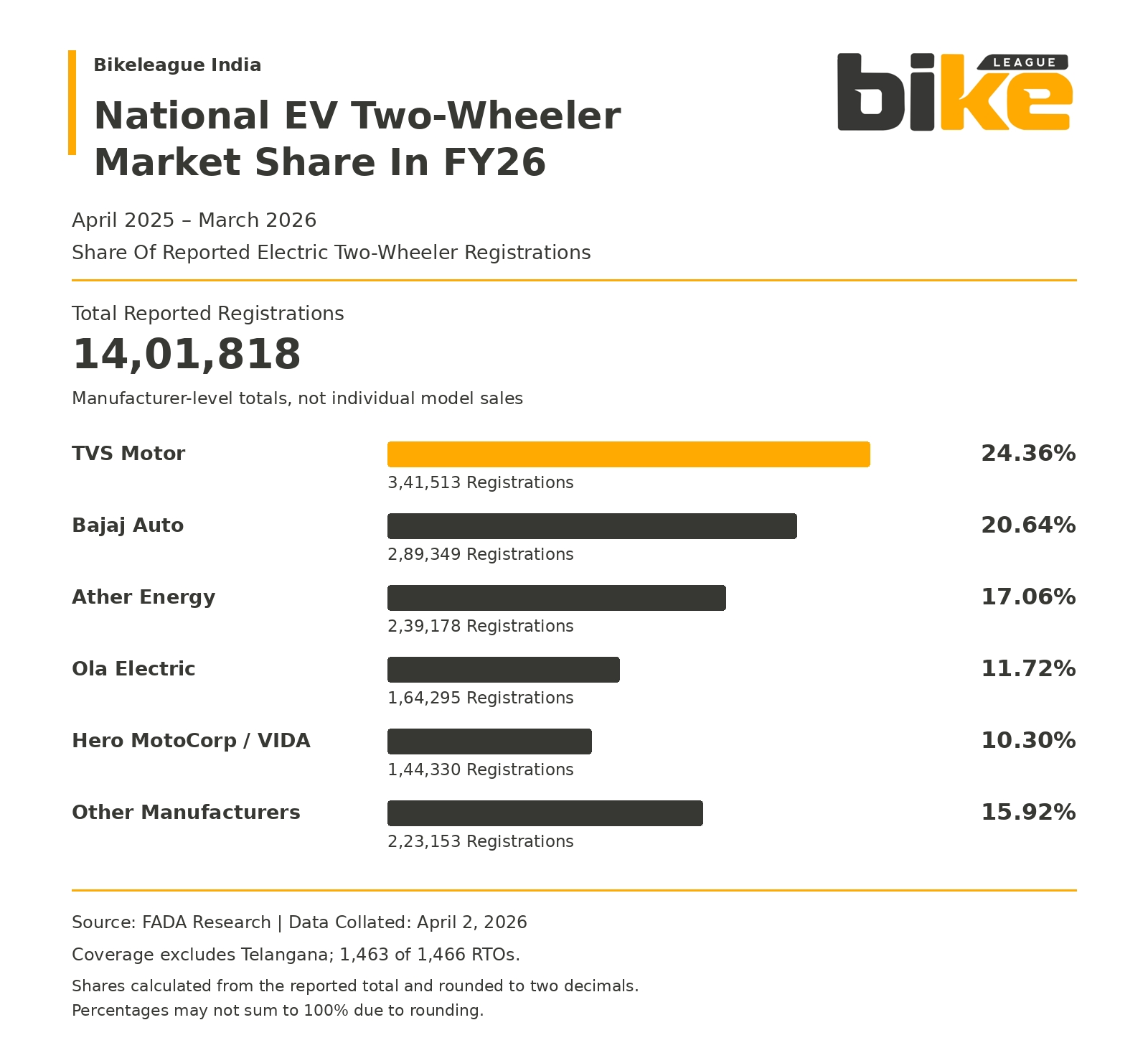
- TVS Motor ranked first with 3,41,513 registrations, followed by Bajaj Auto with 2,89,349 and Ather Energy with 2,39,178.
- Ather added 1,08,006 registrations, the largest absolute increase among the five leading manufacturers. Hero VIDA recorded the fastest percentage growth within that group, at 196.13%.
- Ola Electric ranked fourth with 1,64,295 registrations, down 52.28% from FY25. Hero VIDA ranked fifth with 1,44,330 registrations.
- Among selected manufacturers outside the top five, River Mobility reached 22,354 registrations, up 426.35%, while Simple Energy reached 8,214, up 319.30%.
Source: FADA figures reported by ET Auto. Ather’s absolute increase is calculated from its reported FY25 and FY26 registrations.
National Ev Two-wheeler Market: The Fy26 Picture
The table below shows the top five manufacturers by FY26 retail registrations. FY25 numbers are included for year-on-year comparison, and FY26 market shares show each manufacturer’s position in the electric two-wheeler segment.
| FY26 Rank | Manufacturer / Brand | FY25 Retail Registrations | FY26 Retail Registrations | Reported YoY Growth | Change in Registrations | FY26 E2W Market Share |
|---|---|---|---|---|---|---|
| 1 | TVS Motor | 2,37,929 | 3,41,513 | +43.54% | +1,03,584 | 24.36% |
| 2 | Bajaj Auto | 2,31,172 | 2,89,349 | +25.17% | +58,177 | 20.64% |
| 3 | Ather Energy | 1,31,172 | 2,39,178 | +82.34% | +1,08,006 | 17.06% |
| 4 | Ola Electric | 3,44,300 | 1,64,295 | −52.28% | −1,80,005 | 11.72% |
| 5 | Hero MotoCorp / VIDA | 48,738 | 1,44,330 | +196.13% | +95,592 | 10.30% |
Source: ET Auto’s April 7, 2026 report on FADA’s FY26 electric two-wheeler retail data. Registration volumes and reported year-on-year growth rates follow this report.
Table notes: Absolute changes are calculated as FY26 registrations minus FY25 registrations. Manufacturer market shares use the FY26 electric two-wheeler total of 14,01,818 and are rounded to two decimal places. These shares are for the electric two-wheeler segment only, not the whole two-wheeler market. The figures are for retail registrations and exclude Telangana. More details are in the Data Sources, Coverage and Calculations section.
Manufacturer versus model totals: This table ranks manufacturers, not specific scooter or motorcycle models. TVS Motor’s registrations are not just iQube sales, and Bajaj Auto’s are not only Chetak sales. Autocar Professional’s separate FY26 analysis covers TVS’s iQube and Orbiter scooters and Bajaj’s Chetak and Yulu scooters, but these references do not provide a model-level breakdown of the FADA figures.
Source for product-portfolio context: Autocar Professional’s FY2026 electric two-wheeler analysis.
1. Tvs Motor: Highest Fy26 Registration Volume
TVS Motor led the national market with 3,41,513 registrations and a 24.36% share of the electric two-wheeler segment. Its 43.54% year-on-year growth was higher than the segment’s overall growth of 21.81%.
TVS also performed strongly each month. Autocar Professional’s VAHAN analysis shows TVS led electric two-wheeler registrations in 11 out of 12 months in FY26. Bajaj Auto was first in October 2025, but TVS regained the lead in November and kept it through March 2026.
Source for monthly leadership: Autocar Professional’s FY2026 analysis, citing VAHAN data as of April 1, 2026.
2. Bajaj Auto: Second-largest Manufacturer
Bajaj Auto was second with 2,89,349 registrations and a 20.64% market share. Its registrations increased by 58,177 units from FY25, a year-on-year growth of 25.17%.
3. Ather Energy: Largest Absolute Gain Among The Top Five
Ather Energy added 1,08,006 registrations over FY25, the biggest increase among the top five manufacturers. It finished third in FY26 with 2,39,178 registrations, 82.34% year-on-year growth, and a 17.06% market share.
4. Ola Electric: Lower Registrations Than In Fy25
Ola Electric was fourth with 1,64,295 registrations and an 11.72% market share. Its registrations dropped by 52.28% year-on-year, a decrease of 1,80,005 units from FY25.
5. Hero Vida: Fastest Percentage Growth Among The Top Five
Hero MotoCorp’s VIDA business grew by 196.13% year-on-year, the highest percentage increase among the top five manufacturers. It added 95,592 registrations and ended FY26 with 1,44,330 units and a 10.30% market share. Its percentage growth was higher than Ather’s, but the absolute increase was smaller.
VIDA also improved its position in the last months of the financial year. Autocar Professional’s VAHAN analysis shows Hero MotoCorp moved ahead of Ola Electric to fourth place in the monthly registration ranking in November 2025 and stayed there through March 2026.
However, this monthly improvement did not change the full-year ranking in the FADA dataset: Ola Electric was fourth and Hero MotoCorp’s VIDA business was fifth.
Source for monthly rankings: Autocar Professional’s FY2026 analysis, citing VAHAN data as of April 1, 2026.
Source for annual figures in the five manufacturer profiles: ET Auto’s April 7, 2026 report on FADA’s FY26 electric two-wheeler retail data. Market shares and absolute registration changes are calculated from the reported annual figures. Monthly leadership statements are separately attributed above.
What Fy26 Registrations Reveal About National Brand Preferences
Looking at registrations as a sign of actual purchases, TVS Motor had the largest share in the FY26 dataset, followed by Bajaj Auto and Ather Energy. This shows buying outcomes in the dataset, not results from a consumer survey.
Purchase patterns changed from FY25. TVS, Bajaj, Ather, and Hero MotoCorp increased their registrations, while Ola Electric saw a decline. This does not mean that customers switched from Ola to a specific competitor.
The results do not show that buyers simply preferred established manufacturers over electric-only companies. Growth at Ather, River Mobility, and Simple Energy shows that each manufacturer had different results.
The dataset does not show if price, range, financing, product availability, dealer access, or after-sales service influenced purchases. Explaining these reasons needs more evidence. State and regional preferences also need geographic registration breakdowns.
Source: FADA Research’s FY26 “Electric Two Wheeler Vehicle Retail” graphic, with data collated as of April 2, 2026. Related annual figures are also reported in ET Auto’s April 7, 2026 report.
Electric Two-wheelers’ Role In India’s Overall Ev Market
Electric two-wheelers remained the largest segment of India’s electric vehicle market in FY26. According to Autocar Professional’s analysis of VAHAN data as of April 1, 2026, they accounted for approximately 57% of the roughly 24.5 lakh electric vehicles registered across two-wheelers, three-wheelers, passenger vehicles and commercial vehicles.
The 57% figure shows electric two-wheelers’ share of registrations across all electric vehicle types. This is different from the 6.5% penetration in the FADA dataset, which measures electric registrations as a share of all two-wheeler registrations, including petrol vehicles.
Source for the overall EV market comparison: Autocar Professional’s FY2026 electric two-wheeler analysis. This supplementary comparison is not used to calculate the FADA-based manufacturer market shares.
Monthly Sales Momentum In Fy26
Monthly registrations offer another view of market growth. Autocar Professional’s VAHAN analysis shows electric two-wheeler registrations topped 1 lakh units in 10 months of FY26, compared to four months in FY25.
In March 2026, there were 1,90,941 electric two-wheeler registrations, about 45% more than the previous year. This was higher than the 1,45,011 registrations in October 2025 and marked a strong end to the financial year.
Source: Autocar Professional’s FY2026 analysis, citing VAHAN data as of April 1, 2026. These monthly figures come from a separately reported snapshot; the main annual comparison tables continue to use FADA figures reported by ET Auto.
Beyond The Top Five: Other Electric Two-wheeler Manufacturers
Outside the top five manufacturers, FY26 results were mixed. Greaves Electric Mobility, BGauss Auto, River Mobility, PUR Energy, E-Spring Green Energy, Kinetic Green, and Simple Energy all increased registrations compared to FY25. Revolt Intellicorp saw a decline. The table below is sorted by FY26 registration volume, not percentage growth.
| Manufacturer | FY26 Retail Registrations | Reported YoY Change |
|---|---|---|
| Greaves Electric Mobility (Ampere) | 61,563 | +53.26% |
| BGauss Auto | 26,201 | +51.08% |
| River Mobility | 22,354 | +426.35% |
| PUR Energy | 14,352 | +59.79% |
| E-Spring Green Energy | 12,582 | +792.97% |
| Kinetic Green Energy and Power Solutions | 11,557 | +36.70% |
| Revolt Intellicorp | 10,444 | −9.71% |
| Simple Energy | 8,214 | +319.30% |
Greaves Electric Mobility recorded 61,563 registrations, compared with 40,169 in FY25. BGauss Auto recorded 26,201 registrations, compared with 17,343 a year earlier.
River Mobility’s registrations rose from 4,247 in FY25 to 22,354 in FY26. Its 426.35% growth shows why percentage growth should be considered with registration volumes. A high growth rate does not always mean a bigger market position.
Source: FADA Research’s FY26 “Electric Two Wheeler Vehicle Retail” graphic, with data collated as of April 2, 2026. Manufacturer names, registration volumes and reported year-on-year changes in this table follow the graphic. Related annual figures are also covered in ET Auto’s April 7, 2026 report.
Scope note: This table includes selected manufacturers discussed in the source, not a complete ranking of manufacturers outside the top five. The same FADA dataset coverage applies.
Japanese Manufacturers: Initial Electric Two-wheeler Registrations
Honda, Suzuki and Yamaha recorded a combined 4,746 electric two-wheeler retail registrations in FY26, according to Autocar Professional’s analysis of VAHAN data as of April 1, 2026. Their individual volumes are shown below.
| Manufacturer | Electric Models Discussed in the Source | FY26 Retail Registrations |
|---|---|---|
| Honda | Activa e: and QC1 | 3,856 |
| Suzuki | e-ACCESS | 854 |
| Yamaha | EC-06 | 36 |
| Combined total | All models listed above | 4,746 |
These figures should be considered with the manufacturers’ different market entry dates and availability. Honda launched its electric scooters in February 2025, Suzuki started selling the e-ACCESS in January 2026, and Yamaha entered with the EC-06 in February 2026. Suzuki and Yamaha had only short selling periods in FY26, not the full year.
The table shows registrations at the manufacturer level. Honda’s number includes all its electric models and should not be taken as the sales total for either the Activa e: or QC1 alone.
Source: Autocar Professional’s FY2026 electric two-wheeler analysis. This supplementary table uses its separate VAHAN snapshot, not the FADA dataset used in the main annual comparisons.
Data Sources, Coverage And Calculations
Primary Annual Dataset: Fada Research
The main annual manufacturer comparisons use FADA Research’s FY26 “Electric Two Wheeler Vehicle Retail” graphic, with data collated as of April 2, 2026. The graphic includes FY25 registration volumes for year-on-year comparison. ET Auto’s April 7, 2026 report provides a secondary reference for the annual figures.
- Reporting periods: FY26 covers April 2025–March 2026; FY25 covers April 2024–March 2025.
- Measure: Figures represent retail registrations, not manufacturer dispatches or wholesale sales.
- Coverage and collation date: FADA’s graphic states that the figures exclude Telangana and were collated as of April 2, 2026, in collaboration with the Ministry of Road Transport and Highways, covering 1,463 of 1,466 RTOs.
- Reported values: Annual registration volumes and year-on-year growth rates follow the FADA graphic. April 2, 2026 is the data-collation date, not the end of the FY26 reporting period.
- Calculated registration changes: Each absolute change equals FY26 registrations minus FY25 registrations.
- Calculated manufacturer market shares: Each FY26 manufacturer volume is divided by the reported electric two-wheeler total of 14,01,818 and multiplied by 100. Results are rounded to two decimal places.
Supplementary Source: Autocar Professional’s Vahan Analysis
Selected sections use Autocar Professional’s analysis of VAHAN data as of April 1, 2026. These cover monthly registration momentum, monthly manufacturer rankings, electric two-wheelers’ contribution to the overall EV market, selected Japanese manufacturers’ registrations and product-portfolio context.
Autocar Professional reports an FY26 electric two-wheeler total of 14,01,663, compared with 14,01,818 in the FADA report. Several manufacturer volumes also differ. The two reports do not fully reconcile these differences, so their figures are not treated as interchangeable.
- Supplementary figures are attributed in the relevant sections.
- Autocar Professional’s manufacturer volumes are not divided by the FADA segment total to calculate market shares.
- The FADA coverage statement is not automatically applied to Autocar Professional’s separate VAHAN snapshot.
How To Interpret The Comparisons
This article uses three measures: a manufacturer’s share of electric two-wheeler registrations, electric two-wheelers’ share of all two-wheeler registrations, and electric two-wheelers’ share of all EV registrations. Each measure uses a different denominator.
Full-year and monthly rankings cover different time periods. A manufacturer might move ahead of a competitor in the last months but still not finish ahead in the annual ranking.
Manufacturer totals are not the same as individual model sales. National rankings do not show which brands lead in each state or region. To know that, you need state-level registrations by manufacturer for the full year.
Primary annual source: FADA Research’s FY26 “Electric Two Wheeler Vehicle Retail” graphic, supplied for this article. Secondary reference: ET Auto’s April 7, 2026 report on FADA’s FY26 electric two-wheeler retail data.
Supplementary source: Autocar Professional’s FY2026 electric two-wheeler analysis.
Frequently Asked Questions About India’s Electric Two-wheeler Market In Fy26
1. How Many Electric Two-wheelers Did Fada Report For Fy26?
FADA’s cited dataset recorded 14,01,818 electric two-wheeler retail registrations in FY26, compared with 11,50,790 in FY25, representing reported growth of 21.81%. The dataset excludes Telangana.
2. Which Electric Two-wheeler Manufacturer Led The Fy26 Market?
TVS Motor led the reported national market with 3,41,513 registrations. Bajaj Auto ranked second with 2,89,349, followed by Ather Energy with 2,39,178, Ola Electric with 1,64,295 and Hero MotoCorp’s VIDA business with 1,44,330.
3. What Were The Leading Manufacturers’ Fy26 Market Shares?
Calculated using the reported FADA electric two-wheeler total, TVS Motor held approximately 24.36%, Bajaj Auto 20.64%, Ather Energy 17.06%, Ola Electric 11.72% and Hero MotoCorp / VIDA 10.30%. These shares refer to the electric two-wheeler segment, not the overall two-wheeler market.
4. Which Top-five Manufacturer Added The Most Registrations?
Ather Energy recorded the largest absolute increase among the five leading manufacturers, adding 1,08,006 registrations. Its volume increased from 1,31,172 in FY25 to 2,39,178 in FY26.
5. Which Top-five Manufacturer Recorded The Fastest Percentage Growth?
Hero MotoCorp’s VIDA business recorded the fastest reported percentage growth among the five leading manufacturers, at 196.13%. Registrations increased from 48,738 in FY25 to 1,44,330 in FY26. Ather, however, recorded the larger absolute increase.
6. How Did Ola Electric Perform Compared With Fy25?
Ola Electric recorded 1,64,295 registrations in FY26, compared with 3,44,300 in FY25. The reported decline was 52.28%, while the calculated absolute reduction was 1,80,005 registrations. Ola ranked fourth in FY26.
7. Did Manufacturers Outside The Top Five Record Faster Percentage Growth?
Yes. Among the additional manufacturers listed in the FADA graphic, E-Spring Green Energy grew by a reported 792.97% year-on-year, River Mobility 426.35%, and Simple Energy 319.30%. Their FY26 registrations were 12,582, 22,354 and 8,214 respectively. All three percentage increases exceeded Hero VIDA’s 196.13%, but their registration volumes were substantially smaller. Percentage growth should therefore be considered alongside absolute volumes and the previous year’s base.
8. What Proportion Of Total Two-wheeler Registrations Was Electric?
Electric two-wheelers accounted for 6.5% of total two-wheeler retail registrations in the reported FY26 dataset, compared with 6.1% in FY25. This measures segment penetration, not an individual manufacturer’s market share.
9. Does The Cited Fada Dataset Include Telangana?
No. The cited dataset excludes Telangana and covers 1,463 of 1,466 RTOs. This limitation should be considered when comparing its figures with other reports.
10. Do These National Figures Identify State-wise Brand Leaders?
No. Identifying a state’s leading electric two-wheeler manufacturer requires comparable registrations by manufacturer within that state for the full financial year. National rankings alone do not establish state leadership.
11. What Does Electric Two-wheelers’ 57% Share Of The Ev Market Mean?
Autocar Professional’s separate VAHAN analysis reports that electric two-wheelers accounted for approximately 57% of registrations across all EV categories in FY26. This is different from the 6.5% electric share of total two-wheeler registrations in the FADA dataset. The percentages use different denominators and separately reported datasets.
12. How Strong Was Monthly Electric Two-wheeler Demand During Fy26?
Autocar Professional reported that registrations exceeded 1 lakh in 10 months of FY26, compared with four months in FY25. March 2026 recorded 1,90,941 registrations, approximately 45% higher than a year earlier.
13. Did Hero Vida Overtake Ola Electric In Fy26?
The answer depends on the reporting period. In the FADA-based full-year comparison, Ola ranked fourth and Hero VIDA fifth. Autocar Professional’s separate analysis reported that Hero MotoCorp moved ahead of Ola into fourth place in the monthly ranking in November 2025 and retained that position through March 2026.
Sources for the FAQs: Annual registration volumes, reported growth rates and coverage in FAQs 1–10 follow FADA Research’s FY26 “Electric Two Wheeler Vehicle Retail” graphic, with data collated as of April 2, 2026. ET Auto’s April 7, 2026 report provides a secondary reference. Manufacturer market shares and absolute registration changes are calculated from the FADA volumes. Supplementary information in FAQs 11–13 follows Autocar Professional’s separate VAHAN analysis. FAQ 13 also refers to the FADA-based annual ranking.
Related Two-wheeler Market Reports
- Bike and Scooter Brand Market Shares in India
- Electric Two-Wheeler Sales in India: FY23 and FY24
- Top 10 Sold Petrol Two-Wheelers in India in FY25
- Ola Electric Models
Conclusion
Electric two-wheeler registrations in the FADA dataset rose by 21.81% in FY26; however, results varied by manufacturer. For instance, TVS Motor was first, while Bajaj Auto and Ather Energy followed in second and third place, respectively. Meanwhile, Ola Electric was fourth after a 52.28% drop, and Hero MotoCorp’s VIDA business was fifth.
TVS had the highest annual volume. In contrast, Ather added the most registrations among the top five, and Hero VIDA had the fastest percentage growth in that group. Thus, while these are different achievements, they are not the same as overall leadership.
Autocar Professional’s monthly analysis adds important context. For example, TVS led in 11 out of 12 months, and Hero MotoCorp moved ahead of Ola in the monthly ranking from November 2025 to March 2026. Nevertheless, these monthly results do not replace the FADA full-year ranking.
When considering national buying patterns, the registration data puts TVS Motor first, followed by Bajaj Auto and Ather Energy. However, the data does not show why buyers chose these brands, how satisfied they were, which models they preferred, or which brands led in each state. Furthermore, growth at Ather, River Mobility, and Simple Energy shows that results should be considered by manufacturer, rather than simply as a preference for established companies over electric-only brands.
Sources: ET Auto’s FADA report for annual results and Autocar Professional’s VAHAN analysis for monthly rankings. The datasets are kept separate, and absolute annual registration changes are calculated from the FADA figures.
If you have questions or corrections, please email bikeleagueindia@gmail.com or leave a comment below.