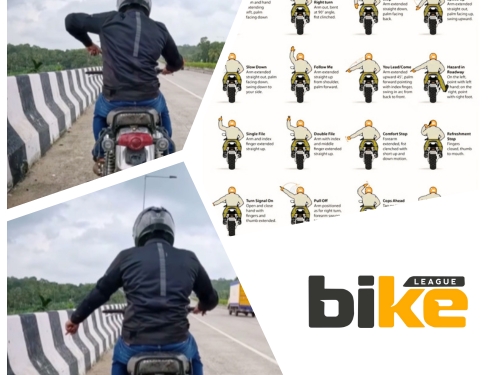
Long story short: In short: This guide will help you learn the key motorcycle hand signals, what they mean, and important safety tips for riders in India. Clear communication on the road keeps everyone safer.
Knowing basic motorcycle hand signals helps you stay safe and communicate better while riding in India. This guide explains the main signals for turning and stopping, why they matter, common mistakes to avoid, and tips for clear communication. Use simple, clear hand signals to ride with confidence.
Key Takeaways
- Hand signals are important for motorcyclists because they help riders communicate about turns, stops, hazards, and group riding, especially if indicators are not working or can’t be seen.
- Riders always use the left hand for signals to maintain throttle and brake control with the right hand, ensuring safety and stability.
- Clear, consistent, and sustained hand signals improve visibility and understanding among group members and nearby drivers, reducing the risk of accidents.
- Practising and standardising universal signals before group rides helps build coordination, making group riding smoother and more disciplined.
- Common mistakes like unclear gestures, using the wrong hand, or forgetting to signal can cause confusion. Riders should always stay alert, make their signals visible, and use them consistently.
What Is A Hand Signal On A Motorcycle?
A hand signal on a motorcycle is a simple gesture made with the rider’s hand, usually the left, to show intentions or warnings to others nearby. Riders use these signals to indicate turns, stops, slowing down, warn about hazards, or coordinate in groups when talking isn’t possible or safe.

For example:
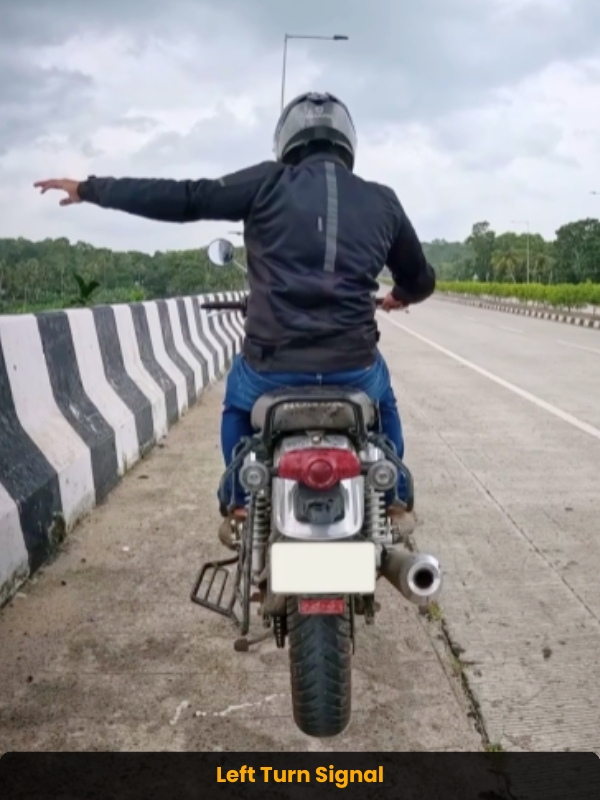
- Extending the left arm straight out horizontally signals a left turn.
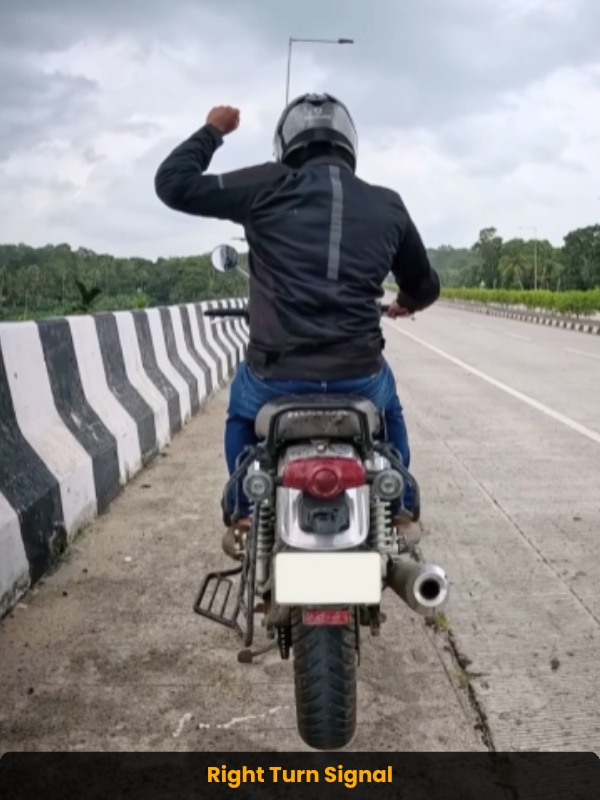
- Bending the left arm upwards at a 90-degree angle with a clenched fist indicates a right turn.
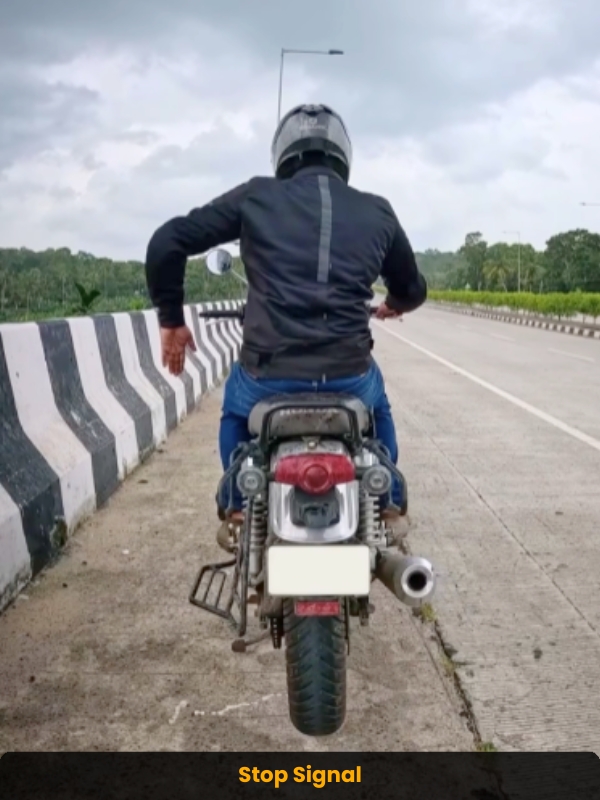
- Pointing the left arm downward at a 90-degree angle with the palm facing backwards means the rider is stopping.
What Is The Importance Of Hand Signals On A Motorcycle?
Hand signals are essential for motorcyclists because they enable riders to communicate their intentions or warn others in a way that everyone can understand. These signals help keep everyone safe and make it easier for riders to work together, especially when signal lights are not visible or not functioning.
The importance of motorcycle hand signals includes:
- Safety: Hand signals help riders communicate their intentions to others, such as turning or stopping, reducing the likelihood of crashes.
- Visibility: Often, turn signals are challenging to see, especially in bright sunlight or heavy traffic. Hand signals make it easier for others to notice what a rider wants to do.
- Group Coordination: During group rides, hand signals help riders share information about speed changes, formation, road conditions, or stops. This keeps the group organised and prevents confusion.
- Redundancy: Hand signals serve as a backup method of communication when lights are not functioning or are not visible to others.
- Clarity: Hand signals convey a clear message to others nearby, which is especially important in noisy or busy traffic.
- Universal Language: These signals are used universally, making them effective even in areas where people speak different languages or follow different driving customs.
Using hand signals correctly helps you ride safely and develop good habits. This can help you avoid accidents and increase your confidence, whether you ride alone or with a group.
In short, hand signals are a crucial means of communication for motorcyclists, enabling them to stay safe and work together effectively. They help make the road safer for everyone.
Why Is The Left Hand Used For Motorcycle Hand Signals?
Motorcyclists use their left hand for signals because the right hand controls the throttle and front brake. Taking your right hand off to signal can cause you to lose speed or accidentally brake. This is risky, especially in traffic or at high speeds.
Using the left hand helps riders keep control of the motorcycle while signalling. This is a common practice everywhere for safer riding.
Rider Hand Signals Vs. Traffic Police Hand Signals: What’s Legally Recognised?
Hand signals given by riders and those given by traffic police carry different legal weight in India. It is important to separate these two types, as they are often bundled together.
Rider-to-rider signals (turn, stop, slow down) have real legal grounding. Rule 9 of the Central Motor Vehicle Rules, 1989 — part of the official test of competence to drive — requires giving traffic signals “in a clear and unmistakable manner by hand or by electrical indicators fitted to the vehicle.” In other words, a basic hand signal for turning or stopping is treated as a legitimate substitute for an indicator, not just a courtesy. However, the extended group-riding vocabulary covered above — single file, follow me, refreshment stop, fuel, cops ahead, and similar gestures — is rider-community convention, not something defined in Indian traffic law. Their value is real, but it comes from shared practice within riding groups and clubs, not from any statute.
Traffic police hand signals sit in a different, more binding category. Under the Rules of the Road Regulations, 1989, drivers must comply with directions given by a police officer regulating traffic, and a signal to stop from a police officer overrides other cues, such as traffic lights. Traffic police are trained in standardised signal sets — for starting or stopping vehicles from a given direction, managing a T-point, and similar situations — as issued in state police traffic manuals. Unlike the informal rider signals above, ignoring a police officer’s hand signal is a traffic offence, not just a communication lapse.
The practical takeaway for riders: know your group’s hand signals for coordination, but never assume they carry any authority on the road. A police officer’s hand signal always takes precedence over your own signalling and over standard right-of-way rules.
What Are The Universal Hand Signals For Motorcycle Riders?
Universal hand signals are simple ways for motorcycle riders to communicate safely during group rides, wherever they are. These standard signals let riders show actions like turning, stopping, slowing down, or warning about hazards without speaking, which is often not possible while riding.
Here are some common universal hand signals used by motorcycle riders in group rides. These are helpful for everyone, including riders in India:
| # | Signal | Gesture |
|---|---|---|
| 1 | Left Turn | Arm and hand extending left, palm facing down. |
| 2 | Right Turn | Arm out, bent at a 90° angle, fist clenched. |
| 3 | Stop | Arm extended straight down, palm facing back. |
| 4 | Speed Up | Arm extended straight out, palm facing up, swing upward. |
| 5 | Slow Down | Extend your arm straight out, palm facing down, and swing it down to your side. |
| 6 | Follow Me | Arm extended straight up from the shoulder, palm forward. |
| 7 | You Lead/Come | Arm extended upward 45°, palm forward, pointing with index finger, swing in an arc from back to front. |
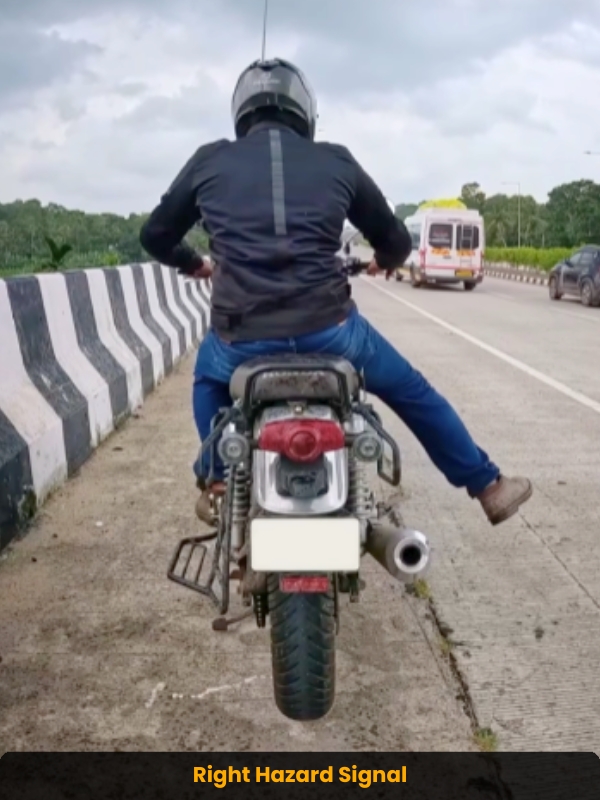
| 8 | Hazard in Roadway | On the left, point with left hand; on the right, point with right foot. |
| 9 | Single File | Arm and index finger extended straight up. |
| 10 | Double File | Arm with index and middle finger extended straight up. |
| 11 | Comfort Stop | Forearm extended, fist clenched with a short up and down motion. |
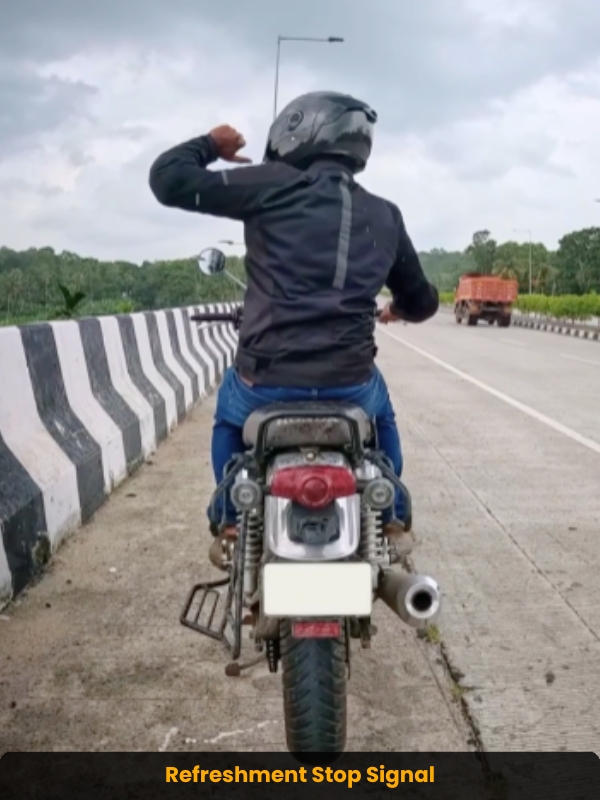
| 12 | Refreshment Stop | Fingers closed, thumb to mouth. |
| 13 | Turn Signal On | Open and close hand with fingers and thumb extended. |
| 14 | Pull Off | Arm positioned as for right turn, forearm swung toward the shoulder. |
| 15 | Cops Ahead | Tap on top of the helmet with an open palm down. |
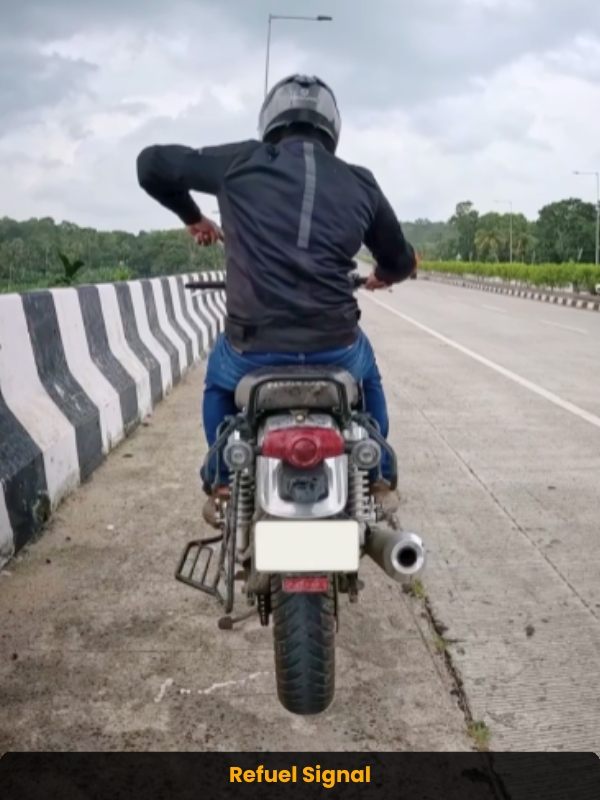
| 16 | Fuel | Extend your arm out to the side, pointing to the tank with your finger extended. |
Note: Pointing with your foot for a right-side hazard (#8) should only be done at low speed or when stopped. Do not try to ride one-footed at higher speeds.
Best Practices
- Always use the left hand for signalling to maintain throttle control with the right hand.
- Keep arm signals clear and deliberate.
- Combine signals with head nods or eye contact when safe.
- Practice these signals during rides to build familiarity within the group.
Motorcycle enthusiasts worldwide, including those in India, use these signals. They help keep group rides safe and facilitate easier communication.
Rider groups can create or add signals to meet their own needs if necessary. Still, using universal signals helps everyone understand one another, even across different groups.
These universal hand signals form the foundation for safe and professional group riding on motorcycles.
What Are The Safety Tips For Hand Signals For Motorcycle Riders In India?
In India, the use of universal motorcycle hand signals should be accompanied by essential safety practices during both group and solo rides.
1. Use The Left Hand For Signalling
Always use your left hand for signals. The right hand controls the throttle and brake. Using the right hand can cause sudden speed changes that might affect riders behind you. In India, the left side of your body is also easier for others to see because vehicles drive on the left side of the road.
2. Make Signals Clear And Sustained
Hold each hand signal clearly for a few seconds so riders behind you can see and understand it. Avoid quick or jerky movements that could confuse others.
3. Signal Well In Advance
Start signalling well before you make a move—ideally at least 100 feet ahead, depending on your speed and traffic. This advance warning gives other riders and drivers time to react safely.
4. Practice Group Communication Etiquette
Make sure everyone in your riding group understands the same hand signals for turns, stops, hazards, and formations. Practice these signals together in safe places before group rides.
5. Enhance Visibility
Wear bright or reflective gloves and gear to make your hand signals more visible, especially at night or in low light. Make sure your signals are clear and avoid awkward positions that could compromise control of the bike. Combine clear hand signals with a working motorcycle headlight to help others notice your intentions in low-light conditions.
6. Combine Signals With Other Safety Measures
Use hand signals in conjunction with your bike’s indicators and brake lights to communicate more effectively with everyone on the road. When possible, confirm your signals with eye contact or a nod to other group riders for added clarity.
7. Avoid Signalling In Dangerous Conditions
Don’t use hand signals when you need both hands on the controls, such as in tight corners, on slippery roads, or when merging into heavy traffic. Always keep complete control of your motorcycle by using your lights and adjusting your position as needed.
8. Be Cautious Of Traffic Around You
Always pay attention to the traffic around you. Your signals should not distract or confuse other drivers. When warning about hazards or police ahead, make sure your hand signals do not cause panic or sudden braking in the group. This awareness is part of defensive riding: think about how others might react before you signal, not just after.
9. Emergency Signals
For emergencies, wave your arm to stop or point out obstacles clearly and promptly. These signals help prevent accidents in unexpected situations during group rides.
10. Signal More Deliberately On Electric Two-wheelers
Electric motorcycles and scooters are much quieter than petrol bikes, so pedestrians, other riders, and drivers cannot hear them coming. This means hand signals are even more important on an electric bike. Always give clear, early signals for hazards or turns, because people around you have less warning that you are coming.
11. Adjust For Monsoon Conditions
Rain gloves and jacket cuffs can make your hand signals harder to see. Heavy rain or fog also makes it difficult for riders behind you to notice your signals. When riding in the monsoon, hold each signal longer and wear bright or reflective rain gear instead of dark colours. Do not assume the rider behind you has seen your signal through the rain. Check over your shoulder or leave more space to stay safe. Wet roads cause many motorcycle accidents in India, so clear signalling should be part of a careful and slower approach when it rains.
By following these safety tips and using hand signals, motorcycle riders in India can ride more safely together, reduce the risk of accidents, and enjoy their rides in various conditions.
What Should A Rider Do If Another Rider Does Not Understand Or Respond To A Hand Signal?

If a rider sees that another rider does not understand or respond to a hand signal during a group ride, here are some critical steps to take:
- Re-Signal Clearly: Repeat the signal in a more obvious way and hold it a bit longer so the other rider can see and understand it. Use precise, bigger movements to avoid confusion.
- Use Additional Communication: Add head nods, helmet taps, or eye contact to your hand signals to make your message more straightforward. If you’re stopped or moving slowly, you can also talk to the other rider.
- Slow Down Safely: Gradually slow down to get the other rider’s attention without braking suddenly. This gives them a chance to catch up or respond to your signal.
- Check the Rearview or Communicate Through Others: If you can’t reach the rider directly, ask someone nearby to help pass on the message with gestures.
- Maintain Group Cohesion: If a rider isn’t responding, the group may need to slow down or stop at a safe place to review instructions or discuss signalling.
- Educate Before the Ride: Make sure everyone knows and practices the standard hand signals before the group ride to avoid confusion later.
- Exercise Patience and Safety: Always prioritise safety. If a signal warns of a hazard or emergency stop and someone doesn’t respond, slow down and let others know to help prevent an accident.
Good communication is key. Repeat signals, use clear gestures, and help each other so everyone understands. This keeps the group safe and organised.
What Specific Situations Require The Use Of Hand Signals Instead Of Electronic Indicators?
Specific situations where motorcycle riders might need to use hand signals instead of electronic indicators include:
- When electronic turn signals are malfunctioning, broken, or not visible to other riders or motorists.
- During group rides, quick and precise communication is needed between riders behind, without relying on electric signals.
- In heavy traffic or daylight conditions, small electric indicators may be more challenging to see at a distance.
- When signalling hazards or emergency stops, which usually don’t have dedicated vehicle lights and require more explicit hand gestures.
- At slower speeds or in stopped positions, hand signals can communicate intentions such as “follow me,” “single file,” or “double file,” which vehicle indicators don’t cover.
- When riding with riders who have varying motorcycle models, some older motorcycles or scooters may lack functional indicators, requiring hand signalling.
How Can Riders Ensure That All Members Of A Group Ride Are Familiar With These Hand Signals?
To ensure all members of a group ride are familiar with hand signals:
- Review the agreed-upon hand signals with the group before the ride. Use pictures or printed guides to help everyone remember.
- Practice the signals together in a safe, stationary place so everyone understands them and feels confident using them.
- Ask experienced riders to show the signals at the start of the ride.
- Use clear, consistent signals, preferably the universal ones, to avoid confusion.
- Remind riders to stay alert and watch for signals throughout the ride.
- Emphasise the importance of observation to make sure riders stay attentive to signals throughout the ride.
- Some groups use rider handbooks, WhatsApp groups, or instructions from the ride leader to help everyone remember the signals.
These steps make group rides safer and more organised by using clear communication and common hand signals suited to the group and riding conditions.
What Are Some Common Mistakes Riders Make When Using Motorcycle Hand Signals In India?
Some common mistakes riders make when using motorcycle hand signals in India include:
- Lack of Awareness and Consistency: Many riders are unaware of the correct signals or fail to use them, especially outside of organised group rides or among less experienced riders. This can cause confusion for both other riders and drivers.
- Using the Wrong Hand or Signal: Some riders use their right hand for signals by mistake, which is unsafe because it affects control of the throttle and front brake. Using unusual gestures can also cause confusion, especially in groups with different experience levels or in heavy traffic.
- Signals Not Visible or Clear: Sometimes hand signals are made too low or too close to the body, so others can’t see them well. Signals should be clear, easy to see, and held where riders behind you can notice them.
- Forgetting to Cancel Indicators: Riders often forget to turn off their indicators or fail to use the right-hand signal to alert others. Not signalling turns or stops can confuse both group members and other drivers.
- Not Adapting to Indian Road Conditions: Due to heavy traffic, sudden obstacles, or unpredictable drivers in India, riders may miss the chance to signal on time or skip signals, assuming others won’t notice or react.
- Imitating Informal Gestures: Some riders use informal gestures or hand waves that may have a different meaning or be ignored by other road users.
Faq About Motorcycle Hand Signals In India
1. What Are The Basic Hand Signals Every Motorcycle Rider In India Should Know?
Basic hand signals include extending the left arm straight out for a left turn, bending the left arm upward at 90 degrees for a right turn, and pointing the left arm downward to stop. Other signals, such as speeding up, slowing down, and hazard warnings, are also essential for safe group rides.
2. Why Do Motorcycle Riders Use Their Left Hand For Hand Signals In India?
The left hand is used because the right hand controls the throttle and front brake. Using the left hand to signal allows riders to maintain full control of speed and braking while safely indicating their intention.
3. How Do You Signal A Right Turn On A Motorcycle Using Hand Signals?
A right turn is signalled by bending the left arm at the elbow upward at a 90-degree angle with a clenched fist, clearly visible to those behind the rider.
4. When Should Hand Signals Be Used Instead Of Electronic Indicators?
Hand signals are especially important when electronic indicators malfunction or are not visible due to bright sunlight or heavy traffic. They are also used in group rides for quick communication or to signal hazards and formations that indicators don’t cover.
5. What Does The ‘stop’ Hand Signal Look Like On A Motorcycle?
For stopping, the left arm is extended straight downwards at a 90-degree angle with the palm facing backwards to alert riders behind.
6. How Do Riders Indicate Hazards Or Obstacles On The Road Using Hand Signals?
Riders point with their left hand towards the hazard when on the left side, or use their right foot to point if the hazard is on the right side of the road, alerting others to potential dangers.
7. What Are The Hand Signals For Group Riding Formations In India?
Signalling ‘single file’ involves extending the arm straight up with the index finger pointed, while ‘double file’ is shown by raising both the index and middle fingers straight up.
8. What Should A Rider Do If Another Rider Doesn’t Understand Or Respond To A Hand Signal?
The rider should repeat the signal more clearly and hold it longer, use additional gestures like head nods or helmet taps, slow down safely to get attention, and communicate verbally if stopped. Educating riders before the ride is also recommended.
9. Are Motorcycle Hand Signals Standardised Across India?
Yes, universal hand signals are widely used across India, especially in group rides. However, some groups may add custom signals to suit their needs but typically adhere to the main universal signals for clarity and safety.
10. What Common Mistakes Do Riders Make With Hand Signals In India?
Common mistakes include using the right hand instead of the left, making signals unclear or too close to the body, forgetting to cancel indicators, and failing to signal in heavy traffic or emergency situations. Awareness and consistent practice are key to avoiding these errors.
11. Are Motorcycle Hand Signals Legally Recognised In India?
Basic hand signals for turning and stopping are legally recognised — Rule 9 of the Central Motor Vehicle Rules, 1989 allows signals to be given “by hand or by electrical indicators fitted to the vehicle” as part of the official test of competence to drive. However, the extended group-riding signals covered in this guide — single file, follow me, refreshment stop, and similar gestures — are rider-community convention rather than something defined in Indian traffic law.
12. Do I Have To Obey A Traffic Policeman’s Hand Signal?
Yes. Under the Rules of the Road Regulations, 1989, drivers must comply with directions given by a police officer regulating traffic, and a police officer’s signal to stop overrides other cues, such as traffic lights. This is different from rider-to-rider hand signals, which are informal — ignoring a traffic policeman’s signal is a traffic offence, not just a miscommunication.
13. Do Hand Signals Matter More On Electric Bikes?
Yes. Electric motorcycles and scooters run nearly silent, removing the audible cue that pedestrians and other road users normally rely on to sense an approaching vehicle. This makes clear, early hand signals more important on an EV than on a petrol bike, not less.
Other Related Links From Bikeleague India
- Buying a second-hand bike in India: Smart or risky choice
- Second hand motorcycle: Things to know when buying It
- Ride with a pillion or without a pillion – Which is best for a bike trip?
- Best mileage bikes in India right now
- Solo motorcycle rides vs. group rides in India: Pros & cons
Sources
- KL Rider
- Royal Enfield
- Central Motor Vehicle Rules, 1989, Rule 9 (Test of Competence to Drive)
- Rules of the Road Regulations, 1989
- Ministry of Road Transport & Highways – Road Safety Portal
Conclusion
Learning motorcycle hand signals is important for safe group riding in India. Clear and steady communication helps avoid confusion, lowers the risk of accidents, and makes rides smoother for everyone. Practice these signals, stay alert, and adjust for the weather to help keep yourself and others safe.
Make signalling a regular habit and encourage your friends to do the same for better road safety. If you have questions or want to share your experiences, feel free to email us at bikeleague2017@gmail.com or leave a comment below.