Long story short: Looking for how to choose or select your perfect bike in India? This guide will help you find the right motorcycle for your riding style. Let’s get started on finding your dream ride!
Choosing the right motorcycle in India is both exciting and a bit overwhelming. With so many brands, styles, and features, it can be hard to know where to start. Whether you commute daily, enjoy weekend rides, or want the latest electric model, this guide will help you make sense of your options. We’ll cover the main things to consider, the types of bikes out there, and tips to help you find a motorcycle that suits your riding style and lifestyle.
Key Takeaways
- Identify your primary riding style—commuting, touring, off-roading, or sport—to guide your bike selection.
- Set a realistic budget that includes insurance, gear, and ongoing maintenance costs, not just the sticker price.
- Always test ride your top choices to assess comfort, handling, and suitability for your body and needs.
- Prioritise brands and models with strong service networks and proven reliability for hassle-free ownership.
- Stay open to both petrol and electric options, considering your long-term needs, local infrastructure, and running costs.
Different types of motorcycles in India
Motorcycles or bikes can be classified based on
- Types of motorcycles based on body style
- Types of motorcycles based on fuel type
| Type | Recommended Bike | Engine (cc) | Key Strengths |
|---|---|---|---|
| Commuter | Hero Splendor Plus XTEC | 97 | 65 kmpl, low maintenance, reliable service network |
| Scooter | Honda Activa 6G | 110 | City agility, 50+ kmpl, vast service availability |
| Street/Sports | Yamaha MT 15 V2 / TVS Apache RR 310 | 155 / 312 | Quick acceleration, sharp handling, LED lights |
| Cruiser | Royal Enfield Super Meteor 650 | 648 | Relaxed posture, highway comfort, classic style |
| Tourer | Royal Enfield Interceptor 650 | 648 | Long-range touring, luggage ready, reliable |
| Cafe Racer | Royal Enfield Continental GT 650 | 648 | Retro racing posture, smooth twin engine |
| Scrambler | Triumph Scrambler 400 X | 398 | Mixed terrain, 28 kmpl, premium feel |
| Adventure | Royal Enfield Himalayan 450 | 452 | High clearance, off-road capable, service network |
| Dirt/Off-road | Hero XPulse 200 4V | 199 | Lightweight 157kg, rally-ready, affordable |
| Supersport | Yamaha R15 V4 | 155 | Track-ready, quickshifter option, agile |
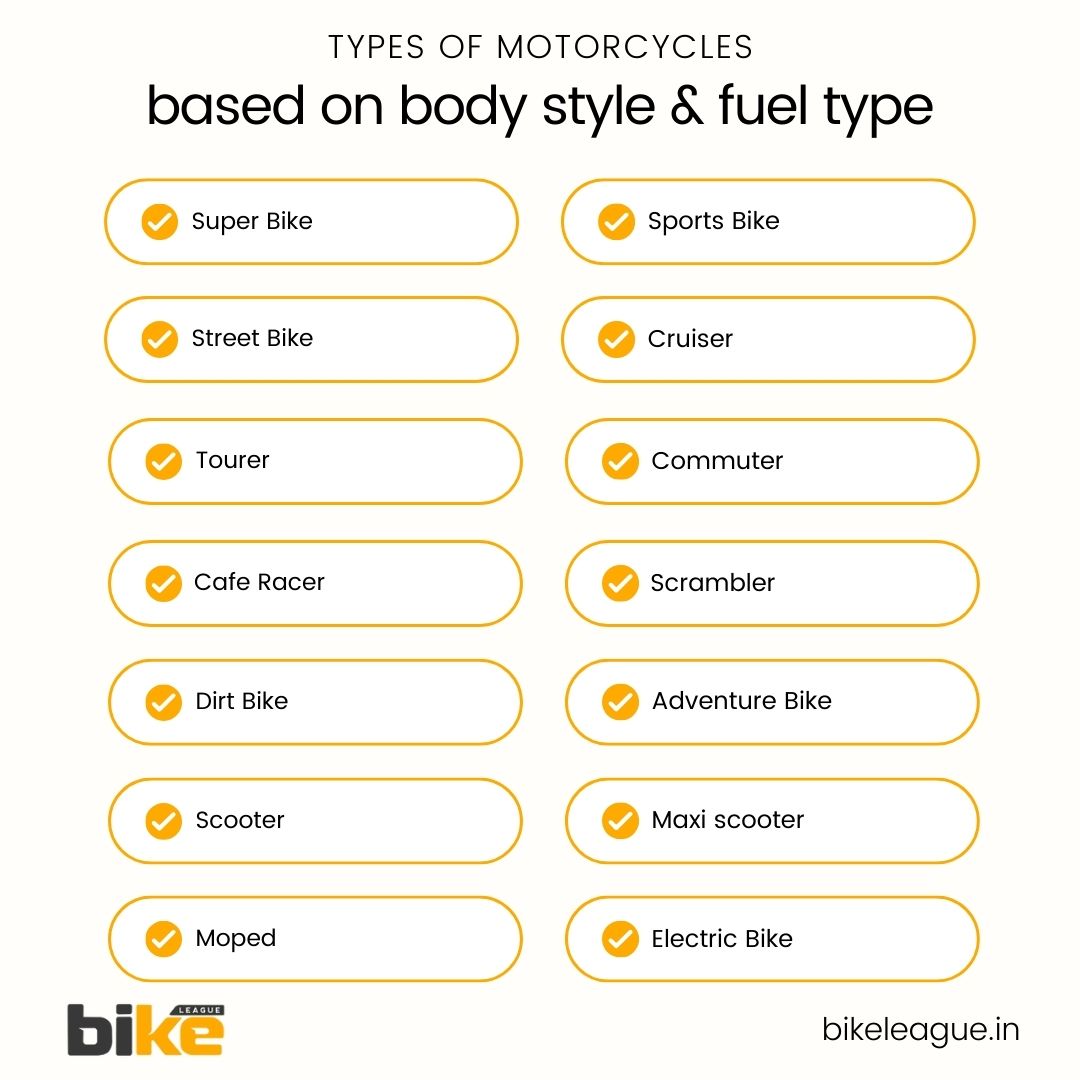
Types of motorcycles based on body style
Also, motorcycles can be classified by fuel type: petrol and electric.
The main classification of motorcycles is by body style, with 12 types.
- Super Bike or Supersport Bike
- Sports Bike
- Street Bike
- Cruiser
- Tourer
- Commuter
- Cafe Racer
- Scrambler
- Dirt Bike
- Adventure Bike
- Scooter
- Maxi scooter
- Moped
Types of motorcycles based on fuel type
Motorcycles can also be classified by fuel type: petrol and electric. To learn more about each type of motorcycle, check out the article below by our team.
Different types of motorcycles explained
We hope you have an idea about the different types of motorcycles. Now, let’s delve into the factors you must consider while choosing the perfect bike for your riding style.
About electric motorcycles and scooters
Electric two-wheelers are changing how people get around in India. There are now over 50,000 charging stations, and FAME III subsidies (up to ₹10,000 per kWh) make electric bikes more affordable than ever. Most electric vehicles on the road are scooters and commuter bikes, making up about 90% of the market, but performance electric bikes are becoming more popular too. With no tailpipe emissions, very low running costs (just ₹0.20 per kilometre), and instant power for city rides—especially with petrol at ₹100 per litre—it’s clear why many people are choosing electric.
Why should you consider an electric bike / scooter now?
- Big savings: Running costs are just ₹1–2 per kilometre compared to ₹3–5 for petrol bikes, and maintenance is minimal.
- Smooth, quiet performance: Electric bikes are silent, feature regenerative braking, and many can go from 0–60 km/h in just 3–4 seconds.
- Charging convenience: Most people charge at home (4–8 hours), and now over 80% of urban areas have good charging coverage.
- Government support: Lower taxes and attractive subsidies mean the upfront cost is much more competitive.
Currently available top electric bike and scooter models
| Category | Model | Range (km) | Top Speed (kmph) | Strengths |
|---|---|---|---|---|
| Commuter Scooter | TVS iQube ST | 212 | 82 | Family-friendly, 5hr charge, 500+ service centres |
| Premium Scooter | Ather 450X | 161 | 90 | App ecosystem, OTA updates, fast charge (80% in 3hrs) |
| Affordable Scooter | Bajaj Chetak | 137-153 | 63 | Classic design, IP67 battery, home swap stations |
| Value Scooter | Hero Vida V2 | 100 | 70 | Budget king, 143km certified range, removable battery |
| Performance Bike | Ultraviolette F77 | 211-323 | 152 | 107Nm torque, 30kW power, premium adventure |
| Everyday Bike | Revolt RV400 | 150-220 | 85 | Swappable batteries, app tracking, 7yr warranty |
How do electric and petrol bikes compare at a glance?
| Aspect | Electric | Petrol |
|---|---|---|
| Cost/km | ₹0.15-0.30 | ₹2.50-4.00 |
| Service/yr | ₹1,500-3,000 | ₹8,000+ |
| Real Range | 80-180km loaded | 250-400km |
| Charge/Fuel | 4-8hrs home | 3min |
Electric bikes cost less to run, are quieter, and have fewer moving parts to service, while petrol bikes still have wider refuelling and service networks for now.
How do you choose or select the perfect bike/ motorcycle according to your riding style?
1. Determine your motorcycle riding style
The first and foremost question you must ask yourself is, are you planning to commute in the city, go on long tours, engage in off-road adventures, or enjoy sport riding? Your motorcycle riding style will dictate the type of motorcycle you need. It’s as simple as that.
2. Set your budget
The next important step is to decide on your motorcycle expenses, including the purchase price, insurance, registration, gear, and any customisation or modifications you intend to make. Set a budget accordingly.
3. Engine size and type
You must consider the engine size and type that suits your riding style. Different motorcycle riding styles require various engine capacities.
- City Commuting: When riding in the city, opt for motorcycles equipped with smaller, fuel-efficient engines, usually ranging from 125cc to 250cc. These bikes are agile and effortless to handle in congested traffic.
- Touring: For extended rides, it is recommended to search for motorcycles with larger displacement engines (350cc and above) as they provide better highway performance and comfort for long-distance touring.
- Off-Roading: Off-road and adventure riders frequently choose bikes with engine displacements ranging from 200cc to 500cc. These motorcycles possess the required torque and suspension to tackle rough terrains.
- Sport Riding: Sportbike enthusiasts seeking an exhilarating ride opt for motorcycles with engines exceeding 250cc. These models provide exceptional speed and manoeuvrability.
4. Ergonomics and comfort of a motorcycle according to riding style
When riding, it is essential to consider your physical comfort. Various motorcycles have different seating postures and ergonomics. Select a bike suitable for your body type and preferred riding posture.
- Relaxed & upright ride position: Cruisers, Touring bikes, Scooters, Naked/Streetfighters, and entry-level motorcycles all have relaxed and upright riding postures to avoid tiredness as much as possible in short and long-distance travel.
- Aggressive forward-leaning ride position: Supermoto, sport bikes, cafe racers, etc., all have aggressive forward-leaning ergonomics to get maximum feel and input from the ride. This riding posture will make you tired and energy-sapping while ridden for long hauls.
- Slight forward-leaning ride position: Adventure/Off-road motorcycles offer a slightly forward-leaning stance, which provides the best of both worlds – aggressiveness and comfort.
5. Features & accessories
Consider your motorcycle riding style when determining the necessary features and accessories.
- When touring, prioritise motorcycles with luggage mounts for panniers and top boxes.
- Consider bikes with advanced braking systems like anti-lock brakes (ABS) in heavy city traffic.
- For hilly or rough terrain, prioritise bikes with good ground clearance and robust suspension.
6. Local Road and traffic conditions
India’s road conditions can vary significantly. Consider a motorcycle with features that suit local requirements, such as:
- Good ground clearance for rough roads or speed breakers.
- Durable and puncture-resistant tyres for variable road conditions.
7. Brand and model reliability
To obtain valuable insights, it is essential to research the reputation and reliability of various motorcycle brands and models. This can be done by reading reviews, consulting with experienced riders, and examining long-term ownership experiences.
8. The fuel efficiency of the motorcycle according to riding style
Given the fluctuating fuel prices in India, it is essential to consider a motorcycle’s fuel efficiency. Look for motorcycles that offer good mileage for your riding style. One thing to note is that as engine capacity increases, mileage decreases. So be mindful of that and generous with fuel efficiency.
9. Test ride
Always test-ride the motorcycles you’re interested in. This will help you assess the bike’s handling, comfort, and performance, allowing you to make an informed decision. Nothing can replace the actual hands-on experience of test-riding a motorcycle.
10. Resale value of motorcycle according to riding style
Consider the motorcycle’s resale value. Some brands and models hold their value better than others, which can be vital if you upgrade or sell your bike. For example, brands like Hero Motocorp and Honda have better resale value than others.
11. Insurance costs
To fully understand ongoing expenses, it is recommended to obtain insurance quotes, as motorcycle insurance costs may vary by model and engine size. Opt for comprehensive insurance, even if the cost is high, as it provides complete protection for your bike.
12. Legal considerations
Ensure the motorcycle you select meets all Indian regulations, including safety standards and emissions requirements. Any modifications that do not comply can result in legal problems.
13. Maintenance and service availability
Consider the availability of authorised service centres and spare parts for your chosen brand and model in your area. This will affect the ease of maintenance and repair. If the motorcycle brand’s service network is vast, it will permanently reduce your problems when issues arise. So, if your motorcycle riding style is for long trips, opt for motorcycle brands with a good service network very seriously.
14. Personal preference for a motorcycle according to riding style
Choose a bike that you connect with on a personal level. Your passion for the bike is crucial to the riding experience and to the long-term aspects of your motorcycle life.
15. Research and seek advice
Join local motorcycle forums, riding communities, and social media groups in India to seek advice from experienced riders who can provide valuable insights, recommendations, and firsthand experiences.
Step by step guide to picking your perfect bike in India
Are you feeling stuck or overwhelmed by all the bike options? You’re not alone. This simple, step-by-step guide is based on what has worked for thousands of new riders and will help you find a bike that truly fits your life. Let’s go through it together.
Step 1: Think About How You’ll Really Use Your Bike
Ask yourself: “What will I use this bike for, most days?”
- If you need it for daily commutes or office runs, go for a commuter bike or a scooter—think Hero Splendor Plus XTEC (97cc, 65 kmpl, easy service) or Honda Activa 6G (110cc, super practical in the city).
- Craving weekend fun or quick rides? Try a street or sports bike like the Yamaha MT 15 V2 (155cc, agile and exciting).
- Planning long highway tours? A tourer or cruiser like the Royal Enfield Interceptor 650 (648cc, super comfy for big journeys) is a great pick.
- Heading off-road or tackling rough roads? Go for an adventure or dirt bike—check out the Royal Enfield Himalayan 450 (452cc, built for tough terrain) or Hero XPulse 200 (199cc, lightweight and fun).
Pro tip: Scroll up to the bike types table—match your everyday need to a type, and you’re already halfway there!
Step 2: Be Honest About Your Budget (And Extras)
The prices you see above are ex-showroom—remember to add another 12–15% for on-road costs, plus ₹5,000–10,000 for insurance and registration, and at least ₹10,000 for safety gear.
- Under ₹1 lakh total? Hero Splendor or Honda Shine.
- ₹1-2 lakh? Yamaha MT15 or RE Hunter 350.
- ₹2 lakh+? RE Interceptor or Himalayan.
Start simple—you can always upgrade once you know what you truly want!
Step 3: Don’t Ignore Service Networks—They’re Your Lifeline
A poor service network means endless headaches, especially if you love to travel.
- Look for brands with service centres everywhere—Hero, Honda, Royal Enfield, and Bajaj have more than 5,000 across India. That’s peace of mind on any trip!
- Premium brands like Yamaha, Triumph, and KTM are catching up, but it’s best if you live near big cities.
Royal Enfield and Hero are usually the most reliable for service in India.
Step 4: Always Take a Test Ride—Trust Your Gut
Visit 2–3 dealers and take at least a 20–30 minute spin in real traffic, not just the showroom lane.
- Can you put both feet flat on the ground? (Seat height under 800mm is ideal for most beginners.)
- Do the brakes feel strong and safe? (Try the ABS if it has it.)
- Is your posture comfortable—no sore wrists or back?
- Engine feels smooth—no weird rattles or shakes?
Nothing beats a real ride—your comfort matters most!
Step 5: Narrow Down and Buy Smart (Use the Quick Picks Table)
| Ride Style | Go-For Pick | Why You’ll Love It |
|---|---|---|
| Daily Hustle | Hero Splendor | 65kmpl + service everywhere |
| Family Run | Honda Activa | Never breaks down |
| Style Points | Yamaha MT15 | Grins-per-km guaranteed |
| Long Hauls | RE Interceptor | Comfy + pannier-ready |
| Offroad Buzz | RE Himalayan | Conquers Kerala backroads |
Use the quick reference table above to make your final call—it’s there to simplify your decision!
Step 6: Going electric? The same above steps and advice apply
The TVS iQube ST (212km range, family-friendly) is a top pick, and running costs are a fraction of petrol bikes (just ₹0.20/km vs ₹3/km).
What should women look for when choosing a scooter or motorcycle in India?
Indian women are riding with confidence, whether for daily commutes, college, or weekend trips. Here’s a friendly, practical guide to help women riders find the right fit, stay safe, and pick from the most popular options.
1. Key things to keep in mind:
- Low seat height: Under 800mm makes it easier to put both feet on the ground, giving more confidence in traffic and while parking.
- Lightweight bikes: Under 120kg is ideal for easy manoeuvring and handling, especially in city traffic.
- Easy handling: Go for models known for their balance and smooth ride.
- Strong service network: Brands with lots of service centres (like Honda and Hero) make maintenance stress-free.
2. Fit and comfort tips
Sit on the bike or scooter—your feet should touch the ground comfortably and your arms shouldn’t stretch to reach the handlebars. Upright posture helps you spot potholes and handle traffic better.
3. Safety essentials
Prioritise models with ABS brakes and bright LED lights. Invest in a full-face ISI helmet, a women’s armoured jacket and pants (Royal Enfield and Rynox offer good options), gloves, and ankle boots—ventilated gear is best for India’s climate.
4. Practical perks
Under-seat storage, low maintenance, and good resale value are big pluses. Honda and Hero are known for these benefits.
5. Popular models loved by women riders
| Bike Model | Seat Height (mm) | Weight (kg) | Why Women Love It |
|---|---|---|---|
| Honda Activa 6G | 780 | 107 | Effortless, vast service, storage |
| TVS Jupiter/Zest | 765 | 103 | Lowest seat, peppy for city |
| Hero Splendor/Honda Shine | 785 | 112 | 65kmpl, lightweight daily king |
| TVS Raider 125 | 780 | 123 | Stylish, easy power for beginners |
| TVS iQube ST | 770 | 118 | Silent torque, 212km range |
| Royal Enfield Hunter 350 | 790 | 181 | Retro cool, but test for weight |
Honda Activa is the top choice for women’s scooters (nearly 90% prefer it), while the Splendor is a favourite for reliability among bikes.
What are the common mistakes to avoid when picking your first bike in India?
Buying your first motorcycle is exciting, but it’s easy to get caught up and make some common mistakes. Don’t worry, you’re not alone. Many new riders in India have shared their “wish I’d known” moments. Let’s look at some of the most common pitfalls and how you can avoid them with confidence.
1. Skipping the Test Ride (Biggest Rookie Error)
It’s tempting to fall for a bike’s looks online, but nothing beats a real-life test ride. Spend at least 20–30 minutes in actual traffic—not just in the showroom lane. Make sure you can put both feet flat on the ground and that the brakes feel natural. No matter how cool a bike looks, shortlist at least three and test ride them all!
2. Ignoring Total Ownership Cost
Buying a bike isn’t just about the sticker price. There are on-road costs (add 15%), insurance, safety gear, and your first service. For example, a bike costing ₹80k might end up costing over ₹1.1 lakh after adding everything. Fuel and maintenance costs can really add up, too, so always budget at least 25% extra for the real cost of ownership.
3. Choosing “Looks” Over Practicality
That Instagram-famous Yamaha R15 may look amazing, but it’s built for racetracks, not daily commutes on bumpy city roads. Pick a bike that truly fits your lifestyle—commuters like the Splendor or Activa are ideal for daily rides, while a Royal Enfield Interceptor is great for touring.
4. Overlooking the Service Network
A stylish, premium brand is only fun until something goes wrong far from home. Brands like Hero, Honda, and Royal Enfield have service centres everywhere in India, making life much easier for new owners. Always check how close your nearest authorised service centre is before you buy.
5. Skimping on Safety Gear
Don’t make the mistake of thinking “I’ll get a helmet later.” Invest in good safety gear right from day one: an ISI-approved helmet, a riding jacket, and gloves. Your safety is always more important than style!
6. Starting with Too Powerful a Bike
Big engines (350cc+) might sound thrilling, but they can be tough for beginners to handle and even land you in trouble. It’s smarter (and safer) to start with something under 150cc, then upgrade once you’ve gained experience.
7. Skipping Pre-Delivery Inspection (PDI)
Don’t just take the keys and ride off! Insist on a proper inspection before accepting your new bike: check for scratches, leaks, working lights, and make sure you get the toolkit.
8. Forgetting Insurance & Documents
Comprehensive insurance costs a bit more than third-party, but it’s worth it for peace of mind. Make sure you have all your documents in order to avoid fines and hassles at the RTO.
Quick Save: Follow the 5-step guide above and remember these tips to set yourself up for a smooth first ride. If you have your own “wish I knew” story, share it in the comments to help other new riders!
Pro Tip for EV Buyers: Before you go electric, make sure you have convenient home charging or nearby swap stations. For long highway trips, petrol bikes are still the more practical choice for now.
FAQ related to how to choose or select the perfect bike according to your riding style
1. What are the most important factors when choosing a motorcycle in India?
Key factors include your riding style (commuting, touring, off-roading, sport), budget, engine size, comfort, brand reliability, and service centre availability.
2. How do I decide which type of bike suits my riding style?
Identify your primary use: daily commuting, long tours, off-road adventures, or sporty rides. Each riding style has ideal bike types—for example, commuters or scooters for city use, cruisers or tourers for long distances, and dirt/adventure bikes for rough terrain.
3. Should I consider an electric bike or stick to petrol?
Electric bikes offer lower running costs, smooth and quiet rides, and are more eco-friendly. Petrol bikes offer a longer range and more widespread refuelling options. Choose based on your daily needs, local infrastructure, and budget.
4. How important is a test ride before buying?
Extremely important. A test ride helps you assess comfort, handling, braking, and posture—real-world experience can reveal issues not obvious in showrooms.
5. What should I budget for besides the bike’s price?
Include insurance, registration, safety gear, maintenance, and accessories. Expect on-road costs to be 12–15% higher than the sticker price.
6. Which brands offer the best service network in India?
Hero, Honda, Royal Enfield, and Bajaj have the most extensive service centres across India, making maintenance and repairs easier.
7. Are there bikes particularly suited for women riders?
Yes, models like Honda Activa, TVS Jupiter, Hero Splendor, and TVS iQube ST are popular due to low seat height, lightweight, and easy handling.
8. What are the common mistakes to avoid when buying your first bike?
Skipping the test ride, ignoring total ownership cost, choosing style over practicality, neglecting service network, and not investing in safety gear are common mistakes.
9. How do I ensure my bike meets legal and safety requirements?
Choose bikes that comply with Indian emission and safety standards. Always buy comprehensive insurance and carry the required documents.
10. How can I find out about resale value and long-term reliability?
Research ownership experiences, read reviews, consult forums, and check which brands/models are known for holding value—Hero and Honda, for instance, tend to have high resale value.
Other related articles from Bikeleague India
- Motorcycle service – All things you need to know explained
- Second hand motorcycle: Things to know when buying in India
- Two Wheeler License in India: Full guide to types & process
- Yamaha vs Honda vs Kawasaki: Which Bike Brand Is Best?
- Bike maintenance at home: Save money & time on services
Conclusion
Choosing the right motorcycle in India is a mix of practicality, passion, and personal preference. By understanding your riding style, setting a realistic budget, considering comfort and features, and staying up to date on trends like electric vehicles, you’ll be ready to make a smart, satisfying choice. The perfect bike is the one that fits your needs now and grows with you as a rider. Happy riding, and may every journey be safe and memorable!
If you have any questions or concerns, email us at bikeleague2017@gmail.com or leave a comment below. We are always happy to help. You can also find us on Bikeleague India’s social media accounts.