

Long story short: Make sure you understand your bike insurance before picking any add-ons. This guide breaks down common policy terms, explains what extra covers do, and highlights what to check before you buy.
Terms like insured declared value (IDV), no claim bonus (NCB), and deductible can make it hard to compare insurance quotes. Add-ons add more options, but their names don’t always make it clear what they cover or if they fit your bike.
This guide will help you understand the terms, compare what’s covered, and know what to ask your insurer. Always read the policy schedule, wording, and any add-on details together instead of just looking at a sales summary.
Key Takeaways
- Understand the difference between third-party cover, own-damage cover and personal accident protection before comparing add-ons.
- Check the coverage period and expiry date of each policy section rather than assuming all protection ends on the same date.
- Compare quotations using consistent details, including IDV, deductibles, coverage periods, and selected add-ons.
- Choose additional protection according to your motorcycle, riding conditions, existing benefits, and ability to meet uninsured expenses.
- Check each add-on’s eligibility, covered events, exclusions, claim limits and conditions. An add-on does not make every repair or loss payable.
- Review the policy documents before paying and renew the required cover before it expires.
Understand Your Bike Insurance Policy First
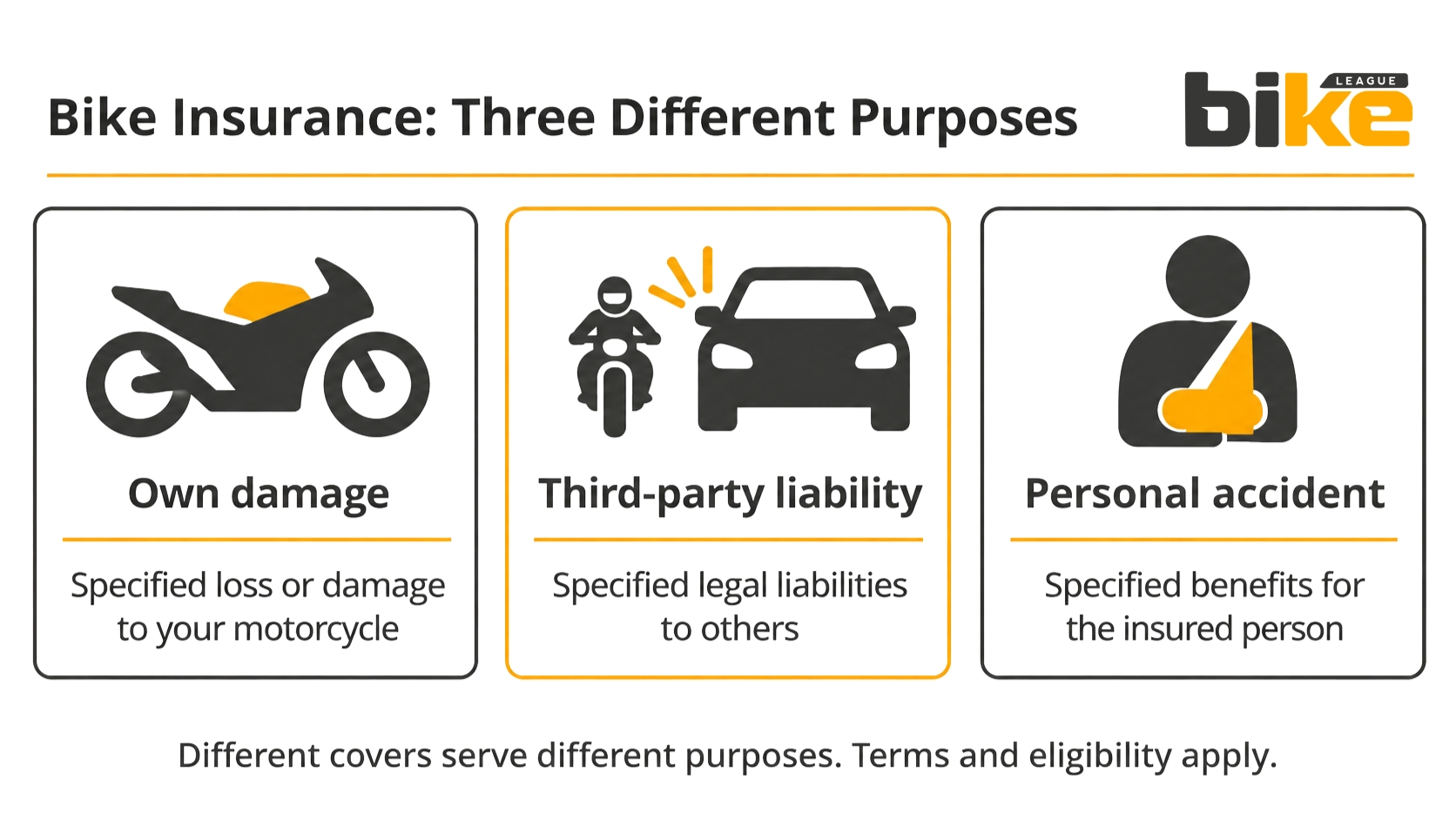
Before comparing insurance terms or add-ons, identify which cover you already have. Third-party insurance, own-damage insurance, and personal accident protection serve different purposes. Buying one does not automatically provide all the others.
1. Third-party Insurance
Third-party insurance covers specified legal liabilities arising from injury or death of other people, or damage to their property, involving the insured motorcycle. It is mandatory for motorcycles used on public roads, but it does not pay for damage to your own bike.
Source: IRDAI’s explanation of motor insurance and third-party liability.
2. Own-damage Insurance
Own-damage cover protects the insured motorcycle against specified risks, such as accidental damage, theft, fire, and certain natural or artificial events, subject to the policy’s terms and exclusions.
You can buy standalone own-damage insurance when you have the required third-party cover separately. Standalone own-damage insurance does not replace third-party insurance. Check that the third-party policy remains valid and provide its details when the own-damage insurer requires them.
3. Comprehensive Or Package Insurance
A comprehensive or package policy combines own-damage and third-party protection. However, “comprehensive” does not mean that every loss, repair or expense is covered. Deductibles, exclusions, and other conditions still apply, and some additional benefits require a separately selected add-on.
4. Bundled Insurance For A New Two-wheeler
Under the bundled arrangement for a new two-wheeler, the policy provides five years of third-party insurance and one year of own-damage insurance. These sections therefore have different expiry dates.
For example, after the first year, the original third-party section may still be active even though the own-damage section has expired. Renew the own-damage protection if you want to continue covering your motorcycle against the risks included in that section.
Do not interpret “five-year insurance” as confirmation that own-damage protection or every selected add-on lasts for five years. Check the start and end dates shown in the policy schedule for each cover.
Source: IRDAI’s Master Circular on Recent Developments in Motor Insurance Products, including the provisions on bundled cover and standalone own-damage insurance.
5. Personal Accident Protection Is Separate
Personal accident protection provides specified benefits for the insured person rather than paying to repair the motorcycle. Check the owner-driver eligibility requirements, the benefits included, and whether separate pillion personal accident protection has been selected. The personal accident section below explains these distinctions.
Check The Dates Before Comparing Add-ons
- Identify whether you hold third-party-only, standalone own-damage, package or bundled cover.
- Check the start and expiry dates of the third-party and own-damage sections separately.
- Confirm which add-ons are listed in the schedule and the period for which each applies.
- Check personal accident protection separately from motorcycle cover.
- Do not assume that renewing one section automatically renews the others.
Common Bike Insurance Terms Explained
Refer to this glossary when you read your policy or compare quotes. These are simple explanations, but your actual cover, limits, and conditions are set by the policy schedule, wording, and endorsements.
| Term | Simple meaning and what to check |
|---|---|
| Premium | The price charged for insurance for the stated coverage period. Check the premium breakdown, selected covers, and applicable taxes rather than assuming every quotation covers the same period or benefits. |
| Policyholder, insured and insurer | The policyholder holds the policy. The insured is the person or entity protected under the relevant cover. The insurer is the insurance company providing that protection. |
| Third-party liability cover | Covers specified legal liabilities for injury or death of other people, or damage to their property, arising from use of the insured motorcycle. This can include damage to another person’s car, subject to the applicable liability, policy terms and limits. It does not cover damage to your own motorcycle. |
| Own-damage cover | Covers loss of or damage to the insured motorcycle from the events specified in the policy, subject to its conditions and exclusions. |
| Comprehensive or package policy | Combines own-damage and third-party protection. The name does not mean that every loss or expense is covered. |
| Policy schedule | The document showing policy-specific information, such as the insured vehicle, coverage dates, IDV, selected benefits, deductibles, and premium. Read it with the policy wording and endorsements. |
| Policy period | The start and end dates for the relevant cover. Third-party, own-damage, personal accident, and add-on protection may not all have the same expiry date. |
| Policy number | The insurer’s identifying reference for your policy. Keep it available when requesting service or notifying a claim. |
| Insured Declared Value (IDV) | The insured value fixed for the motorcycle under the own-damage policy. It is used as the settlement basis for total-loss and constructive-total-loss claims, subject to policy terms. It is not a guaranteed payment for every claim. |
| Sum insured and benefit limit | The amount or limit specified for a particular cover. The motorcycle’s IDV, a personal accident sum insured, and an add-on benefit limit serve different purposes and should not be treated as interchangeable. |
| No Claim Bonus (NCB) | A discount on own-damage premium earned through qualifying claim-free periods. It does not apply to the entire insurance bill. Check the applicable entitlement and any effect of claims or a lapse. |
| Compulsory deductible or excess | The amount you must bear towards an applicable claim under the policy. Check the relevant section and schedule for the amount and how it applies. |
| Voluntary deductible | This is an extra amount you agree to pay on claims, usually to get a discount on your premium. Make sure you know how it works with the compulsory deductible. |
| Depreciation | This means your vehicle loses value as it gets older and is used more. The depreciation used to set the IDV is not the same as the depreciation taken off for replaced parts in a repair claim. |
| Add-on cover | This is an extra benefit you can add to your main policy. Make sure it’s listed in your schedule and read its own conditions, exclusions, and limits. |
| Endorsement | This is an official change to your policy. It can update details, add or limit cover, or record another agreed change. It doesn’t always mean you get more protection. |
| Personal accident cover | This pays certain benefits if the covered person dies or is disabled in an accident. Owner-driver and pillion cover have different rules and coverage. This is not the same as regular medical insurance. |
| Cashless or network garage | This is a garage where the insurer pays the approved part of your repair bill directly. You still have to pay deductibles, excluded items, and anything not covered by your policy. |
| Exclusions | These are things your policy won’t cover, like certain losses, events, uses, or expenses. Check both the main policy exclusions and any special rules for add-ons. |
| Premium loading | This is an extra charge added to your premium based on the insurer’s assessment. When comparing quotes, ask what the loading is for. |
| Anti-theft device discount | You might get a discount if you have a security device that meets the insurer’s rules. Not every GPS tracker or alarm will qualify. |
| Policy lapse or break in insurance | This means there’s a gap between when your cover ends and when it starts again after renewal. Just because late renewal is allowed doesn’t mean you’re covered during the gap. |
| Claim and proof of loss | A claim is when you ask for payment or a benefit from your policy. Proof of loss is the evidence you need to support your claim, such as photos, estimates, invoices, or other required documents. |
| Surveyor or loss assessor | This is a professional who checks the loss and reports on it when needed. Their assessment is part of the claim process, but it doesn’t guarantee your claim will be approved. |
| Total loss | This means the loss is considered total, not just a partial repair. Check your policy’s rules for how these claims are settled. Don’t expect to get back the original purchase price. |
| Constructive total loss (CTL) | According to the standard two-wheeler policy, your motorcycle is a CTL if the total cost to recover or repair it is more than 75% of its IDV, as long as your policy allows. Check your own policy’s wording and settlement rules. |
| First party, second party and third party | These terms describe who’s involved: you (the policyholder) are the first party, your insurer is the second party, and a third party is someone else making a claim for injury or damage caused by your motorcycle. These are just roles, not different types of insurance. |
Ncb Is A Discount On Own-damage Premium
Don’t apply the NCB percentage to your whole premium. The IRDAI’s NCB scale gives bigger discounts for more claim-free years, up to 50%. The discount belongs to you, not the new owner if you sell your motorcycle. Keep proof of your NCB when you switch insurers.
Making a claim can change your NCB at the next renewal. If you have NCB protection, check its rules instead of assuming every claim keeps your discount the same.
Idv Is Not The Same As An Unconditional Payout
IDV is the value your motorcycle is insured for under own-damage cover. For total loss, CTL, or theft claims, what you get paid depends on your policy’s settlement rules and deductions. If you have return-to-invoice cover, check its terms, as it doesn’t apply to every loss.
Late Renewal Does Not Automatically Extend Cover
Make sure you renew before your cover expires. Don’t mix up the time allowed for keeping your NCB, inspection breaks, or the renewal process with actual insurance cover after expiry. Check when your new cover starts and if you need an inspection.
Sources: IRDAI’s Motor Insurance Handbook for explanations of IDV, NCB, deductibles and renewal; and the standard two-wheeler package policy wording hosted by IRDAI for the constructive-total-loss threshold and settlement provisions. Use the wording issued with your own policy for its actual terms.
Owner-driver And Pillion Personal Accident Cover
Personal accident cover pays for certain results of an accident that affects the insured person. It’s not the same as own-damage insurance for your motorcycle or third-party insurance for liabilities to others.
1. Compulsory Personal Accident Cover For The Owner-driver
The compulsory personal accident (CPA) cover for an eligible owner-driver gives at least ₹15 lakh as the insured amount. The payout depends on your policy’s rules for accidental death and certain permanent disabilities. Not every injury will get you the full amount.
To be eligible as an owner-driver, you usually need to be the registered owner of the motorcycle, named in the policy, and have a valid driving licence, as per your policy’s rules.
This cover doesn’t protect just anyone who rides your motorcycle. If someone else, like a family member or friend, uses your bike, check what cover applies to them.
2. Do You Need Separate Cpa Cover With Every Vehicle?
IRDAI allows you to buy owner-driver CPA insurance separately, instead of with every motor policy. Check what the standalone policy covers and its dates. Don’t assume its expiry matches your motorcycle insurance.
If you already have a 24-hour personal accident policy that covers death and both total and partial permanent disability for at least ₹15 lakh, you don’t need a separate CPA cover. Ask your motor insurer to confirm your policy meets these rules and give them any proof they need.
Don’t assume that regular health insurance, life insurance, or your employer’s accident benefit will meet this requirement. Check the benefits, insured amount, and coverage rules carefully.
3. What If The Motorcycle Belongs To A Company Or The Owner Has No Driving Licence?
Standard owner-driver CPA cover doesn’t apply if the motorcycle is owned by a company, partnership, or similar group, or if the owner-driver doesn’t have the right driving licence.
You still need third-party insurance for your motorcycle, and you can’t ride without a valid licence. Ask your insurer what cover is right for the people who use the bike.
Sources: IRDAI’s circular on compulsory personal accident cover for owner-drivers; owner-driver CPA policy wording hosted by IRDAI; and SBI General’s CPA wording for eligibility restrictions.
4. Pillion Personal Accident Protection Is Separate
Owner-driver CPA cover usually does not include the pillion passenger. If you often have a pillion, check if separate passenger personal accident protection is available and included in your policy.
Find out who is insured, the sum insured for each person, what benefits are covered, seating-capacity rules, and any exclusions. The owner-driver’s ₹15 lakh cover does not automatically apply to the pillion.
5. Personal Accident Benefits Are Not The Same As Medical-expense Cover
Owner-driver CPA cover pays only for accidental death and permanent disability as stated in the policy. It does not reimburse every injury, hospital bill, or time off work.
You need separate cover for medical-expense reimbursement, hospital cash, and temporary-disability benefits. If your policy offers these, check the insured event, payment limits, and conditions for each one.
Personal Accident Checks Before Buying
- Confirm who is covered: the eligible owner-driver, a pillion passenger or another specifically insured person.
- Check the sum insured and the compensation scale rather than assuming every injury receives the full amount.
- If relying on existing personal accident insurance, obtain confirmation that it meets the applicable CPA requirements.
- Check the start and expiry dates of the personal accident cover separately from the motorcycle’s other insurance sections.
- Check nominee details where applicable and understand how to notify a claim.
Common Bike Insurance Add-ons: Benefits And Limitations
An add-on gives extra benefits with your insurance policy, usually for an extra premium. What’s available depends on the insurer, product, and your motorcycle. Not every benefit below is offered with every policy or can be added to third-party-only insurance.
Look at the actual policy wording, not just the product name. Make sure your chosen cover is listed in your policy schedule, check its coverage period, and read the eligibility rules, exclusions, deductibles, and claim limits.
| Cover or benefit | Main purpose | Important conditions to check |
|---|---|---|
| Zero depreciation | Reduces or removes specified depreciation deductions on eligible replaced parts in an admissible repair claim. | Check the vehicle’s age eligibility, which parts are covered, what is excluded, how many claims are allowed, and any deductibles. This cover does not automatically pay the full repair bill. |
| Engine or engine-and-gearbox protection | Covers specified damage to listed components under the events and conditions defined in the endorsement. | Check what causes are covered, rules about consequential damage, exclusions, reporting steps, and what to do after a breakdown. This is not a general mechanical warranty. |
| Roadside assistance (RSA) | Arranges specified assistance when the motorcycle is immobilised, such as towing or eligible on-site help. | Check the service area, towing distance, how many times you can call for help, what breakdowns are covered, and what costs you must pay. See if parts, fuel, and repair costs are included or billed separately. |
| Return to invoice (RTI) | Changes the settlement basis for a qualifying theft, total-loss or constructive-total-loss claim according to the endorsement. | Check the vehicle’s age limits, how settlements are calculated, and how registration charges, road tax, accessories, and deductions are handled. This cover does not apply to every repair claim. |
| NCB protection | Preserves the specified no claim bonus entitlement after claims that meet the endorsement’s conditions. | Check which claims are eligible, how many claims are allowed, renewal rules, and what NCB level is protected. This cover does not guarantee your renewal premium will stay the same. |
| Consumables cover | Pays for listed consumables used in qualifying insured repairs. | Check which consumables are covered, what repairs qualify, and any limits or exclusions. This cover does not pay for routine servicing, scheduled oil changes, or regular maintenance. |
| Key replacement or key protection | Pays specified costs associated with a qualifying key loss, theft or damage event. | Check which events are covered, what replacement and programming costs are included, if the lock-set is eligible, claim limits, reporting steps, and any deductible. |
| Declared accessories cover | Insures eligible accessories under the applicable policy provisions or extension. | Check which accessories are included, if you need to declare or value them separately, and what risks are covered. Helmets, custom parts, or modifications are not always insured automatically. |
| Daily allowance or travel benefit | Provides a specified allowance when an eligible insured event leaves the motorcycle undergoing repairs. | Check what events qualify, the minimum repair period, daily allowance, maximum days, and claim rules. This cover does not include ordinary servicing. |
| EV-specific protection | Provides defined protection or assistance relating to eligible electric two-wheeler components, charging equipment, or breakdowns. | Check which components are listed, what causes are insured, battery ownership rules, how depreciation is handled, charging requirements, warranty exclusions, and assistance limits. |
Zero Depreciation Does Not Mean A Zero-cost Claim
Zero-depreciation cover addresses specified depreciation deductions; it does not remove every amount you may need to pay. Deductibles, excluded parts, uninsured work and charges outside the approved claim can remain payable by you.
For example, HDFC ERGO’s two-wheeler add-on wording excludes tyres and batteries from zero-depreciation cover. ACKO’s wording limits the number of depreciation claims to what is stated in your schedule. This shows why you should check your own endorsement instead of assuming all products offer the same cover.
Engine Protection Is Not A Mechanical Warranty
Check what causes of engine or gearbox damage are actually covered by the endorsement. Just needing an engine repair does not mean your claim will be paid. Wear and tear, poor maintenance, or every mechanical failure are not always covered.
If your motorcycle stalls in water or has a possible lubrication problem, follow the manufacturer’s safety instructions and contact your insurer or assistance provider. Check the endorsement’s safety steps and claim rules before you try to restart or repair the motorcycle.
What Is The Difference Between Engine Protection And Consumables Cover?
Engine protection covers certain damage to eligible engine or gearbox parts under the events listed in the endorsement. Consumables cover pays for materials like oils, grease, nuts, and bolts used in insured repairs. These benefits are different and do not replace each other.
If your engine is damaged by something covered under its protection endorsement, that benefit might pay for eligible repair costs. Whether oil and other consumables are also covered depends on the policy wording. Don’t assume one add-on automatically includes the other.
Consumables cover alone won’t make an excluded engine failure payable, and it isn’t meant for routine servicing or scheduled oil changes. Always check what events, items, limits, and exclusions apply to each benefit.
What Is The Difference Between Zero Depreciation And Rti?
Zero-depreciation cover deals with depreciation deductions on eligible parts replaced during a valid repair claim. Return-to-invoice (RTI) cover changes how a qualifying total-loss, constructive-total-loss, or unrecovered-theft claim is settled, based on the endorsement.
For example, if your motorcycle is repaired after an accident, zero depreciation may apply to the replaced parts. If it’s declared a total loss or is stolen and not recovered, RTI may apply. These two benefits cover different situations and don’t replace each other.
Neither benefit covers every expense. For zero depreciation, check which parts are eligible, any deductibles, and claim limits. For RTI, check if your vehicle’s age qualifies, how the settlement is calculated, and if registration charges, road tax, or accessories are included.
Check Accessories Separately
A purchase invoice by itself doesn’t prove an accessory is insured. Check if separately fitted items need to be declared, valued, and listed in your policy schedule, and see how RTI wording treats them.
Policy examples: HDFC ERGO’s annual two-wheeler add-on wording and ACKO’s two-wheeler zero-depreciation wording. These show specific products, not benefits every insurer guarantees. Always check the wording that comes with your own policy.
What To Check For An Electric Two-wheeler
Don’t assume a battery-protection label covers every battery fault, or that standard zero-depreciation includes the traction battery. Check the EV-specific endorsement and consider these questions:
- Which components are insured: the traction battery, motor, controller, charger or charging accessories?
- Does the wording distinguish between a detachable battery, a portable charger, and a wall-mounted charger?
- Which events are covered, and are electrical or mechanical breakdown benefits included?
- How are battery depreciation and partial replacement assessed?
- What exclusions apply to degradation, wear, manufacturing defects, maintenance and warranty-covered losses?
- Are there restrictions involving charging equipment, voltage supply or unauthorised modifications?
- If the battery is leased, swappable or subscription-based, whose insurance covers it?
- Does roadside assistance include depleted-battery incidents, and what assistance is actually provided?
Be especially careful with electrical-event cover. For example, HDFC ERGO’s EV two-wheeler endorsement excludes damage from power outages, surges, dips, or improper voltage or current supply. Don’t assume power-surge protection is included in every EV insurance policy.
EV policy example: HDFC ERGO’s EV add-on wording for bundled two-wheeler insurance. Make sure you check the version and policy arrangement that applies to your quote.
Less Common Benefits Require Product-specific Checks
Some products might offer outstation assistance, hospital cash, medical-expense benefits, or loan-related protection. Don’t assume these are standard add-ons or that their names tell you exactly what they cover.
Before selecting one, obtain the actual wording and check the insured event, eligibility, benefit amount, duration, exclusions, and recipient of payment. In particular, do not assume that loan protection clears the entire outstanding balance or that hospital cash depends on how long the motorcycle remains in a garage.
Owner-driver CPA and pillion personal accident protection are explained earlier. Don’t confuse these with vehicle-repair benefits or general hospital-expense cover.
How To Choose Add-ons For Your Motorcycle
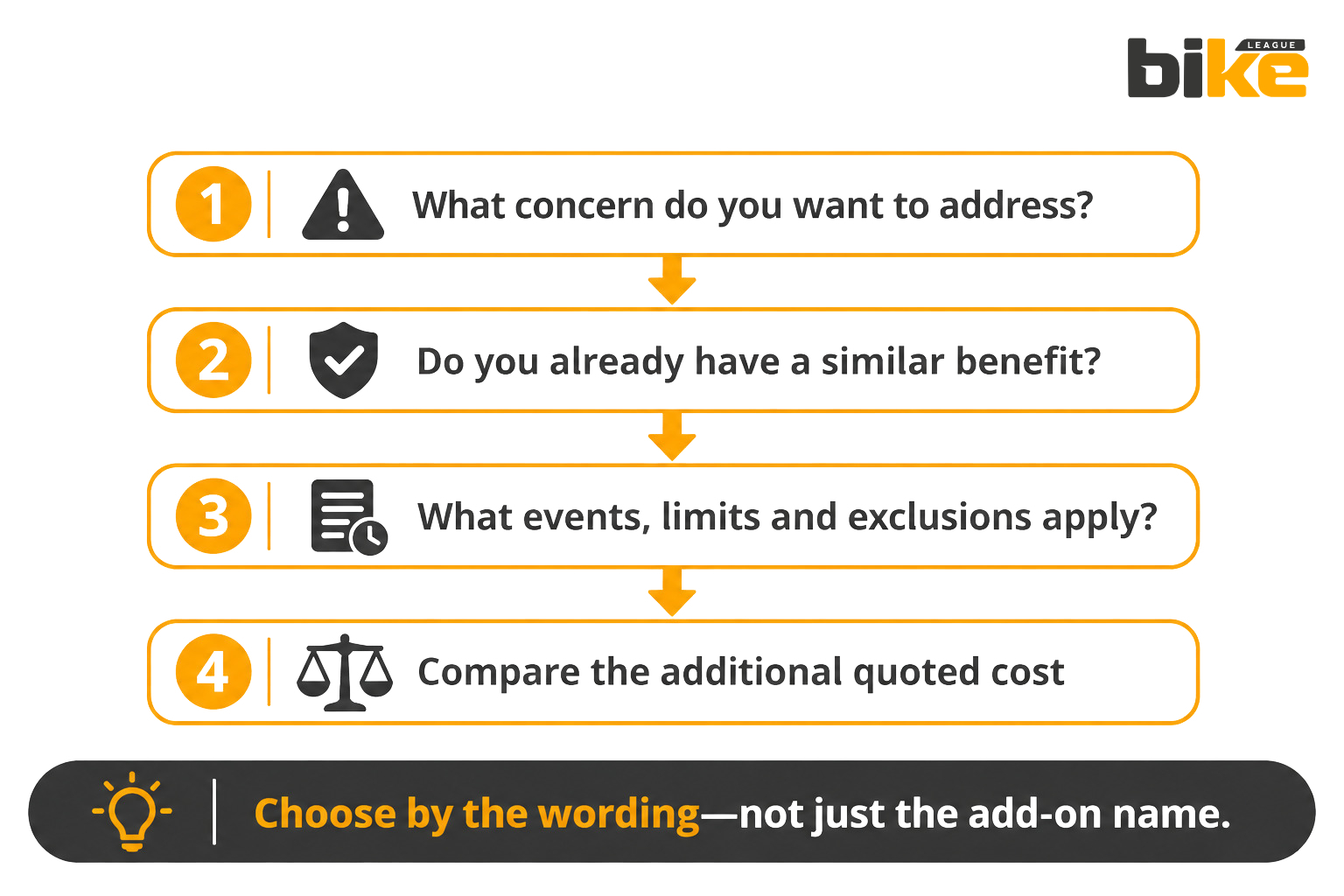
Begin by looking at the cover you already have, the losses you want to protect against, and the costs you could handle yourself. Don’t pick an add-on just because it’s called “essential” or recommended for a broad group like commuters, tourers, or superbike owners.
Use the situations below to help you decide what to look into. These are prompts for comparison, not suggestions to buy every benefit listed. Always check what’s available and read the exact policy wording before making a choice.
| Your concern | Cover or benefit to investigate | Questions to ask |
|---|---|---|
| Depreciation deductions on expensive replacement parts | Zero-depreciation cover | Is the motorcycle eligible? Which parts are included? What deductibles, exclusions, and claim-count limits remain? |
| A breakdown away from reliable assistance | Roadside assistance | Does the service operate along your usual routes? What are the towing and call-out limits? Do you already have comparable manufacturer or membership assistance? |
| Waterlogging and specified consequential engine damage | Engine protection, where available | Which causes and components are covered? What precautions and reporting conditions apply? Which losses remain excluded? |
| The financial effect of theft or total loss | Base own-damage cover, IDV and eligible RTI protection | Does the base policy include theft? What is the settlement basis? If RTI is available, what does its formula include and what restrictions apply? |
| Transport expenses during qualifying accident repairs | Daily allowance or travel benefit, where available | What event triggers payment? Is there a minimum repair period? What are the daily limit and maximum payable days? |
| Regular travel with a pillion passenger | Separate pillion personal accident protection | Who is insured, for which benefits, and for what sum insured? Do not assume owner-driver CPA protection includes the passenger. |
| Loss of or damage to fitted accessories | Applicable accessories cover or extension | Which items must be declared and valued? Are the accessories listed in the schedule? What risks and exclusions apply? |
| Electric two-wheeler battery, charging or breakdown risks | EV-specific protection and assistance | Which components and causes are insured? How are depreciation, degradation, warranty-covered faults, and leased batteries treated? |
| Losing an accumulated NCB after a claim | NCB protection, where available | Which claims qualify? What NCB entitlement is protected? What renewal and claim-count conditions apply? |
Check Existing Benefits Before Paying For More Cover
Review manufacturer assistance, warranties, service packages, memberships and existing personal accident insurance. Compare their scope with the proposed add-on rather than assuming that similarly named benefits provide identical protection.
If you have a loan on your motorcycle, check how a theft or total-loss claim would be settled and if you might still owe money on the loan. Don’t assume that RTI or loan protection will always pay off the full amount.
If you use your motorcycle for delivery, business, or anything other than personal riding, let the insurer know and check if the policy covers that use. Don’t rely on an add-on instead of getting the right main policy.
Consider Both Affordability And The Remaining Exposure
Find out what costs the add-on will cover, what you’ll still have to pay, and if its limits fit your needs. A cheap add-on may not help much if its exclusions leave you unprotected.
On the other hand, don’t ignore a cover just because you haven’t claimed before. Think about the possible financial risk and the extra cost, but remember that insurance isn’t a guaranteed saving or investment.
How To Compare Bike Insurance Quotations
When comparing quotes, use the same motorcycle details and similar coverage. A cheaper price isn’t always better if it means a lower IDV, higher deductible, shorter coverage, or fewer benefits.
IRDAI suggests you compare deductibles, coverage, and IDV as well as the premium when looking for motor insurance. Use the checklist below to spot differences before picking a policy.
Ask For An Itemised Quotation
- Confirm the motorcycle’s model, variant, registration details, age and declared use.
- Identify the policy arrangement: third-party-only, standalone own damage, package or bundled.
- Compare the start and end dates of each cover separately.
- Use the same IDV for a like-for-like comparison, and check how declared accessories are treated.
- Confirm the NCB entitlement used in each quotation.
- Compare compulsory, voluntary, and any other applicable deductibles.
- Request the name, price, and wording of each selected add-on.
- Check whether personal accident protection is included, purchased separately, or omitted on an accepted eligibility basis.
- Check applicable taxes and the final amount payable.
- Confirm relevant repair-network access, assistance arrangements and claim-notification channels.
Source: IRDAI’s motor-insurance guidance on comparing premiums, deductibles, coverage and IDV.
What Affects Add-on Prices And Renewal Premiums?
There is no single pricing formula that applies to every insurer and add-on. The price depends on the motorcycle, the eligible product, and the protection selected. Ask for an itemised quotation so you can distinguish the own-damage premium, other covers, individual add-ons and applicable taxes.
When you compare quotes or look into a renewal price increase, check the following:
- Vehicle details: Confirm that the model, variant, age, registration details, and declared use are recorded consistently.
- IDV and accessories: Check whether the insured value or the value of declared accessories has changed.
- Coverage period: Make sure you are comparing equivalent periods and the same policy arrangement.
- Selected benefits: Check whether add-ons have been added, removed, or changed, including their limits and conditions.
- Deductibles: Confirm whether you have agreed to a different voluntary deductible or whether another applicable excess differs.
- Claims and NCB: Check the claims history and NCB entitlement used in the quotation. NCB applies to own-damage premium, not the entire bill.
- Other pricing changes: Ask the insurer to explain any changed rates, discounts, loadings, charges, or applicable taxes.
These are things to check when comparing, but not every factor will change the price of every add-on. Some benefits have a fixed price, while others depend on your vehicle or the protection you choose.
Why Can Renewal Cost More Even When Idv Falls?
IDV is just one part of your quote. Even if your IDV goes down, your renewal premium might not drop if other prices, discounts, deductibles, or benefits have changed. NCB protection also doesn’t lock in your whole renewal price.
Look at the breakdown of your old and new premiums before deciding. If you have bundled insurance, check which parts really need to be renewed instead of just comparing a new own-damage quote to the old bundled total.
Check The Additional Quoted Cost Of An Add-on
Request prices with and without the proposed add-on while keeping the other details unchanged. This identifies its additional quoted cost more clearly than a general percentage or an advertised starting price.
When you compare insurers, look at the details of the benefits as well as the price. The same add-on name might mean different things, with different limits, deductibles, or help options.
Reference: IRDAI’s Motor Insurance Handbook explains general premium factors. Obtain the current pricing and benefit details from the insurer quoting for your motorcycle.
Do Not Use One Insurer Statistic As The Whole Comparison
If you consider published claim statistics, check the reporting period, definition and scope. Do not assume that a company-wide figure describes two-wheeler own-damage claims or guarantees the outcome of your claim.
Check the policy wording, service details, and claim process along with any statistics. Keep copies of your quote and any documents you used to decide.
Review The Cover Again At Renewal
Your motorcycle’s value, how you use it, your benefits, and your eligibility for add-ons can all change. Always check the new quote instead of assuming everything stays the same.
Check the expiry dates ahead of time so you can compare your options and avoid letting your coverage lapse.
What To Check Before Buying Or Making A Claim
After Purchase: Check The Issued Documents
Check that your issued policy matches the quote you agreed to. Make sure the vehicle details, coverage dates, IDV, deductibles, and benefits are correct. If you find any differences, ask the insurer to fix them right away.
- Check that the selected add-ons appear in the schedule and obtain their wording.
- Confirm personal accident and nominee details where applicable.
- Check that the lender’s interest is recorded correctly where required.
- Retain the quotation, payment receipt, policy documents and important written clarifications.
After An Accident: Follow A Clear Claim Process
Take care of safety and medical needs first. When it’s safe, follow your insurer’s steps for notifying them and making a claim. The process may be different depending on whether it’s your own damage, an injury, third-party liability, or something else.
- Notify the insurer promptly through its official claim channel and obtain a claim reference number.
- Inform the police where required, particularly when the incident involves injury, death or another situation requiring police reporting.
- Record the incident details and preserve photographs or other evidence where it is safe and lawful to do so.
- Ask whether inspection or survey is required and confirm the repair-authorisation process before arranging repairs.
- Use the insurer’s approved assistance or repair arrangements where required by the policy. If emergency recovery is necessary, keep records and receipts.
- Submit the requested documents and retain copies of what you provide.
- Before collecting the repaired motorcycle, check the approved claim amount and the charges you must pay yourself.
Even with cashless approval, not all charges are covered. Ask for a list of deductibles, excluded items, and any other costs you’ll need to pay.
If The Motorcycle Is Stolen
Notify the police and insurer immediately, obtain the required police complaint or FIR reference, and follow the insurer’s theft-claim instructions. IRDAI also advises keeping the transport department informed.
Keep all available keys and vehicle documents safe. If any key or document is missing, let the insurer know instead of assuming it won’t affect your claim. Theft claims may also need extra police documents, like a non-traceable report or certificate, at the right time.
Theft cover, key replacement, and return-to-invoice protection all have different uses. Key replacement doesn’t cover theft of the motorcycle, and RTI is only paid if its specific conditions are met.
Documents Depend On The Claim
Ask your insurer for the list of documents you’ll need for your claim. Depending on what happened, you may need:
- The completed claim form or information submitted through the insurer’s digital process.
- The policy details and motorcycle registration certificate.
- The relevant driving licence, where applicable.
- Photographs, an estimate of damage and other evidence requested for assessment.
- Repair invoices, payment receipts and related records, where required.
- A police complaint, FIR, or other police documents where applicable.
- Vehicle keys and the required police closure or non-traceable documentation for a theft claim.
This list may not cover every situation. Check which documents you need, when to submit them, and if originals are required. Personal accident and third-party claims might need different evidence than an own-damage repair claim.
Sources: IRDAI’s guidance on making a motor insurance claim and IRDAI’s Motor Insurance Handbook. Follow your insurer’s instructions for the particular claim.
If You Disagree With A Claim Decision
Request the decision and the policy details used to make it in writing. If you are not satisfied with the explanation, send a written complaint to the insurer’s Grievance Redressal Officer. Include your policy number, claim reference, supporting documents, and what outcome you want.
If your complaint is not resolved or you are unhappy with the response, follow the next steps for escalation. You can register and track grievances on IRDAI’s Bima Bharosa portal. Filing a complaint with the Insurance Ombudsman is another option, but it has its own rules and requirements.
Useful Official Bike Insurance Resources
- IRDAI motor insurance guidance: consumer explanations of cover, premiums, and policy questions.
- IRDAI motor claim guidance: information on accident, theft, and third-party claim procedures.
- Bima Bharosa: the Insurance Regulatory and Development Authority of India’s grievance registration and tracking portal.
- IRDAI grievance and Insurance Ombudsman guidance: information on escalation routes and complaint requirements.
For questions about your specific product, refer to the insurer’s official policy wording, claim contacts, and grievance details. Remember, this general guide does not replace the contract for your motorcycle.
Frequently Asked Questions About Bike Insurance Terms And Add-ons
1. Does Zero-depreciation Cover Pay The Entire Repair Bill?
No. It addresses specified depreciation deductions on eligible replaced parts in an admissible claim. You may still need to pay deductibles, excluded items, and other charges outside the approved cover. Check vehicle-age eligibility, covered parts, and claim-count limits in your endorsement.
2. How Do I Add Roadside Assistance Or Another Benefit To My Policy?
At renewal, request the add-ons you want before accepting the quotation. To change your policy during the existing period, contact the insurer first: mid-term additions are subject to the product’s rules and the insurer’s acceptance.
- Identify the benefit: Specify whether you want roadside assistance, engine protection, daily allowance, or another cover. Check whether you already have a similar benefit through the manufacturer, a membership, or another policy.
- Confirm eligibility: Ask whether the benefit is available for your motorcycle and base policy, and whether it can be added now or only at renewal.
- Obtain the terms and price: Request the additional premium, coverage period, limits, and exclusions. Ask whether inspection, photographs, or other information are required.
- Confirm when protection begins: Obtain the accepted effective date and complete the insurer’s payment and documentation requirements. Do not assume cover starts when you first submit a request.
- Check the issued documents: Confirm that the selected benefit appears in the endorsement or renewed policy schedule, and retain its wording.
For roadside assistance, check the service area, towing allowance, call-out limits, and charges you must pay yourself. For engine protection, check the covered causes and components rather than assuming that every engine failure is insured.
A new add-on should not be treated as cover for an incident that has already occurred. If the motorcycle has already broken down or suffered damage, disclose the situation and ask what assistance is available under your existing protection.
Product example: HDFC ERGO’s two-wheeler emergency assistance information explains its eligible base policies and purchase process. This does not establish that your insurer permits mid-term additions; confirm that separately.
3. Can I Buy Every Add-on With Third-party-only Insurance?
No. Check the required base policy for each benefit. Add-ons dealing with damage to your motorcycle, such as zero depreciation, generally attach to an eligible own-damage section rather than providing that protection through third-party-only insurance.
Personal accident and assistance arrangements may be offered separately or through different products. Confirm how the proposed benefit is issued and whom or what it protects.
4. How Much Do Bike Insurance Add-ons Cost?
There is no single price or percentage increase that applies to every motorcycle and policy. Obtain an itemised quotation for your vehicle, selected benefits, and coverage period.
To identify an add-on’s additional quoted cost, compare prices with and without it while keeping the other details unchanged. Then compare its conditions, not just its price.
5. Does Ncb Protection Keep My Renewal Premium Unchanged?
No. It protects the specified NCB entitlement only under the endorsement’s conditions. Other pricing factors, the IDV, selected benefits, and applicable charges can still change.
Check which claims qualify, how many claims are permitted, and whether any renewal conditions apply.
6. Can I Transfer My Add-ons When I Buy Another Motorcycle?
Do not assume that add-ons automatically move to the replacement motorcycle. Ask the insurer whether the change requires an endorsement or a new policy, and obtain written confirmation of the benefits, premium, and effective date.
NCB is a separate issue from transferring add-ons. Check your eligibility and the evidence required to carry the entitlement to another policy.
7. What Should I Do If My Bike Is Stolen Or Involved In An Accident?
Address immediate safety and medical needs, notify the insurer promptly, and complete police reporting where required. For theft, inform the police and insurer immediately.
Follow the insurer’s instructions on evidence, inspection, repairs and documents. Keep the claim reference and copies of your submissions. Selected add-ons apply only when their own conditions are met; they do not guarantee claim approval.
8. Does Bike Insurance Cover Accessories And Modifications?
Check how the policy treats factory-fitted equipment and separately fitted accessories. Declare relevant additions or modifications and ask whether they need separate listing, valuation or additional cover.
Do not assume that every custom seat, light, exhaust or helmet is insured. Obtain confirmation of the items and risks covered, and remember that insurance acceptance does not establish that a modification is legally permitted.
9. Does Ev Insurance Cover Every Battery Or Charger Problem?
No. Check the base policy and any EV-specific endorsement for the components and causes covered. Damage from an insured event differs from ordinary degradation, a manufacturing defect, or a warranty-covered fault.
Confirm the treatment of charging equipment, battery depreciation, and leased or subscription batteries. Do not assume that power surges or depleted-battery assistance are included simply because the product is described as EV protection.
10. Does Owner-driver Personal Accident Cover Include My Pillion Passenger?
Do not assume so. Owner-driver CPA and pillion personal accident protection are separate arrangements. Check who is insured, the applicable sum insured, and the benefits selected.
Personal accident benefits also should not be confused with general medical-expense reimbursement. Refer to the personal accident section above for owner-driver eligibility and the existing-cover exception.
Sources for key distinctions: ACKO’s two-wheeler zero-depreciation endorsement hosted by IRDAI illustrates underlying-policy and claim-limit conditions. The policy wordings and official guidance linked in the relevant sections above provide further detail. Use the documents issued for your own policy to confirm the actual benefits.
Related Motorcycle Insurance Guides
- Two-wheeler insurance in India – How to buy and select
- Indian Motor Tariff (IMT) for Two-Wheelers in India
- Bike insurance tips in India – Tips to get a lower premium
- Things to know while buying second hand motorcycle
- Bike IDV Calculator – Calculate Your Bike’s Value Online
Conclusion
Knowing bike insurance terms makes it easier to compare what each policy offers. Start with the base cover, check expiry dates, and make sure you understand the IDV, deductibles, and exclusions before choosing extra benefits.
Choose add-ons that fit your needs instead of buying every option or trusting promises of big savings. Compare similar quotes, read the endorsements you select, and keep written proof of any important clarifications.
Check your coverage if your bike, how you use it, or your situation changes. Keep your policy and claim contacts handy, and renew your cover before it runs out.
If you have any questions or feedback about this guide, you can leave a comment below or email bikeleagueindia@gmail.com. For questions about your own policy or claim, contact your insurer directly for clarification.