

Long story short: This guide explains how vibrations move through motorcycles. It highlights key parts—rubber mounts, vibration dampers, and bar-end weights—that help reduce them.
It’s important to understand and manage vibrations in Indian two-wheelers. Vibrations can affect your safety, comfort, health, and how much you spend on maintenance. Too much vibration makes bikes harder to handle and can raise the risk of accidents. It can also cause fatigue and hand-arm vibration syndrome, which are bad for your health. Vibrations also wear out parts faster, increase repair costs, and shorten your bike’s life.
Reducing vibrations makes rides smoother and helps bikes meet quality standards, leading to happier customers. Both manufacturers and riders benefit, especially with India’s rough roads. Fixing vibration issues makes two-wheelers safer, more comfortable, and less expensive to maintain.
Key Takeaways
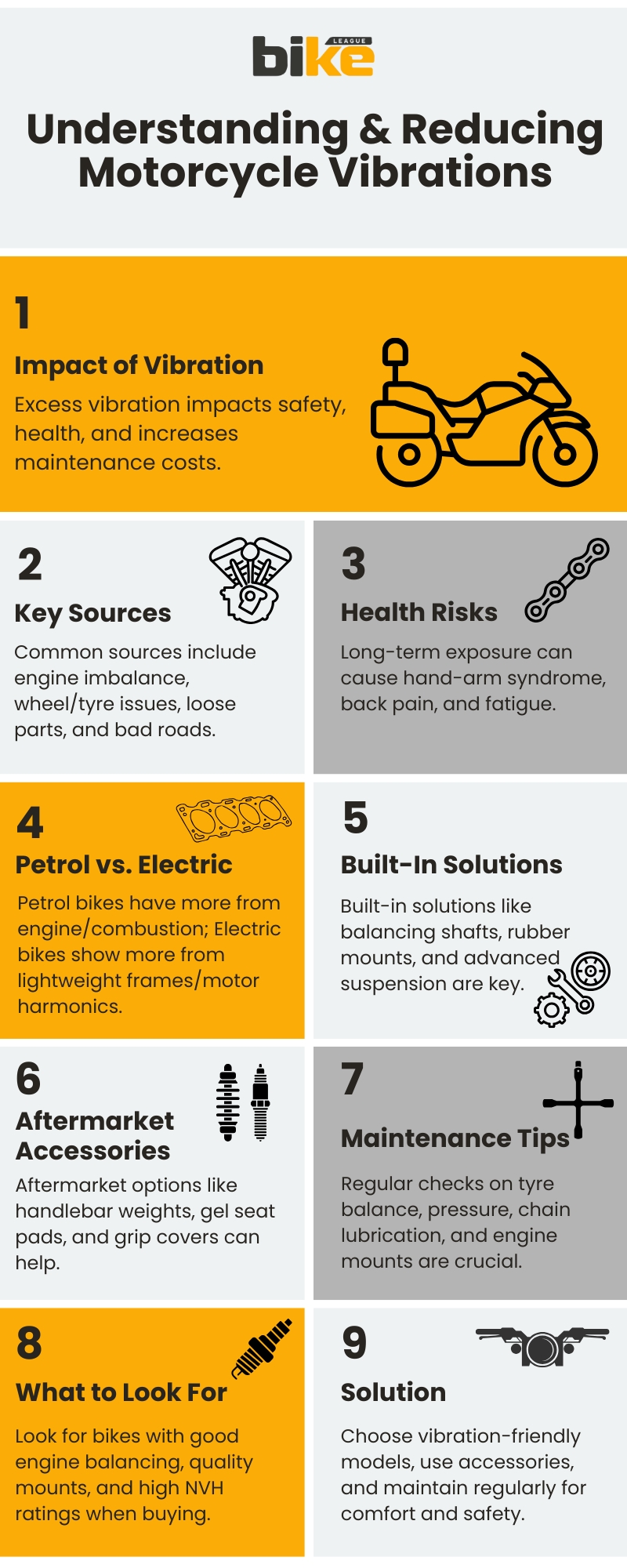
- Controlling vibrations in Indian two-wheelers is essential for rider safety, comfort, and long-term health. Excessive vibrations can lead to fatigue, increase the risk of health problems, and accelerate bike wear, thereby increasing maintenance costs.
- The primary sources of vibration in two-wheelers include engine imbalance, wheel and tyre problems, and loose or worn parts. Poor frame design and India’s challenging road conditions add to the problem. Many of these issues can be managed with thoughtful design and regular upkeep.
- Exposure to vibrations for long periods can cause serious health problems. These include Hand-Arm Vibration Syndrome, muscle and joint pain, fatigue, and even long-term nerve or circulation issues. This makes controlling vibration especially important for frequent riders.
- To keep rides safe and comfortable, Indian manufacturers and mechanics rely on advanced tools like accelerometers and vibration analysers. They also follow international standards and regularly test bikes to measure and control vibration levels.
- Built-in features—such as engine balancing, sturdy frames, and advanced suspension—help reduce vibrations. So do accessories like handlebar weights and gel seat pads. Regular maintenance is just as essential to keep your two-wheeler running smoothly and comfortably.
What Are The Vibrations In Two-wheelers?
In Indian two-wheelers, vibrations are felt in the handlebars, seat, or footrests. These originate from the engine, the road, or mechanical faults and are transferred through the bike to the rider.
Indian roads are often uneven, and bikes are everywhere. Vibrations make riding less comfortable and harder to control. Over time, they can cause health problems. Engine imbalance, wheel or tyre issues, loose parts, and rough roads are common causes.
What Are The Causes Of Vibrations In Two-wheelers In India?
Vibrations in Indian two-wheelers are caused by their design, assembly, and prevailing road conditions.
- Engine and Mechanical Imbalance: Internal engine parts can cause vibrations if not correctly balanced. Key parts include the crankshaft (the rotating shaft that converts the pistons’ up-and-down movement into circular motion) and pistons (moving components that transfer force from expanding gas). This occurs if the engine isn’t running smoothly, RPMs (revolutions per minute) are low, or balancing parts are missing.
- Wheel and Tyre Issues: Handlebars may shake if wheels aren’t balanced or tyres aren’t fitted correctly. Worn tyres, incorrect tyre pressure, or incorrect tyre type also cause vibrations, especially between 90 and 130 km/h.
- Loose parts: Loose or worn chains, sprockets, bearings, or mounts can exacerbate vibrations.
- Structural Design and Mounting: The way the bike’s frame is designed and how parts are attached affects how much vibration the rider feels. Without vibration-damping parts, more vibration reaches the seat, handlebars, and footrests.
- Road Surface Conditions: Bad roads with potholes in India send more vibrations through the bike’s shocks and frame. This causes the rider’s body and hands to shake.
- Rider and Usage Factors: Your riding style, speed, and exposure time all impact how uncomfortable it feels and the associated health risks.
What Are The Health Risks Associated With The Vibrations In Two-wheelers?
Riding Indian two-wheelers for long periods with lots of vibration can lead to several health risks, such as:
- Hand-Arm Vibration Syndrome (HAVS): Continuous vibration from the handlebars can cause numbness, tingling, pain, and reduced grip in the hands and arms. Over time, this may lead to permanent nerve and blood vessel damage.
- Musculoskeletal Disorders: Whole-body vibration, particularly through the seat and footrests, can lead to back pain and spinal disc degeneration. It’s also linked to shoulder stiffness and neck pain. These are common among frequent riders.
- Fatigue and Reduced Concentration: Vibrations exhaust your muscles and cause discomfort. This reduces alertness, slows reaction time, and increases the risk of accidents.
- Circulatory and Nerve Damage: Prolonged exposure to vibration can impair blood circulation and nerve function. Extremities may be affected, leading to conditions such as Raynaud’s phenomenon.
- Long-term Disability: If you’re exposed to vibration for years without taking action, it can cause permanent muscle and nerve damage. This can make daily activities more challenging and lower your overall quality of life.
These health risks show why it’s crucial to control vibrations. Good design, regular maintenance, and rider comfort features all help, especially in Indian two-wheelers.
How Do Vibration Issues Differ Between Petrol And Electric Two-wheelers?
Vibration problems in petrol and electric two-wheelers are mainly due to differences in how their powertrains are built and operate.
Petrol Two-wheelers
- Vibration sources: Internal combustion engines vibrate due to reciprocating masses (pistons, connecting rods) and combustion-induced pressure fluctuations. Mechanical couplings, such as chain drives and gearbox assemblies, add to this. The non-continuous torque delivery and inherent imbalances result in elevated vibration amplitudes.
- Frequency and intensity: Engine firing intervals induce distinct frequency bands with appreciable vibration magnitudes. These are typically transmitted to contact points such as handlebars, seat, and footpegs.
- Typical vibration phenomena: Combustion harmonics, mass unbalance in rotating components, and exhaust system resonance define the vibration spectrum.
- Mitigation strategies: Vibration isolation is addressed using dynamic balancers, elastomeric engine mounts, optimised exhaust topology, and inertial add-ons at control interfaces.
Electric Two-wheelers
- Vibration sources: Electric motors create less mechanical vibration, mostly from unbalanced rotors, gear contact, and electromagnetic forces. Since there is no combustion, many sources of engine vibration are gone.
- Frequency and intensity: Vibrations are usually weaker but can include high-pitched electromagnetic noises and vibrations from the motor’s speed.
- Unique challenges: Lightweight frames pass road bumps more directly to the rider. Vibrations from battery packs and cooling systems can also make riding less comfortable.
- Mitigation approaches: Solutions include carefully balancing the motor, using advanced materials to absorb vibration, special suspension systems, and sometimes active vibration control.
Bs6 Vs Bs4: Does The Emission Norm Affect Vibration?

BS6 is an emission standard, not a vibration standard, so it doesn’t require any vibration-control hardware. However, engine changes made for BS6 compliance have also affected vibration levels:
- Fuel injection replacing carburettors: Nearly all BS6 bikes moved from carburettors to electronic fuel injection (EFI). Precise, sensor-controlled fuel delivery provides more consistent combustion from cycle to cycle. This tends to smooth out the harsh, uneven vibration spikes that carburetted engines can produce under load or during warm-up.
- Engine tuning for refinement: Meeting stricter emission limits came with performance and efficiency trade-offs. To offset these, several manufacturers re-tuned engine internals and mounting for smoother running. Owners of popular BS6 models have reported noticeably reduced low-speed vibration compared to their BS4 counterparts.
- What hasn’t changed: Balancer shafts, rubber engine mounts, and structural vibration damping remain design choices made independently of emission norms. A BS6 single-cylinder engine without a balance shaft can still vibrate as much as a BS4 equivalent. The emission upgrade alone doesn’t guarantee a smoother ride.
If your BS6 bike feels smoother than an older BS4 model, that’s probably down to fuel injection and engine improvements. It’s not because BS6 rules control vibration.
How Do Scooters With Cvt Transmissions Vibrate Differently?
Scooters make up a huge share of India’s two-wheeler market. Their vibration behaviour is distinct from geared motorcycles, mainly because of the CVT (Continuously Variable Transmission) and the under-seat engine layout most petrol scooters use.
- Engine-under-seat placement: Unlike motorcycles where the engine sits between the rider’s knees, scooter engines are mounted under or behind the seat. This puts the vibration source much closer to where the rider sits. As a result, seat and floorboard vibration tends to be more noticeable than handlebar vibration.
- Belt and variator wear: The rubber drive belt and variator (the pulley system that changes gear ratio automatically) wear down over time. A stretched or aged belt, or worn variator rollers, can introduce a distinct droning or buzzing vibration. This vibration changes with throttle position rather than road speed.
- Clutch and torque converter vibration: The centrifugal clutch engages and disengages based on RPM. A worn clutch shoe or dirty clutch housing can cause shudder specifically during take-off from a standstill. Geared motorcycles don’t experience this in the same way.
- Floorboard and footwell transmission: Scooters have a flat floorboard rather than footpegs bolted near the engine. Because of this, vibration often travels through the chassis floor rather than through discrete mounting points. This makes it feel more diffuse and harder to pin down.
- Single-cylinder, high-revving engines: Most Indian scooters use small single-cylinder engines that rev higher than equivalent-capacity motorcycles, to compensate for CVT power loss. This can produce a higher-frequency buzz, rather than the low-frequency thump typical of geared single-cylinder bikes.
Maintenance tips specific to scooters:
- Belt inspection and replacement: Have the CVT belt checked every 10,000–15,000 km (check your owner’s manual). A worn belt is one of the most common, and most overlooked, sources of scooter vibration.
- Variator and roller cleaning: Dirty or worn variator rollers should be cleaned or replaced during regular servicing to keep power delivery smooth.
- Clutch shoe inspection: If you feel shudder specifically at take-off, ask your mechanic to inspect the centrifugal clutch shoes and housing.
- Floorboard mount check: Rubber floorboard mounts and grommets degrade with heat and age; worn ones let more vibration through to the footwell.
What Unique Challenges Or Solutions Apply To Electric Two-wheelers?
Electric two-wheelers pose specialised vibration management demands, distinct from internal combustion alternatives, owing to unique propulsion and structural parameters:
Unique Challenges For Evs
- Different Vibration Sources: Without combustion, electric vehicles (EVs) avoid the usual engine vibration. They still get vibrations from unbalanced spinning parts (rotors), magnetic forces, and gear teeth as they turn.
- High-Frequency Vibrations: Rapid electric switching in motors produces high-pitched (high-frequency) vibrations and repeated vibration patterns (harmonics) that affect comfort.
- Lightweight Chassis: The lighter frame used in EVs means bumps and shakes from the road are felt more directly. There’s less absorption by the structure.
- Battery and Cooling Systems: Battery packs and how they are held in place (mounting) can allow more vibration paths. In contrast, electric cooling fans and pumps generate their own vibrations.
- Reduced Engine Noise: Without engine noises to mask them, smaller vibrations and squeaks stand out. They can be more bothersome than on petrol models.
Unique Solutions For Ev Vibration Issues
- Precision Motor Balancing: Very accurate balancing of moving motor parts reduces mechanical vibrations from spinning components.
- Advanced Materials for Damping: Manufacturers use smart materials, like those that change properties under magnetic fields, along with composites that absorb movement. Applied at mounting points, the frame, or grips, these help block vibration from reaching the rider.
- Enhanced Suspension Systems: Custom-tuned suspension is designed for the specific layout and weight of electric vehicles, reducing bumps transferred from the road.
- Active Vibration Control: Sensors detect vibration in real-time, and electronically controlled parts (actuators) apply counter-movements to reduce them. This is a newer technology used in some EVs.
- Battery Pack Isolation: Special mountings and enclosures for battery packs are designed to keep vibrations from spreading through the vehicle structure.
How Are Vibrations Measured Or Tested (tools, Standards, Or Methods Used By Mechanics Or Manufacturers In India?
Specialised tools and techniques are used to assess vibrations in two-wheelers. These determine the intensity and source of the vibrations. Mechanics and factories in India rely on these methods.
Tools Used For Measuring Vibrations
- Accelerometers: small sensors placed at key points, such as handlebars or the engine. They measure how quickly those parts move, revealing both the intensity (strength) and frequency (how often vibrations happen).
- Vibration Analysers: Vibration analysers gather data from accelerometers and create readable charts. These charts show the strength and patterns of the vibrations. This helps diagnose whether they originate from the engine, wheels, or other locations.
- Laser Doppler Vibrometers: Laser Doppler vibrometers use a laser pointed at bike parts—a non-contact method. The laser tracks movement by bouncing off the surface, allowing vibrations to be observed without adding weight.
- Data Loggers: Data loggers continuously collect vibration information while riding. They produce records that show how vibration changes across different real-life conditions over time.
Testing Methods And Standards
- Frequency Analysis: Frequency analysis separates measured vibrations into different frequency bands. This lets users distinguish engine-related vibrations from those caused by wheel imbalances and pinpoint specific sources.
- Root Mean Square (RMS) and Peak Velocity: Vibration strength is measured by two methods: Root Mean Square (RMS) and Peak Velocity. RMS or Peak values show either the average or the highest vibration forces, in standard units. This makes it easy to compare against accepted limits.
- Hand-arm vibration measurement: assesses the amount of vibration transmitted through the handlebars to the rider, using established health and safety guidelines for comparison.
- Standards Used: Indian manufacturers rely on international and local standards for vibration evaluation. ISO 2631 covers whole-body vibration, and ISO 5349 covers hand-arm vibration. India-specific AIS standards add a third layer — published by the Automotive Research Association of India (ARAI) under the Ministry of Heavy Industries, they govern vehicle-level NVH and vibration testing for type approval.
Applications
- Factory teams test prototype or pre-production bikes by attaching sensors to key points during the NVH process. They then review the data to find and reduce unwanted vibration.
- Service centres use portable measurement tools during inspections to locate sources of shaking. This covers wheels, engine mounts, or other problematic bike parts that might cause excess vibration.
- Many workshops and users now rely on mobile apps and phone sensors for quick, basic vibration checks when specialist equipment isn’t available. This helps with everyday maintenance.
By leveraging these tools and techniques, mechanics and manufacturers in India can detect and solve vibration problems. This helps ensure bikes are safer and more comfortable.
What Features Should You Look For When Selecting Two-wheeler Models Regarding Vibrations?
When buying a two-wheeler, prioritise features that minimise vibrations. This ensures a smoother, safer ride with lower health risks.
- Engine Configuration and Balancing: Prefer multi-cylinder or single-cylinder engines equipped with balancing shafts or counterweights that reduce inherent engine vibration.
- Engine Mounting System: Select models with rubber or hydraulic engine mounts, as these block engine vibrations from reaching the frame.
- Handlebar Design and Grip Quality: Look for ergonomic handlebars with vibration-damping grips or gel inserts to reduce hand-arm vibrations.
- Chassis and Frame Rigidity: A sturdy, well-engineered frame minimises flex and reduces how much vibration transfers to the rider. The result is a smoother ride with less whole-body vibration.
- Wheel and Tyre Specifications: Opt for bikes with properly balanced wheels and high-quality tubeless tyres to reduce wheel vibrations.
- Vibration Damping Accessories: Check whether the manufacturer offers bar-end weights (metal weights fitted to the handlebar ends to absorb vibrations) or cushioned footpegs (footrests with padding to reduce vibration). Also check for optional vibration dampers (devices that reduce vibration strength), offered as factory-fitted or aftermarket options.
- Noise, Vibration, and Harshness (NVH) Ratings: Check the NVH ratings. Lower numbers mean less vibration and a smoother ride.
How Are Engine Cylinders, The Number Of Engine Cylinders, And Vibrations Connected In Two-wheelers?
The number and layout of engine cylinders directly affect how much a two-wheeler vibrates.
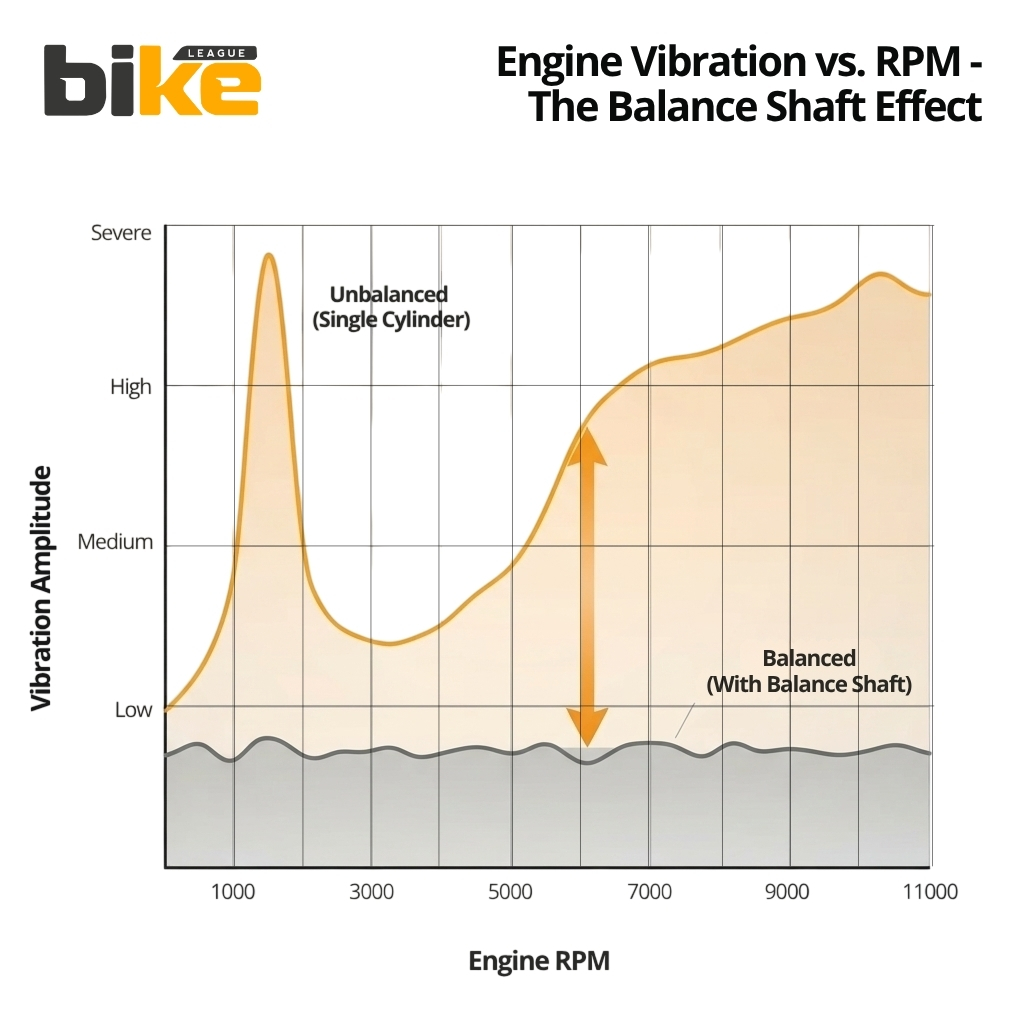
- Single-cylinder engines: Most Indian bikes feature single-cylinder engines. These produce more vibration because only one piston moves up and down, creating unbalanced forces. This causes noticeable shaking, especially at certain RPMs.
- Twin-cylinder and multi-cylinder engines: These balance some of the piston forces, reducing vibration for the rider. Engines like parallel-twin, V-twin, inline-three, and inline-four give smoother rides.
- Vibration frequency and intensity: Engines with more cylinders usually run smoother and vibrate less. Multi-cylinder engines spread out the power strokes, which helps lower vibration.
- Engine mounting and damping: Manufacturers use mounts, rubber parts, and balance shafts to reduce engine vibration. Single-cylinder bikes require these features even more, as they tend to vibrate more.
Real-world Examples: How Vibration Varies Across Popular Indian Motorcycles?
Theory aside, differences in vibration are easy to feel across common Indian motorcycles. Here’s how it plays out on models riders actually own:
- Royal Enfield Bullet/Classic 350 (older UCE engine, pre-2021): The pre-2021 UCE-based Classic and Bullet 350 are widely known among owners for pronounced low-RPM vibration, especially through the pillion seat and mirrors. This is a well-documented characteristic of the design, which had no counterbalancer.
- Royal Enfield Classic 350 / Meteor 350 / Hunter 350 (J-series engine, 2021 onward): The newer J-series 349cc engine added a counterbalancer. Owners and reviewers consistently describe it as a major refinement over the older engine — noticeably smoother at idle and at highway speeds — while retaining the brand’s signature low-RPM thump.
- Bajaj Pulsar 220F: A long-running favourite for highway touring, its air/oil-cooled single-cylinder engine has no counterbalancer. It’s known to develop noticeable vibration once revs climb past roughly 4,500rpm or road speed crosses 80km/h. Riders often describe it as manageable but present on long, fast highway stretches.
- TVS Apache RTR 160 4V vs RTR 200 4V: Both engines use a factory-fitted balancer shaft, so neither is inherently “unbalanced.” The 200 4V’s extra displacement and torque — not any difference in counterbalancing hardware — is what changes its highway feel. Riders report vibration becoming noticeable on both models once revs climb past roughly 7,000rpm. This is a known characteristic of small-capacity single-cylinder engines generally, rather than a flaw specific to either bike.
- Multi-cylinder options (KTM 390 Duke, Triumph Speed 400, Kawasaki inline engines): These use balancer shafts or additional cylinders to spread out power strokes. Riders generally report them as noticeably smoother at sustained highway RPM than comparable single-cylinder commuter or cruiser motorcycles.
- Hero Splendor Plus / Passion Pro (97.2cc air-cooled single, no counterbalancer): This is India’s highest-volume commuter engine architecture, and owner reports on it are notably mixed. Many describe it as smooth through the rev range, while a recurring complaint on owner forums is handlebar buzz setting in around 40km/h. The spread itself is informative. Without a balance shaft to fall back on, a small, cost-focused single is more sensitive to mount condition and maintenance than a bike with built-in counterbalancing.
- Honda Shine 100 / SP125 (98.98cc–123.94cc air-cooled single): Reviewers consistently rate Honda’s small-displacement commuter singles among the smoothest in their segment. It’s a refinement reputation the brand carries over from its scooter engines into its geared bikes.
- Honda Activa 6G (109.5cc single, CVT, under-seat engine): As India’s best-selling two-wheeler overall, the Activa is a useful real-world case of the scooter-specific pattern described earlier. Vibration shows up at the floorboard and seat rather than the handlebar. Owners commonly note a brief buzz during initial throttle pickup that settles once the CVT is fully engaged. That’s different from vibration that builds with road speed, the way it does on a geared motorcycle.
- TVS Jupiter 125 (124.8cc single, CVT): Autocar India’s road test noted mild vibration creeping in through the floorboard from around 50km/h onward, while otherwise describing the scooter as refined. It’s a good illustration of how CVT scooters can stay smooth at low speed and still develop a speed-linked vibration threshold. That vibration is just transmitted through the floorboard instead of the bars.
The pattern holds across the segment: a counterbalancer or additional cylinder does more for real-world smoothness than displacement alone. Two single-cylinder engines of similar capacity can feel very different depending on whether the manufacturer fitted balancing hardware.
How Do Mounts, Rubber Isolators, And Balancing Shafts Limit Vibration In Single-cylinder Two-wheeler Engines?
Mounts, rubber parts, and balance shafts all help control vibration in single-cylinder motorcycle engines.
Mounts And Rubber Isolators
The engine is fixed to the bike’s frame with rubber mounts. These rubber parts soften vibrations and stop them from reaching the frame and handlebars. This way, the rider feels less shaking, and the engine can move slightly to avoid strong jolts.
Balancing Shafts
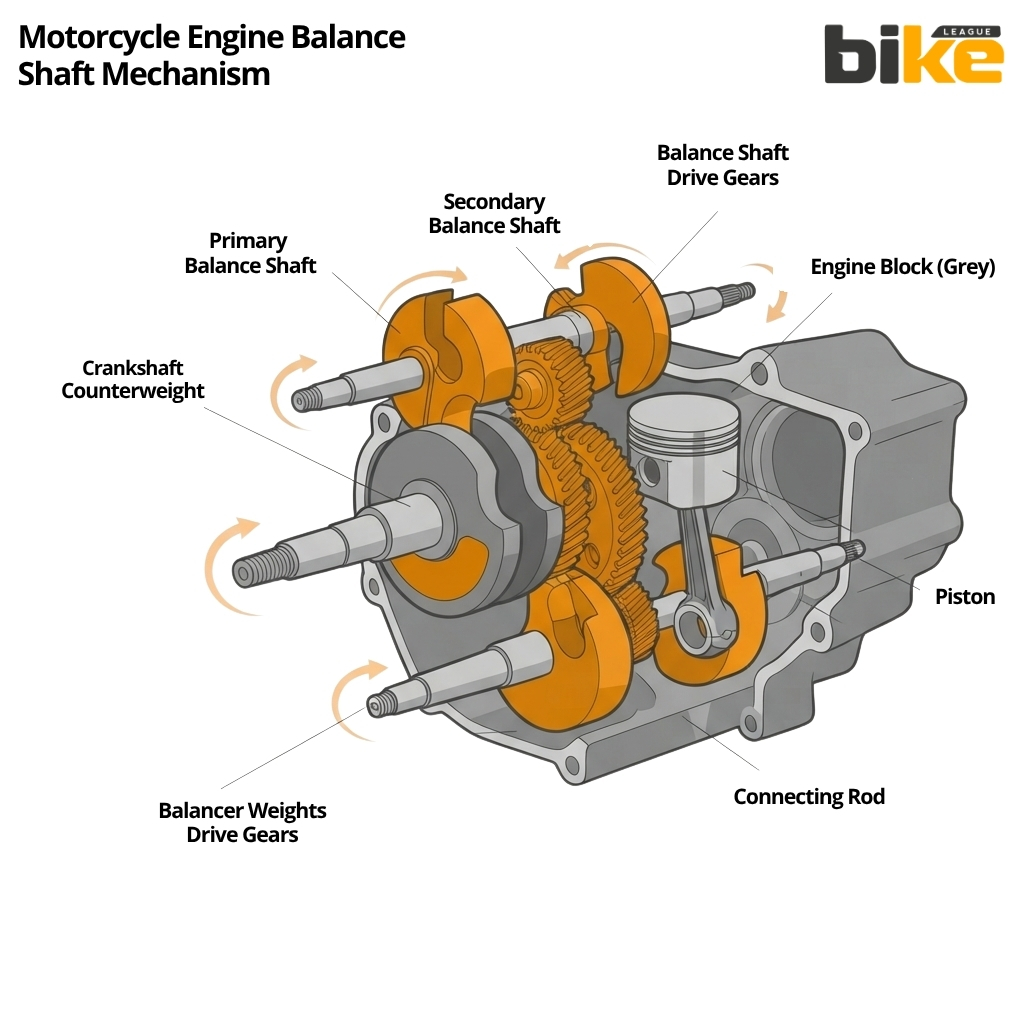
Single-cylinder engines create strong unbalanced forces because the piston moves up and down. Balance shafts are spinning rods inside the engine that generate opposing forces to cancel out the piston’s vibration. This cuts down vibration and helps the engine run more smoothly.
Balance shafts reduce vibration at its source, while rubber mounts absorb and block the rest. Using both makes riding more comfortable and gives you better control, especially on single-cylinder engines.
What Specific Maintenance Practices Can Help Reduce Vibrations In Two-wheelers In India?
Here are some maintenance tips to help you reduce vibrations in Indian two-wheelers:
- Regular tyre and wheel balancing: Keeping your wheels and tyres balanced helps cut down vibrations in the handlebars and frame, especially at high speeds.
- Keep tyre pressure right: If your tyres have too much or too little air, your bike can wobble and shake. Always check and keep them at the recommended pressure.
- Chain and sprocket maintenance: Ensure the chain is well-lubricated and tight, and replace worn sprockets to prevent drivetrain vibrations.
- Engine Tuning and Servicing: Regular engine servicing is essential. Check spark plugs, air-fuel mix, ignition timing, and engine mounts to keep your bike running smoothly and reduce vibrations.
- Check and replace engine mounts and rubber isolators: Replace any worn or damaged engine mounts to stop vibrations from reaching the frame.
- Inspect and maintain suspension parts: Replace worn shocks and other suspension components to reduce road vibrations and enhance handling.
- Tighten loose components: Check and tighten nuts, bolts, and fasteners on the frame, handlebars, and other parts that might vibrate. This helps stop rattles and extra shaking.
- Install aftermarket vibration dampers: You can add handlebar weights, grip covers, or special dampers to reduce vibration in your hands.
- Extra vigilance during monsoon: Prolonged exposure to rain and standing water accelerates rubber perishing in engine mounts and floorboard grommets. It also promotes corrosion at chain links, sprockets, and fasteners. All of this can show up as new or worsened vibration once the season ends. Riders in high-rainfall regions should shorten their mount/grommet and chain-tension inspection interval during monsoon months. Don’t wait for the standard service due date.
Performing these maintenance tasks can make your ride more comfortable and help prevent mechanical problems. It also reduces health risks associated with vibration on India’s various road types.
Is Vibration Covered Under Two-wheeler Warranty In India?
It depends on whether the vibration is normal for the bike or a symptom of a defect. Hero MotoCorp’s published warranty policy is explicit on this point. Ordinary noise, vibration, and oil seepage that don’t affect the vehicle’s performance, quality, or function are listed as outside the scope of warranty coverage. In other words, the baseline vibration a single-cylinder commuter engine produces during normal operation isn’t something a dealer is required to remedy under warranty. That’s true even if it bothers the rider.
That’s different from vibration caused by a genuine defect. The same warranty terms separately commit to covering defects in material and workmanship for the warranty period. So a cracked or prematurely worn engine mount falls under that defect coverage. The same applies to a manufacturing fault that shows up as abnormal vibration, rather than the “normal phenomena” exclusion.
For riders, this distinction is worth knowing before raising a complaint at a service centre:
- Vibration that’s been present since delivery is unlikely to succeed as a warranty claim on its own. This is especially true if it matches what other owners of the same model report.
- A sudden increase in vibration has a stronger case as a defect claim. So does vibration that appears alongside noise or looseness.
- Ask the service centre to log the complaint in writing at each visit. Even a “checked, normal” note builds a record — one that helps if the issue worsens later in the warranty period.
Warranty terms and exclusions vary by manufacturer and model. Check your own vehicle’s warranty booklet for the exact wording that applies to it.
Vibration Causes, Fixes & Costs — Quick Reference
Use this table to quickly match a vibration symptom to its likely cause, typical fix, and approximate cost in India. It also shows whether the fix is a DIY job or needs a workshop visit.
| Vibration Source | Likely Cause | Typical Fix | Approx. Cost (₹) | DIY or Workshop |
|---|---|---|---|---|
| Handlebar shake at speed | Unbalanced wheel or worn tyre | Wheel balancing, tyre replacement | ₹150–₹400 (balancing) | Workshop |
| Vibration at idle or low RPM | Worn/perished engine mounts | Replace rubber/elastomeric mounts | ₹300–₹1,200 per mount | Workshop |
| Rattling from footpegs/chain area | Loose or dry chain, worn sprocket | Clean, lube, adjust chain tension; replace sprocket | ₹100–₹150 (lube/adjust); ₹800–₹2,500 (sprocket) | DIY (lube/adjust); Workshop (sprocket) |
| Hand numbness on long rides | High-frequency vibration at grips | Bar-end weights, gel/rubber grip covers | ₹200–₹600 | DIY |
| Wobble/weave at highway speed | Steering-head play, front-end instability | Steering damper installation, headset adjustment. Persistent instability is also a good time to review your insurance coverage. | ₹1,000–₹3,500 | Workshop |
| Vibration through seat/footrests | Thin factory foam, worn suspension | Gel seat pad; shock absorber service/replacement | ₹500–₹1,500 (seat pad); ₹1,500–₹6,000 (shocks) | DIY (seat pad); Workshop (shocks) |
| Sudden new vibration + noise | Loose fasteners, damaged rim, exhaust mount failure | Full inspection and tightening; mount/rim replacement | Varies — inspect immediately | Workshop (urgent) |
| High-pitched buzz (EVs) | Motor/rotor imbalance, gear mesh, cooling fan | Motor balancing, service check | Workshop diagnostic, varies | Workshop |
Costs are approximate and vary by brand, model, and city. Persistent or worsening vibration should always be inspected by a professional, even if a DIY fix seems to help temporarily.
What Are Aftermarket Vibration Dampers In Two-wheelers In India, And Provide Some Examples?
Aftermarket vibration dampers for Indian two-wheelers are add-ons that reduce vibration at the handlebars, footrests, and seat. They work by absorbing or blocking shakes from the engine, wheels, or road. This makes riding more comfortable and easier to control.
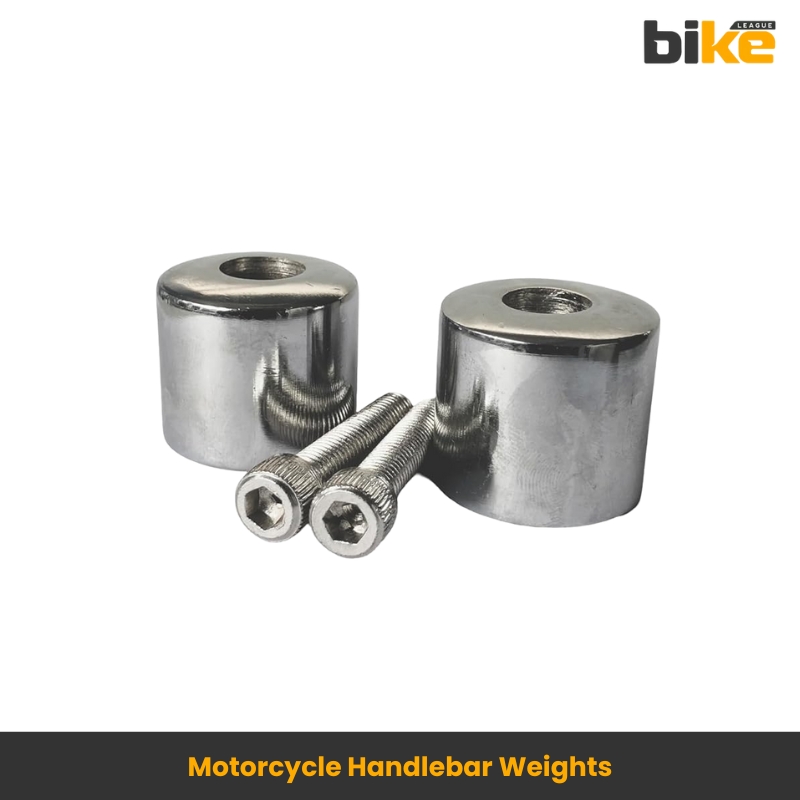
1. Handlebar Weights And Bar-end Weights
Handlebar and bar-end weights are heavy caps that go on the ends of handlebars. They add weight and help reduce vibration at certain speeds.
- Flipkart: Handlebar Weights (various options, universal fit for Indian bikes) – https://www.flipkart.com/search?q=handlebar+weights
- Amazon India: Bike handlebar weights – https://www.amazon.in/bike-handle-weight/s?k=bike+handle+weight
- SuperBikeStore: Specialised bar ends for performance motorcycles – https://superbikestore.in/collections/bar-ends
2. Rubber Grip Covers
Thick rubber or gel grips protect your hands by absorbing vibration before it reaches them.
- Amazon India: Rubber non-slip grip covers for all scooters and motorcycles – https://www.amazon.in/s?k=Rubber+grip+covers+motorcycle
- IndiaMART: Motorcycle grip covers (variety of materials and brands) – https://dir.indiamart.com/impcat/motorcycle-grip-cover.html
3. Steering Dampers
Steering dampers connect the front fork to the frame, helping steady the handlebars and reduce vibration from wobbles.
- Flipkart: Universal motorcycle steering damper option – https://www.flipkart.com/q/motorcycle-steering-damper
- Amazon India: Motorcycle steering Dampers – https://www.amazon.in/s?k=motorcycle+steering+damper
4. Footpeg Dampers
Rubber-mounted or cushioned footpegs reduce vibration transmitted to your feet and are available in many aftermarket options.
- Bikenbiker: Variety of anti-slip and ergonomic footpegs – https://bikenbiker.com/collections/all/footpegs
- Meesho: Budget-friendly bike footrests – https://www.meesho.com/search?q=motorcycle+foot+rest
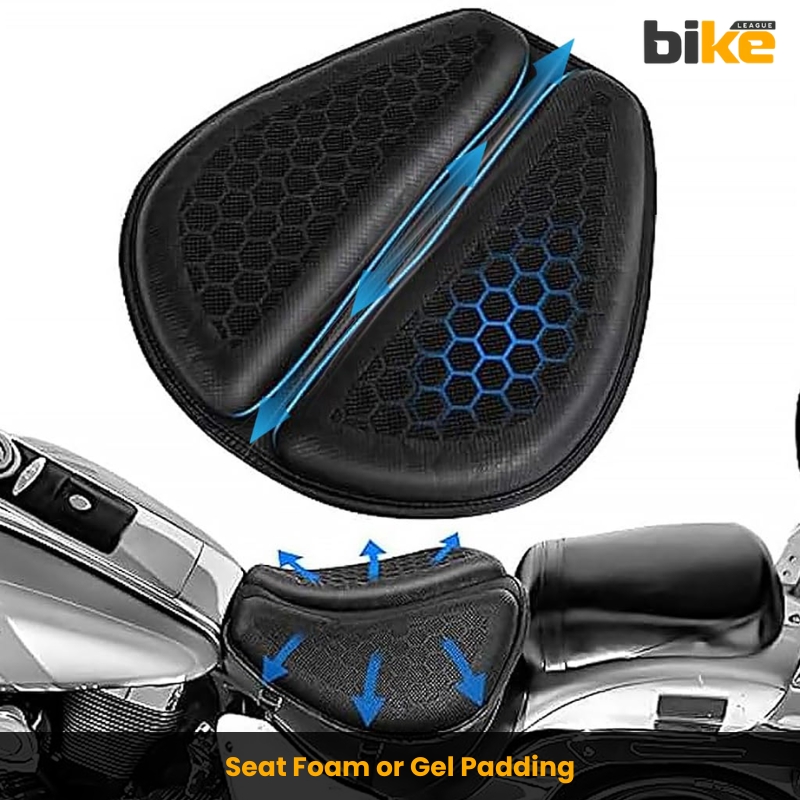
5. Seat Foam Or Gel Padding
Upgrading your seat with gel or memory foam cushions helps absorb vibrations, making your ride more comfortable.
- Flipkart: Gel pad single seat cover – https://www.flipkart.com/q/gel-seat-pad-bike
- Amazon India: Gel pad single seat covers – https://www.amazon.in/s?k=motorcycle+pillion+gel+seat+pad
Are Aftermarket Vibration Dampers In Two-wheelers In India Effective?
Aftermarket vibration dampers for Indian two-wheelers usually work well for certain types of vibration. They’re especially effective against high-frequency vibrations at the handlebars and footpegs. Here’s how they help:
- Targeted Vibration Reduction: Handlebar weights and rubber grip covers add weight or cushion where you hold on. This soaks up vibration before it reaches your hands. This cuts down hand and arm discomfort and fatigue.
- Improved Stability: Steering dampers help prevent the handlebars from wobbling at high speeds, minimising vibration and enhancing safety and comfort.
- Ride Comfort: Gel seat pads and cushioned footpegs absorb vibrations that travel through the seat and feet. This makes the entire ride more comfortable, especially on rough Indian roads.
- Limitations: These dampers are effective against certain types of vibration. But they can’t eliminate all vibrations, particularly low-frequency ones caused by poor road conditions. The bike’s suspension and frame design handle most of those.
- Quality and Fit: These dampers perform optimally when paired with high-quality products specifically designed for your bike and installed correctly. Cheap or poorly fitted dampers may not provide much help or could even cause problems.
- Widely Used: Many Indian riders use aftermarket vibration dampers. Reviews frequently mention improved comfort and reduced fatigue during daily rides and long trips.
Do Performance Modifications Like Exhaust Swaps, Ecu Remaps, Or Tyre Size Changes Affect Vibration?
Beyond dedicated dampers, some of the most common performance modifications Indian riders make can noticeably change a bike’s vibration character. Sometimes it’s for better, often for worse.
- Aftermarket exhausts: Slip-on and full-system exhausts change the back-pressure and resonance the engine was tuned around. Free-flow systems can shift vibration to a different point in the rev range. A poorly matched header can also introduce new droning frequencies that weren’t present with the stock silencer.
- ECU remaps and piggyback tuners: Remapping for more power or a different fuel curve alters combustion pressure and torque delivery. This can smooth out flat spots in some cases. But aggressive maps that push higher cylinder pressures often increase felt vibration at the RPM band where the extra power is made.
- Tyre size and profile changes: Fitting a wider or different-profile tyre than the bike was designed for changes rotating mass. This can throw off factory wheel balance settings. Even a correctly balanced non-stock tyre can alter high-speed stability. It can introduce new speed-linked vibration that wasn’t there with the OEM size.
- Cumulative effect: These modifications interact with each other. A remap paired with a free-flow exhaust and a wider rear tyre changes vibration character in ways that are hard to predict individually. If you’re modifying a bike, it’s worth reassessing vibration-damping accessories (mounts, bar-end weights, wheel balancing) after the changes. Don’t assume factory-tuned solutions still apply.
What Are Indian Two-wheeler Manufacturers Doing To Reduce Vibrations In Modern Models?
Indian two-wheeler manufacturers are employing several advanced methods to reduce vibrations in their new models. This makes rides more comfortable and safer. Here are some key approaches:
- Optimised Seat Design with Advanced Foam Materials: Manufacturers use multilayer polyurethane foams with varying densities and thicknesses in seats. This significantly reduces vibrations transmitted through the seat, enhancing ride comfort.
- Use of Vibration-Damping Materials: Manufacturers use copper-silicone and magnetorheological elastomer (MRE) damping materials at key locations — the handlebars, footrest, and seat — to block and reduce vibrations. MRE materials can adjust to different vibrations, which is promising for electric two-wheelers.
- Advanced Suspension Systems: Better suspension, whether adjustable or semi-active, helps absorb road shocks and vibrations, resulting in a smoother ride and improved control.
- Vibration Refinement in Sub-Chassis and Aesthetic Parts: Manufacturers improve the design and materials of sub-chassis components to reduce vibration transmitted through the bike.
- Adaptive Technologies: Some new methods use GPS and road condition data to adjust suspension in real time. This reduces vibrations in response to road roughness. However, this technology is still in development.
- Silencer Design Optimisation: Modifying the design and materials of exhaust silencers helps mitigate specific vibrations. This reduces both noise and vibration from the exhaust system.
Top Indian two-wheeler brands, including Hero MotoCorp, Bajaj, TVS, and Royal Enfield, use these technologies in their main and mid-range models. This gives riders smoother rides on India’s varied roads.
What Is The Diy Guide For Motorcycle Riders To Identify And Address Common Vibration Problems At Home?
This step-by-step guide helps riders check and fix common two-wheeler vibration problems at home.
1: Preliminary Inspection
- Look for loose parts such as nuts, bolts, engine mounts, footpegs, and handlebar clamps.
- Check your tyres for uneven wear, correct air pressure, cracks, or punctures.
- Check if the rims are bent or if the wheels are not lined up properly.
- Look for slack, rust, or too much wear.
2: Identify When And Where Vibration Occurs
- Ride at different speeds to find out if the vibration starts at specific speeds or is always present.
- Pay attention to whether the vibration is mainly in the handlebars, seat, footpegs, or all over the bike.
- See if the vibration increases when you rev the engine or shift gears.
3: Simple Fixes For Handlebar Vibrations
- Tighten handlebar bolts and clamps using appropriate tools.
- Add or replace handlebar grip covers or gel grips to help absorb vibration.
- Install bar-end weights or check if the existing ones are in good condition to reduce vibration.
- Make sure the wheels are balanced, and the tyres have the right air pressure. If needed, get a professional to balance the wheels.
4: Address Vibrations From The Drivetrain
- Clean and oil the chain, then adjust its tension as the manufacturer recommends.
- Replace worn or damaged sprockets.
- Look at the engine mounts for damage or looseness, and tighten or replace them if needed.
5: Suspension And Frame Check
- Check the front forks and rear shocks for leaks or any damage.
- Push the bike up and down to see if it feels unusually stiff or loose.
- Look over the frame for any visible cracks or bends.
6: Engine And Exhaust Vibration
- Check the spark plugs and replace any that are worn out to keep the engine running smoothly.
- Use quality fuel to avoid engine misfires.
- Inspect exhaust mounts and hangers; tighten or replace if loose.
7: Test Ride And Monitor
- Once you’ve made these changes, take your bike for a test ride on different types of roads.
- Pay attention to any changes in vibration and how comfortable the ride feels.
- If the vibration continues, recheck everything and think about getting professional help for tougher issues.
8: Regular Maintenance Habit
- Make it a habit to balance the wheels and check the tyres regularly.
- Keep the chain properly oiled and at the right tension.
- Make sure the engine is tuned and check the mounts often.
Faq About Motorcycle Vibrations
1. Is Some Vibration In A Motorcycle Normal, Or Should I Always Be Concerned?
Some vibration is normal, especially in single-cylinder engines, and doesn’t indicate a fault. You should be concerned if vibration suddenly increases, appears only at specific speeds, or is accompanied by unusual noise. These are signs of a developing mechanical issue, rather than the bike’s baseline character.
2. Why Does My Bike Vibrate More At Certain Speeds But Feel Smooth At Others?
This usually points to wheel or tyre imbalance, which peaks at specific RPM or road-speed ranges due to resonance. It can also happen if a chain is worn or a sprocket tooth is damaged. This causes periodic vibration tied to wheel rotation rather than engine speed.
3. Can Worn Engine Mounts Really Cause That Much Vibration?
Yes. Rubber engine mounts degrade over time due to heat and age, losing their ability to absorb engine-generated vibrations. Once they harden or crack, vibration that used to be isolated at the engine transfers directly to the frame instead. It reaches the handlebars and seat too.
4. Do Electric Two-wheelers Vibrate Less Than Petrol Ones Overall?
Generally yes, since EVs lack combustion and reciprocating engine parts. However, EVs can feel more sensitive to road-surface vibration due to lighter frames. And without engine noise to mask them, smaller vibrations and rattles become more noticeable.
5. How Often Should I Get My Wheels Balanced To Keep Vibrations In Check?
Most riders benefit from a wheel balance check every 5,000–10,000 km, or immediately after fitting new tyres. If you ride mostly on rough roads or notice new handlebar shake, it’s worth checking sooner.
6. Are Handlebar Weights And Grip Covers Enough To Fix Vibration Problems On Their Own?
They help with high-frequency vibration at contact points. But they won’t fix the underlying cause if it’s an engine, wheel, or mount issue. Think of them as comfort add-ons rather than a repair — persistent or worsening vibration still needs a mechanical inspection.
7. Can Vibration Damage Other Parts Of My Bike Over Time?
Yes. Sustained vibration loosens fasteners and accelerates wear on chains and sprockets. It can also fatigue frame welds and mounting brackets over years of use. Addressing vibration early is generally cheaper than repairing the downstream wear it causes.
8. Should I See A Doctor If My Hands Feel Numb After Long Rides?
Occasional mild numbness that resolves quickly after a ride is common. But persistent numbness, tingling, or reduced grip strength that continues after you’ve stopped riding could indicate early Hand-Arm Vibration Syndrome. It’s worth getting checked, especially if you ride long distances frequently.
Glossary Of Terms Used In This Article
- Accelerometer: A small sensor placed on a bike component that measures how fast it moves, used to detect the strength and frequency of vibration at that point.
- AIS (Automotive Industry Standard): India’s own set of technical standards for vehicles, including guidance on how vibration should be tested and evaluated.
- Balance shaft: A spinning rod inside an engine that generates counter-forces to cancel out the up-and-down motion of the piston, reducing vibration at its source.
- Bar-end weights: Metal weights fitted to the ends of a motorcycle’s handlebars that add mass to help dampen vibration at certain speeds.
- Crankshaft: The rotating shaft inside an engine that converts the pistons’ up-and-down movement into the circular motion that drives the wheels.
- Data logger: A device that continuously records vibration data while riding, building a picture of how vibration changes across different real-world conditions.
- Elastomeric mount: An engine or component mount made from rubber-like material that absorbs vibration before it reaches the frame.
- Frequency analysis: A method of breaking down measured vibration into different frequency bands to identify whether it’s coming from the engine, wheels, or another source.
- Hand-Arm Vibration Syndrome (HAVS): A condition caused by prolonged exposure to handlebar vibration, leading to numbness, tingling, and reduced grip. In severe cases, it causes permanent nerve or blood vessel damage.
- ISO 2631: An international standard covering whole-body vibration exposure and its effects on health and comfort.
- ISO 5349: An international standard specifically covering hand-arm vibration exposure, used to assess vibration transmitted through the handlebars.
- Laser Doppler vibrometer: This non-contact measurement tool uses a laser to track vibration on a bike component without adding any weight to it.
- Magnetorheological elastomer (MRE): This smart damping material changes its properties in response to a magnetic field, letting it adapt to different vibration levels — a technology with particular promise for EVs.
- NVH (Noise, Vibration, and Harshness): Manufacturers use this rating to describe how much noise and vibration a vehicle produces; lower NVH figures mean a smoother, quieter ride.
- Peak velocity: This measurement captures the highest vibration force recorded, used alongside RMS to compare vibration levels against accepted limits.
- Piston: The piston is a moving engine component that transfers the force from expanding combustion gases into mechanical motion.
- Raynaud’s phenomenon: This circulatory condition, sometimes linked to prolonged vibration exposure, restricts blood flow to the extremities (typically fingers), causing numbness and colour change.
- RMS (Root Mean Square): This measurement captures the average vibration force over time, used alongside peak velocity to assess vibration intensity in standard units.
- RPM (Revolutions Per Minute): Engine speed, or how fast the crankshaft is rotating, directly affects the frequency and intensity of engine-generated vibration.
- Steering damper: This component connects the front fork to the frame, steadying the handlebars and reducing vibration from wobble, particularly at high speed.
- Vibration analyser: This tool processes data from accelerometers and converts it into readable charts, helping diagnose the source of vibration.
Other Related Articles From Bikeleague India
- Bike insurance tips in India – Tips to get a lower premium
- Action camera with mount on helmets – Legal or illegal in India
- Royal Enfield Goan Classic 350
- Diesel Wash For Bike: Is It Good or Bad
- Top 10 sold petrol two-wheelers in India in FY24
Conclusion
Now you know what causes vibrations and health problems in two-wheelers, and how to fix them. You also understand how mounts, rubber isolators, handlebar vibration reducers, aftermarket dampers, and balancing shafts help. Together, they make motorcycles and scooters smoother.
If you have any questions, email us at bikeleague2017@gmail.com or leave a comment below. We’re here to help. You can also follow Bikeleague India on social media.