
Long story short: Stay ahead with our effective motorcycle braking tips and techniques for Indian motorcycles. Learn how to use motorcycle front and rear brake safely and effectively in any situation.
Riding a motorcycle on Indian roads is an adventure with unique challenges, unpredictable weather, and many different road conditions. No matter your experience level, learning how to brake properly is key for your safety and confidence.
This guide shares the most important motorcycle braking tips for Indian riders, so you can handle city traffic and highways with confidence. Here are five key takeaways that can help you stay safer on your next ride.
Let’s look at why learning braking techniques matters, how motorcycle braking works, and the key tips every rider in India should know for different situations.
Key Takeaways
- Get comfortable using both your front and rear brakes! Most of your stopping power comes from the front, but the rear brake keeps things steady. When you use them together, you’ll feel more in control and safer, especially in Indian road conditions.
- Adjust your braking to the situation—dry roads let you rely more on the front brake, but when it’s wet or you’re heading downhill, go easy and use the rear brake more. If you ever need to stop suddenly, squeeze both brakes smoothly and avoid panic stops.
- Smooth, gradual braking and using your gears to slow down (engine braking) make a big difference. Keep your body relaxed and in the right position to avoid skids and feel more confident on your bike.
- Practice makes perfect—try different braking scenarios in a safe place and get to know how your bike (and any ABS it might have) reacts. The more you practice, the faster and safer you’ll be when it matters most.
- Watch out for easy-to-make mistakes like using just one brake, pulling the clutch too soon, or rolling downhill in neutral. Bust those old biking myths and keep your brakes in top shape—these small habits make a big difference on real roads.
Understanding Motorcycle Braking Dynamics
1. Front And Rear Brake Utilisation
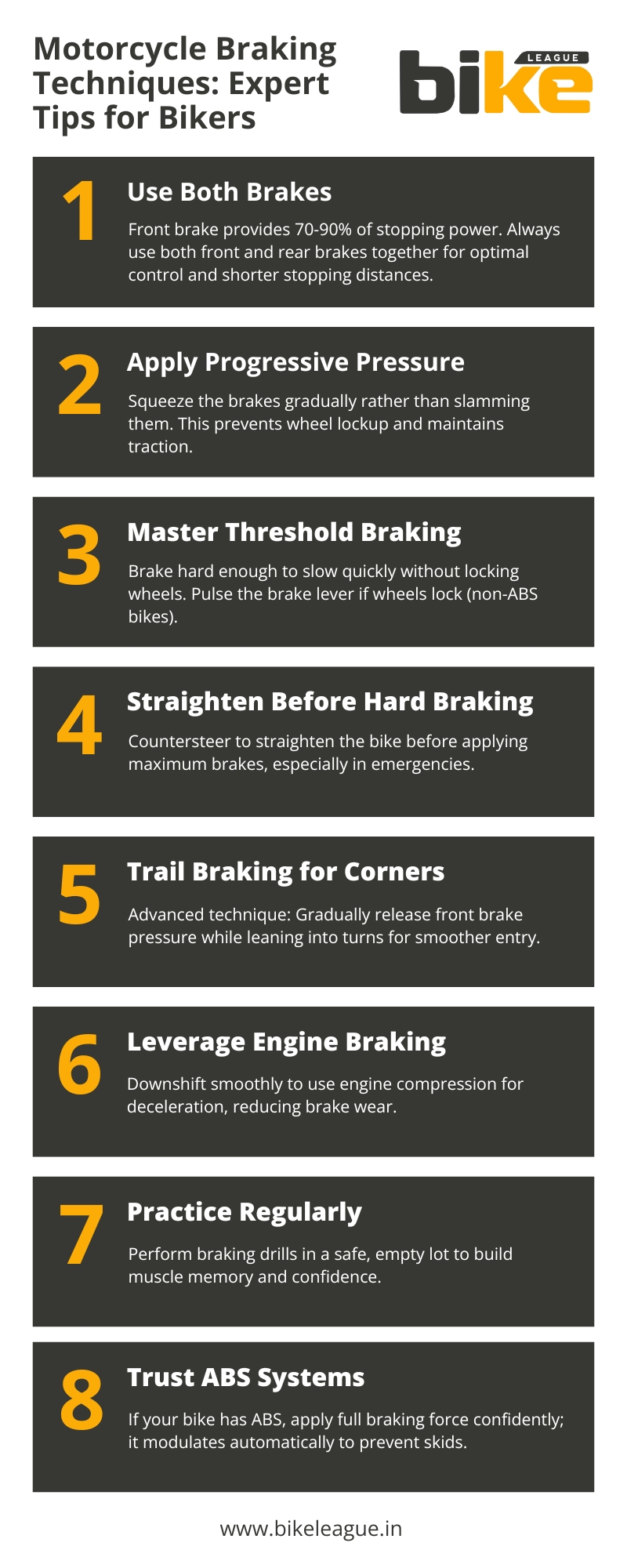
The front brake is responsible for most stopping power, typically around 70%, while the rear brake aids in stability and control, contributing about 30% of the braking force. In emergencies, the front brake’s contribution can increase to 90%, with the rear brake providing the remaining 10%.
2. Weight Transfer
When braking, the motorcycle’s weight shifts forward, increasing the load on the front wheel and enhancing its braking efficiency. This phenomenon, known as weight transfer, is crucial for effective braking.
3. Throttle Control
Proper throttle control is essential before initiating braking. Smoothly reducing throttle input helps stabilise the motorcycle and prepare it for effective braking.
What Are The Braking Techniques For Different Conditions?
| Condition | Braking Ratio (Front/Rear) | Description | Key Focus |
|---|---|---|---|
| Dry Conditions | 60-70% Front / 30-40% Rear | Front brake provides most stopping power due to weight transfer; rear stabilizes | Front dominance, avoid single brake use |
| Wet Conditions | 40% Front / 60% Rear | Gentler touch needed; rear first to avoid skids | Rear brake first, smooth application |
| Sudden/Panic | 90% Front / 10% Rear | Quick controlled stop focusing front brake | Progressive squeeze, pump braking (non-ABS) |
| Steep Descents | 30% Front / 70% Rear | Engine braking primary; rear controls speed | Downshift first, feather rear brake |
| Steep Ascents | 30% Front / 70% Rear | Rear brake holds position against rollback | Rear brake hold, stay in gear |
| With Passenger | 60% Front / 40% Rear | Extra weight increases distances 30-50% | Brake earlier, smoother application |
| Group Riding | Progressive Rear Bias | Coordinated smooth deceleration | Signal first, maintain gaps |
| Curves/Cornering | 80% Front / 20% Rear | Brake before lean-in, trail braking | Straight-line braking first, light trail brake |
1. Braking In Dry Conditions (60% Front And 40% Rear)
The front brake provides the most stopping power in dry conditions, while the rear brake aids stability and control. The optimal braking ratio is 60% front and 40% rear or 70% front and 30% rear. This distribution leverages the increased grip on the front tyre due to weight transfer during braking, while the rear stabilises the motorcycle.
Key Points
- Front Brake Dominance: The brake disc is more prominent in diameter on the front side, so it does the braking duties much more. So, slightly more braking force is given to the front.
- Do not apply the front brake only: Applying only the front brake without using the rear brake causes the motorcycle to shake violently.
- Do not apply the rear brake only: Applying only the rear brake without using the front brake causes the motorcycle to fishtail violently at the bike’s rear end.
2. Motorcycle Braking In Wet Conditions (40% Front And 60% Rear)
Wet conditions significantly reduce tyre traction, making smooth and controlled braking even more critical. Both brakes are essential, but use them with a gentler touch to avoid skidding. The optimal braking ratio is 40% front and 60% rear. The rear brake provides slightly more stopping power in wet conditions, while the front brake aids stability and control.
Key Points
- Gentle braking and slow Speed: Apply the brakes smoothly to avoid locking the wheels. The initial bite is less in wet conditions, so be prepared for a longer stopping distance.
- Apply rear brake first: Apply rear brake first and then only apply the front brake.
- Do not apply the front brake only: Applying only the front brake without using the rear brake causes the motorcycle to skid.
- Do not apply the rear brake only: Applying only the rear brake without using the front brake causes the motorcycle to turn 180 degrees.
3. Motorcycle Braking In Sudden / Panic Situations
The goal is to stop the motorcycle quickly and safely in emergencies. This requires both brakes, focusing on the front brake while avoiding abrupt movements that could lead to skidding.
Key Points
- Do not focus on the colliding object: Do not try to focus on the object you are about to collide with. Instead, focus on the object’s sides, escape areas, and routes.
- Try to hug the fuel tank tightly: Using your knees or thighs, try to hug the tank tightly to stabilise the motorcycle.
- Use pump braking method: In non-ABS bikes, use the pump braking method to reduce the impact of speed and downshift gears. Use a clutch for each gear separately, rather than continuously downshifting, so engine braking is also used.
- Avoid unexpected acceleration using a slight brake lever tweak: We unexpectedly give throttle while braking during panic braking. Adjust the brake lever slightly below the accelerator to avoid this, as shown in the image below.
4. Motorcycle Braking In Steep Descents (30% Front And 70% Rear)
Steep descents like Indian ghat roads increase gravity pull and brake fade risk, demanding engine braking over constant friction. Both brakes assist but prioritise rear for stability on gravel/potholes; gentler inputs prevent washout or overheating. The optimal braking ratio is 30% front and 70% rear. The rear brake manages speed control in low-traction zones, while the front aids straight-line stability.
Key Points
- Engine braking first: Downshift 1-2 gears lower before descent, release throttle for compression—primary slowdown to avoid brake fade.
- Apply rear brake progressively: Feather rear brake for constant low speed (20-30kmph); add light front only on straights.
- Do not apply the front brake only: Applying only the front brake without rear/engine causes front washout or endo on gravel.
- Do not apply constant brakes: Continuous braking without engine cooling leads to pad fade and total loss of stopping power.
5. Motorcycle Braking In Steep Ascents (70% Rear And 30% Front)
Steep ascents shift weight rearward, enhancing rear traction but risking rollback in traffic or stalls. Rear brake holds position effectively; front use is minimal to avoid pitch-forward. The optimal braking ratio is 70% rear and 30% front. The rear brake provides stopping/hold power under load, while the front brake stabilises during slowdowns.
Key Points
- Rear brake hold: Use rear brake to halt or creep uphill; supports weight transfer and prevents rollback on 15%+ grades.
- Engine braking support: Stay in low gear (1st/2nd); throttle off adds compression without full brake reliance.
- Do not apply the front brake only: Applying only the front brake without the rear causes rear wheel lift or instability.
- Do not go neutral: Applying no engine brake in neutral leads to uncontrolled acceleration or clutch abuse on restarts.
6. Motorcycle Braking With A Passenger (60% Front And 40% Rear)
Riding with a passenger shifts weight rearward, increasing stopping distances by 30-50% and risking instability from pillion movement. Both brakes remain essential, but emphasise smoother, earlier application to settle the load and avoid pitching. The optimal braking ratio is 60% front and 40% rear. The front brake provides primary stopping power, while the rear brake enhances stability during weight transfer.
Key Points
- Brake earlier and smoother: Initiate braking 1.5-2x farther than solo to account for added mass; progressive squeeze prevents lurching the passenger forward.
- Apply rear brake more at the end: Increase rear pressure in the final 10-20m to settle rear squat and maintain balance.
- Do not apply the front brake only: Applying only the front brake without the rear causes excessive dive and passenger collision into your back.
- Do not make sudden stops: Abrupt braking without warning causes passenger panic grab, or weight shift, leading to fishtailing.
7. Motorcycle Braking In A Group (progressive Rear Bias)
Group riding demands coordinated deceleration to prevent chain-reaction collisions amid staggered formation and traffic gaps. Both brakes coordinate with signals, prioritising smooth slowdowns over hard stops. The optimal approach uses progressive braking with rear emphasis for control. Rear brake aids pack stability, while the front provides measured power.
Key Points
- Signal before braking: Use left arm signals (point low for hazard) and verbal “slowing/stopping” to alert the pack; maintain 2-4 second gaps.
- Drag rear brake smoothly: Feather rear for gradual deceleration; leader brakes first, others match pace without overlapping.
- Do not brake side-by-side: Riding abreast without gaps causes swerve collisions during sudden stops.
- Do not tailgate during stops: Closing gaps mid-brake leads to rear-end pileups, especially on Indian roads.
8. Braking On Curves And During Cornering
Motorcycle braking on curves demands precise control to manage speed before lean-in, as mid-corner hard braking upsets chassis balance and risks lowsides on India’s twisty ghats or urban turns. Use gentle trail braking—progressively applying the front brake as you enter the curve—to maintain traction without abruptly standing the bike up. Optimal ratio shifts to 80% front and 20% rear, leveraging loaded front tyre grip while stabilising the rear.
Key Points
- Brake before the curve: Slow to entry speed in a straight line using 70/30 front-rear; entering a turn too fast forces run-offs or crashes on potholed bends.
- Trail brake lightly: Ease off the front brake gradually as you lean, matching the brake release to the turn apex—keeps the suspension loaded for stability.
- Do not stab brakes mid-corner: Sudden inputs unload tyres, causing slides; smooth modulation prevents this on gravelly or wet Indian corners.
- Avoid rear brake dominance: Heavy rear mid-turns lift the front or fishtail; use it sparingly to avoid unsettling the chassis during lean.
Additional Tips For Effective Braking In Motorcycles
1. The Two-brake Rule
The front and rear brakes are pivotal in achieving optimal brake control. Riders should apply both brakes simultaneously to ensure braking balance and effectiveness. This synchronised braking approach helps maintain stability and reduce stopping distances.
2. Progressive Braking
Progressive braking involves gradually increasing brake pressure to avoid skidding and maintain control. This technique ensures smoother rides and better bike control. Riders should avoid abrupt braking, especially in emergencies, to prevent loss of grip and stability.
3. Engine Braking
Engine braking involves using the engine’s resistance to slow down the motorcycle. This technique can be instrumental in maintaining control and reducing wear on the brake components.
4. Anti-lock Braking System (ABS)
ABS significantly enhances motorcycle safety by preventing wheel lockup during braking and allowing riders to maintain control, especially on slippery surfaces. ABS is highly recommended for motorcycles with higher displacement and power output.
5. Regular Maintenance
Regularly checking and maintaining brake pads, discs, and fluid levels ensures optimal braking performance. Well-maintained brakes are less likely to fail and provide consistent stopping power.
6. Adaptability To Different Terrains
Different terrains require unique braking approaches. Gravelly paths demand gentle braking to avoid skidding, while wet roads require extra braking distance and cautious application of brakes.
7. Body Position
Maintaining a proper body position, such as keeping the body upright and centred, helps manage the motorcycle’s stability during braking.
8. Practice
Regular practice of braking techniques, especially emergency braking, helps develop muscle memory and improve reaction times. Practising in a safe, controlled environment can significantly enhance a rider’s braking skills.
What Are The Specific Methods For Practising Effective Motorcycle Braking Techniques In India?
Given the unique challenges posed by road conditions, traffic density, and weather, practising effective braking techniques is crucial for motorcycle safety in India. Here are specific methods recommended by experts:
1. Regular Practice In Controlled Environments
Experts strongly advise riders to practice braking techniques regularly in safe, controlled environments. This approach allows riders to develop muscle memory and improve reaction times without the risks of real traffic situations.
2. Scenario-based Practice
It’s essential to practice various braking scenarios that mimic real-world conditions. This includes:
- Emergency braking
- Braking on slopes
- Braking in wet conditions
- Braking on different road surfaces (e.g., gravel, uneven surfaces)
3. Progressive Braking Technique
Practice applying brake pressure gradually to avoid skidding and maintain control. This technique is fundamental in varying road conditions, such as wet or gravelly surfaces.
4. Front And Rear Brake Coordination
Practice using both front and rear brakes simultaneously, understanding that the front brake typically provides about 70% of the stopping power. In comparison, the rear brake contributes around 30%. This ratio can shift to 90% front and 10% rear in emergencies.
5. Engine Braking Practice
Incorporate engine braking into practice sessions. This technique uses the engine’s resistance to slow the motorcycle, helping maintain control and reducing wear on brake components.
6. Body Position And Weight Transfer
Practice maintaining proper body position during braking, keeping the body upright and centred. Learn to shift weight forward during harsh braking to maximise front tyre grip and maintain stability.
7. Abs Familiarization
For motorcycles equipped with Anti-lock Braking Systems (ABS), practice braking in various conditions to understand how the system feels and responds.
8. Wet Weather Braking
Dedicate practice sessions to damp weather conditions, focusing on gentler braking approaches and adjusting the braking ratio to 40% front and 60% rear to prevent skidding.
How Can A Rider Adjust Their Braking Approach For Different Types Of Motorcycles In India?
Different types of motorcycles require adjusted braking techniques due to their varying weight distributions and designs. Here’s how riders can adapt their braking approach based on motorcycle type:
1. Sport Bikes
- These motorcycles are typically front-biased, carrying more weight on the front wheel.
- Riders should use the front brake more aggressively, as it provides the most stopping power.
- Complement front brake usage with the rear brake to maintain balance and control.
- Practice progressive braking to avoid front-end dive and potential loss of control.
2. Cruiser Bikes
- Cruisers tend to be rear-heavy, which affects braking dynamics.
- Apply both brakes, but utilise the rear brake more effectively to reduce stopping distances.
- The rear brake plays a more significant role throughout the braking process than in sport bikes.
- Practice smooth, progressive braking to maintain the bike’s stability.
3. Scooters
- Many scooters in India come with linked braking systems.
- Practice using the front or rear brake lever, understanding that the system automatically applies both brakes.
- This system is particularly effective in maintaining balance and reducing stopping distances.
- Focus on smooth, gradual brake application to maximise the benefits of the linked system.
4. Commuter Motorcycles
- These bikes often have a more balanced weight distribution.
- Practice using both brakes evenly, slightly emphasising the front brake.
- Practice anticipating longer stopping distances for models with drum brakes, especially at the rear.
5. Adventure Bikes
- These motorcycles are designed for varied terrains.
- Adjust braking techniques for different surfaces (e.g., tarmac, gravel, mud).
- Utilise ABS if equipped, but also practice with ABS for off-road scenarios.
6. Touring Bikes
- Given their heavier weight, practice smooth, progressive braking to manage the bike’s momentum.
- Utilise both brakes effectively, emphasising the front brake for maximum stopping power.
- Practice braking with luggage or a pillion to understand how added weight affects braking dynamics.
For all motorcycle types, it’s crucial to adapt braking techniques to Indian road conditions:
- Adjust the braking ratio to 40% front and 60% rear in wet conditions to prevent skidding.
- Use gentler braking with more emphasis on the rear brake on gravel or uneven surfaces for stability.
- In emergencies, use both brakes with a focus on the front brake, avoiding abrupt movements to prevent skidding.
The Most Common Braking Mistakes And Myths In India—and How To Avoid Them
Braking mistakes are surprisingly common among Indian riders, and many stem from long-standing habits or popular myths. Let’s break down some everyday errors and set the record straight so you can ride safer and smarter.
1. Common Braking Mistakes
- Grabbing the Front Brake Suddenly: In a moment of panic—maybe a stray dog darts out, or a pothole appears—some riders slam the front brake hard. This often locks up the front wheel, especially on gravel or loose surfaces, leading to nasty falls. Instead, use a progressive two-finger squeeze on the lever. This gentle, controlled approach can stop you up to 25 meters sooner and help you stay upright.
- Relying Only on the Rear Brake: Many riders, especially those used to older scooters, favour the rear brake. But you’re ignoring the real stopping power! The front brake handles 70–90% of the work because of the way your bike’s weight shifts forward when you stop. Relying just on the rear can double your stopping distance—bad news if a cow or auto suddenly cuts across your path.
- Pulling the Clutch Too Early: If you pull in the clutch right away during a stop, you lose the benefit of engine braking. This means less control, especially at speed breakers or in heavy traffic. Try holding the clutch until you’re nearly at a complete halt.
- Coasting in Neutral on Descents: Rolling downhill in neutral feels easy, but it robs you of engine resistance. On India’s hilly roads, this leads to overheated brakes and dangerous fade—always stay in gear and use engine braking for control.
- Hard Braking Without Modulation: Whether it’s wet, sandy, or slippery (think Kerala monsoon), stomping on the brakes without gentle pressure is a recipe for skids. Always modulate your braking, especially on tricky surfaces.
2. Debunking Popular Myths
- Myth 1: The Rear Brake is Safer for Everyday Use: Not true! The front brake is your main ally. Using only the rear actually makes you more likely to skid, especially in turns. Aim for a 70/30 split—front to rear—for most conditions.
- Myth 2: Avoid the Front Brake on Bad Roads: While it’s smart to be gentle with the front brake on loose surfaces, you shouldn’t skip it altogether. The front brake is effective everywhere—just adjust your pressure based on the road.
- Myth 3: Instantly Pull the Clutch in a Panic: Early clutch use takes away engine braking, making your bike feel unstable. Keep the clutch engaged until you’re almost stopped.
- Myth 4: Lay the Bike Down to Dodge a Crash: This old advice is risky and outdated. It’s much safer to brake hard with the bike upright, especially if you have ABS, rather than deliberately trying to slide.
- Myth 5: Never Brake in a Corner: Actually, trail braking—gently easing off the brake as you enter a turn—can help you control speed and avoid running wide.
3. Quick Fixes For Safer Braking
- Practice emergency stops at 40 km/h in an empty lot every week.
- Check your brake pads for wear and dust each month.
- If possible, choose a bike with ABS (Anti-lock Braking System). ABS can reduce lock-ups by over 30% and help prevent skids.
By becoming aware of these mistakes and myths, you’ll not only ride safer but also more confidently—no matter what Indian roads throw your way.
Faq Related To Motorcycle Braking Techniques
1. Why Is Learning Proper Braking So Important For Indian Riders?
Learning how to brake correctly is essential for staying safe on India’s unpredictable roads. Whether it’s dodging potholes, avoiding stray animals, or dealing with sudden traffic and changing weather, good braking technique gives you more control and peace of mind—no matter where you ride.
2. How Much Should I Rely On The Front And Rear Brakes In Normal Dry Conditions?
On dry roads, your front brake does most of the stopping (about 60–70%), while the rear brake helps keep the bike steady (around 30–40%). Using both at the same time means you’ll stop faster and more safely than if you use just one.
3. What Is Weight Transfer, And How Does It Affect Braking?
When you squeeze the brakes, your bike’s weight shifts forward, pressing down on the front tyre and giving it more grip. That’s why the front brake is so important. But be careful—a sudden yank on the lever can overload the tyre and cause a skid.
4. How Should I Adjust My Braking In Wet Conditions?
When it’s raining, be gentle with the brakes and ride at lower speeds. Try using about 40% front and 60% rear brake. Start with the rear, then add the front smoothly. This helps prevent the wheels from locking up or spinning out on slippery roads.
5. What Is Engine Braking, And When Should I Use It?
Engine braking is when you use lower gears and close the throttle to help the engine slow the bike down. It’s great for going downhill, riding in traffic, or just giving your brake pads a break while keeping better control.
6. How Do I Brake Safely On Steep Descents And Ascents?
On steep downhill roads, shift to a lower gear and use engine braking to control your speed, with about 30% front and 70% rear brake. For steep climbs, use more rear brake (about 70% rear, 30% front) to keep the bike from rolling back. Don’t coast in neutral or rely only on one brake.
7. What Changes When I Brake With A Passenger (pillion)?
When you have a pillion, your bike’s weight shifts back, so it takes longer to stop and balancing can be trickier. Start braking a bit earlier, be extra smooth, and use about 60% front and 40% rear. Avoid sudden stops that could jolt your passenger or throw the bike off balance.
8. How Should I Handle Braking In A Group Ride?
If you’re riding with others, always signal before slowing, leave 2–4 seconds of space, and brake gently, with a bit more focus on the rear brake. Don’t tailgate or ride side-by-side when you’re stopping—this helps everyone avoid pileups and keeps the group safe.
9. What Are The Most Common Braking Mistakes And Myths Among Indian Riders?
Many riders grab the front brake too hard, depend only on the rear, pull the clutch too soon, coast downhill in neutral, or stomp the brakes on poor roads. Myths like “the rear brake is always safer,” “never use the front brake on rough roads,” or “pull the clutch right away if you panic” actually make riding riskier. It’s best to use both brakes together and adjust your style to the conditions.
10. How Can I Effectively Practice Braking Techniques In India?
Practice makes perfect. Find a safe, empty spot and rehearse emergency stops, wet-road braking, and handling slopes or rough surfaces. Work on smooth, progressive braking, coordinating both brakes, using engine braking, maintaining good body position, and, if your bike has ABS, get familiar with how it feels during a hard stop.
Other Related Articles From Bikeleague India
- The ultimate guide to defensive driving for bikers in India
- What is Motorcycle ABS? – Doubts, Queries and FAQ
- 10 Essential electric bike maintenance tips for longevity
- Different types of bike clutch explained
- Ducati Scrambler 2G Full Throttle
Conclusion
Mastering effective braking is more than just knowing which lever to use. It means understanding your motorcycle, adapting to different Indian road conditions, and practising safe habits until they feel natural. Using the right techniques for every situation—whether it’s raining, sunny, in the city, on the highway, riding alone or with a passenger—will greatly improve your safety and confidence.
Keep your brakes in good condition, watch out for common mistakes, and keep practising. With these habits, you’ll be ready for any situation on the road and can enjoy safer, more enjoyable rides.
We’ve covered important details about motorcycle braking techniques in India, including useful tips and techniques. If you have questions, feel free to email us at bikeleague2017@gmail.com or leave a comment below. We’re always happy to help. You can also follow Bikeleague India on our social media accounts.