
Long story short: Adaptive Ride Height (ARH) is a Harley-Davidson suspension feature offered only as a factory option on the Pan America 1250 Special. When you stop, ARH automatically lowers the bike by up to 50mm (about 1 to 2 inches), then raises it back to full height as you ride away. This change does not affect suspension travel, lean angle, or ground clearance while riding. In this article, you’ll learn how ARH works, which sensors and suspension parts it uses, which models have it, and its main pros and cons.
Adventure touring motorcycles have tall seat heights and a strong road presence, but this can make them intimidating for many riders, especially when stopping or moving through traffic. Available only as a factory option on the Pan America 1250 Special, ARH combines that off-road-ready accessibility with everyday performance, without asking riders to trade one for the other.
This feature, only available as a factory option on the Pan America 1250 Special, combines accessibility and performance. In this article, you’ll find out how ARH works, which parts and models are involved, and the main pros and cons of this system.
Key Takeaways
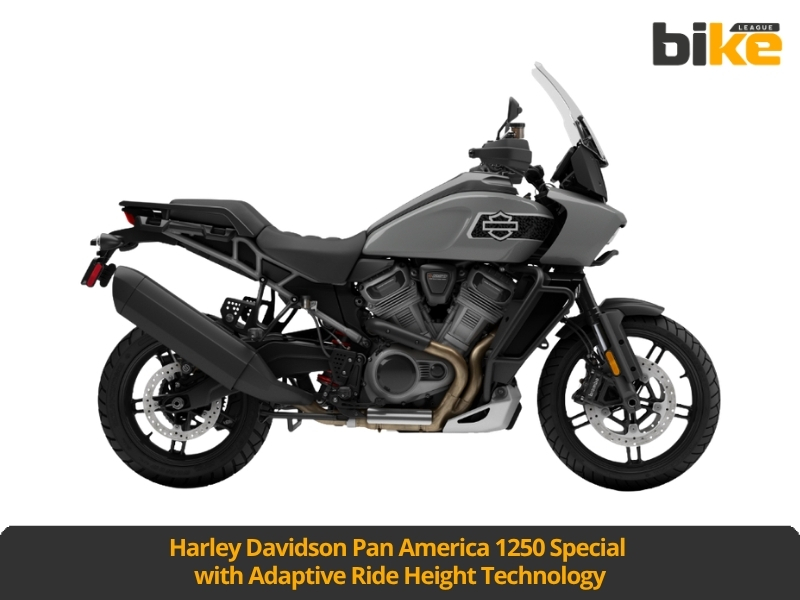
- ARH is an option, not standard equipment. It is available only on the Pan America 1250 Special. That is because the Special already carries the semi-active suspension the system depends on. The standard Pan America 1250 cannot be fitted with it.
- It lowers the bike by up to 50mm (about 1 to 2 inches) at a stop. The exact amount depends on the automatically selected rear preload. The Pan America 1250 Special’s seat height itself is also adjustable between 850mm and 875mm independent of ARH, and the seat rises back to its normal riding height as soon as the motorcycle is moving again.
- Riding dynamics are not compromised. Harley-Davidson states that suspension travel, lean angle, ground clearance, and ride quality remain unaffected while the bike is in motion. The lowering only happens at a stop.
- It works off the same six-axis IMU and sensor set as the rest of the electronics suite. ARH shares its inputs with the semi-active suspension, cornering ABS, and traction control systems. It does not use a dedicated sensor of its own.
- Riders can adjust or disable it. Within Custom ride modes, the rider can change how quickly ARH lowers the bike, or turn the function off entirely.
- Harley was first, but not alone anymore. BMW’s adaptive vehicle height control on the R 1300 GS and Triumph’s Active Preload Reduction on the Tiger 1200 aim to solve the same problem. Each takes its own approach.
What Is Harley-davidson Adaptive Ride Height?
Adaptive Ride Height (ARH) is an electronic suspension feature that changes the motorcycle’s ride height based on whether it is stopped or moving. Harley-Davidson first introduced ARH on the 2021 Pan America 1250 Special, calling it the first system of its kind in the motorcycle industry.
While riding, the suspension keeps the bike at its normal height. This gives you full suspension travel, ground clearance, and the right chassis geometry.
When slowing to a stop, ARH lowers the bike by up to 50mm (about 1 to 2 inches). The drop amount depends on rear preload for the current load. This is separate from the Special’s adjustable seat height, which ranges from 850mm to 875mm. ARH works with any seat height, so more riders can easily put their feet down. Riders get this benefit without sacrificing suspension travel or a permanently low seat height.
The system works only with the Special model’s semi-active suspension. You can’t add it to the standard Pan America 1250, since that version uses a regular, non-electronic suspension and can’t automatically adjust ride height.
How Does Harley-davidson Adaptive Ride Height Work?
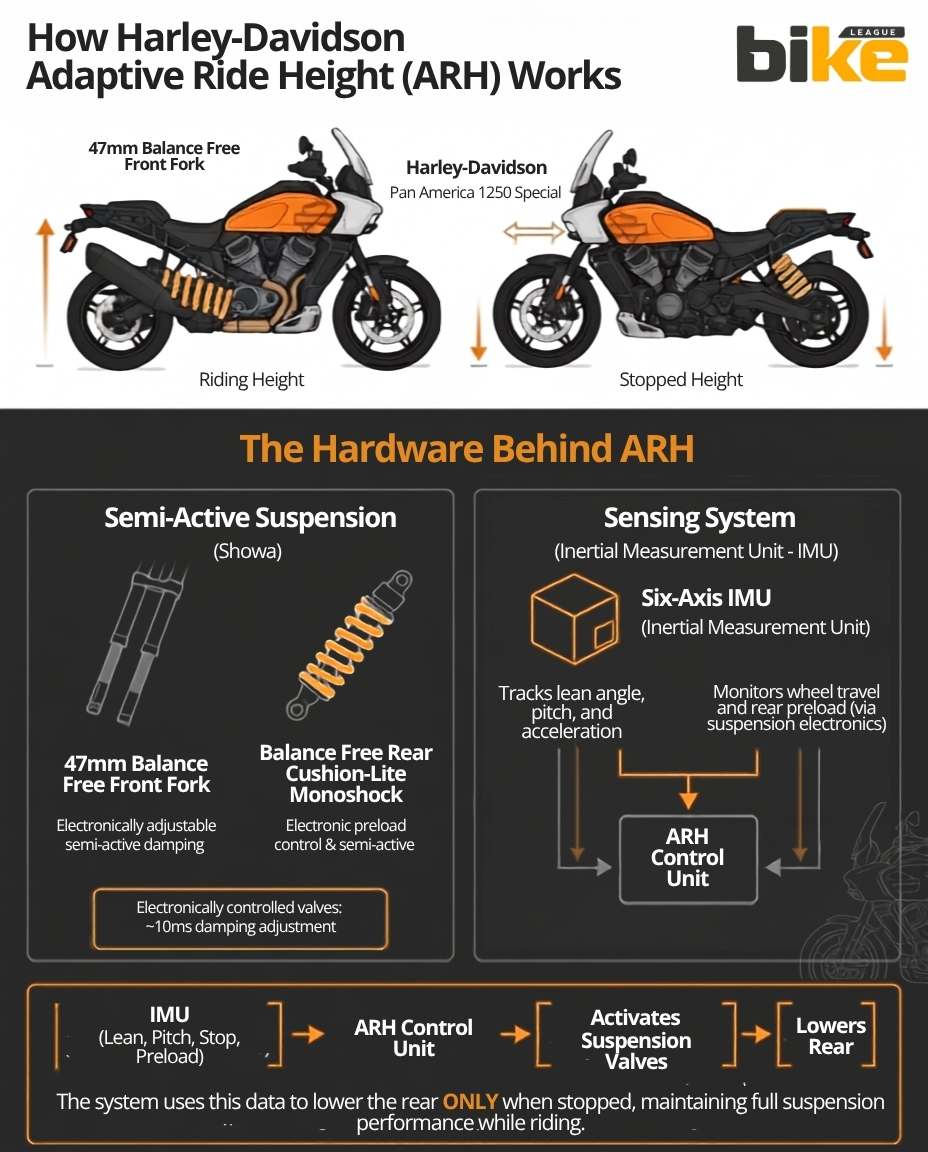
ARH builds on the Pan America 1250 Special’s semi-active suspension from Showa. The bike has a 47mm Balance Free Front fork with semi-active damping and a Balance Free Rear Cushion-lite monoshock with electronic preload and damping control. Both use electronic valves that adjust damping in just 10 milliseconds.
A six-axis Inertial Measurement Unit (IMU), supplied by Bosch, works with this hardware. It is the same unit used for Harley’s cornering ABS, traction control, and drag-torque slip control. The IMU tracks lean angle, pitch, and acceleration. The suspension electronics monitor wheel travel and rear preload. This information tells the system when the bike has stopped and how much preload is set. These are the two things ARH needs to know before lowering the rear.
Step-by-step Operation Of Arh
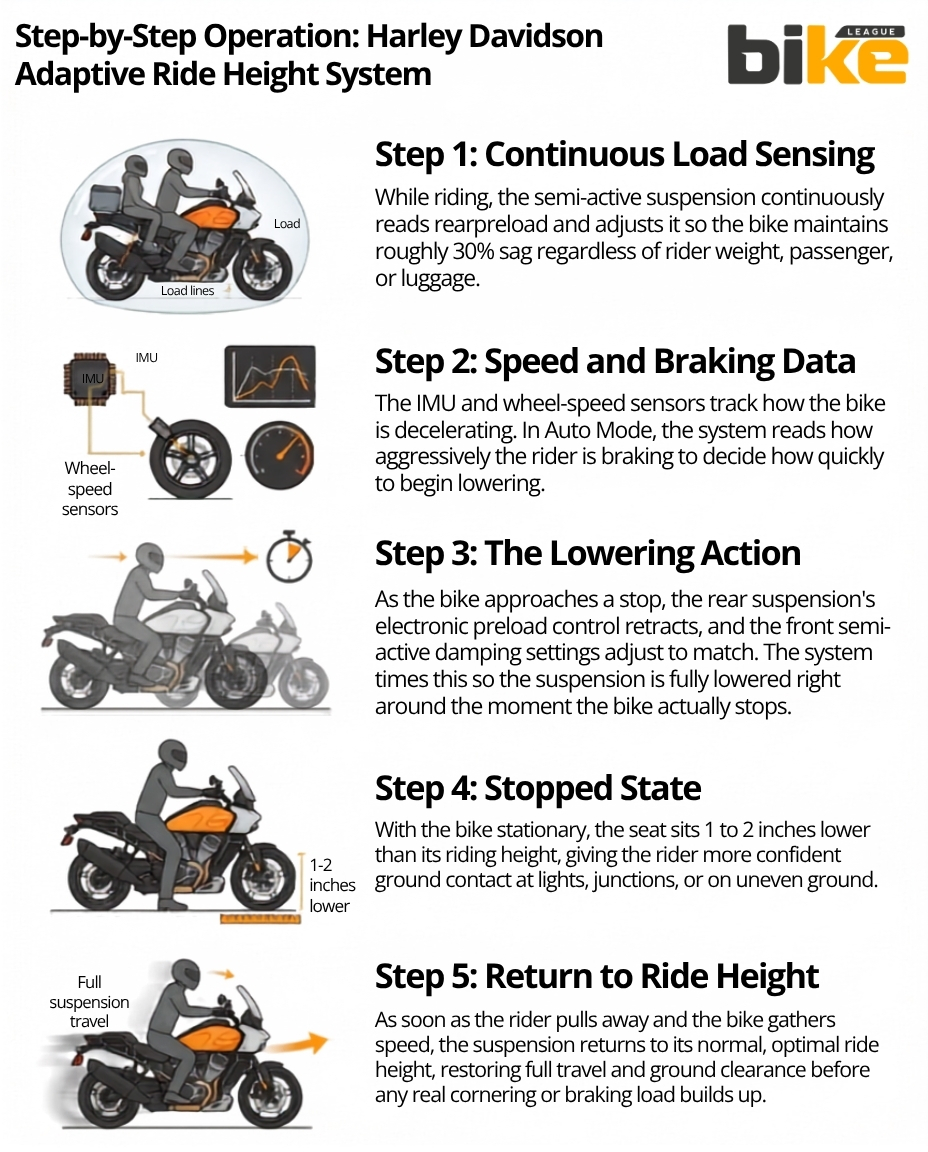
- Step 1: Continuous load sensing. While riding, the semi-active suspension continuously reads rear preload. It adjusts to keep the bike at roughly 30% sag, regardless of rider weight, passenger weight, or luggage.
- Step 2: Speed and braking data. The IMU and wheel-speed sensors track how the bike is decelerating. In Auto Mode, the system reads the rider’s braking aggressiveness. This tells it how quickly to begin lowering.
- Step 3: The lowering action. As the bike approaches a stop, the rear suspension’s electronic preload control retracts. The front semi-active damping settings adjust to match. The system times this so the suspension is fully lowered right around the moment the bike actually stops.
- Step 4: Stopped state. With the bike stationary, the seat sits up to 50mm (about 1 to 2 inches) lower than its riding height. This gives the rider more confident ground contact at lights, junctions, or on uneven ground.
- Step 5: Return to ride height. As soon as the rider pulls away and the bike gathers speed, the suspension returns to its normal, optimal ride height. Full travel and ground clearance are restored before any real cornering or braking load builds up.
Ride Modes On The Pan America 1250 Special
Before looking at ARH’s own settings, it helps to know where they sit within the bike’s broader electronics. The Pan America 1250 Special offers five ride modes: Rain, Road, Sport, Off-Road, and Off-Road Plus. Each adjusts throttle response, traction control, ABS intervention, and suspension behaviour for that riding condition. ARH’s own settings, including its Off-Road and Off-Road Plus tuning described below, work within this same mode structure rather than as a separate system.
Selectable Arh Sub-modes
Harley-Davidson includes four selectable ARH settings instead of just one fixed option:
- Auto Mode: The system judges how aggressively the rider is braking. It times the lowering action so the suspension is fully down right as the bike comes to a stop.
- Custom Mode timing adjustment: Within a Custom ride mode, the rider can adjust how early or late the lowering kicks in relative to the stop.
- Lock at Ride Height: This disables the lowering function altogether. The suspension stays at full ride height even when stationary, which is useful for riders who prefer maximum ground clearance at all times, such as in technical off-road sections.
- Off-Road tuning: In Off-Road and Off-Road Plus modes, the suspension and ARH behaviour is retuned for loose surfaces. Off-Road Plus further increases usable ground clearance for rougher terrain.
Pros Of Harley-davidson Adaptive Ride Height
- Easier footing at every stop. Shorter riders, or anyone handling a fully loaded bike with a passenger, get a lower seat height right when they need it most: at a stop. They lose nothing while riding.
- No compromise while riding. Because the lowering only happens at a stop, suspension travel, lean angle, and ground clearance stay at their full, optimal values once the bike is moving.
- Works automatically. In Auto Mode, the rider does not need to press a button or do anything. The system senses braking and lowers the bike on its own.
- Genuinely broadens who can ride the bike. A tall, heavy adventure bike becomes accessible to a wider range of rider heights than its static seat height figure would suggest.
- Configurable to rider preference. Riders who want the tallest possible stance at all times, such as for technical off-roading, can lock the system at full ride height instead.
- Recognised as a genuine innovation. ARH won Motorcycle.com’s Best Technology award for 2021. It is widely credited as the first system of its kind on a production motorcycle.
Cons Of Harley-davidson Adaptive Ride Height
- Special model and factory-fit option only. ARH is not available on the base Pan America 1250. In markets where it launched as an option, it added to the purchase price, on top of the Special’s own premium over the standard bike.
- Adds electronic complexity. The system depends on the semi-active suspension’s electronic preload and damping valves, the IMU, and wheel-speed sensors. This means there are more parts that could fail or need diagnosis, compared to a regular, mechanically preloaded shock.
- Diagnosis needs Harley’s own tools. As with any electronically controlled suspension, faults are best identified with the manufacturer’s diagnostic equipment. This is done at an authorised dealership rather than by a general mechanic.
- Only solves the stopped-height problem, not overall weight. The Pan America Special still weighs 263 kgs. ARH helps with reach-to-ground at a stop, but it does not make the bike lighter to pick up or manoeuvre at walking pace.
- Rivals have since matched or refined the idea. BMW’s adaptive vehicle height control and Triumph’s Active Preload Reduction mean ARH is no longer the only option for riders shopping this specific feature.
Which Harley-davidson Models Have Adaptive Ride Height Technology In India?
ARH is exclusive to the Pan America 1250 Special, and only as an optional extra on top of that model’s semi-active suspension. It is not available on the standard Pan America 1250, which uses conventional, non-electronic suspension.
| Model | Suspension | ARH Availability | Segment |
|---|---|---|---|
| Harley Davidson Pan America 1250 ST | Conventional (non-electronic) fork and shock | Not available | Adventure Touring |
| Harley Davidson Pan America 1250 Special | Showa semi-active suspension (Balance Free front and rear) | Included, factory-fit | Adventure Touring |
In India, the Pan America Special costs more than the standard model because it includes the required semi-active suspension for ARH. For the latest prices and ARH availability, check with your local Harley-Davidson dealer. Options and on-road pricing may change by year, state, or model.
How Does Adaptive Ride Height (arh) Improve Motorcycle Handling?
Harley-Davidson’s Adaptive Ride Height (ARH) is a semi-active suspension system that automatically changes the bike’s ride height based on whether it’s moving or stopped. It manages this without reducing suspension travel or ground clearance, which is what sets it apart. Here’s how ARH improves handling:
- Full-travel suspension performance at speed: The ride height only drops at low speed or when stopped. This way, you always get full wheel travel and proper geometry when you need control and comfort over bumps.
- Confidence and control at stops: Tall adventure bikes, with seat heights over 31 inches, often make riders stretch for solid footing. While this helps off-road, it can feel intimidating at stops. ARH solves this problem, so riders don’t have to tiptoe or worry about tipping over at lights or on uneven ground.
- Adjustable damping modes: Bikes with ARH let you choose different damping profiles and adjust ride height. One setting softens the ride for comfort, another balances for everyday use, and a sportier mode increases damping for spirited riding. There are also terrain-specific settings, such as one that softens initial damping for big bumps and reduces kickback on rough ground.
- Automatic, not manual: The system lowers the seat on its own as the bike slows down and brings it back to full suspension travel once you’re moving again. You don’t need to press any buttons or make adjustments. This makes the handling benefit seamless, so you don’t have to remember to set anything yourself.
- Configurable behavior: Riders can fine-tune when the lowering happens. ARH has three modes: Short/Long Delay, Auto, and Locked. The delay mode keeps the bike at full height until it fully stops. Auto mode mixes an immediate drop with gradual lowering below 10 mph, depending on braking.
Can Adaptive Ride Height Be Retrofitted On Existing Motorcycles?
No, ARH is not something you can add to an existing bike, whether it is an older Harley or another brand. It is not a retrofit-friendly accessory. Here are the reasons why:
- ARH requires the electronically adjustable semi-active suspension that comes on the Pan America 1250 Special. For the tech to work, it needs the electrically adjustable semi-active suspension found on the Special. A standard (non-semi-active) fork and shock don’t have the actuators, sensors, or ECU integration ARH depends on.
- Models equipped with ARH have wires coming out of the top of both left and right fork assemblies. This distinguishes them from bikes with the regular semi-active suspension, which only has wiring on the left fork leg. So it’s built around specific fork hardware, not just a software toggle.
- The semi-active suspension itself uses sensor data across the motorcycle to automatically control damping in real time. This means ARH is layered on top of an already-integrated electronic suspension and rider-safety sensor suite, not a standalone module.
Because ARH is built around specific fork and shock hardware, dedicated wiring, and factory-set sensor integration, there is no aftermarket kit or dealer-installed retrofit available. This applies to older Pan Americas without ARH, as well as other Harley models such as the Street Glide, Road King, or Sportster. If you want a lower ride height at a stop on a bike without ARH, the usual options are a lowering kit, shorter shock, adjustable or lower seat, or aftermarket suspension revalving. None of these options can copy ARH’s ability to stay tall while riding and lower only at a stop, since they just set a fixed ride height.
What Maintenance Is Required For Adaptive Ride Height Mechanisms?
ARH does not need special scheduled maintenance. It follows the bike’s regular suspension and electrical service intervals. Here are a few key points:
- No dedicated service schedule: There’s no “replace this ARH part every X miles” item. It’s covered by routine fork/suspension checks at normal service intervals.
- Check it after any dealer service: This is the big one. Wiring near the forks can get disturbed during other repairs, and miswiring is a known cause of ARH acting up. Always verify it still lowers and raises properly after service.
- Watch for symptoms, not warning lights: If it fails, you’ll usually notice through behaviour, such as not lowering at a stop, dropping abruptly, or being slow to pump back up, rather than a dashboard alert.
- Diagnostics centre on the solenoid valve: That’s the key component managing pressure in the system. It’s the first thing technicians check when troubleshooting.
- Damping is adjustable, but that’s tuning, not upkeep: You can tweak rebound/compression to suit your weight or riding style, but forcing the adjusters past their stops can damage them.
How Does Arh Compare With Rival Systems?
Harley-Davidson was first to bring an automatic ride-height-lowering system to a production motorcycle. Since then, the idea has spread across the adventure-touring segment, with each brand taking a slightly different approach:
| Brand & System | Approach | Notes |
|---|---|---|
| Harley-Davidson Adaptive Ride Height | Lowers rear preload (and matching front damping) by up to 50mm (1-2 inches) at a stop, restores at speed | First to market, on Pan America 1250 Special only |
| BMW Adaptive Vehicle Height Control (R 1300 GS) | Reduces seat height during slow travel and at a stop, separate from spring-rate-changing Dynamic ESA function | Introduced as part of BMW’s newer electronic suspension package |
| Triumph Active Preload Reduction (Tiger 1200) | Reduces rear preload at low speed and at a stop to lower the seat | Positioned as Triumph’s answer to the same accessibility problem |
All three systems aim to keep the suspension tall for riding, but lower the bike when the rider needs to put their feet down. Each brand uses different suspension hardware and methods to trigger the lowering.
Is Adaptive Ride Height Worth Paying For?
Deciding if ARH is worth the extra cost depends on how comfortable you feel putting your feet down on a tall adventure bike. Here are some points to consider.
- Worth it if you’re not fully flat-footed on the standard Special. The Pan America 1250 Special’s seat height already adjusts between 850mm and 875mm without ARH. If that still leaves you on your toes at a stop, especially with a passenger or luggage aboard, ARH’s extra drop closes that gap without asking you to trade away ground clearance while riding.
- Worth it for stop-and-go city riding. Indian traffic means frequent stops in tight, crowded conditions where confident footing matters more than outright ground clearance. Riders who use the Pan America mainly for commuting or city touring get the most out of ARH day-to-day.
- Skip it if you’re already comfortable on the standard Special. Tall riders who can flat-foot the bike don’t gain much from ARH. The option adds cost and complexity for a benefit they may rarely notice.
- Skip it if technical off-roading is the priority. Off-road riders usually run full ride height and use the Lock at Ride Height setting. For this riding style, ARH is easy to leave switched off and may not be worth the extra cost.
- Factor in the cost as a percentage of an already premium bike. ARH is an added cost on top of the Special’s own premium over the standard Pan America 1250. Against the total on-road price, it’s a small fraction, but it’s still worth confirming the current figure with a dealer, since factory options can change by year and market.
The verdict: ARH is worth the extra cost if it helps you go from tiptoeing at stops to standing flat-footed, especially for shorter riders or those who often ride with a passenger in heavy traffic. If you’re already comfortable on the standard Special or mostly ride off-road with the system locked out, you may not need it.
Myths And Misconceptions About Adaptive Ride Height
1. Myth: Arh Is Available On Every Pan America.
Reality: It is a factory option available only on the Pan America 1250 Special. This is because it depends on that model’s semi-active suspension hardware.
2. Myth: Arh Reduces Suspension Travel Or Ground Clearance While Riding.
Reality: Harley-Davidson states that travel, lean angle, and ground clearance remain unaffected once the bike is in motion. The lowering effect only applies at a stop.
3. Myth: Arh Is The Same As A Low Seat Kit Or Lowering Links.
Reality: A static lowering kit permanently reduces travel and ground clearance. ARH dynamically and automatically adjusts its height, restoring full geometry the moment the bike moves.
4. Myth: The Rider Has No Control Over It.
Reality: Riders can adjust the timing of the lowering action in Custom modes, or disable it entirely with the Lock at Ride Height setting.
5. Myth: Arh Is Just A Marketing Name For Ordinary Semi-active Suspension.
Reality: Semi-active suspension (adjusting damping and preload in real time) is the foundation ARH is built on. ARH itself is the specific function that changes ride height at a stop, a separate, additional behaviour.
Frequently Asked Questions About Adaptive Ride Height
1. What Does Arh Stand For?
ARH stands for Adaptive Ride Height, Harley-Davidson’s name for the automatic ride-height-lowering system on the Pan America 1250 Special.
2. How Much Does Arh Lower The Bike?
It lowers the motorcycle by up to 50mm (approximately 1-2 inches) when stopped. The exact amount depends on the rear preload automatically selected for the current load. This is separate from the Special’s own adjustable seat height, which ranges from 850mm to 875mm.
3. Can I Add Arh To A Standard Pan America 1250?
No. ARH requires the Pan America 1250 Special’s semi-active suspension hardware, which the standard model lacks.
4. Does Arh Affect Handling Or Ground Clearance While Riding?
No. Harley-Davidson states that suspension travel, lean angle, ground clearance, and ride quality remain unaffected while the bike is in motion. Lowering occurs only at a stop.
5. Can Arh Be Turned Off?
Yes. The Lock at Ride Height setting disables the automatic lowering, keeping the suspension at full ride height even when stationary.
6. Is Harley-davidson The Only Brand With This Kind Of System?
No longer. BMW’s adaptive vehicle height control on the R 1300 GS and Triumph‘s Active Preload Reduction on the Tiger 1200 address the same accessibility problem, each with its own system.
7. Does Arh Need Special Maintenance?
Routine servicing is unchanged. Any fault in the system should be diagnosed at an authorised Harley-Davidson dealership using their diagnostic tools, since it’s an electronically controlled function.
Glossary Of Technical Terms Used In This Article
- Adaptive Ride Height (ARH): Harley-Davidson’s system that automatically lowers the Pan America 1250 Special by up to 50mm (1-2 inches) at a stop and restores full ride height once moving.
- Semi-Active Suspension: A suspension system that electronically adjusts damping (and, in some cases, preload) in real time in response to riding conditions, rather than staying at one fixed setting.
- IMU (Inertial Measurement Unit): A six-axis sensor unit, supplied by Bosch on the Pan America, that tracks lean angle, pitch, and acceleration, feeding data to the suspension, ABS, and traction control systems.
- Preload: The initial compression set on a spring before it starts absorbing bumps; adjusting it changes ride height and how the suspension reacts to load.
- Damping: The control of how quickly a suspension spring compresses and rebounds, which affects ride comfort and stability.
- Sag: How much the suspension compresses under the bike and rider’s weight at rest, used as a reference point for correct suspension setup.
- Custom Ride Mode: A rider-configurable mode combining preferences for throttle response, engine braking, traction control intervention, and suspension behaviour, including ARH timing.
Sources
- Harley Davidson Pan America 1250 Special Official India page — seat height range (850mm–875mm)
- Autocar India: Harley-Davidson Pan America 1250 price in India revealed — ARH drop figure (up to 50mm)
- Adventure Motorcycle Magazine: Harley-Davidson Pan America Review — Bosch six-axis IMU
Other Related Links From Bikeleague India
- Motorcycle Cruise Control – All you need to know
- Motorcycle Suspension Settings for Indian Roads: Ride Like a Pro
- Harley Davidson Street Glide
- Kabira Mobility
- Harley Davidson Pan America 1250 Special
Conclusion
Adaptive Ride Height addresses a common problem for adventure motorcycles. It keeps the tall suspension and ground clearance needed for off-road riding, while also making it easier for shorter or less confident riders to reach the ground at stops.
By lowering the Pan America 1250 Special only when stopped and raising it again as soon as you start moving, Harley-Davidson gives riders both advantages without any compromise.
ARH is still an optional feature only for the Special model. BMW and Triumph now offer similar systems. As the first system of its kind on a production motorcycle, ARH set the standard that other adventure-touring bikes are now following.
If you have any questions, email us at bikeleagueindia@gmail.com. We’re here to help. You can also follow us on social media for more updates from Bikeleague India.