
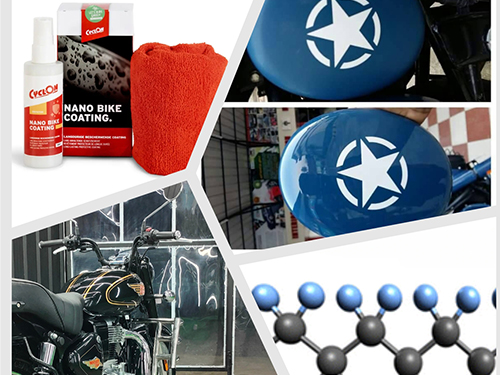
Long story short: In short, nano coating for bikes is an advanced technology that helps your bike look its best. It gives a shiny, easy-to-clean finish that repels water and resists scratches, keeping your bike looking new wherever you ride. This guide explains nano bike coating, compares it to other coatings, and covers its main advantages and disadvantages.
Key Takeaways
- Nano coating is a cutting-edge technology designed to take your bike’s appearance to the next level.
- Nano ceramic coatings protect against UV rays, scratches, and dirt, enhance gloss, ease cleaning, and boost resale value.
- Nano coatings for bikes can be costly, require expert application, and have limited protection. They need maintenance, may cause water spots, and risk the use of non-genuine products.
- Nano-coated bikes require gentle cleaning, manual washes, regular checks, and reapplication. Proper storage and avoiding harsh conditions help maintain the coating’s effectiveness.
- Experts endorse nano coatings for their protection and longevity, while some users question their need for new bikes. Despite the cost, many view them as a worthwhile investment, stressing the importance of quality products.
Introduction
Nano-coating technology is changing the way we protect and care for our bikes. It works by adding a very thin layer of tiny materials to the bike’s surface, which improves its protection and performance.
Nanocoatings help motorcycle owners keep their bikes in great condition. These coatings make the surface repel water and dirt, so grime and moisture slide off easily. This protects the bike’s frame and components from the weather and makes cleaning simple.
What Is The Difference Between Nano, Ceramic, And Teflon Coating For Bikes In India?
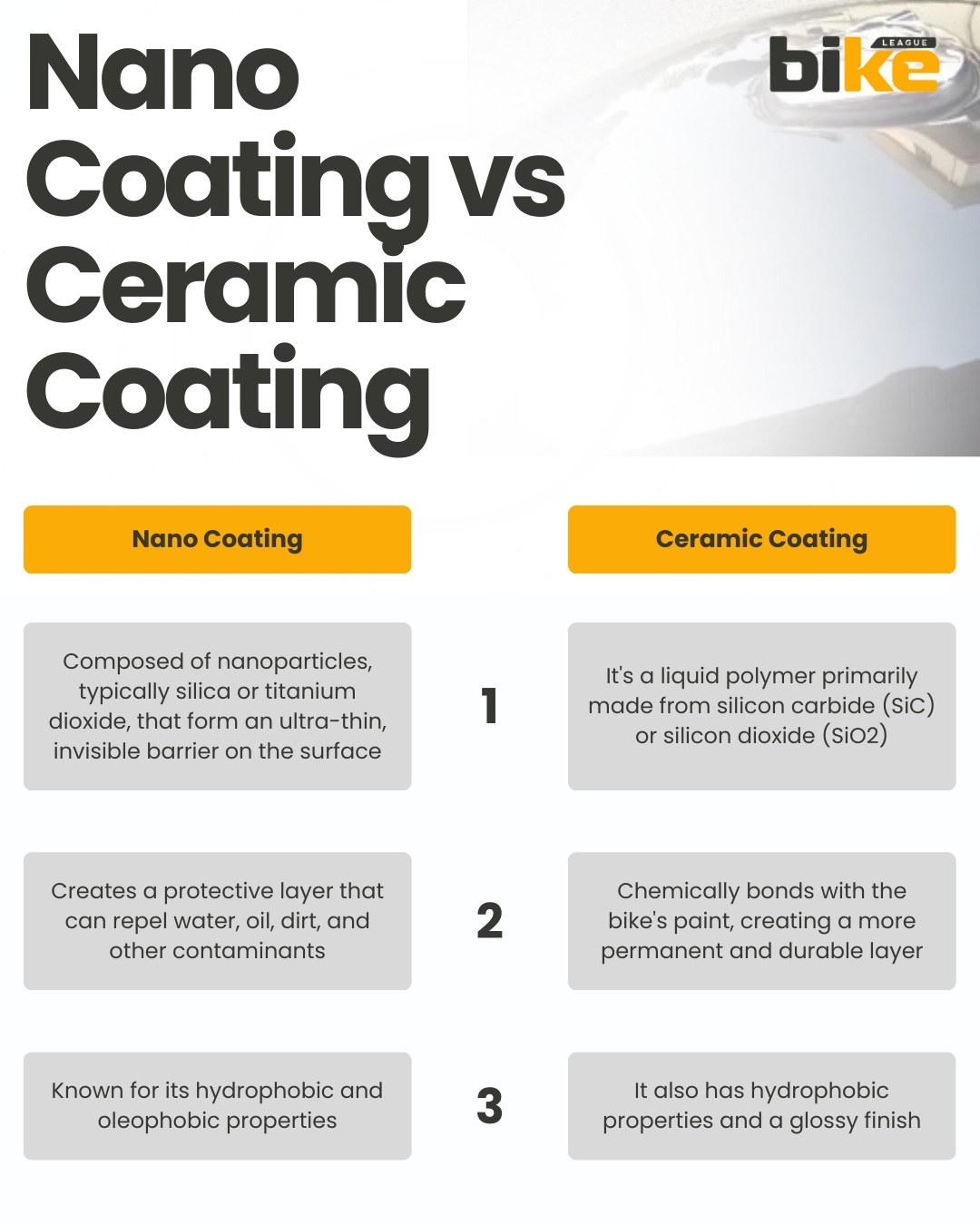
Nano Coating
- Composed of nanoparticles, typically silica or titanium dioxide, that form an ultra-thin, invisible barrier on the bike’s surface.
- Creates a protective layer that can repel water, oil, dirt, and other contaminants.
- Known for its hydrophobic and oleophobic properties.
Ceramic Coating
- Often referred to as nano-ceramic coating, it’s a liquid polymer primarily made from silicon carbide (SiC) or silicon dioxide (SiO2).
- Chemically bonds with the bike’s paint, creating a more permanent and durable layer.
- It also has hydrophobic properties and a glossy finish.
Teflon Coating
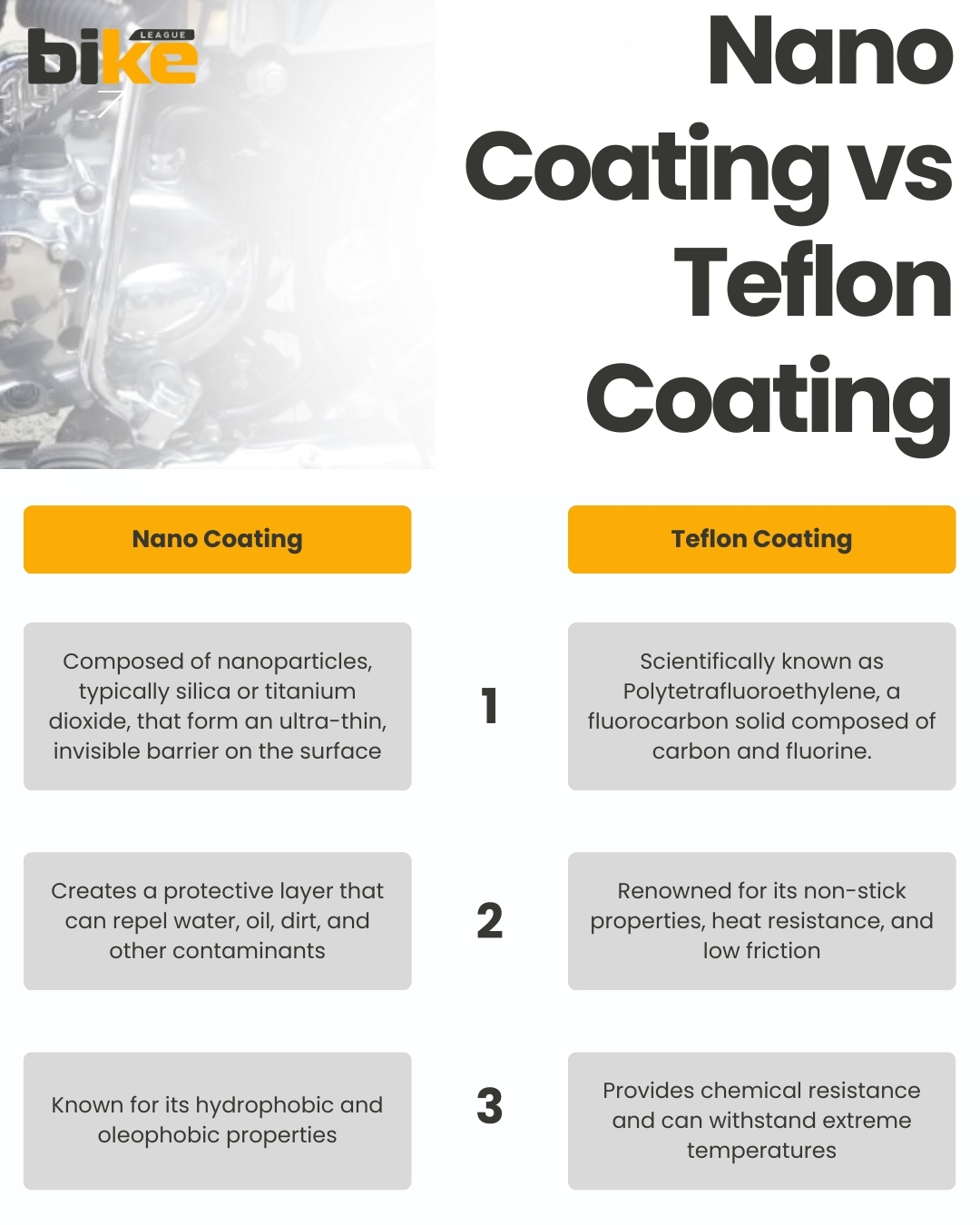
- Scientifically known as PTFE (Polytetrafluoroethylene), a fluorocarbon solid composed of carbon and fluorine.
- Renowned for its non-stick properties, heat resistance, and low friction.
- Provides chemical resistance and can withstand extreme temperatures.
Quick Comparison Table
| Feature | Nano Coating | Ceramic Coating | Teflon Coating (PTFE) |
|---|---|---|---|
| Composition | Nanoparticles (silica/titanium dioxide); ultra-thin barrier | Liquid polymer (SiC/SiO2); nano-ceramic variant | Fluorocarbon solid (carbon/fluorine) |
| Key Properties | Hydrophobic/oleophobic; repels water/oil/dirt | Hydrophobic; glossy, permanent chemical bond | Non-stick, low friction, heat/chemical resistance |
| Durability/Bonding | Thin, invisible layer; less permanent | Chemically bonds to paint; highly durable | Surface-applied; good for high temps but wears faster |
| Best For (India) | Easy cleaning, minor protection in daily use | Long-term UV/scratch resistance in harsh weather | Heat-prone rides, chains/gears; less for paint |
What Is The Step-by-step Application Process Of Nano Coating For Bikes?
Applying a nanocoating to bikes involves several careful steps to ensure it works well and lasts.
Step 1: Initial Cleaning
1. Thorough Wash:
- Use a high-quality bike shampoo to remove all dirt, grease, and residues.
- Clean all areas, including hard-to-reach spots, using bike-specific cleaners and brushes.
2. Degreasing:
Apply a degreaser to remove grease or oil residues, especially around the chain and gear areas.
3. Drying:
Dry the bike completely using a microfiber cloth to prevent water spots.
Step 2: Surface Preparation
1. Decontamination:
Use a clay bar or decontamination product to remove stubborn contaminants like tar, bugs, or iron fallout.
2. Preparation Spray:
Apply a preparation spray or carbon-safe degreaser to ensure the surface is free from oils or residues.
Step 3: Paint Correction (if Necessary)
If the bike’s paint has scratches, swirl marks, or signs of oxidation, use a machine polisher and the appropriate polishing compounds to address them.
Step 4: Application Of Nano Coating
1. Product Selection:
Choose a high-quality nano coating product suitable for bikes, ensuring it’s safe for materials like carbon, aluminium, or titanium.
2. Application:
- Apply the coating using a microfiber cloth or an applicator sponge.
- Work in small sections to ensure even coverage across all bike parts, including the frame, rims, and handlebars.
Step 5: Curing
The coating needs to cure for a specific period, ranging from a few minutes to several hours, depending on the product.
Step 6: Final Buffing
Once the coating has cured, gently buff the surface with a clean microfiber cloth to remove any extra product and give the bike a polished look.
Pros Of Nano Coating For Bikes In India
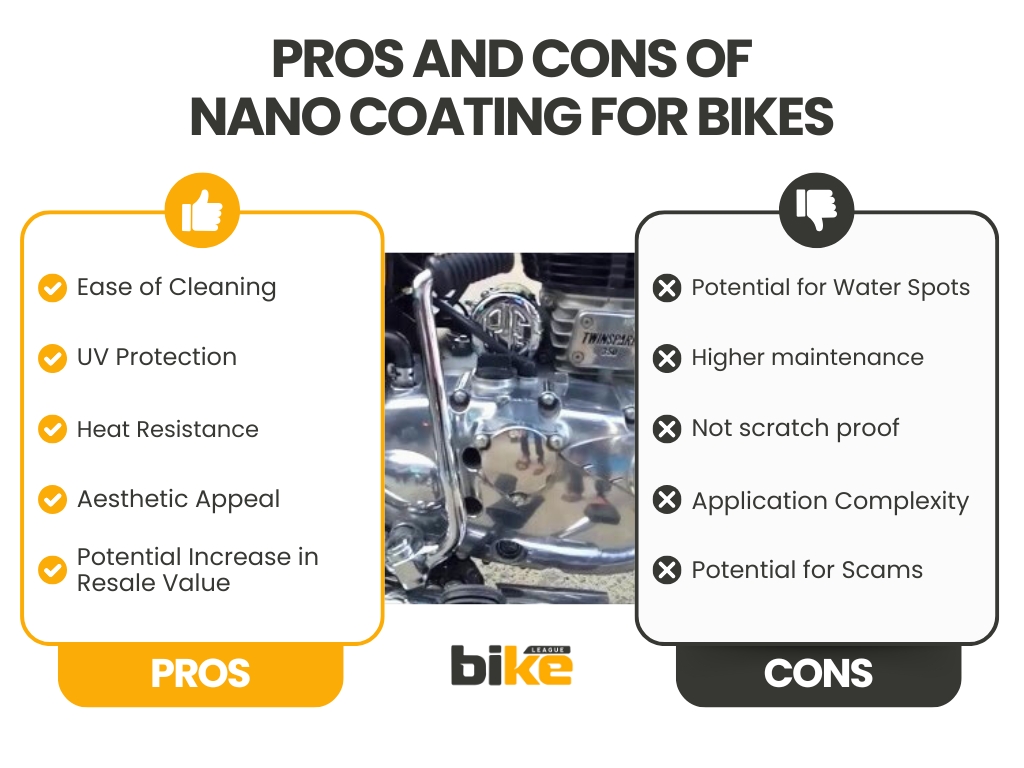
- Enhanced Protection: Nano ceramic coatings provide a robust protective layer that shields the bike’s paint from UV radiation, micro scratches, and environmental contaminants like dirt and salt.
- Durability: These coatings are known for their longevity, often lasting several years with proper maintenance.
- Aesthetic Appeal: Nanocoatings enhance the bike’s visual appeal by providing a glossy finish that highlights the bike’s features.
- Ease of Cleaning: Nano coatings’ hydrophobic properties make it easier to clean the bike, as water and dirt are less likely to adhere to the surface.
- Potential Increase in Resale Value: A well-maintained bike with a nanocoating can have a higher resale value due to its preserved appearance and protection against wear and tear.
- UV Protection: Nanocoatings offer excellent protection against UV rays, which is crucial in India due to the intense sunlight that can cause fading and discolouration of bike surfaces.
- Heat Resistance: Given the high temperatures in many parts of India, the heat resistance offered by nanocoatings is a significant benefit.
Cons Of Nano Coating For Bikes In India
- High Initial Cost: Applying nanocoatings can be expensive, especially when done by professionals.
- Application Complexity: Proper application of nano coatings requires skill and precision. It is often recommended that professionals apply it to ensure even coverage and avoid potential health risks associated with improper handling of nanoparticles.
- Health and Safety Concerns: Nanocoatings, particularly those containing SiO2 particles, can pose health risks if inhaled or absorbed through the skin. Applying these coatings in a controlled environment with appropriate safety gear is crucial.
- Limited Protection Scope: While nano coatings offer excellent protection against certain elements, they do not make the bike scratch-proof or protect against all types of damage, such as fire burns or severe impacts.
- Potential for Scams: There is a risk of encountering non-genuine products or services, which may not provide the expected level of protection or durability. It is essential to choose reputable brands and service providers.
- Maintenance Requirements: Despite their protective qualities, nanocoatings require regular maintenance to ensure longevity. This includes proper washing techniques and the use of specific products to maintain the coating, which might not be feasible for all bike owners.
- Potential for Water Spots: Nanocoatings can make water spot formation easier. In areas with hard water, common in many parts of India, this can be a significant issue, as the minerals in the water can leave marks on the coating.
What Are The Pros, Cons, Costs, Or Risks Of Diy Vs. Professional Nano Coating For Bikes In India?
If you enjoy tinkering with your bike and want to save some cash, a DIY nano-coating might appeal to you. It’s affordable—kits run from ₹1,000 to ₹6,000—and gives you the satisfaction of doing it yourself. That said, professionals usually deliver longer-lasting results, especially with India’s tough climate. Pro jobs cost more (₹5,000–15,000), but you’re less likely to face problems from mistakes during the application.
Diy Pros And Cons
DIY suits tech-savvy riders with garage access, using kits like Super Ceramic or Turtle Wax for quick application.
- Pros: Saves 70-90% on costs (₹1,000-6,000 total including prep tools); flexible scheduling; good hydrophobics if applied correctly, lasting 6-24 months.
- Cons: High failure risk from streaks or uneven layers without pro prep; shorter lifespan (6-12 months in monsoons); no warranty.
Professional Pros And Cons
Professionals ensure even bonding with full decontamination, ideal for premium bikes.
- Pros: Lasts 2-5 years with 9H hardness against UV/pollution; includes warranty and paint correction; lower long-term maintenance.
- Cons: Higher upfront cost (₹5,000-15,000); scheduling downtime; potential overpricing by uncertified shops.
Cost Breakdown
If you’re doing it yourself, expect to pay as little as ₹1,149 for a basic kit that’ll handle your whole bike. But remember, you’ll also need a few extras—like a clay bar, isopropyl alcohol (IPA), or a polisher—which might add another ₹500 to ₹2,000. You can pick these up easily on Amazon or IndiaMart.
| Aspect | DIY | Professional |
|---|---|---|
| Kit/Service | 1,000-6,000 | 5,000-15,000 |
| Prep Tools | 500-2,000 | Included |
| Longevity | 6-24 months | 2-5 years |
Prefer to hand things over to the pros? Professional detailing shops usually charge anywhere between ₹5,000 and ₹15,000 per bike. The price depends on the coating brand (think Ceramic Pro and other premium options) and whether they’re doing a full prep and polish before application.
A Quick Comparison
If you’re after long-lasting durability—especially for touring bikes that see all kinds of weather—professionals are hard to beat. But if you’re budget-conscious and enjoy learning about your bike as you go, the DIY route can be a rewarding project.
| Factor | DIY | Professional |
|---|---|---|
| Durability | 6-24 months, high wear risk | 2-5 years, chemical/UV shield |
| Cost Efficiency | Low initial, high redo risk | Higher initial, fewer reapplies |
| Skill Needed | Advanced prep/timing | None, expert handling |
| Warranty | Rarely | 2-5 years common |
What Are The Maintenance Requirements For Nano-coated Bikes?
Taking care of your bike’s nanocoating is important if you want it to last and work well. Here are the main things you should do:
1. Gentle Cleaning
Use mild detergents to clean the bike, as harsh chemicals can degrade the coating over time. Employ soft cloths or sponges to avoid scratching the coating. Abrasive materials can damage the nanolayer, reducing its effectiveness.
2. Avoid Automatic Washes
It’s better to clean your bike by hand rather than use automatic car washes, which often use rough brushes that can damage the coating.
3. Regular Maintenance Checks
Check your bike once a year to look for any signs of wear or damage to the coating.
4. Reapplication Of Coating
You may need to reapply the nanocoating from time to time, depending on how much you use your bike and the conditions it faces.
5. Proper Storage
Keep your bike in a dry, sheltered place to protect it from harsh weather, which can accelerate coating wear.
6. Avoid Harsh Conditions
Even though nano coatings protect your bike well, keeping it out of extreme weather will help the coating last longer.
Which Are The Recommended Brands And Products For Nano Coating?
Several brands stand out in the Indian market for their quality and performance in nano coating applications for bikes:
Nano Coatings Vs. Traditional Wax/sealant Comparison
Nanocoating offers several benefits compared to using traditional wax or sealants on bikes:
1. Durability
Nanocoating offers long-lasting protection, often several years, compared to traditional wax or sealants that typically last from a few weeks to a few months.
2. Protection Level
Nanocoatings strengthen bikes by chemically bonding to them, offering superior protection against UV rays, dirt, and minor scratches.
3. Hydrophobic Properties
Nanocoatings have excellent hydrophobic and oleophobic properties, repelling water and oil-based substances. This helps keep the bike cleaner and reduces maintenance.
4. Aesthetic Enhancement
Nanocoatings give bikes a glossy finish that makes them look sleek and well-cared-for.
5. Corrosion Resistance
Nano coatings have been shown to offer better performance in harsh environmental conditions, providing excellent corrosion resistance.
6. Maintenance Requirements
Nano coatings don’t need to be maintained as often as regular wax or sealants, but applying them is more complicated and may need to be done seasonally.
7. Cost Considerations
Nanocoatings cost more initially, but they can save money in the long run because they last longer and require less maintenance.
8. Expert Opinions And User Reviews
Most experts and users in India have a positive view of nanocoatings for bikes, though there are a few things to keep in mind:
9. Effectiveness
Nano coatings are widely recognised for their superior protection and longevity compared to traditional methods.
10. User Skepticism
Some users express scepticism about the necessity of coatings for new bikes, suggesting that colours do not fade quickly and that such coatings might be more of a dealer tactic to increase sales.
11. Cost-benefit Analysis
While the initial cost of nanocoatings is higher, many users and experts consider it a worthwhile investment due to the long-term benefits of enhanced protection and reduced maintenance.
12. Product Quality
Users emphasise the importance of choosing high-quality nanocoating products, as cheaper options may not deliver the expected benefits.
| Aspect | Nano Coating | Traditional Wax/Sealant |
|---|---|---|
| Durability | Several years | Few weeks to months |
| Protection Level | Chemically bonds; superior vs UV/dirt/scratches | Surface-level only |
| Hydrophobic Properties | Excellent hydrophobic/oleophobic | Moderate water beading |
| Aesthetic Enhancement | Glossy, sleek finish | Temporary shine |
| Corrosion Resistance | Excellent in harsh conditions | Limited |
| Maintenance Requirements | Less frequent, complex application | Frequent reapplication |
| Cost Considerations | Higher initial, long-term savings | Lower initial, higher over time |
| Aspect | Viewpoint |
|---|---|
| Effectiveness | Superior protection/longevity vs traditional |
| User Skepticism | Unnecessary for new bikes; dealer upsell |
| Cost-Benefit | Worthwhile long-term investment |
| Product Quality | Choose high-quality; avoid cheap fakes |
What To Do If Something Goes Wrong (e.g., Streaks, Uneven Coating, Or Premature Wear) In Nano Coating For Bikes?
If you notice streaks, uneven shine, or that your bike’s nano coating seems to be wearing off too soon, don’t panic—it happens more often than you might think, especially in India’s humid, dusty climate. The good news is, you can often fix these issues without too much trouble. Most problems can be solved by giving the surface a good clean, gently polishing it, or, if needed, having a professional redo the coating.
1. Identify The Issue
Streaks can appear if you used too much product, let the bike dry in direct sunlight, or didn’t buff it properly. Uneven patches might be from leftover oils or dirt left over from the coating, and early wear is usually down to harsh cleaning products, automatic washes, or just riding through a lot of muck. Want to check if the coating’s still working? Spray some water on the bike—if it doesn’t bead up, the protection’s probably gone.
2. Immediate Fixes
- For streaks or uneven spots, try wiping the area with a bit of isopropyl alcohol (IPA) on a soft cloth, or use a gentle detergent wash and a microfiber towel, then buff it with a clean, dry cloth. Don’t reach for the tough stuff—avoid any harsh abrasives at the start.
- If there’s still grime or roughness, use a clay bar with some lubricant to gently lift away stubborn bits. Follow up with an iron remover or a high-pH bike soap, then rinse well and dry the area.
- If the shine and water-repelling effect seem dull, you can boost the coating with a ceramic spray topper or a product like CarPro Reset. This often revives the beading and gloss without needing to strip everything off.
3. Removal And Reapplication
If problems stick around, it might be best to call in a pro detailer. They’ll carefully polish off the old layer (without leaving swirl marks), prep the surface again, and reapply a fresh coat—often fixing things up in a day or two. In 2026, you can expect to pay around ₹3,000–8,000 for repairs at certified shops.
4. Prevention Tips
To keep your nano coating looking its best, stick to gentle hand-washing with pH-neutral shampoo, skip those rough automatic washes, and give your bike a yearly checkup. Whenever possible, park it in a sheltered spot—especially during monsoon season.
Faqs For Nano Coating In Bikes In India
1. How Long Does Nano Coating Last On A Bike?
For DIY jobs, nano coating lasts around 6 to 24 months. If a professional applies it, you can expect it to last 2 to 5 years. Things like regular maintenance, how much you ride, and India’s tough climate (think monsoons and pollution) all play a part. Using gentle, pH-neutral washes will help your coating last longer.
2. How Much Does Nano Coating Cost For Bikes In India?
DIY kits are budget-friendly, usually priced between ₹1,000 and ₹6,000. Professional services cost between ₹5,000 and ₹15,000. Premium brands like Ceramic Pro come with an extra charge of ₹2,000–5,000.
3. Is Nano Coating Worth It For Bikes?
If you ride daily or tour through dusty, humid places, nano coating is a great investment—it keeps bikes clean, repels dirt, and helps with resale. If your bike mostly sits in the garage, though, it may not be worth the expense.
4. Can I Apply Nano Coating Myself (diy)?
Yes, you can. Kits like Super Ceramic are available, but you’ll need a shaded garage, safety gear (gloves and a mask), and patience for the prep (washing, claying, using isopropyl alcohol). If you’re new to this, be careful—streaks and uneven layers are common mistakes.
5. What’s The Difference Between Nano And Ceramic Coating For Bikes?
Nano coatings create a thin water-repellent layer that’s less permanent. Ceramic coatings (sometimes called nano-ceramic) bond to your bike’s paint and offer greater durability and scratch resistance, which is handy for harsh weather.
6. Does Nano Coating Make Bikes Scratch-proof?
No, it helps prevent small scratches and swirl marks, but won’t protect against big impacts or flying rocks. It’s more protective than wax but not a magic shield.
7. Is Nano Coating Safe For Health During Application?
Nanoparticles can irritate your lungs or skin if you inhale them or come into contact with them. Always use a mask, gloves, and goggles, and work in a well-ventilated area. Professionals are trained to handle it safely.
8. How Do I Maintain A Nano-coated Bike?
Hand-wash your bike every couple of weeks with gentle, pH-neutral shampoo (the two-bucket method works best). Avoid automatic washes, use booster sprays every few months, and check the coating at least once a year.
9. Does Nano Coating Affect Bike Resale Or Insurance In India?
It can boost your resale value by keeping the paint in top shape. Nano coating isn’t a modification, so it won’t affect your insurance—but let your insurer know just in case you need to make a claim.
10. Which Are The Best Nano-coating Brands For Bikes In India?
Ceramic Pro, IGL Coatings, Super Ceramic, and Detail Max all have good reputations. Look for a high “9H” hardness rating and see if warranties are available in your area.
Here Are Some Related Articles From Our Team
- A comprehensive guide to choosing the right bike coating
- Bike ceramic coating : Unlock the Shine
- Diesel Wash For Bike: Is It Good or Bad
- Bike wash – Different types, procedures, precautions, FAQ
- Diesel bikes in India: Why are they absent on Indian roads ?
Conclusion
Nano coating offers Indian bike owners durable protection, a glossy finish, and easier cleaning—especially helpful in challenging weather. While costs and upkeep exist, the technology is a smart choice for those seeking long-term care and value for their bikes.
If you have questions or want to know more about bike care, email us at bikeleague2017@gmail.com or leave a comment below. We’re here to help! You can also follow Bikeleague India on social media to stay updated.