Overview
Performance And Engine
The Scram 440 uses a 443 cc, single-cylinder, 4-stroke, air-oil cooled, fuel-injected engine based on the LS 440 platform. It makes about 25.75 PS at 6,250 rpm and 34 Nm at 4,000 rpm, which is more power and torque than the old 411. The long-stroke design, with an 81 mm bore and 86 mm stroke and a 9.5:1 compression ratio, gives it strong mid-range performance and a torquey feel instead of a high-revving nature. For most Indian riders, the engine feels best between 80 and 100 kmph, where it pulls smoothly and vibrations are well managed. Since it meets BS6.2 standards and has electronic fuel injection, it starts easily in cold weather, handles altitude changes better, and runs cleaner and smoother than older Royal Enfield singles.
One of the main improvements over the previous Scram is the 6-speed gearbox. The lower gears are short, making it easy to move through traffic, ride over rough roads, and handle slow off-road sections. The tall 6th gear lowers engine speed on the highway, so cruising at 90–100 kmph is smoother and more fuel-efficient. Power goes to the rear wheel through a chain and a wet multi-plate clutch. The clutch lever is lighter than on older Royal Enfield adventure bikes, which is helpful in heavy traffic, and the gear shifts become smoother after some use. The overall gearing works well for Indian roads, letting you ride at 50–60 kmph in higher gears without the engine struggling, so you don’t have to shift as often.
Most tests in India show the Scram 440’s top speed is about 120 kmph, and sometimes the speedometer reads 120–125 kmph on flat highways. In real-world use, the bike feels best cruising at 90–105 kmph in 6th gear, where the engine is strong and vibrations are manageable for longer rides. It can go over 110 kmph for quick overtakes, but higher speeds bring more vibration and wind, so they’re better for short bursts than for long trips.
Mileage And Fuel Efficiency
Royal Enfield claims the Scram 440 gets about 29–30 kmpl, according to ARAI standards. Independent tests in India show around 27–29.5 kmpl in heavy city traffic and up to 41–42 kmpl on easy highway rides. Most owners can expect mid-30s kmpl.
With its 15-litre fuel tank, the Scram 440 can go about 400–450 km on a full tank, depending on your speed, the roads, and how you ride. If you cruise gently at 80–90 kmph, it’s quite fuel-efficient for a 443 cc bike. But if you ride hard near top speed, mileage drops to the high-20s kmpl.
Features And Technology
Royal Enfield has packed the Scram 440 with features designed for Indian riders, including:
- Torquey 443 cc longstroke engine: Singlecylinder LS 440 motor tuned for usable lowend and midrange torque rather than peak bhp heroics.
- 6 speed manual gearbox: Extra top gear makes highway cruising calmer and more efficient compared to the old 5speed Scram 411.
- Dual channel ABS braking:Disc brakes at both ends with ABS as standard improve safety on wet and broken Indian roads.
- Semi digital instrument cluster: : an analogue speedo with a digital inset for trip meters, a fuel gauge, and warning lamps keeps things simple and legible.
- Navigation ready console: The higher variant supports Royal Enfield’s Tripper pod for turnbyturn smartphonelinked navigation.
- LED lighting package: LED taillamp and updated headlamp (on newer trims) offer better night visibility and lower power consumption.
- Long travel suspension setup: 41 mm telescopic forks at the front and a rear monoshock tuned to handle potholes, speed breakers and mild trails.
- 200 mm ground clearance: Tall enough to clear typical Indian speed breakers, rocks and ruts without scraping the underbelly.
- 795 mm saddle height: Manageable for most Indian riders while still providing a commanding view of the road.
- 15 litre fuel tank: Big enough for 400–450 km of riding between fuel stops, ideal for touring and long commutes.
- Choice of spoke or alloy wheels: Trail variant gets spoked wheels with tubetype tyres; Force variant gets alloy wheels with tubeless tyres.
- BS6.2 EFI and digital ignition: Latest emission standard with cleaner exhaust, smoother fuelling and stable idle across different climates.
- Topbox ready rear rack: Factoryrated rear rack allows mounting a small top box or soft luggage up to around 5 kg.
- Wide, leveragefriendly handlebars: : Make it easier to muscle the 196 kg bike in traffic and on loose surfaces.
- Scrambler style ergonomics: Neutral peg position and upright posture suit both seated and standup riding over rough stretches.
- 3 year standard warranty: Backed by Royal Enfield’s extensive dealer and service network across India.
Build Quality
The Scram 440 uses a half-duplex split cradle frame based on the old Himalayan 411, built to handle India’s rough roads. Weighing about 196 kg, it feels stable and secure, which helps on broken roads and gravel. The paint and plastic quality are generally good, and the latest Royal Enfield switchgear feels more premium than before.
Like most Indian bikes, it’s a good idea to check fasteners and use anti-rust treatment if you live near the coast or in humid areas. The Scram 440’s strong frame, simple suspension, and low-stress engine make it durable. The three-year warranty and shared parts with other Royal Enfields also give long-term owners extra peace of mind.
Handling
The Scram 440 is set up for stability and comfort on rough roads. Its long wheelbase, 200 mm ground clearance, and long-travel suspension help it glide over potholes and patched roads that would bother most street bikes. In city traffic, the 795 mm seat height and wide handlebars make it easier to handle the bike’s weight during U-turns and slow moves. Once you’re moving, it feels easier to manage than its 196 kg weight might suggest, though you’ll still notice it’s not a light bike.
On the highway, the Scram 440 stays straight and steady at its usual cruising speed of 90–100 kmph. On gravel or dirt, you can stand on the pegs and ride through ruts and stones confidently, as long as you remember the bike’s weight and keep your speed reasonable. The brakes—a 300 mm front disc and 240 mm rear disc with ABS—offer smooth and predictable stopping power, matching the bike’s relaxed performance.
Comfort
The Scram 440 is built to be comfortable for Indian riders. Its upright riding position, neutral peg placement, and mid-height seat suit people from about 5’6” and taller. The seat is firm but supportive, making it comfortable for a few hours at a stretch. If you often ride 300–400 km in a day, you can add a gel pad or choose an aftermarket seat for extra comfort.
The suspension is tuned for comfort on rough roads, so it absorbs potholes, bumps, and small stones without tossing the rider around. The air-cooled engine gives off some heat in heavy traffic, but it’s not too much. Vibrations are well managed up to about 100 kmph; above that, you’ll notice more buzzing in the handlebars and footpegs. There’s enough space for a pillion on daily rides and short trips, and the rear rack makes it easy to add a top box or luggage. Wind protection is basic—you’ll feel the wind at highway speeds—but a small flyscreen can help on longer rides.
Styling
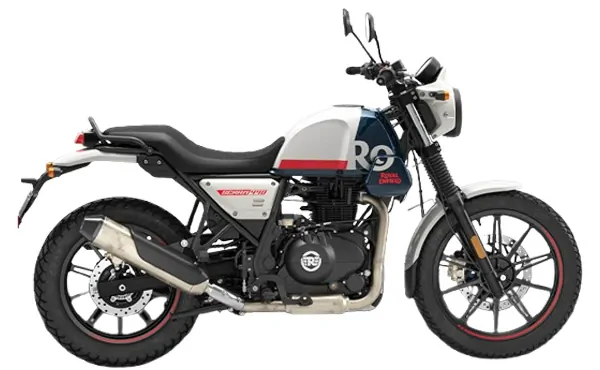
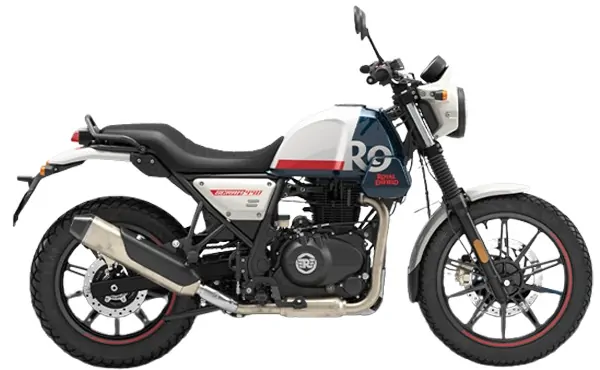
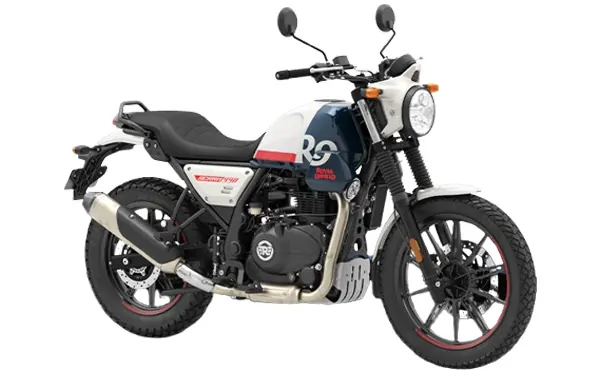
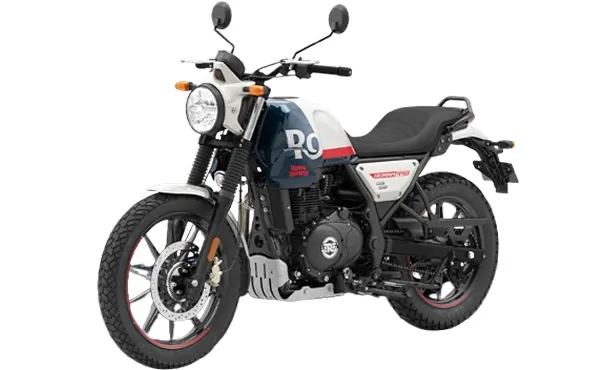
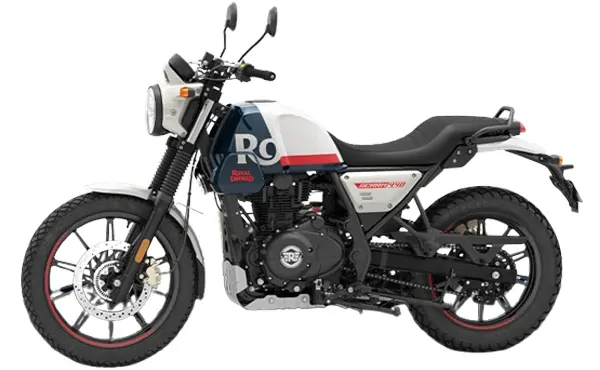
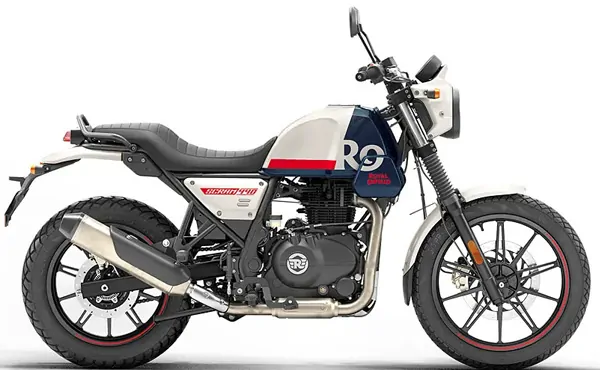
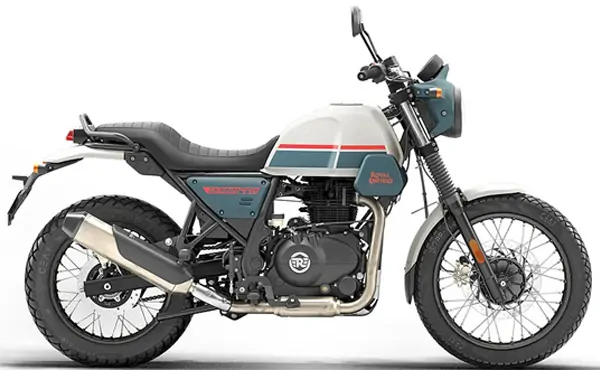
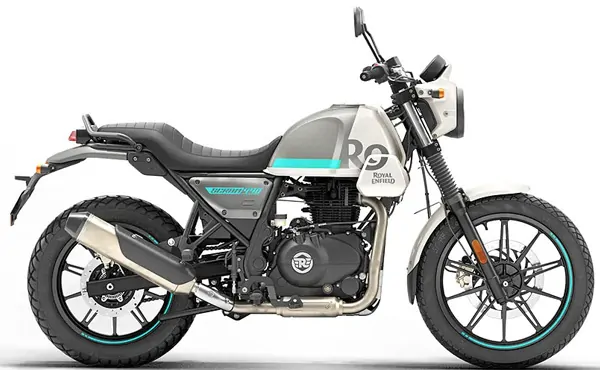
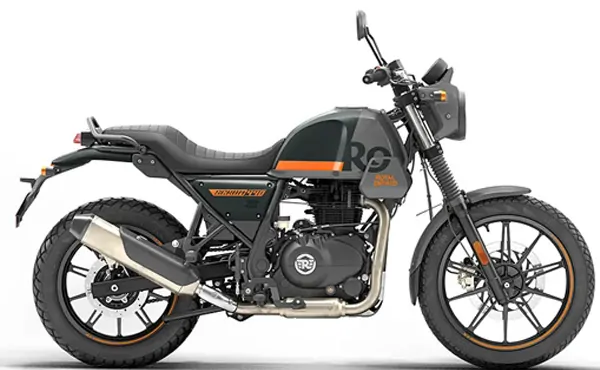
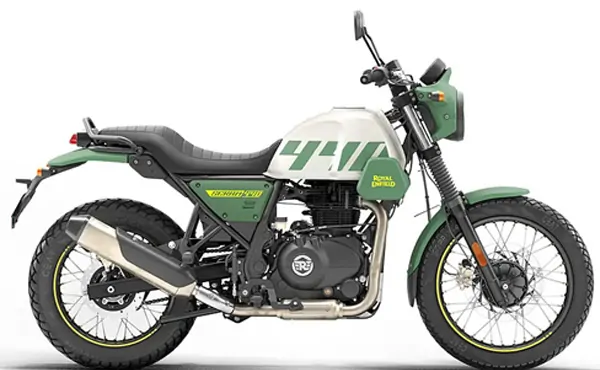
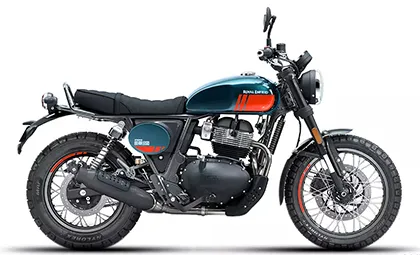
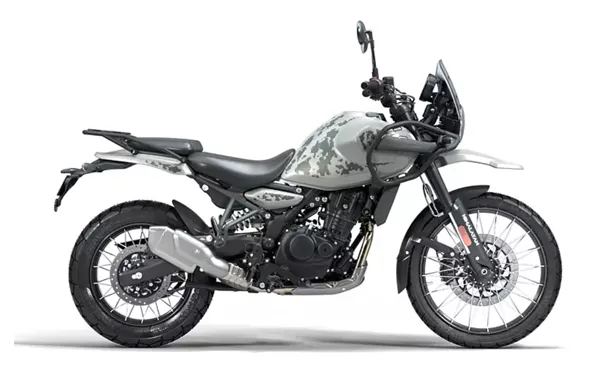
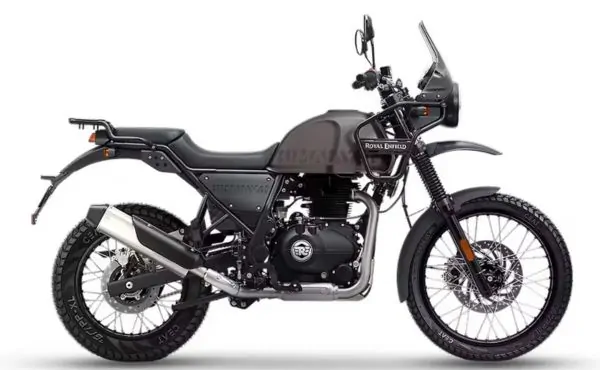
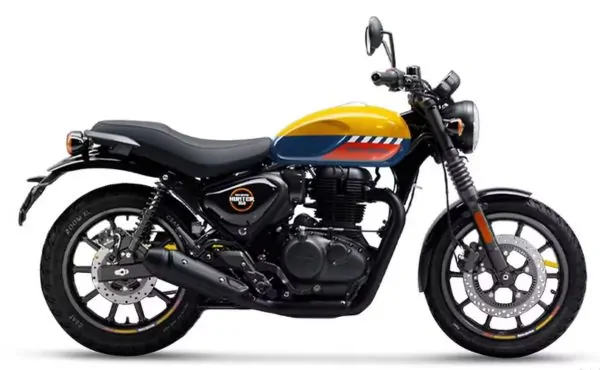
The Scram 440 has a clean, practical scrambler style. It stands upright, with a wide handlebar, a flat one-piece seat, short front and rear mudguards, and minimal side panels that show off the frame and engine. Compared to the taller, sharper-looking Himalayan 450, the Scram looks lower and more compact, with bold graphics and color blocks that make it feel younger and more playful.
Tank shrouds and graphics give the bike a bit more presence in the middle without making it look bulky. The upswept exhaust and dual-purpose tyres show it’s ready for rough roads. Compared to rivals like the Yezdi Scrambler or Triumph Scrambler 400 X, the Scram 440 looks more rugged and less aggressive, fitting its role as a practical, everyday scrambler-tourer for India.
Colors Options And Variants
India-exclusive palette for Scram 440 includes
- Trail Blue
- Trail Green
- Force Blue
- Force Grey
- Force Teal
Two distinct variants cater to Indian preferences:
- Trail: Spoke wheels with tubetype tyres, dualchannel ABS, longtravel suspension, semidigital cluster, Trail Blue/Trail Green colours. Best for riders who want the classic scrambler look and don’t mind tubetype tyres.
- Force: Alloy wheels with tubeless tyres, dualchannel ABS, Tripperready cluster, extra cosmetic bits, Force Blue/Grey/Teal colours. Better suited to daily use and touring, with easier puncture repair and flashier styling.
Value For Money And Pricing
Nationally, exshowroom prices for the Scram 440 start from ₹ 2,24,805, onwards for the base variant. For that money you get a 443 cc, 6speed scramblertourer with dualchannel ABS, longtravel suspension, a 15litre tank and the choice between spokes or alloys, which is strong value against many 400–450 cc rivals. Routine services every 6,000–10,000 km typically cost ₹1,800–3,000 at authorised workshops, and shared components with other REs keep spares pricing sensible.
With realworld economy in the lowtomid30s kmpl and generally robust resale values for Royal Enfield dualpurpose models, the Scram 440 works out as a costeffective option for riders who rack up serious yearly mileage. The large dealer and service network across India further boosts value by making maintenance and parts access easier outside big cities.
Key rivals for the Scram 440 in India include the:
- Yezdi Scrambler
- Triumph Scrambler 400 X
- KTM 250
- KTM 390 Adventure
The Yezdi is lighter and looks more aggressive on paper, but its smaller dealer network and less reliable reputation are drawbacks. The Scram 440 offers more low-end torque, better comfort for long rides, and much wider service support. The Triumph Scrambler 400 X has more power, liquid cooling, and modern electronics, but it costs more and is built more for the road. KTM’s Adventure bikes are better for serious off-roading and have more rider aids, but they’re taller, harder for shorter riders, and more expensive to buy and maintain. Overall, the Scram 440 stands out as a torquey, comfortable, India-friendly scrambler-tourer that’s priced below many other 400 cc bikes.
Verdict
The Royal Enfield Scram 440 is designed with Indian riders in mind: it handles rough roads well, cruises comfortably at about 100 kmph, can carry luggage and a pillion, and stays affordable to own. Its 443 cc long-stroke engine, 6-speed gearbox, long-travel suspension, and 15-litre tank deliver on these needs, making it a reliable, torquey, and comfortable choice for people who ride in cities, on highways, and on rough backroads.
This isn’t the bike for people who want the latest electronics or the highest specs, and it won’t beat liquid-cooled rivals in pure performance. But if you want a tough, versatile, mid-sized bike under about 2.8 lakh rupees on the road—one that can handle daily commutes, rough roads during the monsoon, and weekend trips out of town—the Scram 440 is one of the most practical and well-rounded options in Royal Enfield’s India lineup.
Pros
- Strong low and midrange torque: 34 Nm delivered low in the revs makes city, highway and roughroad riding easy without constant gear changes.
- Relaxed 6speed cruising: Extra top gear lets it sit at 90–100 kmph comfortably, improving refinement and fuel efficiency.
- Practical fuel economy and range: Mixed mid30s kmpl and a 15litre tank give a 400–450 km range, ideal for Indian touring.
- Badroadready hardware: 200 mm ground clearance and longtravel suspension shrug off potholes, speed breakers and village roads.
- Choice of spokes or alloys: Trail for classic looks, Force for tubeless practicality and easier puncture repair.
- Comfortable, upright ergonomics: 795 mm seat height and neutral triangle work well for a wide variety of rider sizes.
- Strong value under: Sits neatly between cheaper 350s and more expensive 400–450 cc ADVs.
Cons
- Heavy for a scrambler: Around 196 kg kerb, which can feel cumbersome in tight spaces or if you drop it offroad.
- Aircooled refinement ceiling: Smooth for what it is, but not as vibefree or thermally robust as modern liquidcooled 400s.
- Modest peak performance: 25.75 PS is fine for India, but riders coming from KTMs or Triumphs may find it tame at high speeds.
- Tubetype tyres on Trail: Spoked Trail variant make puncture repairs more involved than on tubeless alloys.
- Vibrations above 110 kmph: Buzz increases as you approach top speed, making those speeds less pleasant for long durations.
- Basic feature set: No ride modes, traction control or TFT; instrumentation is functional rather than hightech.
- Seat can feel firm on very long days: For regular 300–400 km rides, many riders will want extra padding or an upgraded seat.
Other Related Links From Bikeleague India
List Of All Royal Enfield Bikes In India
About Royal Enfield Company
Royal Enfield represents India’s love for classic motorcycles, offering bikes known for their signature sound, strong build, and a mix of old-school charm with modern performance. Now part of Eicher Motors, the brand leads the mid-size segment and attracts city riders, long-distance travelers, and adventure enthusiasts.
History And Growth
Royal Enfield began its journey in India in 1955, when the UK’s Redditch company partnered with Madras Motors to set up Enfield India and assemble Bullet 350 kits near Chennai. By 1962, production was fully local, which helped the company survive after the UK factory closed in 1971. Eicher took over in 1994, bringing in more efficient UCE engines and launching popular models like the Thunderbird in 2002 and the Classic 350 in 2009. What started as a niche brand in the 1990s grew rapidly, with sales reaching 888,746 bikes in India in FY25 (a 25% increase from the previous year) and 132,132 exports (up 36%), thanks to a wider range of models, global reach, and active rider communities.
Key Milestones And Developments
- 1955: Enfield India was founded; the Tiruvottiyur plant assembled the first Bullets for Indian Army contracts.
- 1970s-80s: Supplied Interceptor models to police and pioneered cast-iron engines during import restrictions.
- 1994: Merged with the Eicher Group; introduced lean-burn technology for better efficiency.
- 2009: The Classic 350 was launched, capturing the retro market with chrome-rich styling.
- 2013: The Oragadam plant opened; Unit Construction Engine (UCE) standardized 346–499cc platforms.
- 2016: The Himalayan adventure tourer with a 411cc air-cooled LS engine targeted global explorers.
- 2017: 650cc parallel-twin Interceptor and Continental GT expanded the premium segment.
- 2020: Meteor 350 cruiser launched with J-series engine and digital upgrades across the lineup.
- 2023: Himalayan 450 debuted with a liquid-cooled Sherpa 452cc platform.
- 2025: Achieved 1 million+ domestic sales milestone; Shotgun 650 and Guerrilla 450 joined the portfolio.
These milestones have transformed Royal Enfield from an old-fashioned brand into a modern icon, known for its advanced features, smooth performance, and options for customization.
Manufacturing Facilities
Royal Enfield’s manufacturing is centered around Chennai, with four main plants. The historic Tiruvottiyur plant makes special Bullet models, producing about 10,000 bikes a year. Oragadam covers 50 acres and uses robotic painting and assembly for exports since 2013. Vallam Vadagal, located in SIPCOT park, can produce over 600,000 bikes, mainly the Classic and Bullet 350cc models. The Cheyyar SIPCOT facility, opening in 2025, will be fully operated by women and focus on high-volume production. The company uses sustainable practices like zero-liquid discharge and solar power, along with advanced technology such as AI quality checks, to support an annual output of over one million bikes and a network of more than 2,500 dealers across India.
Market Position And Achievements
Royal Enfield holds about 70% of India’s premium 125-650cc motorcycle market and 5.74% of the overall two-wheeler market. In January 2026 alone, it sold 106,398 bikes, a 14% increase from the previous year. The first half of 2025 saw 16.88% growth, the fastest among established brands, with the Classic 350 leading at over 40% market share in its segment. Internationally, Royal Enfield has outsold Harley-Davidson since 2015. The company is the top exporter, reaching over 50 countries, and is known for events like the Himalayan Odyssey and One Ride, which attract thousands of riders. Its strong service network and high resale value help keep customers loyal, even with competition from brands like Triumph.
Future Plans
In 2026, as Royal Enfield marks its 125th anniversary, the company will launch its first electric vehicle, the Flying Flea S6/C6, a retro-style commuter made at a new plant in Hosur. This model will be released in the fourth quarter and is expected to cost around ₹1.5 lakh. Alongside this, Royal Enfield will introduce new petrol models like the Bullet 650 twin, Scrambler 450, Himalayan 750 ADV, Continental GT 450 café racer, and Interceptor 750. The company’s future plans focus on more electric vehicles (with 2-3 more by 2028), new factories in the UK and Argentina, larger 750-1200cc twin-cylinder bikes, and advanced features like ride-by-wire and traction control. The goal is to reach 1.5 million units while staying true to the brand’s classic character.
Other Related Articles From Bikeleague India
- Cruising bikes or cruisers – Top 10 under 5 lakhs in India
- New Royal Enfield Bullet 350 vs Old Bullet 350 – A clash of eras
- Royal Enfield Super Meteor 650
- Royal Enfield Bullet 350
- Royal Enfield Meteor 350