
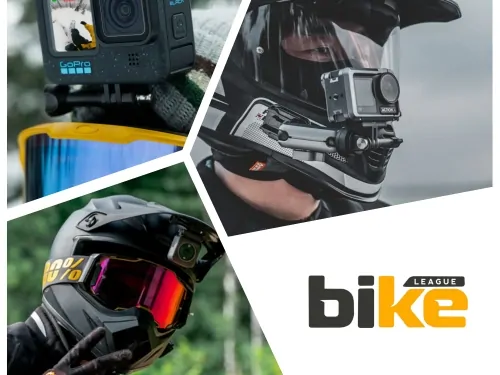
Long story short: To sum up, India does not have a nationwide ban on helmet-mounted action cameras. However, some states, like Kerala, have banned them because of safety concerns and their own interpretation of motor vehicle laws.
More and more riders, vloggers, and adventure lovers in India are using action cameras on their motorcycle helmets. But the laws about helmet-mounted cameras can be confusing, since central and state rules are not always the same.
This guide explains the current laws, safety tips, and how rules are enforced for helmet cameras. It will help you make smart choices before your next ride.
Key Takeaways
- An action camera is a compact, durable digital camera designed to capture clear videos and photos even in challenging environments.
- Never drill, cut, or use screws or permanent fasteners to attach mounts. Doing so severely weakens the helmet’s structure and renders its crash protection ineffective.
- Neither the Motor Vehicles Act 1988 nor the Central Motor Vehicle Rules (CMVR) 1989 contains a specific provision explicitly banning helmet-mounted action cameras nationwide.
- Despite the absence of a direct central law, states like Kerala have actively banned helmet cameras through internal Motor Vehicle Department (MVD) circulars, imposing fines of Rs 1,000 and potential license suspension for three months.
- Use motorcycle-mounted cameras on fairings, handlebars, or mirrors. Consider chest mounts on riding jackets for better frame and legal compliance.
- As of 2026, Kerala operates 726 AI traffic cameras statewide that detect general helmet non-wearing, but there’s no confirmation they can identify helmet-mounted cameras specifically — enforcement of that particular rule still depends on manual stops.
What Is An Action Camera?
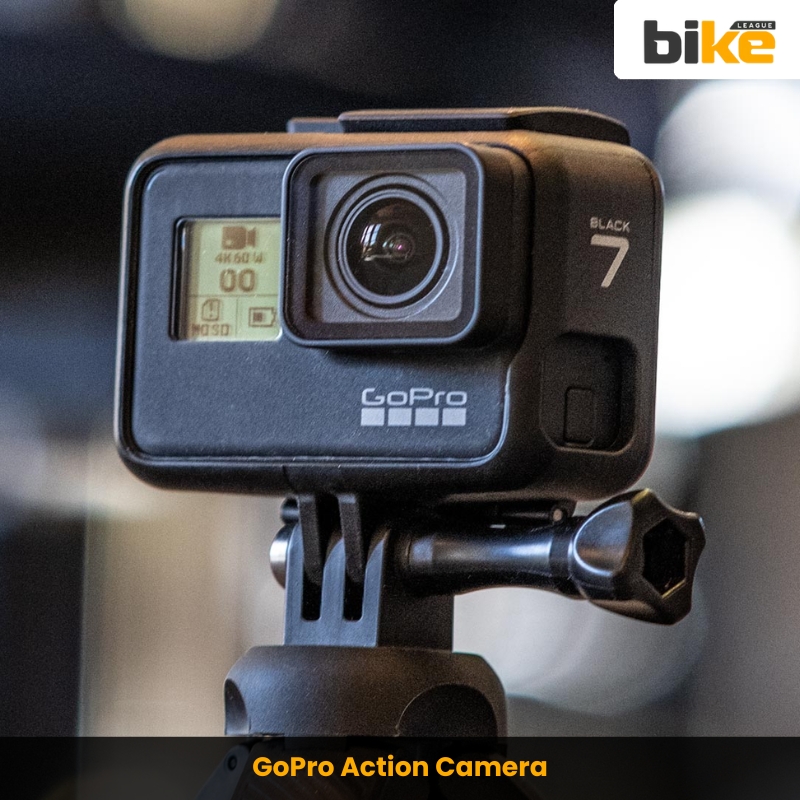
An action camera is a small, tough digital camera made to take clear videos and photos, even in tough conditions.
Here are some main features:
- Ultra-wide-angle lenses for immersive footage
- High-frame-rate video (up to 240 fps) for slow-motion
- Robust stabilisation (optical or electronic) to counteract shake
- Waterproof and shockproof housings
- These cameras are light and come with mounts for helmets, bicycles, and other gear.
Adventure sports fans, vloggers, and motorcycle riders often use action cameras because they let you record hands-free and capture exciting point-of-view videos.
Some well-known models include:
- GoPro HERO13 Black
- GoPro HERO12 Black
- DJI Osmo Action 4
- DJI Osmo Action 5 Pro
- Insta360 X5
- Insta360 Go 3
- YI 4K+
- SJCAM SJ8 Pro
How Can Action Cameras Be Fitted To Motorcycle Helmets?
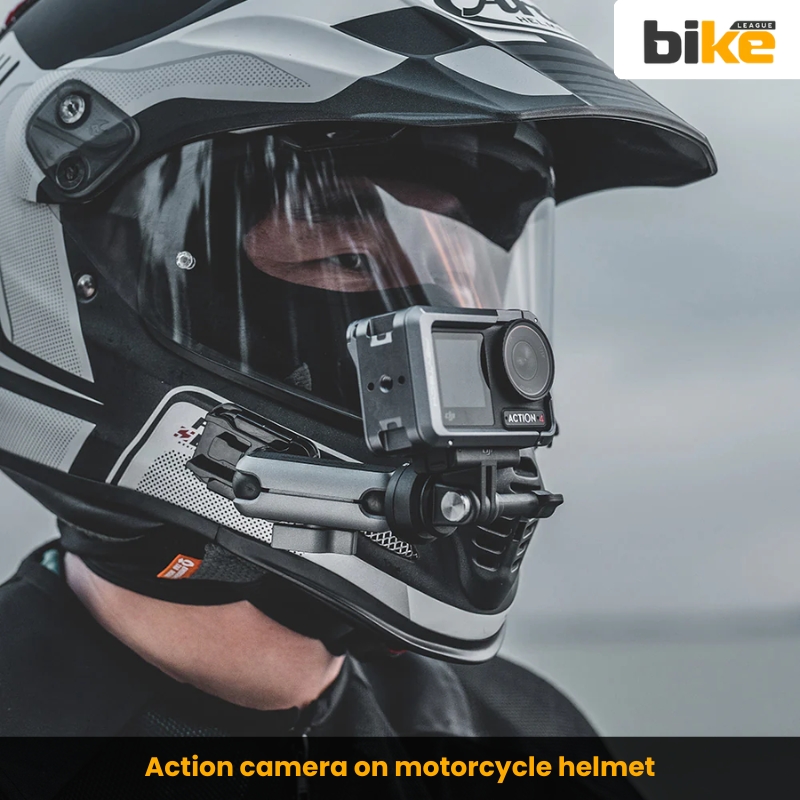
There are a few main ways to attach action cameras to motorcycle helmets. Each method has its own safety, stability, and legal points to think about. Here are the options:
1. Adhesive Mounts
- Most action cameras come with both curved and flat adhesive mounts, explicitly designed for helmets.
- Clean the helmet surface to ensure good adhesive bonding.
- Secure the adhesive mount on a smooth area, usually the sides or top.
- Attach the camera to the mount using the clip.
Be cautious: Be careful with permanent adhesive, as it can weaken your helmet and increase the risk of head injury in a crash. Most safety experts recommend avoiding this method.
2. Strap Or Clip Mounts
- Use strap mounts that wrap around the helmet or chin strap, usually secured with Velcro or plastic clips.
- These are less intrusive and removable.
- Less likely to damage the helmet shell.
- Suitable for temporary or adjustable mounting.
3. Chin Mounts
- Mounting a camera on the chin area can increase the risk of facial and jaw injuries in a crash, as it creates a hard spot near the face.
- Allows a forward-facing point of view.
- Chin-mounted cameras may increase the risk of serious injuries to the face, jaw, or neck in a crash because they concentrate impact forces in these areas.
4. Side Or Top Mounts
- Mounts are placed on the side or top of the helmet for different angles.
- Side mounts are popular for immersive footage.
- May require curved adhesive or a helmet-specific mounting base.
5. Helmet Mounting Accessories
- Some companies offer specialised helmet mounting kits. These kits feature breakaway mounts that are designed to detach upon impact. This can reduce the risk of injury.
- These kits can include magnetic mounts, pivoting bases, or rubber padding. This helps provide better shock absorption.
What Are The Critical Safety And Legal Considerations For Mounting Action Cameras On Motorcycle Helmets?
If you want to put an action camera on your helmet, remember to consider important safety and legal issues. This will help you stay safe and follow the law.
1. Safety Considerations
- Never drill, cut, or use screws or permanent fasteners to attach mounts. Doing so severely weakens the helmet’s structure and renders its crash protection ineffective. It also voids safety certification (BIS/IS 4151).
- Only use mounts and adhesives designed for helmets, as approved by manufacturers. Inferior materials may weaken the shell.
- Do not mount cameras on the chin area. This exposes your face to impact and substantially increases the risk of serious injury in an accident.
- Favour side or top mounts to reduce injury risk and maintain helmet protection during impacts.
- Use breakaway or magnetic mounts, which detach on impact to limit force transfer or snags in a slide.
- Check mounts for secure attachment before riding, as loose mounts can detach or distract.
- Extra camera mounts can affect your balance and how the helmet moves through the air. This might cause neck strain or distract you while riding.
- Adding cameras and mounts can make your helmet heavier, leading to tiredness and discomfort on long rides. It can also affect your control and safety in small ways.
2. Legal Considerations
- Check local laws: Some Indian states, like Kerala, have specific bans on helmet-mounted cameras due to safety concerns. Penalties for violating these state rules can include fines up to Rs 1,000 and license suspension for up to three months.
- Under federal law (CMVR 1989, MVA 1988), helmets must comply with BIS IS 4151:2015 standards and must not be modified. Mounting a camera to a helmet can render it non-compliant under Section 194D, resulting in penalties.
- If authorities believe helmet cameras distract or encourage dangerous driving, riders may be charged under Section 184, which can result in fines or jail time.
- If a helmet is modified for a camera and considered unsafe, authorities can suspend the rider’s license or vehicle registration under existing safety regulations.
- Modifying a helmet can void its BIS safety certification. While IRDAI has no rule naming helmet modifications specifically, its Protection of Policyholders’ Interests regulations require disclosure of information material to a claim — the same principle insurers use to reject claims over undeclared vehicle modifications. A non-compliant helmet at the time of an accident could be argued on similar grounds, though this would be case-specific rather than an automatic denial. Check what your policy actually covers using our Third-Party Bike Insurance Calculator or Comprehensive Bike Insurance Calculator.
3. Recommendations To Stay Safe And Legal
- Use non-invasive mounting options such as motorcycle mounts, chest mounts, or handlebar mounts to avoid helmet modifications.
- Use helmets without permanent camera attachments where helmet cameras are banned.
- Buy helmets with appropriate safety certification (BIS/ISI) and avoid voiding coverage through modification.
- Stay informed about local laws and enforcement trends related to helmet cameras. Watch for changes to protective gear rules.
- Put safety and the law first, even if you lose some convenience when recording. This is better for your long-term well-being.
What Is The Current Legal Status Of Mounting Action Cameras On Motorcycle Helmets In India?
India does not have a nationwide ban on helmet-mounted action cameras. However, enforcement depends on state laws. Some states, like Kerala, have their own penalties and restrictions.
1. No Central Prohibition
Neither the Motor Vehicles Act 1988 nor the Central Motor Vehicle Rules (CMVR) 1989 contains a specific provision explicitly banning helmet-mounted action cameras nationwide.
2. State-level Enforcement
Despite the absence of a direct central law, states like Kerala have actively banned helmet cameras through internal Motor Vehicle Department (MVD) circulars, imposing fines of Rs 1,000 and a potential three-month license suspension.
3. Enforcement Mechanism
State-level enforcement is typically carried out through circulars issued by Motor Vehicle Departments. Legal challenges can only be made after a penalty, making compliance unclear for many riders.
How Can Action Mount Helmet Cameras Be Deemed Illegal By Connecting Five Legal Instruments?
Helmet cameras can be deemed illegal by connecting these legal instruments:
- Central Motor Vehicle Rules 1989
- Motor Vehicles Act 1988
- Section 53
- Section 194D
- Section 184
| Legal Instrument | What It Covers | Connection to Helmet Cameras | Penalty |
|---|---|---|---|
| CMVR 1989 (Rule 138) | Mandates BIS-certified, unmodified protective headgear | Camera mounts alter certified helmet structure | No direct penalty — sets the compliance baseline |
| Section 194D, MVA 1988 | Requires headgear “conforming to prescribed standards” | Modified helmets deemed non-compliant with BIS IS 4151:2015 | ₹1,000 fine + 3-month licence disqualification |
| Section 184, MVA 1988 | Dangerous or reckless driving | Cameras framed as a distraction or stunt-recording incentive | Up to ₹10,000 fine + 6 months–2 years imprisonment |
| Section 53, MVA 1988 | Suspension of registration/licence for unsafe modifications | Kerala MVD applies this to helmet modifications, not just the vehicle | Licence suspension until helmet restored to certified state |
1. Central Motor Vehicle Rules 1989: Helmet Safety Standards
The CMVR 1989 establishes comprehensive safety specifications for motor vehicles and their accessories, including protective headgear.
Rule 138(4)(f) mandates that two-wheeler manufacturers must supply protective headgear conforming to Bureau of Indian Standards (BIS) specifications at the time of vehicle purchase.
Bis Standard Is 4151:2015 Helmet Requirements
- Impact absorption: Helmets must withstand specific force levels during crash testing
- Penetration resistance: Protection against sharp objects piercing the shell
- Retention system strength: Chin straps must securely hold the helmet during impact
- Structural integrity: The shell must maintain protective properties without modifications
- Weight limitation: Maximum 1,500 grams (recently reduced to 1,200 grams for enhanced protection)
- Thickness specifications: 22-25mm with high-quality foam
- Peripheral vision: Adequate field of view for safe riding
Critical Principle
Helmets certified under IS 4151:2015 are designed as complete, integrated protective systems. Any modification—including drilling holes, adhesive mounts, or attaching external objects like cameras—can compromise structural integrity and void safety certification.
While CMVR 1989 does not mention helmet cameras directly, its emphasis on unmodified, BIS-certified helmets allows authorities to prohibit mounts that do not meet safety standards.
2. Section 194d: Penalty For Not Wearing Protective Headgear
Section 194D of the Motor Vehicles Act, 1988, mandates wearing protective headgear that conforms to prescribed standards.
Key Provisions
- All persons above 4 years of age riding or being carried on motorcycles must wear protective headgear that conforms to prescribed standards.
- Fine of Rs 1,000
- License disqualification for 3 months
- Applies to both riders and pillion passengers
Connection To Helmet Cameras
Section 194D’s requirement for headgear “conforming to prescribed standards” becomes the enforcement mechanism against helmet cameras.
Authorities interpret mounting cameras as:
- Modifying BIS-certified helmets, rendering them non-compliant with prescribed standards
- Compromising protective function, meaning the rider isn’t wearing “proper” protective headgear
- Making helmets structurally unsafe, violating the spirit of Section 194D
Transport officials argue that helmets with camera mounts no longer meet BIS IS 4151:2015 specifications; thus, riders can be penalised under Section 194D for not wearing compliant protective headgear.
3. Section 184: Dangerous Driving
Section 184 of the Motor Vehicles Act 1988 addresses dangerous or reckless driving that endangers public safety.
Key Provisions
- Penalises driving in a manner hazardous to the public
- Includes reckless behaviour, excessive speeding, distraction, and actions endangering lives or property
- Penalties: Fines up to Rs 10,000 and imprisonment from 6 months to 2 years, depending on severity and repeat offences
Connection To Helmet Cameras
Section 184 can be invoked against helmet camera users on multiple grounds:
- Distraction: Kerala MVD initially justified the ban by claiming cameras divert riders’ attention from road safety, making them dangerous to other road users
- Reckless Riding for Content: Many young riders perform dangerous stunts, racing, and risky manoeuvres to capture exciting footage for social media (Instagram, Facebook, YouTube), leading to accidents
- Compromised Helmet Safety as Dangerous Conduct: Riding with modified helmets that have weakened protective capabilities could be construed as dangerous behaviour, since riders knowingly use substandard safety equipment
By combining Sections 184 and 194D, authorities argue that helmet cameras both violate safety equipment standards and contribute to unsafe riding practices.
4. Section 53: Suspension Of Vehicle Registration
Section 53 of the Motor Vehicles Act 1988 empowers registering authorities to suspend vehicle registration if the vehicle or its use poses a danger to the public or fails to comply with the Act requirements.
Key Provisions
- Allows authorities to suspend registration of vehicles (or associated equipment) that:
- Suspension remains until defects are rectified and compliance restored.
Constitutes a danger to the public
Fail to comply with the Motor Vehicles Act or rules.
Are used without valid permits
Have undergone unsafe modifications
Connection To Helmet Cameras
The Kerala MVD has extended the interpretation of Section 53 to include helmet modifications, arguing that helmets are essential safety equipment associated with vehicle operation.
Unauthorised helmet modifications (such as camera mounts) warrant a temporary license suspension until the helmet is restored to its original, certified state.
This broad interpretation allows authorities to act against helmet cameras, even without an explicit prohibition, by using vehicle modification provisions as the legal mechanism.
How Do All These 5 Laws Interconnect?
The regulatory framework creates a multi-layered enforcement mechanism where each component reinforces the others:
1. Cmvr 1989 (baseline Standards)
- Establishes BIS-certified helmet requirements (IS 4151:2015)
- Mandates unmodified protective headgear meeting safety specifications
2. Section 194d (helmet Compliance Enforcement)
- Requires wearing helmets conforming to prescribed standards
- Modified helmets with cameras are deemed non-compliant
- Penalty: Rs 1,000 fine + 3-month license disqualification
3. Section 184 (behavioural/safety Risk)
- Addresses distraction and dangerous riding
- Cameras encourage reckless behaviour or distract riders.
- Penalty: Up to Rs 10,000 fine + imprisonment
4. Section 53 (modification Control)
- Provides an enforcement tool for unsafe modifications
- Allows license/registration suspension until compliance is restored
- Applies to helmet modifications as safety equipment
5. Practical Outcome
Even without explicit prohibition, this interconnected framework enables authorities to penalise helmet camera users by arguing:
- Camera mounts violate BIS helmet standards (CMVR 1989 + IS 4151:2015)
- Modified helmets fail Section 194D’s “prescribed standards” requirement.
- Camera usage distracts riders or encourages reckless behaviour (Section 184)
- Helmet modifications warrant license action (Section 53)
Why Kerala Specifically Enforces A Ban On Mounting Action Cameras On Riding Helmets?
Kerala’s Motor Vehicle Department has been the most aggressive enforcer, citing three primary justifications:
- Structural Integrity Compromise: Mounting cameras creates rigid attachment points restricting the helmet’s ability to glide freely during crashes, potentially increasing head trauma. Kerala MVD referenced Michael Schumacher’s 2013 skiing accident, where the helmet-mounted camera was cited as contributing to severe head injuries.
- International Precedent: The FIA (Fédération Internationale de l’Automobile), the governing body of motorsport, has banned the use of helmet-mounted cameras on race tracks due to safety concerns.
- Distraction and Reckless Behaviour:Kerala initially cited distraction as the primary reason, claiming riders become overly focused on recording footage, endangering themselves and others. Additionally, concerns about young riders performing dangerous stunts for social media content contributed to the ban.
What Is The Current Nationwide Status Of The Ban On Mounting Action Cameras On Riding Helmets In India?
As of now, the legal situation across India remains:
- No explicit central ban on helmet cameras nationwide
- State-level enforcement varies, with Kerala actively penalising violators.
- The legal framework exists to justify penalties through interconnected provisions.
- Alternative mounting options (motorcycle fairings, chest mounts, handlebar mounts) remain legal and are recommended.
- The ISI certification mandate continues to gain strength with the government’s crackdown on substandard helmets.
- The Supreme Court’s emphasis on road safety in 2025 reinforces the importance of strict helmet compliance. However, it makes no specific mention of camera mounts.
Does Kerala’s Ai Camera Network Detect Helmet-mounted Cameras?
Since this article was first published, Kerala has scaled up road enforcement significantly through its “Safe Kerala” project — worth understanding if you’re planning to ride in the state.
1. What The Ai Camera Network Actually Does
- Kerala operates 726 AI-based traffic cameras statewide (692 actively issuing fines), commissioned under the Motor Vehicles Department’s Safe Kerala project at a cost of ₹232.25 crore.
- The system detects seven categories of violations: riding without a helmet, driving without a seatbelt, mobile phone use while driving, signal jumping, triple riding, unauthorised parking, and overspeeding.
- As of a Kerala Legislative Assembly statement on 30 June 2026, the state’s Transport Minister confirmed the network remains fully operational and credited it with a measurable rise in helmet compliance and a drop in road fatalities.
2. Does This Change Anything For Helmet-mounted Cameras Specifically?
- Not directly. The AI system is calibrated to flag whether a rider is or isn’t wearing a helmet — a presence/absence check — not to assess whether a worn helmet has been structurally modified with a camera mount.
- No public information from the Motor Vehicles Department confirms the AI cameras can distinguish a stock helmet from one fitted with an action camera.
- Enforcement against helmet-mounted cameras specifically still relies on the original mechanism: an officer visually identifying the mount during a stop, not automated detection.
- That said, the expansion of blanket AI surveillance across Kerala’s roads means riders are under more consistent observation overall, and the state’s enforcement posture on rider-safety-equipment compliance has clearly hardened rather than eased since the ban was first reported.
3. The Other Side Of The Story
The AI camera rollout hasn’t been free of controversy. The opposition Congress party has alleged corruption in the ₹232.25 crore contract, and privacy experts have objected to cameras capturing images inside vehicles to check seatbelt use. Riders should be aware that the enforcement landscape in Kerala is still actively evolving and politically contested, not settled.
What Are The Practical Recommendations For Motorcycle Riders In India On Using Action-cam Cameras On Helmets?
To follow safety rules while recording your rides:
- Avoid helmet-mounted cameras in states with active enforcement (Kerala, potentially others)
- Use motorcycle-mounted cameras on fairings, handlebars, or mirrors.
- Consider chest mounts on riding jackets for better frame and legal compliance.
- Ensure helmets carry the ISI mark as per IS 4151:2015 standards.
- Avoid any modifications to certified helmets that could void safety standards.
- Stay informed about state-specific enforcement policies.
Do Action Camera Mounts Affect Motorcycle Helmet Safety?
People still debate whether action camera mounts make helmets less safe. Some officials ban helmet cameras for safety, but research shows the issue is more complex.
1. Claims That Cameras Compromise Safety
Authorities opposing helmet cameras, particularly Kerala’s Motor Vehicle Department, argue that mounting cameras on helmets:
- Compromises structural integrity: The helmet’s outer shell is designed to glide freely across surfaces during a crash. Camera mounts create rigid attachment points that can restrict this gliding motion, potentially increasing rotational forces and head trauma.
- Weakens helmet structure: Drilling holes or using adhesive mounts can damage the helmet shell, compromising its ability to absorb and distribute impact forces.
- Adds weight and disrupts aerodynamics: Additional weight and protrusions can strain neck muscles and affect stability at higher speeds.
- Creates additional impact points: During a crash, the camera itself becomes a complex object that could concentrate force at a single point rather than distributing it across the helmet surface.
2. Claims Showing Cameras May Actually Improve Safety
Surprisingly, independent scientific research — from Australia and the UK — has found that helmet-mounted cameras do not increase injury risk and may even provide additional protection:
| Study | Year | Sample Size | Key Finding |
|---|---|---|---|
| Transport for NSW, Centre for Road Safety | 2023 | Laboratory crash-rig testing across multiple helmet models | Up to 42% reduction in Head Injury Criterion; no average increase in head/neck injury risk |
| TRL, commissioned by BBC (PPR759) | 2015 | 70+ impact tests across helmet types and mount positions | No test caused injury-threshold failure; front-facing mounts flagged as the one clear risk |
1. Australian Transport Nsw Study (2023)
Tested various helmet attachments in laboratory crash scenarios
Key Finding
- Attaching camera or communication devices to motorcycle helmets does not, on average, increase the risk of head or neck injury
- Results showed significant reductions in injury metrics with camera attachments:
42% average reduction in Head Injury Criterion (HIC)
23% reduction in peak linear acceleration
10% reduction in peak angular head velocity
22% reduction in peak angular acceleration
5 percentage point reduction in the likelihood of severe head injury
Reason
Energy absorbed when the device separated from the helmet upon impact actually provided additional protection.
2. Trl Study, Commissioned By Bbc (2015)
The Transport Research Laboratory (TRL) ran this research on commission from the BBC, testing climbing helmets across various camera mounting positions and configurations, in over 70 individual impact tests.
Key Findings
- In not one of the 70+ tests did the presence of the camera cause the helmet to ‘fail’ the injury threshold standards, and no combination exceeded published legislative performance criteria.
- Cameras detached in around 40% of impacts, yet helmets still performed well in the remaining tests where the camera stayed attached.
- Where the camera didn’t detach, mount deformation absorbed impact energy, effectively acting as an additional protective layer.
- Critical warning: Front-mounted, rear-facing cameras broke away and struck the wearer’s face, even in low-energy impacts — a serious hazard.
Important caveat: TRL noted that “out-of-position” impacts (non-standard crash angles) and improperly mounted cameras significantly increased injury risk, meaning mounting position and mount quality matter greatly. Cameras should never be mounted at the front of a helmet.
How Are The Michael Schumacher Case And Action Mount Cameras On Helmets Related?
The Michael Schumacher skiing accident on December 29, 2013, has become the most cited real-world example in the debate over helmet camera safety. However, the actual evidence remains disputed and inconclusive.
1. What Happened
- Schumacher was skiing with his son Mick at the Méribel resort in the French Alps.
- While helping another skier in an off-piste area, he struck a rock partly concealed beneath the snow.
- He fell 3.5 meters and hit his head on a boulder.
- The impact was so severe that his helmet split in two.
- He was wearing a helmet-mounted GoPro camera at the time.
- Schumacher suffered a traumatic brain injury, was placed in a medically induced coma for 250 days, and has never fully recovered.
2. The Camera Controversy
In October 2014, French motorsports journalist Jean-Louis Moncet made a controversial claim on European radio after allegedly speaking to Schumacher’s son:
“The problem for Michael was not the hit, but the mounting of the GoPro camera that he had on his helmet that injured his brain.”
Moncet later denied speaking directly to Mick Schumacher about this claim.
3. Investigation Findings
- French investigators from the École Nationale de Ski et d’Alpinisme (ENSA), a renowned ski and climbing academy in Chamonix, analysed the helmet fragments.
- They tested whether a solid object (a camera) between the helmet and the rock would weaken the structure.
- A source close to the investigation stated, “The helmet completely broke. It was in at least two parts. ENSA analysed the piece of the helmet to check the material, and all was OK. But why did it explode on impact? Here, the camera comes into question.”
- Investigators examined the helmet camera for clues about the accident circumstances.
- However, no official conclusion was ever publicly released, definitively attributing the blame to the camera.
4. Medical Opinion
Australian neurosurgeon Dr Paul D’Urso commented on the case:
“Any modification of a helmet potentially is going to cause unpredictable results, particularly if there’s a traumatic impact on the helmet… people should be careful with modifications that compromise the structural integrity of sporting equipment, particularly helmets.”
5. Key Context Often Overlooked
- Doctors credited the helmet with saving Schumacher’s life—he likely would have died without it.
- The impact was extremely severe: a 3.5-meter fall onto a boulder that split the helmet in two.
- Helmet camera footage later revealed that Schumacher was not travelling at excessive speed for his abilities.
- The accident occurred in an off-piste area with rocks concealed by snow—inherently dangerous terrain.
6. Fia Response
Following this incident, the FIA (Fédération Internationale de l’Automobile), the premier governing body of motorsport, banned the use of helmet-mounted cameras on race tracks, citing safety concerns.
What Factors Determine The Safety Of Helmet Cameras?
Studies show that the safety of helmet cameras depends on a few key factors:
1. Mounting Position
| Mount Position | Safety Verdict | Why |
|---|---|---|
| Top mount | Generally safe | Mount deformation can absorb impact energy; low injury risk in tests |
| Side mount | Generally safe | Similar protective profile to top mounts; popular for immersive footage |
| Chin mount | Avoid | Concentrates impact force near the face and jaw |
| Front-mounted, rear-facing | Avoid | TRL testing found these can break away and strike the wearer’s face, even in low-energy impacts |
2. Mount Quality
- Properly designed breakaway mounts that detach on impact are safer.
- Poor-quality adhesive or drilled mounts that compromise shell integrity are dangerous.
3. Impact Type
- Standard vertical and lateral impacts: Cameras generally don’t increase injury risk
- Oblique (angled) impacts: Mixed results, with some increased rotational forces
- Out-of-position impacts: Significantly increased risks
4. Helmet Type
Different helmet constructions (hardshell, EPS foam, hybrid) respond differently to camera attachments.
What Are The Manufacturer And Authority Positions On Mounting Action Cameras On Helmets?
- Action Camera Manufacturers: Companies like GoPro state that customers mount cameras at their own risk and don’t officially endorse helmet mounting.
- Helmet Manufacturers: Advise against attaching anything to helmets except their own approved accessories, as modifications void safety certifications.
- Indian Authorities: Kerala MVD and other state transport departments cite the Schumacher case and FIA ban as justification for prohibiting helmet cameras, emphasising the precautionary principle even without definitive proof of harm.
How Can Riders Ensure Their Action Cameras Do Not Distract Them While Riding?
Riders can take several practical measures to ensure that their action cameras do not distract them while riding, maintaining focus, safety, and compliance with road rules:
1. Mount Securely And Out Of The Line Of Vision
- Place the camera where it does not obstruct or interfere with the rider’s direct line of sight, typically on the side or top of the helmet or on the motorcycle itself.
- Avoid mounting cameras on the front or chin area of the helmet to reduce temptation to adjust or monitor the camera screen while riding.
2. Pre-ride Setup
- Adjust all camera settings, angles, and recording modes before starting the ride.
- Ensure the camera is powered on, recording, and ready without the need to touch or look at it during motion.
3. Use Voice Commands And Remote Controls
- Use cameras with voice control features to allow hands-free start/stop recording or mode changes.
- Use remote controls or smartphone apps with handlebar mounts for safe camera control without taking your hands off the handlebars.
4. Avoid Checking Footage Mid-ride
- Avoid stopping to review real-time footage while riding.
- If necessary, plan breaks for checking videos and adjusting camera positions safely.
5. Choose Simple, Automatic Recording Modes
- Use continuous recording or loop recording modes that do not require manual intervention.
- Avoid complicated camera controls or unnecessary mid-ride settings changes.
6. Mount Cameras On The Motorcycle Instead Of The Helmet
Try mounting cameras on the handlebars, windshields, or rear of the motorcycle, since these options are less likely to distract you while riding.
7. Follow Local Laws On Helmet Cameras
Comply with any regional prohibitions on helmet-mounted cameras to avoid legal distractions like police stops or fines.
8. Mental Discipline And Awareness
- Remind oneself that the priority is safe riding, not getting perfect footage.
- Practice mindful riding, focusing attention entirely on the road and surroundings.
Here’s a quick reference for what each violation actually costs:
| Violation | Applicable Section | Penalty |
|---|---|---|
| Non-compliant/modified helmet | 194D | ₹1,000 fine |
| Unauthorised helmet modification | 53 | Licence suspension up to 3 months |
| Distracted/dangerous riding | 184 | Up to ₹10,000 fine + 6 months–2 years imprisonment |
| General helmet non-wearing (Kerala AI cameras) | Safe Kerala enforcement | ₹500 fine |
Faq About Action Camera With Mount On Helmets In India
1. Is Using An Action Camera On A Motorcycle Helmet Legal In India?
There is no nationwide ban, but in states like Kerala, helmet-mounted cameras are banned under safety regulations. Riders caught can face a Rs 1,000 fine and license suspension for up to three months.
2. Why Did Kerala Ban Helmet-mounted Cameras?
Kerala’s Motor Vehicle Department claims that helmet cameras compromise structural integrity and distract riders, violating the Motor Vehicles Act (1988) provisions for safety. The ban also cites the Michael Schumacher accident as an example of camera-related risks.
3. Can I Record My Rides With A Camera Placed Elsewhere?
Yes. The ban applies only to helmet-mounted cameras. You can legally mount your camera on handlebars, fairings, mirrors, or chest harnesses, which do not modify helmets or distract riders.
4. Does The Motor Vehicles Act Explicitly Ban Helmet Cameras?
No. The Motor Vehicles Act, 1988, does not directly mention helmet cameras. However, authorities interpret Section 194D (protective headgear compliance) and Section 184 (dangerous driving) to regulate unsafe modifications or distractions.
5. Why Is Mounting A Camera On The Helmet Considered Unsafe?
Helmet manufacturers design helmets under BIS IS 4151:2015 safety standards. Adding mounts or drilling holes alters weight distribution. It compromises the shell’s impact absorption ability, making it non-compliant and unsafe.
6. Can The Police Fine Me For Wearing A Helmet Camera In Other Indian States?
Currently, only a few states—most notably Kerala—actively penalise helmet cameras. However, traffic police in other states can technically issue fines if they consider the modification unsafe under Rule 138 of CMVR 1989.
7. What Penalties Exist For Using Helmet Cameras Illegally?
Penalties include:
- Fine: Rs 1,000 under Section 194D
- License suspension: Up to 3 months under Section 53
Additional penalties under Section 184 for dangerous or distracted driving
8. Are Helmet-mounted Cameras Allowed In Motorsports?
No. Motorsport governing body FIA (Fédération Internationale de l’Automobile) bans helmet-mounted cameras on race tracks due to structural integrity and safety concerns.
9. What Are Safer Alternatives For Moto-vloggers?
Use non-invasive mounts such as:
- Chest or jacket mounts
- Motorcycle handlebar mounts
- Suction cup or fairing mounts
These offer similar camera angles without violating helmet safety standards.
10. Can Helmet Cameras Void Helmet Or Insurance Coverage?
A camera mount will void the helmet’s BIS/ISI certification (IS 4151:2015), since it counts as an unapproved modification — that part is clear-cut and covered directly under CMVR 1989. Insurance is less clear-cut: IRDAI has no rule specific to helmet cameras, but its Protection of Policyholders’ Interests regulations (2024) allow insurers to reject claims over non-disclosed information material to a loss—the same principle applies to undeclared vehicle modifications. Whether a modified helmet meets that bar hasn’t been tested in a published ruling, so treat it as a real risk rather than a certainty. Use our Comprehensive Bike Insurance Calculator to see what your current policy actually covers.
Sources & References
- Motor Vehicles Act, 1988 (Act No. 59 of 1988) — official consolidated text, India Code (Ministry of Law and Justice): indiacode.nic.in
- Central Motor Vehicles Rules, 1989 — official text, Ministry of Road Transport and Highways: morth.nic.in
- Transport for NSW, Centre for Road Safety (2023) — “Assessing the Safety Impacts of Attachments on Motorcycle Helmets”: transport.nsw.gov.au
- TRL (Transport Research Laboratory), commissioned by BBC (2015) — Report PPR759, “Safety Testing of Helmet-Mounted Cameras”: trl.co.uk
- IRDAI Master Circular on Protection of Policyholders’ Interests (2024): caalley.com (hosted copy)
- Note: Kerala MVD’s helmet-camera circular has not been publicly gazetted. Details in this article are based on contemporaneous press reporting rather than an official published notification.
Other Related Links From Bikeleague India
- Motorcycle helmet in India – All in one buying guide
- What all basic motorcycle accessories should a rider have
- Motorcycle disc brake – Everything you need to know
- Motorcycle mirrors rules, penalties in India
- Comprehensive Bike Insurance Calculator
Conclusion
Helmet-mounted action cameras are still popular with Indian riders, but the laws and safety rules are not simple. There is no national ban, but some states, especially Kerala, enforce their own rules. Changing certified helmets can lead to fines, license suspension, or even insurance problems.
To stay safe and follow the rules, use other mounting options like chest mounts or mounts on your motorcycle, and always use unmodified, BIS-certified helmets. With smart choices, you can record your rides without risking your safety or breaking the law.
We hope this article has cleared up your questions about the laws, safety, and real-life cases of using action cameras on motorcycle helmets in India. If you have more questions, feel free to email us at bikeleagueindia@gmail.com or leave a comment below. We’re happy to help. You can also reach out to us on Bikeleague India’s social media.