
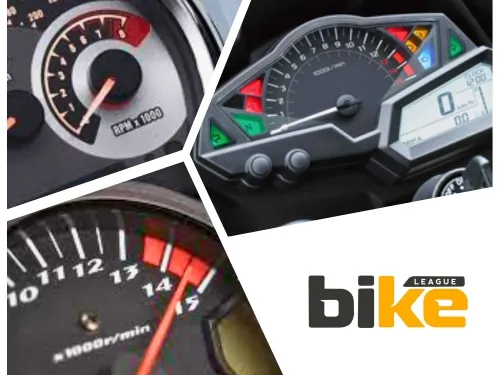
Long story short: Discover redlining meaning for motorcycles/bikes and scooters—max RPM facts, myths, rev limiter role, OBD-2B tracking & safe practices, etc., right here in this article.
Redlining your motorcycle or scooter excites many Indian riders and sparks debate. Are you chasing the thrill of max RPM or just curious about those red numbers? Redlining affects your bike’s performance and engine life, so it’s worth understanding.
This article explains redlining, why it matters, how it’s tracked on modern Indian two-wheelers, and how to ride safely without engine or warranty damage.
Key Takeaways
- Redlining is when you push your motorcycle or scooter’s engine close to its maximum RPM. This thrill gets your heart racing but also needs a little caution.
- Knowing when and how to redline safely lets you enjoy all the fun of spirited riding, without wearing out your engine or risking damage.
- There are plenty of myths about redlining—like thinking it’s always bad or always needed for performance. The truth is in between, and knowing the facts makes a big difference.
- Used responsibly, redlining can be a part of exciting rides, but running at the limit all the time isn’t great for long-term engine health.
- If you understand how redlining works, you’ll make smarter choices on the road and get more out of every ride. You’ll also keep your engine healthy for years to come.
Quick Glossary: Redlining Terms Explained
| Term | What it means |
|---|---|
| Redline | The highest RPM a bike or scooter engine can safely reach, often shown in red on the tachometer |
| Rev limiter | The ECU function cuts fuel or spark when the engine hits redline, stopping RPM from going higher |
| Peak power RPM | The RPM where an engine makes its most power (spec sheet value); not the same as redline, which is usually higher |
| Oversquare engine | Engine with wider bore than stroke, allowing higher revs—common in sportbikes like Yamaha R15 V4 |
| Undersquare (long-stroke) engine | Engine with longer stroke than bore, favoring low-end torque over high revs—seen in cruisers and scooters |
| Lugging | Riding at low RPM under heavy load (like climbing a flyover in too high a gear); stresses the engine more than brief redline bursts |
| Knocking (knock) | Unwanted pinging from fuel igniting unevenly in the cylinder, common with low-octane fuel under high load or high RPM |
| Valve float | When valves can’t close fast enough at high RPM because springs lose control; sustained valve float risks damage |
| Thermal throttling | EV equivalent of redline—when the controller or battery system cuts power to protect from overheating |
| OBD-2B | Mandatory diagnostics on new Indian two-wheelers; logs RPM, throttle, and temperature to flag redlining abuse |
What does redlining actually mean?engine redline meaning
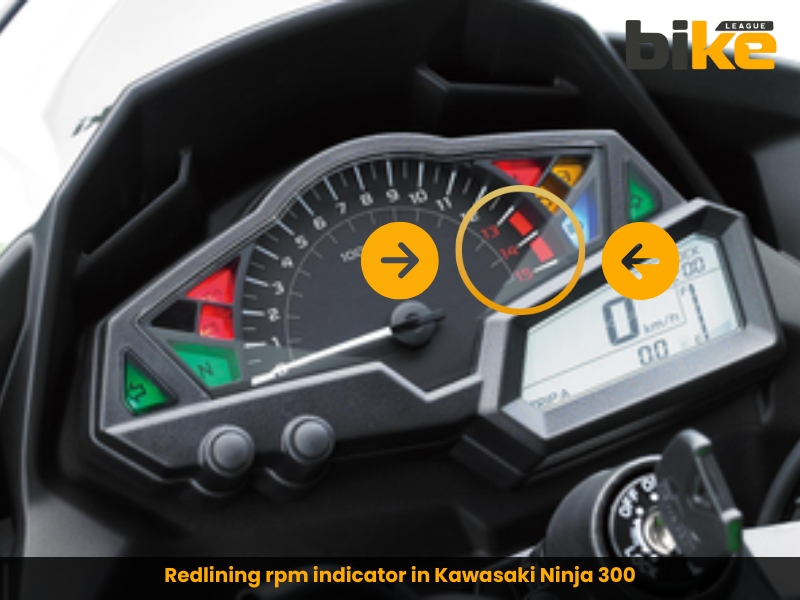
Redlining means running your bike’s engine at its highest safe RPM. This protects important parts like pistons, valves, and bearings from damage. The ‘red line’ on your tachometer shows this danger zone. Remember, redlining is not the same as your bike’s top speed in kilometres per hour.
Most modern bikes have a safety feature called a rev limiter. It stops fuel or spark from reaching the engine once you hit the limit, so the engine can’t go any higher. If you push past this point, you’ll hear the engine stutter.
How Do You Find Your Own Bike Or Scooter’s Redline?
Every bike is different, so each example in this guide names a specific model. Before using these tips, know your bike’s redline. It’s usually easy to find and doesn’t require special tools or a service centre visit.
1. Look At The Tachometer Itself
If your bike or scooter has a tachometer, the redline is usually marked as a red arc or red zone at the end of the dial. On digital clusters, numbers may turn red or the needle graphic may change colour as you approach the limit. Many commuter bikes—especially budget 100–125cc models—don’t have a tachometer. If yours doesn’t, use the other methods below.
2. Check Your Owner’s Manual
This is the most reliable source because it gives you the exact number approved by the manufacturer. Check the ‘Engine Specifications’ or ‘Technical Specifications’ for ‘Maximum Engine Speed,’ ‘Rated RPM,’ or the peak power figure (for example, ‘20.2 PS @ 6,100 rpm’). If you’ve lost your manual, most Indian brands offer PDF versions on their websites.
3. Search Your Exact Model And Variant Online
If the manual isn’t handy, searching “[your bike model] + redline RPM” or “[your bike model] + rev limiter RPM” usually surfaces the number quickly through spec-aggregator sites or manufacturer pages. Two things to watch for when doing this:
Match your exact variant, not just the model name. The same model can have different settings. For example, the Royal Enfield Classic 350 and Meteor 350 use the same engine, but the Classic has different fuel mapping. Older carbureted bikes differ from newer fuel-injected versions, even if the name is the same.
Peak power RPM is not the same as the redline. Spec sheets usually show the RPM where the engine makes its most power (for example, ’38 PS @ 9,800 rpm’). The real rev limiter is often set higher. If you only find peak power RPM, use that as the minimum redline—not the maximum.
4. Ask A Dealer Or Authorised Service Center
If you genuinely can’t find it any other way—like on an older or discontinued model—an authorised service advisor can pull the exact figure from the manufacturer’s internal spec sheet for your bike’s engine code. This also helps if your bike has had an ECU remap, since that can move the rev limiter away from the factory number (see the OBD-2B section below).
5. Quick Reference: Where To Look, In Order
| Source | Reliability | Best For |
|---|---|---|
| Tachometer red zone | High, if fitted | Quick visual check while riding |
| Owner’s manual / manufacturer PDF | Highest | Exact certified figure for your variant |
| Manufacturer website spec page | High | Current models, easy access |
| Third-party spec aggregators | Medium — cross-check variant | Older/discontinued models |
| Authorized dealer/service center | Highest | Remapped ECUs, rare or older bikes |
Quick Reference: Redline Rpm By Popular Indian Bike & Scooter
Here’s a quick list of every model mentioned in this guide. Rev-limiter cutoffs are confirmed by owner reports, dyno data, or the manufacturer. If only the peak-power RPM is available, it’s marked as such—real redlines are usually a bit higher than the peak-power number.
| Model | Category | Redline / Rev Limiter | Peak Power RPM |
|---|---|---|---|
| Yamaha R15 V4 | Sportbike | ~10,800–11,200 rpm (confirmed) | 18.4 PS @ 10,000 rpm |
| TVS Apache RR 310 | Sportbike | ~10,500 rpm (approx.) | 38 PS @ 9,800 rpm |
| KTM 390 Duke | Naked/Streetfighter | ~10,600 rpm (confirmed) | 41.5 PS @ 8,600 rpm |
| Bajaj Pulsar NS200 | Streetfighter | ~10,000 rpm (confirmed) | 24.5 PS @ 9,750 rpm |
| Royal Enfield Guerrilla 450 | Roadster | Peak-power RPM only | 40 PS @ 8,000 rpm |
| TVS Ntorq 125 | Performance scooter | Peak-power RPM only | 9.5 PS @ 7,000 rpm |
| Honda Activa 125 | Commuter scooter | Peak-power RPM only | 8.42 PS @ 6,500 rpm |
| Royal Enfield Classic 350 / Hunter 350 | Cruiser/Roadster | ~6,850 rpm limiter (confirmed) | 20.2 PS @ 6,100 rpm |
What Slang Do Riders In India Use For Redlining?
In India, riders have come up with many creative ways to talk about redlining, especially when chatting about bikes like the Yamaha R15 or TVS Apache during a fun ride.
- Full revving or max revs: Taking the engine right up to the redline on the tachometer.
- Engine screaming or bike cheekhna (Hindi for “bike screaming”): The high-pitched howl your engine makes when it’s spinning at peak RPM.
- Rev limiter bang or cut-off hitting: The stuttering sound you hear when the bike’s computer steps in to stop you from going over the limit.
- Top-end thrashing or high-rev blasting: Used for those moments on the track or when you’re overtaking on highways like NH44.
- Red zone daalna (literally “putting in red zone”): A classic commuter phrase for bikes like the Hero Xtreme or Bajaj Pulsar.
- Engine ko jhatka dena (giving the engine a jerk): This saying is used when you twist the throttle aggressively and push the engine to the limit.
- Limiter pe patakna (smacking the limiter): Popular in South India, especially among sportbike fans with bikes like the KTM RC 200.
What Happens Inside The Engine During Redlining In Motorcycles?
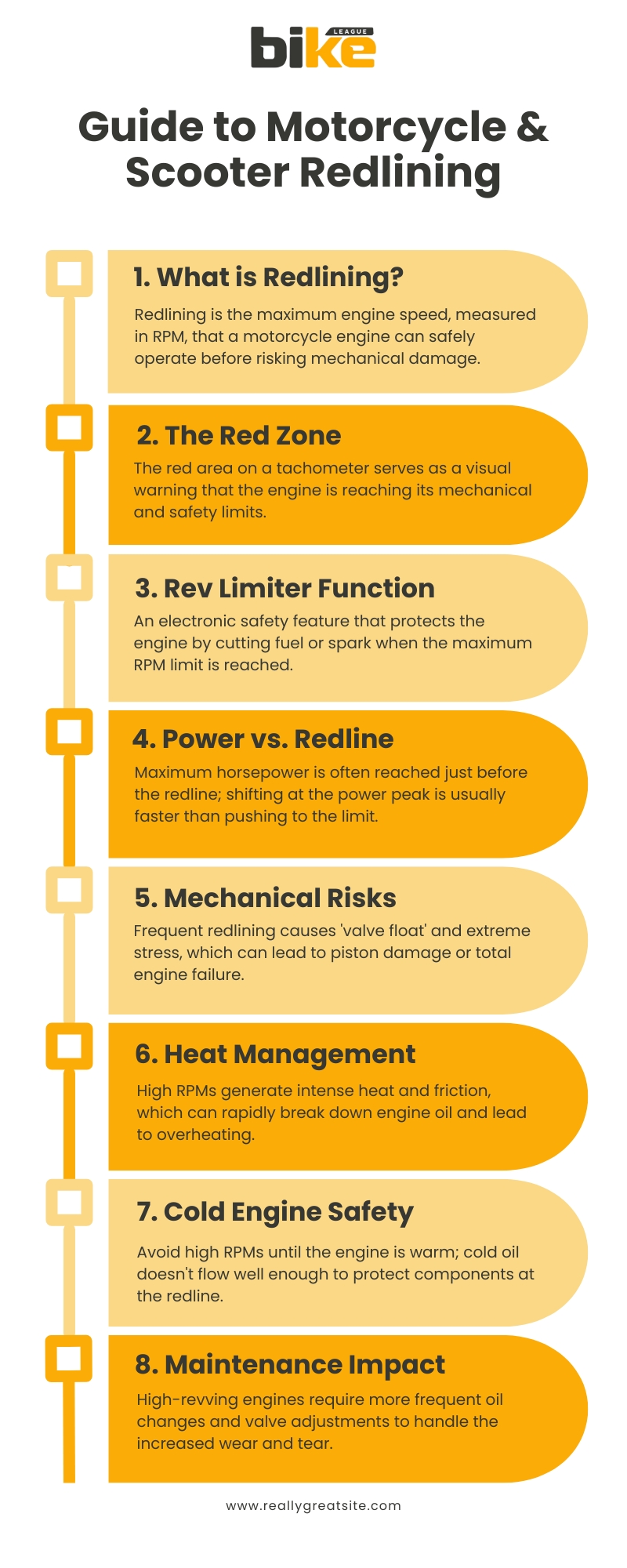
Revving a motorcycle engine to the redline puts all its moving parts under maximum stress, especially at high RPMs. Indian sportbikes usually redline from about 9,000 to over 14,000 RPM. Local factors like 91-octane fuel, hot summers, and new 2025 rules affect how engines handle this stress. Modern ECUs intervene at the limit to protect your engine.
1. Which Engine Parts Work The Hardest At Redline?
At redline, the piston in a bike engine moves extremely fast—over 20 meters per second—and handles forces more than ten times its own weight. The valvetrain (springs, camshafts, valves) can lose control above 12,000 RPM if springs aren’t strong enough, so higher-end bikes use stronger parts. The crankshaft and bearings also face heavy loads and rely on hot oil to prevent wear.
2. How Does The Engine Make And Deliver Power At The Redline?
Bikes like the Yamaha R15 V4 use an oversquare engine design where the piston moves a shorter distance up and down. This allows for higher RPMs and more power for its size than most cars. At redline, the engine breathes well thanks to its tuned intake and exhaust. Beyond the redline, even the best airflow can’t add more power, so the rev limiter is set there.
3. How Do Heat And Friction Affect The Engine At Redline?
At redline, exhaust gas temperatures can reach 800–900°C as they leave the combustion chamber, but that’s just the gas—not the engine metal. The piston crown and engine surface are much cooler, usually 200–300°C, but still hot enough for poor cooling to cause problems. Indian fuel increases the risk of engine knocking. Liquid-cooled bikes like the TVS Apache RR 310 handle heat better than air-cooled models. The hotter the engine gets, the thinner the oil becomes, which speeds up wear, especially if you keep revving hard for long periods.
| Stress Factor | Effect at Redline | Indian Bike Example |
|---|---|---|
| Piston Speed | >20 m/s, inertial stress | Yamaha R15 V4 (~11,000 RPM) |
| Valve Float Risk | Springs compress, timing loss | TVS Apache RR 310 (~10,500 RPM) |
| Oil Shear | Viscosity drops, film breakdown | Royal Enfield Guerrilla 450 (~8,000 RPM) |
| Exhaust Gas Temps | 900°C+, turbine strain | KTM 390 Duke (10,000 RPM) |
4. What Does The Rev Limiter Actually Do?
When you hit the redline, the bike’s ECU (computer) steps in and cuts off the spark or fuel. This causes the engine to stutter, stopping the RPMs from going higher and protecting the engine from damage due to missed shifts or over-revving. In 2025, these systems are even smarter—they adjust limits based on engine temperature and use sensors to detect knocking. This is especially helpful on India’s dusty, humid roads.
5. How Indian Conditions Affect Redlining In Motorcycles?
Poor-quality fuel in India can cause engines to misfire early, so bikes like the Bajaj Pulsar have lower redlines, around 10,000 RPM. Monsoon rains help cool engines, but extra moisture can rust chains and metal parts. Briefly touching the redline during shifting causes almost no extra wear. However, holding high RPM in traffic for long periods could reduce engine life from about 100,000 km to 50,000 km.
What Happens Inside A Scooter’s Engine When It’s Pushed To The Redline?
When you push a scooter’s engine to its redline, it spins slower than most motorcycle engines—usually between 7,000 and 10,000 RPM. Scooters have longer-stroke engines, so they make more pulling power at low speeds, ideal for city riding. In 2025, models like the TVS Ntorq 125 and Suzuki Access 125 use smarter CVT gearboxes and advanced engine computers to handle traffic and heat, making them more reliable than ever.
1. Which Parts Of A Scooter Work Hardest At Redline?
The piston in a scooter’s engine works hard at the redline, facing strong forces as it moves rapidly. The long stroke helps with city acceleration but also creates more sideways push on the piston. The valve system uses softer springs to stay under control at high RPMs, and chain tensioners help reduce vibrations. The CVT belt can stretch if it’s old, so keeping it in good condition is important.
2. Why Do Scooters Rev Lower Than Bikes?
Scooters usually don’t rev as high as bikes (which sometimes go past 13,000 RPM) because their engines are built for quick moves in city traffic, not for racing. Most of the pulling power comes in below 6,000 RPM. Air-cooled scooters like the Honda Activa 125 max out around 8,000 RPM, while sportier, liquid-cooled models like the Aprilia SR 160 can touch about 9,500 RPM.
3. How Do Scooters Handle Heat And Friction At The Redline?
When you rev a scooter hard, exhaust gas temperatures can reach 700–800°C, especially with India’s common 91-octane fuel, but the engine’s metal parts stay much cooler. Most scooters use fans to help cool things down during hot 45°C summers. The faster the engine spins, the more friction builds up, which makes the oil thinner and causes more wear inside. The CVT system can also get hot if you keep revving in neutral or ride hard, so regular maintenance is important.
4. What Does The Rev Limiter Do On A Scooter?
The engine’s ECU (computer) steps in when you reach the redline, cutting the fuel or spark so the engine can’t spin any faster. On a scooter, this feels more like a gentle buzz than the harsh stutter you get on motorcycles. Newer scooters in 2025 will even use sensors to adjust these limits if you happen to get bad fuel.
| Component | Redline Stress Mechanism | Indian Scooter Example |
|---|---|---|
| Piston | Moderate inertial/side loads (5-8g) | TVS Ntorq 125 (~9,000 RPM) |
| Valvetrain | Cam chain stretch, mild float | Suzuki Access 125 (~8,000 RPM) |
| CVT Belt | Tension peaks, heat degradation | Honda Activa 125 (~8,000 RPM) |
| Bearings | Splash lube shear, dust ingress | Ola S1 Pro (~8,500 RPM, electric equiv.) |
5. How Do Indian Conditions Affect Scooter Engines At Redline?
India’s weather and roads can affect how long a scooter engine lasts if you often push it to the redline. Humidity during the monsoon helps cool things down but can also cause rust inside the CVT. Dusty roads wear out parts faster, so scooters can handle fewer high-rev moments over their lifetime. Short bursts to the redline are fine for overtaking, but staying there in traffic can shorten engine life if you don’t use good oil.
Myths And Facts About Redlining In Motorcycles And Scooters In India
Many Indian riders still believe myths about redlining, often picked up from online forums and YouTube. However, data and manufacturer tests give a clearer picture of what’s actually safe for OBD-2 B-compliant motorcycles and scooters.
1. Motorcycle Myths And Facts
Riders often argue about redlining on bikes like the Yamaha R15 V4, especially as more people go on track days and highway rides.
| Myth | Fact |
|---|---|
| Instant engine destruction from redline hits | Designed safe maximum with rev limiter margins; brief shifts add |
| Neutral revving to redline builds no damage | Dry stresses components without load, risking rod/bearing failure more than loaded use (Harley warns of over-rev damage) |
| High RPM always shortens life drastically | Occasional use preferred over lugging (low RPM/high load), which causes carbon buildup; sustained redline accelerates wear |
| All bikes redline identically | Sportbikes (9k–14k RPM depending on model) vs cruisers (6-8k RPM) like Royal Enfield; oversquare vs undersquare designs; Harley V-Twins peak torque below redline |
2. Scooter Myths And Facts
When it comes to scooters, myths about redlining mostly stem from worries about the CVT (continuously variable transmission) in city models like the TVS Ntorq and concerns about poor fuel quality.
| Myth | Fact |
|---|---|
| Redline shreds CVT belts immediately | Peak tension brief/safe; wear from poor maintenance or neutral abuse exceeds normal shifts |
| Avoid all high revs during 500km break-in | Controlled RPM variation seats rings better; manuals allow 70-80% redline post-100km (Harley: 3,500 RPM after 50 miles) |
| Scooters can’t handle redline like bikes | Lower limits (8-9k RPM) match torque-focused design; limiters prevent overstress in traffic |
| Sustained redline boosts mileage | Wastes fuel via poor efficiency; optimal 4-6k RPM for 50+ kmpl on Honda Activa |
3. India-specific Myths And Facts
In India, harsh conditions such as heat, dust, and lower-quality fuel make these myths and misunderstandings even more common.
| Myth | Fact |
|---|---|
| Monsoon redlining causes hydro-lock | Humidity aids cooling; water ingress from poor air filters, not RPM, risks it |
| OBD-2B disables redline performance | Adaptive ECUs maintain limits but log abuse for warranty; no power cuts if compliant |
| Adulterated fuel makes redline deadly | Raises knock risk, but sensors retard timing; use 91+ octane for sustained high RPM |
| Track redlining voids warranty instantly | Documented use often covered; street abuse (cold revs) triggers claims denial |
How Can You Safely Redline Your Bike Or Scooter In India?
Redlining safely means pushing your bike or scooter to high RPMs only for short bursts, like quick shifts or overtakes, and only after the engine is warmed up. Always respect the redline set by your bike’s computer, especially on 2025 OBD-2B models. Keep up with maintenance and watch for issues like hot weather or poor fuel quality to protect your engine.
1. Getting Ready: Preparation Steps
- Let your engine warm up to its normal temperature—about 80–90°C oil—before revving high. Revving a cold engine wears out parts up to ten times faster.
- Always use the recommended oil (like 10W-40 JASO MA2) and change it every 5,000 km, especially in India’s dusty conditions. Check your chain or belt tension weekly.
- Keep your air filter clean so your engine gets the right mix of air and fuel. A dirty filter can cause knocking, especially with India’s 91-octane fuel.
2. How To Redline Smartly: Usage Techniques
- If you ride a bike like the Yamaha R15, shift gears before full redline—aim for 80–90%. For scooters like the TVS Ntorq, use a smooth throttle to protect the CVT belt.
- Don’t rev your engine hard in neutral—keep it below 3,000 RPM and only for a few seconds. Revving while riding (in gear) is safer because oil circulates better.
- If your bike or scooter is new (within the first 1,000 km), don’t exceed 70% of the redline and keep varying your speed, as Hero and Bajaj recommend.
3. What To Watch Out For And Avoid
- If you feel the engine stuttering (that’s the limiter kicking in), ease off the throttle right away. This helps you avoid accidentally going past the redline.
- Never hold the engine at redline for more than five seconds, especially in really hot weather or heavy traffic. This can overheat your exhaust (up to 900°C!) and break down your oil.
- Keep in mind that some new bikes, like the Kawasaki Ninja 650, track your riding. If you abuse the redline too much, it could affect your warranty.
| Vehicle Type | Safe Redline Duration | Key Cautions |
|---|---|---|
| Motorcycles (e.g., TVS Apache RR 310) | 2-3 sec per shift | Downshift carefully; no cold starts |
| Scooters (e.g., Honda Activa 125) | 1-2 sec overtakes | CVT slip signs; neutral abuse worst |
| Cruisers (e.g., Royal Enfield Hunter 350) | Rare, under 8k RPM | Lugging worse than brief peaks |
4. Watch For False Neutrals And Downshift Over-revs
Redlining doesn’t only happen on purpose. The most common accidental way Indian riders over-rev their engine is a botched downshift — usually while braking hard for traffic or slowing for a speed breaker.
Two things typically go wrong:
- False neutral: You go for 2nd gear but the shift lever doesn’t fully engage, landing between gears. The engine suddenly has no load to resist it, and if the throttle is even slightly open, RPM spikes toward the limiter almost instantly — with none of the built-in caution you’d apply during an intentional redline run.
- Downshifting without rev-matching: Dropping two gears quickly (say 4th to 2nd) while the bike is still carrying speed forces the rear wheel to briefly spin the engine faster than it wants to go. On a bike without a slipper clutch, this can momentarily push RPM into the same stress zone as redlining — except unplanned, with the clutch lever out, and often mid-corner or mid-braking, which is a worse time for the rear wheel to hop or lock than a straight-line WOT run.
This matters more in India than the spec sheet suggests, because dense traffic means far more gear changes per kilometre than highway riding — every rider does dozens of quick downshifts a day, and it only takes one badly timed one to hit the limiter unintentionally.
How to avoid it:
- Always confirm the gear has engaged (feel for the solid click, glance at the gear indicator if fitted) before releasing the clutch fully.
- Blip the throttle slightly during downshifts to match engine speed to road speed — this is standard technique on manual bikes and prevents the rear wheel from forcing the RPM up.
- If your bike has a slipper/assist clutch (increasingly common on the KTM 390 Duke, TVS Apache RR 310, and similar performance models), it partially disengages under back-torque and reduces this risk — but it isn’t a substitute for good technique, and most commuter and mid-capacity bikes in India don’t have one at all.
| Clutch Type | Over-Rev Risk on Fast Downshifts | Common On |
|---|---|---|
| Standard clutch | Higher — full engine braking transmitted directly | Most commuters, Classic 350, Pulsar NS200 |
| Slipper/assist clutch | Lower — partially decouples under back-torque | Apache RR 310, KTM 390 Duke, higher-end sportbikes |
5. After A Hard Ride: Quick Checks
After a spirited ride or a day on the track, check your bike or scooter for oil leaks, odd noises, or dirty spark plugs. If you’ve been riding aggressively, get your next service done sooner—at around 3,000 km. And during the monsoon, always dry your chain right away to avoid rust.
How Do Service Centres Spot If You’ve Been Redlining Your Motorcycle Or Scooter In India?
When you take your bike or scooter for servicing at an authorised centre (like Hero, Bajaj, or TVS), the mechanics don’t just rely on a quick look. They use special diagnostic tools—think of them as the bike’s own polygraph machine. For newer, 2025 OBD-2B-compliant models, these tools can plug into the bike’s computer (ECU) to check for ‘redlining abuse’—basically, signs you’ve been pushing the engine too hard at high RPM. Here’s how they do it:
1. Digital Clues From The Bike’s Computer
- The ECU logs how often and how long the engine is pushed near its redline. If you spend more than 20% of your ride time above 90% of the redline, the system flags it as abuse (this is common in bikes like the Yamaha R15 V4 or TVS Ntorq).
- Software lets mechanics view graphs of throttle position and RPM over time. If they spot long stretches at high RPM (say, more than 10 seconds at the limit), that stands out—quick overtakes are normal, but holding max revs isn’t.
- The system also tracks ‘knock events’—warning signs that the engine is struggling, often due to poor fuel quality (a common problem with models like the Pulsar or Activa).
2. Physical Signs The Engine Has Been Stressed
- Technicians look for worn parts: stretched timing chains, damaged rocker arms, or marks on valves, especially in high-revving bikes like the Apache RR 310.
- Pistons and rings can show scuffing or glazing from revving too hard without enough oil, or carbon buildup from slow-speed riding, versus a polished look from high revs.
- On scooters, parts of the CVT (like belts and rollers) get worn out faster if you’ve been revving hard in neutral.
- Mechanics may also check oil samples for tiny metal particles, which increase if the engine’s been overworked.
3. What Else Do They Notice?
- Sometimes, the overall wear on an engine doesn’t match the mileage—if a 10,000 km bike looks like it’s done 30,000 km, that’s a red flag.
- Service books can reveal track days or frequent hard riding, and burnt spark plugs or blue-tinted exhausts tell their own story.
- Chains that have stretched a lot or scooter belts that are cracked before 10,000 km are also clues that you’ve been riding hard.
| Detection Method | Motorcycles Example | Scooters Example |
|---|---|---|
| ECU Logs | RPM peaks > 10.5k (R15 V4) | Limiter hits >9k (Ntorq 125) |
| Wear Patterns | Valve recession (KTM 390) | CVT heat glazing (Activa 125) |
| Oil/Fluid Analysis | High iron/copper (Guerrilla 450) | Sheared additives (Access 125) |
4. What Happens If They Find Redlining Abuse?
If the evidence points to excessive redlining, service centers can mark it as “customer-induced” damage, which may result in warranty claims being denied. All this info gets uploaded to the bike maker’s central database for review. In 2025, many centers use AI-assisted diagnostics to catch more abuse cases than ever before.
While it’s possible to reset minor logs by disconnecting the battery, real engine wear can’t be hidden—so riding hard always leaves some trace.
Why Don’t Cruisers Like The Royal Enfield Bullet 350 And Classic 350 Have A Redline On Their Tachometers?
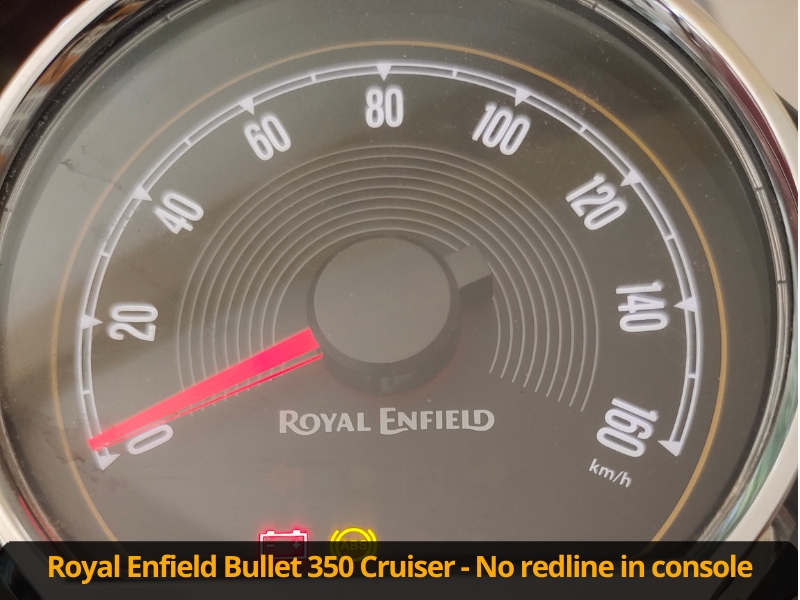
Cruisers like the Royal Enfield Bullet 350 and Classic 350 are built for relaxed, easy riding rather than racing. They focus on strong pulling power at lower engine speeds instead of chasing high RPMs. Because of this, their engines reach maximum power and torque at lower revs—around 6,100 RPM for power and 4,000 RPM for torque—so there’s no need for a high redline. This suits their calm, comfortable cruising style.
1. How The Engine Is Built
These bikes use long-stroke engines—like the J-series 349cc single-cylinder—which means the piston travels farther with each cycle. This design helps the engine deliver plenty of useful power at lower speeds, making it perfect for steady highway cruising.
The heavier engine parts, such as the pistons and connecting rods, aren’t meant to spin at extremely high RPMs, so the engine is kept away from high RPMs to avoid damage. That’s different from sporty motorcycles, which use lighter, short-stroke engines that can rev much higher—sometimes over 12,000 RPM.
2. Why People Ride Cruisers
Cruisers are all about comfort during long rides, usually at speeds between 50 and 90 km/h, so you don’t need to shift gears a lot. The engine delivers useful power right from low speeds—even at idle around 1,050 RPM.
To protect the engine, a limiter kicks in at about 6,850 RPM if you accidentally rev too high. This fits the bike’s character: plenty of pulling power, a signature thumping sound, and a relaxed touring feel.
3. Real-world Limits
You won’t see a red zone on the tachometer because most riders never get close to those high RPMs in everyday riding. These cruisers are designed for India’s varied roads, where low-revving engines make more sense than chasing top speed. Their top speed is around 110–115 km/h, showing that these bikes value efficiency and comfort over raw power.
Do Electric Scooters And Bikes Have A “redline” Too?
Not in the traditional sense — but Indian EV riders run into a very similar wall, just built differently. An electric motor doesn’t have pistons, valves, or a crankshaft, so there’s no mechanical redline to protect. Instead, what stops you is a motor RPM limit set by the controller software, and increasingly, heat. Push an EV scooter hard enough for long enough, and the controller or battery management system (BMS) will throttle power to protect itself — the electric equivalent of hitting the rev limiter, just quieter and, on some models, less predictable.
1. What Actually Limits An Electric Motor’s Top End?
Two things, and they’re different from anything happening in a petrol engine:
- Controller-set RPM ceiling — the motor controller caps how fast the motor is allowed to spin, similar in spirit to a fuel-cut rev limiter, but done entirely in software with no mechanical stress involved at that ceiling itself.
- Thermal throttling — this is the real limiting factor in day-to-day India riding. Sustained hard acceleration or holding top speed heats up the motor windings, the controller’s power electronics, and the battery pack. Once temperature sensors cross a threshold, the system quietly cuts available power to protect the components — riders usually feel this as the scooter suddenly feeling “flat” or sluggish rather than any dramatic cutoff.
2. Why Ev “redlining” Shows Up More In India’s Heat Than On The Tachometer
This is where EV riders should pay closer attention than petrol riders, because India’s climate stacks the deck. Independent test rides of India’s top-selling electric scooters have reported exactly this pattern — for instance, testers evaluating the Ola S1 Pro found that repeated hard acceleration runs led to noticeably dulled throttle response, consistent with the kind of performance-related thermal throttling the scooter has previously shown in reviews. This isn’t unique to one brand — it’s a characteristic of how motor controllers and battery packs behave when pushed hard in hot ambient conditions, which describes most of India for a large part of the year.
3. What Does The “rev Limiter” Moment Feel Like On An Ev?
Unlike the harsh stutter of a petrol bike hitting its limiter, an EV’s protective cutback is usually smooth and almost invisible in the moment:
- Acceleration feels progressively duller rather than cutting out suddenly
- Top speed may quietly drop from the claimed figure as the ride continues
- Some scooters, including the Ola S1 Pro, have a “Limp Home” mode that’s a more severe version of the same protection — it kicks in when the system detects a serious fault or extreme thermal stress, and deliberately restricts power so you can still get the scooter home safely rather than stranding you.
4. How Does This Compare To A Petrol Bike’s Redline?
| Aspect | Petrol Engine Redline | Electric Motor “Redline” Equivalent |
|---|---|---|
| What limits it | Piston speed, valve float, mechanical stress | Controller software cap; motor/battery temperature |
| What you feel | Stuttering fuel/spark cut | Gradual power reduction, duller throttle response |
| Recovery | Instant once RPM drops | Can take minutes to cool down before full power returns |
| India-specific risk factor | Poor fuel quality, high ambient heat | High ambient heat directly reduces sustained power output |
5. How To Ride An Ev Scooter/bike Hard Without Triggering Thermal Throttling
- Avoid holding top speed or hard acceleration continuously for extended stretches, especially in peak Indian summer afternoons — short bursts (like overtakes) are fine; sustained highway-speed cruising in Hyper/Sport mode for long periods is what tends to trigger throttling.
- Give the scooter a few minutes at lower power or standstill if you notice performance dulling — this lets the motor and battery shed heat before you push again.
- Don’t assume silence means no stress — because there’s no engine note to warn you, riders often don’t realise they’re pushing the motor hard until the power drop-off happens.
How Are Obd-2b And Diagnostic Tools Connected To Redlining And Why Does It Matter, And How Are Things Different From Earlier Systems In India?
OBD-2B (On-Board Diagnostics Version 2, Phase B) and modern diagnostic tools have changed how redlining is tracked on Indian two-wheelers in 2025. Unlike older systems that mostly guessed rider habits from worn parts, these tools actually measure and record how often you hit high RPMs. This means things like emissions, engine health, and even warranty decisions are now directly linked to how hard you ride your bike or scooter.
1. What Does Obd-2b Keep An Eye On?
- It tracks things like engine speed (RPM), how much you twist the throttle, the air–fuel mixture, engine temperature, fuel pressure, and more.
- The bike’s computer (ECU) watches all this data in real time. If something goes outside the safe limits—like running at high RPM for too long—it sets off warning codes so mechanics can spot the problem quickly.
- Since April 2023, all new bikes and scooters in India must have these advanced OBD-2 systems, and by 2025, many will be OBD-2B-compliant—like the Honda Activa 110, TVS Jupiter, Apache RR 310, and Suzuki models.
2. How Does This Relate To Redlining?
- OBD-2B systems keep track of how often you ride close to the redline and how many times you hit the rev limiter. If you’re pushing your engine hard a lot, it’ll show up in the logs.
- If the system detects high RPMs along with high engine temperature, a lean fuel mixture, or engine knocking, it can tell whether you’re just riding spiritedly or actually abusing the engine.
- At the redline, engines are more likely to go over pollution limits. OBD-2B helps ensure your bike stays within the legal emissions range, and if it can’t, it triggers a warning.
3. Why Does This Matter?
Protects Your Engine Better
- The system can step in right away—adjusting fuel, timing, or even slowing the bike down—to prevent major damage from overheating when you keep revving hard.
- It helps your engine last longer, even if you like to redline now and then, because it’s always making little adjustments to keep things safe.
Warranty And Riding Habits Are Linked.
- When you go for service, mechanics can plug in and see how often you’ve run your bike hot or at high RPM. If you’ve pushed it too hard, it will show up and could affect your warranty.
- Brands like Honda, TVS, Suzuki, and Bajaj use this info to decide on warranty claims for their OBD-2B bikes and scooters.
Keeps Emissions In Check
- OBD-2/2B is meant to keep your vehicle clean and legal for its whole life—not just when it’s new—by controlling emissions, especially at high RPM.
- If running at high RPM causes problems—like failing sensors or overheating parts—the system will flag them so you can get repairs before things get worse.
4. How Is This Different From Older Systems?
More Things Are Monitored, More Closely.
- Old systems like OBD-I or early BS6 only checked a few basic things, and usually just gave a simple “on/off” warning if something was wrong.
- OBD-2B adds more sensors, tracks RPM and engine load with greater detail, and has stricter rules to catch problems quickly and accurately.
Easier To Understand What Happened
- Before BS6 Phase II, mechanics had to guess if you’d been redlining by looking for clues like odd noises, smoke, or worn-out parts.
- Now, in 2025, scan tools can pull up a history of what was happening at the time of a problem—like RPM, throttle, and temperature—so it’s much easier to see if redlining caused any damage.
Stricter Rules And More Checks
- BS4 and early BS6 models were mostly tested for emissions during certification. OBD-2B, on the other hand, keeps an eye on your bike or scooter at all times and uses diagnostics to catch problems right away.
- So if you keep redlining and push your bike too hard, you’re much more likely to get a warning or trouble code now than on older models.
5. What Does This Mean For You?
- Redlining isn’t hidden anymore—your bike’s computer records how often you ride at the limit, so it’s not just something that shows up when an engine breaks down.
- It’s still okay to occasionally hit the redline on a properly maintained, warm engine. OBD-2B helps keep things safe by making adjustments and warning you early if there’s a real problem.
- If you get your ECU tuned or remapped to change the redline or engine protection, it will affect how OBD-2B works. If the changes mess with emissions or safety monitoring, it could make your bike illegal or void your warranty.
Faqs On Redlining In Motorcycles And Scooters In India
1. What Is Redlining In Motorcycles?
Redlining is when you run your bike’s engine close to its highest safe RPM—the red zone on your tachometer. For sportbikes like the Yamaha R15 V4, that’s typically around 11,000 RPM, with peak power arriving at 10,000 RPM. Other Indian sportbikes range up to around 13,000–14,000 RPM depending on the model. Remember, this isn’t about top speed in km/h, but how fast the engine spins.
2. Is It Safe To Hit The Redline Once In A While?
Yes! Giving your warmed-up engine a quick burst at the redline during gear shifts won’t hurt it—thanks to rev limiters, you’re protected from major damage. Just remember that keeping the needle pinned at the redline for a long time causes extra wear and burns more fuel. Think of redline as a treat, not a habit.
3. What About Revving In Neutral—does That Cause Damage?
It does! Revving the engine hard while the bike is in neutral puts a lot of stress on parts without the cushion of a load, which is rougher on things like bearings and rods. If you must, keep neutral revs below 3,000 RPM and only for a few seconds.
4. Can I Redline My New Bike While It’s Breaking In?
It’s better to wait. For the first 100 km, gradually vary your speed and keep things under 70–80% of the redline. This helps the engine settle in smoothly without unnecessary strain—just like breaking in a pair of new shoes before sprinting.
5. Why Do Scooters Have Lower Redlines Than Motorcycles?
Scooters are built for city traffic and quick getaways, not racing. Their engines usually top out between 7,000 and 10,000 RPM (for example, the TVS Ntorq 125 revs to around 9,000). They use a different engine design and the CVT gearbox, which means they don’t need to spin as fast as sportbikes.
6. Does Redlining Ruin The Cvt Belt On My Scooter?
Not if you’re smart about it. Brief sprints to the redline are usually fine. The CVT belt suffers most when you do hard revs in neutral or skip regular maintenance. If you look after your scooter and avoid abusing it, the belt will last much longer.
7. How Do New Bikes And Scooters (with Obd-2b) Know If I’ve Been Redlining Too Much?
Modern bikes have computers that track how often you reach high RPMs. If you spend more than 20% of your ride time near the redline, or if the engine logs many “limiter hits,” it could be flagged as abuse—especially during warranty checks.
8. Is It Worse To Ride At Low Rpm And High Load, Or To Redline Occasionally?
Believe it or not, running your engine at low RPM under heavy load is actually tougher on it than the occasional spirited run to the redline. Brief bursts help clear out carbon and keep things running clean, while lugging can cause build-up and stress.
9. Are All Redlines The Same For Every Indian Bike?
Not at all! Sportbikes like the R15 V4 redline around 11,000 RPM, while cruisers like the Royal Enfield hit their limit around 6,800–6,850 RPM. Each engine is different, and modern OBD-2B systems won’t cut your power if you’re riding within safe limits.
10. How Can I Redline Safely In India’s Extreme Heat And Monsoon Conditions?
Warm up your engine first, shift gears at 80–90% of the redline for just a couple of seconds, and use good quality (91+ octane) fuel. Humid air can help keep things cool, but always keep your air filter clean to prevent problems in the rainy season.
11. Can A Bad Downshift Over-rev My Engine Even If I’m Not Trying To Redline?
Yes — this is actually the most common way riders accidentally hit the limiter. A false neutral or a fast downshift without matching engine speed to road speed can spike the RPM instantly, since the engine briefly has no load to hold it back. Blipping the throttle on downshifts and confirming each gear has fully engaged are the two habits that prevent it.
Other Related Links From Bikeleague India
- Why do Fi bikes rev high on cold start
- Push start vs Jump start in Fi motorcycle: What works
- Royal Enfield brand – Unknown facts about the company
- Defensive driving for bikers in India – The Ultimate guide
- Electric scooter fire in India: Causes, Risks & Prevention
Conclusion
Redlining a motorcycle or scooter in India is more than just chasing high RPMs—it’s about understanding your ride, respecting its limits, and making informed choices. With today’s advanced engines and safety features, you can enjoy spirited riding while keeping your machine healthy and reliable.
Stay on top of regular maintenance, use quality fuel, and always allow your engine to warm up before exploring the upper range of your tachometer. Remember, responsible redlining adds excitement to your rides without sacrificing longevity.
If you have more questions, feel free to email us at bikeleagueindia@gmail.com or leave a comment below. We’re always happy to help. You can also follow Bikeleague India on social media for the latest updates.