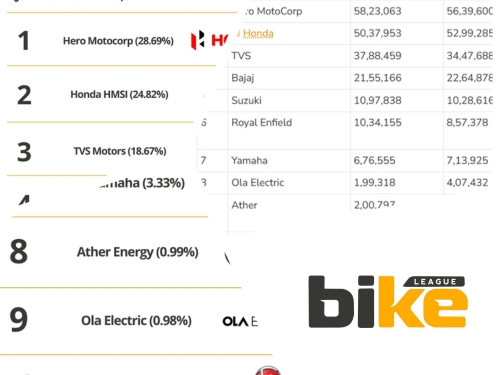
Long story short: Here are the official top 10 bike and scooter brands in India by market share for 2025. See the full rankings, sales numbers, and market share percentages below.
India’s two-wheeler industry is one of the largest and most active globally. In 2025, the market shows a mix of long-standing preferences and new trends in mobility. This report looks at the latest market share data to highlight the leading brands, growing segments, and the impact of electric two-wheelers. Whether you are an industry professional, investor, or enthusiast, this overview prepares you for a data-focused look at the top 10 bike and scooter brands in India by market share in 2025.
Key Takeaways
- Hero, Honda, and TVS maintain their dominance in India’s two-wheeler market due to strong brand presence, affordability, and extensive distribution networks.
- The rise of Royal Enfield and Ather reflects a growing consumer interest in premium motorcycles and electric vehicles, signalling diversification in buyer preferences.
- Electric vehicles, while still a small segment, are steadily gaining ground, with new entrants and established players investing in EV technology and infrastructure
- Shifts in market share demonstrate the impact of changing consumer expectations, with reliability, service quality, and innovation becoming increasingly important
- The industry is poised for further transformation as evolving mobility needs and regulatory changes continue to shape competition and growth strategies.
Top 10 Bike And Scooter Brands In India By Market Share In 2025 As A Table And Analysis
In 2025, India’s two-wheeler market continued to recover, with top brands accounting for the majority of retail registrations. Hero MotoCorp stayed in the lead, while Honda, TVS, Bajaj, and Suzuki influenced the market with their motorcycles, scooters, and premium models.
A major trend in 2025 is the clear divide between brands that focus on motorcycles and those that focus on scooters. Hero and Bajaj mainly sell motorcycles, while Honda and Suzuki perform better with scooters. TVS offers a good mix of both. Although the electric segment is still small, brands like Ather and Ola are making a mark in the premium EV market.
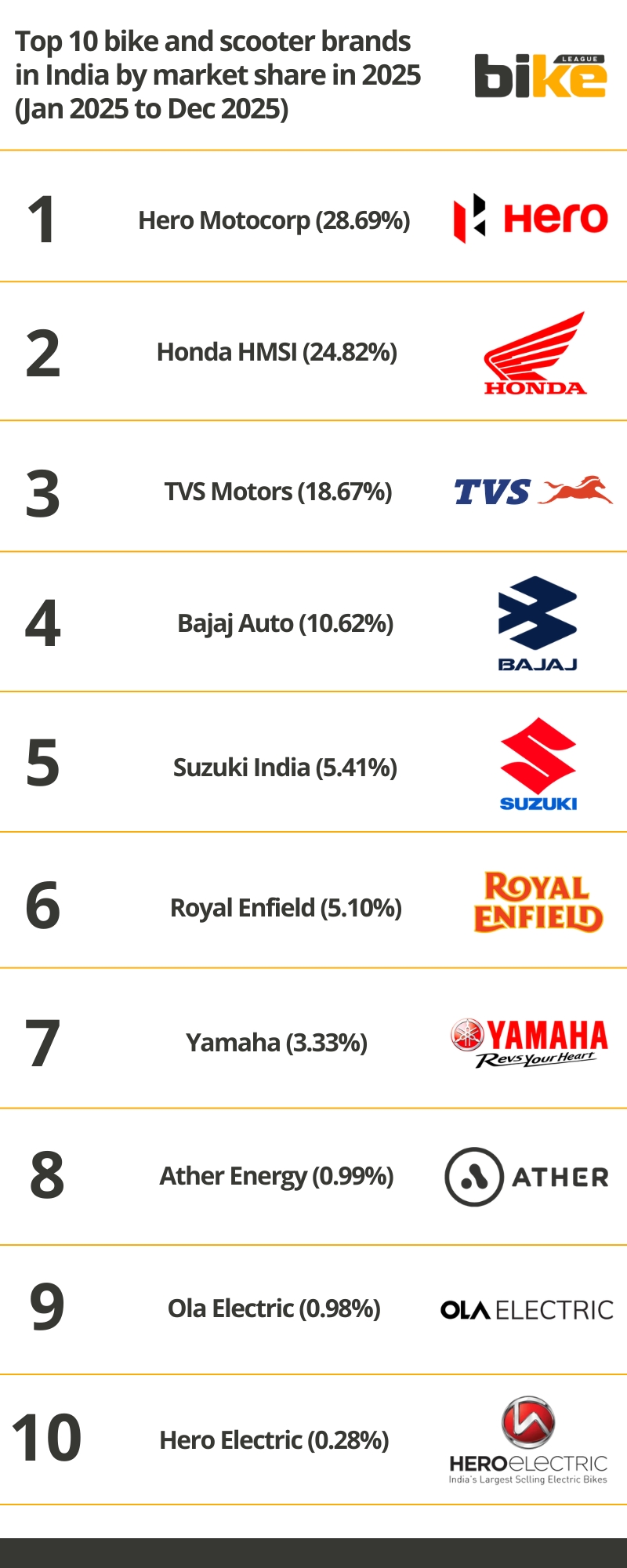
| Rank | Brand | Exact Sales (Units) | Market Share (%) |
|---|---|---|---|
| 1 | Hero Motocorp | 5,823,063 | 28.69% |
| 2 | Honda HMSI | 5,037,953 | 24.82% |
| 3 | TVS Motor | 3,788,459 | 18.67% |
| 4 | Bajaj Auto | 2,155,166 | 10.62% |
| 5 | Suzuki India | 1,097,838 | 5.41% |
| 6 | Royal Enfield | 1,034,155 | 5.10% |
| 7 | Yamaha | 676,555 | 3.33% |
| 8 | Ather Energy | 200,797 | 0.99% |
| 9 | Ola Electric | 199,318 | 0.98% |
| 10 | Greaves EV / Hero Electric | 56,486 | 0.28% |
| Total | 1,95,42,833 | 100% |
Notes
Here’s a quick look at the CY25 two-wheeler market data. The main point is that Hero, Honda, and TVS still lead the market, but the biggest changes are in market share: TVS, Royal Enfield, Suzuki, and Ather gained, while Honda, Bajaj, Yamaha, and Ola lost ground.
Market Concentration
The top three brands make up about 72% of the market, showing how concentrated India’s two-wheeler industry is. Hero leads with 28.69%, followed by Honda at 24.82%, and TVS at 18.67%.
Mass-market Leaders
Hero remained the top seller by focusing on commuter motorcycles, where price, mileage, and a large dealer network matter most. Honda stayed close behind thanks to its strong scooter sales and steady demand for commuter bikes, though it lost the most market share among the big brands. TVS gained the most by offering a balanced mix of scooters, motorcycles, and EVs.
Mid-premium Winners
Royal Enfield stands out as the main premium growth story. Its mid-weight motorcycles, especially the Classic, Bullet, Hunter, and Meteor, continued to attract buyers and pushed the brand’s market share above 5%. Suzuki also improved a bit, mainly thanks to its scooters, while Yamaha stayed steady but did not grow enough to gain share.
Ev Segment Picture
The EV market is still small but is becoming more competitive. Ather increased both its market share and sales, showing strong momentum, while Ola’s sales dropped sharply and its share fell below 1% in 2025. This suggests that EV buyers now value service, trust, and ownership experience more than hype.
What Stands Out
TVS saw the biggest increase in sales among established brands, while Honda lost the most market share. Royal Enfield had the strongest growth in the premium segment, and Ola had the weakest growth among EV brands. In short, brands with strong products and reliable ownership were rewarded, while those with poor execution or lost customer trust fell behind.
Brand-wise Analysis Of The Market Share Of The Top 10 Bike And Scooter Brands In India In 2025
1. Hero Motocorp
Hero MotoCorp retained its top spot, selling 5,823,063 units and holding a 28.69% market share. Its success is mainly due to popular commuter motorcycles such as the Splendor, HF Deluxe, and Passion, which remain the core of its lineup.
Hero’s main strengths are its low prices, big dealer network, and strong demand in rural areas. The brand still has a few electric models, but its lead in commuter bikes keeps it ahead. Growth in 2025 was also helped by steady festival demand and new versions of its main models.
Click this link to know more: Hero Motocorp
2. Honda Hmsi
Honda maintained second place, selling 5,037,953 units and holding a 24.82% market share. The Activa scooter remained its best-seller and led the scooter market, while the Shine and Unicorn models supported its motorcycle sales.
Honda focuses more on scooters than Hero, which helps it succeed in cities and towns. In 2025, it saw steady demand for both scooters and commuter motorcycles. New model versions and a steady supply also helped its sales.
Click this link to know more: Honda
3. Tvs Motor

TVS Motor sold 3,788,459 units and held an 18.67% market share, making it one of India’s fastest-growing big brands. Unlike Hero or Honda, TVS has a good balance of scooters and motorcycles, with models like Jupiter, NTorq, Apache, and Raider leading its success.
TVS is known for sporty designs and products with good features at fair prices. It also saw more interest in its electric iQube and steady demand for its 125cc motorcycles. This mix makes TVS one of the most flexible brands in the market.
Click this link to know more: TVS
4. Bajaj Auto

Bajaj Auto sold 2,155,166 units, accounting for 10.62% market share. Most of its sales come from motorcycles such as the Pulsar, Platina, and CT series, with the Pulsar still a key name in the premium commuter segment.
Bajaj focuses more on motorcycles than scooters, which gives it a clear market identity. Its strength comes from both high-volume commuter bikes and sporty models. In 2025, Bajaj remained a strong player in India, even though its share was lower than that of the top three brands.
Click this link to know more: bajaj
5. Suzuki India

Suzuki India sold over 1.09 million units, achieving a 5.41% market share. Its sales were led by scooters, especially the Access and Burgman Street, which are important products in the 125cc segment.
Suzuki has fewer motorcycles than scooters, so it is strongest in city and family transport. The brand is known for making simple, easy-to-use, and reliable products. Its 2025 results show that focusing on scooters can still bring strong sales in India.
Click this link to know more: Suzuki
6. Royal Enfield
Royal Enfield sold 1,034,155 units, achieving a 5.10% market share. It remains the top brand in the mid-weight motorcycle segment, with the Classic 350, Meteor 350, and Hunter 350 making up most of its sales.
Royal Enfield stands out from mass-market brands by selling lifestyle motorcycles instead of just utility commuters. Its growth in 2025 came from the steady popularity of retro-styled, premium single-cylinder bikes. The brand also attracts buyers with its strong image and a growing customer base in both cities and smaller towns.
Click this link to know more: Royal Enfield
7. Yamaha

Yamaha sold 676,555 units and held a 3.33% market share. Most of its sales came from performance motorcycles such as the R15 and FZ series, as well as scooters such as the Fascino.
Yamaha is known for sporty designs and a youthful image. It does not compete directly with the top commuter brands, but it has built a strong following among buyers who care about style and performance. In 2025, Yamaha remained relevant despite increased competition in the 125cc and 150cc segments.
Click this link to know more: Yamaha
8. Ather Energy

Ather Energy sold 200,797 units, accounting for 0.99% market share. It remained one of the top premium electric scooter brands in India, led by the 450X and other high-end EVs.
Ather’s growth reflects the slow rise of electric two-wheelers in cities, especially among buyers seeking advanced technology and design. Its market share is still small compared to older brands, but its impact in the premium EV segment is bigger than the numbers suggest. In 2025, Ather continued to grow in major cities.
Click this link to know more: Ather
9. Ola Electric

Ola Electric sold 199,318 units and held a 0.98% market share. It remained one of the largest EV-only brands in India, even though its sales dropped sharply from last year.
Ola only makes electric scooters and still has strong brand recognition among EV buyers. In 2025, its results showed better inventory balance and a more careful production strategy. Even with lower sales, Ola is still an important name in India’s electric two-wheeler market.
Click this link to know more: Ola
10. Greaves Ev / Hero Electric
Greaves EV and Hero Electric together sold 56,486 units, making up 0.28% of the market. Most of their sales come from entry-level electric scooters and mopeds, aimed at budget-conscious buyers in cities and towns.
This segment is still much smaller than the main petrol market, but it plays an important role in affordable electric transport. Unlike Ather and Ola, Greaves and Hero Electric focus on the more price-sensitive side of the EV market. Their place in the top 10 shows that electric vehicles are still new but growing steadily.
Click this link to know more: Hero Electric
Analysis Of Top 10 Bike And Scooter Brands In India By Market Share In 2025 Vs 2024
Here’s a look at the brand data for 2025 compared to 2024. The top brands kept most of the market, but the main change was in how their shares shifted, not in who led the market.
| Rank | Brand | 2025 Sales (Units) | 2024 Sales (Units) | Unit Difference | 2025 Share | 2024 Share | Share Difference |
|---|---|---|---|---|---|---|---|
| 1 | Hero MotoCorp | 58,23,063 | 56,39,600 | +1,83,463 | 28.69% | 28.8% | -0.11 pp (-0.38%) |
| 2 | Honda | 50,37,953 | 52,99,285 | -2,61,332 | 24.82% | 27.1% | -2.28 pp (-8.41%) |
| 3 | TVS | 37,88,459 | 34,47,688 | +3,40,771 | 18.67% | 17.6% | +1.07 pp (+6.08%) |
| 4 | Bajaj | 21,55,166 | 22,64,878 | -1,09,712 | 10.62% | 11.5% | -0.88 pp (-7.65%) |
| 5 | Suzuki | 10,97,838 | 10,28,616 | +69,222 | 5.41% | 5.2% | +0.21 pp (+4.04%) |
| 6 | Royal Enfield | 10,34,155 | 8,57,378 | +1,76,777 | 5.10% | 4.3% | +0.80 pp (+18.60%) |
| 7 | Yamaha | 6,76,555 | 7,13,925 | -37,370 | 3.33% | 3.6% | -0.27 pp (-7.50%) |
| 8 | Ola Electric | 1,99,318 | 4,07,432 | -2,08,114 | 0.98% | 2.0% | -1.02 pp (-51.00%) |
| 9 | Ather | 2,00,797 | 1,42,384 | +58,413 | 0.99% | 0.7% | +0.29 pp (+41.43%) |
| 10 | Greaves EV / Hero Electric | 56,486 | — | — | 0.28% | — | — |
| 10 | KTM | — | 58,230 | — | — | 0.2% | — |
Notes:
- The 2024 list includes KTM in the top 10, while the 2025 list lists Greaves EV/ Hero Electric instead.
- pp means percentage points, which is the cleanest way to show market share movement.
- The percentage in parentheses shows the relative change in share from 2024 to 2025.
- TVS was the biggest gainer in volume among the major legacy brands, adding 3,40,771 units.
- Honda saw the biggest share decline, down 2.28 points.
- Royal Enfield and Ather both saw their shares improve.
- Ola Electric lost both volume and share sharply.
Market Structure
- Hero remained the biggest two-wheeler brand in both years, but its share dropped slightly from 28.8% to 28.69%. This shows steady leadership rather than big growth.
- Honda kept its second-place spot, but it lost the most among the big brands, dropping from 27.1% to 24.82% and losing 2.28 percentage points of market share.
- TVS was the biggest winner among the main brands, rising from 17.6% to 18.67% and adding 340,771 units year over year.
Winners And Losers
- Royal Enfield had one of the best results, growing from 857,378 units in 2024 to 1,034,155 in 2025 and increasing its share from 4.3% to 5.10%.
- Suzuki also improved, but by a smaller amount, moving from 5.2% to 5.41% market share.
- On the other hand, Bajaj lost both sales and market share, while Yamaha’s share dropped slightly from 3.6% to 3.33%.
Ev Segment Shift
- .The electric two-wheeler market had mixed results. Ola Electric saw the biggest drop, going from 407,432 units and a 2.0% share in 2024 to 199,318 units and a 0.98% share in 2025.
- Ather moved in the opposite direction, increasing from 142,384 units and a 0.7% share to 200,797 units and a 0.99% share.
- This means the EV market did not shrink evenly. Instead, buyers moved away from Ola and toward Ather and other smaller brands.
Takeaways
The top six brands stayed the same, showing that India’s two-wheeler market is very stable. The main shifts were in market share: TVS and Royal Enfield grew, while Honda and Bajaj lost ground. EV brands became more competitive but are still a small part of the market. Overall, 2025 saw steady leadership and some growth in the middle, rather than a major shake-up.
What Are The Factors Behind The Massive Growth Of Royal Enfield In India In 2025 Compared To 2024?
Royal Enfield was one of the top performers in the data. Its sales rose from 857,378 in 2024 to 1,034,155 in 2025, a gain of 176,777 units. Its market share also increased from 4.3% to 5.10%, an 18.6% increase, which was among the best among major brands.
This growth came from Royal Enfield’s main mid-weight models, especially the Classic 350, Bullet 350, Hunter 350, and Meteor 350, which are the core of its sales. Reports from 2025 and early 2026 show Royal Enfield passing the 1 million domestic sales mark, showing that its growth is part of a bigger trend in premium bikes, not just a one-time jump.
Royal Enfield’s growth came from strong demand for its 350cc models, price support, a wide product range, exports, and steady momentum in premium bikes. The brand also benefited from crossing the 1 million domestic sales milestone in 2025, which shows the growth was broad-based, not just a one-month spike.
350cc Strength
The biggest driver was Royal Enfield’s 350cc lineup, especially the Classic 350, Bullet 350, Hunter 350, and Meteor 350. In 2025, the Classic 350 remained the top-selling model, accounting for a large share of sales in the 250-350cc class. This matters because Royal Enfield has a near-dominant position in that segment, which gives it pricing power and steady buyer demand.
Price Support
Another key factor was price cuts after GST 2.0 benefits were passed on to customers. Royal Enfield lowered prices on its popular 350cc motorcycles by up to Rs 22,000, which likely helped sales in the core mass-premium segment. For a brand like Royal Enfield, even a small price change can have a big impact, since many customers take time to decide.
Premium Demand
Royal Enfield also benefited from a wider market shift toward premium motorcycles. The brand has built a strong lifestyle image, which has helped it recover in the midsize segment over the last few years. Its 650cc lineup also stayed strong, with a high share in its category, showing that Royal Enfield is not dependent on a single product range.
Exports And Momentum
Growth was not limited to India. Exports rose sharply in 2025, and monthly sales crossed 100,000 units for three straight months from August to October, with October reaching a record high. This steady monthly growth usually means healthy demand, strong retail pull, and good product acceptance across markets.
What Are The Reasons Behind The Downfall Of Ola In India In 2025 Compared To 2024?
Ola’s decline is mainly due to service issues, customer trust concerns, and execution gaps. The company itself admitted that service challenges hurt brand trust and reduced sales in the last few quarters.
Another issue is the ownership experience. Ola faced complaints about scooter reliability, delayed repairs, and vehicles sitting at service centres for long periods, which is especially damaging for a daily-use EV. Once trust weakens, even strong branding and aggressive pricing cannot fully protect sales.
Ola Electric’s decline was mainly due to service issues, trust concerns, quality complaints, and much stronger competition. In your data, Ola dropped from 407,432 units in 2024 to 199,318 in 2025, and its market share fell from 2.0% to 0.98%, showing a sharp loss of momentum.
Service Failures
The biggest issue was after-sales service. Reports say Ola’s CEO admitted that service challenges hurt brand trust, and customers complained that scooters stayed at service centres for long periods without timely repairs. When buyers do not trust the service network, they hesitate to buy again or recommend the brand.
Product Trust
Ola also faced repeated complaints about scooter reliability, technical issues, and unresolved defects. Even when a product has good features, EV buyers are highly sensitive to breakdowns because the scooter is their daily mode of transport, not just a lifestyle purchase. That made every unresolved issue more damaging than it would be for some other products.
Faster Rivals
While Ola struggled, rivals improved their positions. TVS, Bajaj, Ather, and Hero Vida gained ground in the electric scooter market, pushing Ola down in the rankings. In your data, Ather grew from 142,000 units to 201,000 units, while Ola nearly halved in volume, so the competitive gap clearly widened.
Faq About The Top 10 Bike And Scooter Brands In India By Market Share In 2025
1. Which Are The Top 3 Two-wheeler Brands In India By Market Share In 2025?
Hero MotoCorp, Honda HMSI, and TVS Motor are the top three brands, together accounting for about 72% of the market.
2. What Factors Contributed To Hero Motocorp’s Market Leadership In 2025?
Hero’s dominance comes from its strong commuter motorcycle lineup, affordable pricing, extensive rural reach, and robust dealer network.
3. How Did Electric Two-wheelers Perform In 2025, And Which Brands Stood Out?
The EV segment remained small but grew steadily. Ather Energy gained momentum, while Ola Electric lost ground due to service and trust issues.
4. Why Did Royal Enfield See Significant Growth In 2025?
Royal Enfield’s strong performance was driven by demand for its 350cc models, price cuts following the GST, a premium brand image, and increased exports.
5. What Caused Ola Electric’s Sharp Decline In Sales And Market Share In 2025?
Ola Electric’s downfall was mainly due to poor after-sales service, reliability concerns, and stiff competition from other EV brands.
6. How Did Honda’s Market Share Change In 2025, And Why?
Honda lost the most market share among the major brands, mainly due to increased competition and a decline in its core commuter motorcycle segment.
7. Which Brands Gained The Most Market Share In 2025?
TVS Motor and Royal Enfield were the biggest gainers in both volume and market share among the top brands.
8. What Is The Split Between Motorcycle And Scooter-focused Brands?
Brands like Hero and Bajaj focus mainly on motorcycles, while Honda and Suzuki are stronger in scooters. TVS maintains a balanced mix of both.
9. How Did The Premium And Mid-premium Motorcycle Segments Perform?
Royal Enfield led the premium segment with strong sales of mid-weight bikes, while Yamaha maintained a steady presence in the performance category.
10. What Are The Key Trends Shaping India’s Two-wheeler Market In 2025?
Key trends include the steady rise of electric vehicles, the growing importance of product reliability and customer service, and the shift toward premium models.
Other Related Articles From Bikeleague India
- Two-wheeler company wise market share in India in FY24-25
- EV Two-Wheeler Brand Preferences in India in FY25
- Oldest motorcycle brands that have stood the test of time
- Two-Wheeler Brand Preferences in India
- List of all Motorcycle, Scooter & E-bike brands in India
Conclusion
The 2025 market share data for India’s two-wheeler industry shows a market shaped by both strong established brands and new competition. Hero, Honda, and TVS remain leaders because of their focus on affordability, practicality, and wide distribution. Meanwhile, the growth of brands like Royal Enfield and Ather points to rising interest in premium and electric segments.
Although electric vehicles remain a small fraction of the total market, their gradual growth and the shifting fortunes of key players reflect a market in transition. Ultimately, customer trust, product reliability, and service quality will determine which brands thrive as India’s mobility needs evolve in the coming years.
If you have questions about the top motorcycle or bike brands in India for 2025, based on market share and sales, feel free to email us at bikeleague2017@gmail.com or leave a comment below. We are always happy to help. You can also contact Bikeleague India on social media.