Overview
Performance & Engine
The 50 SX runs on a 49.9 cc single-cylinder, liquid-cooled 2-stroke engine. Indian spec sheets show it makes about 5.3 to 5.4 PS at high rpm and around 5.2 Nm of torque. This gives a sharp but manageable power delivery, tuned for the quick bursts needed on junior tracks. The engine uses powervalve technology (PCEV, or pressure-controlled exhaust valve) and race-grade induction parts to give small riders a wider powerband. KTM keeps the engine simple and sturdy, so maintenance is easy for Indian owners and teams. You can expect quick throttle response and a motor that works best when you keep the revs up on short, technical laps at Indian academies. Regular cleaning of the powervalve and careful jetting are important in India’s dusty, hot conditions.
The KTM 50 SX uses a simple, rider-friendly transmission that suits its young target riders. Many versions come with an automatic or centrifugal clutch, or a single-speed automatic transmission for the youngest riders. Some variants in India may offer a manual or adjustable centrifugal clutch, depending on the market and dealer. The main goal is to deliver power smoothly and reliably, so beginners can focus on balance and learning lines. When manual gearing is used, the gear ratios are close together to keep the engine in its powerband. Indian teams often change sprockets to adjust acceleration for local tracks.
Top speed is not the main focus for the 50 SX. The bike is designed for quick acceleration and easy-to-learn power delivery, not for high speed. Indian and international specs show top speeds of about 60 to 75 km/h, depending on gearing, rider weight, and the type of transmission. On most Indian junior tracks, riders rarely reach these top speeds because the focus is on controlled corner exits and learning racing skills.
Mileage & Fuel Efficiency
The 50 SX is a race-focused two-stroke minicycle and is not tested by ARAI like commuter bikes. Official ARAI figures for this type of bike are usually not published in India. Some Indian websites mention theoretical or ‘ARAI-style’ numbers, often around 30 kmpl, but these are just rough estimates and do not reflect real on-track use. They should only be used as a basic guide for fuel planning.
Indian riders report that the 50 SX typically delivers 20 to 30 kmpl, depending on how it is ridden. Light transfers or road shuttles give better mileage, while track use with lots of high revs lowers it to the low 20s. The small tank, about 2.3 litres, means the real-world range is limited—about 45 to 70 km per tank with mixed or transfer use, and much less with heavy track riding. Because of this, Indian users often plan short transfers or carry extra fuel when moving between venues.
Features & Technology
Here are the features and technologies of the KTM 50 SX, with each point highlighting details and practical notes relevant for Indian owners, academies, and teams.
- Motocross only race identity: The 50 SX is offered in India as a purpose built junior motocross sportminicycle (not road legal), targeted at very young riders, academies and club programmes so every component and accessory is focused on track performance and teachability.
- Engine displacement and character: 49.9 cc, single cylinder, liquid cooled two stroke engine tuned for peaky, high revving performance that gives sharp, controllable bursts of acceleration ideal for junior circuits in India.
- Power and torque (India figures): Manufacturer/portal listings list peak output at about 5.3–5.4 PS and peak torque at about 5.2 Nm — sufficient for quick exits from corners and safe progression for beginners.
- Powervalve / PCEV system: A pressure controlled exhaust valve broadens the usable powerband so small riders get manageable low speed manners plus stronger mid to top end pull—important on Indian tracks where quick bursts matter.
- Fuel tank: Very small 2.3 litre racing tank (India spec) sized for short sessions; Indian owners routinely plan transfers and may carry a small reserve due to the limited range.
- Transmission options for India: Market/configuration dependent — many 50 SX units use a single speed/automatic (centrifugal) clutch for the youngest riders, while dealer/market variants in India may offer a simple manual gearbox or manual with centrifugal clutch, depending on user preference.
- Drivetrain and gearing flexibility: Where manual gearing exists, it’s closely spaced to keep the two stroke in its powerband; Indian teams commonly change sprockets to prioritise acceleration on tight club circuits or taller gearing for faster youth tracks.
- Frame and chassis: Chrome moly central tube / double cradle frame scaled for juniors provides balanced stiffness and controlled flex, helping youngsters learn jump landings and line choice on varied Indian surfaces.
- Suspension: WP XACT class junior suspension — 35 mm USD forks and WP monoshock with adjustability — tuned for predictable damping and easy track side valving changes suitable for India’s mix of hard packed plains and softer hill tracks.
- Brakes and wheels: Disc brakes front and rear (both around 160 mm in many Indian specs) with small spoke wheels (12 inch front, 10 inch rear) and tubed tyres, providing strong stopping and simple, repairable wheel setups for regional tracks and pit mechanics.
- Weight and ergonomics: Extremely light kerb weight (~41–45 kg depending on spec) and low seat height (~653 mm) make the 50 SX accessible to very young Indian riders, reducing fatigue and building rider confidence quickly.
- Ground clearance and geometry: Ground clearance (~233 mm) and short wheelbase (~1,026 mm) offer obstacle clearance while keeping the bike flickable for quick direction changes on tight junior circuits in India.
- Cooling and heat management: Liquid cooling with compact radiators designed to withstand India’s high ambient temperatures; Indian owners commonly fit radiator guards and monitor coolant levels during extended hot season use.
- Starting system: Many Indian listings show a simple kick start arrangement or minimal electric starting, depending on variant — the emphasis is on reliability and low complexity for paddock use.
- Electronics and instrumentation: A minimalist, race focused dash (basic digital readout) keeps the bike mechanically simple and robust for dusty, high vibration Indian environments, making diagnostics and training easier for academy mechanics.
- Protective OEM components: Fork guards, skid protection and robust fasteners are supplied or frequently fitted in India to protect vulnerable parts from stone strikes and abrasive wash downs at local circuits.
- Variant and livery in India: Sold in India as a single race spec variant (standard 50 SX) with KTM’s factory livery; this uniform offering simplifies spare panel inventory and fleet purchases for academies and teams.
Build Quality
KTM builds the 50 SX with a strong chromium-molybdenum central-tube (double-cradle) frame, forged connecting parts, and quality welds. This gives the bike solid strength for repeated jumps and landings at Indian tracks. The bike comes with race-grade parts like the WP XACT AER or XACT 35 mm USD fork, WP monoshock, quality bearings, and strong fasteners. These features give the minicycle a real race feel and reliable durability when serviced as KTM recommends. Indian academy owners say this helps prevent early wear compared to cheaper mini bikes.
The finish and panel quality on India-supplied units meet KTM’s READY TO RACE standards, with neat decals, UV-resistant plastics, and well-trimmed seat covers. Indian owners often add protective parts like fork guards, skid plates, and clear frame guards to protect against stones and dust at local tracks. Since most 50 SXs in India are sold through KTM’s authorized dealers, buyers in metro areas have good access to spare panels and technical support. Those in smaller towns should plan for possible parts delays or keep basic spares like chains, sprockets, and filters on hand during race season.
Handling
The 50 SX is very light, weighing about 41 to 45 kg depending on the version, and has a compact design. This makes it easy to handle and helps young riders build confidence as they learn line choice and balance on India’s tight club circuits. The chromoly frame’s balanced stiffness and short wheelbase give the bike neutral steering, steady cornering, and stable landings. Indian coaching schools value these traits because they help juniors develop body position and throttle timing faster than heavier bikes.
The WP XACT junior suspension, with a 35 mm USD fork (some versions have an air/AER cartridge) and a WP monoshock, provides smooth damping and can be easily adjusted at the track. Mechanics can quickly set compression and rebound for local conditions, using firmer settings for hard-packed tracks and softer ones for loamy hill circuits like those in the Western Ghats. Since the 50 SX has a sharp power delivery, Indian teams often adjust sprockets and suspension together to improve traction and acceleration for each track. This helps young riders get better drive out of corners and reduces rear wheel spin on dusty surfaces.
Comfort
Comfort on the 50 SX focuses on control, easy learning, and low fatigue, not a soft ride. The low seat height (about 653 mm) and narrow bodywork help small riders grip the bike with their knees and shift their weight easily during rhythm sections at Indian tracks. The firm, race-style suspension gives a lot of feedback from the track. Experienced juniors use this to feel grip and surface changes, while beginners might find it harsh at first. Setting up the suspension correctly, such as adjusting air pressure or spring preload, makes the bike easier to handle and helps riders last longer in sessions.
For comfort in India, owners need to consider the small 2.3-litre tank and heat management. Radiator shrouds and liquid cooling help with high temperatures, but the small fuel tank means owners plan short transfers and carry extra fuel when moving between venues. Academies and families often make small ergonomic changes, like fitting smaller grips, adjusting lever reach, or changing seat foam, to help growing riders stay comfortable and confident. These adjustments are common in Indian training programs.
Styling
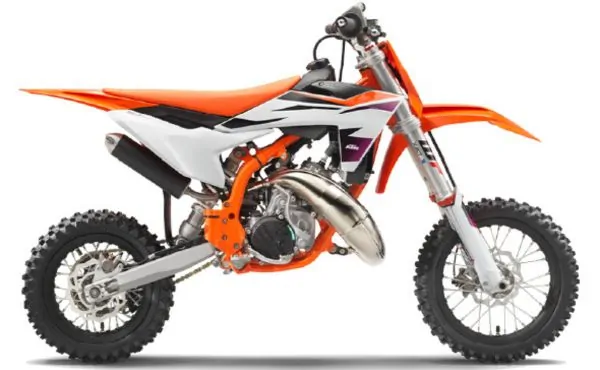
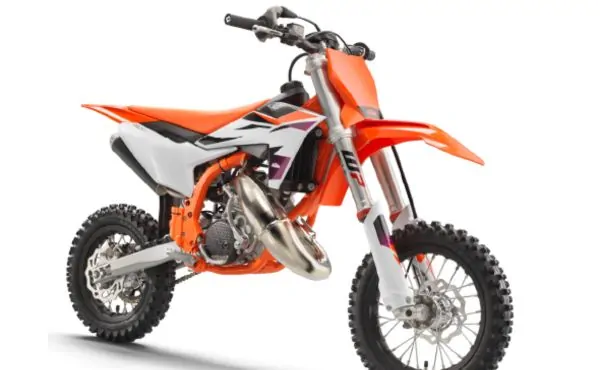
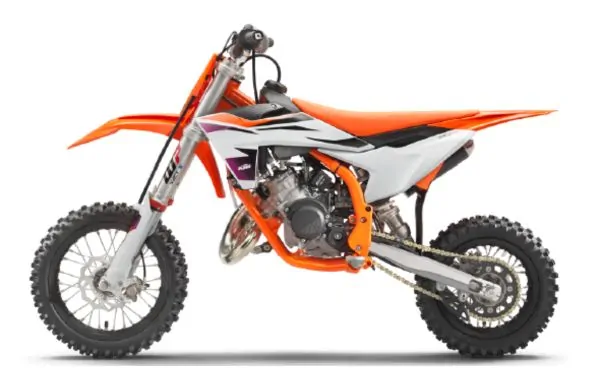
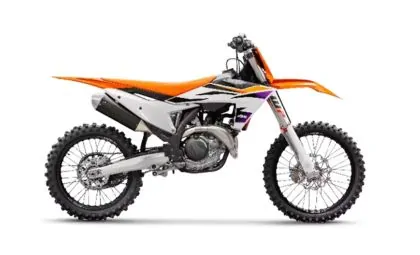
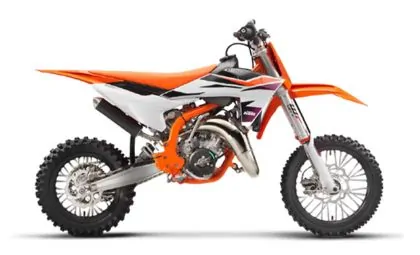
The 50 SX looks like a smaller version of KTM’s full-size SX bikes, with slim, angular plastics and shaped radiator shrouds that focus on function for Indian tracks. The bodywork is narrow and fits closely to the frame, so small riders can grip the bike with their knees and move easily between standing and sitting during rhythm sections and berms at Indian club circuits. The radiator shrouds and side panels are designed to direct airflow and allow quick access to the airbox and powervalve for routine servicing, which is useful in India, where jetting and powervalve checks are common after dusty sessions.
The surface finish and decal quality on India-supplied units meet KTM’s READY TO RACE standards, with UV-resistant plastics, neat graphics, and well-trimmed seats that hold up to frequent washing and dust. Teams and private riders in India often add low-profile protective parts like fork guards, skid plates, and clear frame guards to protect high-impact areas without changing the bike’s race look. These additions help the bike last longer on tracks with lots of stones.
Color Options & Variants
KTM India markets the 50 SX primarily in the brand’s iconic
- Orange
The 50 SX is sold in India in a single factory colour, Electronic or Signature Orange, according to dealer listings and Indian websites. This single-colour policy makes it easier for academies and race teams to manage spare panels and decals, speeds up crash repairs, and keeps bikes looking uniform at events. Riders who want a different look often use removable decals, custom seat covers, or anodized small parts like grips and lever guards. This lets them personalize the bike without changing the original plastics or affecting warranty and parts support.
In India, the 50 SX is available as a single standard race-spec variant, often called the ’50 SX STD.’ This reflects its role as an entry-level race minicycle for academies and young private riders. The standard version comes with all the main race parts, like the chromoly frame, WP junior suspension, and powervalve engine, so buyers get a ready-to-race package without having to choose between factory trims.
Value For Money & Pricing
KTM India sells the 50 SX as a factory motocross minicycle for the Indian market. Dealer and website listings show an ex-showroom price of ₹ 4,75,000 for the standard 50 SX. Since it is a premium, factory-imported motocross bike, buyers should also budget for extra race costs like tyres, chains, sprockets, spare plastics, and skid plates, as well as possible transport costs if they live far from metro dealer hubs.
The 50 SX is a good value for families, academies, and privateer programs looking for a real, ready-to-race minicycle for young riders. It comes with a chromoly frame, powervalve two-stroke engine, and WP-class junior suspension in a compact, ready-to-use package. This means a few upgrades are needed right away for junior sprint racing.
Academies benefit from having all bikes the same: identical specs and a single colour make setup, spare parts, and rider progress easier. This helps spread out the higher upfront cost over many students or rental days. For casual buyers or families who want a bike for both off-road and road use, the 50 SX’s race-only focus, small tank, and two-stroke maintenance needs (like powervalve servicing and frequent filter changes) make it less practical and more expensive than trail or cheaper junior bikes. The investment pays off mainly with frequent track use, academy rentals, or resale within the racing community.
Competitor models in India are
- Kawasaki KX112
- Kawasaki KX85
- Kawasaki KLX 140R F