
From legal requirements to maintenance advice, our blog helps you learn in depth about bike fitness certificates, costs, renewal, and downloads to keep your rides legal and safe in India.
Many people look for a “bike fitness certificate” when their motorcycle reaches 15 years old. There are two main processes. If you have a private (non-transport) motorcycle, you need to renew your registration certificate (RC), which may include a roadworthiness check.
If your motorcycle is registered as a transport vehicle, you need a fitness certificate (FC). This guide will help you figure out which process you need, what to prepare, and where to check your state’s rules.
Key Takeaways
- Check your RC first: private (non-transport) and transport motorcycles follow different processes. Most riders need RC renewal, not a transport FC.
- Private-bike RC renewal uses Form 25 and can be applied for up to 60 days before expiry.
- Inspections may be done at an RTO or an authorised testing station. Which one applies depends on your vehicle category and state.
- Electric two-wheelers follow the same category logic. Low-speed e-bikes (up to 25 km/h and 250 W) are generally treated differently, so check your state’s rules.
- Riding with an expired RC or no valid FC can bring penalties. The exact provision and amount depend on the situation. See the penalties section.
- Timely renewal, complete documents, and a pre-inspection workshop check make the process smoother.
Which Process Applies To Your Motorcycle?
| Your bike | What you need | Where to apply |
|---|---|---|
| Private (non-transport) motorcycle or scooter | Renewal of registration (RC) | Form 25, “Renewal of Registration” on Parivahan |
| Motorcycle registered as a transport vehicle | Fitness certificate (FC) | Fitness services on VAHAN |
| Electric two-wheeler | Same as above, based on its registered category | Same as above |
Check the vehicle class and usage on your RC. If you are unsure which applies, ask your RTO before paying any fees.
What Is A Motorcycle Fitness Certificate?
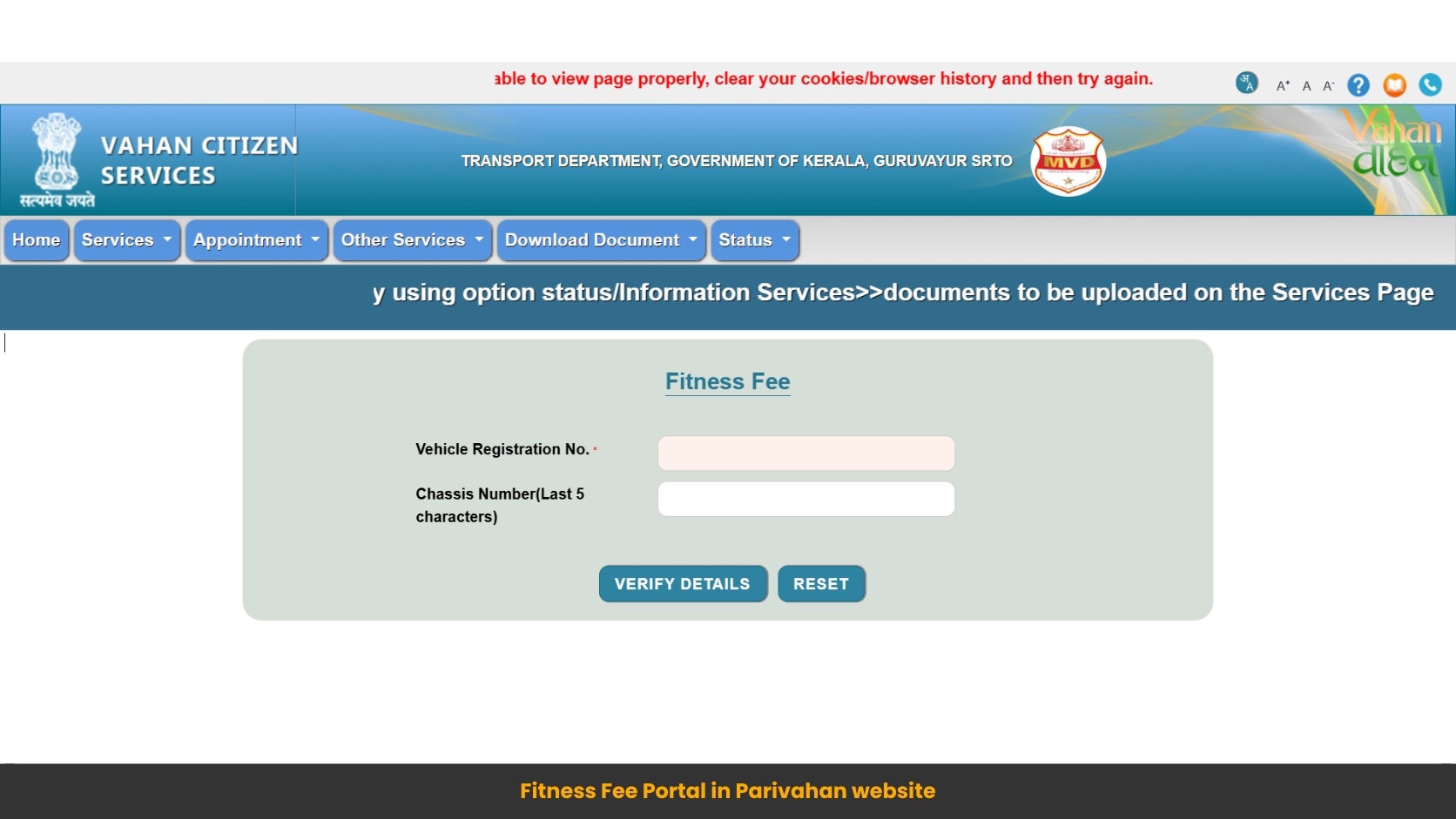
The Regional Transport Office (RTO) or a similar authority in your area gives out Vehicle Fitness Certificates. This important document shows that your vehicle meets the safety and emission standards set by the RTO. It confirms that key parts like brakes, lights, and steering are working properly and that your vehicle is roadworthy and compliant.
Importance Of A Bike Fitness Certificate In India
1. Ensures Safety And Reduces Emissions
Having a valid FC means your motorcycle is safe to ride, which lowers the chance of accidents from mechanical problems. Regular checks also help spot and fix emission issues, making the air cleaner.
2. Legal Compliance
Riding with an expired registration or, for transport vehicles, without a valid fitness certificate can attract penalties under the Motor Vehicles Act. The amount depends on the offence and the state. See the penalties section below for details.
3. Cost Savings
Getting your FC checked regularly can help you save money by catching problems early and avoiding costly repairs down the line.
4. Environmental Benefits
Renewing your bike fitness certificate on time helps keep emissions low, which reduces pollution and supports a healthier environment.
Issuance Authority For Bike Fitness Certificates In India
1. Role Of The Regional Transport Office (rto)
The Regional Transport Office (RTO) is the main authority that gives out motorcycle fitness certificates in India. Either the RTO or an authorised testing station will inspect your motorcycle and issue the certificate. This process makes sure your vehicle meets the needed safety and emission standards.
2. Central Government Regulations
The Ministry of Road Transport and Highways (MoRTH) sets the overarching regulations for vehicle fitness through the Central Motor Vehicles Rules, 1989. Under Section 56 of the Motor Vehicles Act, a fitness certificate is a condition of valid registration for transport vehicles, and the prescribed authority or an authorised testing station can issue it. Testing through registered Automated Testing Stations (ATS) became mandatory for heavy, medium and light goods and passenger transport vehicles from 1 October 2024, after an extension from 1 June 2024 (Economic Times). The Act also allows the Central Government to extend these provisions to non-transport vehicles, subject to conditions it prescribes.
| Date | What happened |
|---|---|
| 2021 | The ministry said state governments, companies, associations and other bodies could open ATS to test both personal and transport vehicles. |
| April 2022 | MoRTH announced that heavy, medium and light goods and passenger vehicles must be tested at ATS from 1 June 2024. |
| 1 June 2024 | Original date for mandatory ATS testing of heavy, medium and light goods and passenger transport vehicles. |
| 1 October 2024 | Extended date for mandatory ATS testing of those transport vehicles. |
3. State Government Involvement
The central government sets the rules, but state RTOs are the ones who issue fitness certificates and do the inspections. If you apply for a fitness certificate online through the Parivahan Sewa website, you need to choose your state and the right RTO. This way, the central government makes the rules and the states carry them out.
4. Automated Testing Stations (ats)
Automated Testing Stations (ATS) use computers and special equipment to check if vehicles are fit. The government requires ATS testing for certain transport vehicles. For private motorcycles, where you get inspected depends on your state and RTO, so ask them if your bike will be checked at the RTO or an authorised station. State governments, companies, and associations can set up ATS under central rules.
What Happens At An Ats Bike Inspection?
If your motorcycle needs to be tested at an Automated Testing Station (ATS), here’s what will happen.
In a manual RTO inspection, an inspector checks your bike by looking at it and using simple tools. At an ATS, computers and equipment like roller brake testers and sensors measure your brakes, speedometer, and emissions.
The main benefit is that the results are based on measurements, not just the inspector’s opinion. How long the test takes depends on the station. ATS testing is required for certain transport vehicles. For private motorcycles, check with your RTO to find out if your bike will be tested at the RTO or at an ATS.
1. What To Expect During Ats Inspection
- Book your slot on the portal your RTO or the testing station directs you to.
- Arrive with your bike, registration certificate (RC), insurance, and PUC. Remove any luggage or extra load.
2. The Main Automated Tests
- Roller brake test: Your wheels are placed on rollers and the equipment measures braking performance against the applicable standard.
- Speedometer check: The rollers simulate speed to check your speedometer’s accuracy.
- Emissions: An analyser checks exhaust gases against the emission norm that applies to your bike’s registration year.
- Visual and function check: The tester checks lights, indicators, horn, steering, tyres, reflectors, the high-security registration plate (HSRP) and the chain.
The station saves your test results digitally. If you pass, your record is updated on VAHAN. If you don’t pass, you’ll get a list of problems to fix before you can take the test again.
3. Ats Vs Rto Inspection
| Aspect | ATS (Automated) | RTO (Manual) |
|---|---|---|
| Method | Equipment-based measurements | Inspector’s visual check and basic tools |
| Results | Recorded digitally on VAHAN | Recorded by the RTO |
| Availability | Authorised testing stations | Local RTO |
| Cost and time | Varies by state and vehicle category. See the fees section. | |
4. How To Find An Ats And Book A Slot
MoRTH’s Automated Fitness Management System (AFMS) helps you find a government-authorised ATS and book an appointment (AFMS portal). You can choose your state, district, and vehicle lane type, and the portal shows only areas with active centres. Always use the official portal to find stations and book, because the date, time, and fee are linked to your vehicle record.
- Open the AFMS portal.
- Select your state, district, and vehicle lane type to see available stations.
- Choose a station, date, and time slot.
- Pay the fee and keep the booking confirmation.
- Bring the original documents on the day.
If there is no active ATS in your area, or if your bike is tested at the RTO, use your RTO’s appointment service instead. Some services offer appointment booking only in certain states.
5. Official Pre-checks From Vahan
VAHAN lists pre-checks for owners before they submit a vehicle for fitness testing (VAHAN). The points below apply to motorcycles and scooters.
| Check | What VAHAN says |
|---|---|
| Tyres | Must comply with the Central Motor Vehicles Rules, 1989. Bald tyres are rejected. |
| Headlamp | Must be fitted and working. A missing or non-working headlamp can make the vehicle unfit. No water inside the lamp, and the dip and high beam must both work. |
| Other lights | Stop light, direction indicators and other necessary lights and bulbs must be in good working condition. |
| Reflectors | Must be in good and working condition. |
| Rear-view mirrors | Both sides must not be broken, loose, or missing. |
| Horn | Must work, and no pressure horn or multi-tone horn should be fitted. |
| Speedometer | Must be in proper working condition. |
| Emissions | Must meet the emission norms in the Central Motor Vehicles Rules, 1989. |
The same page also mentions a windscreen, wipers, retro-reflective tapes, and a speed governor. These usually apply to larger vehicles, so check with your RTO to see if anything else applies to your bike. At an automated fitness centre, no one, including the driver, is allowed in the test lane. Ask the station how motorcycles are handled.
6. Tips To Prepare For The Inspection
- One week before: Have a workshop check your brakes, tyres, chain, lights, and any leaks. Replace worn brake pads or shoes. If the bike smokes or runs rough, get the engine serviced, and get a valid PUC certificate.
- 1–2 days before: Check tyre condition and pressure, and make sure the lights, indicators and horn work. Check that the headlamp is correctly aimed and the steering moves freely without excessive play.
- On the day: Arrive with a clean, leak-free bike. Check that the mirrors and reflectors are intact, the HSRP is fitted, and there are no loose wires or illegal modifications. Adjust the chain as described in your owner’s manual. A short test ride beforehand can help you spot odd noises or vibrations.
How Long Is It Valid?
1. Private (non-transport) Motorcycles
The registration certificate of a private motorcycle is valid for 15 years from the date of first registration. After that, you renew the registration (Form 25) for further periods of five years, and the vehicle must pass a fitness inspection at renewal (Economic Times). You can apply for renewal up to 60 days before the expiry date (Parivahan).
2. Transport Motorcycles
A motorcycle registered as a transport vehicle needs a fitness certificate under Section 56 of the Motor Vehicles Act. Its validity depends on the vehicle category and age, so check the period shown on your certificate or ask your RTO.
Separately, Section 59 of the Act gives the government the power to fix an age limit for motor vehicles, so check whether any age-based restriction applies where your bike is registered and ridden.
What About Electric Two-wheelers?
Electric scooters and bikes are grouped the same way as petrol bikes. Private electric two-wheelers need registration renewal, and those registered as transport vehicles need a fitness certificate. Low-speed electric two-wheelers (up to 25 km/h and 250 W) are usually treated differently and may not need registration. Check your state’s rules.
1. How The Process Works For Electric Two-wheelers
- Only registered electric two-wheelers fall under registration and renewal rules.
- Apply online through Parivahan for the service that matches your registered category. See “Which process applies to your motorcycle?” above.
- Your bike is inspected at the RTO or an authorised station, depending on your state and category.
- An electric bike has no exhaust, so no exhaust-emissions test applies. The inspection focuses on brakes, lights, tyres, steering, and electrical safety.
2. Electric Vs Petrol Two-wheeler Comparison
| Aspect | Electric 2W | Petrol 2W |
|---|---|---|
| Process | Based on registered category | Based on registered category |
| Emission test | Not applicable (no exhaust) | Applicable |
| Validity | As per registered category | As per registered category |
| Low-speed exemption | Up to 25 km/h and 250 W: check state rules | None |
3. Tips To Prepare Your Electric Two-wheeler
- Check that the battery is securely mounted, and that there are no loose or exposed wires or leaks.
- Make sure both the regenerative and the friction brakes work smoothly.
- Check that the tyres, lights, HSRP, and reflectors meet the same condition standards as a petrol bike.
- Have the dashboard battery indicator and charging port checked if anything looks faulty.
How To Apply
1. Offline Process
- Visit the RTO: Fill out Form 25 to renew a private vehicle’s registration, or the application used for transport-vehicle fitness. Form 20 is for new or temporary registration, so do not use it here.
- Submit documents: Provide the documents your RTO lists for the service. These typically include the original registration certificate, valid PUC and insurance, and identity and address proof.
- Pay fees: Pay the amount shown for your vehicle. See the fees section below.
- Inspection: Get your vehicle inspected on the allotted date.
2. Online Process
- Visit the portal: Go to the Parivahan renewal of registration page or the VAHAN citizen services portal.
- Select your service: Choose “Renewal of Registration” for a private bike, or the fitness service for a transport vehicle.
- Enter details: Choose your state, type in your vehicle registration number, and finish the OTP check sent to your registered mobile number.
- Complete the application: Enter the required details, upload the needed documents, and make the payment online.
- Book your inspection: Pick an available inspection slot on the portal and keep your payment receipt.
- Attend the inspection: Bring your bike and original documents to the RTO or testing station on your scheduled date.
Renewal Timing And Process
1. Inspection
When you renew, your bike is checked for roadworthiness. Inspectors look at parts like brakes, lights, and steering.
2. When To Apply
You can renew your registration up to 60 days before it expires, so there’s no need to wait until the last week.
3. Fees
Fees vary by service, vehicle, and state. Check the fees section below for details.
How Long Does The Process Take?
How long it takes mostly depends on how quickly you get an inspection slot at your RTO or testing station, and whether your bike passes the first time or needs repairs and another test.
You can often finish your application and payment online in one go. The main delay is usually waiting for an inspection slot, especially in busy cities.
1. Stages
| Stage | What happens |
|---|---|
| Application and payment | Done online or at the RTO; keep the payment receipt. |
| Slot booking | Depends on slot availability at your RTO or testing station. |
| Inspection | Brakes, lights, steering, and other safety items are checked. |
| Record update | If you pass, your record is updated. |
| Re-inspection | Needed if you fail. Book a new slot after repairs; a retest fee may apply depending on your state. |
2. What Affects The Speed?
- RTO workload: Busy offices tend to have longer waits for inspection slots.
- Inspection result: A failed test adds repair and retest time.
- Paperwork: Mismatched details or expired documents can delay your application.
- Digital records: Once your record is updated, you can usually view or download the document online where your state offers it.
Fees At A Glance
The figures below are from Parivahan’s fees and user charges schedule for motorcycles. States can charge road tax and other amounts on top, and fees can change, so confirm the final amount on the VAHAN fee screen before you pay.
| Item (motorcycle) | Amount |
|---|---|
| Renewal of registration certificate | ₹300 |
| Smart-card RC (additional) | ₹200 |
| Late renewal of registration | ₹300 for each month or part of a month of delay |
| Fitness test (manual) | ₹200 |
| Fitness test (automated) | ₹400 |
| Grant or renewal of certificate of fitness | ₹200 |
| Late fitness certificate renewal | ₹50 for each day after expiry |
The test fee and certificate fee are separate, and registration renewal and fitness are different services. Some states may add road tax or other charges, which can increase the total fees.
How To Download Your Document Via Digilocker
Digital documents aren’t always available for every vehicle or state. Make sure your record shows the document before you start these steps.
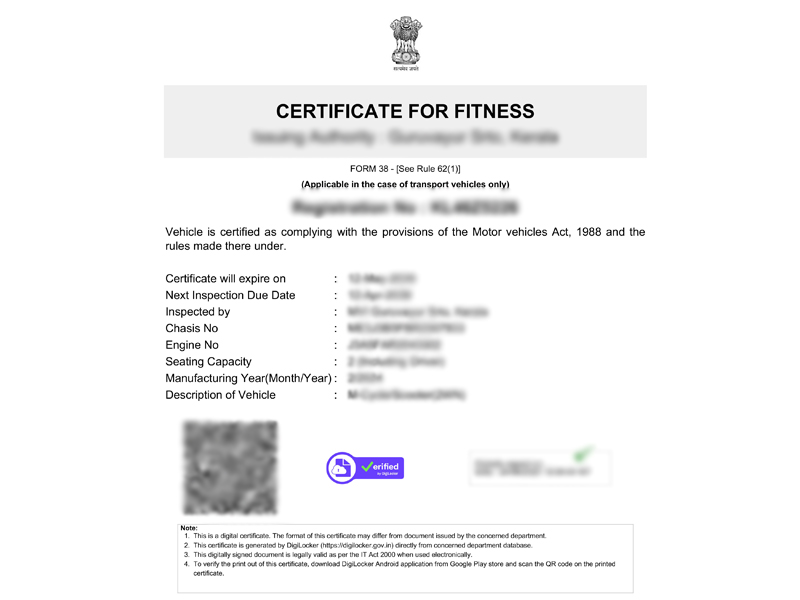
- Register on DigiLocker: Install the DigiLocker app and register using your mobile number.
- Search for your document: Open the “Issued Documents” section and search by your vehicle registration number.
- Download: Save the document to your DigiLocker account.
How To Download Your Document Via Mparivahan
Not all vehicles or states offer digital documents.
- Install and register: Install the mParivahan app and register using your mobile number.
- Add your vehicle: Enter your vehicle registration number to fetch its details.
- Find your document: Look for the relevant section in the vehicle record and download it if it is available.
If you have a transport vehicle, you can also use VAHAN’s Print Fitness Certificate service.
Documents You May Need
- Application form: Form 25 for renewal of a private vehicle’s registration, or the fitness application for transport vehicles.
- Registration certificate (RC): The original.
- Pollution Under Control certificate: Valid.
- Insurance certificate: Valid.
- Road tax receipt: Where applicable.
- Identity and address proof: Of the registered owner.
Some RTOs might need extra documents. Always check the list on the portal for your specific service.
Penalties For Expired Registration Or Fitness
Under Section 192 of the Motor Vehicles Act, using a vehicle without valid registration is punishable. Using a transport vehicle without a valid fitness certificate (Section 56) is treated as the same offence.
- First offence: a fine of ₹2,000 to ₹5,000.
- Second or subsequent offence: imprisonment of up to one year, a fine of ₹5,000 to ₹10,000, or both.
A court may give a lower punishment if it records the reason, and some states have changed these amounts. Late fees apply separately for registration and fitness renewal. Check the fees section above.
If a transport vehicle’s fitness certificate is cancelled because the vehicle no longer complies with the Act or rules, its registration and any permit are treated as suspended until a new certificate is obtained (Section 56(4)).
Why Do Applications Get Rejected, And How Can You Avoid It?
Most delays in registration or fitness renewal happen because of paperwork mistakes, missing or expired documents like insurance or PUC, or a failed inspection. Even small errors, like a typo in your registration number or using the wrong mobile number for OTP, can slow things down.
1. Common Rejection Reasons
| Reason | What to check | Fix |
|---|---|---|
| Incorrect vehicle details | RC number, chassis number, owner name, RTO, OTP mobile number | Compare every entry with your RC before submitting. |
| Insurance or PUC issues | Expiry date and registration number on both documents | Renew and re-check the details. |
| Unpaid dues | Pending taxes, fees or enforcement blocks | Clear them before paying again. |
| Failed inspection | Brakes, lights, tyres, modifications, emissions | Repair, then book a retest. |
2. What Should You Do If Your Application Is Rejected?
Here’s what you can do to fix each problem:
- Double-check your details: Compare what you enter online with your RC. Make sure your registration and chassis numbers are right, and your mobile number can get OTPs.
- Update your insurance and PUC: Renew your insurance policy and get a new PUC. Check that both documents show the correct registration number.
- Clear pending payments or blocks: Pay any unpaid road taxes, fees, or enforcement holds before making another payment.
- Prepare for inspection: If your bike does not pass inspection, fix any issues like brakes, lights, tyre pressure, or horn. Getting a quick checkup at a trusted workshop before the retest can help.
3. How To Avoid Rejection When Applying Online
Before you apply, check that:
- The registration number, owner name, and registered mobile number match your RC.
- Your insurance and PUC are valid and show the right registration number.
- Pending taxes, fees, or enforcement holds are cleared.
- You have selected the service for your category: Renewal of Registration for private bikes, or the fitness service for transport vehicles.
Paying attention to details now can help you avoid most delays.
What Should You Do If Your Bike Fails The Fitness Test?
If your bike does not pass the fitness test the first time, do not worry. This happens often and does not mean your application is finished. The RTO or Automated Testing Station (ATS) will tell you what needs to be fixed, and you can make repairs and try again. There may be a small retest fee, depending on your state’s rules.
1. What Exactly Happens When A Bike Fails The Fitness Test?
- The inspector will mark your bike as “unfit” and clearly tell you or write down the reasons. It could be the brakes, lights, tyres, emissions, or something structural.
- Your fitness certificate application is put on hold until you fix those problems. No new certificate is issued on the Vahan or Parivahan portal until you’ve made the repairs.
- In many states, you’ll need to pay a re‑inspection fee when you bring your bike back for another check.
2. What Are The Steps For Rectification And Re‑inspection?
- Pay close attention to what the inspector mentioned. Request a written report or check your inspection status online. If your certificate is refused, the authority or testing station must give you the reasons in writing. The report will list reasons for failing, such as “brake efficiency low,” “PUC not produced,” or “tyre worn out.”
- Have the repairs done at a reliable workshop or by your regular mechanic. This might include fixing brakes, changing bulbs, replacing tyres, tuning emissions, fixing leaks, or tightening the steering.
- If emissions caused the problem, get a basic service (air filter, spark plug, engine oil, carburettor or fuel injection cleaning) and then get a new PUC certificate after the repair.
3. When You’re Ready For A Retest
- Book a re-inspection slot online, at the RTO, or at the testing station counter. Check if your state has a deadline for this.
- Pay any re-inspection charges online or at the RTO. These fees are usually listed separately from the main test fee.
- Bring your original RC, valid insurance, PUC, tax receipt, and your previous FC application/receipt to the retest.
- Once your bike passes, your record is updated. View or download the document where your state offers it.
4. What If You Can’t Fix The Problems?
If your bike does not pass, you cannot finish your registration renewal or get a transport fitness certificate until you fix the problems and pass a retest. Riding with expired registration or fitness can lead to the penalties mentioned above, so make the repairs and return for a retest.
Faq About Bike Fitness Certificate In India
1. What Is A Bike Fitness Certificate, And Who Needs One?
A fitness certificate confirms that a vehicle is roadworthy. It is legally required for vehicles registered as transport vehicles. Private bikes are subject to registration renewal after 15 years, which includes an inspection. Check the category on your RC to see which applies to you.
2. When Should I Renew?
Renew before the expiry date on your RC (private bikes) or fitness certificate (transport vehicles). Parivahan allows you to apply for renewal of registration up to 60 days before expiry. Check your document for the exact date.
3. What Documents Are Required To Apply For Or Renew?
Typical documents include the Registration Certificate (RC), insurance certificate, Pollution Under Control (PUC) certificate, road tax receipt, identity proof, and address proof. Requirements vary by service, so check the list shown on the portal.
4. What Are The Steps Involved?
The basic steps are: gather the required documents, complete the application (online or at the RTO), pay the fees, have your vehicle inspected, and collect or download your updated document after approval.
5. What Happens If My Bike Fails The Fitness Inspection?
If your bike does not meet the required standards, you will be given a list of issues to fix. Once the necessary repairs are made, you can present your vehicle for a re-inspection.
6. Can I Apply Online?
Depending on your state, you can start the application and pay fees online through the Parivahan portal. The physical inspection of the bike at an RTO or authorised testing station is still required.
7. Are There Penalties For Riding With Expired Papers?
Yes. Using a vehicle without valid registration, or a transport vehicle without a valid fitness certificate, is punishable under the Motor Vehicles Act. See the penalties section above for the amounts.
8. What Is The Fee Structure?
Fees depend on the service, the vehicle, and your state. Registration renewal, the fitness test, and the certificate are charged separately, and delay charges can apply. See the fees section above.
9. Does This Apply To Scooters And Electric Bikes?
The same category rule applies to scooters and electric two-wheelers. Registered private vehicles follow registration renewal, and transport vehicles need a fitness certificate. Low-speed electric bikes may be treated differently, so check your state’s rules.
10. What If I Move To Another State?
For a transport vehicle, a valid fitness certificate is valid throughout India. Moving states still involves re-registering the vehicle in the new state, usually with a No Objection Certificate from your original RTO. For private bikes, ask the new state’s RTO what applies at registration renewal.
11. How Do I Check Whether My Bike’s Certificate Is Still Valid?
Look at the expiry date on your RC (private bikes) or fitness certificate (transport vehicles). You can also check your vehicle record on the Parivahan or mParivahan services, where your state shows it.
12. How Do I Find An Authorised Testing Centre And Book A Slot?
Use the AFMS portal to find a government-authorised ATS and book a slot. If your bike is tested at the RTO, book through your RTO’s appointment service.
13. What Is The Best Platform To Apply, And Should I Use An Agent?
Apply through the official Parivahan and VAHAN services. Agents and third-party sites may charge extra and cannot change the inspection requirement, so compare any quote with the official fees in the fees section.
Official Links
Other Related Articles From Bikeleague India
- Bike Documents for Travel in India: All you need to know
- Motorcycle service – All things you need to know explained
- Bike Pollution Certificate – All you need to know in India
- Medical Certificate for bike riders in India: Essential Guide
- Bike ownership transfer in India – step by step guide
Conclusion
Understanding whether you need registration renewal or a fitness certificate helps you stay legal and safe on Indian roads. Check your RC category, get ready for inspection, keep your documents up to date, and renew on time to avoid penalties. Since rules and fees can vary by state and vehicle type, always check the details with your RTO or on the Parivahan portal before applying.
If you have questions, email us at bikeleagueindia@gmail.com or leave a comment below. We are happy to help. You can also connect with us on Bikeleague India’s social media accounts.