
Long story short: Understand the crucial role of the bike Pollution Under Control (PUC) Certificate, price, validity, fine etc and the Bharat Stage emission norms and standards in keeping your two-wheeler compliant with environmental regulations in India.
Make it a priority to obtain and renew your Pollution Under Control (PUC) certificate on time. In fact, by doing so, you not only comply with the law, but you also contribute to cleaner air and a healthier environment for everyone. Additionally, take responsibility today so that you can ensure your two-wheeler meets all environmental standards.
Before diving into the details, this guide provides you with all the essential steps and context for obtaining and maintaining a PUC certificate for your two-wheeler. Specifically, you’ll learn its significance, applicable rules, how to complete the process both online and offline, consequences of non-compliance, and tips to ensure your bike stays within the emission limits.
Key Takeaways On Bike Pollution Certificate Rules
- The PUC certificate is a mandatory legal document for two-wheelers in India that confirms your vehicle’s emissions meet prescribed standards.
- Regular PUC checks help reduce air pollution and contribute to a healthier environment and community.
- Obtaining or renewing a PUC certificate is a straightforward process available both online and offline at authorised testing centres.
- Non-compliance leads to legal penalties, including fines and possible suspension of vehicle registration or insurance claims.
- Proactive vehicle maintenance and staying up to date on emission norms are crucial for hassle-free PUC certification and responsible ownership.
What Is The Pollution Under Control (puc) Certificate In India?
A Pollution Under Control (PUC) Certificate is a mandatory document for all vehicles in India, including motorcycles and scooters. It is issued by authorised emission testing centres throughout the country. It verifies that a vehicle’s emissions comply with the Government of India’s prescribed pollution control norms.
Importance Of Puc Certificate In India
The PUC certificate is more than just paperwork. In fact, it helps ensure your vehicle’s emissions stay within the government-set limits. Moreover, by getting and renewing this certificate, you’re helping reduce air pollution and support environmental standards.
How To Get A Bike Pollution Certificate In India?
1. Authorised Centres For Bike Pollution Certificate
You can get a PUC certificate at authorised emission testing centres, which are often found at gas stations or special testing shops. During the test, a device called an exhaust gas analyser is placed in your vehicle’s exhaust pipe to measure pollutants like carbon monoxide (CO) and hydrocarbons (HC)—both of which are gases released from your engine. Afterward, the results are then checked against the government-set pollution limits.
2. Cost Of Bike Pollution Certificate
Getting a PUC certificate doesn’t cost much—usually between Rs. 80 and Rs. 100, depending on your vehicle and fuel type. Consequently, this makes it easy to keep your vehicle compliant without spending a lot.
3. Online And Offline Methods To Get Bike Puc Certificate
It’s easy to get a PUC certificate. For example, you can apply online via the Parivahan portal or visit a nearby emission testing station. The online process is simple, and you can quickly download your certificate. As a result, keeping your vehicle compliant has never been easier.
What Is The Validity Of Pollution Under Control (puc) Certificates
How long a PUC certificate stays valid depends on your vehicle’s age and its emission standard.
- For new vehicles, the certificate is valid for one year from the registration date for all BS stages.
- For BS-IV and BS-VI vehicles, the renewal validity period is 1 year.
- For BS-II and BS-III vehicles, it is 6 months.
Be sure to renew your certificate before it expires. However, if you miss the deadline, you have a 7-day grace period to take action and avoid fines or issues.
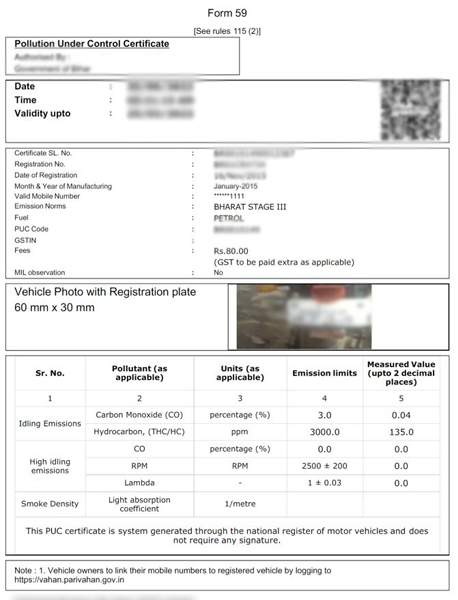
What Are The Details Present In A Two-wheeler Puc Certificate?
1. Basic Information
The PUC certificate lists important information about your vehicle and who owns it:
PUC Certificate Registration Number: A unique identifier for the certificate.
Chassis Number: The vehicle’s chassis number is recorded to ensure the certificate is linked to the correct vehicle.
Vehicle Registration Number: This is used to pull up all necessary details about the vehicle during the emission test.
2. Emission Test Results
The certificate also shows the results of your vehicle’s emission test, including:
Emission Levels: The levels of pollutants emitted by the vehicle, such as carbon monoxide (CO), hydrocarbons (HC), etc., are measured and recorded.
Permissible Limits: The certificate specifies the permissible emission levels, meaning the maximum amount of pollutant gases legally allowed from your vehicle, as per Rule 115 (2) of The Motor Vehicles Act, 1988.
3. Validity Period
Initial Validity: The certificate is valid for one year for new vehicles.
Renewal Period: The certificate must be renewed every six months after the first year.
4. Issuing Authority
Authorised emission testing centres, approved by the Pollution Control Board, issue the certificate.
Additional Information
PUC Details: The certificate includes detailed information about the emission test and the results.
Vehicle Type and Fuel Type: The type of vehicle (two-wheeler) and the type of fuel it uses (petrol, diesel, etc.) are specified.
What Are The Penalties For Not Having A Valid Puc Certificate In India For Two-wheelers?
Understanding the document is only useful if you know the rules. Therefore, let’s see what can happen if you don’t have a valid PUC certificate for your two-wheeler in India.
- As of September 2024, the revised fine structure specifies that owners of two-wheelers will have to pay ₹1,000 for the first offence and ₹1,500 for a second violation.
- In some cases, failing to renew the PUC certificate on time can result in a hefty fine of up to ₹10,000 or even imprisonment for up to six months, depending on the offence’s severity and frequency.
- Traffic police have the authority to seize vehicles that do not have a valid PUC certificate or have an expired one.
What Is The Bharat Stage (bs) Emission Standard?
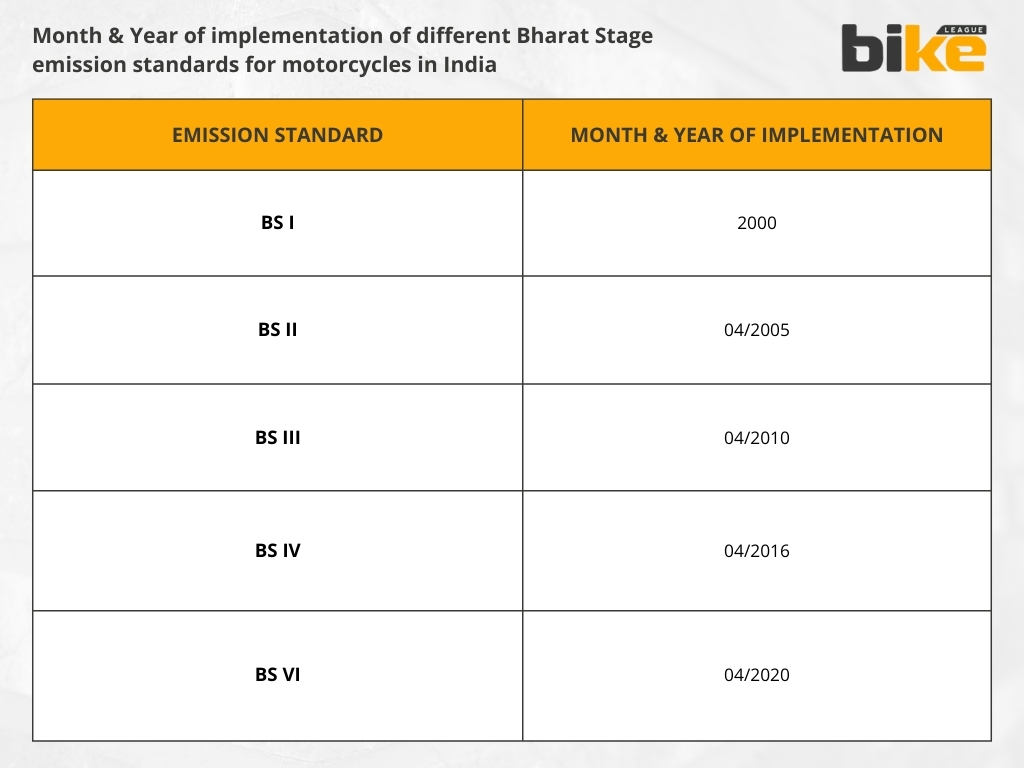
The Bharat Stage (BS) emission standards are rules set by the Indian government to control air pollution from engines, including those in motorcycles and scooters. Each BS stage represents a set of limits for pollutant emissions. Over time, these standards have become stricter; consequently, this shows the government’s commitment to cleaner air and public health.
Different Types Of Bharat Stage (bs) Emission Standards Or Norms In India
Building on that overview, here’s a look at the different types of Bharat Stage (BS) emission standards or norms in India. Furthermore, understanding these norms helps you stay compliant and environmentally responsible.
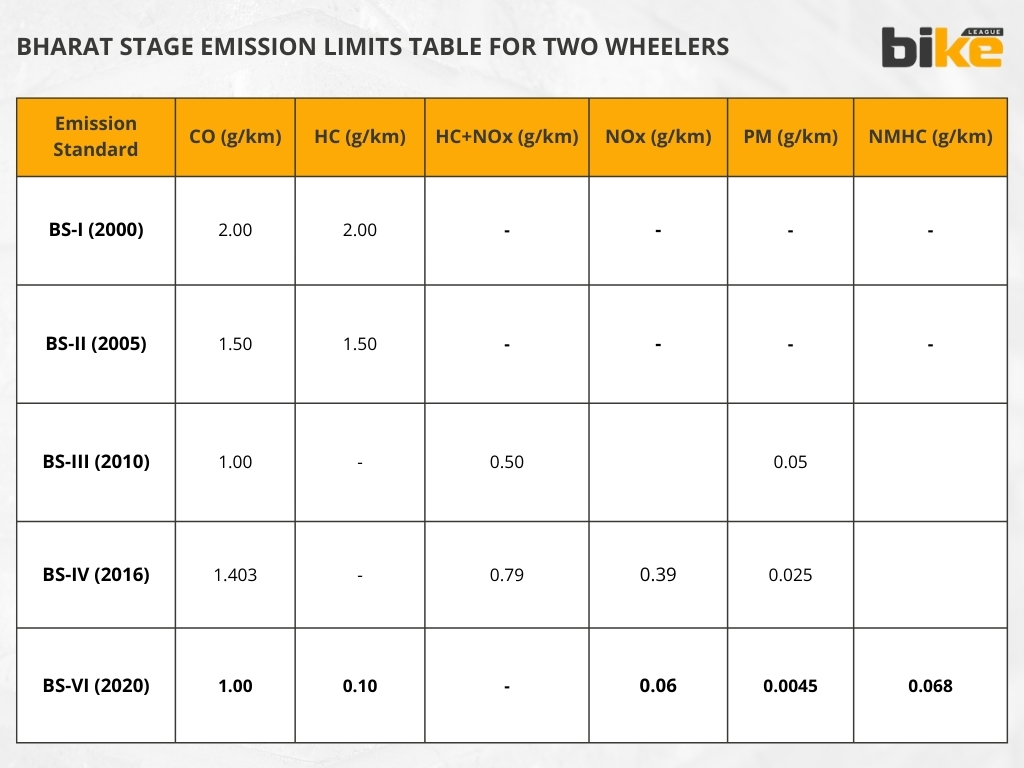
| Emission Standard | CO (g/km) | HC (g/km) | HC+NOx (g/km) | NOx (g/km) | PM (g/km) | NMHC (g/km) |
|---|---|---|---|---|---|---|
| BS-I (2000) | 2.0 | 2.0 | — | — | — | — |
| BS-II (2005) | 1.50 | 1.50 | — | — | — | — |
| BS-III (2010) | 1.00 | — | 0.50 | 0.05 | — | — |
| BS-IV (2016) | 1.043 | — | 0.79 | 0.39 | 0.025 | — |
| BS-VI | 1.00 | 0.10 | — | 0.06 | 0.0045 | 0.068 |
1. Bs2 Emission Standards
BS2 norms began in 2001 and were an important step in reducing vehicle emissions in India. Here are the emission limits for motorcycles and scooters under BS2:
1. Carbon Monoxide (CO): 2.2 g/km
2. Hydrocarbons + Nitrogen Oxides (HC+NOx): 0.5 g/km
3. Respirable Suspended Particulate Matter (RSPM): 0.08 g/km
2. Bs3 Emission Standards
BS3 norms began in 2005 and became required across India by 2010. These rules made the emission limits even stricter:
1. Carbon Monoxide (CO): 2.3 g/km
2. Hydrocarbons (HC): 0.20 g/km
3. Hydrocarbons + Nitrogen Oxides (HC+NOx): 0.35 g/km
4. Respirable Suspended Particulate Matter (RSPM): 0.05 g/km
3. Bs4 Emission Standards
BS4 norms took effect across India in April 2017. These standards set even tougher limits on emissions:
1. Carbon Monoxide (CO): 1.0 g/km
2. Hydrocarbons (HC): 0.1 g/km
3. Hydrocarbons + Nitrogen Oxides (HC+NOx): 0.18 g/km
4. Respirable Suspended Particulate Matter (RSPM): 0.025 g/km
4. Bs6 Emission Standards
BS6 norms started on April 1, 2020, with the government skipping BS5. These rules are much stricter and need advanced technology to meet the limits:
1. Carbon Monoxide (CO): 1.0 g/km
2. Hydrocarbons (HC): 0.10 g/km
3. Nitrogen Oxides (NOx): 0.06 g/km
4. Non-Methane Hydrocarbons (NMHC): 0.068 g/km
5. Particulate Matter (PM): 0.0045 g/km
Explanation Of Emission Limits In Bs Emission Standards
- Carbon Monoxide (CO): A colourless, odourless gas that is harmful when inhaled in large amounts. It is produced by the incomplete combustion of fuel.
- Hydrocarbons (HC): Organic compounds contribute to smog formation and harm human health.
- Hydrocarbons + Nitrogen Oxides (HC+NOx): A combination of hydrocarbons and nitrogen oxides contributes to ground-level ozone and smog formation.
- Nitrogen Oxides (NOx): Gases that contribute to the formation of smog and acid rain and can cause respiratory problems.
- Non-methane hydrocarbons (NMHC): Hydrocarbons, excluding methane, significantly contribute to ozone formation.
- Particulate Matter (PM): Tiny particles that can penetrate the respiratory system and cause health issues.
- Respirable Suspended Particulate Matter (RSPM): Small particles can be inhaled and cause respiratory problems.
What Are The Testing Processes For Different Two-wheeler Types In India?
In India, the PUC certification program sets the rules for emission testing of two-wheelers. Importantly, the process is the same for all bikes and scooters, regardless of engine size or type. Each vehicle must meet the emission limits for its Bharat Stage norm.
What Steps Can Two-wheeler Owners Take If They Fail The Puc Emission Test?
If your two-wheeler fails the PUC emission test, you’ll get a rejection slip that lists the extra pollutants, such as CO, HC, or smoke. You won’t be fined at the testing centre, but you still have to pay the testing fee (₹30–100).
Immediate Consequences
If you fail the PUC test, you can still ride your vehicle for now. However, if you drive without a valid PUC, you may be fined—usually ₹1,000 to ₹2,000 for a first offence, and up to ₹5,000 to ₹10,000 for repeat offences in stricter states like Delhi or West Bengal. You could also face a three-month licence suspension or have your vehicle impounded.
Steps To Resolve
- Diagnose and repair: Common fixes include changing the engine oil, spark plugs, and air filter, tuning the carburettor or EFI, cleaning the exhaust, and avoiding bad fuel. These repairs usually cost ₹200 to ₹1,000 at a mechanic.
- Retest: Return to any authorised centre (no waiting period required) after the fixes; pay the fee again and get a fresh certificate if you pass (valid for 6 months).
Tips for success: Warm up the engine for 20 minutes before the test, check your tyre pressure, use good quality fuel, and bring a mechanic if you’re not sure about the process.
Following these steps keeps you compliant with CMVR Rule 115 across India. In turn, this is helpful for riders who want to avoid any trouble with the RTO.
What Are The Technological Improvements In Motorcycles & Scooters Across Bs Emission Standards?
1. Bs4 Technologies
BS4 motorcycles and scooters usually use basic engine technology, like carburettors and older emission controls. In fact, the main goal was to meet emission norms, not to improve fuel efficiency.
2. Bs6 Technologies
The transition to BS6 norms required manufacturers to adopt more sophisticated technologies, including:
- Fuel Injection Systems: These provide precise fuel delivery and improved combustion.
- Advanced Engine Management Systems: To optimise engine performance and reduce emissions.
- Enhanced Catalytic Converters: To effectively reduce harmful pollutants.
What Is The Impact On Fuel And Costs Across Bs Emission Standards?
1. Fuel Quality
BS6 engines use a significantly lower sulphur content (10 PPM) than BS4 fuel (50 PPM). This reduction in sulphur content helps reduce harmful emissions and pollutants.
2. Manufacturing Costs
Adding advanced technology to BS6 vehicles has increased production costs, leading to higher prices for buyers. Nevertheless, on the plus side, these improvements help save fuel and lower emissions.
Some Common Myths Vs Facts About Puc Certificates For Two Wheelers In India
1. “new Bikes Don’t Need Puc At All”
Myth: If a bike is brand‑new or under one year old, you never need a PUC certificate.
Fact: A PUC certificate is legally mandatory for all motor vehicles; new two‑wheelers get an initial PUC that is valid for 1 year from the date of registration, after which regular renewals are required.
2. “puc Is Needed Only In Delhi / A Few Metros”
Myth: PUC is compulsory only in Delhi, Mumbai or “polluted cities,” not in smaller towns or other states.
Fact: Rule 115 of the Central Motor Vehicles Rules, 1989 makes a valid PUC certificate compulsory for all vehicles across India; enforcement intensity varies by state, but the legal requirement is national.
3. “two‑wheelers Are Exempt; Puc Is Mainly For Cars”
Myth: PUC rules target cars and commercial vehicles, not bikes and scooters.
Fact: The PUC requirement explicitly covers two‑wheelers; emission limits are separately specified for 2‑ and 3‑wheelers based on stroke type and manufacturing year.
4. “i Only Need Puc When Renewing Insurance”
Myth: As long as you show a valid PUC during bike insurance renewal, you are safe the rest of the time.
Fact: You must carry a valid PUC certificate at all times while riding; police can fine you on the road even if your insurer has already seen a valid PUC once.
5. “if My Bike Passes Once, I’m Safe For A Year”
Myth: After one clean report, you don’t need to worry about emissions for a long time.
Fact: For most existing vehicles, the PUC validity is 6 months, and can be shorter if your bike is close to the emission limits; you must test and renew regularly.
6. “bs6 Bikes Don’t Really Need Puc”
Myth: BS6‑compliant two‑wheelers are “green” and don’t practically need emission checks.
Fact: BS6 bikes are cleaner but still legally required to have a valid PUC; some cities may offer longer validity (e.g., 1 year for BS6 vs 3 months for older vehicles in Delhi), but not a blanket exemption.
7. “ev Scooters Never Need Any Puc Or Emission‑related Proof”
Myth: Because there is no tailpipe, electric scooters are outside the PUC framework, so owners can ignore all emission documentation.
Fact: Pure EVs are generally not subjected to tailpipe PUC tests, but many traffic cops still check basic documentation, and hybrid/flex‑fuel two‑wheelers must follow normal PUC rules; insurers and RTOs continue to treat PUC as part of the standard compliance set for IC‑engine vehicles.
8. “no Puc, No Big Deal – Fine Will Be ₹100–200 Only”
Myth: Penalties for missing PUC are minor, so it’s cheaper to risk it.
Fact: Under the Motor Vehicles Act, typical penalties are around ₹1,000 for first offence and ₹2,000 for repeat offences; some cities (like Delhi) impose even higher environment‑related fines in strict drives.
9. “you Need Puc Only Once The Bike Becomes ‘old’”
Myth: For the first few years after purchase, you can ignore PUC and start testing only when the bike ages.
Fact: The law states that after one year from the first registration, every motor vehicle must always carry a valid PUC certificate, irrespective of age, brand, or segment.
10. “petrol Pumps Will Always Give Fuel Even Without Puc”
Myth: “No PUC, No Fuel” is just a headline; pumps will not actually refuse fuel.
Fact: In Delhi and some other regions, petrol pumps have begun enforcing “No PUC, No Fuel” rules more strictly, reducing fuel sales to vehicles without a valid PUC and increasing checks at forecourts.
11. “puc Test Is A Scam; Readings Are Random”
Myth: Machines at roadside centres print random values; paying the fee is enough to get a pass.
Fact: Authorised emission testing centres use calibrated equipment to measure pollutants like CO and HC against limits notified for two‑wheelers by ARAI and CMVR; the printout carries your registration, readings and validity date.
12. “puc Is Very Expensive And Time‑consuming”
Myth: Getting a PUC takes half a day and costs hundreds of rupees, so riders avoid it.
Fact: The typical cost for bikes is roughly ₹30–100, and the test usually takes only a few minutes at a nearby petrol pump or emission centre.
13. “soft Copy / Sms Is Not Accepted; Only Paper Is Valid”
Myth: Traffic cops accept only the original paper slip from the testing centre.
Fact: Digital PUC records are stored in the VAHAN/Parivahan system, and you can show a downloaded PDF or online status; many cities accept digital proof just like for insurance and RC.
14. “regional Rto Rules Override Central Puc Rules”
Myth: If a state RTO site does not clearly mention PUC, riders there are exempt.
Fact: Central Motor Vehicle Rules (Rule 115) apply uniformly across states; state transport departments only frame procedures and enforcement, not the core obligation.
Faq About Puc Certificate And Bs Emission Standards
1. Can We Obtain A Puc Certificate Online?
No, PUC cannot be obtained online. You need to physically inspect and test the vehicle. After that, a certificate can be downloaded from the Parivahan website if required.
2. Do I Need To Obtain A Pollution Certificate For A New Motorcycle?
Yes, you need a PUC Certificate for your new motorcycle. When you buy the vehicle, the motorcycle dealer typically provides a pollution certificate valid for 1 year.
3. Which Website Can You Download The Puc Certificate Online In India?
To download the PUC certificate online, visit this website – https://puc.parivahan.gov.in/puc/views/PucCertificate.xhtml.
4. What Documents Do I Need To Get My Puc Certificate?
Only your vehicle is required. The test centre will use its registration number to find everything else it needs.
5. How To Find Rto-approved Puc Centres?
Visit this link https://puc.parivahan.gov.in/puc/views/PUCCenterList.xhtml to find the RTO-approved PUC Centres in India.
6. Should We Carry The Puc Certificate While Driving The Motorcycle?
You must carry a copy of the PUC Certificate (soft or hard copy) while driving the vehicle. You can be fined for failing to produce the PUC Certificate during a general inspection.
7. What Are The Costs For The Puc Certificate For Motorcycles And The Renewal Period For Bsii And Bsi For Motorcycles?
The cost of the PUC certificate for BSII and BSIII is Rs 80. The renewal period is 6 months.
8. What Are The Costs For The Puc Certificate For Bs Iv & Bsvi For Motorcycles And The Renewal Period?
The PUC certificate for BS IV costs Rs 80, and for BSVI, it costs Rs 100. The renewal period is 1 year for both.
9. Which Type Of Motorcycles And Scooters Need A Puc Certificate?
All motor vehicles with internal combustion engines need to have a PUC certificate. Electric vehicles are exempt from this requirement as they do not emit pollutants.
10. What Happens If My Motorcycle Or Scooter Fails The Puc Test?
You need to fix the problems with your vehicle and then retake the test.
11. What Are The Penalties For Not Having A Valid Puc Certificate?
Not having a valid PUC certificate can result in significant fines. The penalty for the first offence is Rs. 1,000, which increases to Rs. 2,000 for subsequent violations. Please note that these rates vary by state.
12. Why Were There No Bharat Stage 5 Emission Norms In India?
The main reason was that the Government of India has noticed rising pollution, especially in the metros, over the years. As it took over a decade to launch BS4 in the country, the government decided to skip one emission norm (BS5). The Indian government gave ample time to fix the issues and develop new engines for the BS6 norms, which are drastically lower than the previous BS4 emission norms.
Official Links For Bike Pollution Certificate And Bs Norms
Other Related Articles For Pollution Under Control Certificate & Bharat Stage Norms In India
- Second hand motorcycle: Things to know when buying in India
- Must have bike documents for travel in India
- Bike fitness certificate guide – All you need to know
- Diesel bikes in India: Why are they absent on Indian roads ?
- Aftermarket Motorcycle Silencer Rules in India – Explained
Conclusion: Why Bike Pollution Certificate Matters
Following PUC rules isn’t just about obeying the law—it’s also a way to protect the environment and public health. Furthermore, by renewing your PUC certificate on time and keeping your two-wheeler within emission limits, you help improve air quality and support a better future.
Getting or renewing a PUC certificate is simple, whether you do it online or in person. Additionally, staying up to date with the rules, understanding the risks of noncompliance, and maintaining your vehicle regularly will help you avoid fines and keep it in good condition.
As more people learn about air pollution and rules get stricter, it’s important to be a responsible vehicle owner. By following emission norms and keeping your PUC up to date, you help create a cleaner and healthier community for all.
If you have any questions about the PUC certificate, Bharat Stage emission norms, or related standards in India, feel free to email us at bikeleague2017@gmail.com or leave your questions in the comments below. We’re always happy to help.