
Long story short: Motorcycle ABS helps prevent wheel lock-up during braking and lowers the risk of skidding. It’s a helpful safety feature, but it doesn’t replace tyre grip, good judgement, or proper riding skills.
ABS means Anti-lock Braking System. It keeps track of wheel speed and changes brake pressure if it senses a wheel might lock. According to Bosch, motorcycle ABS helps keep the bike stable during braking, even in hard stops or on slippery roads.
For riders in India, understanding ABS is about more than just seeing the badge on your bike. Does it protect only the front wheel or both? How is ABS different from combined braking? What happens when ABS turns on, and what can’t it do?
This guide covers how motorcycle ABS works, compares the main types, clears up common myths, and answers practical questions about braking, maintenance, and ABS rules in India.
Key Takeaways
- Motorcycle ABS monitors wheel speed and adjusts brake pressure when it detects a risk of wheel lock-up.
- Single-channel ABS controls braking pressure at one wheel, usually the front. Dual-channel ABS provides anti-lock control at both the front and rear wheels.
- ABS and CBS are not the same. A Combined Braking System links front and rear braking, while ABS regulates brake pressure to help prevent wheel lock-up. A motorcycle can have both.
- ABS can improve braking stability, but it does not guarantee the shortest stopping distance on every surface or prevent every skid and crash.
- ABS works alongside safe riding habits. Appropriate speed, well-maintained tyres, adequate following distance, and proper braking technique remain essential.
How Does Motorcycle Abs Work?
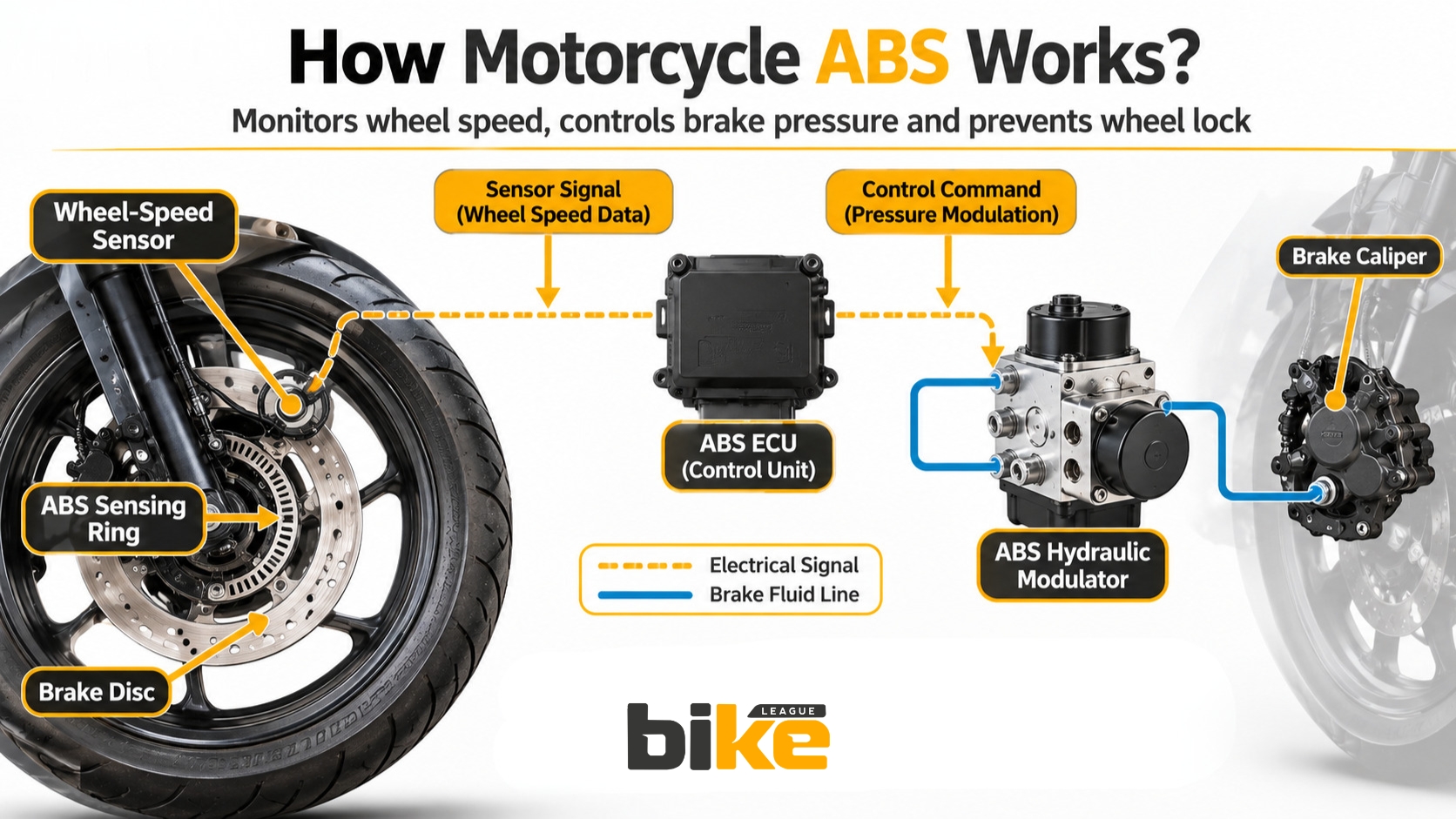
Motorcycle ABS checks wheel speed and changes brake pressure only if it senses a wheel might lock. It steps in when needed, not every time you use the brakes.
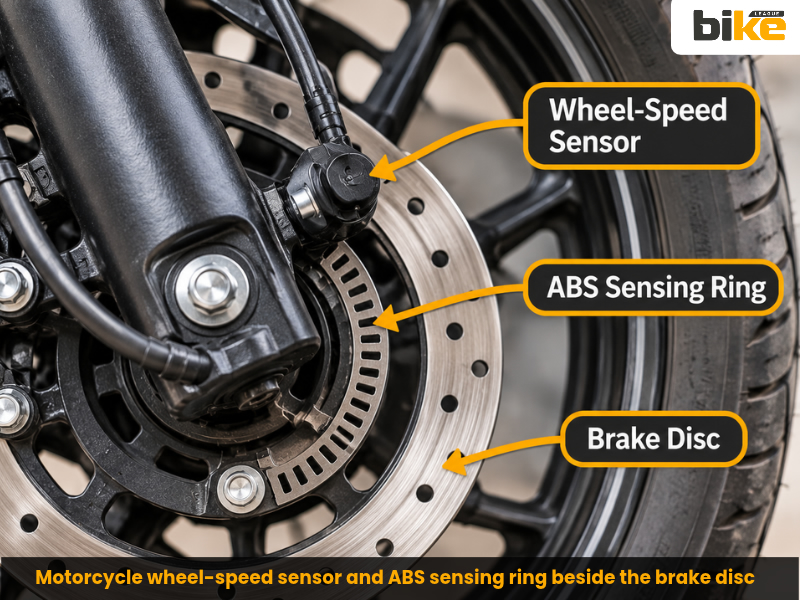
- Wheel-speed monitoring: Sensors measure wheel rotation and send this information to the ABS control unit. The sensor arrangement depends on the motorcycle’s system.
- Lock-up detection: The control unit analyses the signals for signs that a wheel is slowing too rapidly and may lock. This can happen during hard braking or when grip is limited, such as on a slippery road.
- Brake-pressure adjustment: If lock-up is imminent, valves in the hydraulic modulator reduce pressure at the affected brake so the wheel can continue rotating.
- Repeated pressure control: The system holds, reduces, or reapplies pressure as needed while the rider continues braking. This helps control wheel slip and maintain braking stability.
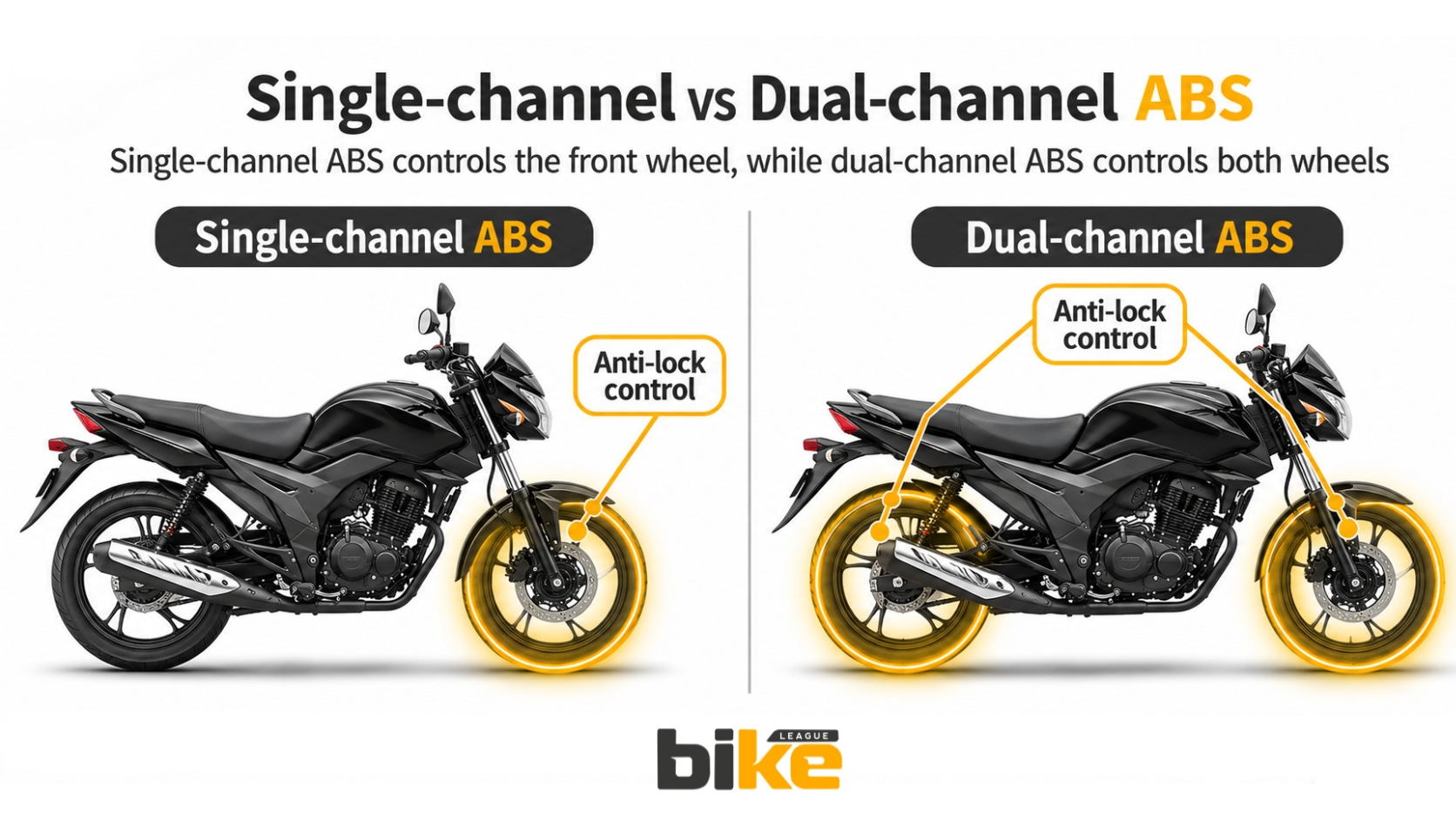
Which wheels get anti-lock protection depends on the ABS setup. A single-channel system usually controls just the front brake, while dual-channel ABS covers both front and rear brakes. Bosch’s motorcycle ABS guide explains how these systems work.
What Are The Different Types Of Motorcycle Abs?
The main types of motorcycle ABS are single-channel and dual-channel. Other terms like cornering ABS and combined ABS refer to extra features, not just how many wheels have anti-lock protection.
1. Single-channel Abs: Is It Effective?
Yes. Single-channel ABS gives helpful anti-lock protection to the wheel it covers, usually the front. It changes brake pressure if that wheel might lock, even during hard braking or on slippery roads.
The main limit is coverage. If a bike has ABS only on the front wheel, the rear wheel can still lock up. Dual-channel ABS adds anti-lock control to both wheels.
So, single-channel ABS is still useful, but it’s not the same as dual-channel protection. It also doesn’t always give the shortest stopping distance or stop every skid or fall.
Just because a motorcycle has front and rear disc brakes doesn’t mean it has dual-channel ABS. Always check the manufacturer’s specs for details.
2. Dual-channel Abs
Dual-channel ABS gives anti-lock control to both the front and rear wheels. It can change brake pressure at each wheel separately if it senses a risk of lock-up.
The main difference is which wheels are covered. Single-channel ABS usually protects the front wheel, while dual-channel covers both. Don’t go by sensor count alone—always check the manufacturer’s specs for the exact type.
3. Cornering Abs
Cornering ABS adds braking control that responds to how much the bike is leaning. It uses data from an inertial measurement unit (IMU) and wheel speed to adjust brake pressure based on the bike’s movement and lean.
This can help keep the bike stable when braking in a turn, but it can’t add extra tyre grip or make sure the bike stays on its path. Some bikes have dual-channel ABS but not cornering ABS.
Bosch’s motorcycle stability control guide explains how lean- and pitch-sensitive brake control supports braking in corners.
4. Combined Abs: Linked Braking With Anti-lock Protection
Combined ABS links the brakes and adds anti-lock control. Depending on the design, using one brake lever can also apply some braking to the other wheel, while ABS works to stop wheel lock-up.
Don’t mix this up with a Combined Braking System (CBS) by itself. CBS splits braking between the front and rear, but having CBS doesn’t mean the bike has ABS. Always check the manufacturer’s description, as terms and features can differ between models.
Motorcycle Abs Comparison
| Configuration or feature | What it does | Important limitation or distinction |
|---|---|---|
| Single-channel ABS | Provides anti-lock control at one wheel, usually the front. | The other wheel does not receive anti-lock protection. |
| Dual-channel ABS | Provides independent anti-lock control at the front and rear wheels. | Does not automatically include cornering ABS or linked braking. |
| Cornering ABS | Adapts brake control using lean and other vehicle-motion data. | Cannot overcome limited tyre grip or prevent every cornering crash. |
| Combined ABS | Combines linked front/rear braking with anti-lock control. | Not the same as CBS alone; operation depends on the model. |
Is Regenerative Braking Or Eabs The Same As Motorcycle Abs?
Regenerative braking and anti-lock braking are not the same. Regenerative braking saves energy when slowing down, while ABS manages braking to help stop wheel lock-up.
Don’t assume an electric two-wheeler has regular ABS just because the specs mention regenerative braking, electronic braking, or “eABS”. Check the manufacturer’s technical details to see if it really has wheel-lock protection and which wheels are covered.
What Is Switchable Abs?
Switchable ABS lets the rider change or turn off anti-lock braking using the bike’s controls. Depending on the model, you might be able to turn off ABS just for the rear wheel or for both wheels.
This feature is designed for certain off-road situations where a skilled rider might need different braking on loose surfaces. If you turn off rear-wheel ABS, the rear wheel can lock when you brake.
Switchable ABS and off-road ABS are similar, but they are not always the same. Off-road mode can also change how the front-wheel ABS works. For example, KTM’s off-road ABS explanation mentions turning off rear-wheel ABS and adjusting front-wheel slip control. Other brands and models may work differently.
For regular road riding, use the ABS setting recommended by the manufacturer. Before switching to an off-road setting, read the owner’s manual to see what changes, how to switch back, and if the mode stays on after restarting. Switch back to the road setting before riding on paved roads again.
Can I Disconnect The Abs Sensor To Disable Abs?
Do not disconnect or change an ABS wheel-speed sensor instead of using the settings provided by the manufacturer. Using an approved off-road mode is not the same as interrupting a sensor. Disconnecting a sensor can cause a fault, and the effect might not be limited to just the rear-wheel ABS.
If your motorcycle has switchable ABS, only use the controls and steps in the owner’s manual. If it doesn’t have this feature, don’t try to disconnect sensors or remove fuses.
For example, Honda’s CRF300L owner’s manual explains there is a special rear-ABS switch for off-road use, and ABS on both wheels comes back when you turn the ignition on again. This feature is specific to this model and does not apply to all motorcycles.
If a sensor is damaged or you see an ABS warning, get it checked instead of trying to bypass the system. For normal road riding, keep the ABS setting recommended by the manufacturer.
What Are The Advantages Of Motorcycle Abs?
Motorcycle ABS helps you control braking when a wheel might lock up. The main benefits are:
- Reduced risk of wheel lock-up: ABS automatically adjusts brake pressure to help keep the protected wheel or wheels rotating during braking.
- Improved braking stability: By controlling wheel lock-up, ABS helps reduce the risk of a braking-related skid or fall, including during hard braking or when road grip changes.
- Potentially shorter stopping distances: ABS can improve stopping performance, but the result depends on the surface, tyres, motorcycle, and rider. It does not guarantee the shortest stop in every situation.
- Lower fatal crash involvement rates in research: Studies comparing motorcycles with and without ABS provide evidence of its real-world safety benefits.
A 2022 study by IIHS researcher Eric Teoh looked at 65 motorcycle models with optional ABS. Using US data from 2003 to 2019, it found that ABS was linked to a 22% lower rate of fatal crashes per 10,000 registered vehicle-years compared to the same models without ABS.
This result shows ABS can improve safety, but it is not a specific estimate for India or a guarantee for every rider. Safe speed, good tyres, enough following distance, and proper braking are still important.
What Are The Disadvantages And Limitations Of Motorcycle Abs?
ABS gives helpful braking support, but it adds extra parts and does not remove all braking risks. The main trade-offs and limits are:
- Additional purchase cost: ABS adds hardware and control electronics. Its effect on the motorcycle’s price depends on the model and equipment package, so there is no single price premium that applies to every bike.
- Additional weight and complexity: The hydraulic modulator, sensors, wiring, and related components add weight and complexity. The amount varies by design; avoid assuming every ABS-equipped motorcycle carries the same weight penalty.
- Potential diagnostic and repair costs: An ABS fault may require specialist diagnosis or replacement of a sensor, wiring or another component. This is different from saying that every ABS motorcycle has high routine maintenance costs. Follow the manufacturer’s servicing requirements and obtain a model-specific quotation for repairs.
- No guaranteed shortest stopping distance: ABS helps prevent wheel lock-up, but stopping performance still depends on the road surface, tyres, motorcycle and rider. Do not treat ABS as a reason to reduce your following distance.
- Protection depends on the system fitted: Front-wheel-only ABS does not prevent rear-wheel lock-up. Standard dual-channel ABS also does not automatically include the lean-sensitive control offered by cornering ABS.
- Limited by available grip: ABS cannot create tyre grip or prevent every slide, fall or collision. Excessive speed, unsuitable tyres and abrupt manoeuvres can still lead to a crash.
These limits mean you should learn how your motorcycle’s brakes work, not avoid ABS. Keep your brakes and tyres in good shape, use the recommended ABS setting for the road, and keep practising good braking.
What Technological Improvements Are Available In Modern Motorcycle Abs?
Modern motorcycle ABS is designed for more precise brake control, smaller hardware, and better integration with other rider-assist systems. The features you get depend on the model, version, and manufacturer.
1. Lean-sensitive Braking Control
Cornering ABS uses wheel speed and data from an inertial measurement unit (IMU) to adjust braking based on how the motorcycle leans or pitches. This helps keep the bike stable when braking in a turn, but it can’t make up for poor tyre grip or prevent every loss of control.
2. Smaller And Lighter Abs Units
Smaller ABS hardware lets manufacturers fit the system to more types of motorcycles and scooters. For example, Bosch has ABS 10 light for front-wheel-only control and ABS 10 base for dual-channel control.
3. Integrated Motion Sensing
Some ABS systems have the IMU built into the ABS unit instead of needing a separate sensor. This can mean less wiring and connectors, and it supports more advanced stability features.
4. Additional Braking And Rider-assistance Functions
Depending on the hardware and software, advanced systems can offer features like rear-wheel lift-up control, electronic combined braking, and vehicle hold. These features are not always included just because a motorcycle has ABS.
Bosch’s motorcycle ABS overview shows examples of compact ABS units and built-in sensors. Before you buy a motorcycle, check its specs and owner’s manual to see which features it has.
How Do Traction Control And Hill Hold Work Alongside Abs?
ABS, traction control, and hill hold each help the rider in different ways. Some motorcycles combine these features using shared sensors and controls, but having ABS does not always mean you also have traction control or hill hold.
| System | When it helps | What it does | Important limitation or distinction |
|---|---|---|---|
| ABS | During braking when a protected wheel is at risk of locking. | Adjusts brake pressure to help control wheel-lock risk and maintain braking stability. | Does not control excessive driven-wheel spin during acceleration or prevent every skid. |
| Traction control | During acceleration when the driven wheel spins excessively. | Uses wheel-speed and other vehicle data to request a reduction in engine or motor torque when needed. | Does not replace ABS. Lean-sensitive operation depends on the system fitted. |
| Hill hold | While stationary before moving off on a slope. | Temporarily maintains brake pressure to help keep the motorcycle stationary. | Is not a parking brake. Activation, release conditions and holding duration vary by model. |
How Can These Systems Work Together?
On a motorcycle with these features, hill hold can help you stay still on a slope, traction control can stop too much wheel spin when you start moving, and ABS can step in if braking might lock a wheel. Each feature works in its own situation, and they don’t always turn on at the same time.
Bosch’s motorcycle stability control overview explains how a broader control platform can support functions such as cornering traction control and vehicle hold. The features actually fitted depend on the motorcycle’s hardware, software, and specifications.
Does Motorcycle Abs Activate Every Time You Brake?
No. ABS keeps track of wheel speed, but it only changes brake pressure if it senses that a protected wheel might lock up. If there is no risk of wheel lock-up during normal braking, ABS does not step in.
ABS can step in even if you are not braking hard or suddenly. On slippery roads, there may be so little grip that a wheel can almost lock up even with gentle braking.
What matters is the risk of a wheel locking up, not just how fast or hard you use the brakes. If your motorcycle has ABS only on the front wheel, only the front wheel gets this protection.
Does Motorcycle Abs Guarantee Complete Safety?
No. ABS helps stop the wheels it controls from locking up when you brake, but it cannot prevent every skid, fall, or crash. It does not add extra tyre grip or make up for riding too fast, following too closely, or making mistakes.
How much protection you get depends on the ABS system your bike has. If you have ABS only on the front wheel, it will not stop the rear wheel from locking up. Regular ABS does not give you the lean-sensitive braking of cornering ABS, and even cornering ABS cannot always keep you safe in every turn.
Think of ABS as a safety tool, not a reason to ride faster or brake later. Keep your tyres and brakes in good shape, leave enough space to stop, and keep practicing good braking techniques.
What Does Motorcycle Abs Feel Like When It Activates?
When ABS steps in, you might notice pulsing, vibration, or a gentle push-back from the brake lever or pedal. This feeling can be different on each motorcycle and might be hard to notice. It happens because the system is changing brake pressure to stop the wheels from locking up.
For example, Honda’s Rebel 1100 owner’s manual explains that the brake lever and pedal may recoil slightly when braking and identifies this as normal.
If you feel normal ABS pulsing, do not let go of the brake suddenly. Follow the braking advice in your motorcycle’s owner’s manual. Also, if your bike has ABS only on the front wheel, the rear wheel can still lock if you press the rear brake too hard.
Not every strange feeling means ABS is working. If you notice constant vibration during normal braking, grinding noises, sudden changes in how the lever feels, or weaker brakes, have a qualified technician check your bike. If your brakes feel unsafe, stop in a safe place and get help instead of riding on.
Which Was The First Indian Motorcycle With Abs?
The TVS Apache RTR 180 ABS, launched on 11 March 2011, was the first Indian motorcycle with ABS. It had a dual-channel system, so both the front and rear wheels had anti-lock control.
According to TVS Motor’s original launch announcement, the system was developed in collaboration with Continental. Its introduction marked an important step in bringing ABS to Indian-made motorcycles.
Do not mix up this launch with a legal rule. Adding ABS to a specific motorcycle and making it a requirement for all manufacturers are two different things.
Is Abs Mandatory On All Two-wheelers In India?
India has set ABS rules for some two-wheelers, but a proposal to expand these rules is not the same as a final, confirmed law.
According to MoRTH’s 2022–23 annual report, the established requirements are:
- Two-wheelers above 125 cc: ABS requirements took effect on 1 April 2018 for new models and 1 April 2019 for all models.
- Two-wheelers at or below 125 cc: ABS or a Combined Braking System (CBS) must be fitted under that framework. CBS alone does not provide anti-lock protection.
What Do The April 2018 And April 2019 Dates Mean?
The rules set different dates for new models and those already being made. New models had to follow the rules from 1 April 2018, and existing models from 1 April 2019.
In this context, “existing models” are those already being made, not every motorcycle ever built or registered. These rules are about manufacturing, not about adding ABS to all older bikes.
What About The Proposed 1 January 2026 Abs Requirement?
MoRTH published draft notification G.S.R. 415(E), dated 23 June 2025, proposing ABS fitment on all L2-category vehicles, with a proposed implementation date of 1 January 2026. The ministry’s legislation listing identifies this notification as a draft.
Just because a draft mentions a date does not mean the rule is already law. For this article, a final notification confirming the expanded rule and its start date has not been found. So, the proposed date should not be treated as a confirmed nationwide start date.
Before you rely on a new rule, check the final government notice for the start date, which vehicles it covers, and if it applies by manufacturing date or another rule. When buying a two-wheeler, check the exact model’s specs to see if it has ABS or CBS.
Can Abs Be Retrofitted To An Older Motorcycle In India?
ABS is not a one-size-fits-all add-on. Before thinking about a conversion, check with your motorcycle’s maker to see if they offer or approve an ABS retrofit for your exact model and version. Without their confirmation, do not assume that parts from another ABS model will work safely on your bike.
Why Is An Abs Conversion Complicated?
ABS works by combining wheel-speed sensors, control electronics, and hydraulic brake pressure. Depending on your motorcycle, converting to ABS might mean changing sensors, wheel-speed rings, mounting points, wiring, brake lines, and the hydraulic control unit.
Installing the parts is just one step. The system also needs to be set up and tested for your motorcycle. Just because it seems to work during normal braking does not mean it will work right in an emergency.
What Should You Check Before Considering A Retrofit?
- Manufacturer support: Obtain written confirmation that the proposed conversion is supported for your exact motorcycle.
- Technical compatibility: Confirm the required parts, control-system compatibility, installation procedure and testing requirements with the manufacturer or its authorised technical team.
- Legal requirements: Ask the registering authority whether the proposed alteration is permissible and what documentation or approvals would be required. Do not assume that an inspection alone makes a conversion legal.
- Insurance and warranty: Describe the proposed work to your insurer and manufacturer, and obtain written clarification of any effect on cover or warranty.
Section 52 of the Motor Vehicles Act, 1988 governs vehicle alterations. It should not be interpreted as automatically permitting an ABS retrofit simply because an owner is willing to report the modification or seek approval.
What Is The Practical Alternative?
If you cannot get a manufacturer-approved ABS conversion, it is safer to pick a motorcycle that already has ABS from the factory. If you are buying a used bike, make sure the ABS works properly and have the brakes checked before you buy.
How Does Motorcycle Abs Perform On Different Indian Road Surfaces?
ABS helps stop the wheels from locking up when you brake, but how well it works depends on how much grip your tyres have on the road. Stopping distance also depends on your speed, the road surface, tyre condition, and your bike’s brakes. Do not expect ABS to always make you stop in a shorter distance.
| Surface or situation | Role of ABS | Important limitation | Rider precaution |
|---|---|---|---|
| Wet roads during the monsoon | Adjusts brake pressure when reduced grip creates a risk of wheel lock-up. | Cannot restore grip lost to water, mud, oil or slippery road markings. | Reduce speed, increase following distance and apply the brakes progressively. |
| Gravel, sand and loose dirt | Controls wheel-lock risk according to the system’s calibration. Some motorcycles offer an off-road setting. | Stopping performance varies with the loose material, tyres and ABS settings. There is no universal stopping-distance advantage. | Follow model-specific off-road instructions and restore the recommended road setting before returning to paved roads. |
| Potholes and broken tarmac | Provides wheel-lock control, but braking remains affected by changing grip and uneven surfaces. | Does not make damaged roads safe or compensate for excessive speed. | Slow down when hazards are visible, leave extra space and have persistent braking changes checked after a hard impact. |
| Snow and ice | Addresses wheel-lock risk but cannot solve the underlying lack of tyre grip. | The motorcycle can still slide or fall, and stopping distances may be much longer than expected. | Do not assume ABS makes the route safe. Postpone the ride or choose another route when traction is unsafe. |
| Mountain roads and long descents | Helps control braking-related wheel lock-up. | Does not prevent brake fade caused by overheating during prolonged braking. | Follow the manufacturer’s guidance on gear selection, engine braking and brake use during descents. |
The Honda Rebel 1100 owner’s manual points out these limits. It warns that stopping distances can be longer on slippery roads, that ABS can sometimes increase stopping distance, and that brakes can overheat if you keep braking on steep hills.
Common Myths About Motorcycle Abs
If you misunderstand ABS, you might expect it to do more or less than it really can. Here are some common myths and what ABS actually does.
1. Abs Makes The Brakes Weak
ABS changes brake pressure for a short time when needed to stop the wheels from locking. This is on purpose and doesn’t mean your brakes are broken. But if your brakes always feel weak, don’t just assume it’s normal ABS—get them checked.
2. Abs Adjusts The Brakes Every Time I Slow Down
ABS watches wheel speed all the time, but it only steps in if it senses a risk of the wheels locking up. It doesn’t adjust the brakes every time you slow down. Sometimes, if the road is very slippery, ABS might step in even with light braking.
3. Abs Always Produces The Shortest Stop
ABS can help you stop better, but it doesn’t always mean you’ll stop in a shorter distance on every type of road. Things like tyres, speed, road conditions, and how the system is set up all play a part. The main job of ABS is to stop the wheels from locking when you brake.
4. Abs Is Useful Only When It Rains
A wheel can almost lock up on dry roads just like on slippery ones. That means ABS can help during hard braking even when it’s dry. Don’t think of ABS as something useful only in the rain.
5. Skilled Riders Have No Use For Abs
Being a skilled rider is still important, but it can’t prevent every surprise or sudden change in grip. ABS gives you extra help with braking, but it doesn’t replace your own judgement.
A Highway Loss Data Institute study found that riders with ABS had fewer collision claims, no matter their risk group based on car insurance history. This shows ABS can help different types of riders, though the study didn’t directly compare beginners and experienced riders.
6. Two Disc Brakes Mean Dual-channel Abs
Disc brakes and ABS channels are not the same thing. A bike might have disc brakes on both wheels but only have ABS on the front. Always check the specific model’s details instead of guessing based on the brake parts you see.
7. Any Abs Protects Me While Cornering
Standard ABS doesn’t adjust for how much the bike is leaning. Cornering ABS uses extra information about the bike’s movement to help, but even that can’t make up for poor tyre grip or promise you’ll always be safe.
8. An Abs Warning Light Means The Bike Is Safe To Ride Normally
Don’t assume an ABS warning light is nothing to worry about or that every problem leaves your brakes working fine. Look in the owner’s manual to see what the light means and what to do. If the warning stays on or your brakes feel odd, get help from a professional.
9. Abs Guarantees Lower Insurance Premiums
Don’t expect to get an insurance discount just because your bike has ABS, or that it will pay for itself. Discounts depend on your insurer, your policy, and their rules. Always check your quote and the policy details.
10. Abs Prevents Every Skid And Crash
ABS helps stop the wheels it controls from locking up when you brake. It can’t prevent every skid, crash, or fall. You still need to ride at a safe speed, keep enough distance, use good tyres, and brake properly.
Frequently Asked Questions About Motorcycle Abs
1. What Does Abs Mean On A Motorcycle?
ABS means Anti-lock Braking System. It watches how fast the wheels turn and changes the brake pressure if a wheel might lock up. ABS helps you stay stable when braking, but it can’t stop every skid or crash.
2. How Can I Check Whether My Motorcycle Has Single-channel Or Dual-channel Abs?
Look at the manufacturer’s specs or your owner’s manual for your bike’s model, year, and version. Single-channel ABS usually works only on the front brake, while dual-channel ABS works on both front and rear. Just having two disc brakes doesn’t mean you have dual-channel ABS.
3. Can The Rear Wheel Lock On A Motorcycle With Abs?
Yes. If your motorcycle only has ABS on the front wheel, the rear wheel isn’t protected from locking up. The rear can also lock if you turn off rear ABS using a setting from the manufacturer.
4. Which Is Better For Braking Safety: Abs Or Cbs?
ABS gives you protection against the wheels locking up when you brake, which CBS alone can’t do. ABS checks wheel speed and changes brake pressure if a wheel might lock. CBS just spreads braking between the front and rear but doesn’t stop the wheels from locking by itself.
You can have both systems on one motorcycle—linked brakes and ABS. When you compare bikes, check exactly what setup they have. If a bike only has ABS on the front, the rear wheel isn’t protected. Dual-channel ABS covers both wheels.
To sum up, CBS can’t replace ABS. If you want anti-lock protection, choose a bike with ABS and check which wheels it covers. You still need to use good braking technique, and neither system always gives you the shortest stop.
5. Is Abs Worth It, And Should I Choose It Over A Non-abs Motorcycle?
Yes. If you’re choosing between similar motorcycles in good shape, the one with ABS is usually safer to brake. ABS protects against wheels locking up, which you don’t get on a bike without it.
Studies that compare the same motorcycle models with and without ABS show that ABS adds safety. Still, ABS can’t promise you’ll never crash or always stop in the shortest distance on every road.
Before you buy, check the exact specs: single-channel ABS usually covers just the front wheel, while dual-channel ABS works on both. If you’re buying used, also check the bike’s condition, tyres, brakes, and make sure the ABS works. Don’t rely only on an ABS badge—inspect the bike carefully.
6. Does Abs Always Shorten Stopping Distance?
No. ABS can help you stop better, but how well it works depends on the road, tyres, bike, and rider. The main job of ABS is to stop the wheels from locking. Don’t follow other vehicles more closely just because you have ABS.
7. Is Pulsing At The Brake Lever Or Pedal Normal?
It’s normal to feel pulsing or a slight push-back when ABS kicks in. But if you feel constant vibration, grinding, odd lever movement, or weaker brakes during normal braking, get them checked instead of thinking it’s just ABS.
8. Why Is My Motorcycle’s Abs Light On, And What Should I Do?
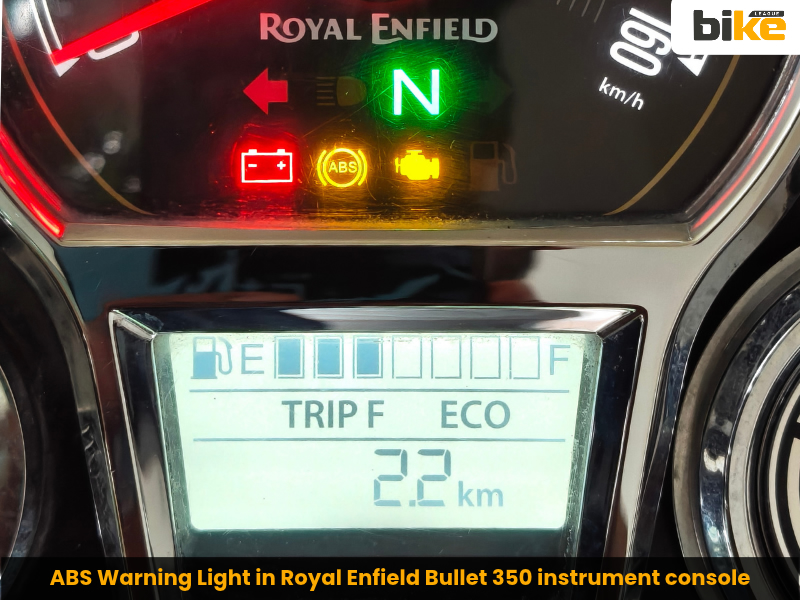
The ABS light might stay on after you turn on the ignition, but this doesn’t always mean there’s a problem. On some motorcycles, the light stays on until you start moving and the bike finishes its checks. Always check your owner’s manual for your model’s normal sequence. Don’t use another motorcycle’s speed threshold or reset steps for yours.
If the light remains on beyond the normal startup sequence, flashes unexpectedly, or comes on while riding, follow these steps:
| Observation | What to check | Recommended action |
|---|---|---|
| ABS light is on immediately after switching on the ignition. | The normal startup sequence described in your motorcycle’s owner’s manual. | Do not assume an immediate fault. Follow the model-specific instructions rather than another motorcycle’s speed threshold or reset procedure. |
| ABS light remains on beyond the normal startup sequence, flashes unexpectedly or appears while riding. | The manufacturer’s warning instructions, any selected ABS mode and other warning indicators. | Follow the manual’s riding restrictions and arrange diagnosis. Normal braking feel does not confirm that anti-lock protection is available. |
| The warning appeared after tyre replacement, wheel removal or other recent work. | When the warning began, what work was performed and any accompanying symptoms. | Give these details to the technician. Do not assume the timing identifies the failed component. |
| Accessible sensor wiring or a sensing ring appears damaged. | Visible damage only, with the motorcycle safely parked and switched off. | Arrange inspection. Do not unplug connectors, bend components, adjust sensor gaps or dismantle the brakes. |
| The warning is accompanied by weak or abnormal braking, a visible brake-fluid leak or another brake warning. | Immediate braking safety; do not attempt a road test to confirm the fault. | Stop somewhere safe and arrange assistance rather than continuing to ride. |
Don’t remove a fuse, disconnect a sensor, or keep clearing a warning just to turn off the light. Turning off the light doesn’t mean the real problem is fixed.
Follow the manufacturer’s advice about riding with a warning light. Just because the brakes feel normal doesn’t mean the anti-lock system is working.
9. Does Abs Work At Every Speed?
Not always. ABS might only work above a certain speed, and this can be different for each system. Check your owner’s manual instead of relying on speeds listed for other models.
10. Does Motorcycle Abs Need Special Maintenance?
Stick to the manufacturer’s schedule for brake service, fluid type, and inspections. Having ABS doesn’t mean your motorcycle always needs costly maintenance, but some repairs or checks might need special tools or skills for your model.
11. Is Abs Mandatory On Every New Two-wheeler In India?
Don’t assume that a suggested start date means a law is already in place. The rules are different for two-wheelers above 125 cc and those at or below 125 cc. Check the regulation section above for details and the latest updates on expanding the rules to all L2-category vehicles.
12. Can I Add Abs To An Older Motorcycle?
Don’t think ABS can be added to any motorcycle as a standard accessory. Check with the manufacturer to see if your model can be converted, and make sure it meets technical, legal, and insurance requirements before doing anything. If there’s no approved conversion, it’s safer to choose a motorcycle that already has ABS from the factory.
13. Should I Switch Abs Off For Normal Road Riding?
Leave the road ABS setting on as the manufacturer recommends. Only use off-road settings when the manual says it’s okay for your bike and the conditions. Switch back to the road setting before riding on paved roads again.
14. Is An Older Motorcycle Without Abs Illegal To Ride In India?
No, an older motorcycle isn’t illegal just because it doesn’t have ABS. The ABS rules apply to certain types of motorcycles made after specific dates. These rules don’t mean you have to add ABS to every older bike that’s already registered.
A motorcycle that was made and registered without ABS is not the same as one that needed ABS but had it removed or turned off.
Whether you can use an older motorcycle on the road depends on its registration, condition, and other rules or local restrictions. Not having ABS doesn’t determine its legal status on its own.
Don’t think that new rules for newly made vehicles mean older non-ABS motorcycles are banned. Read the exact wording of the final rule, and ask your registering authority if you need to be sure about your bike.
Related Motorcycle Braking And Safety Guides
- Motorcycle Braking Techniques
- Motorcycle Disc Brakes: Everything You Need to Know
- Motorcycle Traction Control: How It Works, Pros and Cons
- Engine Braking in Bikes: Detailed Guide for Riders
- Monsoon Bike Riding Safety Tips in India
Conclusion
Motorcycle ABS helps stop the wheels from locking up when you brake, but it’s important to know how your bike’s system works. Single-channel, dual-channel, and cornering ABS each have their own features, and CBS and traction control do different jobs.
Check your motorcycle’s specs and owner’s manual instead of relying on a badge or general info. Learn about its ABS settings, stick to the maintenance schedule, and get any ongoing warning lights or strange braking checked out.
Most importantly, remember that ABS helps you ride safely but doesn’t replace safe riding habits. You still need to keep a safe speed, leave enough space, maintain your tyres, and use good braking technique.
Got a question about motorcycle ABS or see something that should be updated? Leave a comment below or email the Bikeleague India team at bikeleagueindia@gmail.com. If you have a fault or urgent brake issue, contact your motorcycle manufacturer’s service centre instead of waiting for an online answer.

Demystifying active safety systems like motorcycle ABS requires breaking down the interplay between electronic sensors and hydraulic modulation, and this FAQ guide does it brilliantly. Explaining the cycle of pressure release via solenoid valves inside the modulator unit perfectly clarifies why riders experience that signature lever pulsation during threshold braking. Furthermore, tackling common doubts about stopping distances across low-traction surfaces provides crucial foundational knowledge for both novice and experienced riders. A top-tier, highly detailed technical resource for the two-wheeler community!
Thank you, Saleh – BikeBD team, for your kind feedback. These words are what fuel us towards even more improvement and the urge to grow our team.