

Long Story Short: Slow down, plan your ride, and never risk riding through unknown floodwater. Before heading out in the Indian monsoon, check the weather and your route, inspect your bike, wear waterproof gear, and delay your trip if rain, flooding, or poor visibility make it unsafe.
Riding during a monsoon bike ride often means dealing with wet roads, low visibility, slippery patches, waterlogged streets, and unexpected road closures. Staying safe comes down to being prepared, riding smoothly, keeping enough distance from others, and knowing when to stop or turn back if things get worse.
This Bikeleague India guide will walk you through checking your motorcycle or EV, choosing the right rain gear, safety bike riding on wet roads, making decisions about flooded routes, planning your journey, and caring for your bike after the ride. And also tips related to bike ride in the rain. Always follow your owner’s manual and listen to local authorities for weather, flooding, and road closure updates.
Key Takeaways
- Decide Whether to Ride: Check IMD weather warnings, rainfall radar, flood alerts, road closures and local traffic updates. Postpone non-essential travel during severe weather, lightning, flooding, landslide risk or poor visibility.
- Prepare the Motorcycle or EV: Check tyres, manufacturer-recommended cold tyre pressure, brakes, lights, chain condition and essential electrical functions. For EVs, inspect the charging port and follow the model-specific owner’s manual.
- Wear Gear That Keeps You Protected and Visible: Use a certified full-face helmet with a clear visor, waterproof riding gear, gloves, boots and reflective elements. Carry dry clothing and protect your phone, documents and electronics in waterproof bags.
- Ride Smoothly on Wet Roads: Slow down early, leave more following distance, brake progressively and avoid sudden throttle, braking or steering inputs. Treat painted markings, metal covers, mud, loose gravel and puddles as low-grip hazards.
- Do Not Gamble With Floodwater: Turn back if the water depth, road surface or current is unknown. Do not enter flowing water, flooded underpasses or water that hides road edges, potholes, drains or debris.
- Inspect the Vehicle After Rain: Clean off mud and grime, check brake feel and electrical functions, lubricate a chain-driven motorcycle and follow the manufacturer’s charging precautions for EVs. Arrange service support after a stall, submersion or warning light.
How To Prepare Your Motorcycle For Monsoon Riding In India
To stay safe while riding in the monsoon, make sure your motorcycle is in good condition. Here’s a checklist to help you get ready for your next ride:
1. Tyres
Tyres are your motorcycle’s only contact with the road, so inspect them carefully before and during the monsoon. Check for adequate tread depth, uneven wear, cracks, cuts, bulges or embedded objects. Replace a tyre that is worn or damaged before riding in wet conditions.
Check tyre pressure when the tyres are cold—before riding or after the motorcycle has been parked for several hours. Use the cold tyre-pressure specification in your owner’s manual or on the vehicle’s tyre-pressure label. Do not use the maximum pressure printed on the tyre sidewall as your motorcycle’s recommended pressure.
Do not deliberately lower tyre pressure for monsoon road riding. Correct manufacturer-recommended pressure supports stable handling, predictable braking and the tyre’s intended water-clearing performance. Adjust pressure only according to the motorcycle manufacturer’s instructions for your load, pillion or luggage.
2. Brakes
Reliable brakes are essential in the monsoon because wet roads increase stopping distances and reduce available tyre grip. Before the rainy season, inspect the front and rear brake pads or shoes, discs or drums, brake hoses, fluid level and brake-light operation.
If the brake lever feels spongy, the brake pedal travels unusually far, the motorcycle pulls to one side, you hear unusual noises, or braking performance feels weak, do not ignore it. Have the motorcycle inspected by a qualified technician before riding in heavy rain.
Follow the brake-fluid type and replacement interval specified in your owner’s manual. Brake fluid can absorb moisture over time, so it may need replacement as part of scheduled maintenance. Brake-fluid replacement and bleeding should be performed correctly using the specified fluid; using an incorrect fluid or allowing air into the system can affect braking performance.
If your motorcycle has ABS, remember that it can help reduce wheel lock during hard braking, but it does not create extra tyre grip or remove the need to slow down early on wet roads.
3. Lights, Indicators And Horn
Rain, fog and road spray reduce visibility, so confirm that the headlight, tail-light, brake light, indicators, number-plate light and horn work correctly before riding. Replace dim, flickering or failed bulbs, and keep lenses clean so other road users can see your motorcycle clearly.
Ask someone to check the brake light while you operate both the front and rear brakes. If your motorcycle has hazard lights, confirm that they work. Use them only when stopped or when warning other road users of an immediate hazard; do not use them instead of turn indicators while riding normally.
4. Electricals And Battery
Inspect visible wiring, switchgear, battery terminals and connectors for loose fittings, damaged insulation, corrosion or water-trapping dirt. Make sure rubber caps, grommets and covers are properly seated after servicing or washing.
If you notice repeated fuse failure, flickering lights, difficult starting, warning lights, an electrical burning smell or intermittent instrument-cluster behaviour, arrange inspection by a qualified technician. Do not use tape, lubricant or improvised repairs to hide damaged wiring.
5. Chain And Sprockets
Rain and road grime can wash away chain lubricant and accelerate wear. Check chain slack against the specification in your owner’s manual, and inspect the chain and sprockets for rust, tight links, excessive wear or damaged teeth.
After a wet or muddy ride, clean the chain with a cleaner suitable for your chain type, dry it and apply a compatible motorcycle chain lubricant. Apply lubricant to the inside run of the chain, allow it to settle and wipe off excess to prevent it reaching the tyre, brake disc or other components. Avoid steel brushes and products that are not suitable for sealed O-ring or X-ring chains.
6. Air Filter And Airbox
Inspect the air filter and airbox more often during the monsoon, especially after dusty, muddy or waterlogged roads. Look for water, mud, damaged seals or a blocked airbox drain, where fitted.
Follow the owner’s manual for the correct service method. Paper filters may require replacement rather than washing, while foam or reusable filters may have specific cleaning and oiling procedures. If the filter or airbox is wet, muddy or contaminated after a water crossing, do not continue riding until it has been inspected and serviced correctly.
How To Gear Up For A Monsoon Motorcycle Ride Or Trip In India?
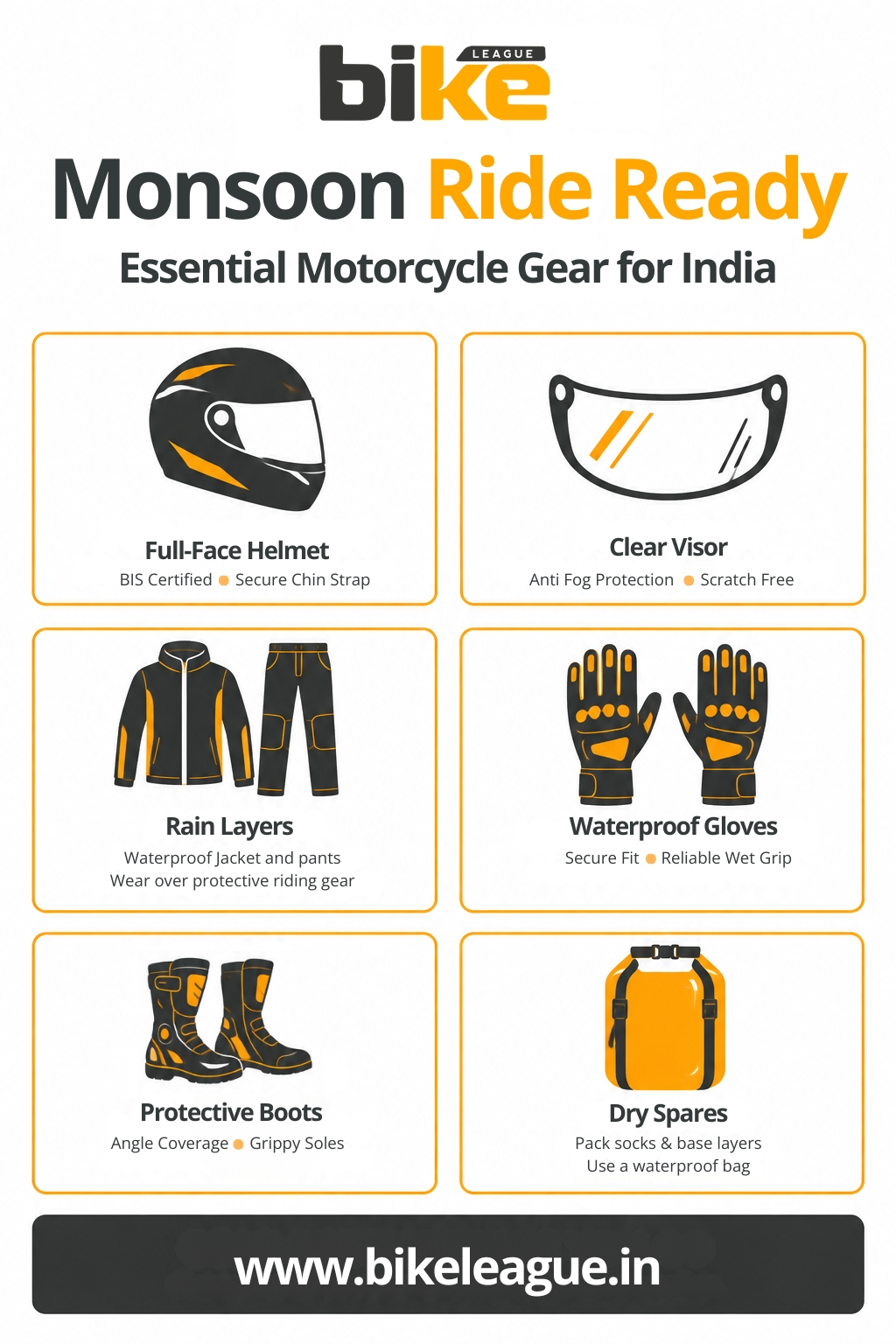
Good rain gear should do more than keep you dry. It should protect you in a fall, help other road users see you and allow you to operate the controls comfortably. Choose gear that fits properly and does not restrict head movement, braking, clutch use or foot movement.
| Riding Gear | What to Look For | Check Before Riding |
|---|---|---|
| BIS-certified full-face helmet | A properly fitting helmet with a secure chin strap and a clear, scratch-free visor that seals properly. | Fasten the chin strap and make sure you have a clear view of the road. |
| Visor anti-fog protection | A compatible anti-fog insert or visor-safe anti-fog solution. | Clean the visor with a soft microfiber cloth and visor-safe cleaner. Do not ride if fogging, scratches or rainwater obstruct your view. |
| Waterproof riding jacket and pants | A waterproof outer layer that fits over protective riding gear, with reflective panels or high-visibility elements. | Make sure the clothing does not restrict movement or fit so loosely that it flaps while riding. |
| Waterproof gloves | Gloves that fit securely, retain grip when wet and allow comfortable control operation. | Check that you can operate the clutch, brake and switches without difficulty. |
| Protective waterproof boots | Ankle-covering riding boots or sturdy waterproof footwear with grippy soles. | Make sure the footwear stays secure and does not interfere with the gear lever or rear brake pedal. Avoid open sandals and smooth-soled footwear. |
| Base layers and spare clothing | Moisture-wicking base layers, with spare socks, gloves and a lightweight base layer for long rides. | Pack spare clothing in a waterproof bag to keep it dry. |
Before leaving, wear the complete gear set and sit on the motorcycle. Confirm that you can turn your head, operate the controls, use indicators and check mirrors without restriction.
How To Pack For Monsoon Travelling In India?
Pack light, but carry essentials that help you manage rain, a puncture, low visibility or an unexpected delay. Keep electronic items, documents and spare clothing inside waterproof pouches or dry bags.
- Tyre Repair Kit, Inflator and Pressure Gauge: Carry a puncture repair kit only if it is suitable for your tyre type, along with a compact inflator and an accurate pressure gauge. A temporary roadside repair is not suitable for a sidewall cut, major tyre damage or any tube-type tyre puncture.
- Basic Tool Kit: Carry the motorcycle manufacturer’s tool kit, along with essential items such as a torch, fuses if applicable, cable ties and electrical tape. Carry spare parts only when they are relevant to your motorcycle, and you know how to use them safely.
- Microfiber Cloth: Keep a clean microfiber cloth in an easily accessible waterproof pouch for wiping your visor, mirrors, lights and charging-port area. Do not wipe a visor with a dirty cloth, as it can scratch the surface.
- Waterproof Phone Protection: Use a waterproof phone pouch or rain cover, especially when using navigation. Carry a power bank and download offline maps before long rides in areas with unreliable network coverage.
- First-Aid Kit and Personal Medicines: Pack a compact first-aid kit with basic wound-care supplies, along with any personal prescription medicines you may need. Keep the kit dry and easily accessible.
- Visibility and Emergency Items: Carry a reflective vest or reflective band, a small torch or headlamp, emergency contact details, some cash and a charged phone. Save roadside-assistance and insurance contact numbers before the ride.
- Dry Clothing: Pack spare socks, gloves and a lightweight base layer in a dry bag. Staying dry helps maintain comfort and concentration during a long ride.
Emergency Contacts For Monsoon Motorcycle Rides In India
Save these numbers before a long monsoon ride:
| Emergency Contact | When to Use It | Details to Save or Share |
|---|---|---|
| 112 — Emergency assistance | For police, fire, health or other emergency assistance. | Share your exact location, nearest landmark, type of emergency and whether anyone is injured. |
| 1033 — National Highway Helpline | For assistance on National Highways, including road incidents, ambulance support, patrol vehicles and highway-related issues. | Share the highway number, direction of travel, nearest kilometre marker, toll plaza or landmark. |
| Insurer and roadside-assistance provider | For policy-related assistance, breakdown support, towing or claim guidance, depending on your coverage. | Save your policy number, claim helpline and roadside-assistance number offline. |
| Vehicle manufacturer or authorised service centre | For vehicle-specific service support or roadside assistance for your motorcycle or EV. | Save the relevant service and roadside-assistance contact numbers before leaving. |
| Family member or trusted friend | To share your travel plan and provide updates about delays or route changes. | Share your route, expected arrival time and live location before a long ride. |
In an emergency: Move yourself out of danger first, if possible. Share the nearest landmark, highway number, kilometre marker, town or live location when asking for help.
What To Do If Your Motorcycle Breaks Down In Rain?
A breakdown in rain can quickly become dangerous because visibility is poor and other road users may not expect a stopped two-wheeler. Prioritise your personal safety over repairing the motorcycle at the roadside.
- Slow down and signal early: Hold the handlebars firmly, ease off the throttle, use indicators and move gradually toward a safe stopping place. Avoid sudden braking or sharp steering, especially after a puncture or loss of power.
- Stop away from traffic: Choose a safe shoulder, service road, fuel station, parking area or other legal stopping place. Do not stop on a blind bend, bridge, narrow lane, flooded underpass, fast-moving carriageway or location with poor visibility.
- Make yourself and the motorcycle visible: Once stopped in a safe place, switch on hazard lights if your motorcycle has them. Wear a reflective vest or band if available. Do not ride normally with hazard lights flashing or use them instead of turn indicators.
- Move away from the traffic lane: Stand well away from moving vehicles, preferably behind a barrier where one is available. Do not stand beside the motorcycle on the traffic side, and do not attempt repairs while exposed to fast-moving traffic.
- Assess only obvious and safe problems: Check for a flat tyre, an empty fuel tank, a loose luggage strap or a visible leak only when it is safe. Do not attempt major repairs, touch damaged electrical wiring or restart a motorcycle that stalled in floodwater.
- Call for assistance: Contact your manufacturer’s roadside-assistance service, insurer or a trusted recovery provider. On a National Highway, call 1033. Call 112 for a medical emergency, crash, dangerous traffic situation or immediate threat to safety.
- Share your exact location: Provide the road name or highway number, direction of travel, nearest kilometre marker, toll plaza, fuel station, landmark or live location. Mention that you are on a two-wheeler and state whether you need medical help, towing or a puncture repair.
How To Stay Safe On A Monsoon Bike Ride In India
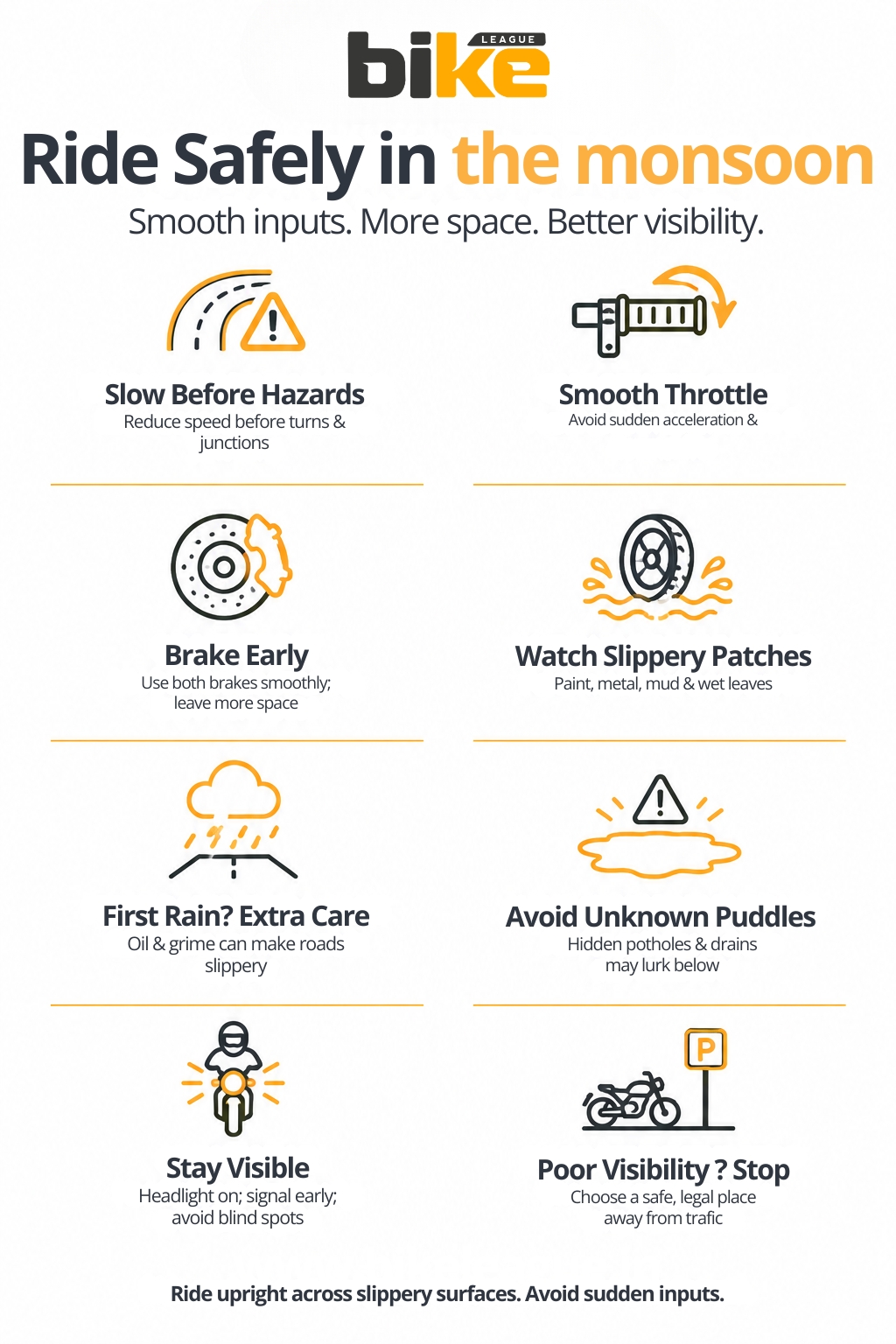
Once you and your bike are ready, keep these riding habits in mind to handle less grip, longer stopping distances, and lower visibility during the monsoon:
- Slow Down Before the Hazard: Reduce speed before corners, junctions, puddles and congested traffic. Wet roads offer less grip, so enter turns slower than you would in dry conditions.
- Use Smooth Throttle Control: Open and close the throttle gradually. Avoid sudden acceleration, abrupt downshifts and rapid gear changes that can unsettle the motorcycle or cause wheel spin.
- Brake Early and Progressively: Leave a larger following distance and begin slowing down early. Apply both brakes smoothly while the motorcycle is as upright as possible. Avoid sudden braking while leaned over or on a slippery surface.
- Watch for Low-Grip Surfaces: Treat painted lane markings, zebra crossings, arrows, manhole covers, drain grates, metal plates, bridge joints, wet leaves, loose gravel, mud and road-repair patches with extra caution. If you must cross one, reduce speed beforehand, keep the motorcycle upright and avoid sharp steering, braking or hard acceleration while on it.
- Be Extra Careful During the First Rain: After a dry spell, rain can bring oil, diesel, dust and road grime to the surface, especially near junctions, fuel stations, bus stops and traffic signals. Ride more slowly until the road has been washed clean.
- Treat Puddles as Unknown: A puddle can hide potholes, broken road edges, open drains or debris. Avoid it if possible. If you cannot avoid a shallow puddle, slow down, keep the motorcycle upright and cross it smoothly without sudden inputs.
- Stay Visible: Use your headlight when rain, fog or spray reduces visibility. Wear reflective gear, signal early and avoid riding in the blind spots of buses, trucks and cars.
- Stop if Visibility Becomes Unsafe: If heavy rain, fog, spray or a fogged visor prevents you from clearly seeing traffic and road hazards, slow down and stop at a safe, legal location. Do not stop under a bridge, on a blind bend, in an underpass or at the edge of fast-moving traffic.
How To Ride Safely In A Group During The Monsoon
When riding in a group during the monsoon, plan ahead, keep plenty of space between bikes, and set a pace everyone can handle. Remember, staying together is less important than making sure everyone can brake safely, see clearly, and ride within their limits.
- Hold a pre-ride briefing: Agree on the route, planned stops, regrouping points and what to do if someone becomes separated. Make sure everyone knows the destination and has the relevant emergency and roadside-assistance contacts.
- Choose an experienced lead and sweep rider: The lead rider should set a manageable pace and communicate route changes. The sweep rider stays at the rear to help identify riders who fall behind or need assistance. Divide a large group into smaller groups to make coordination easier.
- Set the pace for the least experienced rider: Do not pressure anyone to keep up, overtake or enter a corner faster than they feel comfortable. Avoid overtaking other riders within the group or treating the ride as a competition.
- Use single file when conditions require more space: Ride single file on curves, poor road surfaces and stretches with reduced visibility. Avoid riding side by side, as this limits each rider’s room to manoeuvre around hazards. Do not hold a fixed formation at the expense of choosing a safer road position.
- Increase following distance in rain: Leave a generous gap from the motorcycle ahead and increase it further when grip or visibility deteriorates. Do not close the gap merely to keep the group compact; every rider needs enough space to brake or avoid a hazard independently.
- Communicate without losing control: Agree on simple signals before departure and use them only when it is safe. Signal turns and slow down early. Do not make abrupt movements, take your attention off the road or handle a phone while riding.
- Regroup safely if separated: Follow traffic signals and allow other vehicles to move normally. Never run a red light, block a junction or speed through rain to catch up. Continue to the agreed regrouping point and stop only where it is safe and legal.
- Plan regular breaks and stop when needed: Use breaks to check riders, visibility, weather and vehicle condition. If someone is struggling with fatigue, fogging, wet gear or motorcycle trouble, stop at a safe location and reassess the plan.
No rider should feel pressured to continue: If visibility becomes unsafe, floodwater blocks the route, or conditions exceed anyone’s ability, stop safely, turn back or postpone the ride. A group’s decision to continue does not make a hazardous stretch safe.
How To Handle Flooded And Waterlogged Roads
Flooded roads can hide potholes, open drains, debris, damaged surfaces, and even strong currents. The safest option is to avoid riding through floodwater whenever you can. Just because another vehicle made it across doesn’t mean it’s safe for you.
- You cannot clearly see the road surface, road edges or the route ahead.
- You cannot confirm that the water is shallow and still from a safe position.
- The water is flowing, rising, carrying debris or disturbing the road surface.
- There may be open drains, manholes, broken road edges, potholes, low bridges or damaged surfaces beneath the water.
- The crossing could expose the engine, intake, exhaust, electrical system or an EV’s battery and charging components to water.
Turn back, wait for the water to recede or choose another route. No destination is worth risking a fall, engine damage or electrical-system damage.
1. Before You Enter A Waterlogged Stretch
- Stop and assess the road: Watch the water movement, look for debris and check whether other road users are struggling or turning back. Do not rely only on cars or large vehicles as their safe crossing depth may be different from that of a two-wheeler.
- Check for a safer option: Use an alternative route, wait at a safe location or ask local authorities, traffic police or nearby residents about road conditions.
- Keep a safe gap: Never follow another vehicle closely into water. Leave enough space to stop or turn around if conditions change.
2. If You Must Cross Shallow, Still Water
- Ride slowly and smoothly: Use gentle throttle, avoid sudden braking and keep the motorcycle as upright as possible.
- Choose the safest visible line: Stay away from road edges, dividers, drain covers, manholes and areas where the water surface is disturbed.
- Do not stop unnecessarily: Keep moving steadily only when the route is clearly safe. Avoid sharp turns, quick acceleration and overtaking.
- Do not ride through moving water: Flowing water can push a two-wheeler off balance and may conceal a washed-out road surface.
3. Important Precautions For Electric Two-wheelers
Check the owner’s manual for your exact EV before riding in rain or waterlogged conditions. An IP rating describes tested protection for specific components; it is not a general permission to ride through floodwater. Avoid deep or unknown water, and do not attempt a crossing if water may reach the battery pack, motor, charging port or other electrical connectors.
After riding in rain, inspect the charging port and connector before charging. Allow the vehicle and charging area to dry for the period stated in your owner’s manual, then wipe accessible moisture with a soft, clean, dry cloth. Do not charge the EV if the port, connector or cable is wet, dirty, damaged or showing signs of water ingress.
4. If Your Motorcycle Or Ev Stalls In Water
- Do not repeatedly try to restart it: Repeated starting attempts can worsen engine or electrical damage.
- Move yourself to safety first: Switch on hazard lights if possible, push the vehicle only when it is safe, and keep clear of moving traffic or rising water.
- Arrange roadside assistance or towing: Take an ICE motorcycle or EV to an authorised service centre if it has stalled in deep water or shows warning lights, unusual noise or electrical faults.
- Do not charge a wet EV: Follow the exact drying and charging procedure in the owner’s manual. Use only the approved charger.
5. After Crossing Water
- Ride slowly on a safe, dry stretch and apply the brakes gently several times to help clear surface moisture.
- Check that the brakes, lights, horn, indicators and throttle feel normal before resuming normal riding.
- Clean mud and grit from the chain, sprockets, wheels and exposed parts, then lubricate the chain using a motorcycle-safe chain lubricant.
- Seek professional inspection if the engine oil looks milky, the engine misfires, the brakes feel abnormal, warning lights appear, or the EV does not operate normally.
When To Postpone Or Stop A Monsoon Ride
Rain doesn’t always mean you have to stay home, but severe weather, poor visibility, and flooding can make riding unsafe. Before a long trip, check IMD warnings for your area, local traffic updates, and any road closure notices.
- An IMD red warning, severe thunderstorm warning, lightning warning or a local emergency advisory applies to your route.
- Heavy rain, spray, fog or a fogged visor prevents you from clearly seeing vehicles, road edges, potholes and hazards ahead.
- Water is flowing across the road, visibility of the road surface is lost, or an underpass and low-lying stretch is flooding.
- Your planned route has a closure, landslide warning, fallen trees, damaged roads or official diversion.
- Your motorcycle develops weak brakes, tyre damage, electrical faults, warning lights or an engine problem.
Do not wait under a tree, on a bridge, in a flooded underpass, on a blind bend or at the edge of fast-moving traffic. Use a safe, legal shelter such as a fuel station, designated parking area or building forecourt, where permitted.
How To Use Weather Warnings For Ride Planning
| Weather Warning | Recommended Riding Decision |
|---|---|
| Yellow warning | Stay updated and review your departure time, route and local road conditions before leaving. |
| Orange warning | Be prepared for disruption, waterlogging and difficult travel. Avoid non-essential rides and keep an alternative plan. |
| Red warning | Avoid non-essential travel. Follow directions from local authorities, traffic police and disaster-management agencies. |
Weather can change fast, sometimes quicker than the forecast says. Check the latest local weather updates just before you leave and again during breaks if your ride is long.
How To Plan A Safer Monsoon Route
Plan a monsoon route using current weather, flood and road-closure information rather than relying on routes that were safe on previous trips. Avoid low-lying roads, flooded underpasses, river crossings and landslide-prone stretches when conditions are uncertain.
Check official weather, traffic and highway updates shortly before departure, and be ready to delay, turn back or take a safer alternative. A national highway, elevated road or familiar route is not automatically safe during heavy rain, poor visibility or flooding.
1. Handy Apps To Help You Navigate
Here are some apps you can count on for flood alerts and real-time route planning during the rainy season:
- FloodWatch India: This app gives you a 7-day flood forecast, real-time river levels from hundreds of stations, and location-based risk updates in both English and Hindi. It’s perfect for checking river basins like the Ganga or Godavari before you head out.
- IMD Mausam: Get rain radar, lightning alerts, and instant weather updates. Pair this with Google Maps to avoid areas highlighted in orange or red for heavy rainfall.
- Drive Weather: This app gives you route-specific weather forecasts, radar overlays, wind chill info for bikers, and time sliders so you can pick the driest window for your journey.
- AccuWeather and Windy: Use these as supplementary weather tools for rainfall forecasts, radar and storm tracking. Check official IMD warnings and local authority updates before deciding whether to travel.
- Rajmargyatra: NHAI’s highway app provides highway-user information, nearby facilities and access to the National Highway Helpline 1033 for assistance. Check the latest route information before entering a long highway stretch.
- State Traffic Police and District Administration Updates: Check official local updates for diversions, closures, landslide risk and emergency instructions. In Kerala, use Kerala Police traffic updates and call 112 in an emergency.
2. Safer Route Strategies
Don’t choose a monsoon route just because it’s a national highway, an elevated road, or a route you’ve used before. Always check current conditions before you leave and be ready to change your plan if needed.
| Route Situation | Safer Decision | What to Check Before Leaving |
|---|---|---|
| Urban waterlogging and underpasses | Avoid low-lying roads, underpasses, river-side routes and known waterlogging points. Choose an alternative only when the road surface and traffic movement are visible. | Local traffic police updates, navigation alerts, rainfall radar and local news. |
| Highways during heavy rain | Use major routes only when they are officially open and visibility is adequate. Slow down for spray, standing water, crosswinds, large vehicles and sudden traffic queues. | NHAI/Rajmargyatra updates, National Highway Helpline 1033, weather alerts and fuel-stop availability. |
| Ghat roads and hilly areas | Avoid non-essential travel during heavy rain, especially at night. Do not stop below steep cut slopes, unstable rock faces or trees that may fall. | District administration, police, PWD or highway authority updates for landslides, rockfall, closures and diversions. |
| River basins, dams and flood-prone regions | Avoid routes near flooding rivers, dams, causeways and low bridges when rain is heavy or water levels are rising. | CWC FloodWatch India forecasts, local flood advisories, dam-release notices and district emergency updates. |
3. Pre-trip Planning Steps
- Check the IMD or CWC weather forecasts a day or two before your trip, especially if you’re planning to ride for more than one day. Turn on app notifications so you stay updated while on the road.
- Enter your planned route in your weather or navigation app to see if rain is expected along the way. If heavy rain is predicted, it’s best to postpone your ride for safety.
- Check local updates from traffic police on social media or use highway apps to find out about any diversions or road closures before you travel.
- Identify safe, legal places to stop along the route, such as fuel stations, designated parking areas or building forecourts where permitted. Avoid planning to wait in flooded underpasses, beneath trees, on bridges, on blind bends or beside fast-moving traffic.
How To Take Care Of Your Rain Gear During The Indian Monsoon
Regularly cleaning and drying your rain gear keeps it comfortable, clean, and water-repellent. Always check the care label and follow the instructions for your jacket, pants, gloves, boots, helmet liner, and rain suit. Materials like PVC, textiles, and waterproof-breathable fabrics may each need different care.
1. Clean Rain Gear Correctly
- Remove mud and road grime promptly: After a wet ride, wipe or rinse off mud, salt, insects and dirt before they dry onto the fabric, zips and reflective panels.
- Follow the care label: Hand-wash or machine-wash only if the manufacturer permits it. Close zips, fasteners and Velcro, empty pockets and remove detachable liners or armour when the care instructions require it.
- Use suitable cleaning products: Use the cleaner recommended by the gear manufacturer, preferably a technical cleaner for waterproof-breathable garments. Avoid bleach, fabric softener, harsh stain removers and unsuitable detergents, as they can damage fabrics, coatings or water repellency.
- Rinse thoroughly: Detergent residue can reduce breathability and water repellency. Use an extra rinse if the care label permits it.
2. Dry Gear Fully Before Reuse Or Storage
- Dry in a shaded, ventilated place: Hang gear where air can circulate and allow it to dry completely. Avoid direct sunlight, high heat, radiators and open flames unless the manufacturer specifically permits a different method.
- Use a dryer only when permitted: Some waterproof garments allow low-heat tumble drying, which may help restore water repellency. Other garments can be damaged by machine drying. Follow the care label for your exact product.
- Dry gloves, boots and liners separately: Open them fully and allow airflow inside. Do not store any item while it is damp, as trapped moisture can cause odour, mildew and material deterioration.
3. Restore Water Repellency When Needed
- Test the outer fabric: After washing and drying, sprinkle water on the outer surface. If water no longer beads and runs off, the durable water-repellent (DWR) finish may need renewal.
- Use a compatible DWR treatment: Choose a wash-in or spray-on treatment that is suitable for the garment fabric and membrane. Apply it exactly as directed by the product and gear manufacturer.
- Do not use a fixed schedule: Reapply DWR based on the garment’s performance and care instructions—not automatically every month or after a specific number of rides.
4. Store Gear Properly
- Store gear only when it is clean and completely dry.
- Keep it in a cool, dry and ventilated place, away from direct sunlight and damp cupboards.
- Avoid sealing damp gear inside plastic bags for long periods.
- Inspect seams, zips, Velcro, reflectors and waterproof coatings regularly. Repair or replace the item if it leaks, has damaged stitching, broken fasteners or compromised protective areas.
How To Care For Your Motorcycle Or Ev After Rain?
After riding in rain, remove mud and road grime, check essential controls and allow the motorcycle or EV to dry as directed in the owner’s manual. Floodwater exposure, a stall, submersion, warning light or unusual behaviour requires more caution and may require professional inspection.
Petrol motorcycles and electric two-wheelers have different water-related risks. Follow the model-specific owner’s manual and use authorised roadside assistance or service support when there is any doubt about water ingress or damage.
1. If You Have A Petrol Motorcycle (ice)
After an ordinary rainy ride, clean mud and road grime from the motorcycle, dry accessible surfaces and lubricate the chain with a motorcycle-specific chain lubricant. However, a motorcycle that has stalled in water, been submerged or crossed deep water needs more careful handling.
- Do not attempt to restart the engine: If the engine stalled in water or water may have reached the air intake, keep the ignition switched off. Do not repeatedly press the starter button or try to “test” whether the engine will start.
- Move the motorcycle only if it is safe: Push it to a dry, safe location if possible. Do not put yourself at risk in moving water, heavy traffic or a flooded underpass.
- Arrange towing or roadside assistance: Take the motorcycle to an authorised service centre or qualified workshop for inspection. Inform the technician that the motorcycle stalled or was exposed to floodwater.
- Ask for a complete inspection: The workshop should inspect the air filter and intake system, engine oil, fuel system, exhaust, electrical connectors, brakes, wheel bearings, chain and other affected components. Replace contaminated fluids or damaged parts only as required by the manufacturer’s service procedure.
- Check for warning signs after a rainy ride: Seek professional help if the engine misfires, the oil appears milky, the brakes feel weak, the clutch slips, warning lights appear, or you notice unusual sounds, vibration or electrical faults.
- Protect against corrosion: Once the motorcycle is safe to use, wash off mud and dirty water, dry the bike, clean and lubricate the chain, and use only motorcycle-safe products on exposed metal parts according to the owner’s manual.
2. For Electric Two-wheelers (evs)
Electric two-wheelers are designed for normal rain use, but floodwater, a damaged charging port or possible water ingress require extra caution. Always follow the instructions in the owner’s manual for your exact model.
- Park in a dry, ventilated place: After riding in rain, park the EV under cover when possible. Do not park or charge it in standing water or an area that may flood.
- Inspect before charging: Check the charging port, connector, cable and protective cap for water, mud, debris, physical damage or loose parts. Do not insert the charger if the port or connector appears wet, dirty or damaged.
- Dry the charging area correctly: Wipe accessible moisture from the charging port area and connector with a soft, clean, dry cloth. Do not spray water, lubricants, water-displacing products, cleaning chemicals or any unapproved substance into the charging port or electrical connectors.
- Wait before charging: Allow the vehicle and charging area to dry for the period specified in your owner’s manual. Wipe accessible moisture with a soft, clean, dry cloth before connecting the charger.
- Use the approved charger: Charge only with the charger, cable and electrical setup approved by the vehicle manufacturer. Follow the manufacturer’s instructions on whether charging should be started, stopped or avoided during rainfall.
- Check basic functions before the next ride: Confirm that the display, lights, indicators, horn and brakes work normally. Look for warning messages, unusual noises, reduced performance or signs of water ingress.
- Contact authorised service after deep-water exposure: Do not charge or ride the EV if it was submerged, stalled in floodwater, has warning lights, a damaged port, abnormal odour, repeated errors or any suspected battery or electrical-system water ingress. Contact authorised roadside assistance or a service centre.
For routine cleaning, wash only as permitted in the owner’s manual. Avoid directing high-pressure water at the battery area, motor, charging port, display, switches, bearings and electrical connectors.
3. Tips For Both Types Of Bikes
After rain or shallow-water exposure, check that the brakes, lights, horn, indicators and tyres are functioning normally before your next ride. Clean off mud and road grime promptly, park in a dry location where possible, and arrange professional inspection after a stall, submersion, warning light or unusual mechanical or electrical behaviour.
Comprehensive insurance and optional add-ons may help with certain flood-related repair or towing costs, but coverage, exclusions and claim procedures vary by insurer and policy. Read your policy wording and contact the insurer before authorising major repairs.
Monsoon Motorcycle Riding Faqs
1. Is It Safe To Ride A Motorcycle In Heavy Rain?
It is safer to postpone a ride when rain, fog or spray prevents you from seeing road edges, traffic, potholes and hazards clearly. Avoid non-essential travel during severe-weather warnings, flooding, thunderstorms or local road closures. If conditions worsen while riding, stop at a safe and legal shelter rather than continuing through poor visibility or standing water.
2. Should I Reduce Motorcycle Tyre Pressure For Riding In Rain?
No. Maintain the cold tyre pressure recommended in your motorcycle owner’s manual or on the vehicle’s tyre-pressure label. Do not deliberately lower pressure for monsoon road riding, as incorrect pressure can affect handling, stability and tyre life.
3. Can Abs Prevent A Motorcycle From Skidding On Wet Roads?
ABS can help reduce wheel lock during hard braking, but it cannot create grip where the road surface is slippery. Reduce speed early, leave more following distance, use smooth braking inputs and avoid sudden braking while leaned over or riding across painted markings, metal covers, gravel, mud or standing water.
4. What Should I Do If My Motorcycle Stalls In Floodwater?
Do not repeatedly try to restart a vehicle that has stalled in floodwater. Move yourself to safety first, move the vehicle only when it is safe, and arrange roadside assistance or towing.
For a petrol motorcycle, keep the ignition off if water may have entered the intake or engine. Have it inspected before attempting to restart it.
For an electric two-wheeler, do not charge or ride it if there may be water ingress, damage, warning messages, unusual smells or abnormal operation. Contact authorised roadside assistance or a service centre and follow the model-specific owner’s manual.
5. Can I Charge An Electric Scooter After Riding In Rain?
Check the charging port, connector and cable for moisture, mud or damage before charging. Follow the exact drying and waiting instructions in your EV owner’s manual, and use only the approved charger. Do not charge an EV that has been submerged, shows warning lights or has suspected water ingress.
6. What Should I Check After Riding In Rain?
Check brake feel, tyre condition, lights, horn, indicators and chain condition. Clean off mud and dirty water, lubricate the chain on chain-driven motorcycles, and inspect the charging area before charging an EV. Seek service support if you notice a weak brake, warning light, unusual noise, misfire or electrical fault.
7. Does Two-wheeler Insurance Cover Flood Damage?
Coverage depends on your policy, exclusions and optional add-ons. Comprehensive insurance may cover certain flood-related damage, while engine or electrical damage from water ingress may require specific add-on protection. Read your policy wording and contact your insurer before authorising major repairs.
Related Motorcycle Safety Articles From Bikeleague India
- Best bike trip routes in Kerala
- Bike wash – Different types, procedures, precautions, FAQ
- Motorcycle headlight in India – Everything you need to know
- Motorcycle fuel tank – How to maintain properly
- TVS Apache RTR 180
Conclusion
Monsoon riding can be safe and enjoyable if you prepare well and make smart choices on the road. Check your motorcycle or EV, wear waterproof gear, slow down early, leave extra space, and make sure others can see you.
Before you ride, remember:
- Check: Tyres, cold tyre pressure, brakes, lights, chain, visor and weather warnings.
- Pack: Rain gear, phone protection, first-aid supplies, puncture equipment suited to your tyre and emergency contacts.
- Ride: Smoothly, slowly and with a larger following distance than in dry conditions.
- Avoid: Sudden braking, painted markings, metal covers, deep puddles and unknown or flowing floodwater.
- Stop: When visibility becomes unsafe, a warning applies to your route, or your motorcycle shows a mechanical or electrical problem.
Sometimes, the safest thing to do during the monsoon is to wait, turn back, or choose a different route. It’s better to arrive late than to risk riding through floodwater, poor visibility, or damaged roads.
For help during an emergency, call 112. On National Highways, call 1033 for highway assistance. Before a long ride, share your route and expected arrival time with a trusted person.
For vehicle-specific questions, follow your owner’s manual and contact the manufacturer’s authorised service or roadside-assistance provider. For an immediate emergency, call 112; for assistance on a National Highway, call 1033.

hero
Can you please elaborate the requirement?
Can you please elaborate the requirement?
India Uttar Pradesh Pratapgarh
Can you please elaborate the requirement?