
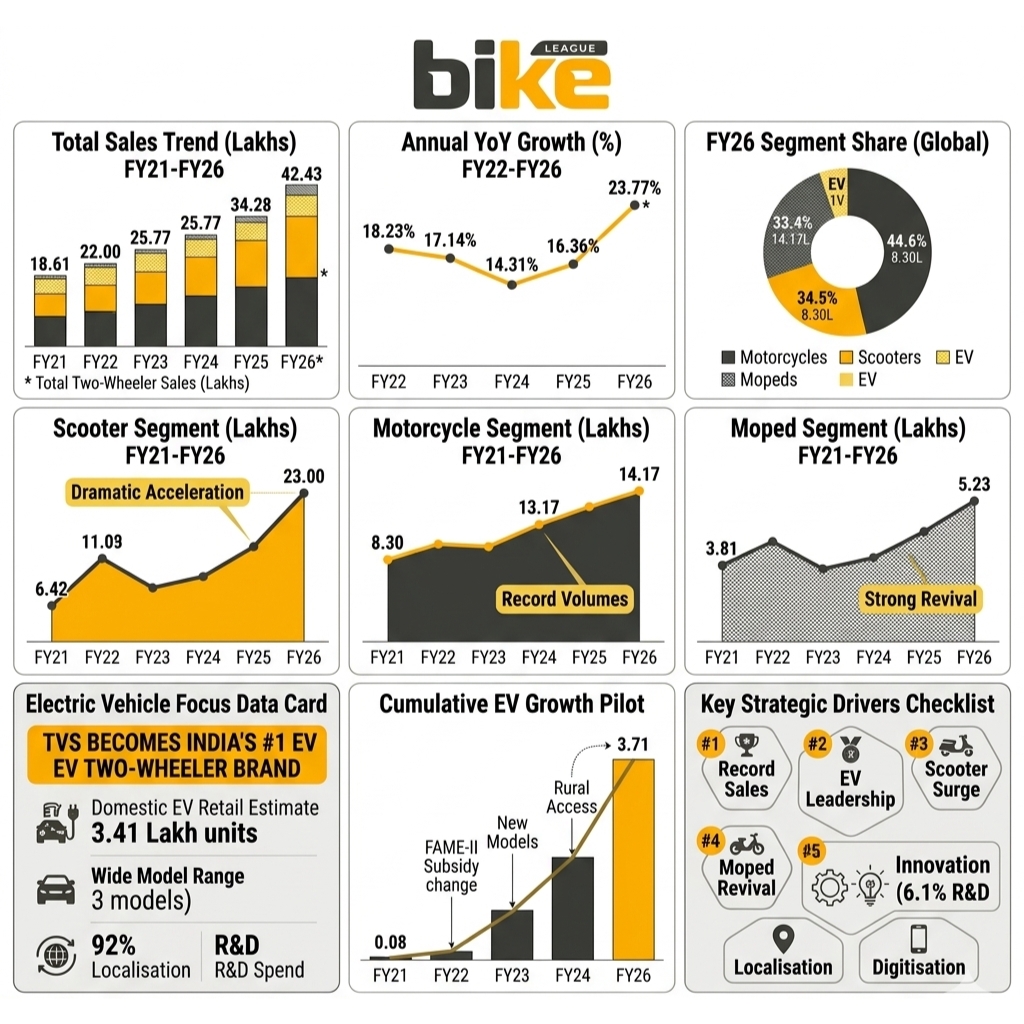
Long story short: Here’s a quick overview of TVS Motors Growth story in India’s two-wheeler market, highlighting key milestones in electric vehicles and segment-wise growth statistics from FY2021 to FY2026.
TVS Motor Company has become a significant player in India’s two-wheeler industry in recent years. This report reviews TVS’s growth from FY21 to FY26. It highlights performance in motorcycles, scooters, and mopeds. The report also covers TVS’s quick progress in the electric vehicle (EV) segment.
This summary covers important milestones, strategy changes, and yearly growth statistics. It shows how TVS improved its market position. It also explains how TVS became a leader in both traditional and electric mobility.
Key Takeaways
- Record Sales Growth: TVS Motor achieved its highest-ever sales in FY26, with two-wheeler volumes reaching 42.43 lakh units, representing a 21% year-on-year increase.
- Electric Vehicle Leadership: TVS became India’s leading electric two-wheeler brand in FY26. The company retailed over 3.41 lakh EVs domestically. It also expanded its portfolio to three electric models.
- Scooter Segment Surge: Scooter sales hit a record 23 lakh units, powering overall growth and boosting TVS’s scooter market share to 28%.
- Moped Revival: The XL100 moped crossed the 5 lakh unit mark, showing strong demand in rural and semi-urban markets thanks to targeted programs like the Rural Accelerator.
- Strategic Innovation and Localisation: TVS focused investments in R&D, product premiumisation, and localisation of EV components. These efforts drove operational efficiency, profitability, and resilience against supply chain disruptions.
TVS Motors sales analysis FY21-26 in India
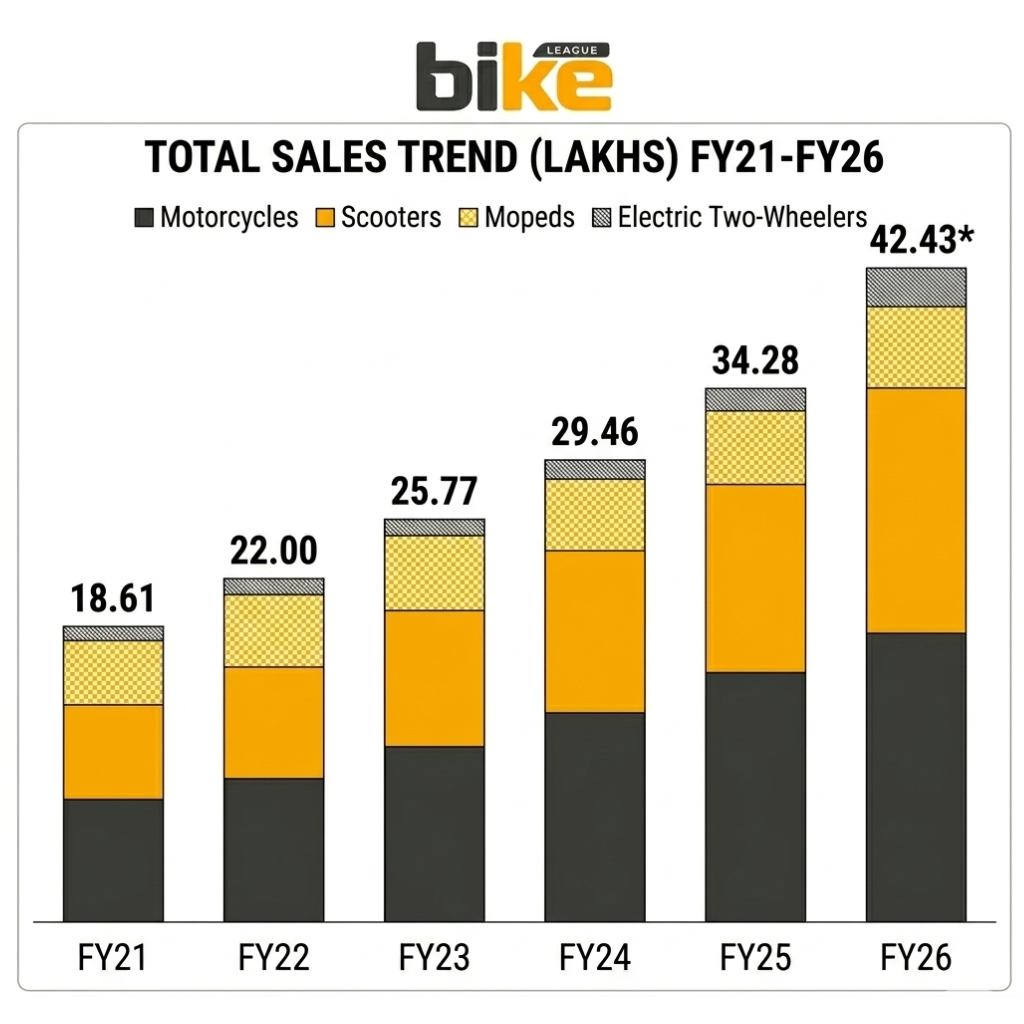
The table below lists TVS’s two-wheeler sales volumes. It shows domestic sales from FY21 to FY25. It also shows total sales, including exports, for FY26. This format makes year-on-year comparisons straightforward.
| Financial Year | Motorcycles (Lakhs) | Scooters (Lakhs) | Mopeds (Lakhs) | Electric Two-Wheelers (Lakhs) | Total T-Wheelers (Lakhs) | YoY Growth (Lakhs) | YoY Growth |
|---|---|---|---|---|---|---|---|
| FY 2020-21 | 8.30 | 6.42 | 3.81 | 0.08 | 18.61 | – | – |
| FY 2021-22 | 9.57 | 7.58 | 4.71 | 0.13 | 22.00 | 3.39 | 18.23 |
| FY 2022-23 | 10.32 | 9.55 | 4.83 | 1.07 | 25.77 | 3.77 | 17.14 |
| FY 2023-24 | 11.60 | 10.75 | 4.92 | 2.19 | 29.46 | 3.69 | 14.31 |
| FY 2024-25 | 13.20 | 12.14 | 4.75 | 4.19 | 34.28 | 4.82 | 16.36 |
| FY 2025-26* | 14.17 | 23.00 | 5.23 | 3.71 | 42.43 | 8.15 | 23.77 |
*FY 2025-26 figures represent total global wholesales (domestic + exports) as officially reported by TVS Motor. Previous years reflect domestic-only figures. The EV figure of 3.71 lakh is the global wholesale; domestic EV retail was approximately 3.41 lakh units.
The data shows three main trends. These trends are outlined below.
- Motorcycles and scooters have grown consistently. Scooters have emerged as the single largest growth driver in FY26. Scooter sales surged 27% year-on-year to 23 lakh units globally.
- Mopeds, after a slight dip after FY22, recovered in FY26. The XL100 sold over 5 lakh units for the first time in recent years.
- Electric two-wheelers grew at triple-digit annual rates from FY23 to FY25. They kept up strong double-digit growth in FY26 (33% globally). TVS became the top brand in India’s EV two-wheeler market.
Between 2021 and 2025, TVS’s domestic two-wheeler sales grew at a compound annual rate of 16.7%. Internal combustion models grew by 12.2% each year. Electric two-wheelers grew much faster at 147.9%. In FY26, total two-wheeler sales, including exports, reached 42.43 lakh units. This was a 21% increase. Scooters passed 23 lakh units. Motorcycles reached 14.17 lakh units. Both set new records. TVS’s domestic market share also rose to 20% in FY26. This was up from 18% in FY25.
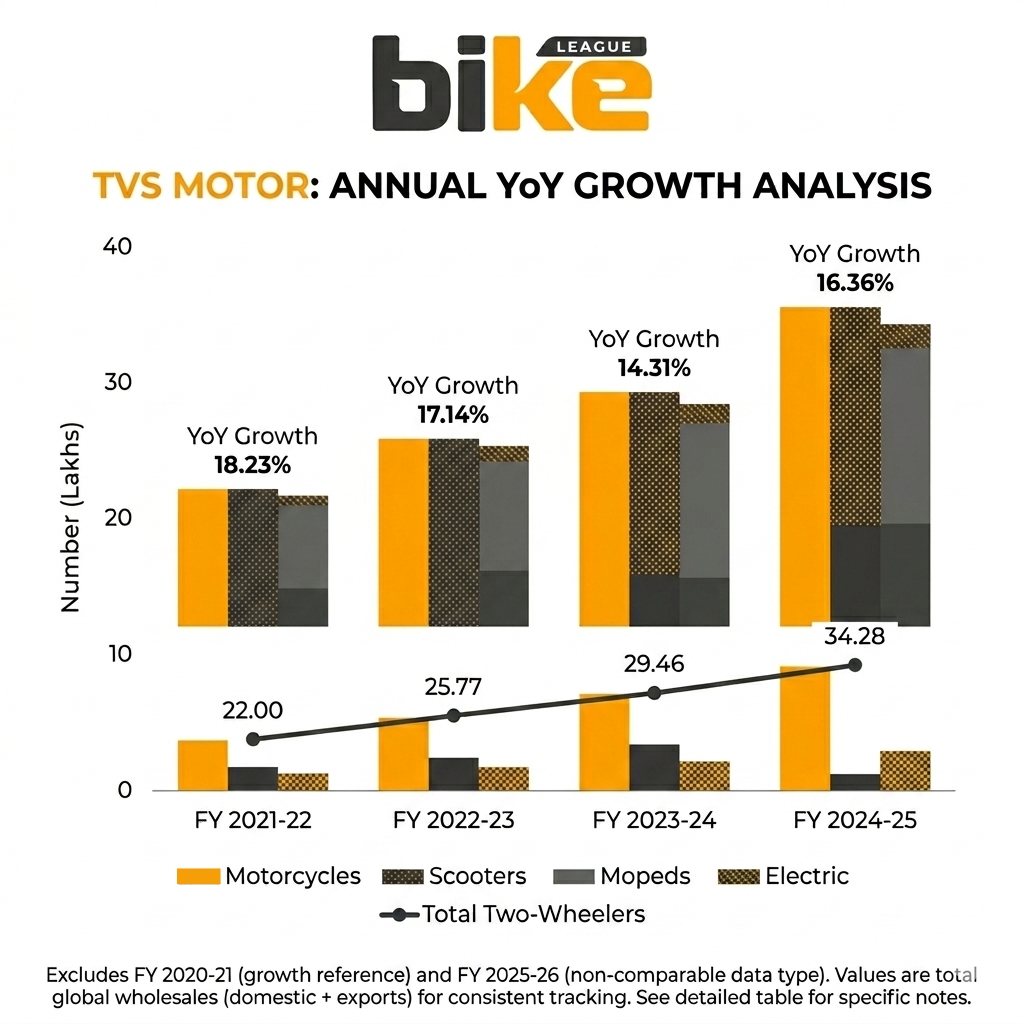
Moped sales peaked in FY 2022. Sales dropped slightly from FY23 to FY25 as TVS focused more on higher-value motorcycles and scooters. In FY26, sales recovered. The XL100 sold over half a million units. This shows that mopeds remain important in rural and semi-urban areas. At the same time, TVS sold more premium products. These products cost ₹18,000 to ₹22,000 more per unit. This continues to help TVS keep better profit margins.
Ownership trends for motorcycles and scooters are changing. Scooters were once mostly popular with women in cities. Now, they are more common in smaller towns. TVS’s scooter market share grew to 28% in FY26. Motorcycle sales are also increasing. Features such as lower seats and clutchless gearboxes have helped this growth. With a wide product range, TVS is well-positioned to benefit from these changes.
The following sections describe the causes of these trends in each fiscal year.
Fy 2021: Resilience And Recovery Amid Uncertainty
- India implemented a strict nationwide lockdown.
- Dealerships were forced to close, and supply chains were disrupted.
- Resulted in over a 60% drop in retail finance disbursements.
1. Impact Of Nationwide Lockdown (q1 Fy 2020-21)
- Launched to adapt to the new market conditions.
- Provided contactless sales consultations.
- Offered doorstep test rides.
- Implemented real-time inventory tracking.
- Aim: To lower access barriers, especially for rural customers, via hyperlocal logistics.
2. Tvs Arogya Path Initiative
- TVS restored 95% of pre-pandemic production capacity.
- Achieved through proactive vendor financing.
- Helped ease working-capital challenges for tier-II and tier-III suppliers.
3. Production Recovery By December 2020
- Strong kharif harvest increased rural income.
- High minimum support prices bolstered disposable income.
- 3. Limited public transport accelerated the replacement cycle for commuter motorcycles and mopeds.
4. Demand Side Factors
- The TVS XL100 moped saw an 18% volume increase in H2 FY 2020-21.
- Its popularity is attributed to its reliability for agricultural and small-business usage.
5. Tvs Moped Performance
- The model featured a lighter chassis and advanced ride modes.
- Attracted many young riders in the competitive 150-cc segment.
6. Popularity of Apache RTR 160 4V
- The TVS iQube scooter sold 8,000 units.
- Signified TVS’s commitment to the EV market.
- Strategic launches in Bengaluru and Delhi gathered essential customer usage data.
- Data used to inform future software and battery management improvements.
7. Commitment To Electric Vehicles (evs)
Fy 2022: Consolidation Through Product Diversification
- FY 2022 served as a consolidation phase for TVS, building on the resilience demonstrated in FY 2021 during global semiconductor shortages.
1. Consolidation Year
- TVS managed to avoid severe impacts from supply chain disruptions due to lower chip intensity in its commuter motorcycle lineup.
2. Resilience To Supply Chain Issues
- Introduced the Raider 125 motorcycle, strategically positioned between the budget 110-cc bikes and premium 150-cc models.
- Achieved significant market penetration, capturing an 11% share of the 125-cc sub-segment within nine months, with sales surpassing 200,000 units.
3. Launch Of Raider 125
- Notable growth in scooter sales, particularly with the introduction of the smartphone-connected Jupiter 125.
- The Jupiter 125 features a newly designed chassis, enhancing storage capacity and fuel efficiency.
- Strong appeal to key demographics, especially working women and college students, who represent nearly 40% of India’s scooter market.
4. Increase In Scooter Sales
- Expanded the electric iQube presence to 33 cities, further supported by mobile service units to enhance customer service.
- Although electric vehicle sales were lower than internal combustion models, the iQube’s domestic value addition reached 84% due to a focus on local sourcing.
- This strategy helped mitigate the impact of global fluctuations in lithium-ion battery prices.
5. Expansion Of Electric Iqube
- The growth in sales of premium motorcycles and scooters contributed to an increase in the company’s EBITDA margin by 140 basis points compared to FY 2021, reflecting improved financial health and operational efficiency.
6. Financial Performance
Fy 2023: The Inflexion Point Of Electrification
- The central government increased the incentive for electric vehicles from ₹10,000 to ₹15,000 per kilowatt-hour.
- The subsidy cap was raised to 40% of the vehicle cost, incentivising more buyers.
1. Restructuring Of Fame-ii (june 2022)
- The enhanced subsidy led many hesitant consumers to become immediate buyers.
- TVS Motor was well-prepared with localised supply chains, allowing for the expedited production of the second-generation iQube.
2. Impact On Consumer Behaviour
- TVS increased its domestic localisation ratio from 60% to 84% within a year, minimising the financial impact of an appreciating dollar on production costs.
3. Localisation And Cost Management
- Electric vehicle dispatches skyrocketed from 0.13 lakh to 1.07 lakh, indicating a twelve-fold increase over the fiscal year.
- The customer demographic shifted from primarily early adopters in metropolitan areas to a more diverse group, including educators and small-business owners in various cities.
4. Surge In Electric Vehicle Dispatches
- The enhanced range (100 km in real-world conditions) and the development of third-party charging networks alleviated initial customer concerns about range anxiety.
- The running cost savings of approximately ₹1 per kilometre became a significant selling point.
5. Improved Value Proposition
- The Apache RTR series was updated with modern features such as ride-by-wire throttle, slipper clutch, and racing aesthetics influenced by TVS’s participation in the Asia Road Racing Championship.
- The 200-cc motorcycle segment gained a competitive edge with an aggressive offering priced under ₹1.60 lakh.
6. Innovation In Internal Combustion (ic) Products
- By March 2023, over 40% of bookings originated on digital platforms, even if finalised in physical stores, marking a doubling of year-on-year digital penetration.
- This digital shift provided valuable first-party data for future marketing, cross-selling of accessories, and insurance products.
7. Omnichannel Purchase Experience
- Total domestic wholesale shipments reached 25.77 lakh units, with a year-on-year growth of 3.77 lakh units.
- This growth rate of 17.14% surpassed the category average and exceeded internal growth targets set for investors.
8. Domestic Wholesale Shipments
Fy 2024: Scaling New Heights In Premium And Electric Segments
- TVS Motor launched the Apache RTR 310 , its most significant product in a decade.
- The motorcycle features a lightweight steel trellis frame and a 312-cc liquid-cooled engine developed with BMW Motorrad. Advanced technologies included: – Cornering ABS for improved safety. – Cornering ABS for improved safety.
1. Tvs Motor’s New Product Launch
- The introduction of the Apache RTR 310 led to an 18% increase in inquiries for smaller Apache models at showrooms.
- Encouraged customer interest in the brand’s offerings.
2. Impact Of Apache Rtr 310 Launch
- Ergonomically designed handlebars for better comfort.
- Voice-enabled infotainment system for enhanced user experience.
- AI-powered mileage optimiser, delivering significant fuel efficiency while remaining competitively priced under ₹1 lakh.
3. Scooter Innovations
The Ntorq 125 XT was introduced with advanced features:
- Electric vehicles transitioned from being a novelty to a mainstream choice.
- The iQube received a new battery pack, increasing energy density to 172 Wh/kg, resulting in: – An extended range of 150 km per charge. – Reduced charging time to four hours when using a 650-W home charger.
4. Mainstream Adoption Of Electric Vehicles
- TVS signed an agreement with Bharat Petroleum Corporation to establish 1,000 fast-charging stations.
- Planned operationalisation of 300 stations by March 2024, providing: – Enhanced long-distance travel options. – Solutions to battery-swap concerns for fleet operators.
5. Infrastructure Expansion For Electric Vehicles
- Domestic two-wheeler dispatches reached 29.46 lakh units, an increase of 3.69 lakh units annually.
- Significant growth in electric vehicle sales, reaching 2.19 lakh units.
- The EV share of TVS’s domestic portfolio surpassed 7%, achieving a milestone earlier than analysts had projected, who expected this to happen by FY 2026.
6. Operational Excellence Of Tvs
Fy 2025: Sustaining Momentum Through Technological Leadership
- Introduced as India’s first fully-faired electric motorcycle.
- Features a powerful 12-kW mid-mounted motor and liquid-cooled battery sleeves.
- Capable of accelerating from 0 to 60 km/h in just 3.9 seconds.
- Designed to attract a youth market that is environmentally conscious yet desires excitement in their rides.
- Incorporates an over-the-air firmware update feature for enhanced user experience.
1. Introduction Of The E-apache
- Equipped with 16-litre waterproof under-seat storage, this feature enhances utility for users.
- Advanced dual-fork front suspension offers improved ride quality and handling.
- Strengthens TVS Motor’s position within the electric vehicle (EV) sector.
2. Introduction Of The Creon Electric Scooter
- Aimed at expanding presence in rural areas through innovative dealership models.
- Transformations included smaller, cloud-connected kiosks requiring only 400 square feet.
- Implementation of Aadhaar-based e-KYC and UPI payment systems streamlined loan approvals.
- Quick motorcycle deliveries facilitated the conversion of latent demand into actual sales.
- Rural districts contributed to 55% of FY 2025 domestic sales, marking a 10-percentage point increase from the previous year.
Rural Accelerator Programme
- Helped balance production capacity for domestic markets during slow periods.
- Production was redirected to West Africa and Latin America to maintain steady line rates.
- Cost reduction efforts supported rural financing solutions.
4. Strategic Exporting Of Motorcycles
- Total domestic sales reached 34.28 lakh units, a growth of 4.82 lakh units (16.36%) from FY 2024.
- Marked the highest sales gain in the company’s history.
- Electric two-wheeler sales rose significantly to 4.19 lakh units, nearly doubling compared to the previous year.
- Motorcycle sales totalled 13.20 lakh units, boosted by new trims of the Raider , Ronin , and Apache RTR.
- Enhanced features included self-diagnostics and configurable riding modes via the TVS Connect app.
5. Sales Performance Overview For Fy 2025
Fy 2026: Record-breaking Growth And Ev Market Leadership
- TVS Motor recorded its highest-ever annual sales in FY 2025-26, with total two and three-wheeler sales reaching 58.89 lakh units — a 24% jump from 47.44 lakh units in FY25.
- Two-wheeler sales alone reached 42.43 lakh units (56.70 lakh including three-wheelers when counted separately in some reports), up 21–23% year-on-year.
- Q4 FY26 (January–March 2026) was the best-ever quarter, with 15.60 lakh units sold — 28% higher than Q4 FY25.
1. Highest-ever Annual Sales
- TVS sold a record 23 lakh scooters in FY26, up 27% year-on-year, driven by the Jupiter, NTorq, and Zest on the ICE side, and the iQube and the newly launched Orbiter on the electric side.
- TVS’s scooter market share rose to 28% in FY26 from 26% in FY25, making it the second-largest scooter brand in India.
- Rural and semi-urban demand, powered by a strong monsoon and festive season, contributed significantly to scooter volume growth.
2. Scooter Segment Powers Overall Growth
- TVS Motor emerged as the leading electric two-wheeler brand in India in FY26, retailing over 3.41 lakh electric scooters domestically — a 43.54% year-on-year increase over 2.38 lakh units in FY25.
- This dethroned Ola Electric, which had led the segment in FY25 but saw sales nearly halve in FY26 due to service and supply chain challenges.
- TVS held a 24.36% domestic EV market share in FY26, followed by Bajaj Auto (20.64%) and Ather Energy (18%).
- TVS’s EV portfolio expanded to three models — the iQube, TVS X, and the new Orbiter — giving it the widest electric range among Indian OEMs.
- TVS Motor now has over 9 lakh cumulative EV customers in India.
3. Tvs Becomes India’s #1 Electric Two-wheeler Brand
- Motorcycle sales reached 14.17 lakh units in FY26, up 18% year-on-year — the highest-ever for the segment, surpassing the previous best of 12.23 lakh units in FY24.
- The Apache series continued to lead the 150–200cc segment. The Raider 125 maintained strong momentum, with 4.26 lakh units sold and a 12% share in the 125cc category.
- TVS’s domestic two-wheeler market share rose to 20% in FY26, up from 18% in FY25 — and TVS overtook Yamaha to become the world’s third-largest two-wheeler manufacturer after Honda and Hero.
4. Motorcycle Segment Sets New Record
- The TVS XL100 sold 5.23 lakh units in FY26, up 4% year-on-year — crossing the half-million mark for only the second time and showing a recovery from the FY23–FY25 dip.
- Sustained rural demand and TVS’s Rural Accelerator Program (launched in FY25) continued to support moped penetration in tier-3 and tier-4 markets.
5. Moped Revival: Xl100 Crosses 5 Lakh Units
- TVS Motor recorded 30% growth in revenue and 40% growth in Operating Profit Before Tax (Operating PBT) in FY26, with Operating PBT rising to ₹4,975 crore from ₹3,563 crore in FY25.
- Operating EBITDA margin improved by 60 basis points to 12.9%, reflecting continued operational efficiencies and premiumisation of the product mix.
- Exports grew 33% in FY26 to 15.85 lakh units, with TVS now the second-largest two-wheeler exporter from India after Bajaj Auto, holding a 28% export market share across 90+ countries.
6. Financial Performance
What Are The Strategic Factors Behind The Growth Trajectory Of Tvs In The Past Years In India?
- Integral to TVS’s identity, with a notable increase in R&D spending from 4.2% to 6.1% of turnover during the review period.
- Focused investments in lightweight materials, traction-control algorithms, and hybrid technologies led to significant product enhancements, moving beyond mere superficial updates.
- In FY26, innovation extended to the launch of the Orbiter electric scooter, OTA-enabled platforms across the lineup, and TVS Ebike Company AG expanding the group’s presence in the European e-bike market.
1. Innovation
- Initially implemented as a cost-saving strategy, localisation has transformed into a strategic approach to minimise supply-chain risks.
- By FY 2025, the iQube showcased 92% localised content, which includes a homegrown battery-management system and locally sourced motors.
- Mitigated exposure to currency fluctuations and stabilised against commodity price increases through effective localisation.
2. Localisation
- Encompasses both consumer and enterprise dimensions, fostering a connection between technology and business operations.
- The TVS Connect platform experienced significant growth, reaching 3.5 million active users by March 2025, contributing to a growing subscription revenue stream for connected services.
- Implementation of cloud-based manufacturing systems led to a 14% reduction in cycle-time variability and enhanced quality ratios.
3. Digitisation
- Partnerships with non-banking financial companies (NBFCs) and fintech organisations have facilitated improved access to financing for localised development buyers.
- Data-driven risk assessment approaches effectively lowered interest rates by 40 basis points for these buyers, making financial products more accessible.
- Notably, first-time buyers constituted 37% of TVS’s domestic customer base in FY 2025, a stable figure since FY 2021.
4. Financial Inclusion
- Sustainability efforts have positively influenced the brand’s digital delivery and resulted in financial advantages.
- The Hosur manufacturing plant operates on 78% renewable energy, underscoring a commitment to environmental responsibility.
- A lithium-ion battery-recycling facility was inaugurated in late 2024, with a capacity of three gigawatt-hours, supporting a circular economy and yielding cost savings via lower energy tariffs.
- In FY26, Norton Motorcycles (a TVS group brand) continued to strengthen premium positioning globally, while TVS Ebike Company AG expanded in the European sustainable mobility market.
5. Sustainability
What Specific Strategies Did Tvs Motor Company Implement To Diversify Its Product Offerings And Establish Itself In The Electric Two-wheeler Market In India?
Some of the specific strategies that TVS Motor Company implemented to diversify its product offerings are:
Diversification Of Product Offerings
- Premiumisation: Introduced premium models like the Apache and the Raider Super Squad Edition, featuring advanced technologies such as race-tuned stability control and smart connectivity.
- Broader Product Mix: Maintained strong sales in commuter motorcycles (Raider, Star City+), economic scooters (Jupiter, Zest, Scooty Pep+), and mopeds (XL 100) to cater to both urban and rural markets.
- Electric Two-Wheeler Innovation: Launched the TVS iQube, flagship TVS X, and the Orbiter in FY26, backed by dedicated R&D for EVs. TVS now holds the widest EV portfolio among Indian two-wheeler OEMs, with three electric models and over 650 EV-related patents.
- In-House Capabilities: Developed battery manufacturing and energy management expertise, becoming India’s only OEM with comprehensive EV and connected vehicle solutions.
- Continuous Pipeline: Regularly planned and launched new ICE and EV products to adapt to changing consumer demands — a strategy that helped TVS claim India’s #1 EV two-wheeler position in FY26.
Market Entry And Ev Establishment
- Complete EV Platform: Made early investments in electric powertrain development, positioning the iQube and TVS X as segment benchmarks, and adding the Orbiter in FY26 to address a wider price range.
- Expansion of Dealer Network: Increased EV reach to over 690 dealers in India to enhance service and customer confidence.
- Connected Mobility & Digitalisation: Implemented SmartXonnect telematics across many models, improving user experience with features like apps and live charge status. A team of over 2,000 engineers now focuses on advanced technology solutions at TVS.
- Charging Infrastructure: The agreement with Bharat Petroleum Corporation for 1,000 fast-charging stations, with 300 operational by March 2024, continued to support long-distance EV adoption through FY26.
How Did The Changes In Indian Government Policies And Market Regulations Directly Affect Tvs’s Operational Decisions During This Period?
Here are some of the direct influences of Indian government policies and market regulations on TVS’s operational decisions:
- FAME-II and Policy Incentives: Increased government subsidies under the FAME-II scheme lowered electric vehicle costs, prompting TVS to expand its electric vehicle portfolio. These incentives, along with the PM E-DRIVE scheme that succeeded FAME-II, continued to support EV adoption in FY26.
- BS-VI and Emission Norms: Stricter BS-VI standards prompted TVS to rapidly update its product line with efficient internal combustion engines and compliant models, thereby moving towards cleaner technologies.
- PLI Schemes: The ₹25,938 crore production-linked incentive for the automotive sector supported local manufacturing growth, leading TVS to source 93% of materials locally and boost domestic R&D for EVs.
- Tax and Regulatory Changes: A reduction in corporate tax from 30% to 25% and increased government capital expenditure improved profitability, enabling TVS to invest in product development, digitalisation, and expansion.
- Safety and Compliance: New regulations requiring features like ABS, OBD-II, and enhanced vehicle safety drove TVS to focus on advanced technology in its premium models.
- Delhi EV Policy 2026–2030: The newly announced Delhi Electric Vehicle Policy is expected to further boost the share of EVs in two-wheeler sales, and TVS — as India’s #1 EV brand — is well-placed to benefit from this tailwind in FY27.
What Factors Contributed To The Steady Growth In Tvs Electric Two-wheeler Sales Compared To Tvs Traditional Two-wheeler Segments?
Ev Growth Drivers
- Product Innovation: Focus on next-gen features like digital clusters, OTA updates, long-range batteries, and smart connectivity has made EVs appealing to young, urban consumers and fleet operators. In FY26, the Orbiter and continued iQube updates further widened the addressable market.
- Competitive Pricing: Policy incentives (FAME-II, PM E-DRIVE), local supply chain development, and R&D on affordable batteries have enabled TVS to price the iQube and TVS X competitively against ICE models.
- Dealer Coverage & Trust: A wide network of over 690 EV dealers, strong after-sales service, and established trust in the ICE segment have supported the growth of EV sales.
- Marketing and Customer Experience: TVS utilised digital outreach, consumer education, app-based ownership experiences, and robust warranty support to alleviate range anxiety and promote EV adoption. TVS now has over 9 lakh cumulative EV customers in India.
- Government Support: City-level bans on older ICE vehicles, green zones, and government backing for EV charging infrastructure have increased interest in electric vehicles, benefiting TVS due to its readiness and market presence.
Comparison With The Ice Segment
The ICE segment experienced steady growth of 18–27% across motorcycles and scooters in FY26, driven by ongoing launches and rural demand. In contrast, the EV segment maintained strong double-digit growth (33% globally, 43% domestically), with TVS achieving #1 EV brand status. The Orbiter’s launch in FY26 addressed a previously underserved price point, while the iQube continued to dominate in terms of volume. TVS’s approach demonstrates that EV and ICE growth are complementary rather than competing.
Sources Used In This Article
Fy2021
- TVS Motor Company FY2021 Annual Press Release (official)
- TVS Motor FY2021 Annual Report (investor relations)
- TVS iQube charging infrastructure & early EV expansion (BikeAdvice.in, June 2021)
(Note: this page now reflects FY2024 data; TVS’s FY21 annual release is in the same press release archive)
Fy2022
- TVS iQube updated, expanded to 33 cities — Autocar India (May 2022)
- TVS Motor FY2022 record revenue & profit — official press release
(FY23 release references FY22 baseline; FY22 standalone release is in the same archive)
Fy2023
- FAME-II subsidy revision impact on TVS iQube pricing — Business Standard (June 2023)
- TVS iQube surpasses 2 lakh cumulative sales, FY23 volumes — Autocar India (October 2023)
- TVS Motor FY2023 record revenue & profit — official press release
Fy2024
- TVS Apache RTR 310 launched — Autocar India (September 2023)
- TVS Apache RTR 310 targets doubling 310cc volumes — Autocar India
- TVS iQube FY2024 retail data, BMW CE 02 exports — Autocar India (April 2024)
- TVS Motor FY2024 highest-ever sales press release — official
- TVS Motor FY2024 highest-ever revenue and profit — official
Fy2025
- TVS Motor FY2025 highest-ever sales, EBITDA, and profit — official press release
- TVS Motor Q1 FY2026 results (references FY2025 full-year base) — Business Standard
- TVS global EV expansion strategy, iQube milestones — Autocar Professional
Fy2026
- TVS Motor FY2026 Annual Results (Press Release via The Print/ANI)
- TVS posts best-ever two-wheeler sales in FY2026 at 4.24 million units
- Record scooter and bike sales power TVS to best-ever 4.24 million units in FY2026
- TVS Motors races ahead, the biggest share gainer in FY26 (market share data)
- Record 1.4 million electric 2Ws sold in FY2026 — TVS as new EV market leader
- TVS clocks retail sales of 300,000 electric 2Ws for the first time in a fiscal
- E2W OEMs open FY2026 with best-ever April sales, TVS is No. 1 for the first time
- FADA FY2026 two-wheeler retail sales report (via The Bike Junction)
- FADA electric two-wheeler retail FY2026 — TVS tops with 3,41,513 units (via Acko Drive)
- TVS Motor Company FY2021 Annual Press Release (official)
- TVS Motor FY2021 Annual Report (investor relations)
- TVS iQube charging infrastructure & early EV expansion (BikeAdvice.in, June 2021)
(Note: this page now reflects FY2024 data; TVS’s FY21 annual release is in the same press release archive)
Other Related Links From Bikeleague India
- Two wheeler Sales in India FY 2023-24 | Analysis of Top Brands
- Two wheeler sales in India in FY 24-25 | Analysis of Top Brands
- Top 10 sold petrol two-wheelers in India in FY26
- TVS Iqube
- Top 10 Sold Electric Two-Wheelers in India in FY25
Conclusion
From FY21 to FY26, TVS Motor Company transformed its position in India’s two-wheeler market. The company achieved record growth in motorcycles, scooters, and mopeds, and became a leader in electric mobility. Investments in innovation, localisation, and digitalisation helped TVS handle market challenges and take advantage of new opportunities.
Flagship models, fast EV adoption, and a strong rural presence helped TVS maintain strong performance and grow its market share. With supportive government policies and growing demand for advanced features, TVS is ready to lead the next phase of growth and innovation in India’s changing mobility market.
We hope this overview explains the reasons and data behind TVS Motor’s growth from FY21 to FY26. If you have questions or want more details about top petrol two-wheeler sales, you can email us at bikeleague2017@gmail.com or leave a comment below. We’re happy to help. You can also follow Bikeleague India on social media for updates.