
Long story short – We want to make your motorcycle helmet buying decision on the right track and the right product in this overloaded information era, with different helmet types, rules, safety standards and much more in India.
Choosing the right motorcycle helmet is one of the most important decisions a rider in India can make. With a wide variety of helmet types, safety standards, and regulations, it’s easy to feel overwhelmed by the sheer volume of information and marketing claims.
This guide aims to clear up any confusion and help you make a confident, informed choice. Whether you are buying your first helmet or upgrading, we will cover helmet safety, legal requirements, features, and top brands. Our goal is to help you ride safely and with peace of mind.
Key Takeaways
- Always choose a helmet that meets or exceeds safety certifications like ISI, DOT, or ECE for maximum protection.
- Ensure proper fit and comfort—try on different helmets and prioritise a snug, secure fit to enhance safety and avoid fatigue.
- Beware of counterfeit helmets and always verify certification marks, build quality, and brand reputation before purchasing.
- Modern helmets offer advanced features like ventilation, Bluetooth, and anti-fog visors that improve both safety and convenience for Indian riders.
- Never buy used helmets unless you can fully verify their history and condition; a new, certified helmet is always the safest investment.
How A Motorcycle Helmet Works And What Is The Anatomy Of A Helmet
The helmet comprises several high-quality materials, each with a clear-cut purpose. They work together to protect the head from all sorts of worse situations. Let’s check the anatomy of a helmet and how it works.
1. Hard Outer Shell
Most helmets are made from polycarbonate or fibreglass, which are more affordable than Kevlar or carbon fibre. Premium helmets use Kevlar or carbon fibre, which cost more but offer better protection in tough situations.
2. Protective Inner Shell
Every helmet has an inner shell to protect the head against physical impact when it hits the road. This protective inner shell is expanded polystyrene (EPS). EPS absorbs the impact force and cushions the skull to protect the head.
3. Removable Soft Lining
The third layer is a removable soft liner that protects the face and neck against the EPS’s hard surface. The removable soft lining is washable and is usually made of hypoallergenic materials to prevent allergic reactions.
4. Protective Padding
Protective padding protects the cheek and jawbones. It is made of soft sponge or shock-absorbing composite materials that keep you comfortable on long rides and protect the facial bones.
5. Strapping Mechanism
A good quality strap is essential to keep the helmet on your head during an accident. The release mechanism should also be easy to use, so you do not get frustrated when taking the helmet off.
6. Vents
Ventilation systems let air flow in and out of the helmet, helping riders stay cool and comfortable on long rides. Good ventilation is especially important in hot weather.
7.visors
A visor is a curved piece above the eyes that protects you from the sun, dust, and other elements. Visors are made to handle daily use and can be replaced when needed.
Motorcycle Helmet Types Legal And Allowed In India
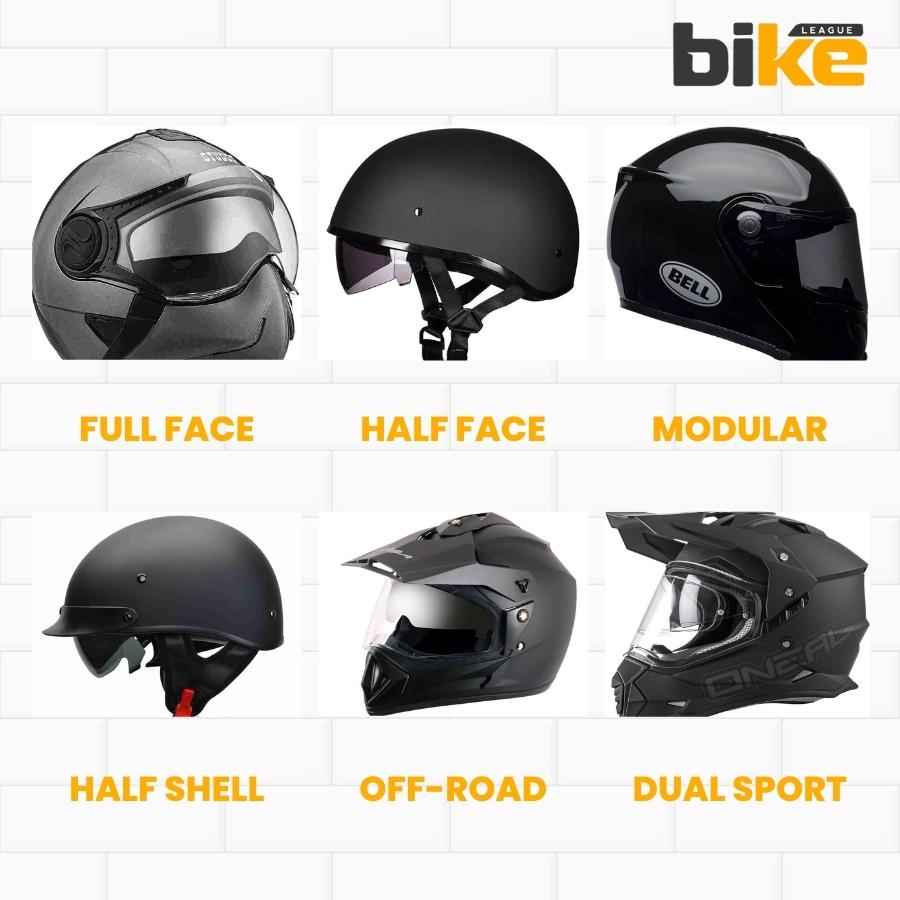
There are six types of helmets that are legal in India. They are:
1. Full Face Helmet
These helmets offer the most protection, covering the entire head, face, and jaw. They are ideal for highway riding and high-speed travel.
2. Modular Helmet / Flip-up / Flip Front Helmet Types
These helmets combine full-face protection with the convenience of an open-face helmet. The chin bar can be flipped up, allowing easy face access and improved ventilation.
3. Half Face / Open Face Helmet Types
These helmets provide less protection than full-face helmets but offer more airflow and visibility. They are suitable for low-speed riding and urban environments.
4. Half Shell Helmet
These helmets offer the least protection, covering only the top of the head. They are not legal in most states in India.
5. Off-road Helmets
These helmets are designed for off-road riding and feature a peak to protect the rider’s face from the sun and mud. They also have a removable visor to add airflow.
6. Dual Sport Helmets
These helmets are designed for both on-road and off-road riding. They combine features of both full-face and off-road helmets.
Many people in India think half-helmets and half-shell helmets are illegal, but they are allowed. However, they offer very little protection and must be ISI-certified.
Motorcycle Helmet Safety Standards In India
There are mainly 5 helmet standards in India that we can see on the helmets, and they are
1. Isi (indian Standards Institute)
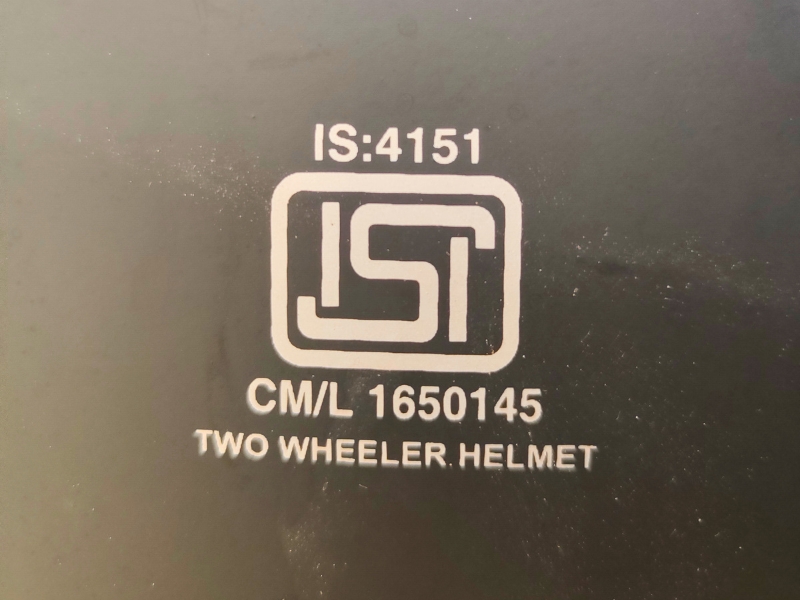
Indian Standards Institute (ISI) standard number and designation for motorcycle helmets in India is IS 4151. This standard is specifically designed for protective helmets for two-wheeler riders, including motorcycles and scooters. It’s important to note that IS 4151 was first issued as an emergency standard in 1967 and has undergone several revisions, the most recent being the fourth revision in 2015.
Main Points About Isi Helmet Standards In India
- Impact Absorption: Ensures the helmet can absorb the energy of an impact to protect the rider’s head.
- Penetration Resistance: Tests the helmet’s ability to withstand penetration by sharp objects.
- Retention System: Evaluates the strength and durability of the chin strap.
Detailed Requirements And Criteria
The IS 4151 standard outlines several specific safety requirements that motorcycle helmets must meet to ensure adequate rider protection. These requirements include:
- Impact Absorption: Helmets must effectively absorb impact to protect the rider’s head during a collision. This involves rigorous testing of the helmet’s ability to withstand the effects on various parts of its structure.
- Penetration Resistance: The helmet shell must resist penetration by sharp objects. This is tested by applying a pointed object to the helmet to ensure it does not penetrate the shell.
- Retention System: The chin strap and its attachments must be strong enough to keep the helmet securely on the rider’s head during an accident. The strap’s strength and durability have been thoroughly tested.
- Field of Vision: Helmets must provide a minimum field of view to ensure the rider can see adequately while riding. This is a crucial safety aspect and forms part of the certification process.
- Labelling and Marking: All helmets must be appropriately labelled with the manufacturer’s details and the ISI mark to indicate compliance with the standard. If a visor is provided, it must also be appropriately marked.
- Material Specifications: The helmet shell can be made from either metallic or non-metallic materials, but it must conform to the test requirements specified in the standard.
- Weight Limitations: Recent updates to the standard have set a maximum weight limit for helmets to ensure comfort and usability. The maximum weight is now set at 1.2 kg, down from the previous limit of 1.5 kg.
2. Dot (department Of Transportation)
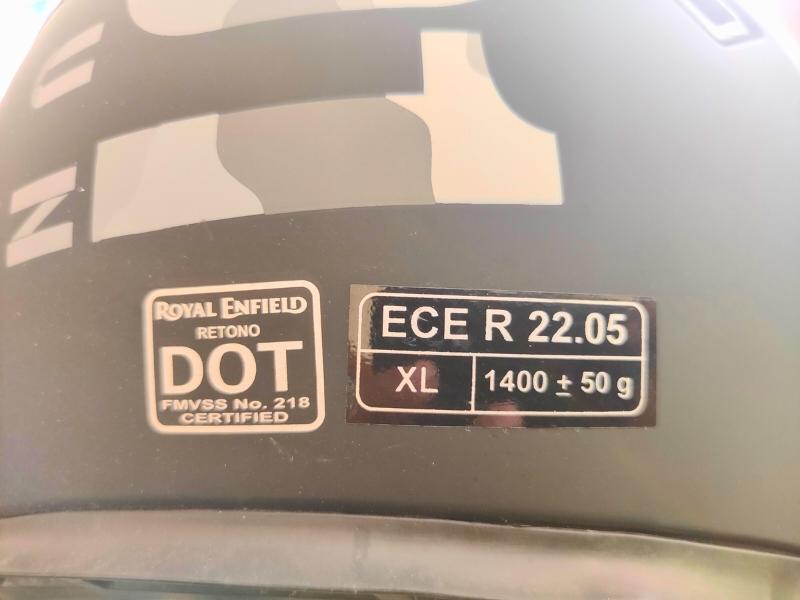
The Department of Transportation certification is a U.S. government standard that signifies helmets have undergone tests for impact absorption, penetration resistance, and retention strap strength. Unlike other certifications, manufacturers self-certify that their helmets meet DOT standards, with random testing conducted to ensure compliance. A DOT sticker signifies that the helmet meets necessary U.S. safety requirements.
Main Points About Dot
- Impact Absorption: Tests the helmet’s ability to absorb energy during an impact.
- Penetration Resistance: Ensures the helmet can resist penetration by sharp objects.
- Chin Strap Strength: Evaluates the durability and strength of the retention system.
- Peripheral Vision: Ensures the helmet provides adequate field of vision.
3. Ece (economic Commission For Europe)
The ECE standard is recognised in over 50 countries and includes rigorous testing for impact absorption, strap integrity, and abrasion resistance. ECE-certified helmets undergo testing at independent labs before they can be sold, ensuring consistent safety for riders. The current ECE standard is ECE 22.06, which has been in force since January 2022.
Main Points About Ece Helmet Standards In India
- Impact Absorption: Tests the helmet’s ability to absorb energy during an impact.
- Chin Strap Durability: Evaluates the strength and durability of the chin strap.
- Shell Strength: Ensures the helmets outer shell can withstand impacts.
- Visibility: Tests the helmet’s field of vision to ensure it provides adequate visibility.
4. Snell (snell Memorial Foundation)
SNELL standards are among the strictest, involving tests including impact, penetration, flame resistance, and the ability to withstand rolling. This certification is voluntary, with helmets undergoing independent testing by the Snell Foundation. A SNELL certification means the helmet offers superior protection, often exceeding the requirements of other helmet standards in India.
Main Points About Snell
- Impact Resistance: Tests the helmets ability to withstand multiple impacts.
- Penetration Tests: Ensures the helmet can resist penetration by sharp objects.
- Chin Bar Strength: Evaluates the strength and durability of the chin bar.
- Retention System: Tests the durability and strength of the retention system.
5. Sharp (safety Helmet Assessment And Rating Programme)
SHARP, from the UK, goes beyond standard certification tests by rating helmets from one to five stars based on their safety features and performance in impact tests. This rating system offers an easy way for riders to understand a helmet’s safety level, providing additional information on how a helmet might perform in real-world accidents.
Main Points About Sharp
- Star Rating System: Rates helmets from one to five stars based on their performance in impact tests.
- Field of Vision: Considers the helmets field of vision.
- Ventilation: Evaluates the helmets ventilation system.
- Ease of Use: Assesses how user-friendly the helmet is.
| Aspect | ISI (IS 4151) | DOT (FMVSS 218) | ECE 22.05 / 22.06 | SNELL (M2020/M2025) | SHARP |
|---|---|---|---|---|---|
| Region / role | India-only, mandatory on public roads | USA, legal minimum for road use | Europe + 50+ countries, most widely accepted worldwide | Private US-based foundation, voluntary & niche | UK govt program, extra rating (not a certification) |
| What it is | Regulatory certification (ISI mark) | Regulatory self-certification by manufacturers | Regulatory type-approval, batch-tested | Independent performance certification beyond legal norms | Lab re-testing and 1–5 star safety score of ECE helmets |
| Test philosophy | Basic impact, penetration, retention, visor, flame; Indian conditions | Focus on a few high-energy impacts and penetration; higher g limits vs ECE/SNELL | Multiple impact points, real-world angles, now rotational/oblique in 22.06; more samples tested | Very high energy impacts, multiple hits, penetration, roll-off, flame; prioritises maximum shell strength | Retests retail helmets at higher impact speeds on flat and oblique anvils; weights results by crash statistics |
| Impact severity allowed | Meets Indian minimums; less transparent globally and generally below ECE/SNELL rigor | Considered less stringent than modern ECE/SNELL for energy limits | New 22.06 is stricter than 22.05, with broader speed and angle coverage | Among the most demanding; some SNELL lids can be “harder” than ECE for low-speed hits | Uses higher impact velocities than base ECE tests and exposes weak zones visually |
| Rotational / oblique tests | Not highlighted as a core focus publicly | Not primarily focused on rotational forces | 22.06 explicitly adds oblique/rotational evaluation | SNELL has added more modern test elements but is still mainly linear-impact oriented | Includes oblique impacts and maps side/rear protection, where real-world injuries are common |
| Production control | BIS audits and lab testing for licensed manufacturers | Manufacturer self-declares; random NHTSA spot checks | Third-party labs test type samples; ongoing conformity checks | Snell independently buys/tests batches before certifying | Govt testers buy from shops and test anonymously |
| Legal status in India | Only ISI-marked helmets are legal for sale/use on public roads | Not recognised alone for legality in India | Not sufficient legally by itself; must also carry ISI for road use | Voluntary, not a legal requirement anywhere | Just an information/rating layer, not a road-legal standard |
| Real-world usability | Ensures minimum protection and compliance; many cheap lids barely meet baseline | Good for US-legal use but not automatically the “safest” | Strong mix of science + practicality; great for touring across countries | Favoured for track / high-risk use; can be heavier, stiffer | Great for comparing models within your budget by star score and impact map |
| Best use case (India) | Bare minimum legal compliance; city runs if budget-limited (aim for ISI + one more standard) | Add-on label if you import from US, but pair with at least ISI for legality here | Ideal combo: ISI + ECE (preferably 22.06), good for touring and daily use | Track days, very spirited riding, or riders prioritising max lab performance | Use SHARP stars (aim 4–5) to choose among ECE helmets that already fit and meet legal needs |
What Are The Features To Consider While Buying Motorcycle Helmets In India?
When purchasing motorcycle helmets in India, consider the following features:
- Safety Certifications: Look for ISI, DOT, or ECE approval to ensure the helmet meets rigorous safety standards.
- Fit: A helmet should fit snugly without pressure points. Try different sizes and shapes to find your perfect match.
- Weight: Lighter helmets reduce neck fatigue on long rides. However, don’t sacrifice protection for weight savings.
- Ventilation: Good airflow keeps you cool and comfortable, especially in India’s climate.
- Visor Quality: Look for scratch-resistant, anti-fog properties. A Pinlock system is a bonus for clear vision in all conditions.
- Noise Levels: Consider how much wind noise you’re willing to tolerate, especially for highway riding.
- Comfort Features: Removable, washable liners and moisture-wicking fabrics enhance long-term comfort.
- Style: While safety comes first, there’s nothing wrong with looking good on the road.
- Brand Reputation: Stick to established brands with a track record of quality and after-sales support.
- Budget: Determine how much you’re willing to spend, but remember – your head is worth the investment.
What About Buying Used Helmets? Is It Advisable, And What Are The Risks Involved, Or How Can You Inspect A Used Helmet For Safety?
It is usually not a good idea to buy a used helmet. There are serious safety risks that you cannot spot just by looking at it.
What Are The Main Risks?
- Hidden crash damage: Even if a helmet looks fine, impacts can create invisible cracks or compress the inner foam. Once damaged, a helmet cannot protect you properly—just like an airbag after it deploys.
- Unknown history: You can’t be sure if the helmet was dropped or involved in an accident. Even minor falls can compromise its safety.
- Age and wear: Materials break down over time due to sun, sweat, and regular use. Padding also loses its shape, and helmets should be replaced every 3-5 years regardless of visible damage.
- Fit and hygiene: Used helmets may not fit you well, and sweat and bacteria can be hard to remove completely.
When Might Buying Used Helmets Be Acceptable?
Buying used helmets is only okay in rare cases, like when you buy directly from someone you trust and know the helmet was never dropped or crashed, or if it is a high-end, recent model in perfect condition. Even then, check it very carefully and try to buy new if you can.
Inspection Checklist
If you do consider a used helmet, check for:
- No cracks, deep scratches, or obvious damage on the shell
- Inner liner with no dents, tears, or crumbling foam
- Clean smell with no mold or chemicals
- The strap and buckle are strong and not frayed.
- The Visor is clear and moves smoothly.
- Proper fit—snug but not painful
- All certification stickers are present and readable.
- If you drop it from about 5 feet and see visible damage or deformation, it’s not safe (though this is not a foolproof test)
A new helmet is always safest. Only consider a used helmet if you can verify its history and condition beyond doubt.
How To Identify Genuine Motorcycle Helmets And Avoid Fake Ones In India?
Fake helmets are a big problem in India. Many cheap helmets sold on the street look real but do not protect you and can break easily in a crash. These helmets put riders at risk of head injuries and make road safety rules like the “No Helmet, No Fuel” rule less effective.
Key Risks
- Catastrophic failure: Cheap helmets are often made with packing-grade thermocol or poor-quality foam, which simply can’t absorb impact. Even a minor crash can cause them to crack apart.
- Fake certifications: Some helmets misuse ISI marks or display copied DOT/ECE stickers that haven’t been properly verified.
- Poor construction: Thin outer shells, weak straps, and flammable padding have all been found in counterfeit helmets. In 2024-25, thousands of such helmets were seized in BIS raids.
- Easy to find: Fake helmets are everywhere, both in local shops and online. Many of them fail basic safety checks in tests.
How To Spot Fakes
Use this quick checklist before buying:
| Check | Genuine Signs | Fake Red Flags |
|---|---|---|
| ISI Mark | Embossed/raised, clear 7-digit CM/L number, hologram/UV features; verifiable on BIS site (bis.gov.in). | Printed sticker, hazy/smudged, off-centre, no serial match; generic “ISI”. |
| Build Quality | Smooth paint/seams, sturdy shell (check weight per model specs), even stitching on liners/straps. | Rough edges, cheap plastic, uneven paint, flimsy straps, light/cheap feel. |
| Labels & Docs | Crisp inner labels with model/serial/manufacture date, warranty card, and manual. | Peeling stickers, missing details, no hologram/serial. |
| Padding/Liner | Thick, high-density EPS foam; removable, well-stitched cheek pads. | Thin/compressed foam, poor stitching, chemical smell. |
| Price/Source | Brand MRP (₹1,500+ for basic ISI); authorised dealers, brand sites/Amazon verified sellers. | Unrealistically low (₹110-500); street vendors, unverified online. |
| Extras | Comfort features intact (vents, buckles); no missing parts. | Scratches, pre-applied, solvent odour, loose bits. |
Prevention Tips
- For touring or long-distance riding, choose a helmet with both ISI and ECE 22.06certifications (usually in the ₹3,000–8,000 range). Avoid unknown brands or helmets under ₹1,000.
- Genuine ISI helmets are often bundled with new two-wheelers—use these instead of accepting freebies from dealers.
- Well-known brands like Steelbird, Vega, and MT Helmets provide ways to check authenticity.
Remember, a fake helmet is not just a waste of money. It can actually be more dangerous than not wearing a helmet at all. Always choose a genuine, certified helmet for real protection.
What Are The Latest Motorcycle Helmet Rules In India?
- All riders and pillion riders above four must wear a helmet while riding a motorcycle in India. This rule applies to all states and union territories of India.
- Helmets must be made from high-impact absorbing materials like ABS (Acrylonitrile Butadiene Styrene) or polycarbonate to provide adequate protection against impact. The inner shell should be made from expanded polystyrene (EPS) or polypropylene (EPP) to effectively absorb and distribute the impact force.
- All helmets sold in India must be BIS certified, ensuring they meet the specified helmet safety standards under CMVR (Central Motor Vehicles Rules). This certification guarantees that the helmet’s materials, construction, and performance meet the required safety standards.
- The helmet’s inner liner should have a minimum thickness of 20-25 mm (0.79-0.98 inches) and be made from high-quality foam to provide comfort and shock absorption.
- The maximum weight of a helmet should not exceed 1.2 kg (2.65 lbs) to minimise fatigue and neck strain during prolonged riding.
- The helmet’s visor must be made from a durable transparent material that offers clear visibility without distortion or obstructions. It should also protect against UV rays and scratches. Some visors may have anti-fog and quick-release mechanisms for added convenience.
- The helmet must have a secure and easy-to-use chinstrap system, such as a quick-release buckle or double D-ring fastener, to ensure proper fit and prevent the helmet from coming off during an accident.
- No cameras can be fixed on top of the helmet, resulting in several accidents.
Which Are The Best Motorcycle Helmet Brands In India?
Some of the best motorcycle helmet brands in India are listed below
- Vega
- Steelbird
- Studds
- Royal Enfield
- SMK
- LS2
- THH
- MT
- Sol
- Axor
- Aerostar
- HJC
- Shoei
- Gliders
- AGV
- Aaron
- Bell
- Arai
- Shark
- Tiivra
- Reise Moto
If you are on a tight budget and need a decent amount of quality, then the best helmet brands are
- Vega
- Steelbird
- Studds
- THH
On the other hand, if budget is not an issue and quality is what you are purely looking for, then the best helmet brands are
- SMK
- LS2
- MT
- Shoei
- AGV
All About Motorcycle Helmet Fit And Size Measurement
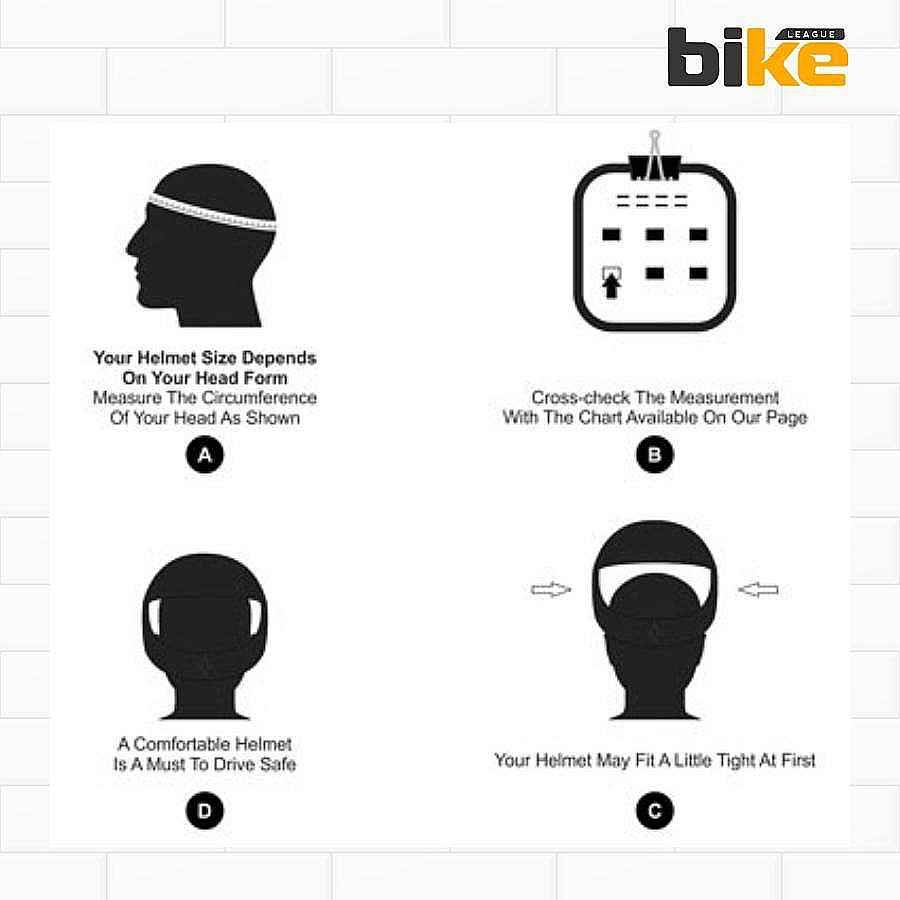
- As per the image above, wrap a measuring tape around the head.
- The measuring tape must go above the eyebrows in the forehead and the ears in the back.
- Next, check the size chart and compare your measurements with the same.
- If two to three fingers can enter inside the head while wearing the helmet, it is loose and should be looked for in smaller sizes.
- Initially, the helmet will be tight while wearing and loosen up a bit.
- There should be no movement of the helmet while shaking the head.
- We can consider Head shapes also, and there are three shapes: round oval, intermediate oval, and long oval.
- Long Oval – Head shape is longer from forehead to back of skull vs ear to ear.
- Intermediate Oval – The most common head shape. The front-to-back measurement is slightly longer than the ear-to-ear measurement.
- Round Oval – Both front-to-back/ear-to-ear measurements are nearly the same.
All About Motorcycle Helmet Certification, Fit, Visibility, Air Circulation, Weight
Customers must consider certification, fit, visibility, air circulation, weight, and washing options for the inner material.
- A helmet should not be too tight or too loose.
- Maximum visibility is better for riding.
- Air circulation/ventilation should be proper inside.
- Weight should not be too much, as it can result in neck pain.
- Internal materials like inner lining should be washable.
- Visors should be anti-UV and anti-scratch resistant and replaceable.
- Should have ISI, DOT, and ECE certifications. ECE is the most thoroughly tested, while ISI and BIS are mandatory helmet standards in India.
What Are The Latest Features Available In Motorcycle Helmets?
Modern helmets feature advanced features that enhance both safety and comfort. Options like Bluetooth connectivity, anti-fog visors for monsoon conditions, and modular designs offer practical advantages for today’s riders. These innovations comply with India’s ISI standards while providing convenient benefits for everyday use.
1. Bluetooth Connectivity
Bluetooth 5.2 headsets (speakers + mic) handle music, GPS, and intercoms with 48-hour battery life. Noise cancellation cuts wind roar.
For example, the Headfox N2 Air offers flip-up functionality and rear LED lighting at an accessible price point. The Vega Cruze Pro complies with DOT and ISI standards and includes Bluetooth features.
2. Smart Technology
Crash detection sends SOS/GPS alerts; integrated LEDs signal turns/brakes. EV-specific like Ather’s app-linked helmets. For instance, the Livall BH60SE incorporates voice command features and a heads-up display (HUD).
3. Anti-fog Solutions
Pinlock membranes or films prevent visor fogging (₹200-1k). Electric heaters in premiums like Shoei. Universal anti-fog films are compatible with popular brands like Vega and Steelbird.
4. Modular Options
Modular helmets with flip-up chin bars allow for better airflow and easier communication when stopped. Some models also offer quick-swap visors and sun shields for added convenience.
Examples include the Acerbis Serel and MT Thunder SV, which are popular choices for touring riders.
Common Myths About Motorcycle Helmets In India
Myth 1: Helmets Are Only Necessary At High Speeds Or On Long Rides.
Fact: Accidents can happen anywhere, regardless of speed or distance. It is essential to wear a motorcycle helmet while riding, even for short distances or at low speeds.
Myth 2: Helmets Are Too Expensive.
Fact: Motorcycle helmets come in a range of prices to suit different budgets. There are many affordable, high-quality helmets available in India that offer excellent protection without breaking the bank.
Myth 3: Helmets Are Bulky And Uncomfortable To Wear.
Truth: Helmets are manufactured using lightweight materials like polycarbonate and ABS, and comfortable liners ensure a comfortable fit.
Myth 4: Helmets Restrict Your Field Of Vision.
Fact: Modern motorcycle helmets are intended to provide a wide field of vision, typically around 210 degrees, allowing riders to see everything they need while riding.
Myth 5: Helmets Are Not Necessary For Skilled Riders.
Truth: Even the most experienced and skilled riders can be involved in accidents. Helmets are not about being a good or lousy rider; they are about protecting your head from serious injury in the event of an accident.
Myth 6: Helmets Restrict Airflow And Make Riding Uncomfortable.
Fact: Modern helmets have advanced ventilation systems that allow adequate airflow, preventing overheating and discomfort during long rides. Many helmets have adjustable vents to customise airflow based on personal preferences and riding conditions.
Myth 7: Motorcycle Helmets Make You Look Like A Dork.
Fact: Two-wheeler helmets come in various styles, types & designs to suit individual tastes. Many stylish and attractive helmets are available in India.
Myth 8: I’m A Careful Rider, So I Don’t Need A Helmet.
Fact: Even the most careful riders can be injured in an accident. Wearing a helmet to protect yourself from serious injury is always best.
Myth 9: I Don’t Need To Wear A Helmet Because I’m Not Going To Crash.
Fact: No one plans to crash, but accidents can happen even to the most cautious riders. It is always best to wear a helmet to protect yourself from serious injury in the event of an accident.
Faq About Motorcycle Helmets In India
1. Which Are The Best Motorcycle Helmets In India?
The best helmet depends on your needs, budget, and intended use. Instead of recommending specific models, focus on finding a helmet that fits well, has reliable safety certifications (ISI, DOT, ECE), and suits your riding style.
2. Should I Buy A Helmet Online Or Offline?
You can browse models and compare prices on official company websites or trusted eCommerce platforms like Amazon India or Flipkart. However, always make your final purchase offline—try on the helmet in person to ensure a proper fit and comfort.
3. Why Is It Important To Try On A Helmet Before Buying?
Every head is different, and only by wearing the helmet can you check for the right fit, comfort, and pressure points. An ill-fitting helmet compromises safety and comfort, so always try before you buy.
4. Are Free Helmets From Dealers Safe To Use?
Free helmets provided by dealers with new motorcycles are often lower in quality and may not offer adequate protection. For your safety, invest in a certified helmet of your choice rather than settling for a basic free one.
5. How Often Should I Replace My Motorcycle Helmet?
Replace your helmet every 5 years, or sooner if it has been in a crash or shows signs of damage or wear (such as a weakened chin strap, a cracked shell, or deteriorated padding).
6. What Is The Safest Type Of Helmet For Indian Roads?
Full-face helmets are generally considered the safest for Indian roads as they provide maximum coverage for the head, face, and chin, offering optimal protection in the event of an accident.
7. How Can I Tell If A Helmet Is Genuine Or Fake?
Check for genuine certification marks (ISI, DOT, ECE), a clear serial number, sturdy build quality, and purchase only from authorised dealers or brand websites. Avoid extremely cheap helmets and inspect for proper labelling and holograms.
8. Can I Use A Helmet Without A Visor?
While some helmet types allow for visor removal, riding without a visor exposes your eyes to dust, debris, and wind, reducing safety and comfort. Always use a visor or wear protective eyewear if your helmet design permits.
9. What Are The Rules For Carrying A Helmet As A Pillion Rider?
The law in India requires both the rider and the pillion to wear helmets that meet BIS certification requirements. Failing to comply can result in fines and an increased risk in the event of an accident.
10. How Do I Maintain And Clean My Helmet?
Clean the outer shell with mild soap and water, use a soft cloth for the visor, and remove and wash the inner lining if it’s detachable. Allow all parts to air dry completely before reassembly. Regular cleaning maintains hygiene and prolongs the life of the helmet.
Essential Links For Motorcycle Helmet, Standards & Types In India
- Bureau of Indian Standards (BIS)
- Department of Transportation (DOT)
- Snell Memorial Foundation (SNELL)
- Safety Helmet Assessment and Rating Programme (SHARP)
- economic commission for europe (ECE)
Other Related Articles From Bikeleague India
- Action camera with mount on helmets – Legal or illegal in India
- What all basic motorcycle accessories should a rider have
- Must have bike accessories for a long distance trip
- Second hand motorcycle: Things to know when buying in India
- Motorcycle gloves in India – All in one buying guide
Conclusion
Choosing the right motorcycle helmet is not just about following the law. It is an important step to protect your life and make every ride as safe and comfortable as possible. With so many options and changing safety standards in India, it is important to be a well-informed buyer.
Always choose certified helmets, pay attention to fit and comfort, and watch out for fake products. Buying a good helmet means investing in your safety and peace of mind. Ride safely, make smart choices, and let your helmet be your trusted companion on every trip.
If you have any questions about motorcycle helmet types, rules, or standards in India, feel free to email us at bikeleague2017@gmail.com or leave a comment below. We are always happy to help you.