
Long story short – Get all doubts about motorcycle ABS right here, and we will explain in the simplest terms.
Motorcycle safety in India is changing rapidly due to new rules and advanced technology. One of the biggest changes is that more two-wheelers now come with Anti-lock Braking Systems (ABS). ABS is now an important feature for riders and will soon be required on all new motorcycles, scooters, and mopeds in India.
But what is ABS, how does it work, and why does it matter for Indian roads? In this article, we’ll explain everything you need to know about motorcycle ABS, clear up common myths, and make the latest technology easy to understand.
Key Takeaways
- ABS (Anti-lock Braking System) will become mandatory on all new two-wheelers in India from January 1, 2026, to enhance rider safety and reduce wheel lock-up-related accidents.
- ABS technology prevents wheel lockup during hard or sudden braking, allowing riders to maintain steering control and avoid skidding, especially on wet, gravel, or uneven roads.
- There are various types of motorcycle ABS—single-channel, dual-channel, combined, cornering, and regenerative—catering to different riding needs and motorcycle categories.
- While ABS adds some cost and weight to motorcycles, its benefits in accident prevention and improved stability far outweigh these drawbacks.
- ABS is a valuable safety enhancement, but it does not replace the need for good riding skills; riders should continue practising safe braking techniques and remain vigilant on the road.
From January 1, 2026, all new two-wheelers in India—including scooters, motorcycles, and mopeds—must have Anti-lock Braking Systems (ABS), no matter their engine size. This rule has made bikes a bit more expensive but has also made riding safer by preventing wheel lock, which often leads to accidents. There are still some misunderstandings about ABS, so we’ll clear those up and explain the different types of anti-lock braking systems.
How Motorcycle ABS works?
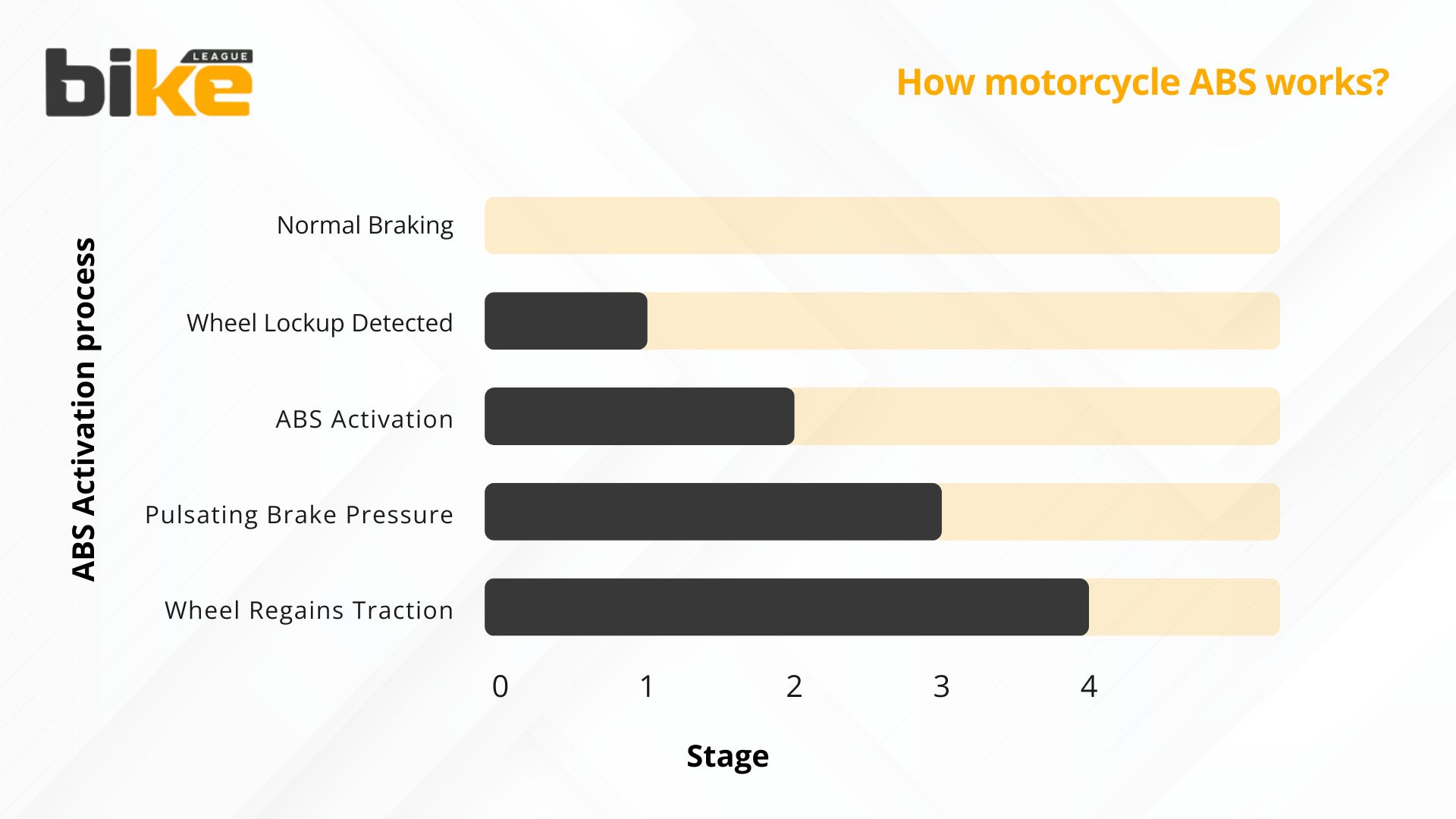
- Wheel Speed Sensors: Each wheel has a speed sensor attached to it, which continuously monitors the wheel’s rotational speed.
- Control Unit: The ABS control unit receives data from the wheel speed sensors. It analyses this data to determine if a wheel is about to lock up.
- Hydraulic Pump and Valves: If the control unit detects an impending lockup, it signals the ABS hydraulic pump and valves to regulate brake pressure.
- Pressure Modulation: The ABS pump and valves rapidly reduce and increase brake pressure, creating a pulsating effect. This prevents the wheel from completely locking up while maintaining maximum braking force
- Rider Feedback: The rider may feel a slight pulsing sensation in the brake lever or pedal during ABS activation. This is normal and indicates the system is working correctly.
What Are The Different Types Of Motorcycle Abs?
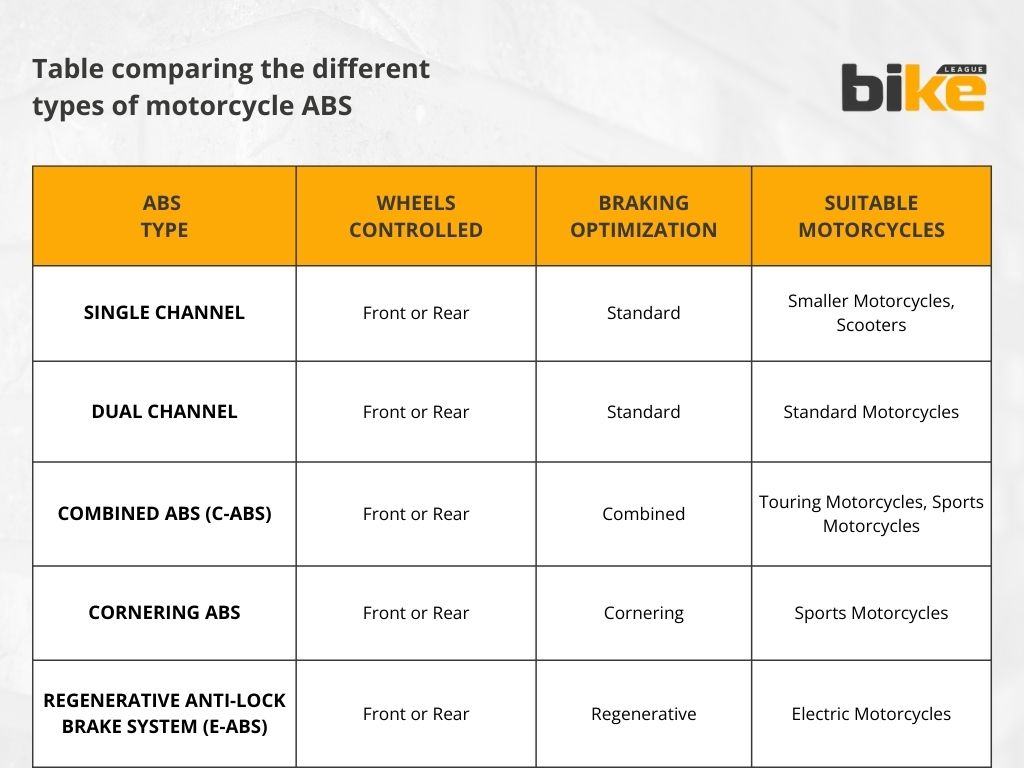
- Single-Channel ABS: This is the most basic type of ABS, which operates on the front or rear wheel only. Single-channel ABS is often found on smaller motorcycles and scooters.
- Dual-Channel ABS: As the name suggests, dual-channel ABS operates independently on both the front and rear wheels. This provides better control and stability for motorcycles that require more precise braking.
- Combined ABS (C-ABS): C-ABS integrates the ABS system with the motorcycle’s braking system, allowing the rider to apply both brakes simultaneously and distribute braking force effectively.
- Cornering ABS: This advanced ABS system is designed to optimise braking performance while cornering. It considers the motorcycle’s lean angle and adjusts brake pressure accordingly to maintain stability and prevent loss of control.
- Regenerative Anti-lock Brake System (eABS): This system is specifically designed for electric motorcycles. It utilises regenerative braking to recapture energy while applying ABS, improving efficiency and extending range.
| Type | Technology & Working | Pros | Cons |
|---|---|---|---|
| Single-Channel ABS | Controls only front wheel; sensors monitor front speed and modulate brake pressure to prevent lock-up | Lower cost; lighter weight; sufficient for commuters and low-speed riding | No rear protection; less stability in panic stops |
| Dual-Channel ABS | Independent control on front and rear wheels via separate sensors for balanced modulation | Better stability; shorter stops; ideal for highways and mixed roads | Higher cost; added ~2-3kg weight |
| Combined ABS (CBS) | Links front/rear brakes mechanically/electronically; one lever activates both with force distribution | Balanced braking for beginners; cost-effective for | Less precise at high speeds; no true anti-lock |
| Cornering ABS | IMU detects lean angle; adjusts braking during corners to prevent slides | Safe corner braking; maintains line; premium stability | Expensive; only on high-end bikes |
| eABS (Regenerative) | For EVs; combines ABS with regen braking to recapture energy and prevent lock | Efficient; extends range; smooth stops | EV-specific; complex maintenance |
What Is The Difference Between Dual-channel Abs And Single-channel Abs
Dual-channel ABS has sensor units at the front and rear, while Single-channel ABS has only one wheel-speed sensor in the front.
What Is Switchable Abs?
Switchable ABS allows the rider to disable rear-wheel ABS to make the ride adventurous and exciting for experienced riders, especially in off-road conditions.
What Are The Advantages Of Motorcycle Abs?
- Reduces stopping distance.
- Averts locking of tyres.
- Prevents skidding of the motorcycle in all sorts of conditions.
- Improved vehicle stability.
What Are The Disadvantages Of Motorcycle Abs?
- Increases the cost of a motorcycle.
- Added kerb weight.
- Ride becomes less entertaining.
- High maintenance cost.
What Are The Latest Technological Advancements In Motorcycle Abs?
1. Enhanced Abs Systems
Technological advancements have led to the development of enhanced ABS systems, including features like Traction Control, Hill Hold Control, and Rear-wheel Lift-up Mitigation. These features contribute to a safer and more comfortable riding experience.
2. Modular And Scalable Systems
The latest generation of ABS systems, such as Bosch’s generation 9, is modular and scalable, making them suitable for a wide range of vehicle classes, including small bikes and scooters.
3. Integration With Electronic Sensors
Modern ABS systems are increasingly integrated with electronic sensors and brake modulators, further boosting their effectiveness and reliability.
How Do Enhanced Abs Features Like Traction Control And Hill Hold Control Work With Standard Abs?
Enhanced ABS features like Traction Control and Hill Hold Control work with standard ABS in motorcycles to provide a comprehensive safety system. Here’s how they integrate:
1. Traction Control System (tcs)
Traction Control Systems prevent the rear wheel from losing traction by modulating power output, particularly useful when accelerating on slippery surfaces or when the motorcycle is leaning. TCS integrates with ABS in the following ways:
- Shared Components: TCS often shares the same control module and sensors as the ABS system, including wheel speed sensors.
- Wheel Spin Detection: The system compares the speed of the front and rear wheels to detect discrepancies that might indicate a loss of traction.
- Intervention Methods: When wheel spin is detected, TCS can:
- Electronically adjust the throttle position.
- Alter ignition timing
- Cut fuel supply to one or more cylinders.
- ABS Integration: TCS can use the ABS components to apply brake force to spinning wheels, helping to regain traction.
2. Hill Hold Control (hhc)
Hill Hold Control prevents the motorcycle from rolling backwards when starting on an incline. Its integration with ABS includes:
- Sensor Utilisation: HHC uses the motorcycle’s angle and wheel speed sensors, often part of the ABS system.
- Brake Application: When the bike is stationary on a slope, HHC engages the brakes automatically.
- ABS Integration: HHC is typically integrated with the motorcycle’s ABS, utilising existing brake control mechanisms to apply and release the brakes as needed.
The integration of these systems creates a comprehensive safety package that enhances motorcycle control and stability:
- Shared Components: All three systems often share the same control module, sensors, and actuators, allowing seamless integration and coordinated responses.
- Complementary Functions: While ABS focuses on preventing wheel lockup during braking, TCS prevents wheel slip during acceleration, and HHC assists with starts on inclines.
- Enhanced Safety: Combining these systems significantly improves overall safety. For example, studies have shown that ABS alone can reduce fatal motorcycle crashes by 37%. When combined with TCS and HHC, the safety benefits are further amplified.
- Real-World Application: In challenging scenarios, such as accelerating on a wet incline, these systems work together seamlessly:
- TCS manages wheel spin during acceleration
- HHC prevents rollback when starting
- ABS ensures effective braking if needed
This integration ensures motorcycles can navigate challenging terrain and perform manoeuvres more safely and effectively, reducing accident rates and severity.
Does Abs Activate Each Time When We Brake?
ABS comes into play only when sudden hard brakes are applied. The rider can feel increased resistance on the brake levers while ABS is on.
Does Motorcycle Abs Provide 100% Safety?
No. However, not every scenario is one in which ABS helps the rider escape tight situations or avoid losing motorcycle control. It brings an extra layer of safety for the rider.
How Does Abs Feel For The Motorcycle Rider?
Rider will feel a vibration or rattle at the lever accompanied by some sound from the brakes, which is very normal. With ABS, a hard pull on the brake lever will bring your bike to a safe stop. Do not let go of the lever when there is pulsation or vibration in the lever. Keep the pressure on the lever steady until the bike has slowed.
When Was Motorcycle Abs Introduced In India?
Motorcycle ABS was first introduced in India in 2011 when TVS Motor Company launched the Apache RTR 180 ABS. This was a significant milestone in Indian motorcycle safety, making India one of the first Asian countries to mandate ABS on two-wheelers.
Is ABS mandatory for all two wheelers in India?
Yes, starting January 1, 2026, the Indian government has mandated that all new two-wheelers—including scooters, motorcycles, and mopeds—must be equipped with Anti-lock Braking Systems (ABS), regardless of engine capacity.
Can Abs Be Retrofitted To Older Motorcycles In India?
No, adding ABS to older motorcycles is not something most riders, or even mechanics, can easily do in India. The process is complicated, costly, and involves numerous legal steps.
Why Is It So Tough?
To add ABS to a bike that didn’t come with it, you would need a new ECU (the bike’s ‘brain’), a hydraulic modulator, special wheel speed sensors, new wiring, and possibly upgraded disc brakes. This can cost between ₹25,000 and ₹50,000 or more if you use authorised centres, such as for a KTM Duke. Even then, most bike brands do not officially support these upgrades. Companies like Bosch have offered ABS Light kits before, but right now, there are no plug-and-play options for regular riders. Usually, ABS systems are installed at the factory.
What About The Legal Side?
If you try to modify your braking system, you’ll need approval from the RTO (as per the Motor Vehicles Act), and your bike will have to pass an inspection. If you skip the paperwork, you risk facing fines, having your bike impounded, or even losing your insurance. The new 2026 rules apply only to new bikes sold—not to upgrades or retrofits for older motorcycles.
Honestly, if you want ABS, it’s much easier and safer to sell your old bike and buy one that already comes with the system from the factory, whether it’s new or used.
What About The Performance Of Abs In Various Road Conditions In India?
ABS is designed to provide better control and reduce the risk of wheel lockup across a variety of Indian road conditions. While it generally helps shorten stopping distances on wet or slippery surfaces, in some dry or loose conditions, the stopping distance may be similar to or slightly longer than non-ABS braking, but with improved stability and steering control.
1. Monsoon Wet Roads
- During heavy rain, ABS helps by rapidly pulsing brake pressure, giving tyres a better chance to grip the road and reducing the risk of skidding if you have to brake suddenly.
- Some motorcycles also offer ‘rain modes’ that work together with ABS to adjust throttle response and braking intervention, but it’s always smart to slow down, especially when rain first starts, and roads are extra slippery.
- Real-world tests in India, such as those on the Bajaj Pulsar RS200, show that ABS can make a real difference by letting you stay in control and steer around hazards even during heavy rain.
2. Gravel Surfaces
- On gravel, ABS can help you stop more confidently and stay upright, even if you’re not an expert rider. Tests on adventure bikes have shown that ABS often results in shorter stopping distances and better stability than braking manually on loose surfaces.
- Modern ABS systems usually work well in standard riding modes, but some bikes have special off-road ABS settings that let the rear wheel slip a bit more for tricky terrain. Using proper gravel tyres also helps you stop quicker—sometimes by several metres at moderate speeds.
- This extra stability can help you dodge obstacles and bust the myth that ABS is a problem for off-road riders.
3. Ice And Snow
- On ice, ABS will still work to prevent your wheels from locking, but stopping distances can actually get longer—especially if you don’t have special winter tyres. ABS is more helpful on hard-packed snow or wet roads, while studded tyres are best for pure ice.
- If you’re riding in deep snow, ABS might get in the way if you need your tyre to dig in. That’s why some bikes let you switch to an off-road ABS mode, so you get better control when things get tricky.
- You won’t find snow and ice in most parts of India, but if you ride in the far north during winter, make sure you have the right tyres and always brake gently. ABS will help support you in these conditions.
4. High-altitude Regions
- ABS works the same way at any altitude. Systems like cornering ABS on bikes such as the KTM 390 Adventure perform just as well in the Himalayas as they do at sea level.
- At high altitudes, it’s usually the engine that needs adjusting, not the ABS. The braking system remains reliable even on rough Himalayan roads.
- If you’re heading onto really loose surfaces, look for bikes with switchable off-road ABS for more confidence and control.
5. Poor Maintenance Of Indian Roads
- ABS really proves its worth on India’s potholed roads, gravel stretches, and unexpected bumps. It helps you keep control if you have to stop suddenly—especially handy with unpredictable traffic and wild monsoon weather.
- Modern ABS sensors are tough enough to handle the bumps and shakes from rough roads, especially with dual-channel systems (which are now required on bigger bikes in India).
- All in all, ABS helps lower your crash risk, even on waterlogged lanes or broken road edges that are all too common on Indian rides.
Misconceptions About Motorcycle Abs In India
1. Abs Reduces Braking Power
One of the most common misconceptions is that ABS makes the brakes less powerful. This is not true. ABS is designed to prevent wheel lockup during hard braking, not to reduce braking power. In fact, ABS allows riders to apply maximum braking force without risking skidding, thereby improving stopping performance in many situations.
2. Abs Is Always Active
There’s a misconception that ABS is constantly engaged during riding. ABS only activates during sudden or hard braking situations where wheel lockup is imminent. During everyday riding and gentle braking, the system remains inactive, allowing regular brake operation.
3. Abs Eliminates The Need For Braking Skills
Some riders believe that having ABS means they don’t need to develop proper braking techniques. This is a dangerous misconception. Experts emphasise that ABS should be seen as a tool to enhance safety, not as a substitute for riding skills and experience. Riders are encouraged to develop their braking skills and judgment, as ABS is most effective with good riding practices.
4. Abs Makes Riding Less Enjoyable
Some enthusiasts believe that ABS diminishes the thrill of riding, particularly for those who enjoy more adventurous or sporty riding styles. This misconception fails to recognise that ABS primarily engages in emergencies and doesn’t significantly alter the everyday riding experience.
5. Abs Is Only Beneficial On Wet Or Slippery Roads
While ABS is highly effective in challenging road conditions, some riders mistakenly believe it’s only useful in wet or slippery conditions. In fact, ABS provides significant benefits in all road conditions, including dry pavement, by preventing wheel lockup and maintaining stability during hard braking.
6. Abs Increases Stopping Distance
Contrary to this belief, ABS can reduce stopping distances under certain conditions. By preventing wheel lockup, ABS allows maximum braking force to be applied consistently, leading to shorter stopping distances, especially on slippery surfaces.
7. Abs Is Too Complex And Prone To Failure
Some riders are intimidated by the perceived complexity of ABS and worry about system failures. However, modern ABS systems are highly reliable and designed to function effectively with minimal maintenance. In the rare event of a system failure, the brakes typically default to normal operation without ABS assistance.
8. Abs Is Unnecessary For Experienced Riders
There’s a misconception that experienced riders don’t need ABS because they have advanced braking skills. However, studies have shown that ABS can benefit riders of all skill levels, including experienced ones, by providing an additional layer of safety in unpredictable emergency situations.
9. Abs Significantly Increases Motorcycle Cost
While it’s true that ABS does add to the cost of a motorcycle, the perception that it significantly increases the overall price is often exaggerated. The safety benefits and potential reduction in insurance costs can offset the initial price increase over time.
10. Abs Prevents All Types Of Accidents
Some riders mistakenly believe that ABS can prevent all types of accidents. While ABS is highly effective in reducing inevitable crashes, particularly those related to braking and skidding, it’s not a panacea for all road safety issues. Riders must still practice safe riding techniques and remain vigilant on the road.
Faq Related To Motorcycle Abs
1. What Is Abs In Motorcycles?
ABS (Anti-lock Braking System) is a safety feature that prevents wheel lockup during hard or sudden braking, reducing the risk of skidding and allowing the rider to maintain steering control.
2. How Does Motorcycle Abs Work?
ABS uses sensors to monitor wheel speed and a control unit to automatically modulate brake pressure. If a wheel is about to lock up, the system reduces brake force and then reapplies it, ensuring optimal grip and stability.
3. Why Is Abs Important For Indian Roads?
Indian roads can be unpredictable, with varied surfaces, sudden obstacles, and changing weather conditions. ABS helps riders brake safely on wet, gravel, or uneven roads, significantly reducing accident risk.
4. What Types Of Abs Are Available For Motorcycles?
The main types are single-channel ABS (controls one wheel), dual-channel ABS (controls both wheels independently), combined ABS (links the front and rear brakes), and advanced systems such as cornering ABS and regenerative ABS for electric bikes.
5. Is Abs Now Mandatory On All Two-wheelers In India?
Yes, starting January 1, 2026, all new motorcycles, scooters, and mopeds sold in India must have ABS, regardless of engine size.
6. Can Abs Be Retrofitted To Older Motorcycles?
Retrofitting ABS to older bikes is generally not practical due to high costs, technical complexity, and regulatory hurdles. It’s much easier and safer to buy a new motorcycle with factory-installed ABS.
7. Does Abs Increase The Stopping Distance?
ABS may slightly increase stopping distance on some dry surfaces. Still, it consistently reduces stopping distance on wet or slippery roads. Most importantly, it improves control and stability during emergency braking.
8. Does Abs Activate Every Time I Brake?
No. ABS only activates when it detects that a wheel is about to lock up, typically during sudden or hard braking. Normal, gentle braking does not engage the ABS.
9. Does Abs Guarantee 100% Safety?
No safety system can guarantee total protection. ABS greatly enhances safety, but riders should continue practising proper braking techniques and remain alert on the road.
10. Are There Any Downsides To Having Abs On Motorcycles?
The main disadvantages are slightly higher cost, added weight, and potentially higher maintenance. However, the safety benefits far outweigh these drawbacks for most riders.
Other Related Articles From Bikeleague India Team
- Motorcycle Braking Techniques – All expert tips for bikers
- Why do Fi bikes rev high on cold start
- Engine braking in bikes: Detailed guide for riders
- Motorcycle Traction Control: How It Works, Pros & Cons
- Aprilia SR 160
Conclusion
Motorcycle ABS is a major step forward for road safety in India. As this technology becomes standard on all new two-wheelers, it will help save lives, reduce crashes, and make riding more confident for everyone—from daily commuters to adventure seekers.
While ABS is not a substitute for skill or awareness, it gives riders a critical safety net in emergencies and unpredictable road conditions.
Embracing ABS, along with practising good riding habits, is the best way to enjoy the freedom of two wheels while staying safe.
If you have more questions or concerns about motorcycle ABS, feel free to email us at bikeleague2017@gmail.com or leave a comment below. We’re always happy to help. You can also connect with Bikeleague India on our social media accounts.

Demystifying active safety systems like motorcycle ABS requires breaking down the interplay between electronic sensors and hydraulic modulation, and this FAQ guide does it brilliantly. Explaining the cycle of pressure release via solenoid valves inside the modulator unit perfectly clarifies why riders experience that signature lever pulsation during threshold braking. Furthermore, tackling common doubts about stopping distances across low-traction surfaces provides crucial foundational knowledge for both novice and experienced riders. A top-tier, highly detailed technical resource for the two-wheeler community!
Thank you, Saleh – BikeBD team, for your kind feedback. These words are what fuel us towards even more improvement and the urge to grow our team.