
Simple One S
Last Updated: October 14, 2026
Introduction
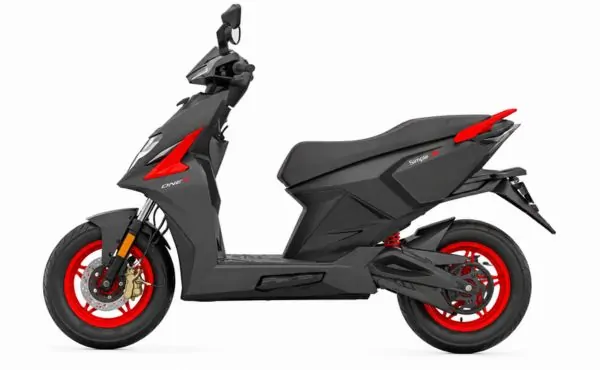
The Simple OneS is Simple Energy’s electric scooter designed for city use in India. It is positioned below the higher-performance Simple One 5.0 kWh model. The OneS comes with a 3.7 kWh battery, a claimed IDC range of up to 190 km, and a top speed of 90 km/h. It works well for city commuting, daily errands, and some suburban trips, but is not meant for frequent high-speed rides. The OneS keeps many practical and connected features from the Simple platform, including four ride modes, traction control, regenerative braking, SuperHold hill-hold, Park Assist, a roomy floorboard, boot space, and navigation. Buyers should know that the latest Gen 2 OneS is different from older OneS or Dot One versions, which have different power, range, speed, and charging details.
Ratings
- 90%
Performance
- 90%
Features
- 90%
Handling
- 100%
Comfort
- 95%
Build Quality
- 100%
Styling
- 85%
Value for Money
- 93%
Total
Ratings calculation is purely based upon pros and cons of the model given below in the overview section.
Price

Special Features
1
Four Ride Modes
2
Traction Control
3
Regenerative Braking
4
Superhold Hill-hold Assist
5
Drop Safe Fall Detection
6
Rapid Brake Alert
7
Exit Lights
8
App Integration
9
Keyless Lock And Unlock
10
Usb Charging Port
11
Boot Space
12
Fast-charging Compatibility
Full Specifications
| Motor Type | PMSM |
| Power | 8.84PS |
| Torque | 52Nm |
| Top Speed | 90km/h |
| Transmission | Automatic |
| Battery Type | Lithium Ion |
| City | 120-150 km/full charge |
| Highway | 100-120km/full charge |
| Speedometer | Digital |
| Tripmeter | Digital |
| Low Battery Indicator | Yes |
| Start Type | Self start |
| Kill Switch | -- |
| Clock | Yes |
| Pass Light | Yes |
| Stand Alarm | Yes |
| Tyres (F) | 90/90 - 12Tubeless |
| Tyres (R) | 90/90 - 12Tubeless |
| Brakes (F) | Disc 200mm |
| Brakes (R) | Disc 190mm |
| Front Suspension | Telescopic Forks |
| Rear Suspension | Mono-shock |
| Kerb Weight | 118kg |
| Seat Height | 780mm |
| Battery | 3.7kWh Lithium-ion |
| Charging Time (0-100%) | 5 hours |
| Head Lamp | LED |
| Tail Lamp | LED |
Overview
Performance And Motor
The OneS delivers 52 Nm of peak torque, can go from 0 to 40 km/h in 3 seconds, and has a top speed of 90 km/h. This acceleration is good for quick starts at traffic lights, overtaking in traffic, climbing flyovers, and everyday city riding, though it is not as performance-focused as the 5.0 kWh Simple One.
The latest OneS does not have an official peak power rating. Since unofficial numbers can vary, it is best for buyers to trust the official performance claims of 52 Nm, 0–40 km/h in 3 seconds, and a 90 km/h top speed. Always check the dealer’s current specification sheet for the exact motor rating before booking.
The OneS comes with four riding modes. Riders can pick between saving energy or getting a stronger response, depending on traffic, road conditions, and how far they need to go. Using faster modes will use more energy and lower the distance you can travel on a single charge.
The Simple OneS has a fully automatic electric drivetrain. There is no clutch, manual gearbox, or gear shifting. You just twist the throttle, and the motor sends power straight to the rear wheel. This setup makes the scooter easy to handle in busy city traffic, stop-and-go situations, and while parking.
The scooter uses regenerative braking, which recovers some energy when slowing down. It also has traction control and a SuperHold system for hills.
Regenerative braking can help reduce regular brake use in city traffic, but riders still need to use the main brakes for emergencies, wet or loose roads, or when more stopping power is needed.
The latest Simple OneS has a claimed top speed of 90 km/h. This is enough for city roads, flyovers, ring roads, and moderate suburban routes, but it is not meant for regular high-speed highway use.
Earlier versions of the OneS listed a top speed of 105 km/h, but that was for a different model with different power and range numbers. The current model’s top speed is 90 km/h. If you are looking at older stock, check the exact specs with the dealer.
Charging Time
The OneS has a 3.7 kWh battery and can be charged at home from 0 to 80% in 3 hours 30 minutes using a regular plug, with no extra adapter needed. Charging times can vary based on the charger or product updates, so it’s best to get the charging time and charger output confirmed in writing for your scooter.
Charging times for the latest OneS can differ, with reports ranging from about 4 hours to reach 80% to a slower 5.54 hours. These differences may be due to older stock, different chargers, or updates. To be safe, plan for an overnight or long workplace charge unless the dealer confirms a faster charging time for your scooter.
Fast charging is available, and there are over 250 charging points in more than 110 cities. Before depending on public charging for daily use, check that chargers are accessible, compatible, and working along your routes.
Range
Electric scooters use IDC-certified range instead of petrol-style km per litre mileage. The latest OneS has this official figure:
| Battery pack | Certified IDC/ARAI-listed range |
|---|---|
| 3.7 kWh | Up to 190 km per charge |
The 190 km range claim is for the latest Gen 2 OneS. Older OneS models had an IDC figure of 181 km. Make sure the quote, brochure, registration, and delivered scooter all match the updated 3.7 kWh, 190 km specs.
The IDC number is a controlled test result, not a daily guarantee. Things like rider weight, carrying a passenger, ride mode, traffic, speed, quick acceleration, hills, road and tyre condition, weather, and battery health all affect the real range in India.
There is not much independent long-term range testing for the latest OneS Gen 2. The 190 km IDC figure is the upper limit for comparison, but actual results will vary depending on how you use the scooter.
For everyday use in Indian cities and suburbs, you can expect about 120–150 km per charge. Using smooth throttle, lower-power modes, steady speeds, proper tyre pressure, and lighter loads can help you get closer to 150 km. Riding fast, carrying more weight, hard acceleration, rough roads, hills, traffic jams, and a passenger will bring the range closer to 120 km.
| Riding style | Practical planning range |
|---|---|
| Smooth, efficiency-focused city use | About 140–150 km |
| Mixed city and suburban riding | About 120–140 km |
| Frequent high-speed or hard acceleration | About 100–120 km |
The OneS is best for riders whose daily trips are within 80–100 km and who can easily charge at home or work. This way, you have a good charge reserve and do not need to rely on the full claimed range.
Features And Technology
The Simple OneS is an electric scooter designed for city use. It combines a 3.7 kWh battery with practical ride assistance, connected navigation, safety features, and everyday storage. Compared to the flagship Simple One 5.0 kWh, the OneS has more modest performance and features, but it keeps the essentials needed for city commuting.
- Four ride modes: The OneS offers four riding modes, so riders can choose between more efficient city riding and stronger throttle response. The exact operating modes and speed limits should be confirmed during the showroom demonstration.
- Traction control: The scooter includes traction control to help manage rear-wheel slip when accelerating on wet, dusty, loose, or uneven Indian roads. This system helps, but it does not replace smooth throttle control or safe riding.
- Regenerative braking: Regenerative braking recovers some energy when the rider slows down, helping reduce energy use in stop-start traffic. It is not clear whether all four selectable regeneration levels from the flagship model are included on the OneS.
- SuperHold hill-hold assist: SuperHold prevents the scooter from rolling back after stopping on an incline. It is helpful on flyovers, parking ramps, basement exits, and sloping junctions where holding the brake lever all the time can be inconvenient.
- Drop Safe fall detection: Drop Safe detects if the scooter tips over and automatically cuts motor power. This can help prevent unintended acceleration after a fall or if the vehicle is knocked over.
- Rapid Brake Alert: The scooter activates a warning signal during sudden braking to alert traffic behind. This improves rear visibility during quick stops in dense urban traffic.
- Exit Lights: These lights provide clear guidance after the scooter is parked or switched off. They are useful in dimly lit apartment parking areas, office basements, and driveways.
- Dual-disc brakes: The OneS uses disc brakes at both ends. This setup provides stronger, more controlled braking than scooters with rear drum brakes. Riders should check if ABS is included, as it is not listed in the available specifications.
- Rear monoshock and telescopic front forks: The scooter uses telescopic front suspension and a rear monoshock. This setup aims to balance steering control with comfort on city roads, speed breakers, and moderate potholes.
- 7-inch TFT instrument display: The scooter has a 7-inch TFT display that shows riding information like speed, battery charge, ride mode, range, trip details, and system alerts.
- Bluetooth and internet connectivity: The display supports Bluetooth and internet, so it can work with a smartphone and connected systems.
- Turn-by-turn navigation: The OneS offers turn-by-turn navigation instead of full-map navigation. This gives route prompts on the dashboard without needing a phone mounted on the handlebar.
- App integration: The dashboard connects to an app, giving access to vehicle information, connected functions, navigation support, and app-linked ownership tools. The exact services depend on the software version and subscription plan.
- Call, music, and notification functions: The connected dashboard supports call alerts, music controls, and smart notifications from a paired phone. For safety, riders should use these features only when parked or with proper hands-free controls.
- Do Not Disturb and Incognito modes: The OneS offers Do Not Disturb to reduce dashboard interruptions and Incognito mode to limit some location or data sharing. These features give owners more control over notifications and privacy.
- Keyless lock and unlock: The OneS supports keyless locking and unlocking, making routine starts and parking more convenient than using a regular key.
- Side-stand motor cut-off: The scooter will not move when the side stand is down, helping prevent a common low-speed accident when leaving a parking spot.
- USB charging port: A front USB port lets riders charge a smartphone or other small devices while travelling. This is useful when navigation or long commutes drain the phone’s battery.
- Boot space: The OneS has under-seat storage for daily items like rain gear, documents, a small bag, or certain helmet types. The exact boot capacity is not specified.
- Front glove box: A front glove box keeps small essentials like keys, documents, a phone, or cables within easier reach than the under-seat compartment.
- Ergonomic seat: The scooter has an ergonomic seat designed to give better support on longer city rides. It is paired with a spacious floorboard for more room for the rider’s feet and small bags.
- Spacious floorboard: The broad floorboard gives extra foot space and can hold small bags during daily errands. This adds practical utility for city riders.
- Smart charging and charging limit: The OneS supports smart charging and a charge limit setting. Setting a charge limit can help owners keep a regular charging routine instead of keeping the battery at a high charge for long periods.
- Fast-charging compatibility: The scooter works with a public charging network of over 250 points in more than 110 Indian cities. Riders should check that active, compatible chargers are available on their regular routes before relying on public charging.
- IP67 battery protection: The 3.7 kWh battery meets IP67 standards for dust and water protection. It is designed for normal rain and dusty roads, but riders should still avoid deep, flowing, or uncertain flooded roads.
Build Quality
The Simple OneS uses a compact, commuter-oriented scooter structure with telescopic front forks, a rear monoshock, dual disc brakes, and a 3.7 kWh battery. Simple Energy states that the battery and relevant components have cleared IP67 testing, indicating protection against dust and water ingress suitable for normal rain and dusty urban usage. That does not make the scooter suitable for deep, flowing, or uncertain floodwater.
The OneS is described as having thoughtfully crafted interiors, a front glove box, under-seat boot space, a spacious floorboard, and an ergonomic seat. These details show that its layout is intended for daily errands and commuting rather than only high-performance riding. The available information does not provide boot capacity, detailed chassis materials, or kerb weight, so buyers should not rely on unofficial specifications without dealer confirmation.
Initial feedback is broadly positive but comes from a limited sample size. The Gen 2 scooter is described as having excellent build quality and no vibrations at speed. As these are individual opinions rather than results from controlled quality testing, inspect panel alignment, paint quality, switchgear operation, seat latch, boot hinges, charging-port flap, brake-lever feel, tyre condition, and dashboard responsiveness before delivery.
Handling
The OneS is intended to be easy to manage in crowded city environments. Its official features include a rear monoshock, telescopic front suspension, dual disc brakes, traction control, regenerative braking, Park Assist, and SuperHold hill-hold. Together, these should make it convenient for traffic, mild gradients, parking ramps, and routine stop-start use.
Owners describe the Gen 2 OneS as light-steering and easy to turn, even in small parking areas. Some report that it does not feel excessively heavy with a pillion, while others highlight improved chassis stability at around 80 km/h. These observations suggest that the scooter’s weight distribution and city-speed manners are generally confidence-inspiring, though they are not a substitute for a professional long-term road test.
Traction control can help limit rear-wheel slip under acceleration on wet, dusty, or loose surfaces, while regenerative braking can make low-speed deceleration smoother. However, ABS is not listed in the available specifications, so riders should use progressive brake inputs, particularly in rain, over painted road markings, or on rough tarmac.
Comfort
The Simple OneS has an ergonomic seat and a spacious floorboard, both intended to make city commuting more relaxed. The broad foot space lets riders reposition their feet and carry small bags, while the long-term comfort claim is supported by the rear monoshock, which balances ride comfort with road control.
Initial feedback suggests that the OneS can be comfortable on typical city surfaces, handles rough roads well, and offers effortless handling. However, because the owner reports the base is small, these reports should be treated as early impressions rather than definitive assessments of ride quality or long-term reliability.
A careful test ride should cover the exact conditions the owner encounters daily: uneven concrete, potholes, speed breakers, flyovers, traffic crawling, and a short pillion ride. Check whether the front fork transmits sharp impacts, whether the rear monoshock feels too firm over abrupt bumps, whether the seat remains supportive after 30–45 minutes, and whether the floorboard and handlebar position suit the rider’s height. The OneS appears best suited to city riders who prioritise a balanced, easy-to-manage scooter rather than a plush long-distance touring machine.
Styling
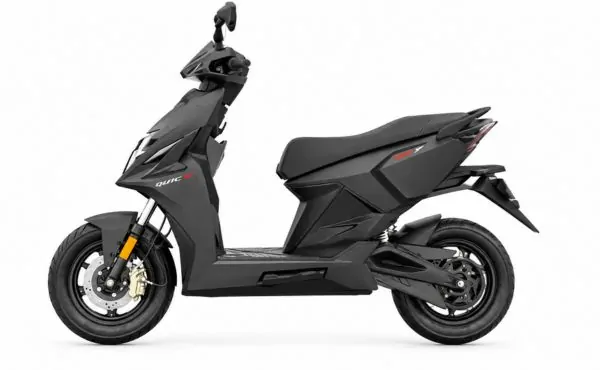
The Simple OneS follows the same futuristic, aerodynamic styling theme as the Simple One Gen 2. It has a sharply shaped front apron, a low, sporty stance, pronounced body creases, narrow rear bodywork, and an angular LED lighting signature. The design is aimed more at younger riders looking for a sporty, tech-oriented electric scooter than buyers seeking the rounded, conservative profile of a conventional family EV.
Its bodywork includes flowing curves, prominent ducts and vents, and an apron-mounted air duct that adds visual drama. The vents near the instrument console are intended to help cool the display and enhance the scooter’s high-tech appearance, rather than serving as engine-cooling intakes.
The OneS has a spacious floorboard, ergonomic seat, under-seat boot space, and a front glove box, which prevent its sporty look from making it impractical for daily city use. The design is therefore a balance of striking styling and commuter usability, although it remains visually more aggressive than family-oriented alternatives such as the TVS iQube or Bajaj Chetak.
The main visual difference between the OneS and the higher Simple One Gen 2 models is the dashboard arrangement: the OneS uses a simpler non-touch display, while the 4.5 kWh and 5.0 kWh variants receive a touchscreen interface. Its exterior silhouette, however, remains closely related to the higher-spec versions.
Colour Options And Variants
The Simple OneS is available in four India-spec colours:
- Brazen Black
- Brazen X
- Grace White
- Light X
- Brazen Black: The most aggressive-looking option in the range. Its dark bodywork, combined with red accents, gives the OneS a sporty, performance-oriented appearance that suits riders who want the scooter to stand out in city traffic.
- Brazen X: Brazen X builds on the dark Brazen Black theme with a more expressive dual-tone treatment and contrasting graphics. It is aimed at buyers who prefer a bolder, younger visual identity than a simple black finish.
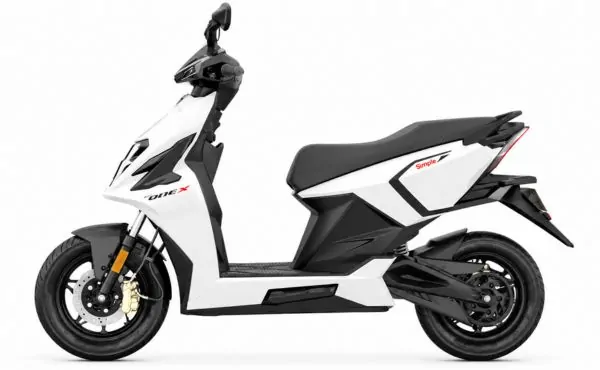
- Grace White: the cleanest and most understated colour option. The lighter paint highlights the scooter’s angular front apron, sharp side panels, vents, and streamlined rear bodywork. It is a good choice for riders who prefer a modern but less flashy appearance.
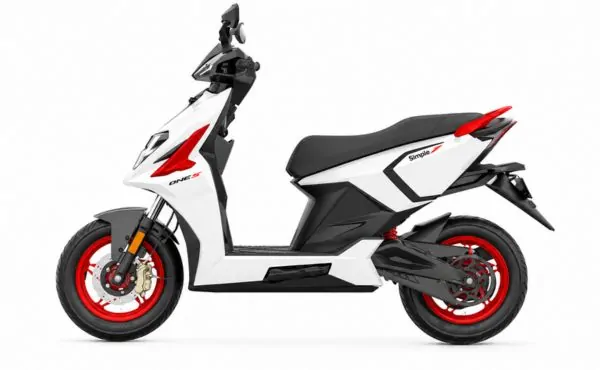
- Light X: Light X is the most vibrant dual-tone option, combining white bodywork with red accents and graphics. It gives the OneS a fresh, energetic look and strongly emphasises its sporty design language.
The Simple OneS is available as a single 3.7 kWh variant. Simple Energy lists it with a 190 km IDC range claim, 90 km/h top speed, 52 Nm peak torque, and 0–40 km/h in 3 seconds.
The official Simple Energy product page compares the OneS 3.7 kWh directly with the higher Simple One 5.0 kWh, which has a 265 km IDC claim, 115 km/h top speed, 72 Nm torque, and a 2.55-second 0–40 km/h claim. The OneS is therefore the value-focused Simple model for city riders who do not need the flagship version’s extra range and performance.
Do not confuse the OneS with the higher Simple One Gen 2 4.5 kWh and 5.0 kWh variants. Those models have larger batteries, touchscreen dashboards, more performance, and access to a wider nine-colour range. The OneS is the single-variant urban alternative, with a 3.7 kWh battery, a 90 km/h top speed, four ride modes, practical storage, and a more accessible entry point into the Simple lineup.
Value For Money And Pricing
The Simple OneS is Simple Energy’s urban-focused 3.7 kWh electric scooter. Simple Energy’s current product page lists a starting price of ₹ 1,71,999. The OneS is sold as a single-core configuration with a 3.7 kWh battery, a 190 km IDC range claim, a 90 km/h top speed, 52 Nm of torque, and a 0–40 km/h acceleration time of 3 seconds. There are no alternative battery capacities or performance trims within the OneS range; colour selection, optional accessories, an extended battery-and-motor warranty, and the Simple SuperPack subscription are the main areas where the final purchase package can differ.
The final on-road price will be higher than the listed starting price after accounting for insurance, registration-related charges, accessories, extended warranty, subscription fees, and dealer charges, where applicable. Before paying a booking amount, request an itemised quotation that identifies the vehicle’s manufacturing month, battery warranty, charger inclusion, delivery timeline, included connected services, and the cost of any add-ons.
The OneS’s strongest value point is its long claimed range relative to its battery size. It pairs a 3.7 kWh battery with an IDC range of up to 190 km, alongside a claimed top speed of 90 km/h and 0–40 km/h acceleration in 3 seconds. It also includes four ride modes, traction control, regenerative braking, SuperHold hill-hold, dual disc brakes, a rear monoshock, navigation, connectivity, smart alerts, a glove box, under-seat storage, and a spacious floorboard.
For a daily rider with reliable home charging, the OneS can be an attractive alternative to owning a petrol scooter. Simple Energy’s running-cost illustration estimates an annual operating cost of ₹2,006 for the OneS, compared with ₹16,002 for a petrol scooter, based on 20 km daily usage, electricity at ₹10 per unit, a petrol price of ₹100 per litre, 40 km/l petrol-scooter fuel economy, and the company’s maintenance assumptions. This is a company illustration rather than a guaranteed ownership cost, but it shows the potential savings for routine commuters.
The value equation is less compelling if the actual retail price is close to ₹1.72 lakh. At that level, the OneS competes with more established premium EVs that may offer stronger service networks, more polished software, a touchscreen display, or higher outright performance. The OneS makes most sense when local service access is convenient, its claimed range suits the rider’s real daily route, and the buyer values its traction control, 190 km IDC claim, spacious floorboard, and practical city-oriented design.
Charging is another ownership advantage. Official information lists 0–80% charging in 3 hours 30 minutes through a normal plug, while some comparison data quotes 4 hours; either figure supports a practical overnight or workplace routine. Simple Energy also claims more than 250 charging points across 110-plus cities, but buyers should confirm the availability of working chargers along their actual routes rather than relying solely on the headline network count.
The Simple OneS competes with both value-led and premium electric scooters in India. Its direct competitors include the
The best alternative depends on whether the buyer values claimed range, brand support, storage, removable batteries, performance, or lowest purchase cost.
For buyers considering the OneS, test it against the Ather 450X, Ola S1 Pro, and a comparably priced TVS iQube or Bajaj Chetak. For those seeing the earlier ₹1.40–1.50 lakh prices, it becomes a more compelling value-focused option—provided the local Simple service network, charger access, warranty terms, and delivery commitment are satisfactory.
Verdict
The Simple OneS is a well-equipped urban electric scooter for Indian riders who want a sporty design, strong claimed range, everyday practicality, and useful rider-assistance technology in one package. Its 3.7 kWh battery, 190 km IDC claim, 90 km/h top speed, four ride modes, traction control, regenerative braking, SuperHold hill-hold, dual-disc brakes, connected navigation, and practical storage make it especially relevant for regular city and suburban commuting. For riders with dependable charging at home or work and daily travel comfortably below 80–100 km, the OneS can offer convenient EV ownership and potentially much lower energy costs than a comparable petrol scooter.
However, the buying decision should go beyond the headline specifications. The 190 km IDC figure will not be a daily real-world guarantee; the OneS lacks a touchscreen console and ABS, and Simple Energy’s service and public-charging reach should be checked carefully in the buyer’s own city. Its value is strongest when available at a competitive local price and when authorised workshop support, parts availability, warranty coverage, charging equipment, and delivery commitments are clearly confirmed in writing. A thorough test ride—covering traffic, rough roads, speed breakers, a flyover, and a pillion run—will help determine whether the OneS is the right fit against alternatives.
Pros
- Strong claimed range: The Simple OneS has a 3.7 kWh battery and a claimed 190 km IDC range, providing a substantial range reserve for regular city use and moderate suburban travel. IDC is a controlled-test figure, but it remains useful for comparing models.
- Quick city acceleration: Simple Energy claims 0–40 km/h in 3 seconds, which should give the OneS quick starts from traffic signals, useful response in traffic gaps, and sufficient acceleration for flyovers and urban overtakes.
- Practical 90 km/h top speed: The 90 km/h claimed top speed gives the OneS more flexibility than low-speed commuter EVs. It should suit city roads, flyovers, ring roads, and normal suburban commuting.
- Four ride modes: The scooter offers four riding modes, allowing riders to adjust performance and efficiency based on traffic, route, and daily range needs.
- Traction control: Traction control can help limit rear-wheel slip during acceleration on wet roads, dusty surfaces, loose gravel, and uneven tarmac. It is a valuable feature for monsoon and mixed-surface riding in India.
- Regenerative braking: Regenerative braking recovers energy during deceleration and can reduce regular brake use in stop-start traffic. This can help improve smoothness and efficiency in dense urban commuting.
- SuperHold hill-hold system: SuperHold helps prevent rollback on slopes, making the OneS easier to manage on flyovers, basement ramps, parking exits, and inclined traffic junctions.
- Useful safety features: Drop Safe cuts motor power if the scooter tips over, while Rapid Brake Alert warns traffic behind during sudden braking. These functions add safety support for everyday riding.
- Dual-disc braking setup: The OneS has disc brakes at both ends, offering more substantial stopping hardware than scooters with a rear drum brake.
- Comfort-focused basic hardware: Telescopic front forks and a rear monoshock are intended to provide a controlled ride over normal city roads, moderate potholes, and speed breakers.
- Spacious floorboard and ergonomic seat: A broad floorboard lets riders reposition their feet and carry small bags, while the ergonomic seat is designed to enhance comfort for daily commuting.
- Useful storage arrangement: The OneS has an under-seat storage area and a front glove box, providing space for documents, rain gear, a phone, keys, cables, and other small daily essentials.
- Connected navigation and alerts: The dashboard supports navigation, calls, and music controls, smart alerts and notifications, Simple Connect integration, Incognito mode, and Do Not Disturb mode.
Cons
- No touchscreen console: Unlike the flagship Simple One 5.0 kWh, the OneS lacks a touchscreen dashboard. It receives a simpler digital display, which may feel less premium for its price range.
- Real-world range will be lower: The 190 km IDC range is measured under controlled conditions. In real Indian use, faster riding, harder acceleration, steep roads, passenger loads, traffic congestion, poor surfaces, low tyre pressure, and high temperatures will substantially reduce distance. One owner notes that using Sport or Power mode can bring EV range into the 80–120 km range.
- Developing service network: Simple Energy claims 250-plus charging points across 110-plus cities, but its retail, workshop, and parts network remains smaller than those of established brands such as TVS, Bajaj, and Ather. Confirm the closest authorised service centre, recovery support, parts lead times, and appointment availability before booking.
- Developing service network: Simple Energy claims 250-plus charging points across 110-plus cities, but its retail, workshop, and parts network remains smaller than those of established brands such as TVS, Bajaj, and Ather. Confirm the closest authorised service centre, recovery support, parts lead times, and appointment availability before booking.
- Mixed historical service feedback: Older Simple One owners have reported delays, weak customer communication, slow service turnaround, and inconsistent breakdown support. These reports concern earlier models and do not necessarily reflect every OneS Gen 2 experience, but they warrant careful local verification.
- Fast-charging network is limited: The company’s stated network of 250-plus points in 110-plus cities is useful, but it is smaller than networks claimed by some larger EV manufacturers. Public charging should be treated as backup unless active, compatible chargers are confirmed along regular routes.
- No ABS listed: The official OneS page confirms dual-disc brakes and traction control but does not list ABS. Traction control helps while accelerating, not when braking, so riders should brake progressively on wet roads, painted markings, gravel, and broken tarmac.
- Charging time discrepancy: Some official information states 0–80% in 3 hours 30 minutes, while other sources list 4 hours. Buyers should obtain written confirmation of the charger output and expected charging time for the specific scooter being delivered.
- Fixed battery requires parking access: The OneS has a fixed battery, so it is best suited to owners who have reliable electricity access at the scooter’s parking location or can use workplace/public charging. It is less convenient than removable-battery EVs for apartment residents without a nearby socket.
Frequently Asked Questions About Simple Ones
1. What Is The Range Of The Simple Ones?
The Simple OneS has a 3.7 kWh battery with a certified IDC range of up to 190 km per charge. In real-world Indian riding conditions, practical range is typically about 120-150 km, depending on riding style, load, traffic, and road conditions. Riders who use smooth throttle and lower-power modes can get closer to 150 km, while frequent high-speed or hard acceleration brings it closer to 100-120 km.
2. How Long Does The Simple Ones Take To Charge?
The Simple OneS can be charged from 0 to 80% in 3 hours 30 minutes using a regular home plug, with no extra adapter needed, though some reports cite times ranging from about 4 hours to 5.54 hours. Fast charging is also available through Simple Energy’s network of over 250 charging points in more than 110 Indian cities.
3. Does The Ather 450x Have Abs?
No, ABS is not listed in the official specifications for the Simple OneS. The scooter comes with dual-disc brakes and traction control, but since traction control only helps during acceleration and not braking, riders should use progressive brake inputs on wet roads, painted markings, gravel, and broken tarmac.
4. What Is The Price Of The Simple Ones?
The Simple OneS has a starting price of ₹1,71,999 as listed on Simple Energy’s official product page. This is for a single 3.7 kWh variant with no alternative battery or performance trims. The final on-road price will be higher after adding insurance, registration charges, accessories, and dealer fees.
5. What Is The Difference Between The Simple Ones And The Simple One 5.0 Kwh?
The Simple OneS is a value-focused, single-variant model with a 3.7 kWh battery, 190 km IDC range, 90 km/h top speed, 52 Nm torque, and a non-touch display. The Simple One 5.0 kWh is the flagship version with a larger battery, a 265 km IDC range, an 115 km/h top speed, 72 Nm of torque, a touchscreen dashboard, and access to a wider nine-colour range.
Other Related Links From Bikeleague India
List Of All Simple Energy Electric Scooters


About Simple Energy Electric Scooters
Simple Energy, based in Bengaluru, makes electric two-wheelers designed for Indian customers seeking long-range, high-performance scooters. The company started in 2019 and began selling its first model, the Simple One. Since then, it has added the One Gen 1.5, OneS, and Generation 2 scooters to its lineup.
Simple Energy presents itself as a tech-driven competitor in India’s growing electric scooter market. The company highlights its large battery packs, long range, smart features, locally made parts, and a push to boost manufacturing within India.
Suhas Rajkumar started Simple Energy in Bengaluru to create electric scooters as practical as petrol ones, but with better performance, longer range, and advanced software features. The company’s first model, the Simple One, set the tone with its focus on range and sporty looks.
Simple Energy focuses on premium and mid-range electric scooters, not the budget segment. Its scooters are aimed at city commuters, tech-savvy riders, and people who want more range for daily use and occasional longer rides.
| Aspect | Simple Energy’s position |
|---|---|
| Company type | Indian electric two-wheeler manufacturer |
| Headquarters | Bengaluru, Karnataka |
| Core product category | Electric scooters |
| Manufacturing base | Hosur, Tamil Nadu |
| Main products | Simple One Gen 1.5, Simple OneS and Generation 2 range |
| Brand focus | Range, performance, connected technology and localisation |
| Target market | Urban and semi-urban electric-scooter buyers |
Simple Energy’s main goal is to build an Indian electric-vehicle platform with greater control over how its products are designed and made. The company is working to assemble batteries, manufacture electric motors, develop software, and produce other key parts locally to reduce reliance on imports in the future.
History And Growth
Simple Energy started in 2019, when India’s electric two-wheeler market was just beginning to grow. The company first gained attention with the Simple One, which was advertised as having a claimed range of over 200km in its early version.
It took longer than planned for Simple Energy to move from announcing its product to delivering scooters, a common issue for new EV companies. Later, the company ramped up production at its Hosur plant and began opening more stores in southern and western India.
The One Gen 1.5 and OneS became Simple Energy’s main products in stores. In FY2024–25, the company sold over 1,000 units, and demand for these models led to a 40% increase in production at the Hosur plant.
In 2026, Simple Energy began a new phase of growth with its Generation 2 scooters. The company called 2026 an “inflexion year” as it aimed for a bigger retail push, more new products, and better use of its manufacturing capacity.
| Period | Major development |
|---|---|
| 2019 | Simple Energy was founded in Bengaluru. |
| Early development stage | The company developed the Simple One electric scooter platform. |
| Commercial operations | The One range entered the market after product and manufacturing preparation. |
| FY2024–25 | Simple Energy crossed 1,000 electric-scooter sales through the One Gen 1.5 and OneS. |
| 2025 | Output at the Hosur facility was increased by 40% to support demand. |
| January 2026 | The company introduced its Generation 2 scooter range. |
| June 2026 | Simple Energy raised ₹250 crore in a Series B round for expansion. |
Key Milestones And Developments
Simple Energy has focused on building a brand known for long-range electric scooters rather than just competing on price. The Simple One set this image, and the newer One Gen 1.5 and OneS models help illustrate the differences between the company’s products.
Simple Energy also emphasises its work in developing technology within India. In 2025, the company said it was the first Indian manufacturer to make heavy rare-earth-free motors at scale. This matters because rare-earth materials are common in permanent-magnet motors and are tied to global supply chain issues.
| Milestone | Details |
|---|---|
| Company formation | Simple Energy was established in Bengaluru in 2019. |
| Simple One development | The company created a performance-oriented, long-range electric-scooter platform. |
| Retail product expansion | Simple One Gen 1.5 and OneS became the main commercial models. |
| Sales achievement | The company crossed 1,000 unit sales in FY2024–25. |
| Production ramp-up | Hosur output increased by 40% in 2025. |
| Motor localisation | Simple Energy reported commercial production of heavy rare-earth-free motors in September 2025. |
| Generation 2 launch | A new Gen 2 scooter range was introduced in January 2026. |
| Series B funding | The company raised ₹250 crore in June 2026 to support production, working capital, R&D, sales, and customer experience. |
The Generation 2 lineup includes an “Ultra” model, which the company says can go up to 400km on a single charge. However, buyers should note that real-world range depends on factors like test cycles, city conditions, load, riding style, terrain, tyre pressure, and temperature.
Manufacturing Facilities
Simple Energy manufactures its scooters in Hosur, Tamil Nadu, a key hub for automotive and EV production near Bengaluru. The company’s plant covers 200,000 square feet and benefits from nearby suppliers and good transport links.
The Hosur plant is used to make electric scooters, and Simple Energy has also invested in expanding its battery assembly line. The company expects to see results from this investment starting in August 2026.
There are different estimates for the plant’s capacity. In June 2026, Simple Energy stated it could produce about 3,000 scooters per month. In January 2026, it mentioned an annual capacity of 300,000 scooters. These numbers are not directly comparable, since annual capacity is often much higher than what is actually being produced, depending on equipment, supplies, staff, demand, and plant utilisation.
| Manufacturing aspect | Details |
|---|---|
| Main facility | Hosur, Tamil Nadu |
| Facility size | Approximately 200,000 square feet. |
| Current reported output capability | Around 3,000 scooters per month in June 2026. |
| Reported installed annual capacity | Up to 300,000 scooters annually, according to January 2026 reporting. |
| Battery operations | Additional investment in the battery assembly line. |
| Near-term utilisation target | 75%–80% by the end of the next financial year, versus around 35% at the time of the June 2026 report. |
| Local-component focus | Battery assembly and heavy rare-earth-free motor production. |
Simple Energy has said it is looking to expand its capacity and is in talks with state governments about it. As of January 2026, the company had not announced a new factory location, so any future plant remains under consideration rather than confirmed.
Market Position And Achievements
Simple Energy is still a small but ambitious player in India’s electric two-wheeler market. It competes with big names like TVS, Bajaj, Ather, Ola Electric, VIDA, and other new companies.
Right now, Simple Energy’s market share is small. The company aims to reach 5% of India’s electric two-wheeler market by FY2027, up from about 0.3% in May 2025.
Simple Energy’s main achievement is not just sales numbers, but building its own EV brand, product platform, manufacturing base, and local technology. Selling over 1,000 units in FY2024–25 shows the company has moved past prototypes and limited launches to full commercial operations.
| Area | Simple Energy’s position |
|---|---|
| Market category | Indian electric scooter manufacturer |
| Main product segment | Premium and performance-oriented scooters |
| Major products | One Gen 1.5, OneS and the Gen 2 range |
| Main differentiation | High claimed range, performance, technology and localisation |
| FY2024–25 milestone | More than 1,000 scooter sales. |
| Reported starting market share | Around 0.3%, cited in its FY2027 plan. |
| FY2027 market-share target | 5% of India’s electric two-wheeler market. |
| Retail footprint | Presence reported in Karnataka, Maharashtra, Goa, Andhra Pradesh, Telangana and Kerala. |
Simple Energy’s main challenge is growing its business. Compared to the biggest EV companies, it has fewer stores, makes fewer scooters, and has less experience with nationwide service and spare parts. The company’s success will depend on scaling up without losing quality, reliability, or good customer service.
Future Plans
Looking ahead, Simple Energy plans to boost production, open more stores, launch new Generation 2 scooters, make more parts locally, and eventually go public.
After raising ₹250 crore in Series B funding, Simple Energy said that about 70% of the funds would go toward working capital and production expansion. The rest would be used for sales, marketing, research and development, and improving customer experience.
Simple Energy aims to sell about 10,000 electric scooters per month by March 2027. The company also has plans to reach 10,000 units per month by January 2027 and 15,000 per month by March 2027. These are future goals, not current production numbers.
| Future focus | Planned direction |
|---|---|
| Generation 2 range | Stabilise and expand the new product portfolio. |
| Production | Improve battery-line output and scale utilisation at Hosur. |
| Monthly sales target | Approximately 10,000 scooters by March 2027. |
| Capacity target | 10,000 units per month by January 2027 and 15,000 by March 2027, according to reported plans. |
| Retail network | Grow from 15 dealerships to a reported target of 250 outlets across additional states. |
| Near-term store target | About 150 outlets and 200 service centres during the year, as reported in June 2026. |
| Localisation | Further development of battery assembly, motor production, and domestic component capability. |
| Funding and IPO | A public listing was first discussed for FY2027, but June 2026 reporting indicated a later target of the second half of FY2028. |
The timeline for Simple Energy’s IPO has changed. Earlier, the company planned for Q2–Q3 of FY2027, but as of June 2026, it was aiming for the second half of FY2028. For accuracy, use the later date unless the company announces a new update.
Other Related Links From Bikeleague India
User Reviews
There are no reviews yet. Be the first one to write one.

Hiran Narayanan
Founder & CTO at Bikeleague India
Hiran Narayanan is the Founder and CTO of Bikeleague India, bringing over 15 years of experience in motorcycle technical writing. He develops detailed analyses, tools, model overviews, and blogs that contribute to bikeleague.in's improving rankings.