Overview
Performance And Engine
The R2M uses a 204 cc, single-cylinder, four-stroke, liquid-cooled engine with double overhead camshafts and four valves. It has fuel injection, a 66 mm bore, and a 59.6 mm stroke. The engine features an 11.5:1 compression ratio, an electric starter, and E20 compatibility.
| Engine item |
Specification |
| Displacement |
204 cc |
| Cylinder configuration |
Single-cylinder |
| Engine cycle |
Four-stroke |
| Cooling |
Liquid-cooled |
| Valvetrain |
DOHC, four valves |
| Fuel system |
Fuel injection |
| Bore × stroke |
66.0 × 59.6 mm |
| Compression ratio |
11.5:1 in Yamaha’s shared engine specification |
| Maximum power |
26.5 PS at 10,000 rpm |
| Maximum torque |
19.1 Nm at 8,000 rpm |
| Starting system |
Electric starter |
| E20 compatibility |
Yes, in Yamaha’s shared specification |
The displacement, configuration, bore, stroke, and output are already mentioned above. The other engine details are included here for completeness.
Maximum power is 26.5 PS at 10,000 rpm, and maximum torque is 19.1 Nm at 8,000 rpm. This is also shown as 19.5 kW. The M version does not have a more powerful engine than the other R2 models.
PS and bhp are different units, so their numbers should not be swapped directly.
During circuit testing, the accelerator felt soft at low revs. The engine was easy to manage during the cool-down lap, but its low-end power was not very strong. This shows that being flexible at low rpm isn’t the same as having strong low-end acceleration; an engine can run at low revs without responding well.
With the throttle fully open, the engine started pulling harder around 6,000 rpm and felt noticeably more energetic beyond 7,000 rpm.
The engine revved happily up to about 11,000 rpm. It performed best at higher revs, with peak power at 10,000 rpm. This was seen as a clear improvement over the R15.
Vibration was noted as a concern. A buzz started around 7,000 rpm and got stronger through the handlebars, tank, and footpegs at higher revs. More road testing may show how this affects daily use. These findings are specific to this bike and do not set a standard for all motorcycles.
The M version was tested for about 15 minutes on a circuit. This does not cover how it performs in Indian traffic, engine heat in jams, highway overtaking with a load, or long-distance cruising. The short cool-down lap provides only limited low-speed information and isn’t the same as a full road test. No acceleration numbers are given.
The R2M uses a six-speed manual transmission and a wet, multi-disc assist-and-slipper clutch. The transmission is a constant-mesh, six-speed unit. This configuration uses a six-speed constant-mesh manual gearbox with a wet, multi-disc assist-and-slipper clutch.
The assist-and-slipper clutch makes it easier for the rider and helps stop the rear wheel from hopping during hard downshifts. These features help with clutch use and downshifting, but they do not make the gearbox automatic.
A quickshifter is included. The mid-level R2 gets a bidirectional quickshifter, and the top M version adds even more features, so the R2M comes with this as well.
A speed just above 140 km/h was seen in sixth gear during the circuit session.
The display showed an estimated top speed of about 155–160 km/h. The numbers above separate the speed seen from the expected maximum.
Mileage And Fuel Efficiency
No verified ARAI mileage figure is available for the Yamaha R2M. Mileage remains to be tested for the 204 cc petrol-manual powertrain.
A mileage of about 40–44 km/l is suggested for mixed riding, but this is not the official ARAI figure.
The R2M can use E20 fuel, but no fuel-efficiency result is linked to it. Fuel compatibility and mileage are separate points.
A 38 km/l average is reported by owners for the wider Yamaha R2 range. There is no separate R2M sample, submission count, or average just for the M version.
A 38 km/l figure is mentioned, but it’s unclear whether it comes from M-version owners, testing, or a general model reference.
Features And Technology
The Yamaha R2M offers electronic rider aids, connected instruments, and adjustable parts in its India-market package. Key features are a 5-inch full-colour TFT display, Y-Connect, selectable riding modes, traction control, dual-channel ABS, and an up-and-down quickshifter. The M version adds adjustable levers, front-fork preload adjustment, and keyless start with steering lock. These features set the R2M apart from the lower R2 models.
- Five-inch full-colour TFT display: The R2M features a 5-inch full-colour TFT instrument display designed to present riding information clearly.
- Y-Connect smartphone connectivity: The R2M features Y-Connect as the connectivity platform. Connectivity is identified by its official name; it does not assume navigation, any notification type, or remote-control functions are included.
- Electronically controlled throttle: The electronically controlled throttle body provides precise throttle control, improved low-rpm rideability, and a natural engine-braking feel. This establishes electronic throttle control, not cruise control or independently adjustable engine-braking settings.
- Three preset riding modes: The R2M features three selectable riding modes, including Sport mode. There is no complete numerical calibration for each preset, so separate power outputs or intervention thresholds should not be included.
- Customisable throttle and traction-control settings: The R2M includes a custom mode that lets you select accelerator response and traction-control level, separate from the three preset modes. Not every available throttle-response setting is enumerated.
- Three-level traction control: The R2M features a three-level traction control system. Lean-sensitive operation is not established, and the system should not be presented as a guarantee against loss of grip.
- Dual-channel ABS: The R2M includes dual-channel anti-lock braking. Cornering ABS or a user-selectable rear-ABS-off mode is not established.
- Front and rear disc brakes: The R2M has a 282 mm front disc and a 220 mm rear disc, with a radially mounted brake caliper. This confirms a disc brake at each end rather than a front-disc/rear-drum arrangement. The specification alone does not establish a measured stopping distance.
- Assist-and-slipper clutch: The assist-and-slipper clutch reduces rider effort and helps avoid rear-wheel hop during aggressive downshifts. No numerical reduction in lever effort is published.
- Up-and-down quickshifter: The R2M includes an up-and-down quickshifter. The full operating conditions, such as minimum engine speed or permitted gears, are not specified.
- Adjustable rider footpegs: The R2M features adjustable footpegs, which tailor the riding position and improve control. The number of positions, adjustment range, or whether tools are required are not specified.
- Adjustable levers on the M version: The R2M includes adjustable levers as an M-specific feature. The number of adjustment positions or the adjustment mechanism is not specified.
- Preload-adjustable upside-down front forks: The R2M includes 37 mm upside-down front forks with preload adjustment as an M-version addition. Preload adjustment should not be expanded into a claim of separately adjustable compression and rebound damping. Electronic suspension adjustment is also not established.
- Adjustable rear Monocross suspension: The R2M features an adjustable linked-type Monocross rear suspension. The adjustment type or separate compression- and rebound-damping controls are not specified.
- Keyless starting and steering lock: The R2M includes keyless start and steering lock as convenience features. These should not be expanded into remote engine starting, app-based unlocking, or a published detection range.
- Bi-functional LED headlamp: Bi-functional LED headlamp Steel-tube diamond frame: The R2M uses a steel-tube diamond frame with a high-tensile-steel backbone. This is a chassis specification, not an aluminium frame or evidence of a quantified rigidity advantage.
- Seventeen-inch alloy wheels and tubeless tyres: The R2M has 17-inch alloy wheels at both ends, with a 100/80-17 front tyre and a 140/70R17 rear tyre. Tubeless construction is confirmed. A claim that both tyres are radial—or that neither is radial—would be inappropriate without further clarification.
- Tuned induction sound: The manufacturer lists tuned induction sound. There is no published sound-pressure level, selectable sound settings or independently measured output benefit. This is a listed sound characteristic, not an active sound system or a confirmed power upgrade.
Build Quality
The Yamaha R2M uses a steel-tube diamond frame. Its M-version specifications cite high-tensile-steel construction, with substantial reinforcing members along the chassis sides. These observations apply directly to the R2M, not to an assessment carried over from the lower R2 versions.
The chassis is described as a comprehensive structure with almost trellis-like side reinforcement. No evident handling disadvantage was found from the change away from the R15’s Deltabox layout during the short test. That is a riding impression, however, not a measured comparison of frame stiffness or fatigue resistance.
The R2M’s quality and finish, particularly the switchgear, are positively assessed for initial assembly and component presentation. This does not establish long-term paint retention, corrosion resistance, or identical finish quality across every production motorcycle.
There is no material-by-material breakdown of the exterior panels or controlled durability results. The R2M can be described as having a positive initial finish, but not as an all-metal exterior or proven lifetime resistance to rattles and deterioration.
The M-specific listing confirms 37 mm upside-down front forks and a linked-type Monocross rear suspension. Front preload adjustment is an M-version addition. This distinguishes it from the lower versions, rather than assuming the M badge adds a benefit.
The specification page also lists rear-suspension adjustability but does not clearly identify every adjustment available. Neither that entry nor the front preload provision establishes separately adjustable compression and rebound damping. Electronic suspension is explicitly listed as absent.
The R2M has a kerb weight of 150 kg, compared to 149 kg for the base motorcycle. It measures 1,980 mm long, 700 mm wide, 1,140 mm high, with a 1,340 mm wheelbase. These figures are published dimensions; they do not independently measure build strength or rider space.
Handling
The R2M stands out for its agile handling. The M version feels light, easy to turn, and predictable, making it a capable, approachable sports bike that responds as expected and doesn’t feel nervous. These comments are based on circuit riding, not a full review of Indian road conditions.
The R2M keeps its familiar, responsive handling. Its 150 kg kerb weight makes it feel light overall, but the extra weight compared to the R15 can be noticed when riding both bikes one after the other.
The R2M is fun and predictable in corners. There are no measured steering or turning-circle numbers, and no controlled tests for low-speed parking. So, easy direction changes on the track do not guarantee it will be just as easy to handle in crowded streets.
The R2M uses MRF tyres, the same as the R15. Their track grip is adequate, though the limits of adhesion were not fully explored. A predictable frame does not necessarily mean the tyres give the rider equally strong feedback.
Tyre pressures were lowered by approximately 6 psi for the circuit session. That detail describes the test conditions, not a road-use recommendation. No information establishes comparable grip on wet roads, loose surfaces, or broken tarmac.
Yamaha describes the electronically controlled throttle as providing precise control and a natural engine-braking feel. In Sport mode, throttle response was found smooth and predictable, while traction control did not become intrusive during the session. This supports a positive impression of control in those conditions, not an assessment of every mode or intervention setting.
Yamaha also states that the assist-and-slipper clutch helps avoid rear-wheel hop during aggressive downshifts. It is a documented aid to downshift control, but should not be described as preventing instability under all combinations of rider input and road grip.
The R2M has a 282 mm front disc and a 220 mm rear disc, with a radial-mounted brake caliper identified in its specification. Yamaha confirms dual-channel ABS.
The front brake felt spongy, but stopping power was good and there was no worry when braking into corners. The main issue was some ABS intervention during hard braking on the track, but it was not too much. This could be more noticeable at higher speeds.
The distinction matters: the criticism concerns lever feel and electronic intervention under demanding track use, not a measured failure of stopping performance. There is no stopping-distance result or equivalent assessment during ordinary commuting.
Comfort
The R2M keeps a focused sports-bike riding position. The changes from the R15 are minor, so the riding posture is still very similar. It is a bit more accessible, but not upright or much more relaxed than before.
One clear ergonomic difference is the tank, which looks and feels bigger. A rider who is 6 feet 1 inch tall can fit into a full racing crouch, but the bike may not feel roomy for everyone. This works for one tall rider, but does not mean all tall riders will be comfortable.
This does not show how much strain there is on your wrists, knees, or back during long city or highway rides. A position that feels fine during a short track session may feel different on a long ride at lower speeds.
The R2M’s listed seat height is 810 mm, with no seat-height adjustment. This is 5 mm lower than the R15’s 815 mm seat and is considered a modest improvement in accessibility.
Seat height by itself does not show if a rider can put both feet flat on the ground. No tests measure ground reach across different rider sizes, and no numbers are published for seat width, cushion firmness, or seating length.
Yamaha confirms adjustable rider footpegs, intended to help tailor ergonomics and control. The M version also has adjustable levers. These offer some flexibility in rider fit, but the available material doesn’t specify the number of positions or adjustment ranges.
Those provisions should not be interpreted as proof that every rider can achieve an ideal knee angle, lever reach or long-distance posture. They establish adjustability, not a universally comfortable result.
The M version’s front preload adjustment and adjustable rear suspension are confirmed. However, the available riding assessment involved only about 15 minutes on a circuit. It does not show how the motorcycle handles potholes, sharp road repairs, or repeated speed breakers.
So, it is not accurate to call the ride always soft or always harsh. There is more proof about how the chassis works on the track than about comfort for different riders, loads, or road conditions.
The listed 170 mm ground clearance helps on uneven roads, but the specification doesn’t provide clearance under different loads. It cannot guarantee that the motorcycle will avoid grounding on every speed breaker.
A buzz starts around 7,000 rpm and gets stronger through the handlebars, tank, and footpegs at higher revs. This could affect comfort during long high-rpm rides. The reviewer did not give a final opinion on how this would feel in normal road use.
There is not enough information about long-distance comfort for the rider or passenger. The short circuit test does not show how the seat feels after hours, how well it fits a passenger, or how tiring it is on long trips. So, it is not possible to say for sure if it is comfortable for all-day or two-up use.
Styling
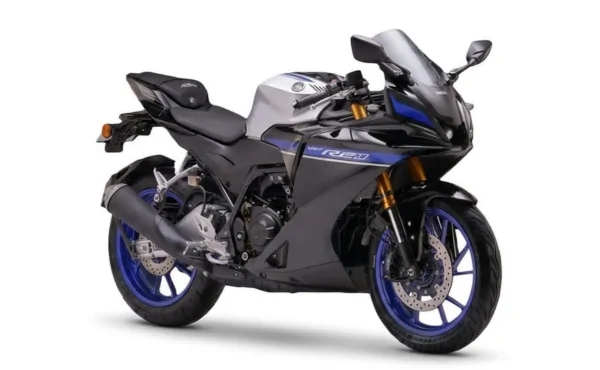
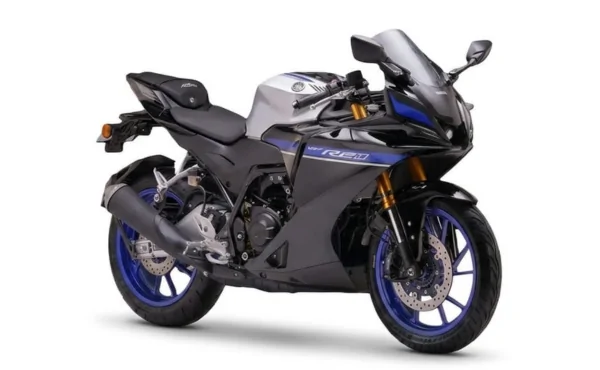
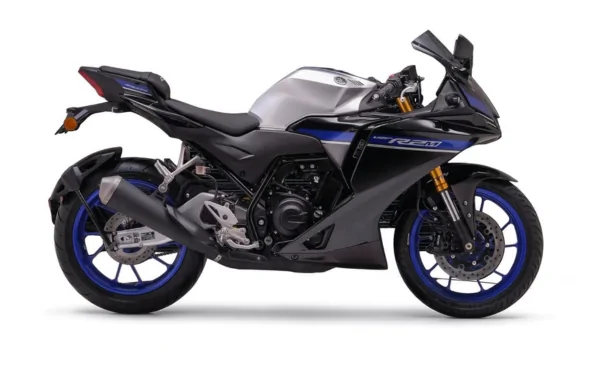
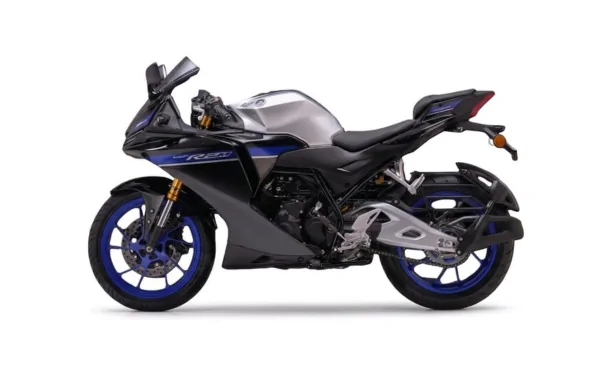
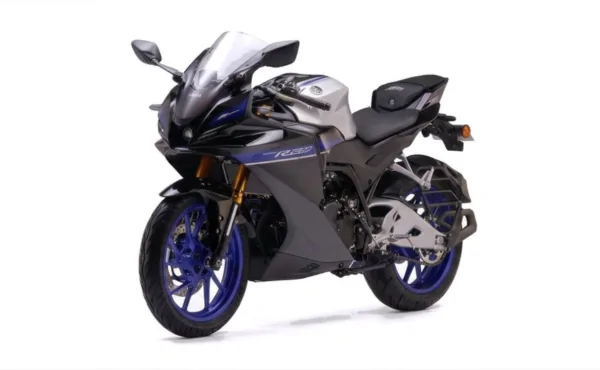
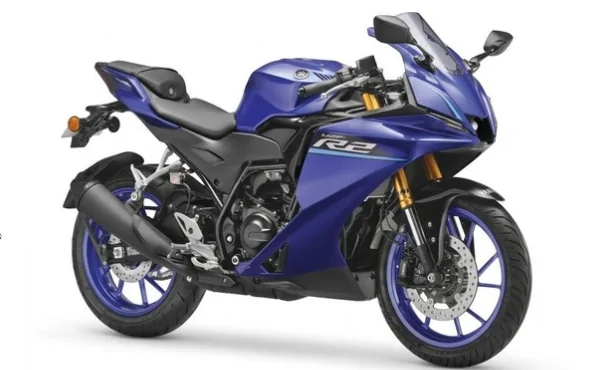
The Yamaha R2M uses fully faired sports-bike bodywork, with its clearest India-market visual distinction being the exclusive Metallic Gray colour scheme. The tested motorcycle is the M version and has a unique paint scheme. The official listing independently identifies Metallic Gray as its selectable finish.
The supplied accessible text does not expose a complete R2M styling or colour selector. Confirmation is available for the colour, and further details are described in model reviews.
The R2M looks a lot like the R15, even though it is the newer bike. The similarity is so strong that most people would need a close look to spot the differences. Yamaha kept the familiar small-supersport style.
The fuel tank looks and feels bigger than the R15’s, which adds to the bike’s visual presence. However, this is not a measured comparison of the tank’s actual size.
The M version’s documented visual distinction is its unique paint scheme. No evidence indicates it has an entirely different fairing shape, tail section, or fuel-tank shell than the lower R2 versions.
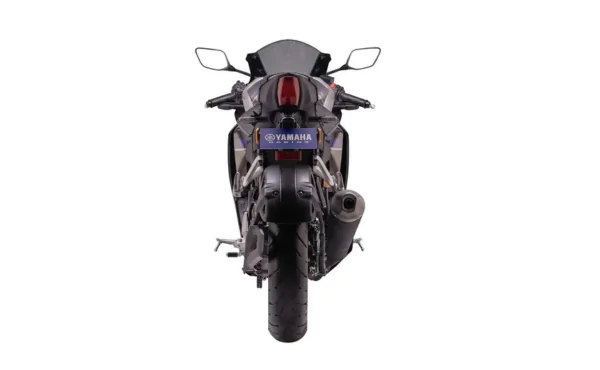
The Metallic Gray scheme combines a black fairing finish with dark-blue and grey graphics. The treatment is not uniformly grey across every body panel: the colour name identifies the overall scheme, while black panels and contrasting graphics are an important part of its appearance.
This combination distinguishes the M version through its livery. Exact graphic dimensions, decal materials and the finish of every smaller panel are not specified.
The Metallic Gray scheme uses a grey-finished tank with a black stripe running through its middle. This clearly contrasts with the predominantly black fairing and its blue-and-grey graphics.
It is not established whether every painted surface uses the same gloss level or coating process. Therefore, it would be inappropriate to describe the entire motorcycle as matte, gloss, or satin based solely on the Metallic Gray name.
The R2M features blue-finished rims as part of the Metallic Gray presentation; their presence does not mean Racing Blue is a separately available R2M body colour.
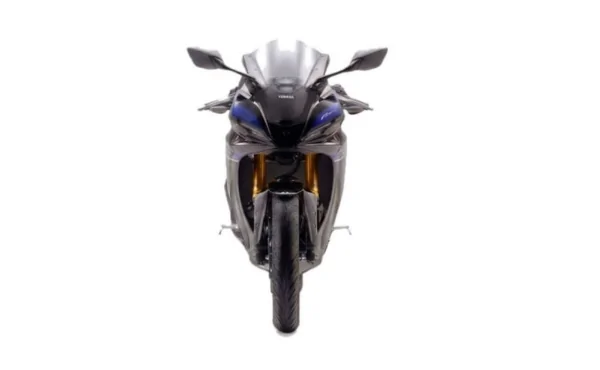
A bi-functional LED headlamp and daytime running lights are included as elements of the motorcycle’s front lighting presentation. No evidence exists of a unique M-only headlamp shape or a separate lighting assembly exclusive to this version.
A specific projector count should not be inferred from general model descriptions where the terminology differs. For an R2M-focused styling account, “bi-functional LED headlamp with daytime running lights” is the directly supported description.
Colour Options And Variants
The current listing supports only Metallic Gray as an R2M colour option. This scheme is exclusive to the top-spec M version.
| Variant |
Colour choices |
| Official listed colour |
Metallic Gray. |
| Fairing |
Black finish with dark-blue and grey graphics. |
| Fuel tank |
Grey finish with a black central stripe. |
| Wheels |
Blue-finished rims. |
| Allocation |
Exclusive to the M version in BikeWale’s colour guide. |
Broader model galleries list Matte White Pearl, Dark Bluish Gray, Metallic Black, Racing Blue and Metallic Gray together. Only Metallic Gray is reserved for the M version.
Therefore, Matte White Pearl, Dark Bluish Gray, Metallic Black, and Racing Blue should be excluded as R2M choices. The supported selection is Metallic Gray, not a five-colour M palette.
There is only one M version, rather than several separately named R2M sub-variants. The product is listed as “R2M” with Metallic Gray selected. There is no established separate R2M Standard, R2M Quickshifter, or special-edition sub-variant.
Within the requested scope, the supported India-market combination is Yamaha R2M in Metallic Gray. Different dealer inventory entries or spelling variations in the colour name are not additional factory variants without manufacturer confirmation.
The top M version is distinguished from the lower versions and explicitly identified by its unique paint scheme. The wider range’s Standard and Quickshifter labels should not be presented as two R2M versions.
The accurate styling-and-variant summary is one supported R2M version with an exclusive Metallic Gray scheme, characterised by black fairing panels, blue-and-grey graphics, a grey tank with a black stripe and blue wheels. There is no established additional R2M colour or a separately styled factory sub-variant.
Value For Money And Pricing
The Yamaha R2M is priced at ₹ 2,53,000 ex-showroom Delhi, with an indicative on-road price of approximately ₹2.74 lakh in Delhi. These are different price categories: the ex-showroom figure is not the full purchase cost, while the on-road listing is an estimate, not a final dealer invoice.
The Yamaha R2M booking amount is ₹10,000, which is adjusted against the overall vehicle price in the final quotation. This is a booking payment—not the motorcycle’s retail price.
Yamaha states that actual on-road prices may vary with state-specific taxes, insurance selection and changes in law. Optional products or services, such as accessories, extended warranty, and delivery outside the dealership, are not included in the indicative calculation. Consequently, a buyer’s final payable amount may differ from the estimate.
A written quotation should separate the ex-showroom price, registration-related charges, insurance and optional additions. The ₹10,000 booking payment should also appear as an amount already paid and adjusted against the total, rather than being treated as an additional charge above the agreed vehicle price.
The R2M’s value rests on its combination of the shared sports-motorcycle package and additional adjustment and convenience equipment. The M version adds adjustable levers, front-fork preload adjustment, keyless starting and steering lock, and a unique paint scheme.
The R2M costs ₹13,500 more than the quickshifter-equipped version and ₹22,500 more than the base version. These are comparisons within one dated Delhi ex-showroom price list—not a guarantee that every current dealer quotation preserves exactly the same gaps.
The intermediate version already introduces the bidirectional quickshifter, while the M adds further equipment. The ₹13,500 step above that version should therefore not be described as payment for the quickshifter alone. Its documented justification includes the adjustable levers, front preload adjustment, keyless functions and exclusive presentation.
Yamaha’s M-specific specifications list 26.5 PS and 19.1 Nm, matching the published output of the shared engine. The available evidence does not establish a more powerful M-specific engine. Therefore, a higher purchase price should not be interpreted as an independently documented increase in maximum power or torque.
For buyers who will use the adjustment and keyless conveniences, the M premium reflects identifiable equipment. For someone who wants mainly the shared engine and quickshifter, those additions may be less compelling. This is a conditional assessment of the equipment-to-price relationship, not proof that one version is universally better value.
The motorcycle gets praise for its performance, handling, features, and quality, but its price is a concern. It is seen as expensive for a 200 cc-class bike. It does its job very well, but it could have been priced lower.
That verdict followed approximately 15 minutes of circuit riding. It supports an assessment of sporting appeal and initial equipment value, not a complete conclusion about long-term ownership costs, everyday comfort or fuel expenditure.
A complete annual maintenance budget or a controlled total-cost-of-ownership comparison against competitors is not published. Therefore, it would be unsupported to call the R2M the cheapest motorcycle in its category to maintain, or to claim that lower running costs will necessarily offset its purchase premium.
Likewise, a displayed starting EMI should not be treated as the total financing cost. Affordability depends on the down payment, loan tenure, interest rate, fees and total amount repayable—not the monthly figure alone.
Relevant faired-motorcycle alternatives include
- KTM RC 200
- Suzuki Gixxer SF 250
- TVS Apache RR 310
These models occupy different price and capacity positions, so they should be treated as cross-shopping alternatives rather than mechanically identical substitutes.
Mentioning the M version and several rivals helps keep the price category consistent, avoiding comparisons between an R2M on-road figure and a rival’s ex-showroom price.
These differences are provided as examples. Rival prices are starting figures and do not establish equipment equivalence with the M version. They remain estimates, not binding dealer quotations.
The R2M is not the cheapest among these options. Its value depends on whether you want its mix of sporty feel, electronics, adjustability, and keyless features. The RC 200 and Gixxer SF 250 cost less, while the RR 310 is more expensive. These price differences do not make any one bike the clear best value or cheapest to own long-term.