Overview
Performance And Engine
The R2 uses a 204 cc, liquid-cooled, four-stroke engine with double overhead camshafts and four valves. It is a single-cylinder unit with fuel injection and an electric starter.
The bore and stroke are 66.0 × 59.6 mm, with an 11.5:1 compression ratio and engine-speed references for maximum power and torque.
| Engine item |
Specification |
| Displacement |
204 cc |
| Cylinder configuration |
Single-cylinder |
| Engine cycle |
Four-stroke |
| Cooling |
Liquid-cooled |
| Valvetrain |
DOHC, four valves |
| Bore × stroke |
66.0 × 59.6 mm |
| Compression ratio |
11.5:1 |
| Maximum power |
26.5 PS (19.5 kW) at 10,000 rpm |
| Maximum torque |
19.1 Nm at 8,000 rpm |
| Fuel system |
Fuel injection |
| Starting system |
Electric starter |
| E20 compatibility |
Yes |
This confirms the single-cylinder configuration.
The engine makes 26.5 PS (19.5 kW) at 10,000 rpm and 19.1 Nm of torque at 8,000 rpm. These figures show the engine’s peak output, but they don’t reveal how it performs at lower speeds or provide a complete torque curve.
The R2 offers three riding modes: Street, Rain, and Sport. There are no specific power, torque, or acceleration numbers for each mode, so it’s not possible to give separate performance figures for them.
Official 0–60 km/h or 0–100 km/h acceleration times for the non-M R2 are not available. As a result, there are no specific acceleration numbers based on the engine’s output.
The transmission is a constant-mesh, 6-speed unit with a wet, multi-disc clutch.
The R2 Standard uses a one-down, five-up gear-shifting pattern and chain final drive. The clutch is an assist-and-slipper unit.
The R2 features a six-speed, constant-mesh manual gearbox with a wet, multiple-disc assist-and-slipper clutch and chain final drive. Individual gear ratios or a final-drive ratio are not specified.
The non-M R2 comes in Standard and Quickshifter versions. The Quickshifter is available only on certain models, so it’s not included on every R2.
The second version’s system is a third-generation bidirectional quickshifter. Its availability does not indicate different internal gearbox ratios or a higher maximum engine output than the Standard version. Only one six-speed transmission specification is published for both non-M versions.
No verified numerical top speed has been established for the India-market Yamaha R2. Therefore, there is no basis to present a specific km/h figure as an official maximum.
An independently measured maximum speed specifically for the non-M R2 is not established. Results from different models should not be automatically substituted.
Mileage And Fuel Efficiency
No ARAI-certified mileage figure is available for the petrol-manual 204 cc powertrain. Accordingly, no numerical fuel-efficiency value can be presented here as verified ARAI mileage.
Owner reports suggest the R2 achieves about 38–44 km/l in mixed riding, but this is not an official test result or certified mileage.
E20 compatibility is confirmed, but no mileage figure is attached to that entry. E20 compatibility should remain a fuel-compatibility statement rather than evidence of any particular fuel-efficiency result.
An owner-reported average of 38 km/l is listed for the Yamaha R2. This is an explicitly labelled user-mileage reference, not an ARAI claim.
The submission count or a consistent measurement procedure is not disclosed. The information does not demonstrate an independently audited dataset for the non-M R2.
For accuracy, 38 km/l can be mentioned as an owner-reported figure. There is no official mileage number or verified comparison between the two non-M R2 versions.
Features And Technology
The Yamaha R2 offers electronic rider aids, digital displays, and adjustable controls. Key features are a 5-inch full-colour TFT display, Y-Connect, three riding modes, traction control, dual-channel ABS, and an assist-and-slipper clutch. It also has adjustable footpegs and upside-down front forks. Some versions include an up-and-down quickshifter. Not all features are available on every model, and R2M equipment is not standard on the R2.
- Five-inch full-colour TFT display: A 5-inch full-colour TFT instrument display is included, designed to present riding information clearly. Brightness control and left-handlebar toggle switches are provided for navigating the screen. It is not specified as a touchscreen.
- Digital riding information: The R2 Standard offers a digital speedometer, tachometer, odometer, fuel gauge and tripmeter, along with a clock, gear-position indicator and gear-shift light. Low-fuel and low-battery indicators are included. Fuel-consumption and distance-to-empty readouts are not conclusively confirmed.
- Y-Connect smartphone connectivity: The R2 Standard features Y-Connect smartphone connectivity, including Bluetooth connectivity and call/SMS alerts. Details about all supported functions are not listed.
- Three selectable riding modes: The R2 Standard offers three riding modes: Street, Rain, and Sport. These are associated with Yamaha Ride Control and the electronically controlled throttle. Specific power reductions or electronic-intervention thresholds for each mode are not provided.
- Electronically controlled throttle body: The electronically controlled throttle body provides precise throttle control, improved low-rpm rideability, continued pull at higher rpm and a natural engine-braking feel. This confirms electronic throttle control, not cruise control or independently adjustable engine-braking settings.
- Traction Control System: Traction control reduces the chances of wheelspin. The number of intervention levels or lean-sensitive operation is not specified, and the feature should not be presented as a guarantee against loss of grip.
- Dual-channel ABS: Dual-channel anti-lock braking is confirmed, with disc brakes at both ends. Cornering ABS and selectable rear-wheel ABS deactivation are not established.
- Front and rear disc brakes: The R2 Standard has a 282 mm front disc and a 220 mm rear disc, creating a dual-disc setup with dual-channel ABS. These specifications identify the equipment but do not provide a measured stopping distance or prove identical braking performance on every road surface.
- Assist-and-slipper clutch: Yamaha confirms an assist-and-slipper clutch, which reduces rider effort and helps prevent rear-wheel hop during aggressive downshifts. The clutch is a wet, multiple-disc unit. No numerical reduction in lever effort or adjustment range is specified.
- Up-and-down quickshifter on the applicable R2 version: The up-and-down quickshifter is available on certain R2 versions. It is not a standard feature on every non-M R2. Manufacturer claims such as “Segment First” should be understood as marketing descriptions without a defined comparison basis.
- Adjustable rider footpegs: Adjustable footpegs allow the riding position to be tailored for ergonomics and control. The number of positions, adjustment range or tool-free mechanism is not specified.
- Adjustable clutch and brake levers: The R2 Standard features adjustable clutch and brake levers, though the number of adjustment positions and the adjustment mechanism are not specified.
- Upside-down front forks: Yamaha lists USD front forks. Non-M versions do not have front-suspension adjustability. Front preload adjustment attributed to the R2M should not be transferred to the R2.
- Preload-adjustable rear suspension: The R2 Standard features a linked-type Monocross rear suspension with preload adjustment. The number of preload positions or separate compression and rebound damping adjustment is not specified.
- Steel-tube diamond frame: Yamaha confirms a steel-tube diamond frame as a chassis feature. Frame weight or rigidity measurements are not provided. It should not be relabelled as an aluminium frame or assigned a quantified structural advantage without further evidence.
- Tuned induction sound: Yamaha lists tuned induction sound among the R2’s features, attributed to a new air-cleaner box and revised muffler design. No sound-pressure measurement or additional power gain specifically attributable to the sound tuning is provided.
- Projector LED headlamp and daytime running lights: The headlamp is a projector LED unit flanked by slit-pattern LED DRLs. A specific projector count cannot be stated. No measured beam distance, brightness rating or adaptive-lighting capability is established.
- LED rear lamp and indicators: The R2 Standard features an LED brake/tail lamp and LED turn signals, along with a pass-light function. Hazard-warning-light operation is not confirmed.
- Front USB charging port: The R2 Standard is equipped with a front USB charging port. Its connector type, power output or fast-charging capability are not identified.
- Side-stand engine cut-off and warning indication: The R2 Standard has a side-stand engine cut-off and a stand alarm, establishing an engine-operation interlock and a warning function. Whether the warning is audible is not specified.
- Alloy wheels with tubeless tyres: The R2 is fitted with 17-inch alloy wheels at both ends, with a 100/80-17 front tyre and a 140/70-R17 rear tyre. Both tyres are tubeless, and the rear is specifically radial. Tubeless construction should not be described as puncture-proof.
- Electric starting and E20 compatibility: The R2 features an electric starter and E20 compatibility. These entries do not, by themselves, establish automatic start-stop, silent-start operation or compatibility with unrestricted higher ethanol blends.
Build Quality
The Yamaha R2 uses a steel-tube diamond frame with a diamond chassis and an aluminium swingarm. No published measurements exist for frame rigidity, corrosion resistance, or long-term durability.
No issues are reported with uneven panel gaps or rattles. The upside-down forks and aluminium swingarm are notable component features. Positive initial assessments of assembly and component presentation have been reported.
The available official material does not identify the material of every exterior panel or publish controlled tests of paint durability and finish retention. It is therefore more accurate to describe the R2 as well assembled than to claim an all-metal exterior, permanent rattle-free operation, or proven long-term resistance to deterioration.
Yamaha’s official feature panel confirms upside-down front forks. The R2 Standard features KYB front forks and a linked-type Monocross rear suspension with rear preload adjustment. The non-M versions do not receive front-suspension adjustability.
Consequently, front adjustment associated with R2M should not be attributed to the R2. Similarly, rear preload adjustment does not provide separate compression or rebound damping adjustment.
Handling
The R2 is praised for being agile. Track tests show it turns easily in both slow and fast corners and changes direction smoothly, with good feedback from the chassis and tyres. These results are based on track use, not on wet roads, loose surfaces, or daily traffic.
The R2 remains stable when leaned over, with no obvious wallowing or bucking. It responds predictably to throttle changes, so riders can adjust their line mid-corner without sudden reactions from the bike. Track feedback calls the handling approachable.
The steel-tube diamond-frame motorcycle is described as light and flickable, with stable corner entry and exit. However, it lacks instrumented handling measurements or established safe cornering limits for all riders and road conditions.
The R2 Standard weighs 149 kg kerb. Track feedback on direction changes describes the motorcycle as manageable within its sporting category. Kerb weight is provided as a reference, but there is no available measurement for parking effort, steering lock, or U-turn ease.
There is no published turning-circle measurement or dedicated low-speed manoeuvrability test. No evidence confirms it is effortless in every congested Indian street or equally easy for riders of all sizes.
The electronically controlled throttle body provides precise control, improved low-rpm rideability, and a natural engine-braking feel. The throttle is described as easy to modulate, with linear delivery. Predictable throttle inputs have been noted in track use for controlled adjustments through a corner.
The assist-and-slipper clutch helps avoid rear-wheel hop during aggressive downshifts. This is a documented control aid, not a guarantee against instability caused by every downshift, road surface or rider input.
The R2 features dual-channel ABS. The electronic braking system is distinct from the brake feel: progression and feel are praised, but stronger braking power would be welcome, and the response is described as somewhat squishy.
Braking feedback is mixed under track use. There are no stopping-distance measurements or confirmation of the same response in ordinary commuting, so criticism should not be taken as an unsupported claim of unsafe braking.
Comfort
The R2 has a sports-bike riding position, but it’s less demanding than the R15. The seat is less aggressive, making it easier for riders to move around. This allows more freedom of movement, but it doesn’t guarantee comfort on long rides.
The R2 features higher clip-on handlebars and a revised footpeg position, reducing shoulder and back strain compared with the R15. This suggests a more accommodating position within the sports-bike format, not an upright commuter posture.
Adjustable rider footpegs are included, allowing the riding position to be tailored for ergonomics and control. The number of positions, adjustment range or whether adjustment requires tools is not stated.
There is no evidence that every rider will find an ideal knee angle or riding position.
The R2 Standard has an 810 mm seat height, which is a useful reference for accessibility. However, seat height is not a guarantee that riders of a particular height can place both feet flat on the ground. No controlled ground-reach assessment exists across different rider sizes.
The available evidence also does not provide measured seat length, usable seat width or cushioning density. There is no basis for precise claims about seating space and support from the seat-height figure alone.
The suspension is set up for comfort. However, most riding impressions come from track use, not from regular road tests with potholes or speed bumps. So, the evidence is stronger for track performance than for daily comfort on rough roads.
Available evidence does not describe the R2 as uniformly plush or harsh. The published suspension layout and positive initial comfort impressions do not establish how the motorcycle responds across different rider weights, rear-preload settings, or passenger loads.
The less aggressive ergonomics are reported to offer a more accommodating starting point than the R15. There is no evidence of comfort on long-distance road journeys or fatigue after several hours of continuous use.
Pillion comfort is not well documented. The presence of a pillion seat, footrests, and a grab rail is confirmed, but these entries do not establish passenger seat support, usable space, or long-distance comfort. There is no evidence that the R2 comfortably accommodates two adults on extended journeys.
Styling
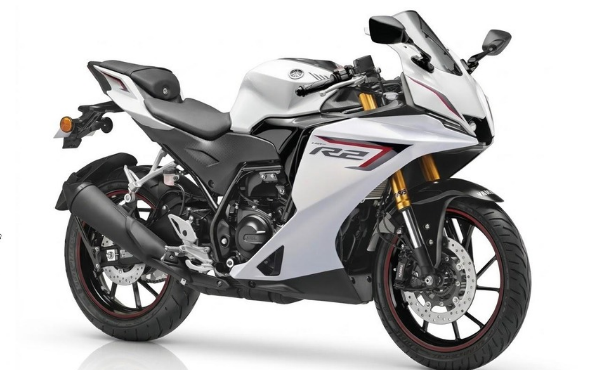
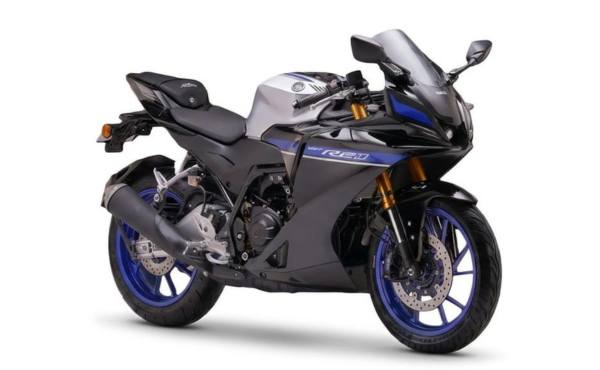
The Yamaha R2 follows Yamaha’s R-Instinct design language, with fully faired bodywork, sharply defined panels, and a front lighting arrangement inspired by the brand’s larger sportbikes. The main visual difference between the R2 Standard and R2 Quickshifter is colour availability; both share the same body shape.
Colour and variant information is based on available materials. The Standard and Quickshifter versions each have specific colour allocations, excluding R2M-only finishes.
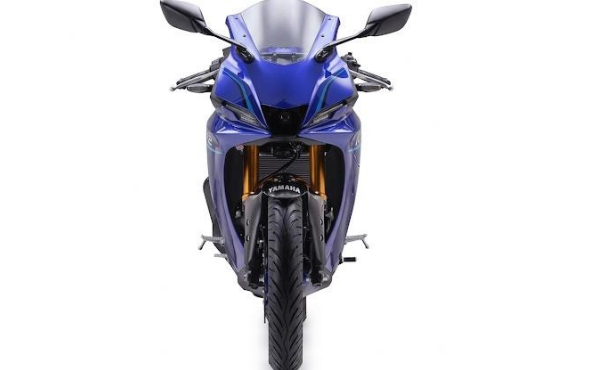
The R2’s front combines a projector LED headlamp with slim, slit-pattern LED daytime running lights. The narrow DRLs and angular fairing give the motorcycle its recognisable sports-bike face. The indicators are mounted higher, near the handlebars, rather than in the fairing position described for the R15.
Official descriptions vary regarding the number of projector headlamps: some references mention a projector headlamp, while others specify “Dual LED Projector Headlamp.” The supported description is projector LED lighting with slim LED DRLs, without asserting a specific number of projector units.
The fairing extends from the handlebar area to the bellypan, with sharp cuts and creases that reinforce the R2’s angular appearance. Part of the forward-inclined engine remains visible, so the side treatment does not completely conceal the powertrain.
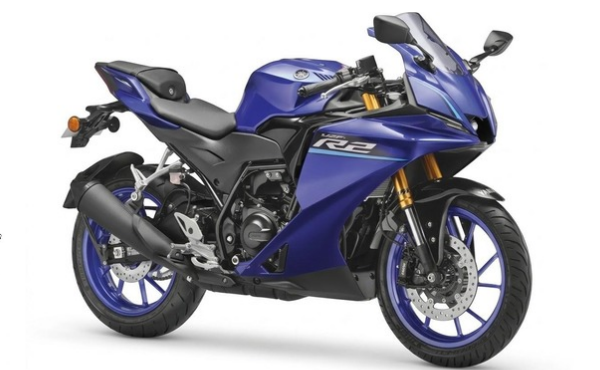
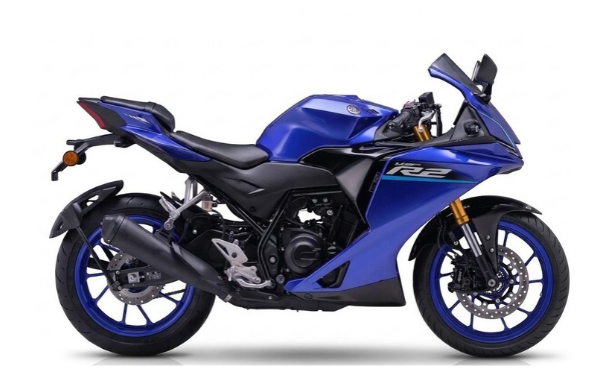
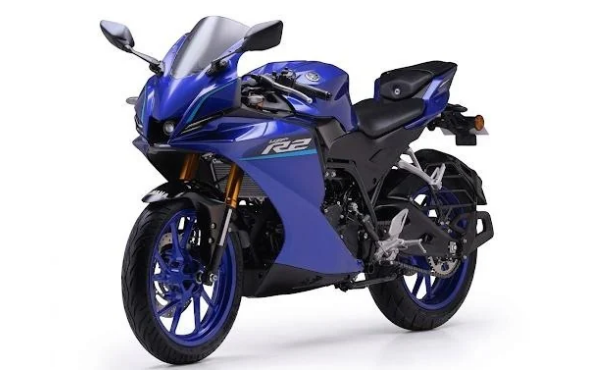
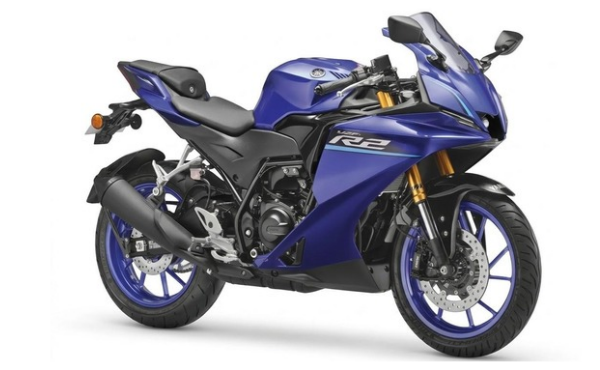
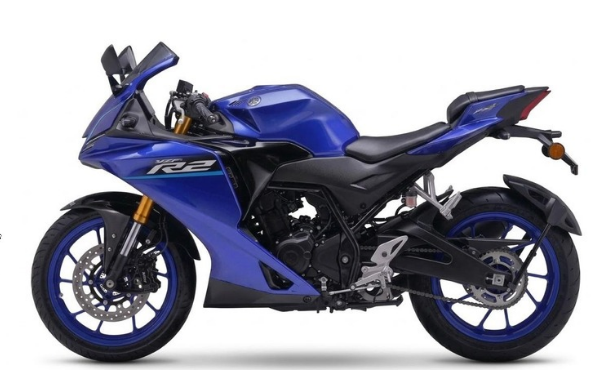
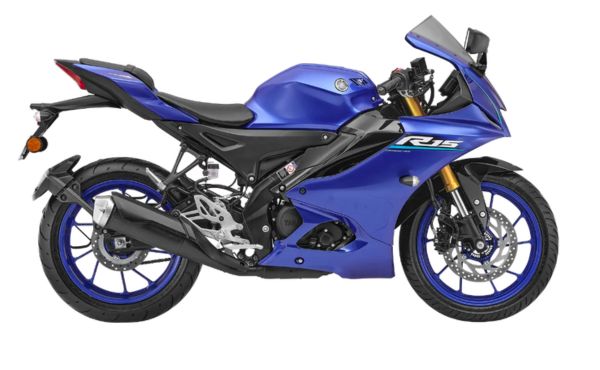
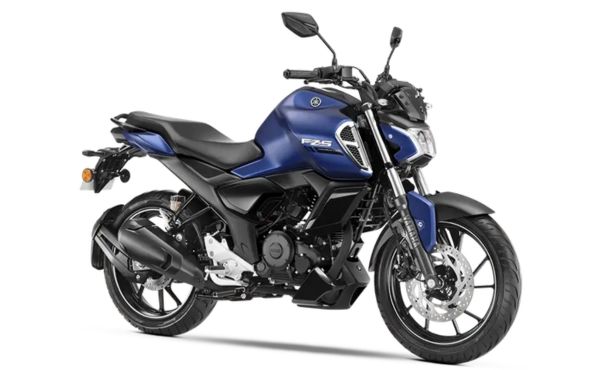
The blue motorcycle’s layered body panels, Yamaha tank emblem, and prominent R2 side graphics establish the look of the pictured finish, but do not assign identical graphic colours or panel treatments to every other colour option.
The R2 features a sporty rider’s seat with a stepped pillion. This creates a raised rear-seat profile. The shape is documented, but passenger comfort is not established by this feature alone.
The side profile also includes a large muffler with silver accents and brushed-silver rider and pillion footrest assemblies that contrast with the black frame. The upside-down front forks are finished in brushed gold. These details contribute to the published visual presentation without creating different finishes for each colour scheme.
Colour Options And Variants
There are five colour options for the combined R2 and R2M models. Only four belong to the two non-M R2 versions:
- Matte White Pearl
- Dark Bluish Gray
- Metallic Black
- Racing Blue
Metallic Gray is reserved for R2M and is excluded here.
| Non-M R2 version |
Listed colour choices |
| R2 Standard |
Matte White Pearl; Dark Bluish Gray |
| R2 Quickshifter |
Metallic Black; Racing Blue |
Racing Blue and Metallic Black are reserved for the Quickshifter version, while Metallic Gray is for the R2M. Complete colour and version pairing details are not provided in a single listing.
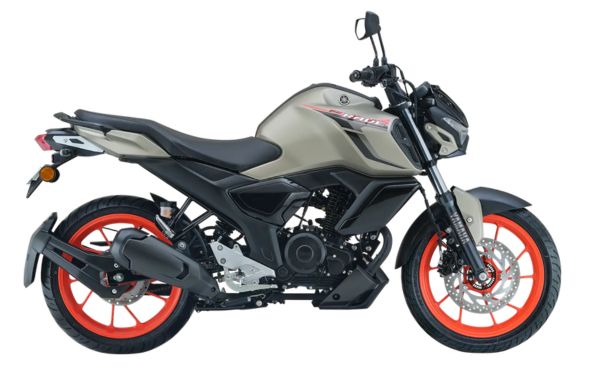
Matte White Pearl is a Standard-version colour. Images of this colour are for representation only and may not reflect every equipment detail on the delivered motorcycle.
We do not have a complete panel-by-panel description of this finish. Exact wheel colours, accent-strip colours or decal placement should not be invented from the colour name alone.
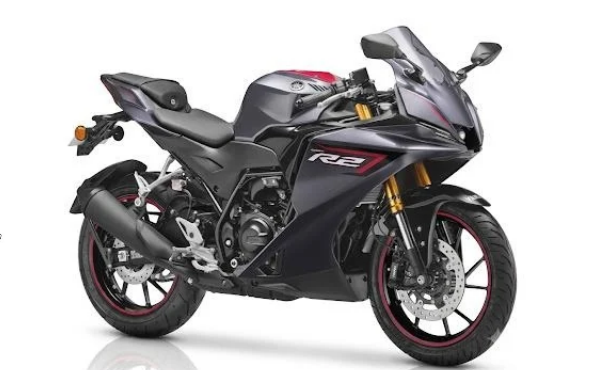
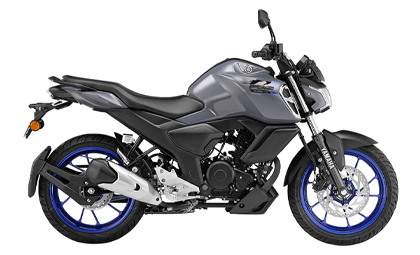
Dark Bluish Gray is the other supported Standard-version option. Do not confuse this with Metallic Gray, which is allocated to R2M.
No complete graphic or wheel-finish combination is specified for Dark Bluish Gray. Its name establishes the listed colour choice, not the finish of every exterior component.
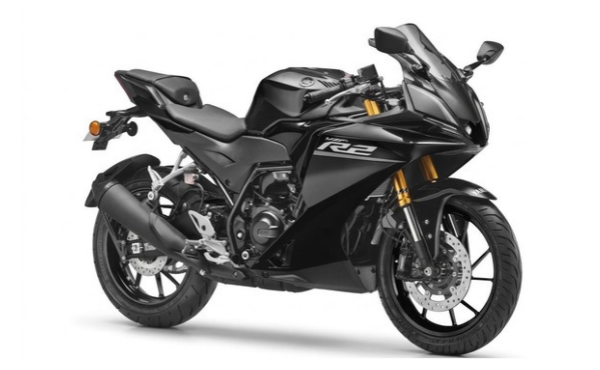
Metallic Black is specifically identified as a Quickshifter-version colour. Buyers should not assume that it is available on Standard merely because it appears in the combined R2 colour gallery.
There is no sufficiently detailed textual description of accent colours or graphic layout to support further claims about the scheme.
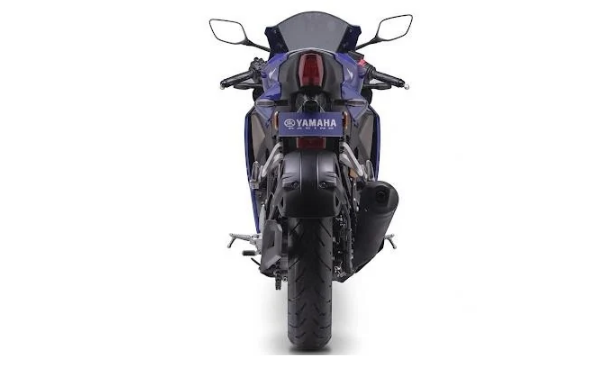
Racing Blue is reserved for the R2 Quickshifter. The blue motorcycle in the supplied official feature images shows blue bodywork, blue wheels and contrasting R2 graphics. Those visible details describe the pictured motorcycle; the images alone do not establish the exact appearance of the other three non-M colour choices.
The non-M Yamaha R2 is listed in two versions:
- Standard
- Quickshifter
| Version |
Styling distinction |
Variant identification |
| R2 Standard |
Matte White Pearl or Dark Bluish Gray; shared R2 fully faired design |
Base non-M version |
| R2 Quickshifter |
Metallic Black or Racing Blue; shared R2 fully faired design |
Quickshifter-equipped non-M version |
The colour allocation and version names are based on official manufacturer specifications. The Standard specification excludes a quickshifter, while the Quickshifter entry identifies the second non-M version.
Standard provides the R2’s main visual identity: angular full fairing, slim LED DRLs, projector LED lighting, a stepped seat arrangement and the distinctive side-panel treatment. Supported colours include Matte White Pearl and Dark Bluish Gray.
The quickshifter retains the same documented R2 design language but is distinguished by the colour range Metallic Black and Racing Blue. Yamaha’s official feature image advertises an up-and-down quickshifter, which belongs to a separate version rather than Standard. This identifies the variant without implying exclusive body panels, lamps or a different seat shape.
Metallic Gray is an R2M variant and is not part of the four-colour non-M selection. R2M-specific visual treatments or equipment should not be transferred to Standard or Quickshifter simply because all three appear in some product listings. For the requested scope, two non-M versions offer four colour choices.
Value For Money And Pricing
Yamaha offers the R2 in India in two non-M versions: Standard and Quickshifter. Yamaha’s official launch announcement gives a starting price of ₹ 2,30,500 ex-showroom Delhi for the standard variant. The Quickshifter variant costs ₹9,000 more than the standard variant.
A starting on-road price of ₹2,63,188 in Delhi is listed for the R2, including the ex-showroom price, registration charges, and insurance. Starting on-road totals vary across Indian cities, including ₹2,74,089 in Mumbai and ₹2,97,653 in Bengaluru. These illustrate why an ex-showroom price should not be treated as the total amount payable or transferred unchanged between locations.
For an accurate purchase comparison, a written quotation should separate the motorcycle price, registration-related charges, insurance, accessories and any finance fees. Complete city-specific on-road breakdowns for both non-M versions are not provided.
The R2’s value proposition centres on combining its lightweight sports-bike package with electronic rider aids and a colour TFT display. Yamaha confirms traction control, selectable riding modes, an assist-and-slipper clutch, upside-down front forks and dual-channel ABS across the range. A 5-inch full-colour TFT display is also included. These documented inclusions give the Standard version a substantial equipment base rather than reserving the principal rider aids for the more expensive version.
Standard is the less expensive non-M R2. It retains the officially confirmed core rider aids, while it is explicitly stated that a quickshifter is not fitted to this version. It therefore makes financial sense for buyers who want the main R2 package but don’t specifically need quickshifter operation.
The R2 Quickshifter is priced at ₹9,000 above the Standard Model. Yamaha confirms that the second non-M version gets a third-generation bidirectional quickshifter, plus version-specific colour and finishing treatments. The premium therefore isn’t solely due to a different engine or a higher published power figure.
This upgrade is most defensible for someone who specifically values the quickshifter and the associated version presentation. No higher maximum engine output, higher top speed, or lower ownership costs are established for this version. Its higher price should not automatically be equated with a measurable improvement in every aspect of performance.
In summary, the R2 offers higher performance than the R15 and retains the smaller bike’s engaging riding feel. It is positioned as an upgrade within Yamaha’s lineup.
However, that conclusion followed about 20 minutes of circuit riding and excluded fuel economy, pillion comfort, everyday rideability, and road ride quality from the assessment. It therefore reflects perceived sporting value, not a complete long-term ownership-cost verdict.
No complete servicing-cost schedule, guaranteed annual maintenance expenditure, or controlled cost-per-kilometre comparison against rivals is published. Consequently, it is unsupported to call the R2 the cheapest motorcycle in its category to own or to claim that its purchase premium will necessarily be recovered through lower running costs.
Likewise, an advertised EMI should not be treated as proof of affordability without the down payment, interest rate, tenure, fees and total payable amount. The R2’s purchase value and financing cost are separate questions.
The most relevant faired motorcycle alternatives in a typical R2 comparison set include
- KTM RC 200
- Bajaj Pulsar RS 200
- Suzuki Gixxer Sf 250
- TVS Apache RR 310
These differences are calculated from listed starting prices. They are not same-city dealer quotations, and the starting version of each rival may not offer equipment directly equivalent to the selected R2 version.