
Long story short: In short, here are some tips to help you lower your yearly bike insurance premium and save money.
In India, motorcycle insurance is required by law for all two-wheeler owners under the Motor Vehicles Act 1988. For more on buying and selecting two-wheeler insurance, see this article.
Looking for ways to lower your bike insurance premium without losing important coverage? No matter if you’re new to riding or have years of experience, knowing how insurance works and using the right tips can help you save money every year.
This guide covers the main things that affect your bike insurance costs and gives you practical tips to lower your premium while keeping full protection.
Key Takeaways
- While purchasing bike insurance, start by comparing different policies. Online comparison tools provide clear information on features, coverage, and price, helping you choose the best option and save money.
- The No Claim Bonus (NCB) lowers your yearly premium if you haven’t made claims, rewarding careful driving.
- Making frequent small claims can raise next year’s premium, so consider paying for minor repairs out of pocket.
- Only choose add-on covers that add value, as unnecessary ones increase your premium.
- Installing an ARAI-approved anti-theft device can reduce your premium. Practising safe driving reduces accidents and keeps your premium low.
Quick Comparison: Ways To Reduce Your Bike Insurance Premium
| Tip | How It Works | Typical Savings |
|---|---|---|
| Compare policies before buying | Weigh coverage, CSR, and renewal cost, not just first-year price | Varies by insurer |
| Maximise NCB | Stay claim-free to earn a renewal discount on the OD premium | 20-50% on OD premium |
| Renew before expiry | Avoids re-inspection paperwork and protects your existing NCB | Protects existing NCB |
| Avoid claims for minor repairs | Pay small repair costs out of pocket instead of filing a claim | Preserves NCB long-term |
| Stay with the same insurer | Builds loyalty standing that some insurers reward at renewal | Varies by insurer |
| Always ask for discounts | Some discounts aren’t offered upfront unless you ask | Varies by insurer |
| Choose add-ons wisely | Skip add-ons that don’t add real value for your bike | Avoids unnecessary premium increase |
| Install an ARAI-approved anti-theft device | Certified devices qualify for a discount on the OD component | ~2.5% on OD premium |
| Maintain a clean driving record | Fewer accidents and violations lower your long-term risk profile | Improves renewal pricing over time |
| Buy online | Lower administrative costs get passed on as a discount | Varies by insurer |
| Take a long-term policy (2-3 years) | Bundled multi-year pricing plus protection from mid-term TP hikes | Varies by insurer |
| Join a recognised automobile association | Some insurers offer a small discount for verified membership | Small, insurer-dependent |
| Opt for a higher voluntary deductible | You take on more out-of-pocket risk per claim in exchange for a lower premium | Varies with deductible amount |
| Consider Pay-As-You-Drive or telematics | Premium is priced on actual mileage or riding behaviour | Varies by insurer; select insurers only |
| Set your IDV within the allowed range | Avoid inflating IDV beyond your bike’s realistic value | Directly affects OD premium (~±15% band) |
What Is A Bike Insurance Premium?
A bike insurance premium is the amount you pay to get protection for your two-wheeler. The key benefit is that it covers expenses for accidents, theft, damage, and third-party liability, providing you with financial security for a year.
What Are The Major Components Of A Bike Insurance Premium?
The major components of a bike insurance premium in India are:
1. Own Damage (od) Premium
This component covers damage to your bike due to accidents, fire, theft, natural disasters, or vandalism. The rate is based on your bike’s Insured Declared Value (IDV), age, make, and model. Use our Bike IDV Calculator to check how your IDV is likely to affect this part of your premium.
2. Third-party Liability Premium
Mandatory by law, this covers financial liability for injuries, death, or property damage to third parties caused by your vehicle. IRDAI regulates the premium and sets it based on the bike’s engine capacity (cc). You can get an instant estimate using our Third-Party Bike Insurance Calculator.
3. Personal Accident Cover
This is a compulsory add-on, covering injury or death of the owner-driver. The sum insured is typically ₹15 lakh.
4. Add-on Covers (optional)
You can choose additional benefits for an extra premium, such as:
- Zero depreciation cover
- Roadside assistance
- Engine protection
- Consumables cover
- Return to invoice cover
5. No Claim Bonus (ncb)
This discount applies if you made no claims in previous policy years. It reduces your premium on renewal.
6. Deductibles
These are fixed amounts that you pay out of pocket at the time of a claim. Higher deductibles can lower the premium.
7. Gst And Taxes
GST at 18% (or applicable rate) is added to the insurance premium for both basic and add-on covers.
You may have seen news about GST being removed from insurance. That change, starting in September 2025, only applies to individual life and health insurance policies, which are now GST-exempt. Motor insurance, including bike insurance, is not included in this exemption and still has 18% GST on both the base premium and any add-on covers.
8. Insured Declared Value (idv)
The current market value of your bike, which is the maximum sum assured by the insurer, directly affects premium calculation.
Each insurance policy’s overall premium is determined by a combination of these elements, customised according to the specific bike, usage, location, and chosen features.
What Are The Tips To Reduce Bike Insurance Premiums To Save Money In India?
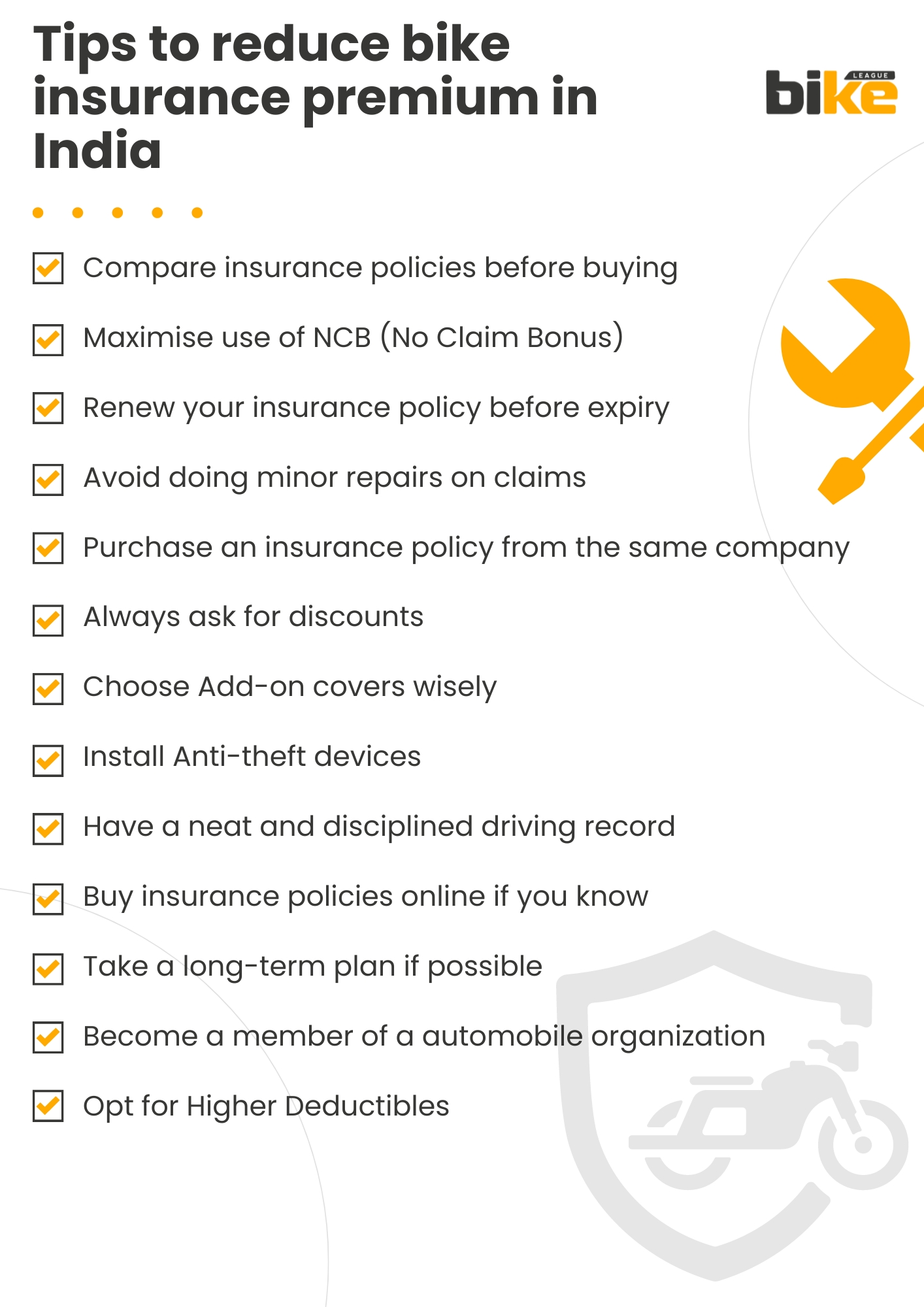
Tip 1: Compare Insurance Policies Before Buying A Bike
Begin by comparing different two-wheeler insurance policies available in the market. Online comparison tools make it easy to compare coverage options and prices, so you can choose wisely and save money.
Look at policies based on what you need to get the best deal. Check the features and renewal costs, not just the first-year premium. Sometimes, a low first-year premium means you’ll pay more when you renew.
Price isn’t the only thing that matters. You should also check if the insurer is reliable when it comes to paying claims. Before you decide, look at:
- Claim Settlement Ratio (CSR): This is the percentage of claims an insurer settles out of all claims received in a year. IRDAI publishes this every year for each insurer. A general insurer with a CSR above 90-95% is usually reliable. A cheap policy from an insurer with a poor settlement record can end up costing you more than a slightly more expensive one that pays out when you need it.
- Cashless garage network: Check how many authorised network garages the insurer has in your city and along routes you ride regularly. A larger cashless network means less out-of-pocket spending and paperwork at claim time.
- Claim rejection rate and reasons: Check how often an insurer rejects claims and the reasons for it. Common reasons are expired policies, undeclared modifications, or missing documents. You can usually find this information in insurer disclosures and customer reviews. It’s a good idea to check this before choosing a cheaper premium.
Tip 2: Maximise Use Of Ncb (no Claim Bonus)
The No Claim Bonus (NCB) is a great way to save on insurance. If you don’t make any claims during a policy year, you get an NCB, which lowers your future premiums. To keep this benefit, report only major accidents and transfer your NCB if you switch insurers.
If you have not made a claim in a year, you will receive an NCB. This gives you a 20-50% discount on your next year’s premium. Run your numbers through our Comprehensive Bike Insurance Calculator to see exactly how much your NCB slab saves you.
Tip 3: Renew Your Bike Insurance Policy Before Expiry
Renew your policy before it expires to avoid extra paperwork, like taking photos of your bike and submitting more documents. This also helps you keep your No Claim Bonus (NCB) benefits.
Tip 4: Avoid Doing Minor Repairs On Claims
Showrooms might suggest filing claims for small repairs to save you from paying out of pocket. But making claims for minor damage can raise your premium next year. Even if the increase seems small at first, frequent claims can make your premium much higher over time.
Tip 5: Purchase A Bike Insurance Policy From The Same Company
If you renew your motorcycle insurance with the same company for several years, you may get rewards, discounts, or loyalty points for being a loyal customer. Most companies appreciate long-term customers.
Tip 6: Always Ask For Discounts
Some motorcycle insurance companies don’t offer discounts unless you ask. Don’t be shy. Sometimes staff don’t mention discounts because they are new or it’s not company policy to bring it up.
Tip 7: Choose Add-on Covers Wisely
Insurance companies offer many add-on covers, but you should only pick the ones that really add value for your bike. Add-ons always increase your premium, not lower it. Watch out for sales tactics and make your choices carefully.
Tip 8: Install Anti-theft Devices
Motorcycle insurance companies may lower your premium if you install security devices like anti-theft alarms. To get the discount, make sure the device you choose is approved by the Automotive Research Association of India (ARAI).
Tip 9: Have A Neat And Disciplined Driving Record
Having a clean driving record is important for lowering your insurance premium. Insurers prefer drivers who have fewer accidents and violations because they are less risky. Following traffic rules and riding safely can help you avoid accidents.
Tip 10: Buy Bike Insurance Policies Online If You Know
Buying bike insurance online can help you save on commission fees. But if you’re not familiar with insurance, it’s better to buy offline to avoid mistakes.
Tip 11: Take A Long-term Bike Insurance Plan If Possible
Instead of paying for just one year, think about getting a policy for 3-5 years at once. You’ll usually get a good discount. Just remember, you won’t have as much flexibility to change your policy during that time.
If you have any problems with the insurance company, you might lose money if you try to change your policy. So, check the company’s reputation and the benefits it offers before you choose.
Tip 12: Become A Member Of A Recognised Automobile Association Or Organisation
Some motorcycle clubs or organisations give their members discounts on vehicle insurance. If you belong to a touring club or an automobile association, use this benefit to lower your bike insurance premium. Keep in mind, only a few insurance companies offer this discount.
Tip 13: Opt For Higher Bike Insurance Deductibles
A bike insurance deductible is the amount you agree to pay out of your own pocket when you make a claim. It’s your share of the repair or replacement costs if your bike is damaged or in an accident.
If you choose a higher deductible, your premium will be lower because the insurer takes on less risk. Just make sure you can afford to pay the deductible if you need to make a claim. You can use our Comprehensive Bike Insurance Calculator to try different deductible amounts and find the right balance between saving on your premium and what you might have to pay yourself.
Tip 14: Consider A Pay-as-you-drive Or Telematics-based Policy
A new option in India is usage-based insurance, where your premium depends on how much or how safely you ride, instead of a fixed yearly amount. There are two types, but only a few insurers offer them right now:
- Pay-As-You-Drive (PAYD): You pick an expected yearly distance when you buy the policy, and your Own Damage premium is set based on that. This is good for people who don’t use their bike every day. If you ride less than a standard policy expects, you might be paying too much for the OD part.
- Telematics/usage-based insurance: A device or app tracks how you ride—like your speed, braking, and when you travel. Insurers then use this information to set your renewal price based on your actual riding habits, not just your age or bike model.
Not all insurers offer these options yet, especially for two-wheelers. Check with each insurer to see whether they offer these policies before you decide.
Tip 15: Set Your Idv Within The Insurer’s Allowed Range, Don’t Just Accept The Default
When you buy or renew your policy, insurers usually suggest an IDV based on standard depreciation rates. Most let you adjust this by about ±15%. Choosing the right IDV can really affect your premium, so it’s something you can control.
If you set a lower IDV, your Own Damage premium goes down, but you’ll get less money if your bike is stolen or totalled. Don’t pick a lower IDV just to save on premium. Also, don’t set your IDV higher than your bike’s real value, because you’ll pay more but won’t get a bigger payout. Insurers pay based on the actual value of your bike.
The safest way is to use an IDV calculator to find your bike’s standard depreciated value. Only choose a different value if you have a good reason, like if your bike is in great condition and worth more than average.
What Specific Discounts Can I Ask For When Purchasing Bike Insurance In India?
When purchasing bike insurance in India, you can ask for or look for the following specific discounts to get a lower premium:
- No Claim Bonus (NCB): The most significant discount, rewarding claim-free years. Starts at 20% after the first claim-free year and increases to a maximum of 50% after five consecutive claim-free years.
- Voluntary Deductible: Opting for a higher voluntary deductible (the amount you pay out of pocket before insurance kicks in) typically lowers your premium.
- Anti-theft Device Discount: Installing an ARAI-approved anti-theft device on your bike can get you a discount on the Own Damage component of your premium, usually around 2.5%.
- Long-term Policy Discount: Buying insurance for two or three years at once often comes with a discount compared to annual renewals, plus it protects you from premium hikes on third-party cover during the policy tenure.
- Online Purchase Discount: Many insurers offer lower premiums or special discounts for buying or renewing your bike insurance online due to lower administrative costs.
- Automobile Association Membership: Some insurers provide a small discount if you are a member of recognised automobile associations.
What Factors Affect Bike Insurance Premiums In India?
Several factors affect the bike insurance premium in India, shaping the final amount you pay for coverage:
- Make, Model, and Variant of Bike: Premiums are higher for expensive, performance-oriented, or sports models, and lower for standard commuter bikes.
- Engine Capacity (CC): Larger engine capacity results in a higher premium due to increased risk and repair costs; for example, bikes above 350cc attract significantly higher rates.
- Age of Vehicle: New bikes have higher premiums, while older bikes benefit from reduced rates because their Insured Declared Value (IDV) depreciates over time.
- Location: Urban areas and regions with high accident or theft rates see higher premiums. In contrast, rural locations may offer lower premiums.
- Type of Insurance Policy: Comprehensive policies cost more than third-party-only policies because they cover both own-damage and third-party liabilities.
- Rider’s Profile: Younger or inexperienced riders generally pay higher premiums due to perceived risk, while experienced riders may get better rates.
- Claim History (No Claim Bonus): If you have made no claims in previous years, you receive a No Claim Bonus discount on your premium upon renewal.
- Deductibles: Opting for a higher voluntary deductible lowers your premium. Still, it increases out-of-pocket expenses at the time of claim.
- Add-on Covers: Including additional benefits (zero depreciation, roadside assistance, engine protection, etc.) increases the overall premium.
- Installed Security/Anti-theft Devices: Approved anti-theft devices, such as GPS trackers and alarms, can earn discounts on your premium because they reduce theft risk.
- Usage and Frequency: The frequency of use and whether the bike is for personal or commercial purposes influences premiums due to varying risk profiles.
Each insurer may weigh these factors slightly differently, but together they determine the amount you pay for bike insurance annually.
How Is Bike Insurance Different For Electric Two-wheelers?
Electric scooters and motorcycles are insured under the same Motor Vehicles Act framework as petrol bikes, but a few things work differently:
- Lower Third-Party premium: IRDAI-notified third-party rates for electric two-wheelers are set lower than petrol equivalents of similar power, since TP pricing is based on motor power (kW) rather than engine capacity (cc).
- The battery isn’t fully covered by default: A standard comprehensive policy covers battery damage from accidents, but typically excludes water ingress, electrical surge, and post-warranty degradation — despite the battery often being the single most expensive component on the bike. A dedicated Battery Protection add-on closes this gap and is worth pricing in separately when comparing EV policies.
- Personal Accident Cover still applies the same way: The ₹15 lakh compulsory PA cover for the owner-driver is identical to petrol bikes — this doesn’t change for EVs.
- IDV and OD pricing reflect EV-specific depreciation: Battery health and technology turnover mean EV resale value doesn’t always follow the same depreciation curve as petrol bikes, so it’s worth checking your IDV against actual EV market value rather than assuming standard slabs apply identically.
If you’re insuring an EV, ask specifically whether the quote includes battery cover as standard or as a separate add-on — this is the detail most likely to catch new EV owners off guard at claim time.
How Do I Transfer My No Claim Bonus If I Switch Bike Insurers In India?
To transfer your No Claim Bonus (NCB) when switching bike insurers in India, follow these steps:
- Obtain NCB Certificate from Your Current Insurer: Before your existing policy expires or when you plan to switch, request an official NCB certificate from your current insurer. This certificate confirms your claim-free status and the discount percentage you have earned. It is valid for up to 3 years after your policy expires.
- Submit NCB Certificate to New Insurer: When purchasing your new bike insurance, provide this NCB certificate to the new insurer. This lets the new insurer apply the appropriate discount to your premium based on your claim-free years.
- Provide Required Documents: Along with the NCB certificate, you may need to submit your previous policy documents, bike registration certificate (RC), and valid identity proofs to the new insurer for verification.
- Buy/Renew Policy Within Validity Period: Ensure you buy or renew your new policy within 3 years of your previous policy’s expiry to retain the NCB. Otherwise, the bonus lapses.
- Verification and Activation:The new insurer will verify the NCB certificate and apply the discount before issuing your new policy.
By following these steps, you can successfully retain and transfer your No Claim Bonus to your new bike insurance policy, helping you enjoy lower premiums even when switching insurers.
What Types Of Anti-theft Devices Are Recognised By Bike Insurance Companies For Premium Discounts In India?
Bike insurance companies in India recognise anti-theft devices that are certified by the Automotive Research Association of India (ARAI) for premium discounts, typically up to 2.5% on the own-damage premium component.
Common Recognised Anti-theft Devices
- Electronic Immobilisers: Prevent the bike from starting without the correct key or electronic code. These are widely accepted and very effective.
- GPS-based Security Systems: Devices that enable real-time location tracking and unauthorised movement alerts. Several ARAI-approved models from brands like Autocop, Pricol, and KPIT Technologies are accepted.
- Alarm Systems: Electronic siren-based alarms that activate with forced movement or tampering. Bike alarms with ARAI certification are eligible for discounts.
- Central Locking Systems: Advanced systems for two-wheelers that disable ignition or lock wheels with electronic controls. These are usually part of multi-feature security solutions.
- Disc Brake Locks and Handlebar Locks: While useful as deterrents, these mechanical devices alone are generally not enough for discounts unless combined with electronically certified locking systems.
Certification Requirement
- The device must be ARAI-approved and fitted by an authorised dealer or service centre.
- Insurers may require the ARAI certificate or fitting bill as proof before offering the premium discount.
Examples Of Some Recognised Brands
By installing these certified anti-theft devices, you can lower your bike insurance premium while improving your motorcycle’s security in India.
What Are Some Specific Examples Of Anti-theft Devices That Are Approved By The Automotive Research Association Of India (arai) For Motorcycles?
To get the detailed official list of all ARAI-approved devices, please visit this link.
https://www.araiindia.com/pages/downloads
Though these devices are approved by ARAI under AIS 140, always check with the manufacturer or installer for suitability and exact model compatibility for your motorcycle or scooter—size, wiring, and mounting points may vary by two-wheeler model.
Faq About Tips To Reduce Bike Insurance Premiums In India
1. What Role Does The No Claim Bonus (ncb) Play In Reducing Premiums?
The No Claim Bonus (NCB) is a discount insurers offer for not making any claims during the policy period. Accumulating NCB over the years can substantially lower your premium costs. Make sure your NCB is transferred if you switch insurers.
2. Is It Beneficial To Avoid Making Small Claims?
Avoiding small claims helps preserve your No Claim Bonus, a key factor in reducing your bike insurance premiums over time and saving money. Holding back on minor claims can lead to significant long-term savings.
3. How Does Timely Policy Renewal Affect Insurance Costs?
Renewing your policy on time ensures continuous coverage and prevents the premium spike that comes with lapses. Timely renewal is crucial to maintain your No Claim Bonus and avoid penalties.
4. What Is The Impact Of Choosing A Higher Deductible On Premiums?
Opting for a higher deductible can lower your premium by reducing the insurer’s risk. However, choose a deductible you can afford to pay out of pocket if you make a claim.
5. How Does Maintaining A Clean Driving Record Affect Insurance Premiums?
A clean driving record is crucial for reducing insurance premiums. Insurers favour drivers with fewer accidents and violations, as they pose a lower risk. Safe riding practices, such as adhering to traffic rules and avoiding risky manoeuvres, can significantly reduce the likelihood of accidents and, consequently, your premiums.
6. Why Should I Consider Installing Anti-theft Devices On My Bike?
Installing anti-theft devices can deter theft and vandalism, reducing the need for insurance claims. Insurers often offer discounts for bikes with security features such as alarms, immobilisers, and GPS trackers, as these reduce theft risk.
7. Does My Bike Insurance Premium Change Based On Pillion Rider Cover?
Personal Accident Cover for a pillion rider is an optional add-on, not compulsory, so it adds to your premium if selected. If you rarely ride with a pillion, skipping this add-on is another way to keep your premium down. Just weigh that against the protection you’d be giving up.
8. How Does The Age Of The Bike Affect The Insurance Premium?
As a bike ages, its market value decreases, which lowers insurance costs. As a bike depreciates over time, premiums decrease, making it more affordable to insure older bikes.
9. How Can Comparing Insurance Policies Help Reduce Premiums?
Comparing different two-wheeler insurance policies is a fundamental step in finding the best deal. By evaluating options, you can identify policies that provide the necessary coverage at competitive rates, resulting in significant savings.
Other Related Articles From Bikeleague India
- Two wheeler insurance in India – How to buy and select
- Mileage in Two wheelers – Proven & useful tips
- Bike loan Interest rate – Factors that have an impact in India
- Understanding bike insurance jargons & Essential Addons
- Third party Bike Insurance Calculator – Calculate your insurance
- Comprehensive Bike Insurance Calculator – Estimate your full premium
- Bike IDV Calculator – Check your Insured Declared Value
Conclusion
By following the strategies outlined above, you can make informed decisions that keep your bike insurance affordable without compromising on essential coverage.
Remember to check your policy regularly, look out for new discounts, and ride safely to keep saving money each year. Being proactive helps you stay protected and save more while you’re on the road.
I hope these tips help you lower your bike insurance premium. If you have questions, email us at bikeleagueindia@gmail.com or leave a comment below. We’re always happy to help.